Japan’s plan to make radiation readings come out looking better
Plan to lower radiation readings OK’d JIJI NOV 12, 2013 Japan Times, 12 Nov 13 To facilitate the return of evacuees, the Nuclear Regulation Authority has approved a change in the way radiation doses are monitored around the crippled Fukushima No. 1 nuclear power station that will effectively result in lower readings, but observers warn this could raise public mistrust. Continue reading
Two former Japan Prime Ministers call for ending nuclear power
Japan Ex-Leaders Join Calls Against Nuclear Power TOKYO November 12, 2013 (AP) abc news, By ELAINE KURTENBACH AP Business Writer, Associated Press writer Mari Yamaguchi contributed to this report.
Former Prime Minister Junichiro Koizumi said Tuesday that the current prime minister, Shinzo Abe, should take advantage of his high public support and sway in parliament to “do the right thing.”
“Prime Minister Abe should use the power given to him to do what the majority of the people want,” Koizumi said in a speech at the Japan Press Club. “It can be achieved. Why miss this chance?”
Koizumi, who supported nuclear power during his 2001-2006 term in office, said that with Japan’s nuclear plants all offline for safety checks it would be easiest to begin the phase-out soon…….
Polls have shown the majority of the public, jittery over radiation risks, prefers to shift away from the nuclear plants that provided nearly a third of Japan’s power generation capacity before the accident at the Fukushima Dai-Ichi nuclear plant, the worst since the Chernobyl disaster in 1986.
Even within Abe’s Liberal Democratic Party, opinions over the future for nuclear power are divided.
Japan’s rapid turnover in leadership over the past two decades means there are plenty of former prime ministers. At least three, including Koizumi, have said they support ending use of nuclear power.
Their support could help reinvigorate the anti-nuclear movement, which has lost some of its vitality nearly three years after the Fukushima accident.
Another former prime minister, Morihiro Hosokawa, said in an interview published in the Tokyo Shimbun on Tuesday that he also favors an end to reliance on nuclear power.
“I can’t understand why they want restarts of the nuclear plants when there is no place to discard the nuclear waste,” said Hosokawa, who served as prime minister for eight months in 1993-94. “It would be a crime against future generations for our generation to restart nuclear plants without resolving this issue,” he said.
Koizumi likewise emphasized his concern over nuclear waste disposal, especially in a densely populated, land-scarce country like Japan.
Experts have questioned whether earthquake-prone Japan can safely store nuclear waste under any scenario.
“I think it is too optimistic and irresponsible to assume we can find a final radioactive waste storage site in Japan, after the accident,” he said.
Even burying it underground for 100,000 years could expose future generations to harmful radiation, he said.
“What language should we use to convey the hazards to those people in the future?” he said…….. http://abcnews.go.com/International/wireStory/japan-leaders-join-calls-nuclear-power-20859089
Another $5 billion borrowed by Japan for Fukushima nuclear cleanup
Japan readies additional $30 billion for Fukushima clean-up: sources BY YOSHIFUMI TAKEMOTO TOKYO Tue Nov 12, (Reuters) – Japan’s government is finalizing plans to borrow an additional 3 trillion yen ($30 billion) to pay for compensating Fukushima evacuees and cleaning up the area outside the wrecked nuclear plant, said people with knowledge of the situation.
The additional borrowing would mark both a recognition of the project’s mounting costs and the difficulty of hitting initial targets for reducing radiation levels in the towns and villages hardest hit by the fallout from the worst nuclear accident since Chernobyl.
The new government borrowing program would increase the amount earmarked for Fukushima-related expenses to the equivalent of just over $80 billion, according to government officials with knowledge of the developing plan who asked not to be named.
That $80 billion excludes the cost of decommissioning Fukushima’s six reactors, a process expected to take decades.
The new funding, which is being reviewed as part of the regular budget-setting process, would increase the amount earmarked for paying for work crews to decontaminate Fukushima towns and villages by about $500 million, according to the sources.
The rest of the extra funding raised by the government would be used to defray the cost of creating a storage facility for the radioactive waste, including topsoil and leaves collected from the evacuated zone, and would be available to pay compensation to more than 50,000 nuclear evacuees who remain shut out of their homes more than two and a half years after a massive earthquake and tsunami in March 2011 triggered meltdowns and explosions at the Fukushima plant…… http://in.reuters.com/article/2013/11/12/us-japan-fukushima-borrowing-idINBRE9AB0H520131112
Doubts about Fukushima evacuees ever going home
Fukushima residents may never go home, say Japanese officials Admission deals blow to government assurances that radiation near the Daiichi nuclear plant can be brought down to safe levels Justin McCurry in Tokyo theguardian.com, Wednesday 13 November 2013 Japanese officials have admitted for the first time that thousands of people evacuated from areas near the Fukushima Daiichi nuclear powerplant may never be able to return home.
A report by members of the governing Liberal Democratic party [LDP] and its junior coalition partner urges the government to abandon its promise to all 160,000 evacuees that their irradiated homes will be fit to live in again. The plan instead calls for financial support for displaced residents to move to new homes elsewhere, and for more state funding for the storage of huge quantities of radioactive waste being removed from the 12-mile evacuation zone around the plant.
The parties’ admission that some areas closest to the wrecked facility will remain too contaminated for people to make a permanent return is a blow to official assurances that radiation can be brought down to safe levels.
The government has come under pressure to abandon those promises amid evidence that attempts to reduce radiation to its target of 1 millisievert a year are failing. Decontamination is woefully behind schedule in seven of the 11 selected towns and villages, forcing authorities to concede recently that they will not complete the work by the March 2014 deadline…….
“At some point in time, someone will have to say that this region is uninhabitable, but we will make up for it,” the LDP’s secretary general, Shigeru Ishiba, said recently. It now appears that officials will abandon efforts to clean up highly irradiated areas closest to the plant and focus on areas where there is a more realistic chance of success……. The last category includes the small town of Okuma, where evacuated residents told the Guardian over two years ago that they had given up all hope of ever returning…… http://www.theguardian.com/environment/2013/nov/12/fukushima-daiichu-residents-radiation-japan-nuclear-power
Japan blocks interviews with Fukushima residents

 Top nuclear official blocks interviews with people over Fukushima exposures; Only allowed to talk to “friendly” gov’t leaders — Reuters: “No matter how hard they try, radiation isn’t going down” -Resident (VIDEO) http://enenews.com/top-nuclear-official-blocks-interviews-with-people-over-fukushima-exposures-only-allowed-to-talk-to-friendly-govt-leaders-reuters-no-matter-how-hard-they-try-radiation-isnt-going-down
The Mainichi, Nov. 11, 2013: NRA chairman blocks interviews with Fukushima residents over exposure doses […] NRA Chairman Shunichi Tanaka intervened to limit such interviews to friendly local government leaders, the Mainichi Shimbun has learned. Tanaka’s action is igniting a chorus of protests from members of the NRA’s expert panel […] The panel under NRA Commissioner Kayoko Nakamura’s leadership started deliberations in September by inviting five outside experts, including those in charge of emergency radiation medicine. […] However, when NRA Chairman Tanaka learned of the proposal in late October he rejected it […] Masafumi Yokemoto, professor of environmental policy at Osaka City University […] criticizes NRA Chairman Tanaka for meddling in the expert panel’s deliberations and blocking interviews with evacuees to draw a foregone conclusion that the repatriation of evacuees is the only viable option. […]
Reuters, , Nov. 11, 2013: […] Some had hoped the decontamination project employing thousands of temporary workers to strip trees, spray roads and remove topsoil would be enough […] 90 percent of the projected reduction in radiation comes from natural decay of radioactive particles over time.[…] “No matter how hard they try to decontaminate, radiation isn’t going down. So even though we have decided to go back, we can’t,” said Keiko Shioi, a 59-year-old housewife from Naraha, near the nuclear plant. […]
NHK WORLD, Nov. 11, 2013: Experts call for change in radiation measuring […] A panel of experts is urging the Japanese government to change the way it measures radiation exposure for evacuees from the Fukushima nuclear accident when they return home. […] To date, officials have estimated exposure based on radiation levels in the environment. But the panel says they should measures exposure by equipping individuals with radiation monitors called dosimeters. Radiation measurements made by dosimeters tend to be one-third to one-seventh of readings estimated through environmental monitoring. […] The panel also calls for assigning local government officials and health nurses as advisors in each community. […]
NHK Newsline, Nov. 11, 2013 (h/t Anonymous tip): […] The proposal comes at a time when the government is aiming to lift the evacuation advisory for areas where annual radiation doses are estimated at 20 millisieverts or lower. […] The new method is expected to help promote returns of evacuees as well as reduce costs for decontaminating areas tainted by radioactive fallout.
NHK Newsline, Nov. 11, 2013 (at 0:45 in): Readings on such devices [personal dosimeters] tend to be one-third to one-seventh lower than estimates based on environmental monitoring. […] Radiation measurements made by dosimeters tend to be one-third to one-seventh of readings estimated through environmental monitoring. […] “Individual monitor readings don’t necessarily reflect different radiation levels in a household.” -Fukushima evacuee
Watch NHK’s broadcast here
Fukushima evacuees returning to areas of high level radiation
TV: “It’s a crime what’s happening at Fukushima” — People resettling areas 10 to 15 km from plant with “radiation levels still very, very high and even lethal in some cases” — Hotspots 60 to 70 km away same level as ghost towns in Chernobyl (VIDEOS) http://enenews.com/tv-its-a-crime-whats-happening-at-fukushima-people-resettling-areas-10-to-15-km-from-plant-with-radiation-levels-still-very-very-high-and-even-lethal-in-some-cases-ho
RT,, Nov. 7, 2013 — Kevin Kamps, Beyond Nuclear: Well, that’s a great tragedy that the Japanese government is allowing this [resettling near Fukushima] to happen. To within the closest 12.4 miles of the devastated nuclear power plant obviously the landscape is contaminated, the food supplies are contaminated. As your reporter said, it’s up to individual private citizens to try to figure out how bad the contamination is. The environmental groups are trying to help them. So, it’s beyond tragic, it’s a crime what’s happening at Fukushima Daiichi.
Abby Martin’s ‘Breaking the Set‘ with RT reporter Alexey Yaroshevsky, Nov. 8, 2013 (at 26:30 in): What struck me the most, and I’m saying that as a person who’s been in the Chernobyl exclusion zone […] The cities and towns which are located just 10-15 km from the nuclear power station where obviously radiation levels are still very, very high and even lethal in some cases. So those town have been reopened for settlers, we literally saw people rebuilding their houses in these areas and this is creating a huge concern in Japan […] In some other areas 60-70km from the nuclear power station, the areas which have never been included into an exclusion zone, which have never been under lockdown, raditional levels, the ones we’ve encountered, some hotbeds, hotspots of radiation we encountered have 3 microsieverts per hour. And this is the same level as the ghost town of Pripyat in the exclusion zone in the Ukraine, the level which would not allow humans to live in this area. Watch the report here
Japanese safety experts secretly funded by nuclear industry
 Experts commissioned by nuclear watchdog fail to report ¥40 million in funding, Japan Tmes, JIJI NOV 9, 2013 At least 10 university experts commissioned by the Nuclear Regulation Authority to discuss safety rules failed to report over ¥40 million they received in donations and research funding from the atomic energy industry, sources said Saturday.
They received the undeclared money from power companies, nuclear plant makers and other related entities and had not declared this total as of late October, according to documents reviewed by Jiji Press based on the information disclosure law.
The NRA commissions experts to discuss nuclear safety standards and other regulations, and asks them to disclose the amount of money provided to them since fiscal 2009. The industry watchdog does not verify reports of such funds.
Of the experts who failed to report part of the funding they received, five took part in discussions about new safety measures, two participated in talks on regulatory systems and another two attended meetings on the Fukushima disaster.
According to materials provided by universities to which they belong, Yutaka Abe, a professor at the University of Tsukuba, had the highest unreported amount, at around ¥13.14 million…… http://www.japantimes.co.jp/news/2013/11/09/national/experts-commissioned-by-nuclear-watchdog-fail-to-report-%C2%A540-million-in-funding/#.UoE3r3Bwo7p
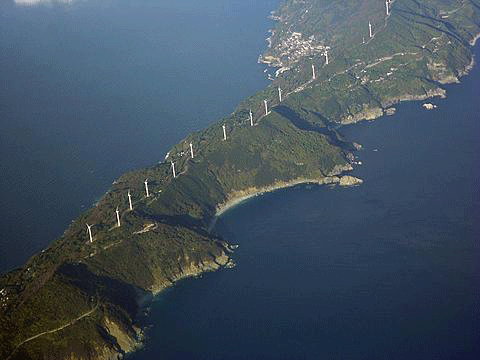
Japan’s wind energy now supplied from both on and offshore
Bad manners: Japanese lawyer’s letter to Emperor about Fukuhsima
Anti-nuclear letter handed to Japan’s Emperor Akihito causes uproar, news.com.au, NOVEMBER 07, 2013 A NOVICE Japanese lawmaker who wanted to draw attention to the Fukushima nuclear crisis has caused an uproar by doing something taboo: handing a letter to the emperor.
The ruckus began at an annual autumn Imperial Palace garden party last week. As Emperor Akihito and his wife, Michiko, greeted a line of guests, outspoken actor-turned-lawmaker Taro Yamamoto gave the emperor the letter – a gesture considered both impolite and inappropriate…….. Yamamoto’s action drew criticism from both ends of the ideological spectrum and left many Japanese baffled by what they consider to be a major breach of protocol: reaching out to the emperor in an unscripted act………Many conservatives still consider the emperor and his family divine (“the people above the clouds”) and believe a commoner shouldn’t even talk to him…….The Imperial Household Agency vice chief said that Yamamoto’s action was “inappropriate,” and that the incident could affect operation of future palace public events. He said the agency has the letter, and Akihito hasn’t read it.
Yamamoto’s anti-nuclear stance makes him a target for conservatives in the ruling Liberal Democratic Party, which is pushing for a return to nuclear power. Education Minister Hakubun Shimomura called for Yamamoto’s resignation……
Nakano [ Koichi Nakano, a political scientist at Sophia University in Tokyo] said Yamamoto has at least drawn some public attention to the potential health risks faced by children from the Fukushima area and plant workers. ”After all, he might have achieved part of his goals, ” Nakano said. http://www.news.com.au/world/anti-nuclear-letter-handed-to-japans-emperor-akihito-causes-uproar/story-fndir2ev-1226755434400
Eyes of the world on Fukushima, as critical nuclear fuel rods cleanup to begin
“They have to remove the fuel as early as possible – the risk from major structural failure leading to pool collapse is a greater threat than leaving the fuel in situ.”.
Radiation levels in those reactors are still too high for humans to enter, and attempts to use robots to determine the exact location of the melted fuel have failed. Instead, officials are placing their faith in the law of gravity, assuming only that the highly hazardous material lies somewhere deep inside the reactor basements.
 Fukushima nuclear cleanup enters critical phase Tokyo Electric Power to begin removing more than 1,500 fuel assemblies from spent fuel pool in unprecedented operation Justin McCurry in Fukushima The Guardian, Friday 8 November 2013 Gazing down at the glassy surface of the spent fuel pool inside the No 4 reactor building at Fukushima Daiichi, it is easy to underestimate the danger posed by the highly toxic contents of its murky depths.
But this lofty, isolated corner of the wrecked nuclear power plant is now the focus of global attention as Japan enters the most critical stage yet in its attempt to clean up after the worst nuclear accident in the country’s history.
Later this month the plant’s operator, Tokyo Electric Power (Tepco), will begin removing more than 1,500 fuel assemblies from the pool, the first step in a decommissioning process expected to last at least three decades.

On Thursday, the Guardian witnessed Tepco’s preparations for an unprecedented operation that the utility’s critics claim has the potential to end in disaster.
The risk posed to the reactor by earthquakes and other natural catastrophes has made removal of the fuel – 1,331 spent assemblies and 202 fresh ones – a matter of urgency. Continue reading
Soon to begin – the dangerous process of removing nuclear fuel rods from Fukushima Unit no. 4
Unit 4 presented particular dangers because its entire stock of fuel rods was in the pool at the time of the accident.
If the operation goes as planned, attention will then focus on the massive challenges posed by Units 1, 2 and 3.
Tepco will not confirm the precise timing of the fuel rod operation but after so much public outrage at the company’s handling of the crisis so far, scrutiny of this latest episode will be intense.
Fukushima nuclear plant set for risky operation http://www.bbc.co.uk/news/science-environment-24843657 7 Nov 13 David Shukman A task of extraordinary delicacy and danger is about to begin at Japan’s Fukushima nuclear power station.
Engineers are preparing to extract the first of more than 1,000 nuclear fuel rods from one of the wrecked reactor buildings. This is seen as an essential but risky step on the long road towards stabilising the site.
The fuel rods are currently in a precarious state in a storage pool in Unit 4. This building was badly damaged by an explosion in March 2011 following the Great Tohoku earthquake and tsunami. Moving the rods to safety is a high priority but has only become possible after months of repair work and planning.
One senior official told me: “It’s going to be very difficult but it has to happen.” Continue reading
UNSCEAR falsified estimations of medical effects of Fukushima radiation
U.N. cover-up of Fukushima exposed on TV — Medical Doctor: There’s now many more cancer cases than we expected from Fukushima, UNSCEAR report has falsified estimations (VIDEO) http://enenews.com/tv-investigation-details-u-n-cover-up-of-fukushima-medical-doctor-theres-now-many-more-cancer-cases-than-we-expected-from-fukushima-unscear-report-has-falsified-estimations-video
Title: Medical experts criticize UNSCEAR report for playing down consequences of Fukushima nuclear accident
Source: 3sat (German language public TV network)
Captions: World Network For Saving Children From Radiation
Date Published: Nov. 5, 2013
Dr. Alex Rosen, Medical Doctor and radiation specialist: There is now a much higher number of thyroid cancer cases than we expected. […]
Narrator: According to Dr. Alex Rosen, there are various falsified estimations in the UNSCEAR [United Nations Scientific Committee on the Effects of Atomic Radiation] report. […]
Professor Wolfgang Hoffman, professor of epidemiology at Geifswald University: It is certain that we will have an elevated level of cancer. […]
Marc Molitor, journalist with Belgisher TV (Belgium): A certain member within UNSCEAR told me that the report was written to play down the consequences of the Fukushima nuclear accident. Moreover, he also said that the members pretend not to learn the lesson from Chernobyl. There was seemingly a discussion on it.
[UNSCEAR Report:t: “No discernible increased incidence of radiation-related health effects are expected among exposed members of the public or their descendants. The most important health effect is on mental and social well-being”]
The health price paid by Fukushima clean-up workers
Fukushima: Japan’s Cut-Price Nuclear Cleanup: Human Error, Plummeting Morale and Worker Exodus 福島は割引清掃 By Global Research News Global Research, November 04, 2013 The Asia-Pacific Journal, Vol. 11, Issue 43, No. 2, October 28, 2013. “……….Shigemura is most concerned about the 70 percent of Tepco workers at Fukushima Daiichi who were also forced to evacuate their homes by the meltdown. They have yet to come to terms with the loss of their homes, and many are living apart from their families in makeshift accommodation near the plant.
“They were traumatized by the tsunami and the reactor explosions, and had no idea how much they had been irradiated,” Shigemura says. “That was the acute effect, but now they are suffering from the chronic effects, such as depression, loss of motivation and issues with alcohol.”
Men such as Watanabe Kai(30), who was forced to flee his family home in March 2011, have never had psychological counseling and were immediately thrown back into the fight to save the Daiichi plant. Today, he monitors tanks full of highly toxic water for leaks. For a job with potentially serious consequences on his health, he is paid 15,000 yen a day.
Relatively little is known about the people who work at the Daiichi plant. Tepco severely rations interviews with its full-time staff. Contract workers such as Watanabe, employed by one of dozens of subcontractors, rarely talk to journalists because they fear for their jobs. Watanabe insists on a pseudonym for interviews.
Born and raised in the town of Okuma, a few miles from the plant, Watanabe’s family are nuclear refugees. His mother and father left the home he shared with them on March 12th and now live and work in Iwaki, 34 km south of the plant. He doesn’t believe they will ever return. Like Pripyat, the Ukrainian town evacuated after the 1986 Chernobyl disaster, Okuma is a nuclear ghost town.
Watanabe labored through the disaster at the Daiichi plant until he reached his annual limit for radiation exposure. He then cycled through the remaining jobs for nuclear workers in Fukushima, ending up with a decontamination crew, cleaning up the radiation that poisoned his home. The irony wasn’t lost on him but he says he bears no grudges. “We have to fix the mess we made.”…….http://www.globalresearch.ca/fukushima-japans-cut-price-nuclear-cleanup/5356796
UN inspectors in Japan to monitor Fukushima radiation leaks
UN nuclear inspectors in Japan as China demands ‘accurate’ information on radiation Voice of Russia, 6 November 2013, Inspectors from the UN’s nuclear watchdog arrived in Tokyo Wednesday to monitor marine pollution near Fukushima as China demanded Japan provide “accurate” information on how it is handling the crisis.
China told the UN General Assembly it was worried about radioactive water leaks from the Japanese plant, which went into meltdown after being hit by a tsunami in March 2011.
“China follows closely the countermeasures to be adopted by Japan,” China’s deputy UN ambassador Wang Min told a debate on the International Atomic Energy Agency (IAEA).
“We urge the Japanese side to spare no effort in minimising the subsequent impact of the accident and provide timely, comprehensive and accurate information to the international community,” Wang added……..
Fukushima “continues to be a source of serious concern, especially to adjacent countries, because of the spillage of contaminated water into the sea,” said South Korea’s deputy UN ambassador Sul Kyung-Hoon………
The first batch of IAEA experts arrived in Japan on Wednesday at the invitation of the Japanese government as it looks to bolster its credibility.
The two researchers from the Environment Laboratories in Monaco are planning to analyse sea water near Fukushima, the agency said.
Their analysis will contribute to the IAEA-led international peer review of Tokyo’s roadmap towards decommissioning the destroyed reactors, it said.
“One of the focuses of the mission is the contaminated water issue,” the agency said.
The experts are David Osborn, director of Environment Laboratories in Monaco, and Hartmut Nies, head of the Radiometrics Laboratory, it said…..: http://voiceofrussia.com/news/2013_11_06/UN-nuclear-inspectors-in-Japan-as-China-demands-accurate-information-on-radiation-0357/
Low morale amongst Fukushima’s cut price nuclear clean-up workers
Fukushima: Japan’s Cut-Price Nuclear Cleanup: Human Error, Plummeting Morale and Worker Exodus 福島は割引清掃 By Global Research News Global Research, November 04, 2013
The Asia-Pacific Journal, Vol. 11, Issue 43, No. 2, October 28, 2013. TEPCO woes continue amid human error, plummeting morale and worker exodus By Justin McCurry and David McNeill reporting from Fukushima
During a visit to Fukushima Daiichi in September, Abe Shinzo told workers: “the future of Japan rests on your shoulders. I am counting on you.”
The prime minister’s exhortation was directed at almost 6,000 technicians and engineers, truck drivers and builders who, almost three years after the plant suffered a triple meltdown, remain on the frontline of the world’s most hazardous industrial cleanup.
Yet as the challenges facing Fukushima Daiichi become clearer with every new radiation leak and mishap, the men responsible for cleaning up the plant are suffering from plummeting morale, health problems and deep anxiety about the future. Even now, at the start of a decommissioning operation that is expected to last four decades, the plant faces a shortage of workers qualified to manage the dangerous work that lies ahead, according to people with firsthand knowledge of the situation inside the facility. Continue reading
1 This Month





PLEASE OPPOSE HR 8255 AND S.3639 – bills would accelerate satellite deployment, with no environmental review or safeguards – https://ncstd5li.quorum.us/campaign/169331/
To see nuclear-related stories in greater depth and intensity – go to https://nuclearinformation.wordpress.com
-
Archives
- October 2026 (67)
- September 2026 (339)
- August 2026 (330)
- July 2026 (355)
- June 2026 (287)
- May 2026 (306)
- April 2026 (356)
- March 2026 (251)
- February 2026 (267)
- January 2026 (308)
- December 2025 (358)
- November 2025 (359)
-
Categories
- 1
- 1 NUCLEAR ISSUES
- business and costs
- climate change
- culture and arts
- ENERGY
- environment
- health
- history
- indigenous issues
- Legal
- marketing of nuclear
- media
- opposition to nuclear
- PERSONAL STORIES
- politics
- politics international
- Religion and ethics
- safety
- secrets,lies and civil liberties
- spinbuster
- technology
- Uranium
- wastes
- weapons and war
- Women
- 2 WORLD
- ACTION
- AFRICA
- Atrocities
- AUSTRALIA
- Christina's notes
- Christina's themes
- culture and arts
- Events
- Fuk 2022
- Fuk 2023
- Fukushima 2017
- Fukushima 2018
- fukushima 2019
- Fukushima 2020
- Fukushima 2021
- general
- global warming
- Humour (God we need it)
- Nuclear
- RARE EARTHS
- Reference
- resources – print
- Resources -audiovicual
- Weekly Newsletter
- World
- World Nuclear
- YouTube
-
RSS
Entries RSS
Comments RSS

