Indefinite delay for restart of Japan’s idled nuclear reactors

 Restart of nuclear facilities and policy for nuclear waste disposal in Japan unlikely to be settled soon http://enformable.com/2014/01/restart-nuclear-facilities-policy-nuclear-waste-disposal-japan-unlikely-settled-soon/ In Japan, utilities are working to restart idled nuclear power plants across the nation and regain public support post-Fukushima. The Nuclear Regulation Authority, a newly established regulator, set new safety standards in July of 2013 which call for greater preparedness in regards to severe accidents, earthquakes, and tsunamis.
So far, 7 utilities have applied for regulatory officials to conduct safety screenings required to restart 9 plants. Officials still say that none of the plants are ready to restart because utilities have not adequately revised their estimations of potential earthquake activities.
This week, Shunichi Tanaka, chairman of the Nuclear Regulation Authority told reporters that there was no time limit on how long the safety screening process might take.
Even if operators are able to pass safety screens, they still need to obtain consent from local governments before the reactors can be restarted.
The task will not be easy in a nation which before the Fukushima Daiichi nuclear disaster had very little experience with management of severe accidents. The challenge is even greater considering the fact that the most experienced members of the workforce are aging and the new workforce has little to no prior experience with nuclear power.
As a nation Japan still has to revise a basic policy for the long-term disposal of nuclear waste. While government plans call for storage in deep underground repositories, experts caution that finding such locations in Japan will be difficult due to the seismicity of the area and lack of public trust. So far, no municipalities have come forward with any candidate sites.
Steam from Fukushima reactor No. 3 is not due to explosion, but to hot radioactive rubble
 Gundersen: Very visible steam at Fukushima Unit 3 is from constant radioactive releases — Coming from hot rubble, not related to new explosion http://enenews.com/gundersen-very-visible-steam-releases-at-fukushima-unit-3-are-radioactive-coming-from-hot-rubble-not-new-meltdown-or-explosion
Fairewinds Energy Education, , Jan. 1, 2014: […] the Internet has been flooded with conjecture claiming that Fukushima Daiichi Unit 3 is ready to explode. Fairewinds Energy Education has been inundated with questions about the very visible steam emanating from Fukushima Daiichi Unit 3. […] Hot water vapor has been released daily by each of the four Fukushima Daiichi nuclear power plants since the accident. We believe that is one of the reasons TEPCO placed covers over Daiichi 4 and 1. […] radioactive rubble (fission products) was left in each unit […] heat from this ongoing decay of radioactive rubble is constantly releasing moisture (steam) and radioactive products into the environment. […] [Unit 3] is still producing slightly less than 1 megawatt (one million watts) of decay heat […] it is creating radioactive steam […] hot radioactive releases […] have occurring [sic] for the entire 33 months […] The difference now is that the only time we visibly notice these ongoing releases is on the cold days […]
The Ecologist reported on this unsubstantiated rumor which was then used as a source by ‘Gizmodo. The Ecologist has now changed their original report without any notice or explanation.Here’s the original ending: “The Turner Radio Network is advising people on the West Coast of North America to”prepare for the worst” in case a meltdown of the waste fuel is in fact commencing. No official warnings have been released on either side of the Pacific.”
Fukushima nuclear reactor No 3 could be melting down now, TEPCO admits
 TEPCO Quietly Admits Reactor 3 Could Be Melting Down NOW nsnbc International Susanne Posel (OC) , 30 Dec 13, – The Turner Radio Network (TRN) has issued a report regarding the Fukushima Daiichi Nuclear Power Plantstating that it is expected to affect the entire Northern Hemisphere.
According to the report: “Persons residing on the west coast of North America should IMMEDIATELY begin preparing for another possible onslaught of dangerous atmospheric radiation from the Fukushima nuclear disaster site in Japan.”
TEPCO has confirmed via camera surveillance, that steam has begun to pour from Reactor 3, although they have “not been identified abnormal plant conditions.”
TEPCO is reporting that “radioactive steam has suddenly begun emanating from the previously exploded nuclear reactor building #3 at the Fukuishima disaster site in Japan.”
The corporation is not clear on the details of the sudden change at Reactor 3 because of “lethal radiation levels in that building.”
Summations from experts conclude that this may “be the beginning of a ‘spent fuel pool criticality (melt down)’ involving up to 89 TONS of nuclear fuel burning up into the atmosphere and heading to North America.” Steam has been viewed coming from Reactor 3.
Educated guesses suggest that the steam is “coming from what’s left of the fifth floor of the mostly-destroyed building.”
TEPCO has admitted that “they do not know why this steam is being generated, but matter-of-factly revealed on December 28 that the steam was first spotted on December 19 for a short period of time, then again on December 24 and again on December 25.”
The accord is that “pellets of radioactive fuel, ejected when the reactor exploded, went into the spent fuel pool located above the reactor and have begun melting down so seriously that they are boiling off the water in the spent fuel pool.”
Should this be the case “the situation could escalate rapidly out of control.”
TRN is warning of preparatory measures that should be taken by those living on the West Coast of America because after the “releasing 89 tons of deadly radioactive fuel directly into the air”, it would be a matter or 2 to 3 days before the deadly material would fry North America “by [the] levels of airborne radiation and ‘hot particles’ which could kill………http://nsnbc.me/2013/12/30/tepco-quietly-admits-reactor-3-melting-now/
Mystery of steam rising from Fukushima nuclear reactor No 3
Mystery Steam Over Fukushima Could Be Sign Of Another Meltdown http://www.gizmodo.com.au/2014/01/radioactive-mystery-steam-over-fukushima-could-mean-another-meltdown/ ASHLEY FEINBERG 2 Jan 14, The newest update in the highly disconcerting series of devastating failures that is the Fukushima cleanup effort is troubling to say the least. Tepco has confirmed that (unexplained) plumes of steam have been rising from the mangled remains of Reactor Building 3. In other words, there’s a chance Fukushima could be in the middle of another meltdown.
The thing is no one has been able to find out the exact cause of the rising, mysterious radioactive steam because the combination of physical damage and, more importantly, lethal radiation levels have made investigating the reactor impossible. Tepco has known that a followup meltdown was a severe possibility though. The Reactor 3 fuel storage pond is still home to about 80 tonnes of plutonium-based mixed-oxide fuel according to the The Ecologist, and should that fuel storage pond dry out, the highly radioactive rods will melt down with devastating results.
Still, there are two other slightly less severe possibilities outlined by The Ecologist. First, the molten fuel could have burnt its way through the base and into the soil below, producing steam as it comes into contact with groundwater (while simultaneously releasing radioactive contaminants into the ocean). Second, reactor rod fragments could have come into contact with rainwater, producing extreme amounts of heat and, consequently, steam. As The Ecologist notes, “Of the three choices this is probably the least serious.”
While some of the possible outcomes might be better than others, nothing we’re facing is exactly ideal. But of course, that seems to be the recurring theme for Tepco’s efforts at containing the Fukushima disaster. Why change now. [Tepco viaThe Ecologist via Fark]
Gloom of Fukushima’s ghost areas
Fukushima ghost towns struggle to recover amid high radiation levels Post-tsunami reconstruction and radiation cleanup could take 10 years, but officials say something has been permanently lost Simon Tisdall in Namie The Guardian, Thursday 2 January 2014 Nearly three years after a major earthquake, tsunami and nuclear radiation leak devastated coastal and inland areas of Japan’sFukushima prefecture, 175 miles north-east of Tokyo, Namie has become a silent town of ghosts and absent lives.
Namie’s 21,000 residents remain evacuated because of continuing high radiation levels, the product of the March 2011 disaster at the Fukushima Daiichi nuclear power station, six miles to the south. Homes, shops and streets are deserted except for the occasional police patrol or checkpoint…..
Namie is nobody’s town now. Nobody lives here, and nobody visits for long. Even the looters have stopped bothering, and no one knows exactly when the inhabitants may be allowed to return permanently – or whether they will want to.
The 2011 catastrophe faded from world headlines long ago, but in Namie, Tomioka, Okuma, Futaba and other blighted towns in the 20-mile evacuation zone around the Fukushima plant, it is a disaster that never ends……..
For Fukushima’s displaced population, the effects of the disaster continue to be deeply felt. The evacuation area was subdivided earlier this year into three zones of higher or lower radiation risk. In the worst affected zone, return will not be allowed before 2017 at the earliest.
In other areas, families and businesses face difficult decisions about whether or not to go back. At present, no one is even allowed to stay overnight. Locals say that whatever happens, many younger people will not return.
There is little or no trust in official pronouncements, given the failure of the Fukushima Daiichi operator, Tokyo Electric Power Company (Tepco), to take adequate measures to protect the plant against the tsunami and the company’s unimpressive post-disaster record.
There are suspicions that the government knows some towns may never be safe to live in again, but refuses to admit it in order to protect Japan’s unpopular nuclear power industry. There is also a sense that Fukushima’s victims have been forgotten……Nobody has died directly as a result of the nuclear disaster, but a close eye is being kept on the incidence of thyroid cancer in children, following the experience of Chernobyl…….
Tetsurou Eguchi, the deputy mayor of Minamisoma City, said the radiation-related cleanup was likely to take another five to six years and could cost as much as ¥350bn (£2bn), much of which would come from the national government. Post-tsunami reconstruction would take up to 10 years. But something intangible had been permanently lost, he said. “When it comes to the economy, and individual and social life, it is very difficult to recover this, compared with how it used to be.”
The most challenging problem, he said, was decontamination. “Basically [the radioactive fallout] is not in the air any more. It’s in the soil.” The area was dependent economically on small businesses, agriculture, fishing and tourism, including the famous annual Soma Nomaoi samurai festival, he said. All had been seriously affected…….
“I don’t think Fukushima is fully supported by the whole country. And that’s what the citizens here think.” http://www.theguardian.com/environment/2014/jan/01/fukushima-ghost-towns-high-radiation-levels-tsunami
Fukshima reactor 4 steaming, and the fears of America’s West Coast
 Fukushima Radiation Fallout Yakuza to Save the World? Guardianly. com by Michael Smith on December 31, 2013 “………..Several scenarios have been put forward as to why Reactor 3 is suddenly, and intermittently, producing steam. The first scenario is that a meltdown is already taking place. The reactor still has 89 tons of spent fuel inside it which could be drying out and melting down.
Scenario two deals with the corium reaching groundwater and the melted down molten fuel has reached the soil underneath the reactor and is reacting with moisture in the soil and it is releasing more radioactive fallout. The third scenario, which is the most “desirable” of the three is that the damaged fuel rods and pellets have come in contact with rainwater.
While some websites have printed directions for those inhabitants of the West Coast who may or may not be affected by radioactive fallout in two to three days, the Yakuza continue to prey on Japan’s homeless population to provide slave labor to clean up the ongoing mess.
If the latest steam escaping from Reactor 3 is the result of further meltdowns, West Coast populations have been told to buy gas masks, duct tape and plastic sheeting. There are also instructions on what to do with the sheeting and tape, such as putting it over the inside of doors and windows, as well as what rating of mask to purchase.
Not everyone who has heard of the nuclear fallout time period prediction will rush out to purchase supplies from their nearest D.I.Y store. However, the idea of Yakuza slave labor being responsible for saving the world from Fukushima radioactive fallout migration is, in itself, frightening. It also makes the idea of safeguarding houses a precautionary measure of necessity instead of a hysterical knee jerk reaction. Meanwhile the clock keeps ticking as TEPCO wait to see what is causing the steam to rise from the destroyed reactor.http://guardianlv.com/2013/12/fukushima-radiation-fallout-yakuza-to-save-the-world/
UN official shocked at exploitation of homeless men working at wrecked Fukushima nuclear plant
UN Official ‘Astounded’: Homeless are taken to work in Fukushima, ready to die — Pastor: “At end of month, they’re left with no pay” — Police: They end up in debt to employers after food and housing fees deducted (VIDEO) http://enenews.com/un-official-astounded-homeless-are-taken-to-work-in-fukushima-theyre-ready-to-go-die-pastor-at-end-of-month-theyre-left-with-no-pay-police-they-end-up-in-debt-to-employer
Reuters, Dec. 29, 2013: SPECIAL REPORT- Japan’s homeless recruited for murky Fukushima clean-up […] Some say better homeless than going into debt by working […] Gangsters run Fukushima labour brokers […] Sendai, the biggest city in the disaster zone, has emerged as a hiring hub for homeless men. Many work […] cleaning up radioactive hotspots […] Seiji Sasa, 67 [recruits] homeless men at the Sendai train station to work in the nuclear cleanup. […] homeless men ended up in debt after fees for food and housing were deducted, police say. […] a shelter funded by the city […] sent other homeless men to work for him […] 55-year-old homeless […] worker’s paystub, reviewed by Reuters, showed charges for food, accommodation and laundry were docked from his monthly pay equivalent to about $1,500, leaving him with $10 […] The problem of workers running themselves into debt is widespread.
Kenichi Sayama, general manager at subcontractor Fujisai: “If you don’t get involved (with gangs), you’re not going to get enough workers […] The construction industry is 90 percent run by gangs.”
Yasuhiro Aoki,, Baptist pastor and homeless advocate: “Many homeless people are just put into dormitories, and the fees for lodging and food are automatically docked from their wages […] Then at the end of the month, they’re left with no pay at all.”
Shizuya Nishiyama, , 57 years old: He now sleeps on a cardboard box in Sendai Station […] [For decontamination work, an employer] offered him $90 a day […] he was made to pay as much as $50 a day for food and lodging. He also was not paid on the days he was unable to work [but] would still be charged for room and board. He decided he was better off living on the street than going into debt. “We’re an easy target for recruiters […] if we haven’t eaten, they offer to find us a job.”
Mr. Anand Grover, Esq., United Nations Special Rapporteur, , published Oct. 24, 2013: (at 15:30 in) “These workers told me, ‘Do you know we are actually living in a shanty town?’ I can show you the photographs — literally on the pavement, in the non-used pavement between the railway station there were plastic huts where people were living, in Japan, in Tokyo — not Bombay. It actually astounded me that these things were happening. Then they told me that people come take them, give them ‘X’ amount of money […] They’re ready to go into the fire and die. Other people are not ready to do it.”
Dire health consequences predicted from Fukushima nuclear disaster
Experts: Fukushima disaster victims to include up to 600,000 deaths, over 100,000 still-births, and over 100,000 children with genetic deformations http://enenews.com/experts-fukushima-victims-to-include-up-to-300000-deaths-over-100000-still-births-and-over-100000-children-with-genetic-deformations
| Anna Sablina, cancer researcher and assistant professor at University of Leuven, Dec. 26, 2013: […] in case of such high radioactive dose and exposure it obviously can increase a probability of cancer development especially thyroid cancer and leukemia. […] We can always compare what people already know about the Chernobyl accident because it is a quite similar situation [to Fukushima] […] the only problem in the Chernobyl area is a really increased rate of thyroid cancer especially for kids. More than 5,000 kids there diagnosed the thyroid cancer after Chernobyl, so I would say it probably could be the same case as in Japan. And for the rest it is a bit difficult to say […] I think most of the time the only people who were directly involved in cleaning up and fixing the accident could have a really increased rate of cancer but for the rest it will be really difficult to say […] |
Health consequences of chronic internal contaminations by radionuclides (pdf) IRSN (Radio-protection agency of France), 2005: The IRSN then recommends then to initiate in-depth researches in order to improve the knowledge in the area of health consequences of chronic internal contaminations […] not only focusing to cancers but also to the other types of effects and to all tissues. The main criticism to the current system is that it is mainly […] relating to the probability for a cancer or severe hereditary effects to occur [and] does not incorporate other pathologies and, in fact, researches conducted during the past years in radiotoxicology basically focused to the occurrence of cancers while neglecting other effects. It is now important to fill the gaps in this area and to describe all biological and health effects that may occur after a chronic contamination by radionuclides.
The unpalatable facts on the Fukushima radiation situation
Putting Fukushima In Perspective, http://www.marketoracle.co.uk/Article43766.html The Market Oracle, Dec 29, 2013 There was no background radioactive cesium before above-ground nuclear testing and nuclear accidents started.
Wikipedia provides some details on the distribution of cesium-137 due to human activities:………………And Fukushima radiation has arrived on the West Coast years earlier than predicted.)
The Canadian government has confirmed in October that Fukushima radiation will exceed “levels higher than maximum fallout” from the nuclear tests.
The party line from the Japanese, Canadian and American governments are that these are safe levels of radiation. Given that those countries have tried to ban investigative journalismand have tried to cover up the scope of the Fukushima disaster, people may want toinvestigate for ourselves.
For example, Gundersen notes that the U.S. government flew helicopters with special radiation testing equipment 90 days after the Fukushima meltdown happened. The government said it was just doing a routine “background radiation” check, but that it was really measuring the amount of “hot particles” in the Seattle area (starting at 27:00). Hot particles are inhaled and become very dangerous “internal emitters”. The government then covered up the results on the basis of “national security”.
As the Washington Department of Health noted at the time:
A helicopter flying over some urban areas of King and Pierce counties will gather radiological readings July 11-28, 2011. [Seattle is in King County.] The U.S. Department of Energy’s Remote Sensing Laboratory Aerial Measurement System will collect baseline levels of radioactive materials.
**Some of the data may be withheld for national security purposes.
Similarly, the Department of Homeland Security and National Nuclear Security Administration sent low-flying helicopters over the San Francisco Bay Area in 2012 to test for radiation. But they have not released the results.
Indeed, residents of Seattle breathed in 5 hot particles each day in April of 2011 … a full 50% of what Tokyo residents were breathing at the time:
After all, the reactors at Fukushima literally exploded … and ejected cladding from the reactors and fuel particles. And see this.
Gundersen says that geiger counters don’t measure hot particles. Unless the government or nuclear scientists measure and share their data, we are in the dark as to what’s really going on.
http://www.washingtonsblog.com/
Washington’s Blog strives to provide real-time, well-researched and actionable information.
We at Washington’s Blog have an insatiable curiosity for new discoveries, new information and new insights.
Despite our passion for what’s new, there are themes that we keep reporting on year after year, as they reflect a bigger picture which remains fairly constant, or the root causes of our problems which have still not been addressed, or potentially powerful solutions which have still never been tried.
© 2013 Copyright washingtonsblog – All Rights Reserved Disclaimer: The above is a matter of opinion provided for general information purposes only and is not intended as investment advice. Information and analysis above are derived from sources and utilising methods believed to be reliable, but we cannot accept responsibility for any losses you may incur as a result of this analysis. Individuals should consult with their personal financial advisors.
5,000 children at grave risk of cancer from Fukushima radiation
Impact of Fukushima radiation disaster: 5,000 kids could be diagnosed with cancer – scientist http://voiceofrussia.com/2013_12_26/Impact-of-Fukushima-radiation-disaster-5-000-kids-could-be-diagnosed-with-cancer-scientist-1163/ Slowly, the world is waking up to the realities of Japan’s nuclear catastrophe: this disaster is real. USS Reagan and Fukushima cancer levels are miles above comparative levels. Anna Sablina, cancer researcher, Assistant Professor of the University of Leuven and group leader of Flanders Institute of Biotechnology, discussed the impact of Fukushima disaster in an interview with the VoR. Continue reading
Japan to join in UK’s economically insane nuclear power project
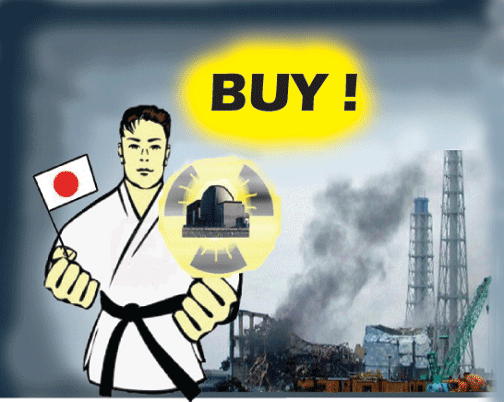 Toshiba to buy majority stake in UK nuclear consortium,Dan Milmo, The Guardian UK 27 Dec 13, Japanese company keen to kickstart ambitious reactor building programme that stalled after 2011 disaster at Fukushima Japanese group Toshiba has confirmed that it is in the final stages of securing a majority stake in a British nuclear power consortium, bringing a further boost to the UK’s ambitious nuclear programme.
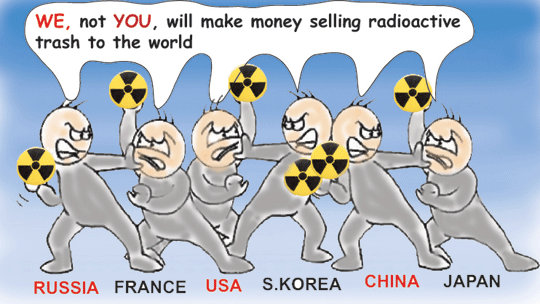
Toshiba’s chief executive, Hisao Tanaka, said an agreement to take a controlling shareholding in the NuGen consortium could be in place as early as January. NuGen is a joint venture between Spanish power company Iberdrola and French utility firm GDF Suez that is developing a plant at Sellafield in Cumbria, where the owners plan to build 3.6 gigawatts of nuclear capacity on a disused reactor site…….
Toshiba is keen to kickstart an ambitious reactor building programme that stalled after countries around the world – led by Germany – froze nuclear expansion plans and tightened regulations in the wake of Japan’s 2011 disaster at Fukushima.
Its domestic rival, Hitachi, has bought the Horizon project which intends to build two nuclear power stations, in Anglesey and Gloucestershire.
Britain is one of the few countries pressing ahead with nuclear plans in spite of the safety fears raised by Fukushima. The government’s determination to make nuclear a central part of its energy strategy was confirmed two months ago when ministers approved a deal with France’s EDF Energy to build the £16bn Hinkley Point nuclear power plant in Somerset. Analysts at Liberum Capital said state guarantees on electricity prices offered to EDF in order to secure the deal could prove to be “economically insane”. The European Union has also weighed into the nuclear subsidy debate by launching an investigation into whether the Hinkley deal broke state aid rules……..
Tanaka said a majority stake was necessary to make progress on the project, where delays have frustrated the UK government, sources say, as it pushes through its own ambitious nuclear programme to replace new reactors. A controlling stake would allow Westinghouse, 87%-owned by Toshiba, to supply three of its AP1000 reactors for the site……http://www.theguardian.com/business/2013/dec/26/toshiba-stake-uk-nuclear-consortium
Tepco’s plan to clean up Fukushima, -technology not invented yet, restart of idled reactors
 The plan, which includes a cost-cutting round of early retirements, assumes the giant utility will be allowed to restart some of its idled nuclear reactors.
The government believes it may take 40 years completely to dismantle the plant and could require the use of technology that has not yet been invented.
Fukushima operator readies new restructuring plan http://au.finance.yahoo.com/news/fukushima-operator-readies-restructuring-plan-000222900.html 27 Dec 13, Tokyo Electric Power Wednesday submitted a fresh restructuring plan to a Japanese government-backed fund that envisages the creation of a special unit to dismantle the crippled Fukushima nuclear plant.
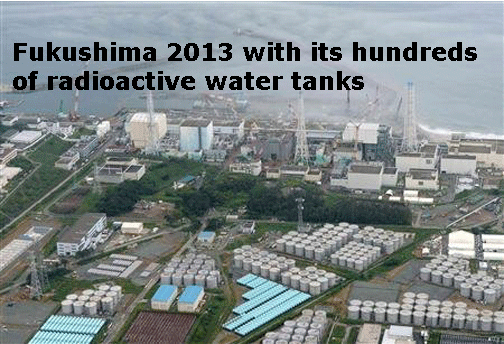
TEPCO president Naomi Hirose pledged thorough implementation of the plan, once approved by the government as expected next month. Continue reading
A family’s health wrecked by Fukushima nuclear radiation
Fukushima Mother: ‘Strange smell’ at start of nuclear disaster — Health of entire family has deteriorated — More people who stayed have died, more kids have leukemia and cancer — All our thyroid exams turned out totally different when tested in Tokyo (VIDEO) http://enenews.com/fukushima-mother-strange-smell-at-start-of-nuclear-disaster-health-of-entire-family-has-deteriorated-more-people-who-stayed-have-died-more-kids-have-leukemia-and-cancer-all-our-thy
Mother speaking at Fukushima Collective Evacuation Trial Team press conference on Dec. 4, 2013, transcribed by Kiiko and translated by Fukushima Voice, Published Dec. 22, 2013:
[…] I still remember how it was very hard for me and my children to breathe due to strange smell […] Every day the government and specialists said […] “There is no immediate health effect.” […] we ate local vegetables and drank tap water. […] I began to have dry coughs of unknown etiology. When I went to a hospital, I was told “An increasing number of people had the same symptom.” […] My son [and] many others around us, at all ages, also complained of bone pain in the soles of their feet. […] Health of all the family members quickly deteriorated during the period awaiting evacuation. […] My dry cough got so bad to the point of nearly choking in the middle of the night […] arm bone pain was so bad that I could barely open and close doors. […] My grade school age son continued to have nausea and headache […] they found blood in his urine […] he often had diarrhea. I also began to have continuing nausea, headache and diarrhea. […] my son’s blood pressure had gone down to 82/50. […] [We] went to a hospital in Tokyo for thyroid examination. […] all of us had results which were totally different from the results in Fukushima [son diagnosed with thyroid adenomatous goiter and lymphadenopathy with over 10 lymph nodes involved]. When I took him to a hospital in Yamanashi, he was diagnosed with “autonomic nervous system disorder.” […] More people who remained in Fukushima are suffering from the same symptoms as mine. More people have died. There are more children who got leukemia, who began to have bloody noses and who have thyroid cancer. […]
Watch the press conference here
Nuclear power industry manipulates Japanese politicians
 Nuclear power backers picking up steam on reactor restarts THE ASAHI SHIMBUN, by Senior Staff Writer Atsushi Komori and Kaname Kakuta. 23 Dec 13 Japan’s 2011 nuclear disaster triggered feverish calls among citizens and even politicians to abandon the nation’s reliance on nuclear power.
But almost three years later, pro-nuclear officials, business leaders and utilities wielding awesome economic and political clout are regaining strength and maneuvering to tighten the noose around local government leaders who have been demanding that Japan do away with nuclear power. Continue reading
Abe’s second strike against freedoms
 The Abe administration has reportedly started preparations for introducing the “crime of conspiracy” by revising the law on the punishment of organized crime and the control of proceeds resulting from crime. Although it has not been decided when a revision bill will be submitted to the Diet, there is the danger that it will give the government a strong weapon to control civic movements, especially those that oppose government policies.
The recently enacted state secrets law will not only greatly limit people’s access to government information but also punish those who try to get secret information even if they didn’t know it was designated as secret.
The introduction of the crime of conspiracy will further weaken freedoms that have already been hollowed out by the secrecy law. So it is important for citizens to start a widely based action to stop this move by the administration.
If the crime of conspiracy is introduced, one could be punished for joining others to plan a crime even if it is not actually carried out or even if no concrete preparations have been made — a huge departure from the current principle that arrests can be made only when a crime has actually been committed or attempted.http://www.japantimes.co.jp/opinion/2013/12/22/editorials/abes-second-strike-against-freedoms/#.Urhe-6VRGf0
1 This Month





PLEASE OPPOSE HR 8255 AND S.3639 – bills would accelerate satellite deployment, with no environmental review or safeguards – https://ncstd5li.quorum.us/campaign/169331/
To see nuclear-related stories in greater depth and intensity – go to https://nuclearinformation.wordpress.com
-
Archives
- October 2026 (66)
- September 2026 (339)
- August 2026 (330)
- July 2026 (355)
- June 2026 (287)
- May 2026 (306)
- April 2026 (356)
- March 2026 (251)
- February 2026 (267)
- January 2026 (308)
- December 2025 (358)
- November 2025 (359)
-
Categories
- 1
- 1 NUCLEAR ISSUES
- business and costs
- climate change
- culture and arts
- ENERGY
- environment
- health
- history
- indigenous issues
- Legal
- marketing of nuclear
- media
- opposition to nuclear
- PERSONAL STORIES
- politics
- politics international
- Religion and ethics
- safety
- secrets,lies and civil liberties
- spinbuster
- technology
- Uranium
- wastes
- weapons and war
- Women
- 2 WORLD
- ACTION
- AFRICA
- Atrocities
- AUSTRALIA
- Christina's notes
- Christina's themes
- culture and arts
- Events
- Fuk 2022
- Fuk 2023
- Fukushima 2017
- Fukushima 2018
- fukushima 2019
- Fukushima 2020
- Fukushima 2021
- general
- global warming
- Humour (God we need it)
- Nuclear
- RARE EARTHS
- Reference
- resources – print
- Resources -audiovicual
- Weekly Newsletter
- World
- World Nuclear
- YouTube
-
RSS
Entries RSS
Comments RSS

