shock and collapse – the plight of Fukushima nuclear plant officials in March 2011
Leader of Fukushima plant “started staggering… mumbling ‘It’s all over’” before last reactor melted — Appears to collapse, has visions while motionless on floor — Top official “bursts into tears” at meeting — No way to prevent ‘utter catastrophe’ — ‘Chilling’ sound soon heard, ‘gaping hole’ in reactor suspected http://enenews.com/leader-fukushima-plant-started-staggering-around-mumbling-all-before-last-reactor-melted-appears-collapse-begins-having-visions-motionless-floor-senior-official-bursts-tears-around-same-time?utm_source=feedburner&utm_medium=email&utm_campaign=Feed%3A+ENENews+%28Energy+News%29
Kyodo News (Part 9), Sep 23, 2014 (emphasis added) : Reactor 2′s cooling system finally stopped functioning at 1:25 p.m. on March 14… [In 5 hours]… the water level had drained to 3.7 meters below the top of the nuclear fuel… leaving it fully exposed. There was also no signthe seawater was entering the reactor… firetrucks that were supposed to be injecting water into the reactor had run out of fuel… [Fukushima chief Masao] Yoshida would later recall that this felt like a “turning point,” beyond which “we had run out of all options and I thought I might really die.”… Yoshida went up to [the many workers on the 2nd floor] and said: “Thank you for dealing with the situation until now. It is OK to go home.”… 8:30 p.m… Yoshida then asked [if] there was any place people could evacuate to… Yoshida [was told] that the No. 2 plant was ready… With workers unable to operate the venting valves, the pressure continued to build… an experienced leader… felt that the reactor’s containment vessel could break at any time…
Kyodo News (Part 10), Sep 23, 2014:: A [Tepco] senior official broke down and wept in the prime minister’s office when the utility felt it had exhausted all options to prevent an utter catastrophe... bursting into tears… Shortly after 4 a.m. on March 15 [Japan was] facing a potential rupture of the reactor 2 containment vessel… [Prime Minister Naoto] Kan soonrealized it was too late to rein in the crisis… a chilling sound swept through the response office at 6:14 a.m, albeit duller than that of the two previous hydrogen blasts. Those present felt their blood freeze as they were told by reactor operators that the pressure inside the reactor 2 suppression chamber, connected to the containment vessel, had dropped to zero… radioactive steam could pour out into the external environment, leaving no safe place inside the plant or in the surrounding area. “The suppression chamber might have a gapping hole… [Yoshida] instantly decided it was time to evacuate the site.
Testimony reveals odd behavior just before ‘chilling sound’ and pressure dropping to zero at Unit 2: Early on March 15, silence engulfed the emergency response office as the point of no return neared. Yoshida stood up and started staggering around, mumbling to himself, “It’s all over.”… Yoshida was searching for the right time to allow Tepco employees to leave the plant, except for a skeleton crew… As he returned to his seat, he leaned back in his chair, crossed his arms and closed his eyes… he was thinking about what might happen if the reactor 2 containment vessel failed, discharging a catastrophic amount of radioactive materials… He could not think of a way to avoid such a scenario. [Shiro] Hikita… sawYoshida’s body slide from the chair onto the floor. At first he thought Yoshida had collapsed but then realized he was sitting cross-legged as if meditating. With his eyes closed,Yoshida did not move for several minutes. Yoshida later said he was calling to mind the faces of his longest-serving colleagues: “There were about 10 or so. I thought those guys might be willing to die with me.”
Japan’s media self-censorship about radioactive particles

 NHK changed their TV program about Fukushima radioactive particle to dinosaur with no explanation http://fukushima-diary.com/2014/09/nhk-changed-tv-program-fukushima-radioactive-particle-dinosaur-explanation/ Iori Mochizuki 25 Sept 14, NHK cancelled their TV show about radioactive particle scheduled for 9/21/2014.The title of the show was “Nuclear accident – Follow the unidentified radioactive partile !”. It was scheduled to be broadcast at 23:30 of 9/21/2014, but instead, they rebroadcast the show about dinosaur, which was originally broadcast only 5 weeks ago.
About the sudden change of the TV program, NHK has made no announcement though it’s public broadcasting.
Tokyo rallies against the return of nuclear power
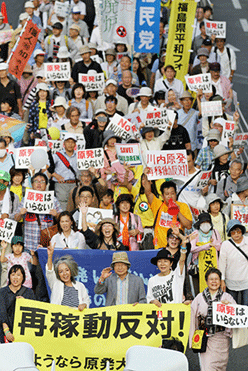 ‘What’s your anti-disaster plan?’ Thousands protest Japanese nuclear revival RT.com September 23, 2014 Thousands of people protested in Tokyo on Tuesday, criticizing the government’s move to restart two of Japan’s nuclear reactors by arguing that no sufficient anti-disaster plans have been presented three years after the Fukushima catastrophe.
More than 16,000 activists gathered in the Japanese capital, speaking out against the September 10 decision by the country’s nuclear watchdog to restart two reactors at the Sendai plant in southern Japan. We don’t need nuclear plants,” was one of the main slogans protesters shouted as the demonstration marched through the capital, now more than three years after a triple reactor meltdown at Fukushima’s power plant in March 2011.
“Three and a half years has passed since the nuclear accident, but self-examination has yet to be made,”Nobel literature laureate Kenzaburo Oe told the Tokyo rally.
“[Japan’s government] is going ahead with the plan to resume operation at the Sendai plant without compiling sufficient anti-disaster plans,” Oe said, according to public broadcaster NHK…….http://rt.com/news/190068-japan-nuclear-energy-protest/
Wild life affected by even low levels of radiation in Fukushima area
 Even Low Radiation Levels In The Fukushima Disaster Area Are Harming Animals http://www.businessinsider.com.au/even-low-radiation-levels-in-the-fukushima-disaster-area-are-harming-animals-2014-9 CHRIS PASH Butterflies eating food collected from around the Fukushima nuclear meltdown site showed higher rates of death and disease, according to a Japanese study.
Researchers fed groups of pale blue grass butterflies (Zizeeria maha) leaves from six different areas at varying distance from the disaster site and then investigated the effects on the next generation.
Feeding offspring the same contaminated leaves as their parents magnified the effects of the radiation.
But offspring fed uncontaminated leaves were mostly like normal butterflies and the authors say this shows that decontaminating the food source can save the next generation.
The 2011 meltdown at the Fukushima Dai-ichi nuclear power plant released substantial amounts of radiation into the surrounding area.
Humans were evacuated and no significant health effects have been reported but the scientists from the University of the Rukyus, Okinawa, are studying the impact on the area’s wildlife.
In a previous study, the group suggested that eating leaves with high levels of radiation seriously affected the pale grass blue butterfly.
Their new study investigated the effect of eating leaves with much lower levels of radiation, which had been collected in 2012, a year after the disaster, from six areas that were between 59kms and 1,760kms from the site.
Their study, published in the journal BMC Evolutionary Biology, showed that even in these comparatively low levels of radiation, there was an observable difference in the butterflies’ lifespan, depending on the dose of caesium radiation in their food. Butterflies fed leaves with higher caesium radiation doses were also smaller and some had morphological abnormalities such as unusually shaped wings.
Professor Joji Otaki, of University of Rukyus, says wildlife has probably been damaged even at relatively low doses of radiation.
He says the study demonstrates that eating contaminated foods can cause serious negative effects on organisms.
“Such negative effects may be passed down the generations,” he says.
“On the bright side, eating non-contaminated food improves the negative effects, even in the next generation.”
Painfully slow and expensive – Fukushima radioactive trash cleanup
Fukushima cleanup going painfully slow, Japan Times BY MIZUHO AOKI STAFF WRITER SEP 22, 2014 Three and a half years after Tokyo Electric Power Co.’s crippled Fukushima No. 1 nuclear power station spewed massive amounts of radioactive materials into the air and water, decontamination work in Fukushima Prefecture has yet to draw to an end.
The government initially hoped to complete the decontamination by the end of last March, but the process continues to lag far behind, prompting the government to push back the goal by three years to 2017.
Due to the slow progress, huge bags filled with contaminated soil can still be seen piled up at hundreds of temporary storage sites across the prefecture, and many residents are in limbo, unable to make up their minds about whether to return home in the near future or to relocate for good.
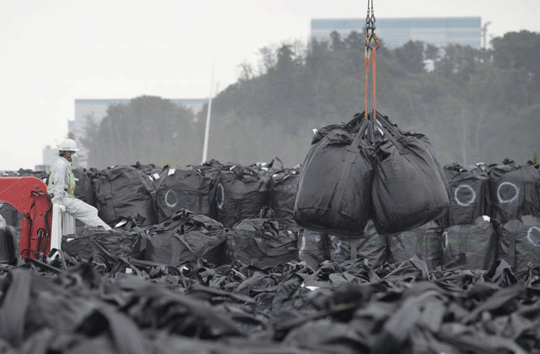
How are toxic houses and land decontaminated?
The work mainly consists of scraping off the top layer of soil, removing grass and fallen leaves, and washing roofs and walls with water or wiping them off with cloth.
As of March, the removed soil and grass was being stored at more than 660 temporary storage sites set up by municipal governments in Fukushima and at 53,000 decontaminated spots such as school grounds and people’s front yards, according to the Fukushima Minpo newspaper………
Why is it taking so long?
The major reason is the lack of temporary storage sites that would be used until the government builds more permanent facilities.
Some residents are opposing the temporary storage of contaminated waste out of fear of radiation and uncertainty over how long the bags of tainted soil will be stored there.
But the central government hopes to speed up the whole process after reaching agreement with Fukushima Gov. Yuhei Sato on Sept. 1 to build temporary storage facilities in Okuma and Futaba in return for ¥301 billion in subsidies.
The government plans to start moving waste to the facilities in January and complete the transportation in three years.
The government is currently mulling the best way to move the contaminated waste. Last Thursday, the Environment Ministry proposed a transportation plan to a panel of experts, including using 10-ton dump trucks on expressways to deliver the soil quickly — and hopefully safely — to sites where it will likely sit for decades awaiting permanent disposal.
Will the government’s plan work?
That remains to be seen. The government still needs to negotiate with more than 2,000 landowners to acquire 16 sq. km of land in Okuma and Futaba to build the storage facilities…….
The total is estimated to reach 22 million cu. meters, equal to filling the Tokyo Dome 18 times.
Within three decades, the waste is supposed to moved to the final disposal sites the government plans to create outside Fukushima. However, the locations of these final sites have yet to be found.
The neighboring prefectures are having their own problems with radiation-tainted waste, as their residents are strongly opposed to storage nearby.
In July, the Environment Ministry designated a plot of state-owned land in Shioya, in Tochigi Prefecture, but the mayor and residents are opposed to the plan, saying it will damage the environment in which they live…….
The government estimates that the decontamination will cost about ¥2.5 trillion in total. But according to a calculation by the National Institute of Advanced Industrial Science and Technology, it could be twice as much, reaching a staggering ¥5 trillion. http://www.japantimes.co.jp/news/2014/09/22/reference/fukushima-cleanup-going-painfully-slow/#.VCNe35RdUnk
Fukushima” radioactive groundwater seeps towards Tokyo
 VIDEO: Radioactive material now flowing toward Tokyo and contaminating their water supply; Problems “actually only getting worse” — “Truth is no one in world really knows how to deal with Fukushima” — Gov’t Expert: Tepco “should give up’ making ice walls VIDEO: Radioactive material now
  flowing toward Tokyo and contaminating their water supply; Problems “actually only getting worse” — “Truth is no one in world really knows how to deal with Fukushima” — Gov’t Expert: Tepco “should give up’ making ice walls
Japan Times, Sept 19, 2014: Tepco started building ice walls [but] has been unable to seal the leaks… it hasn’t been able to freeze because the [highly contaminated] water is flowing too fast [from the turbine buildings]. Tepco is trying to figure out how it can seal up the leak[s]… but it is still unclear when it will be able to plug the leaks. [Atsunao Marui, a groundwater expert who isa memer of a goverment panel dealing with the tainted water issue] said Tepco has been spending too much time trying to make the ice walls work, and should give up and explore other alternatives.
Dr Ronald McCoy, MD, physician, Sept. 18, 2014 (emphasis added): Experts say that the Japanese government will soon be left with no choice but to release radioactive water into the ocean… The truth is that no one in the world really knows how to deal with the Fukushima accident… Murphy’s Law is inexorable: If anything can go wrong, in time it will go wrong. A major nuclear accident [can] render large areas of land uninhabitable for thousands of years.
Interview with Yokohama evacuees Beverly Findlay Kaneko and son Ryan, Social Uplift, Sept. 14, 2014 (at 3:00 in): I started working on March 11 this year, 2014, with Libbe Halevy of Nuclear Hotseat and we helped her produce a segment called Voices from Japan (Part 1 | Part 2 | Part 3 |Part 4)… We interviewed probably 12-14 different people, top people in the anti-nuclear and the humanitarian movements, regarding Fukushima… Every last one of those people said here we are 3 years after the disaster and nothing has changed. Nothing has changed except for the fact that the government keeps trying to brush the issue under the rug and cover up… Unfortunately the cleanup up the site has not progressed they are to the point now where there is so much contaminated water collecting at the site that now the only choice they have is to dump it into the Pacific Ocean. The rivers in Fukushima Prefecture were contaminated at the time of the accident. That contamination is now flowing toward the Tokyo area, contaminating the Tokyo water supply. So environmentally things have not gotten better they’re actually only getting worse.
Dr. Ferenc Dalnoki-Veress and Dr. Arjun Makhijani, Asia-Pacific Journal, Dec. 19, 2011: Some of the fuel has reached the concrete floor and may breach it, posing a threat of unremediable contamination of ground water.
See also: Bloomberg: Could Fukushima contamination flow downstream to Tokyo and present a big risk? (VIDEO)
Radioactive pollution from Fukushima is becoming a wider problem
Japan Times: Fukushima plant plagued by problems as radioactive material bleeds into Pacific — Radiation level in groundwater now 25,000 times higher than when year began http://enenews.com/japan-times-fukushima-plant-plagued-problems-radioactive-material-bleeds-pacific-record-radiation-level-groundwater-25000-times-higher-when-year-began?utm_source=feedburner&utm_medium=email&utm_campaign=Feed%3A+ENENews+%28Energy+News%29
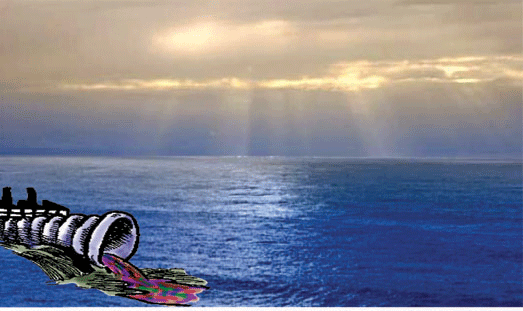
Japan Times, Sept 19, 2014: Tainted water problems still plague Fukushima, despite some positive signs — More than three years since [3/11] the Fukushima No. 1 power plant is still bleeding tons of toxic radioactive water into the Pacific Ocean… [It’s] developed into a wider problem that is stoking public concern… [Tepco] is still trying to find a way to deal with the plant’s utility trenches, which are filled with highly contaminated water. The trenches, which run beneath the plant, were built to house cables and pipes… installed to bring in seawater for cooling purposes… Leaving the tainted water in the trenches is risky. For instance, if another major quake hits and damages the trenches, the toxic water will escape and contaminate the groundwater. Tepco said the trenches… can’t be drained until the leaks from the buildings are plugged…
Asahi Shimbun, Sept 19, 2014: Local fishermen are crying foul over [TEPCO’s] latest plan to discharge processed contaminated water… into the ocean. TEPCO and the central government held the first explanatory briefing… Their explanation was apparently unconvincing. “I can’t believe anything TEPCO says,” one of the attendees said after the meeting… many members of local fisheries associations opposed the plan on the opening day of the briefing sessions… [Others] expressed concern over the plan’s safety. “If a critical problem should occur, (local fisheries) would be severely damaged,” [fisherman Yoshinori Sato] said. “They wouldn’t be able to recover.” Another member criticized the utility for burdening local fishermen with such proposals, asking, “How many times will we have to make a similar painful decision?”
While Japan’s media outlets are focused on the meetings between government/Tepco and the fishermen over the whether to allow ‘processed’ contaminated water releases, new Tepco data published September 18 reveals strontium-90 concentrations are at record levels in groundwater just 100 feet from the ocean. Gross beta has risen to 720 million becquerels per cubic meter (Bq/m³) — and according to Tepco’s most recent strontium-90 tests released September 10 (4 months after the samples were taken), strontium-90 comprises over 95% of the total gross beta at this location — resulting in a Sr-90 concentration of 695 million Bq/m³. At the start of 2014, 28,000 Bq/m³ of gross beta was detected in groundwater from the same well — now 8 months later, the levels are over 25,000 times greater.
Japan’s government looks to financially supporting the nuclear industry
 Editorial: Nuclear plant support measures run counter to official policy, Mainichi 22 Sept 14 拡大写真The Ministry of Economy, Trade and Industry is considering boosting support for nuclear power plants as Japan moves toward full liberalization of its electricity retailing market.
Under the system eyed by the ministry, consumers would shoulder the huge costs of building and decommissioning reactors so that even if there were an electricity price war, power companies wouldn’t go into the red. In essence, the system makes it easy to build and rebuild nuclear power plants and maintain them in the future.
But proposals that attempt to extend the life of nuclear power plants when the government has yet to present a picture for the future of the nation’s energy policies cannot be justified.
Nuclear power costs much more than thermal and other forms of power, yet for decades power companies have recovered expenses, protected by regional monopolies and the full cost pricing method that tacks the cost of producing electricity onto power bills.
With the full liberalization of electricity retailing set to be implemented in fiscal 2016, however, those power companies will lose their regional monopolies. And then the full cost pricing method will be abolished. If more newcomers enter the electricity market and the price of electricity drops, it will become even harder for power companies to recover costs associated with nuclear power.
The Ministry of Economy, Trade and Industry therefore proposed new measures to support nuclear power at a meeting to deliberate the role of the nation’s nuclear power plants. With respect to the system guaranteeing a set price for electricity produced though nuclear power, the ministry proposed that the cost of decommissioning nuclear reactors and the disposing of spent nuclear fuel be made part of a standard price, with consumers forced to cover the difference if the market price falls below that standard.
The ministry is also reportedly set to consider revisions to accounting systems to ease the effects of reactor decommissioning on management.
In terms of fuel alone, nuclear power plants can be run more cheaply than oil-fired power plants or those running on liquefied natural gas. This is probably why power companies are rushing to restart reactors. But when it comes to building a new nuclear plant or rebuilding an existing one, then the circumstances are entirely different. The latest support measures indicate that if market principles were to be given free reign, then the option of maintaining nuclear power would vanish…….http://mainichi.jp/english/english/perspectives/news/20140918p2a00m0na003000c.html
Japanese town finds a way to regulate against nuclear waste plans for its area
Tochigi town passes water-protection ordinance to block nuclear waste plans THE ASAHI SHIMBUN, 21 Sept 14 A town in Tochigi Prefecture has found a novel way to block the construction of a final disposal site for radioactive waste from the 2011 Fukushima nuclear crisis by passing an ordinance that will protect its natural resources.
The ordinance, passed unanimously by the Shioya town assembly on Sept. 19, will protect an area that includes local springs, as well as mountain forest that was designated by the Environment Ministry as a candidate for the final disposal facility.
The ministry plans to use the site to store designated waste which contains more than 8,000 becquerels of radioactivity per kilogram.
Under the ordinance, the town government aims to protect the quality and quantity of water in springs, including the Shojinzawa Yusui, recognized by the ministry as one of the best 100 natural waters in Japan……..A group opposed to the construction of the disposal site had gathered more than 60,000 signatures inside and outside the prefecture as of Sept. 19, more than five times the town’s population……. http://ajw.asahi.com/article/0311disaster/fukushima/AJ201409200104
Japan’s politicians look for nuclear plan B – burying reactors
Politicians mull idea of burying power plants Politicians discuss plan B in nuclear power push: underground reactors, Japan Times BY ERIC JOHNSTON 21 Sept 14 For more than four decades, the Kansai region has relied on Fukui Prefecture’s nuclear power plants, including 11 operated by Kansai Electric Power Co. (Kepco), to keep the region powered up.
But now that a growing number of plants are nearing or have reached the end of their 40-year life cycle, the question is: What’s next?
While most of the discussion is focused on whether to continue running or decommission them, there is an interesting — to be polite — school of thought among certain politicians that says they should be replaced with underground reactors……http://www.japantimes.co.jp/news/2014/09/21/national/politics-diplomacy/atomic-plan-b-go-underground/#.VCChHpRdUnk
The Fukushima nuclear emergency DID cause radiation sickness
 VIDEO: Gov’t experts highly suspicious of Japan’s claim that nobody suffered acute radiation syndrome after Fukushima — So many workers were ill they had to lay on cardboard after running out of beds — Officials “repeatedly talked of death” — CBS: There were reports of people with radiation sickness http://enenews.com/video-foreign-govt-very-suspicious-japans-claim-suffered-acute-radiation-syndrome-after-fukushima-many-workers-ill-lay-cardboard-after-running-beds-officials-repeatedly-talked-death-video?utm_source=feedburner&utm_medium=email&utm_campaign=Feed%3A+ENENews+%28Energy+News%29
Japan Times, Sept. 17, 2014 (emphasis added): [Deceased Fukushima Daiichi chief Masao Yoshida] repeatedly talks of “death” in the initial days of the crisis as the realization sinks in that the nuclear fuel had already started to melt.
Mainichi, Sept 12, 2014: “Nobody came to help us. I am still full of resentment and bitterness,” Yoshida said… heaping scorn on [the] TEPCO President… and calling him ”that man.”
Xinhua, Sept 11, 2014: Masao Yoshida [revealed] the government had utterly failed to understand the gravity of the workers’ situation at the plant… three days into the crisis the chief had lost hope and was losing his grip on the situation… politicians and TEPCO officials at the headquarters were clueless as to the dire predicament he and his workers were in, including those who had been exposed to potentially lethal levels of radiation.
Kyodo News, Sept 14, 2014: [Satoru] Hayashizaki and his coworker opened the door to the [No. 3] suppression chamber’s room… “My hands, covered by rubber gloves, instantly got hot”…Hayashizaki felt groggy… he put his right foot down on it only to see the rubber sole of his shoe melt instantly, leaving a black smear… He was alarmed to see [his dosimeter number] rising rapidly, even though he was [back] in the control room… everyone else’s dosimeters were rising… [He] thought he might die… and started writing a farewell letter.
Kyodo News, Sept. 14, 2014: Mitsuhiro Matsumoto, 47, was outside during both explosions… he [became] unable to believe anyone or any of the information he received. “I completely lost my will to fight”… Many [workers] had already absorbed more than 100 millisieverts… A man injured by the rubble was soon brought in on a stretcher… there were no doctors… Another man [was] in a state of panic… Those feeling ill were taken to a meeting room… Tepco quickly ran out of mattresses and had to put down cardboard for them to lie on… the door closed behind [Yumiko Kato and a reactor operator] shouted: “Is that an explosion? Again?” He then clasped his arms around his knees and trembled, muttering “I am afraid, afraid, afraid.”… “I want to go home,” a young female Tepco employee said as she started to cry…[Kato] said, “Let’s believe in our people, because they are working very hard.” The situation, however, only got worse, cornering everyone at the plant.
IRSN, France’s Institute for Radiological Protection and Nuclear Safety (at 11:00 in): “At first sight there was no acute radiation syndrome observed in the weeks following the accident, , as was the case of the first rescue workers during the Chernobyl accident. These figures are to be taken with great caution because of severe degradations due to the tsunami… Medical checkups are now implemented by the Japanese authorities.” >> Watch the video here
Contrary to IRSN’s claim about medical checkups, NHK recently reported, “Screening of workers is left up to the contractors […] they’re not obliged to submit data. [A gov’t adviser says they need] a centralized system to collect health data right away.” And according to the Asahi Shimbun, “Many companies involved have failed to conduct medical examinations.. [It’s now] impossible to check whether workers have suffered health problems.”
CBS News discussed radiation sickness after the explosions: Prof. Cham Dallas, a nuclear energy expert, you’ve been in contact with both the Japanese and the US government throughout this process… Let’s talk about radiation exposure… Dallas: “There’s some disconnects here. We’re being told by the Japanese government that the radiation levels are very low… We have reports of people with radiation sickness. That’s the disconnect, usually it takes days for radiation [sickness]” >> Watch the broadcast here
How Australians pay twice over for electricity infrastructure
DORC rort: The art of getting energy infrastructure paid for twice, SMH, September 19, 2014 Michael West Business columnist “……..you will hear how you have been paying for something, on a quarterly basis for the past 10 years, which you have already paid for. We are all victims of a high-brow rort by governments and energy companies.
While the consulting industry thrives on selling so-called expert valuations to justify this rort, Sydney University finance professor David Johnstone says it should end…….
energy companies are valuing old assets such as gas pipelines – things that consumers have already paid for – as if they were brand-spanking new. We, the mug punters, are lumbered with the cost on our power bills.
This is the DORC rort (depreciated optimised replacement cost), its moniker alone sufficient to discourage further inquiry.
Suffice to say that a reasonable thing for regulators to do might simply be to value assets at their cost, or to recognise only what their owners actually spend. Suffice to say that in Singapore and Hong Kong they would not be silly enough to use DORC, yet large corporations from these places are here enjoying riskless 10 per cent returns by stinging we mug Aussies twice for access to old gas pipelines, things that were paid for, and privatised, years ago……
why are assets that are already in private hands given the same favourable regulatory treatment? “I think it comes down to ideology as well as vested interests,” Johnstone says. “Economists fall in love their own models and crave the authority of being scientists.” http://www.smh.com.au/business/dorc-rort-the-art-of-getting-energy-infrastructure-paid-for-twice-20140919-10jega.html#ixzz3DuqE0nIm
Radioactive Strontium at record high levels near Fukushima nuclear reactors
 Ocean hits record high for radioactive Strontium at all 6 locations near Fukushima reactors — Levels up to 20 times higher than reported last week — Officials: Contamination from highly radioactive ‘debris’ is seeping into ground and flowing out to sea http://enenews.com/record-high-strontium-90-ocean-water-every-location-destroyed-fukushima-reactors-levels-20-times-higher-reported-last-week-officials-contamination-highly-radioactive-debris-seeping-ground-flowin?utm_source=feedburner&utm_medium=email&utm_campaign=Feed%3A+ENENews+%28Energy+News%29
TEPCO Prompt Report of Result of Analysis, Sept. 10, 2014:
Port of Fukushima Daiichi, around Discharge Channel and Bank Protection — Seawater
This newly published data shows record levels of Strontium-90 have been detected at all 6 seawater monitoring locations in front of the destroyed reactors. At 3 of 6 locations levels are around triple the previous record set last year.
Yet a report released by TEPCO days later on Sept. 12, 2014 claims: “Results indicate efforts to protect water are succeeding… inside the port area, concentrations of radioactivity have been steadily decreasing… Strontium… nearest the reactors… show levels of 70-100 Bq/L … Strontium 90 has been reduced to approximately a third of earlier levels [and] are projected to further reduce… Strontium 90 outflows to one-fortieth of the current estimated amount of outflow.”
According to a TEPCO document from last month: “Groundwater around reactor buildings (Unit 1 to 4) is confirmed to contain radioactive materials which have mixed with rainwater having been contacted with contaminated debris left on the ground surface due to the accident… contaminated water in the buildings theoretically does not mix with the groundwater flowing around the buildings.”
See also: Strontium-90 from Fukushima found along west coast of N. America
Japan’s growing stockpile of plutonium trash
Japan’s plutonium stockpile jumped to 47 tons in 2013 KYODOHTTP://WWW.JAPANTIMES.CO.JP/NEWS/2014/09/17/NATIONAL/JAPANS-PLUTONIUM-STOCKPILE-ROSE-47-TONS-2013/#.VBTITPRDUNL SEP 17, 2014 Japan had about 47.1 tons of plutonium in and outside the country at the end of 2013, about 2.9 tons more than the year before, the Cabinet Office said on Tuesday. Newly added were 2.3 tons generated through spent fuel reprocessing outsourced to Britain and 640 kg not reported to the global watchdog in 2012 and 2013. The 640 kg is part of mixed plutonium-uranium oxide (MOX) fuel stored in a reactor that was offline during that time.

Revelations of the unreported 640 kg stoked controversy in June, though the Japan Atomic Energy Commission had said it was exempt from International Atomic Energy Agency reporting requirements, insisting at that time that fuel inside reactors is considered “being used.”
Under Japan’s nuclear fuel recycling policy, plutonium extracted by reprocessing conventional uranium fuel is consumed by existing reactors in the form of MOX fuel. But this policy is jeopardized by public concerns about nuclear power amid the Fukushima crisis.
A further increase in plutonium could raise concerns in the international community about its possible diversion to nuclear weapons.
The earlier unreported 640 kg of plutonium was contained in MOX fuel loaded in March 2011 into reactor 3 of Kyushu Electric Power Co.’s Genkai nuclear plant in Saga Prefecture during its regular checkup, but has been left there unused as the reactor could not restart in light of the disaster at Tokyo Electric Power Co.’s Fukushima No. 1 complex.
In Japan solar floating panels are taking over from nuclear power
Japan: ‘solar islands’ replace nuclear power http://www.enn.com/business/article/47833 15 Sept 14 As Japan seeks to end reliance on nuclear power, one of the answers is floating ‘solar islands’, writes Jon Major. A 70MW solar island opened last year, and two additional plants have just been announced. Two companies in Japan recently announced they are to begin building two large solar power islands that will float on reservoirs.

This follows smartphone maker Kyocera’s Kagoshima Nanatsujima Mega Solar power plant, the country’s largest at 70 megawatts, which opened in late 2013 and is found floating in the sea just off the coast of southern Japan.
The two new solar islands, to be built by Kyocera and commercial partners, will form a network of thirty 2MW stations – adding another 60MW of solar capacity.
The move comes as Japan looks to move on from the Fukushima disaster of 2011 and meet the energy needs of its 127m people without relying on nuclear power.Shattered confidence in nuclear power
Before the incident around 30% of the country’s power was generated from nuclear, with plans to push this to 40%. But Fukushima destroyed public confidence in nuclear power, and with earthquakes in regions containing reactors highly likely, Japan is now looking for alternatives.
Solar power is an obvious solution for relatively resource-poor nations. It is clean, cost-competitive, has no restrictions on where it can be used and has the capability to make up for the energy shortfall.
A small fact that solar researchers love to trot out is that enough sunlight falls on the earth’s landmass around every 40 minutes to power the planet for a year. To put this another way, if we covered a fraction of the Sahara desert in solar panels we could power the world many times over.
The technology already exists, so producing enough solar power comes primarily down to one thing: space. For countries such as the USA with lots of sparsely populated land this is not an issue, and there have already been a large number of solar farms installed around the country.
For Japan, the answer is offshore
But Japan where space is limited, more inventive solutions are required. This is the principle reason behind the decision to move their solar power generation offshore.
While the land is highly congested, and therefore expensive, the sea is largely unused. It therefore makes a good degree of sense to use this space for floating power plants.
Continue reading at ENN affiliate The Ecologist.
Japan just does not know what to do with its masses of radioactive trash
With no plans, designated waste sits by farms Japan News, September 12, 2014 The Yomiuri Shimbun Most radioactive-contaminated materials being kept at temporary storage sites in Fukushima and nearby prefectures still have nowhere to go.

In the Tohoku and Kanto regions, the 2011 crisis at the Fukushima No. 1 nuclear power plant has produced a massive amount of waste tainted with radioactive substances that were released into the air from the power plant.
However, the central government is having difficulty finding locations to build final disposal sites, where the waste will be buried underground. At this stage, there are no clear prospects for construction plans anywhere in the regions.
“Authorities say it’s safe, but will it really be safe, even when we’re hit by tornadoes or typhoons? I hope it moves somewhere else soon,” said a rice farmer in his 60s in Tome, Miyagi Prefecture, referring to one of the warehouses of “designated waste” that stand in an area of farmland near his rice paddies. The city is one of the most famous rice-producing areas in the prefecture.
Covered in sheets of silver foil designed to protect against the sun’s rays, the warehouses store the designated waste — rice straw that was originally supposed to be used as livestock feed. The city government initially explained that the warehouses would be kept in the farmer’s vicinity for only two years — until January this year.
Waste with cesium levels higher than 8,000 becquerels per kilogram will receive an environmental ministry designation based on the special measures law on handling environmental pollution caused by radioactive substances. The amount in Tokyo and 11 other prefectures totaled about 146,000 tons as of June 30, according to the Environment Ministry……..
As a construction plan for final disposal site has been substantially delayed, the contaminated rice straw will remain in the warehouses for the time being…….http://the-japan-news.com/news/article/0001561227
1 This Month





PLEASE OPPOSE HR 8255 AND S.3639 – bills would accelerate satellite deployment, with no environmental review or safeguards – https://ncstd5li.quorum.us/campaign/169331/
To see nuclear-related stories in greater depth and intensity – go to https://nuclearinformation.wordpress.com
-
Archives
- October 2026 (58)
- September 2026 (339)
- August 2026 (330)
- July 2026 (355)
- June 2026 (287)
- May 2026 (306)
- April 2026 (356)
- March 2026 (251)
- February 2026 (267)
- January 2026 (308)
- December 2025 (358)
- November 2025 (359)
-
Categories
- 1
- 1 NUCLEAR ISSUES
- business and costs
- climate change
- culture and arts
- ENERGY
- environment
- health
- history
- indigenous issues
- Legal
- marketing of nuclear
- media
- opposition to nuclear
- PERSONAL STORIES
- politics
- politics international
- Religion and ethics
- safety
- secrets,lies and civil liberties
- spinbuster
- technology
- Uranium
- wastes
- weapons and war
- Women
- 2 WORLD
- ACTION
- AFRICA
- Atrocities
- AUSTRALIA
- Christina's notes
- Christina's themes
- culture and arts
- Events
- Fuk 2022
- Fuk 2023
- Fukushima 2017
- Fukushima 2018
- fukushima 2019
- Fukushima 2020
- Fukushima 2021
- general
- global warming
- Humour (God we need it)
- Nuclear
- RARE EARTHS
- Reference
- resources – print
- Resources -audiovicual
- Weekly Newsletter
- World
- World Nuclear
- YouTube
-
RSS
Entries RSS
Comments RSS

