Nuclear weapons and the USA’s militarisation of Asia-Pacific
Obama Threatens China with Nuclear Weapons. Militarization of Asia-Pacific By Stephen Lendman Global Research, May 01, 2015 Last Friday, National Security Council senior Asian affairs director Evan Medeiros said John Kerry and Defense Secretary Ashton Carter would meet their Japanese counterparts in New York on Monday.
They’d “announce some historic changes to the way US-Japan alliance operates” ahead of Prime Minister Shinzo Abe’s Washington visit this week. Continue reading
Despite the USA’s nuclear lobby – solar power is winning in Japan
 I predict, because solar is rising so rapidly in the land of the rising sun, that Japan will never restart any of its nukes – even though the U.S. media is demanding Japan restart one of its nukes. Let us pray that the solar home owners in Japan win this race against nuclear power. Our lives too depend on solar winning
 Four years after Fukushima, Japan is solar-powered Bay View by Theresa Coleman and Paul Kangas, 29 Apr 15 In the week before the March 11, 2011, earthquake at Fukushima, one person, Prime Minister Naoto Kan, did an extraordinary act that set Japan’s energy course in history for the next 100 years. He was able to convince the Japanese Parliament to pass a solar payment policy (SPP), that required big utilities in Japan to pay solar home owners $0.53 kwh for 20 years.
This is amazing. One, because the rate is very attractive to solar home owners and two, because he even made the effort.This one policy shift is now making Japan one of the leading solar powered nations on earth – far ahead of California or the U.S.
Number one in solar generation in 2014 was Germany. The same year they won the World Cup in soccer. They are on a roll.It is going to be interesting to see if China becomes No. 2 in 2015. It is a tight three-way race between Japan, Germany and China. Who will win?
The really big question is: “What inspired Prime Minister Naoto Kan to introduce this solar payment policy to the Japanese Parliament the day before Fukushima? Was it Chernobyl?
Apparently Kan had read the book “Solar Economy” by Hermann Scheer the year before. It got him to thinking about how solar policy could actually be drafted to shut down all the nuclear power plants in Japan over the next 50 years……….
This one policy shift is now making Japan one of the leading solar powered nations on earth – far ahead of California or the U.S. Number one in solar generation in 2014 was Germany.
Clean energy set to beat nuclear in Japan
Japan Sees Clean Energy Edging Out Nuclear Power in 2030, Bloomberg, Chisaki Watanabe and Emi Urabe 28 Apr 15 Clean energy sources will supply as much as 24 percent of Japan’s electricity in 15 years, while atomic power will account for as much as 22 percent, according to a draft report from the Ministry of Economy, Trade and Industry on what Japan’s electricity mix should look like by 2030……
If all 24 nuclear reactors currently under review for a restart by the country’s nuclear watchdog are allowed to switch back on, they would still not be able to generate more than 16 percent of Japan’s power, Greenpeace estimates. At least 10 more reactor units need to resume operations to reach the government’s target for nuclear, the group said.
Such a mass-scale restart is unlikely, according to Shaun Burnie, a nuclear specialist at Greenpeace Germany.
“The scale of the challenges facing the nuclear industry are such that generation from reactors is likely to collapse during the coming decade,” Burnie said in the statement. “Many reactors will never restart, and most reactors over the coming years will be too old to operate.”…..http://www.bloomberg.com/news/articles/2015-04-28/japan-expects-renewable-energy-to-edge-out-nuclear-power-by-2030
Prime Minister Shinzo Abe muzzling critics in Japan’s media
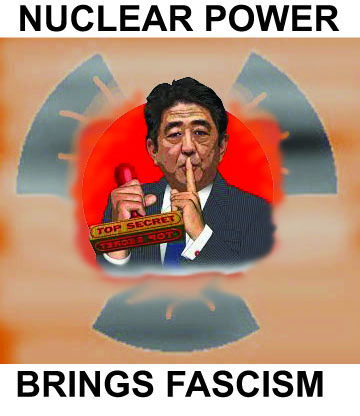 Effort by Japan to Stifle News Media Is Working, NYT By MARTIN FACKLER APRIL 26, 2015 TOKYO — It was an unexpected act of protest that shook Japan’s carefully managed media world: Shigeaki Koga, a regular television commentator and fierce critic of the political establishment, abruptly departed from the scripted conversation during a live TV news program to announce that this would be his last day on the show because, as he put it, network executives had succumbed to political pressure for his removal.
“I have suffered intense bashing by the prime minister’s office,” Mr. Koga told his visibly flabbergasted host late last month, saying he had been removed as commentator because of critical statements he had made about Prime Minister Shinzo Abe. Later in the program, Mr. Koga held up a sign that read “I am not Abe,” a play on the slogan of solidarity for journalists slain in January at a French satirical newspaper.
The outburst created a public firestorm, and not only because of the spectacle of Mr. Koga, a dour-faced former top government official, seemingly throwing away his career as a television commentator in front of millions of viewers. His angry show of defiance also focused national attention on the right-leaning government’s increased strong-arming of the news media to reduce critical coverage.
Mr. Abe’s efforts have had a chilling effect on coverage at a time when he is pushing ahead with a conservative agenda to dismantle the nation’s postwar pacifist consensus and put forth more positive portrayals of Japan’s World War II-era behavior. Experts warn that muzzling the press makes it easier for the government to make big changes that might not enjoy broad popular support, such as rewriting the pacifist Constitution, or even restarting the nation’s stalled nuclear industry.
“The Abe government is showing an obsession with the media that verges on paranoia,” said Keigo Takeda, a former editor in chief at Newsweek Japan who is now a respected freelance journalist. “I have never seen this level of efforts to micromanage specific newspapers and TV programs.”…..http://www.nytimes.com/2015/04/27/world/asia/in-japan-bid-to-stifle-media-is-working.html?smid=tw-share&_r=1
One of world’s largest floating solar plants opened in Japan
JAPAN OPENS MEGA FLOATING SOLAR POWER PLANT, CLIMATE GROUP, 26 APR 15 LONDON: JAPAN HAS JUST OPENED ONE OF THE WORLD’S LARGEST FLOATING SOLAR POWER PLANTS, SIGNALLING INCREASING ADOPTION OF THE EFFICIENT AND INNOVATIVE TECHNOLOGY IN THE COUNTRY, WHICH IS DUE PARTLY TO LACK OF SPACE ON LAND.
As highlighted in a report released this week by The Climate Group, regions with more land space, specifically the UAE with its huge solar resources, are primed to benefit from the fast-growing low carbon economy.

The giant plant in Japan was inaugurated last March but has only just opened, as announced by Kyocera and Ciel et Terre International, two manufacturers that are heavily investing in this technology. The system is made up of two solar parks, at Nishihira Pond and Higashihira Pond in Kato City in Japan’s Hyogo Prefecture, with a capacity of 1.7 megawatts (MW) and 1.2 MW respectively.
CLEAN TECHNOLOGY
Solar photovoltaic (PV) technology is becoming more wide-spread in Japan, driven in part by the closure of the country’s fleet of nuclear plants following the Fukushima disaster – even if there are some concerns about the possibility the country could soon reopen them.
… total solar PV capacity has moved from just 19 MW in 1992 to 13,532 MW in 2013 –more than double the previous year.
FLOATING SOLAR
However, with a landmass slightly smaller than California and a population density closer to India, this expansion in PV collides with the lack of space. Thankfully, Japan is surrounded by sea and has many water reservoirs to cater for its seasonal variation in rainfall levels, so is experimenting more frequently with floating PV systems.
Not only is floating solar more convenient, it is also more energy efficient. A study by Korea Water Resources Corporation (K-water) claims the technology is more efficient because it has a lower temperature during the day when compared to overland PV modules. This should be achieved due to the reflection of light from the water surface, which keeps the PV modules cooler………http://www.theclimategroup.org/what-we-do/news-and-blogs/japan-opens-mega-floating-solar-power-plant/
Arrest of anti nuclear protestor who landed drone on Shinzo Abe’s office
Man arrested for landing drone on Shinzo Abe’s office in nuclear protest, Guardian, 25 Apr 15
Yasuo Yamamoto charged over landing of drone with tiny amount of radiation in apparent protest against use of nuclear power after Fukushima disaster. A Japanese man has been arrested for landing a drone on the prime minister’s office with a minuscule amount of radiation in an apparent protest against the use of nuclear power, four years after the Fukushima disaster.
Unemployed Yasuo Yamamoto, 40, who lives in Fukui Prefecture in western Japan, was arrested on Friday and charged with obstruction of official business, police said.
The maximum penalty is three years in prison or a 500,000 yen (£2,770) fine.
Media reported that Yamamoto turned himself in at a police station in Fukui and said he landed the drone as a protest against nuclear power…..A drone marked with a radioactive sign was found on the roof of Japanese prime minister Shinzo Abe’s office on Wednesday. The radiation was so low it was not harmful to humans.
Yamamoto said he put radioactive sand that he got from Fukushima in a container on the drone, media reported…….http://www.theguardian.com/world/2015/apr/25/man-arrested-for-landing-drone-on-shinzo-abes-office-in-nuclear-protest
High levels of radiation in children’s playground – Tokyo park closed
 Tokyo park closed over dangerous radiation Sky News, , 24 April 2015 Extremely high levels of radiation have been discovered in a playground in Tokyo, officials said Friday, fanning fears for the health of children in the area.
Soil underneath a slide at the park in the northwest of the Japanese capital showed radiation readings of up to 480 microsieverts per hour, the local administrative office said.
Anyone directly exposed to this level would absorb in two hours the maximum dose of radiation Japan recommends in a year. “Many children play in the park daily, so the ward office should explain the situation,” Kyodo News quoted a 62-year-old local woman as saying.
The radiation level is over 2000 times that at which the national government requires soil cleaning in areas around the Fukushima Daiichi nuclear plant, where reactors melted down after the March 2011 tsunami…….
The park has been sealed. http://www.skynews.com.au/news/world/asiapacific/2015/04/24/tokyo-park-closed-over-dangerous-radiation.html#sthash.1X8diUzn.dpuf–
Japan’s nuclear legal battles drag on – putting nuclear restart in doubt
 Nuclear power in Japan Legal fallout Court cases frustrate efforts to restart Japan’s nuclear plants, Economists Apr 25th 2015 | NIIGATA “……….the seven reactors at the Kashiwazaki-Kariwa complex sit idle, along with the rest of Japan’s nuclear-power facilities. Four years after meltdown at the Fukushima Dai-ichi power plant, all Japan’s 48 usable reactors are the focus of safety concerns. An industry that once produced nearly a third of Japan’s electricity remains paralysed……..
confidence in restarting the reactors may be misplaced. Every one of them is the subject of a lawsuit by locals trying to stop them from being fired up again. The government and the energy utilities will continue to argue that although they cannot completely rule out another accident, they have made nuclear power as safe as possible. By rejecting that argument, the Fukui court has set a precedent other courts may follow, says Mutsuyoshi Nishimura, a former climate-change negotiator.
Kansai Electric has challenged the Fukui ruling. Experts say the company will very likely get a higher court to overturn it. But the longer legal tussles drag on, the older the reactors become, putting their eventual operation in doubt. The Nuclear Regulation Authority (NRA), Japan’s new watchdog, is reviewing about 20 reactors for compliance with its regulations. Luc Oursel, the late chief executive of Areva, a French nuclear giant, predicted in 2013 that two-thirds of Japan’s plants would eventually restart. Few believe that now.
For Tokyo Electric Power (TEPCO), the operator of the ruined Fukushima plant, these issues are a matter of life and death. Kashiwazaki-Kariwa is its only remaining viable nuclear facility. The company says it loses ¥100 billion ($835m) per reactor every year that the reactors are down. The plant’s chief, Tadayuki Yokomura, says that TEPCO has poured $2 billion into reinforcing the facility against earthquakes and tsunamis. There is, he insists, no reason why all seven reactors cannot be restarted. The problem is that he has yet to convince the public of that. http://www.economist.com/news/asia/21649557-court-cases-frustrate-efforts-restart-japans-nuclear-plants-legal-fallout
TEPCO begins freezing wall of ice around Fukushima Daiichi nuclear reactors
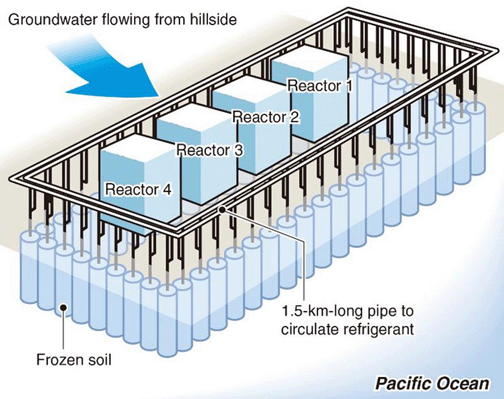
Fukushima Daiichi Frozen Wall Begins Freezing Operations http://www.fukuleaks.org/web/?p=14725 April 23rd, 2015 TEPCO’s contractors have begun the process of freezing the completed sections of the frozen wall. Blocks 1-8 are currently in the freezing process. Other sections are either still under construction or in the process of having the plumbing installed. The sections currently being frozen include the land side and north sides of the reactor building areas.
As workers’ radiation exposure count rises, shortage of labour predicted at Fukushima nuclear plant
 Fears grow over labour shortage at Fukushima nuclear plant, Power Engineering, 20/04/2015 By Tildy Bayar A labour shortage could be in the works for the decommissioning crew at Japan’s Fukushima No 1 nuclear power plant, analysts have warned, potentially putting the project at risk.
According to a weekend report in the Asahi Shimbun newspaper, an official at Japan’s Agency for Natural Resources and Energy said it is “unclear to some extent whether it will be possible to secure enough labour until the decommissioningprocess is completed”. At issue is the number of workers being forced to leave after reaching the legal limit for radiation exposure – 100 millisieverts in five years, or a maximum exposure rate of 50 millisieverts per year – set by the national Industrial Safety and Health Act. (The International Commission on Radiological Protection recommends that workers receive no more than 20 millisieverts per year over five years.)
Of the plant’s 14,000 registered workers, 174 have reportedly left the plant after reaching the legal limit, and 2081 have received between 50 and 100 millisieverts of exposure. Of the latter group, the Asahi Shimbun said “a majority” have been transferred to lower-exposure positions by their companies before reaching the limit, a common practice once an employee’s exposure reaches 20 millisieverts.
This leaves the coming work – including tasks which need to be carried out within the most radioactive parts of the plant – in doubt……….. Analysts say a long-term plan is needed to keep the project going for the 30-40 years that complete decommissioning is projected to take. Shigeaki Tsunoyama, who heads the Fukushima Prefectural Government’s safety advisory group, told the Asahi Shimbun that “decommissioning will stall” if too many experienced workers hit the exposure limit and leave or are transferred. “The government and Tepco have to take some steps as early as possible,” he warned.
One area being explored by Tepco is the replacement of human workers with robots in radioactive areas of the plant. So far, the utility says it has used robots equipped with cameras to explore the damage inside the reactors. “We are expecting to apply remote techniques further to the operations,” it stated, “such as the decontamination of the high-dose radiation area inside the reactor buildings and the removal of fuel debris from the reactor contaminant vessel or the reactor pressure vessel.”
Next on the agenda for Tepco is removing fuel rods from reactor 3’s spent fuel pool, which is planned to largely involve remote operations in order to limit workers’ exposure. However, some workers will be required to set up the necessary equipment. http://www.powerengineeringint.com/articles/2015/04/fears-grow-over-labour-shortage-at-fukushima-nuclear-plant.html
Drone supposedly containing radiation landed on Shinzo Abe’s roof
 Drone containing radiation lands on Japanese prime minister Shinzo Abe’s roof, Straight.com by Charlie Smith on April 22nd, 2015 Shortly after a Japanese court has approved restarting a shuttered nuclear power plant, an unmanned aerial vehicle landed on the roof of the prime minister’s home.
It has sparked discussions in Japan about the prospect of terrorists using drones to launch attacks during the 2020 Summer Games, which will be hosted in Tokyo.
The levels of radiation in this instance were not deemed harmful.
There’s no evidence at this point that the drone was placed there as a protest against Abe’s desire to restart nuclear reactors in Japan.
Public opinion is strongly against the use of nuclear power in Japan four years after a meltdown in Fukushima………
Tokyo police have reportedly revealed that there was a camera on the drone, which was decorated with a sticker carrying a symbol indicating it was radioactive.
“The police also said traces of radioactive cesium were detected on the roof near the drone, though it was unclear if they came from the drone,” the New York Timesreported. “Cesium is not usually found in nature, but large amounts of it were released into the atmosphere during the Fukushima nuclear disaster in 2011.” http://www.straight.com/news/435371/drone-containing-radiation-lands-japanese-prime-minister-shinzo-abes-roof
Court in south-west Japan rejects a residents’ injunction against restarting 2 nuclear power plants
 Japan moves nearer to restarting nuclear reactors after court gives go-ahead, Guardian, Justin McCurry in Tokyo, 22 Apr 15 Court in south-west Japan rejects a residents’ injunction against resuming operations at the Sendai power plant apan’s plans to return to nuclear power generation more than four years after the triple meltdown at Fukushima received a boost on Wednesday after a court approved the restart of two nuclear reactors.
The Kagoshima district court in south-west Japan rejected a residents’ injunction against restarting two reactors at the Sendai nuclear power plant, bringing the country a step closer to operating a nuclear reactor for the first time since September 2013.
The ruling comes a week after another court sided with concerned residents in a separate case by temporarily blocking the planned restart of two reactors at the Takahama plant on the Japan Sea coast, citing safety concerns.
Hiroyuki Kawai, head lawyer for the plaintiffs, described Wednesday’s ruling as “extremely regrettable”.
He added: “We will not give in, we will continue fighting. We will not let our emotions be swayed by any short-term results and we will fight until we get rid of all nuclear reactors in Japan.”……
Wednesday’s court decision leaves Kyushu Electric Power, the operator of Sendai nuclear power plant, with just one more regulatory obstacle to overcome before it can restart the two reactors, possibly as early as June.
Regulators have said they are “very close” to completing their review of the Sendai reactors’ safety regime.
Once the licensing procedures are complete, the two reactors, which were commissioned in the 1980s, would have to pass a final operational safety inspection before being switched back on, the NRA commissioner, Toyoshi Fuketa, said.
“We need to have a period for inspection and this is the first experience for Kyushu and for us,” he said. “It will take a certain time … it’s quite difficult to say.”
In the latest lawsuit, residents had argued that Kepco and regulators had underestimated the risk posed to the Sendai plant by nearby volcanoes, and that evacuation plans in the event of a Fukushima-type disaster were insufficient.
The plaintiffs said the “ability to predict eruptions is known to be inadequate”, adding there were “no grounds for Kepco’s assertion that the probability of a [volcanic] eruption is low”………
Kansai Electric Power, which serves the huge city of Osaka, faces legal challenges against four of its 11 reactors, and has said it would decommission two reactors.
Tokyo Electric Power, the operators of the ruined Fukushima Daiichi, is hoping to persuade local authorities to approve the restart of Kashiwazaki Kariwa, the world’s biggest nuclear power plant.
Chubu Electric Power, meanwhile, was forced to close its Hamaoka plant in May 2011 owing to its proximity to offshore tectonic plates. The plant is in a region that experts say is at risk of being struck by a powerful earthquake. http://www.theguardian.com/world/2015/apr/22/japan-moves-nearer-to-restarting-nuclear-reactors-after-court-gives-go-ahead
The demise of 2 robots inside the Fukushima nuclear disaster
These Robots Are Stranded Inside a Nuclear Disaster http://www.defenseone.com/technology/2015/04/these-robots-are-stranded-inside-nuclear-disaster/110683/ BY ADAM PASICKQUARTZ
This month, a Tokyo utility company sent two specially-designed robots on an ill-fated mission into the Fukushima nuclear disaster site to assess the damage.
Four years after an earthquake and tsunami destroyed Japan’s Fukushima nuclear plant, Tokyo Electric Power Co. is still at work trying to clean up the scene. This month TEPCOsent two specially-designed shape-shifting robots into the Fukushima No. 1 nuclear reactor to assess the damage.
Even if the robots hadn’t been damaged, a Pixar-style “WALL-E” ending was never in the cards: As IEEE Spectrum notes, the robots became so radioactive that they would have been permanently stored in a shielded box if they had returned from their missions.
The anonymous snakebots may be done for, but there is still a vast robot menagerie working on the Fukushima cleanup—including Quince, Packbot, Raccoon, and Rosemary
Japanese court to rule on injunction to block restart of 2 nuclear reactors
Japan nuclear ruling to show whether legal fight emboldened By Reuters | 21 Apr, 2015,KAGOSHIMA (JAPAN): A Japanese court will rule on Wednesday on an injunction to block the restart of two more nuclear reactors, a decision that could determine whether a legal drive by citizens to prevent the reopening of the sector on safety grounds will gather steam.
A court order preventing Kyushu Electric Power Co from operating Sendai would risk tying up the industry in legal battles for months or years.
Last week’s ruling “certainly sets a precedent and it will cause some of the other governors and other courts to think twice” about nuclear, said Michael Jones, Senior Analyst at consultancy Wood Mackenzie,
Local residents who submitted a suit against the restart of the restart of the Sendai reactors argue the utility and regulator has underestimated the risk of nearby volcanoes and operational plans lack credible evacuation measures. …….
Should the injunction request be rejected, as many expect, Japan’s biggest utilities still face the possibility of being forced to mothball their reactors amid mounting legal challenges, Jones said.
“It is not totally unreasonable to think that, to imagine, that the three largest utilities, Tepco, Chubu and Kans .. http://economictimes.indiatimes.com/articleshow/47004245.cms?utm_source=contentofinterest&utm_medium=text&utm_campaign=cppst
Fukushima radiation raises cancer risk for millions of people
Report says 32 million people in Japan are exposed to radiation from the Fukushima nuclear disaster (PRWEB UK) 11 March 2015 Geneva: Approximately 32 million people in Japan are affected by the radioactive fallout from the nuclear disaster in Fukushima, according to the 2015 Fukushima Report now available from Green Cross. This includes people who were exposed to radiation or other stress factors resulting from the accident, and who are consequently at potential risk from both long and short-term consequences.
The 2015 Fukushima Report is available for download in English at http://www.greencross.ch/en/news-info-en/case-studies/fukushima-report.html. Continue reading
1 This Month





PLEASE OPPOSE HR 8255 AND S.3639 – bills would accelerate satellite deployment, with no environmental review or safeguards – https://ncstd5li.quorum.us/campaign/169331/
To see nuclear-related stories in greater depth and intensity – go to https://nuclearinformation.wordpress.com
-
Archives
- October 2026 (49)
- September 2026 (339)
- August 2026 (330)
- July 2026 (355)
- June 2026 (287)
- May 2026 (306)
- April 2026 (356)
- March 2026 (251)
- February 2026 (267)
- January 2026 (308)
- December 2025 (358)
- November 2025 (359)
-
Categories
- 1
- 1 NUCLEAR ISSUES
- business and costs
- climate change
- culture and arts
- ENERGY
- environment
- health
- history
- indigenous issues
- Legal
- marketing of nuclear
- media
- opposition to nuclear
- PERSONAL STORIES
- politics
- politics international
- Religion and ethics
- safety
- secrets,lies and civil liberties
- spinbuster
- technology
- Uranium
- wastes
- weapons and war
- Women
- 2 WORLD
- ACTION
- AFRICA
- Atrocities
- AUSTRALIA
- Christina's notes
- Christina's themes
- culture and arts
- Events
- Fuk 2022
- Fuk 2023
- Fukushima 2017
- Fukushima 2018
- fukushima 2019
- Fukushima 2020
- Fukushima 2021
- general
- global warming
- Humour (God we need it)
- Nuclear
- RARE EARTHS
- Reference
- resources – print
- Resources -audiovicual
- Weekly Newsletter
- World
- World Nuclear
- YouTube
-
RSS
Entries RSS
Comments RSS

