Japan should move nuclear power into terminal phase
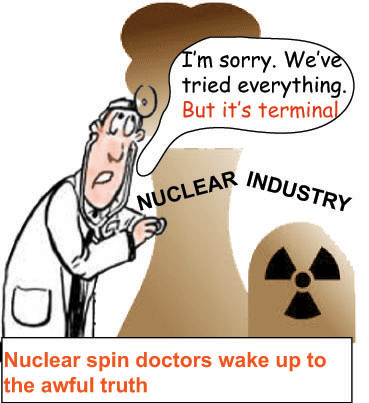
 The electric utilities would doubtless resist any plan to scrap the remaining reactors and reduce the nation’s dependence on nuclear power to zero, but they could probably be induced to go along if the authorities simultaneously drew up measures to cushion the financial blow. The government will also need to compensate localities for the loss of jobs and subsidies associated with the nuclear power plants by funding programs to foster the growth of other industries. Now is the time to plan for a shift from long-term nursing to end-of-life care for Japan’s unsustainable nuclear power industry.
- |The resumption of commercial operations at a nuclear power plant in Kagoshima Prefecture last September might seem to bode well for the comeback of nuclear energy in Japan after the nationwide shutdown precipitated by the 2011 Fukushima meltdown. But the author argues that the government’s policy of “long-term nursing care” for an unsustainable industry is merely delaying the inevitable while exposing the nation to unacceptable risks.

Dim Prospects and a Growing Burden
The obstacles to the industry’s revival will scarcely disappear after 2015. Fukushima Prefecture is lobbying to have all its remaining nuclear plants scrapped, and local opposition to resumption of operations predominates in Niigata Prefecture, Shizuoka Prefecture, and the village of Tōkai in Ibaraki Prefecture. Between them, these four locales account for 15 (about a third) of the nation’s nuclear reactors. Four other units (one at Japan Atomic Power’s Tsuruga plant, two at Hokuriku Electric’s Shika plant, and one at Tōhoku Electric’s Higashidōri facility) are facing likely decommissioning owing to earthquake hazards. Kansai Electric is appealing a May 2014 court order against restart of two reactors at its Ōi facility, and more unfavorable rulings are possible in the months ahead.
The electric utilities themselves are expected to scrap a number of older units in consideration of cost factors. Reactors are licensed to operate for no more than 40 years, and the upgrades required to win an extension under the new regulations would be prohibitively expensive in many cases. Five older reactors were officially retired for this reason last April (Kansai Electric’s Mihama-1 and Mihama-2, Japan Atomic Power’s Tsuruga-1, Chūgoku Electric’s Shimane-1, and Kyūshū Electric’s Genkai-1).
Even those facilities that make it back online face a tough road ahead. The Fukushima disaster has drastically altered the Japanese public’s perception of nuclear energy’s risks. Henceforth, every accident, issue, or natural disaster has the potential to cause an extended or permanent shutdown at any given plant. And the construction of new reactors is virtually out of the question.
The goal of returning to pre-Fukushima levels of nuclear power generation is quite simply out of reach. Japan currently has 43 operable nuclear reactors (excluding the five already decommissioned). Realistically, no more than half of these can be expected back online before 2020, and they will be under intense scrutiny as each new problem—both in Japan and overseas—calls their safety and viability into question once again.
Nuclear power imposes heavy cost burdens that can only grow in the years ahead. Thus far the government has borne the brunt of the costs and risks, nurturing the industry with subsidies to the host communities and prefectures, funding for research and development, and guaranteed assistance with compensation and cleanup costs in the event of an accident, while allowing the electric utilities to pass the costs of the nuclear fuel cycle to their customers. In today’s climate, this amounts to long-term nursing care for a terminally ill industry. An end to these lavish supports is the electric power industry’s worst nightmare……….
As noted above, the electric utilities cannot hope to restart more than about 20 of its reactors by 2020 under the best of conditions. It will not be difficult to shut down those 20 reactors by 2030.
The electric utilities would doubtless resist any plan to scrap the remaining reactors and reduce the nation’s dependence on nuclear power to zero, but they could probably be induced to go along if the authorities simultaneously drew up measures to cushion the financial blow. The government will also need to compensate localities for the loss of jobs and subsidies associated with the nuclear power plants by funding programs to foster the growth of other industries. Now is the time to plan for a shift from long-term nursing to end-of-life care for Japan’s unsustainable nuclear power industry. http://www.nippon.com/en/currents/d00200/
Japan’s new nuclear regulatory regime is inadequate

 Time to Stop Nursing the Nuclear Power Industry, nippon.com Yoshioka Hitoshi, 7 Dec 15 “……. Failings of the New Safety Standards
Despite the reforms instituted in the wake of the 2011 meltdown, the fundamental safety issues surrounding nuclear power in Japan remain unresolved.
The final report of the government’s Investigation Committee on the Accident at the Fukushima Nuclear Power Stations, along with a slew of outside reports, points to the culture of complacency that undermined Japan’s pre-2011 nuclear safety regime and left the country—with its high population density and high risk of natural disasters—vulnerable to a catastrophic accident. It was clear that the government needed to institute a far stronger regulatory regime if it wanted to resurrect Japan’s nuclear power program. In September 2012, it launched the Nuclear Regulation Authority, and in July 2013, the NRA adopted new safety standards for reactors in use at nuclear power stations.
Unfortunately, the new regulatory regime is also inadequate to ensure the safety of Japan’s nuclear power facilities.
The first problem is that the new safety standards on which the screening and inspection of facilities are to be based are simply too lax. While it is true that the new rules are based on international standards, the international standards themselves are predicated on the status quo. They have been set so as to be attainable by most of the reactors already in operation.
In essence, the NRA made sure that all Japan’s existing reactors would be able to meet the new standards with the help of affordable piecemeal modifications—back-fitting, in other words. In practice, they need only to add a new layer of emergency management and some back-up equipment to meet the new standards for emergency preparedness. The estimates for earthquake intensity and tsunami height in each locale have been revised upward, but not to the point where they would necessitate fundamental design changes.
The second basic problem is that the new standards do not cover all the levels of “defense in depth” advocated by the International Atomic Energy Agency in its seven-stage International Nuclear Events Scale. They extend only as far as Level 4 (“control of severe conditions including prevention of accident progression and mitigation of the consequences of a severe accident”), stopping short of Level 5 requirements for responding to accidents that threaten the surrounding area through significant release of radioactive materials.
Under the Act on Special Measures Concerning Nuclear Emergency Preparedness, the prefectural and municipal governments within a 30-kilometer radius of a nuclear power facility are given full responsibility for emergency preparedness and evacuation planning geared to nuclear accidents with wider consequences, whose impact extends beyond the confines of the plant compound. Under the law, the plans must incorporate all items on a mandated checklist, but they are not subject to any outside review. The NRA does not view local preparedness or evacuation plans for a nuclear disaster as part of its regulatory regime.http://www.nippon.com/en/currents/d00200/
Fukushima nuclear disaster – still not understood, still not under control
Time to Stop Nursing the Nuclear Power Industry, nippon.com Yoshioka Hitoshi “….Fukushima’s Ongoing Disaster The risks attached to nuclear power are of a completely different magnitude from those associated with other civilian technologies. A nuclear accident can cause catastrophic damage extending over a vast area and persisting for many years. As of September 2015, the number of people displaced by the Fukushima accident stood at 107,700. Damages from the accident have already reached ¥11 trillion, and the final tally will doubtless soar to several times that amount. Moreover, the safety problems at the Fukushima Daiichi Nuclear Power Plant have yet to be resolved.
The three basic conditions for controlling a nuclear accident are stopping the chain reaction, cooling the fuel, and containing the radioactive material. By these criteria, the Fukushima accident has yet to be brought under control after more than four years. The water-injection system used to cool the molten fuel has been plagued by reliability issues. As for containment, the radioactive materials spewed over a vast area during the accident can never be recovered, nor can the radioactive wastewater that has been discharged into the ocean. Furthermore, workers have been unable to pinpoint the location of the highly radioactive fuel that leaked out of the reactors during the meltdown.
In many respects, the progress and causes of the accident remain unclear to this day. Without knowing these things, how can we institute effective safety measures to ensure that such accidents will not occur in the future?http://www.nippon.com/en/currents/d00200/
Japan’s nuclear regulatory body investigating spent nuclear fuel containers
 Regulator probes fuel container strength at Fukushima nuclear plant http://www.japantoday.com/category/national/view/regulator-probes-fuel-container-strength-at-fukushima-nuclear-plantDEC. 06, 2015 -TOKYO — Japan’s nuclear regulatory body has launched an investigation into metallic spent fuel containers at Tokyo Electric Power Co’s Fukushima Daiichi nuclear plant as they may not have sufficient strength.
Members of the Nuclear Regulation Authority raised the issue Friday at a meeting to discuss nuclear safety problems. The body will examine whether the containers made by Kobe Steel Ltd are safe for long-term use.
The nuclear regulation watchdog said it will also launch a probe at Japan Atomic Power Co’s Tokai No. 2 nuclear power plant in Ibaraki Prefecture as the same type of fuel container may be used there.
The fuel storages meet strength criteria set by the Japan Society of Mechanical Engineers. But the metal plates inside them may not be strong enough for use in storing nuclear spent fuel.
TEPCO said it believes the strength of the containers meets the NRA’s safety standards.
Japan’s Nuclear Regulatory Authority fails to conduct on-site checks for plant cables
NRA fails to conduct on-site checks for nuclear plant cables, Japan Times, 5 Dec 15 The Nuclear Regulation Authority failed to conduct on-site inspections to determine if safety equipment cables were installed separately from other cables at nuclear power plants during the safety screening process required for the restart of reactors, it was learned Saturday.
The revelation came to light when it was recently revealed that safety cables at nuclear facilities, including Tokyo Electric Power Co.’s Kashiwazaki-Kariwa plant in Niigata Prefecture, were not separated from other cables, a violation of the new nuclear safety standards introduced in July 2013.
The nuclear safety watchdog’s oversight also includes cables installed for reactors that have already passed safety screenings, including those at Kyushu Electric Power Co.’s Sendai plant in Kagoshima Prefecture.
At all seven reactors at the Kashiwazaki-Kariwa plant, many safety-related cables, including those used to transmit data from water meters and for water injection operations, were found combined with other cables. The seven units are all boiling-water reactors…….
In pre-restart reactor inspections, the NRA does not check to see if safety cables are separated, although inspections are done for fire-extinguishing and other equipment, the officials added.
At the Kashiwazaki-Kariwa plant, the problem cables were first found under the central control rooms for the No. 1 to No. 7 reactors.
The NRA then asked other power companies with boiling-water reactors to check and report if they had similar issues. Power utilities with pressurized-water reactors were also asked to report.
At the Kashiwazaki-Kariwa reactor, mixed cables were found in areas outside the central control rooms.
“At present, we can’t deny the possibility that safety and other cables are mixed at pressurized-water reactors, but how to handle the problem has yet to be decided,” an official at the NRA said. “First, we’ll analyze the report from Tepco.”
Of pressurized-water reactors in Japan, the No. 1 and the No. 2 reactors at the Sendai power plant resumed operations in August and October, respectively.
The No. 3 and No. 4 reactors at Kansai Electric Power Co.’s Takahama plant in Fukui Prefecture, central Japan, and the No. 3 reactor at Shikoku Electric Power Co.’s Ikata plant in Ehime Prefecture have also passed NRA safety screenings. http://www.japantimes.co.jp/news/2015/12/05/national/nra-fails-to-conduct-on-site-checks-for-nuclear-plant-cables/#.VmNeVtJ97Gg
JIJI
Japan’s PM Abe visiting India to market nuclear reactors

 Ahead of PM Abe’s visit, India-Japan racing to seal nuclear pact http://www.hindustantimes.com/india/ahead-of-pm-abe-s-visit-india-japan-racing-to-seal-nuclear-pact/story-TwhHbjC7kPuNYNSWoU6iUK.html Jayanth Jacob, Hindustan Times, New Delhi Dec 04, 2015
India and Japan are working to seal a nuclear pact during the visit of Prime Minister Shinzo Abe from December 11-13 for the annual summit between the two countries.
“We hope it will be a done deal this time. But considering the complex nature of negotiations that mark the civil nuclear agreements till the last moment, we should be guided by caution till the pact is finally sealed,” said a senior official.
Japanese firms play a crucial role in the US and French nuclear industries. An Indo-Japanese pact is crucial for fully realising the ongoing civilian nuclear cooperation India has with these two countries. Japanese forging major, Japan Steel Works (JSW), is a supplier of the critical reactor equipment of reactor pressure vessel for most firms worldwide.
But the sides have to agree upon the text of the agreement that will satisfy both countries. Nuclear issue is a sensitive one in Japan — the only country to have suffered a nuclear attack. For instance, Japan wants explicit commitment on testing clauses —the deal will be off in event of a nuclear test by India. India says this touches upon the issue of ‘strategic autonomy’, which is outside the purview of civil nuclear pact that the country has been negotiating with Japan.
But sources said Japan has stopped pressuring India into signing the non-proliferation treaty (NPT) that New Delhi finds discriminatory.
Abe will visit Varnasai, the constituency of PM Narendra Modi who is likely to accompany him on the visit.
Troubling indications of recurring nuclear criticality at Fukushima Daiichi
 Former Japan Ambassador: Uncontrolled nuclear chain reactions could be underway at Fukushima — “Troubling indications of recurring criticality” as Tellurium-132 detected over 100 miles from plant — ‘Recriticality’ discussed by Japan’s top nuclear official http://enenews.com/former-japan-ambassador-uncontrolled-nuclear-chain-reactions-suspected-fukushima-troubling-indications-recurring-criticality-tellurium-132-detected-100-miles-plant-recriticality-issue-discussed
Japan Times, Nov 4, 2015 (emphasis added): The former Japanese ambassador to Switzerland,Mitsuhei Murata, recently suggested that Japan should stage an ‘honorable retreat’ from hosting the 2020 Olympics due to the unpredictable situation at the crippled Fukushima No. 1 nuclear power plant.
Japan Times (Hotline to Nagatacho — Brian Victoria, Kyoto), Nov 4, 2015: [F]ormer Japanese ambassador to Switzerland, Mitsuhei Murata, recently proposed… for Japan to stage an “honorable retreat” from hosting the 2020 Olympics… [I]n the September issue of Gekkan Nippon, Murata… noted the danger still posed by large numbers of spent fuel rods suspended in spent fuel pools in reactors 1, 2 and 3 [which] can’t be removed from the damaged reactor buildings due to the high levels of radioactivity surrounding these reactors… Murata’s gravest concern is a number of troubling indications of recurring criticality [ i.e. uncontrolled nuclear chain reactions] in one or more of the reactors at Fukushima No. 1. For example, he notes that in December 2014, both radioactive iodine-131 and tellurium-132 were reported as having been detected in Takasaki city, Gunma Prefecture [~130 miles SW of Fukushima Daiichi]. Given the short half-lives of these radioactive particles, their presence could not be the result of the original meltdowns at Fukushima.
Ambassador Murata to Dr. Thomas Bach (President of the International Olympic Committee), Jun 15, 2015: Allow me to send you a letter, motivated by my sense of mission to inform you of the worsening situation in Fukushima, which regrettably is being downplayed by our Government and does not seem to be well known internationally… Contrary to the assurances of the Japanese Government and [TEPCO], the situation at the site of the Fukushima Daiichi Nuclear Power Plant is not at all under control… Not only do we have a continued contamination of the groundwater and the Pacific Ocean… but the brittle structure of the damaged plant represents itself a serious threat, in particular in our earthquake prone region.
Ambassador Murata to Susana Malcorra (United Nations Chef de Cabinet), Aug 27, 2015: I am sending you my fourth message to President Bach of The IOC. I inform him of my message addressed to Prime Minister Abe. In my message… I ask for the first concrete international cooperation concerning the method of cooling spent fuel rods making use of zinc instead of water. This is crucially important. The Pacific Ocean is more and more contaminated with the daily release of more than 300 tons radioactive groundwater. I remind Prime Minister Abe that the decision to retreat from the Tokyo Olympic Games and carry out an international verification of the suspected re-criticality is urgently needed… My interview article was published in the magazine “Monthly Japan” (September). The article entitled “An honorable retreat from the Tokyo Olympic Games” is given a central place. Reactions are noteworthy and encouraging. Conscientious citizens start questioning the integrity of the IOC. Please convey my warmest greetings to Secretary-General Ban-kimoon.
Interestingly, two weeks ago the head of Japan’s Nuclear Regulation Authority addressed the recriticality issue:
Fukushima Minpo, Oct 20, 2015: Nuclear regulator chief says Fukushima Daiichi recriticality“physically impossible” — Shunichi Tanaka, chairman of the Nuclear Regulation Authority, visited the Minamisoma city government for talks with Mayor Katsunobu Sakurai on Oct. 22. Regarding Tokyo Electric Power Co.’s crippled Fukushima Daiichi nuclear power plant, Tanaka said, “We are no longer in a situation that prevents residents from returning (to their evacuated hometowns). Recriticality is physically impossible.”
Despite bribes offered, 47 Prefectures not keen to host Japan’s 166,000 tons of nuclear waste
Japan’s 166,000 tons of nuclear waste still waiting to be buried, Digital Journal, By Karen Graham 29 Nov 15 In a survey conducted last month by the Kyodo News survey, none of the 47 prefectures showed much interest in hosting a nuclear waste dump site, with 14 saying “absolutely no.”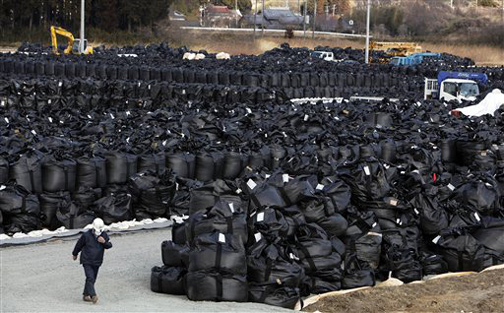
Being that the government considered the situation an “emergency,” temporary sites were set up in a number of prefectures, with the government promising landowners to only lease the land for a period of two years. The waste has been stored in polyvinyl buildings.
But the government has reneged on those promises. Shigetaro Chiba, a 73-year-old farmer who leased land to the government for two years, said, “I was made to agree to extend the lease after the initial two-year period promised by the government expired. The new contract no longer specifies a deadline.”
In 2014, the Nuclear Waste Management Organization (NUMO) started work on updating guidelines, as well as working to design, construct, and operate an underground storage facility nearly 4 square miles in area, which would be operated for 50 years and monitored for an additional 300 years before being shut down.
Work on updated guidelines for a nuclear waste site
NUMO is funded by every power company in Japan that has nuclear power plants, with their fees based on how much radioactive waste they produce each year. The agency has worked on getting communities to express interest in a waste disposal site, but have had no takers despite being told they would receive billions in subsidies.
‘NO to nuclear waste dumping’ say 13 Japanese Prefectures
 Thirteen prefectures say no to hosting nuclear waste depository, Japan Times, 29 Nov 15 KYODO A total of 13 out of the nation’s 47 prefectures say they would refuse to host a final disposal site for highly radioactive nuclear waste, a Kyodo News survey showed Saturday.
In the survey conducted between late October and early November, 13 local governments said they would “never accept” such a facility, eight sounded negative, while 24 declined to clarify their position and two said they will “carefully consider the possibility.” None showed a positive stance toward hosting the site.
In May, the government introduced a plan in which it will choose candidate sites for burying high-level radioactive waste based on scientific analysis, rather than waiting for municipalities to express a willingness to host a final depository.
The change of policy reflects the lack of progress made in the process of soliciting candidate sites that began in 2002 due to safety concerns.
For permanent disposal, high-level nuclear waste needs to be stored in a final depository more than 300 meters underground for up to 100,000 years until radiation levels fall and it no longer poses a threat to humans and the environment.
Among the 13 prefectures opposed to accommodating a disposal site, four host nuclear power plants…….http://www.japantimes.co.jp/news/2015/11/29/national/thirteen-prefectures-say-no-hosting-nuclear-waste-depository/#.VltoWNIrLGh
Fukushima: pressure of groundwater causing underground wall around reactors to lean and crack
TV: Underground wall around Fukushima reactors started “leaning” — Cracks developing due to rising water levels — Problems seen along almost entire length of sea wall — Trying to make repairs to keep groundwater from surging (VIDEO) http://enenews.com/nhk-underground-wall-around-fukushima-reactors-started-lean-rising-water-levels-causing-cracks-develop-problems-occuring-along-almost-entire-length-sea-wall-tepco-trying-make-repairs-keep-gro?utm_source=feedburner&utm_medium=email&utm_campaign=Feed%3A+ENENews+%28Energy+News%29
NHK World, Nov 25, 2015 (emphasis added): Groundwater wall at Fukushima plant leans slightly — The operator of the damaged Fukushima Daiichi nuclear plant has found that a wall it built 30 meters into the ground to block the flow of radioactive water is leaning slightly. {TEPCO] built the steel barrier along a coastal embankment to stop contaminated groundwater from seeping into the sea… TEPCO inspectors found that the wall is leaning up to some 20 centimeters toward the sea. They say this is due to the pressure of the groundwater flow. The officials also blamed rising groundwater levels for cracks found in the embankment’s pavement. The utility says workers are buttressing the wall with steel pillars…
NHK (Google translation), Nov 25, 2015: In TEPCO Fukushima Daiichi nuclear power plant, it can be seen that the equipment called “impervious wall”, which was completed last month in order to reduce the outflow of the contaminated groundwater, are slightly tilted to the sea side… [T]he pavement of the seawall also cracked… When depends on the Tokyo Electric Power Company, after the “impervious wall” has been completed, it is that it’s because thewater level of the land side of the groundwater is rising.
Fukushima Minyu Shimbun (Google translation), Nov 26, 2015: … sea side wall is inclined about 20 centimeters at the maximum to the sea side, cracks of up to about 1 centimeter has occurred in the pavement of the seawall. That inclination and cracks have occurred in almost the entire sea side wall… TEPCO, rain water enters the cracks of the pavement, so that the groundwater does not surge, is promoting the repair to block the cracks spraying resin.
Nuclear giants AREVA and Hitachi to help dismantle Japan’s nuclear recators
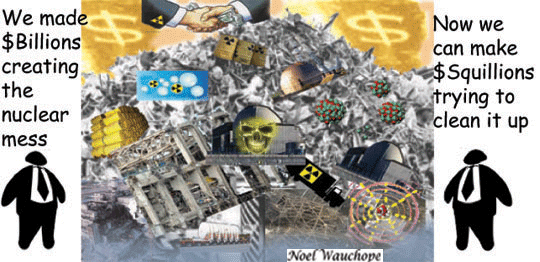
Areva was involved in the Fukushima clean-up, but that reactor is not covered by the new agreement, the French group said in a statement. It has been working with Hitachi to improve Japanese reactors’ safety for the past two years.
Areva’s role will now be to participate in preliminary studies for dismantling boiling-water reactors.
Prime Minister Shinzo Abe’s government has been pushing for a return to nuclear power to generate electricity after Japan’s several dozen reactors went offline in the wake of the 2011 disaster.
The resource-poor nation’s energy bill has soared since it was forced to turn to fossil-fuel imports to plug the gap.
But the Japanese public remains wary of atomic power, and Abe’s push has prompted rare protests and damaged his popularity.
Declaration of the World Nuclear Victims Forum in Hiroshima
The world nuclear victims forum was held at Hiroshima.
“A charter of world Nuclear Victim’s rights” was adopted. https://www.facebook.com/permalink.php?story_fbid=10154396267119937&id=685379936
世界核被害者フォーラム
Declaration of the World Nuclear Victims Forum in Hiroshima
(Draft Elements of a Charter of World Nuclear Victims’ Rights)
November 23, 2015
1. We, participants in the World Nuclear Victims Forum, gathered in Hiroshima from November 21 to 23 in 2015, 70 years after the atomic bombings by the US government.
2. We define the rights of nuclear victims in the narrow sense of not distinguishing between victims of military and industrial nuclear use, including victims of the atomic bombings in Hiroshima and Nagasaki and of nuclear testing, as well as victims of exposure to radiation and radioactive contamination created by the entire process including uranium mining and milling, and nuclear development, use and waste. In the broad sense, we confirm that until we end the nuclear age, any person anywhere could at any time become a victim=a Hibakusha, and that nuclear weapons, nuclear power and humanity cannot coexist.
3. We recall that the radiation, heat and blast of the atomic bombings of Hiroshima and Nagasaki sacrificed not only Japanese but also Koreans, Chinese, Taiwanese and people from other countries there as a result of Japan’s colonization and invasion, and Allied prisoners of war. Continue reading
In Japan, the “Nuclear Village” is in charge again
In Japan the propaganda warfare took a more sinister turn blaming the victims for their predicament. Japanese newspaper Asahi Shimbun that is closely connected to Japan’s ruling elite has run a series of articles on “radiophobia”, attributing health complaints of the affected to psychological and emotional stress.
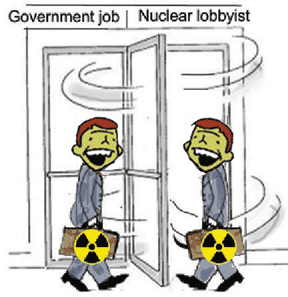 The long standing and corrupt practice of “amakudari” -“descent from heaven” which led to the capture of regulators by the regulated in form of career revolving doors has made any meaningful reform a pipe dream.
The Fukushima disease: Creation of virtual world based on radioactive reality,Rt.com 24 Nov 15 Derek Monroe “…………”We are in a difficult position that we made ourselves reliable on nuclear energy first and then were hurt by it,” said a local Minamisoma city employee who asked to remain anonymous as he was not authorized to talk to the media. “Many people here had good jobs and good lives and when the nuclear accident happened this came to a complete halt,” he said. The city’s website now is very optimistic in its proclamation of moving forward without nuclear power, despite the central government’s move to the contrary. The government in Tokyo has decided what is best for the citizens of Minamisoma and all of Japan.

Furthermore, nuclear power is back in charge as if it never left. Nationalist Prime Minister Abe Shinzo’s administration is another one anointed by “kempatsu mura” – “the nuclear village”, power and money complex that has been a steady fixture in the history of modern Japan. In 2012, Tokyo’s Waseda University researcher Tetsuo Arima disclosed declassified CIA documents dating to the 1950s. It was revealed that the long time kingmaker of Japanese politics, Matsutaro Shoriki and head of the country’s most powerful Yomiuri Shimbun media empire, worked hand in hand with the CIA to popularize nuclear energy as way for the future. Despite its peaceful angle and spin thrown onto the Japanese public that was still traumatized within a generation of the Hiroshima and Nagasaki bombings, Shoriki insisted the way to a successful future would have to include Japan’s nuclear armament………..
The long standing and corrupt practice of “amakudari” –“descent from heaven” which led to the capture of regulators by the regulated in form of career revolving doors has made any meaningful reform a pipe dream. This ultimately allowed the Tokyo Power Company (TEPCO), Japan’s largest utility, to defeat any efforts to improve plant safety as it would cost it too much money to comply with increased regulatory requirements. ………..
In Britain the government together with the industry decided on a strategy to spin the information released to the public as to avert a backlash against nuclear energy experienced in Germany as result of the disaster in Japan.
In Japan the propaganda warfare took a more sinister turn blaming the victims for their predicament. Japanese newspaper Asahi Shimbun that is closely connected to Japan’s ruling elite has run a series of articles on “radiophobia”, attributing health complaints of the affected to psychological and emotional stress. Ironically the same took place during a period of “radiophobia” scare doled out by medical professionals and nuclear experts in the Soviet Union after the Chernobyl disaster. Their fears and concerns were met with explanation that the victims were subjected and suffered from fear of radiation rather than the radiation itself. University of California anthropologist Adriana Petryna’s ethnographic study of the Chernobyl medical assessment and compensation system shown it was biased against the victims and politically manipulated. The same now applies to the case of Fukushima disaster victims as the more sophisticated forms of manipulation employing intrinsically Japanese traits of shame and group think are now used to shift the effects of the disaster onto victims’ own sense of responsibility. This allows the system to move on and not take responsibility for what transpired while using the cultural trait of the population’s acquiescence as a catalyst for its de facto forced amnesia.
Looking at the Japanese media and governmental space that work hand in hand to obfuscate its responsibility to inform, the truth of the matter is : the technology to decommission melted reactors doesn’t exist and the most optimistic scenario of final solution to the crisis is pure fiction.
As the country’s political establishment is readying itself to host the 2020 Olympics in Tokyo for which there is no public money or popular support whatsoever, the nuclear sword of Damocles will be hanging over it. The negligence and incompetence bordering on willful disregard for lives of its citizens makes the Japanese government a perfect candidate for prosecution under the crimes against humanity statues. Its handling of the Fukushima crisis puts into doubt Japanese credentials as a real democracy that is able and willing to address its citizens’ needs instead of using them as fodder for obscene corporate profits and foreign policy gamesmanship.
As a result Fukushima is worse than Chernobyl in many respects, making the difference between both political systems only a semantic one at best.
Japan Red Cross declined to be interviewed for the story.
Japanese Government did not respond to questions about its propaganda funding.
Chicago Tribune did not respond to request for interview.
Greg Burns did not respond to request for interview.
TEPCO did not respond to request for interview.
Japan Times did not respond to request for interview. https://www.rt.com/op-edge/323105-japan-fukushima-nuclear-disaster/
Japan to step up radiation protection, as worker’s leukaemia attributed to radiation
 Leukemia case recognized Last month, the Health, Labor and Welfare Ministry acknowledged a man in his 40s who developed leukemia after working at the Fukushima plant as a sufferer of work-related illness. He was the first decommissioning worker to be recognized as such.
Appropriate radiation control vital for Fukushima decommissioning http://the-japan-news.com/news/article/0002580144, November 22, 2015 The Yomiuri Shimbun It will take about 40 years to decommission reactors at Tokyo Electric Power Co.’s Fukushima No. 1 nuclear power plant. To secure the personnel necessary for that task, it is important to thoroughly safeguard the health of such personnel.
TEPCO has started stepping up its safety measures. The utility has established a consultative body in cooperation with subcontracting firms that dispatch personnel to the plant, thereby increasing the frequency of visits and inspections at their work sites. Measures also include expanding worker safety education. These steps are in keeping with a set of safety guidelines laid down by the government in late August.
An average of about 7,000 personnel work at the Fukushima facility every day, and not a small number of accidents tied to construction and other work have occurred. We hope TEPCO will comprehensively improve the work environment of these personnel.
It is particularly important to reduce the workers’ radioactive exposure. Continue reading
Japan ramps up its evacuation rules for nuclear ship accidents
 Evacuation rules revised for nuclear vessel accidents http://www.
japantimes.co.jp/news/2015/11/20/national/science-health/evacuation-rules-revised-for-nuclear-vessel-accidents/#.Vk-NWdIrLGh KYODO The government on Friday lowered the threshold for evacuating residents during accidents on nuclear vessels, bringing it in line with accidents at atomic power plants.
Under the new rules, residents will begin evacuating when radiation exceeds 5 microsieverts per hour in areas near nuclear-powered aircraft carriers or submarines — significantly lower than the previous 100 microsieverts per hour.The government also revised its emergency manual to reflect the change, and local authorities will now order or advise residents to leave based on the new rules.
Cities hosting U.S. Marine Corps bases with nuclear vessels are Yokosuka, Kanagawa Prefecture, Sasebo, Nagasaki Prefecture, and Uruma, Okinawa Prefecture.
The Cabinet Office had been working to revise the standards after disaster management minister Taro Kono instructed it to do so last month.
The government is also eyeing further amendments since discrepancies between nuclear vessel accidents and nuclear plant accidents still exist.
For example, people within a 30-km radius of a nuclear plant are urged to stay indoors during an accident, while only those within a 3-km radius of a nuclear vessel accident are urged to do so.
The rules for power plant accidents were revised in the wake of the 2011 Fukushima disaster.
1 This Month




PLEASE OPPOSE HR 8255 AND S.3639 – bills would accelerate satellite deployment, with no environmental review or safeguards – https://ncstd5li.quorum.us/campaign/169331/
To see nuclear-related stories in greater depth and intensity – go to https://nuclearinformation.wordpress.com
-
Archives
- September 2026 (339)
- August 2026 (330)
- July 2026 (355)
- June 2026 (287)
- May 2026 (306)
- April 2026 (356)
- March 2026 (251)
- February 2026 (267)
- January 2026 (308)
- December 2025 (358)
- November 2025 (359)
- October 2025 (375)
-
Categories
- 1
- 1 NUCLEAR ISSUES
- business and costs
- climate change
- culture and arts
- ENERGY
- environment
- health
- history
- indigenous issues
- Legal
- marketing of nuclear
- media
- opposition to nuclear
- PERSONAL STORIES
- politics
- politics international
- Religion and ethics
- safety
- secrets,lies and civil liberties
- spinbuster
- technology
- Uranium
- wastes
- weapons and war
- Women
- 2 WORLD
- ACTION
- AFRICA
- Atrocities
- AUSTRALIA
- Christina's notes
- Christina's themes
- culture and arts
- Events
- Fuk 2022
- Fuk 2023
- Fukushima 2017
- Fukushima 2018
- fukushima 2019
- Fukushima 2020
- Fukushima 2021
- general
- global warming
- Humour (God we need it)
- Nuclear
- RARE EARTHS
- Reference
- resources – print
- Resources -audiovicual
- Weekly Newsletter
- World
- World Nuclear
- YouTube
-
RSS
Entries RSS
Comments RSS

