Japanese fishing industry leader is “greatly concerned” over the pending disharge of Fukushima radioactive water into the ocean.

The leader of a Japanese fisheries industry group told officials on Monday
he was “greatly concerned” about the discharge of treated radioactive water
set to be released into the sea from the wrecked Fukushima nuclear plant.
The government is expected to decide soon, perhaps within days, when to
start releasing the water, equivalent to the contents of 500 Olympic-size
swimming pools, despite objections at home and abroad to the plan.
Reuters 21st Aug 2023
Poisoning the planet
Radioactive water dump is just latest example our reckless destruction of habitat
By Linda Pentz Gunter, 20 Aug 23, https://beyondnuclearinternational.org/2023/08/20/poisoning-the-planet/
Much has been made — and rightly so — about the potential impact on human health and the Japanese fishing industry if Japan moves forward with its proposal to dump 1.2 million cubic meters — that’s 1.3 million tons —of radioactively contaminated water into the Pacific Ocean from the destroyed Fukushima Daiichi nuclear power plant site.
Unfortunately, this looks likely to happen sometime this month or next despite the worldwide outcry. But when I say “happen”, that rather suggests a one-off dump. Instead, the discharge of these liquid nuclear wastes could go on for at least 17 years according to the Atomic Energy Society of Japan, but likely longer as decommissioning work at the site is expected to take at least 30-40 years.
It is perfectly right and reasonable that the Japanese fishing community sees its livelihood under threat from this proposal. Indeed, it has already taken a hit, as imports of Japanese fish stock to South Korea were down by 30% in May, before the dumping even began. This was clearly driven by jitters around the on-going safety of Japanese fish supplies once those radioactive discharges get underway.
And Pacific Island nations, along with an international team of scientific experts, have equally decried the plan as premature, unnecessary and in need of far greater confidence and further study before such discharges are executed, if ever.
But there is a greater moral issue here, one that speaks to humankind’s reckless and selfish behavior on planet Earth ever since mechanization and the various so-called industrial revolutions began.
For almost three centuries in the developed world, we have continuously and wantonly destroyed vast areas of precious habitat for numerous species. We have clear cut forests, sliced the tops off mountains, broken open the earth to mine minerals, exploded atomic weapons, spewed mercury and carbon into our air, drilled for oil, sprayed pesticides at will and filled the oceans with plastics, to name just a few environmental atrocities.
The toxic mess these activities leave behind has been dumped into rivers, streams, lakes and oceans, or on the lands where the less influential and powerful amongst us live — in the United States almost always in communities of color or on Native American reservations.
One of the worst offenders on this list is nuclear waste. In keeping with our heedless irresponsibility we have kept making lethal radioactive waste without the slightest idea how to safely manage or store it for the longterm. For years, barrels of the stuff were dumped into the sea, until a 1994 amendment to the London Dumping Convention, put an end to it.
But of course the nuclear industry found a way around this. Routine liquid discharges through a pipe circumvented this law. Institutions such as the LaHague reprocessing site on the northern French coast, have discharged radioactive liquids (and gases) for decades. Didier Anger, the now retired expert activist on the environmental crimes at La Hague, uses this history to warn us urgently and eloquently of the folly of discharging nuclear waste into our oceans.
At times, the liquid wastes from La Hague, measured at the discharge point by vigilant groups such as Greenpeace, could have been classified as high-level radioactive waste that would normally require a deep geological repository.
As we approach the moment when radioactive liquids are once more poured into the sea, this time in Japan, imposing a toxic burden on the creatures who are already struggling to survive there, we must ask whether human beings have some sort of divine right of kings to trash the habitat of other living things?
The answer should surely be ‘no’. That humans can generate a radioactive mess and “dispose” of it into some other creatures’ habitat, poisoning their environment is, frankly, both arrogant and abhorrent.
We have already done this everywhere and it has come with a terrible price to other creatures as well as to ourselves. The destruction and contamination of habitat has led to mass extinctions. The US has lost three billion birds since 1970. That’s one in four birds. We may have thought the birds were back in abundance during the start of the covid pandemic, but that was just us hearing what’s left of them more clearly, in the quiet of lockdown.
Bees, who perform around 80% of all pollination, are dying out and hives collapsing, all due to human activities. These include pesticides, drought, habitat destruction, nutrition deficit, air pollution, and, of course, the climate crisis.
Absent these and other essential members of the web of life, our own extinction is not far behind.
We need to stop this behavior and we need to stop it now. We should do it not only for ourselves but for the countless innocent creatures who should not be expected to offer up their homes as our dustbins.
Loading up the Pacific Ocean with liquid radioactive waste — whether it dilutes and disperses or not — is a crime of immorality representative of so many that have come before. If we are truly to change our plundering, polluting and profligate ways, banning the radioactive water dump at Fukushima would be an excellent place to start.
Linda Pentz Gunter is the international specialist at Beyond Nuclear and writes for and curates Beyond Nuclear International.
Japan’s nuclear plants are short of storage for spent fuel. A remote town could have the solution.
Chugoku Electric’s plan to build a nuclear power plant in Kaminoseki has been stalled for more than a decade since the Fukushima Daiichi disaster, delaying subsidies for the remote town, whose population is aging and shrinking.
“The town will only get poorer if we just keep waiting,” Kaminoseki Mayor Tetsuo Nishi – “We should do whatever is available now.”
ByMARI YAMAGUCHI Associated Press, https://abcnews.go.com/Business/wireStory/japans-nuclear-plants-short-storage-spent-fuel-remote-102373016 August 19, 2023
TOKYO — A Japanese town said Friday it has agreed to a geological study to determine its suitability as an interim storage site for spent nuclear fuel.
Kaminoseki, a small town in the southwestern prefecture of Yamaguchi, said it would accept the offer of a survey by Chugoku Electric Power Co., one of two major utility operators, along with Kansai Electric Power Co., whose spent fuel storage pools are almost full.
The Japanese government is promoting the greater use of nuclear power as a low-carbon energy source, but the country’s nuclear plants are running out of storage capacity.
The problem stems from Japan’s stalled nuclear fuel recycling program to reprocess plutonium from spent fuel for reuse. The government has continued to pursue the program, despite serious technical setbacks. A plutonium-burning Monju reactor failed and is being decommissioned, while the launch of the Rokkasho reprocessing plant in northern Japan has been delayed for almost 30 years.
After the meltdown of the Fukushima Daiichi nuclear power plant in 2011, many reactors were temporarily taken offline and their restarts delayed, helping to reduce the spent fuel stockpile.
However, when Prime Minister Fumio Kishida’s government decided to reverse a phaseout and maximize nuclear power as clean energy, concerns over the lack of storage space were rekindled.
Earlier this month, Chugoku put forward a proposal to build a storage facility jointly with Kansai Electric, but the plan was met by angry protests from residents, who surrounded the mayor and yelled at him.
Chugoku Electric’s plan to build a nuclear power plant in Kaminoseki has been stalled for more than a decade since the Fukushima Daiichi disaster, delaying subsidies for the remote town, whose population is aging and shrinking.
“The town will only get poorer if we just keep waiting,” Kaminoseki Mayor Tetsuo Nishi told a televised news conference Friday. “We should do whatever is available now.”
Kansai Electric, Japan’s largest nuclear plant operator, is urgently seeking additional storage for spent fuel: the cooling pools at its plants are more than 80% full. The company pledged to find a potential interim storage site by the end of this year.
About 19,000 tons of spent fuel, a byproduct of nuclear power generation, is stored at power plants across Japan, taking up about 80% of their storage capacity, according to the economy and industry ministry.
The continuation of spent fuel reprocessing program and the delay have only added to Japan’s already large plutonium stockpile, raising international concern. Japan also lacks a final repository for high-level nuclear waste.
An intermediate facility is designed to keep nuclear spent fuel in dry casks for decades until it is moved to a reprocessing or to a final repository. Experts say it is a much safer option than keeping it in uncovered cooling pools at their plants.
If the storage is actually built, it will be the second such facility in Japan. The only other one is in Mutsu, near Rokkasho, which is reserved for Tokyo Electric Power Co. and a smaller utility.
Japan mothers’ group fears Fukushima water release could revive health concerns
By Kiyoshi Takenaka, Akiko Okamoto and Tom Bateman, August 18, 2023
IWAKI, Japan, Aug 17 (Reuters) – Waves crashing on a Japanese beach lashed a man and a woman wearing waders and hats as they demonstrated the use of a blue bucket to scoop some of the liquid into large plastic containers to be taken away and tested for radiation.
Members of a group that tracks such levels in food and seawater, they fear Japan’s plans to release treated radioactive water into the sea near the Fukushima nuclear plant could stir an anxiety among residents reminiscent of the 2011 disaster.
“The people of Fukushima endured the risks for the last 12 years and have confirmed the radiation level has dropped,” said Ai Kimura, director of non-profit group Mothers’ Radiation Lab Fukushima, also known as Tarachine.
“But if radioactive materials are released into the ocean now, it will again bring back the tragedy of 12 years ago,” she added, speaking at the lab in the city of Iwaki, 50 km (30 miles) south of the power plant.
Japan is preparing this summer to start discharging into the Pacific more than a million tons of water from the tsunami-crippled power plant, but has not yet revealed the date.
Although the government and an international nuclear regulator say the plan is safe, it has alarmed neighbours, particularly China, and the regional fisheries industry.
Tarachine comprises 13 members – mostly mothers – who had no experience in radiology when they started, but were taught by scientists and doctors how to run tests and keep records.
After losing a job cooking school lunches in the wake of the disaster, Kimura joined the group in 2014 and taught herself how to measure radiation, in hopes of protecting her daughters, who were teenagers at the time, as well as others.
Now she says she wants more dialogue between the government and plant operator Tokyo Electric Power (9501.T) on one side, and citizens, fishermen and others on the other, to allay concerns over safety and other fears.
“Since the ocean has no walls … and what’s been released can’t be taken back, this issue is not only for Fukushima or for Japan to give consideration to, but for the whole world,” Kimura added.
…………… Kimura’s group vowed to continue its activities after the release begins.
“We will keep on providing data, so that fathers and mothers can decide for themselves, and children can also decide, when they grow up, whether to eat Fukushima fish or whether to go swimming in the sea,” Kimura said.
Reporting by Kiyoshi Takenaka, Akiko Okamoto and Tom Bateman; Editing by Chang-Ran Kim and Clarence Fernandez https://www.reuters.com/world/asia-pacific/japan-mothers-group-fears-fukushima-water-release-could-revive-health-concerns-2023-08-17/
Agency to test for tritium in fish after Fukushima water discharge
The Fisheries Agency will conduct daily checks of tritium levels in fish
caught off the coast of Fukushima Prefecture after treated water from the
Fukushima No. 1 nuclear power plant is released into the ocean.
The agency announced on Aug. 10 that the results of the checks would be released two
days later. The study will continue for about a month after the start of
the discharge of water treated after being contaminated with radiation
within the plant grounds.
The government plans to begin releasing the
water, which has accumulated at the crippled plant for more than a decade
and is nearing the capacity of storage tanks on the site, later this
summer. China has been especially virulent in opposing the discharge of the
treated water due to environmental concerns. The results of the daily
checks will be released in Japanese and English by the Fisheries Agency.
Asahi Shimbun 11th Aug 2023
Nippon Life bans investments in nuclear arms firms, tobacco companies

The company’s ESG investment list already excludes cluster munitions and landmine manufacturers and coal power programs.
By Kenneth Araullo, Aug 10, 2023
https://www.insurancebusinessmag.com/asia/news/life-insurance/nippon-life-bans-investments-in-nuclear-arms-firms-tobacco-companies-455734.aspx
Nippon Life, Japan’s largest life insurer, will not invest in nuclear weapons manufacturers as part of its new environmental, social, and governance (ESG) policy.
In addition to nuclear arms, tobacco-related companies – a first for a major insurer in the country – and palm-oil related businesses are also off its investment list. Nippon Life’s exclusion list already includes manufacturers of inhumane weapons like cluster munitions and landmines, in addition to coal-fired power generation programs.
With this change, Nippon Life is affirming its commitment to nuclear disarmament and abolition, an idea that is beginning to see huge strides ever since the G7 leaders’ “Hiroshima Vision on Nuclear Disarmament.” According to The Mainichi, Nippon Life decided that it should “clarify a corporate policy of not investing in or financing nuclear weapons manufacturers, based on the mission of the life insurance business and its public nature.”
In addition to Nippon Life, Dai-ichi Life already bans investments or loans to nuclear arms firms; this makes two of the largest insurers in the country now following the same ESG policy regarding such weapons.
Elsewhere, the Japan Fair Trade Commission (JFTC) has started its probe into four nonlife insurers which were alleged to have taken part in price fixing activities.
As Japan set to dump nuclear-contaminated wastewater in late August, Japanese nuclear expert vows to ‘fight it to the end’
Global Times, By Xu Keyue, Aug 07, 2023
As mainstream Japanese media revealed that Tokyo could start to dump the nuclear-contaminated wastewater as early as the end this month after the trilateral US-Japan-South Korea summit, observers and the wider public in China, Japan and South Korea reiterated their opposition to the irresponsible move with a Japanese nuclear expert stating that they would continue to protest against the plan.
“We plan to fight it to the end. We are planning to hold a big gathering in front of the prime minister’s office on August 18 and we plan to make a petition and submit signatures,” Hideyuki Ban, a Japanese nuclear expert and co-director of the Citizens’ Nuclear Information Center (CNIC), told the Global Times on Monday.
According to Japanese media outlet Asahi Shimbun, the Japanese government has entered into coordination to determine the wastewater release timing after the summit with the US and South Korea scheduled for August 18. After Prime Minister Fumio Kishida returns from the US, he will hold a ministerial meeting and make a decision over the dumping of contaminated wastewater.
Asahi cited several officials as saying that the dumping is estimated to begin as early as the end of August. The report claimed that Kishida is expected to explain “the safety of the treated water, its scientific basis, and measures to be taken after the release” to the two leaders of the US and South Korea to gain their understanding.
But Ban believes if the contaminated wastewater is dumped in late August, it is the Japanese government that would force the plan without caring for the concerns and opposition from fisheries and the relevant personnel………………………………….
As many parties in Japan and other countries including China oppose the wastewater dumping plan, the Japanese government must be thinking that it will at least get the consent of Seoul and Washington and if the three reach a consensus over the issue during the summit, it is expected to help Tokyo press ahead with its arbitrary plan, Ban pointed out.
Anonymous Japanese officials in the prime minister’s office were quoted by Asahi as saying that they believe since some offshore trawling will commence off the coast of Fukushima Prefecture in September, the government hopes to avoid starting the release after the fishing season has begun. For this reason, it is assumed that the dumping will start around the end of August, Asahi reported. https://www.globaltimes.cn/page/202308/1295820.shtml
Counting the dead at Hiroshima and Nagasaki

This is a very long, well-researched, and amply illustrated article. Below are a few snatches to give a sense of the work involved in seeking an answer to this question.
Bulletin, By Alex Wellerstein, August 4, 2020
How many people died as a result of the atomic bombings of Hiroshima and Nagasaki?
There is one thing that everyone who has tackled this question has agreed upon: The answer is probably fundamentally unknowable. The indiscriminate damage inflicted upon the cities, coupled with the existing disruptions of the wartime Japanese home front, means that any precise reckoning is never going to be achieved.
Earliest estimates……………………………………………………………………………………….
Occupation estimates………………………………….
……………………………………………………………………………………………………………………………………………….. One of the most useful sources they consulted was also one of the most grim: schools and schoolchildren, which kept meticulous attendance records. Not only were there good records, but “the headmasters in many instances had made earnest efforts to trace families by letter, messenger, or personal contact.” Even better, the researchers found that many of the children were not in their classrooms at the time of the bombing, but had been detailed into “patriotic work parties” throughout the city, working in factories or working on firebreaks. So this provided data for many different distances from the bombing, and different types of structures. In this tragic fashion, the most vulnerable of those who died at Hiroshima and Nagasaki played a key role in establishing the total death counts…………………………………………………………………………………………………………………………………
Japanese-led reconsiderations………………………………………………………………………………………………………………….
So what numbers should one use?
Given all of the above, and the disagreements about source terms that can dramatically alter the totals, what numbers should people who want to discuss the victims of the bombings use when doing so?
There is, I think it should be clear, no simple answer to this. In practice, authors and reports seem to cluster around two numbers, which I will call the “low” and the “high” estimates. The “low” estimates are those derived from the estimates of the 1940s: around 70,000 dead at Hiroshima, and around 40,000 dead at Nagasaki, for 110,000 total dead. The “high” estimates are those that derive from the 1977 re-estimation: around 140,000 dead at Hiroshima, and around 70,000 dead at Nagasaki, for a total of 210,000 total dead. Given that the “high” estimates are almost double the “low” estimates, this is a significant difference. There is no intellectually defensible reason to assume that, for example, an average (105,000 dead at Hiroshima, 55,000 dead at Nagasaki) would be more accurate or meaningful.
My qualitative sense is that historians who want to emphasize the suffering of the Japanese (and the injustice of the bombing) tend to prefer the “high” numbers, while those who want to emphasize the military necessity of the attack tend to prefer the “low” numbers. And therein lies the real question: What do these estimates do for us, rhetorically? It is clear that numbers, stripped from their technical contexts, are deployed primarily as a form of moral calculus. And this should not surprise us, given that so much of the argument defending the atomic bombs relies on another casualty estimate: how many people might have died in a full-scale land invasion of Japan (numbers that have been similarly contested for decades, ranging from tens of thousands of casualties, to the more imaginative millions).
Separately, the number of dead at Hiroshima and Nagasaki have also been explicitly compared to the estimated dead from the devastating firebombing attacks against both Germany (notably Dresden) and Japan (notably Tokyo) that preceded them. This argument is again part of the justification of atomic bombings, an attempt to show that they were not “special” in any particular moral sense when put up against “conventional” Allied activity. Whether this is or isn’t a strong argument is out of scope for this article, but it is just worth keeping in mind what work the “low” numbers do, for they pale in comparison with the highest estimates of the Tokyo bombing dead, and with the estimates for a land invasion of Japan.
Given that there is no satisfactory way to decide whether the “low” or “high” estimates are more accurate, it is fairly clear there is no “neutral” choice to be made. It ultimately comes down to which sort of authority one wishes to go with: the official estimates of the United States military in the 1940s, or the later estimates by a group of anti-nuclear weapons scientists, largely spearheaded by Japan. Both made legitimate points in making their estimations; neither show any apparent perfidy or obvious intellectual dishonesty.
Short of choosing one or the other, is there an elegant way to talk about the range? Saying “between 70,000 and 140,000 people died at Hiroshima” captures some of it, but does not really capture the reasons for the variance in these numbers. I might suggest, if there is space to do so, saying something like:
“The United States military estimated that around 70,000 people died at Hiroshima, though later independent estimates argued that the actual number was 140,000 dead. In both cases, the majority of the deaths occurred on the day of the bombing itself, with nearly all of them taking place by the end of 1945.”
This makes the authorship claims more explicit (even as it generalizes quite a bit into “the United States military” and “independent estimates”), and also makes it clear that this range is the cause of two entirely different assessments, not the errors of a single assessment. And it clarifies the question of timing, if the latter clause is allowed in. It is a wordy explanation—journalists will no doubt question whether it is worth the space in an article where they probably just wanted a simple number to quote—but if we are going to invoke such uncounted dead, it is worth the effort to do it in a way that is respectful of the uncertainties involved.
Decades Later, the U.S. Government Called Hiroshima and Nagasaki ‘Nuclear Tests’
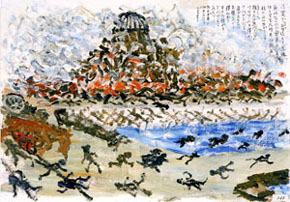
The military was able to test both a uranium-fueled bomb on Hiroshima and a second plutonium bomb on Nagasaki to gauge their effects on big cities.
Today, in some elite circles of Russia and the United States, normalized talk of using “tactical” nuclear weapons has upped the madness ante.
NORMAN SOLOMON, AUG 1, 2023 https://wordpress.com/read/feeds/2663585/posts/4838936867
In 1980, when I asked the press office at the U.S. Department of Energy to send me a listing of nuclear bomb test explosions, the agency mailed me an official booklet with the title “Announced United States Nuclear Tests, July 1945 Through December 1979.” As you’d expect, the Trinity test in New Mexico was at the top of the list. Second on the list was Hiroshima. Third was Nagasaki.
So, 35 years after the atomic bombings of those Japanese cities in August 1945, the Energy Department—the agency in charge of nuclear weaponry—was categorizing them as “tests.”
Later on, the classification changed, apparently in an effort to avert a potential P.R. problem. By 1994, a new edition of the same document explained that the bombings of Hiroshima and Nagasaki “were not ‘tests’ in the sense that they were conducted to prove that the weapon would work as designed…or to advance weapon design, to determine weapons effects, or to verify weapon safety.”
But the atomic bombings of Hiroshima and Nagasaki actually were tests, in more ways than one.
Take it from the Manhattan Project’s director, Gen. Leslie Groves, who recalled: “To enable us to assess accurately the effects of the bomb, the targets should not have been previously damaged by air raids. It was also desirable that the first target be of such size that the damage would be confined within it, so that we could more definitely determine the power of the bomb.”
A physicist with the Manhattan Project, David H. Frisch, remembered that U.S. military strategists were eager “to use the bomb first where its effects would not only be politically effective but also technically measurable.” The military was able to test both a uranium-fueled bomb on Hiroshima and a second plutonium bomb on Nagasaki to gauge their effects on big cities.
For good measure, after the Trinity bomb test in the New Mexico desert used plutonium as its fission source on July 16, 1945, in early August the military was able to test both a uranium-fueled bomb on Hiroshima and a second plutonium bomb on Nagasaki to gauge their effects on big cities.
Protests held in Tokyo against nuclear water discharge
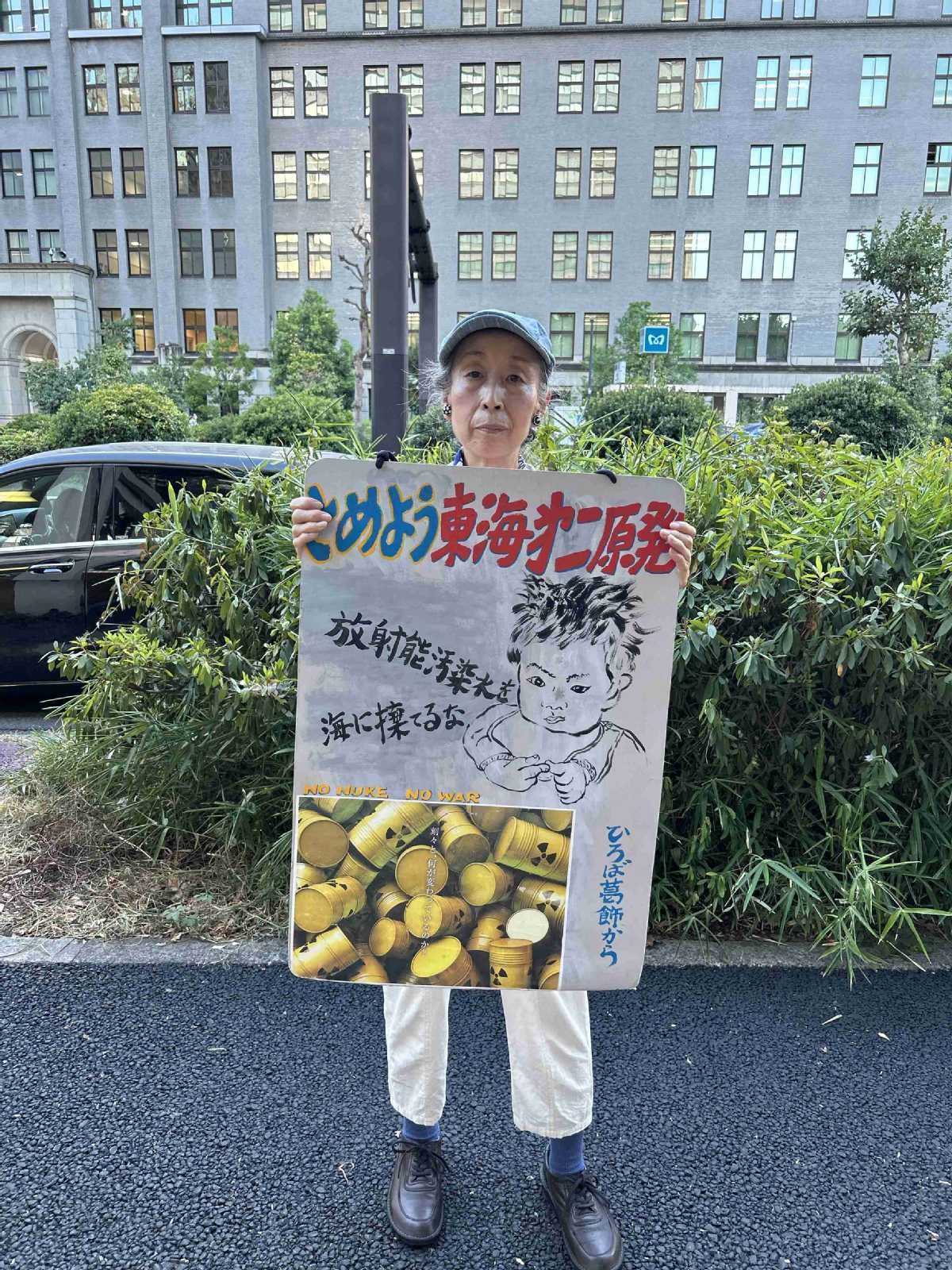
By Jiang Xueqing in Tokyo | chinadaily.com.cn 2023-07 https://global.chinadaily.com.cn/a/202307/31/WS64c7b5d8a31035260b819829.html
—
Japanese and South Korean civic groups gathered in front of the Japanese Prime Minister’s official residence on Monday in opposition to the administration’s plan to discharge nuclear-contaminated water from the Fukushima Daiichi nuclear power plant into the ocean.
People attending the rally said the Japanese government’s insistence on discharging nuclear-contaminated water into the sea is an irresponsible move.
They raised doubts about the Japanese government’s claim the nuclear-contaminated water will be diluted before being released. Whether diluted or not, the protesters said, the overall radioactive substance level in the water remain unchanged.
They stressed discharging the water into the ocean will have a significant impact on the global marine environment.
Last week, a similar protest was held by Japanese people in front of the Ministry of Economy, Trade and Industry in Tokyo.
Protesters said on Friday the ocean discharge plan is unacceptable because it poses a significant danger of radioactive contamination and will adversely affect the marine ecosystem and human health.
Some expressed concerns about Japan’s economy, which they believe will be affected by a boycott movement in neighboring countries and regions.
Failed Fukushima System Should Cancel Wastewater Ocean Dumping
The global ban on ocean dumping of radioactive waste adopted in 1993 applies only to barrels. It has allowed Britain and France to pump billions of gallons of radioactive wastewater into the Irish Sea and the North Sea respectively, for decades.
BY JOHN LAFORGE, 25 July 23 https://www.counterpunch.org/2023/07/25/failed-fukushima-system-should-cancel-wastewater-ocean-dumping/
From the Fukushima-Daiichi triple-reactor meltdown wreckage, Japan’s government and “Tepco,” the owner, are rushing plans to pump 1.37 million tons (about 3 billion pounds) of radioactive wastewater into the Pacific.
Their record is poor. Their lies are documented. This is not safe, at all.
To keep the three meltdowns’ wasted fuel from melting again, Tepco continuously pours cold water over 880 tons of “corium,” the red-hot rubblized fuel amassed somewhere under three devastated reactors. “That water leaks into a maze of basements and trenches beneath the reactors and mixes with groundwater flowing into the complex,” Reuters reported Sep. 3, 2013.
Most of this water is collected and put through Tepco’s jerry-rigged mechanism dubbed ALPS, for Advanced Liquid Processing System, which it turns out hasn’t processed much of anything.
Tepco, Japan’s Nuclear Regulatory Authority, the International Atomic Energy Agency (IAEA), and much of the media endlessly repeat that ALPS removes over 62 radioactive materials from the ever-expanding volume of wastewater. Reports regularly claim the planned dumping is routine, safe, and manageable.
This unverified PR loop has fooled a lot of people, but the ALPS is a fraud. As early as 2013, the filter system stalled and the IAEA reported that April that ALPS had not “accomplished the expected result of removing some radionuclides,” Reuters reported.
In September 2018, the ALPS was revealed to have drastically failed, forcing Tepco to issue a public apology and a promise to re-filter huge volumes of the waste.
According to Reuters, Oct. 11, 2018, documents on a government committee’s website show that 84 percent of water held at Fukushima contains concentrations of radioactive materials higher than legal limits allow to be dumped.
Among the deadly isotopes still in the waste are cesium-137, strontium-90, cobalt-60, ruthenium, carbon-14, tritium, iodine-129, plutonium isotopes, and more than 54 more.
In a June 14, 2023 op/ed for the China Daily, Shaun Burnie, the Senior Nuclear Specialist at Greenpeace East Asia, reported that the ALPS “has been a spectacular failure,” and noted:
“About 70 percent or 931,600 cubic meters of the wastewater needs to be processed again (and probably many more times) by the ALPS to bring the radioactive concentration levels below the regulatory limit for discharge. Tepco has succeeded in reducing the concentration levels of strontium, iodine, and plutonium in only 0.2 percent of the total volume of the wastewater, and it still requires further processing. But no secondary processing has taken place in the past nearly three years. Neither Tepco nor the Japanese government has said how many times the wastewater needs to be processed, how long it will take to do so, or whether the efforts will ever be successful. … none of these issues has been resolved.”
Tepco says it will re-filter more than 70 percent of the wastewater through ALPS again, a process that itself leaves massive amounts of highly radioactive sludge that must be kept out of the environment for centuries.
Hoping to slow the rush to dump, Professor Ryota Koyama from Fukushima University, said in an interview with China Media Group last May, “If the Japanese government or the Tokyo Electric Power Co. really wants to discharge contaminated water into the sea, they need to explain in more detail whether the nuclides have really been removed.”
International law governing state-sponsored or corporate pollution of the seven seas is relatively useless in challenging Tepco’s outrageous transfer of private industrial poison into the public commons. The global ban on ocean dumping of radioactive waste adopted in 1993 applies only to barrels. It has allowed Britain and France to pump billions of gallons of radioactive wastewater into the Irish Sea and the North Sea respectively, for decades.
Japan Doesn’t Want to Fight for Taiwan and Neither Do Other US Allies

if Japan fought alongside the US in a hypothetical conflict with China over Taiwan, the Japanese civilians and economy would suffer greatly. What’s more, in a conflict between two nuclear powers, China and the US, Japan may itself become a nuclear target,
22.07.2023 Ekaterina Blinova https://sputnikglobe.com/20230722/japan-doesnt-want-to-fight-for-taiwan-and-neither-do-other-us-allies-1112066099.html
Despite Japan bolstering its military capabilities under the nation’s new Defense Buildup Program, it appears to have zero appetite to engage in direct confrontation with China over Taiwan, Western media and think tanks say.
US military facilities in Okinawa, Japan, might play a central role in any Taiwan crisis, according to the Western press. Moreover, American military analysts have almost unanimously agreed that Japan is “the most likely US ally to contribute troops” in a potential US conflict with China over the island.
Back in October 2021, War on the Rocks, a US online media outlet, quoted a Japanese poll which appeared to indicate that 74% of respondents would support their government’s military engagement in the Taiwan Strait against China. The report further speculated about the possibilities of circumventing the country’s Constitution, which limits Japan’s ability to participate in conflicts.
Bold statements made by some Japanese officials also seemed to confirm Tokyo’s resolve. One of them, former Minister of Defense Yasuhide Nakayama, insisted in June 2021 that Taiwan is a “red line” and that “we have to protect Taiwan as a democratic country.” Japan and Taiwan are geographically close and any possible military actions over the island could potentially affect Japan’s Okinawa prefecture, Nakayama argued at the time.
Is China Going to Take Taiwan by Force?
The People’s Republic of China, which considers Taiwan its inalienable part, has repeatedly stated that it is going to reunite with the island peacefully, referring to years of fruitful collaboration with the former Taiwanese government formed by members of Kuomintang Party.
The Kuomintang can make a spectacular comeback during the Taiwanese general elections, scheduled for January 2024. The party’s victory could nip the fuss around Taiwan’s secessionism and potential conflict in the bud. Even US lawmakers admit it, considering the Kuomintang’s win a potential “threat” to Washington’s plans in the Asia-Pacific.
Biden Fast-Tracks Arming of Taiwan
For their part, the Biden administration and American legislators have repeatedly issued provocative statements with regard to the island, with the US president claiming time and time again that Washington is ready to “protect” Taiwan “militarily.” The US has also bolstered arms sales to the island.
In late June, Biden approved two potential arms sales totaling $440 million to Taiwan, including ammo and other military equipment. Earlier, in March, the US State Department approved a $619 million sale of hundreds of missiles to Taiwan to arm its new US-made F-16 jet fighters. Moreover, the Biden administration has started to use fast-track authority for accelerating the pace of the arming of Taiwan. The same mechanism has been used by Biden to speed-up Ukraine’s militarization.
Japanese Leadership Seems Unhappy With US Bellicosity
The unfolding situation has apparently given shivers to the Japanese leadership. The Wall Street Journal broke on Monday that the Japanese government is ready to give permission to the US to use bases in Japan in the case of conflict over Taiwan, but Tokyo’s own participation is unlikely.
Per the report, Washington invited Tokyo to consider using its Self-Defense Forces, especially the Maritime Self-Defense Force for hunting for Chinese submarines around the island of Taiwan and for other military missions.
Presently, Japan is home to about 54,000 US troops, according to the Council on Foreign Relations. It also hosts the headquarters of the US Navy’s 7th Fleet and the 31st Marine Expeditionary Unit.
Tokyo’s concerns have certain grounds. In May, Japanese scholar Kiyoshi Sugawa wrote for Responsible Statecraft, the online magazine of the Quincy Institute (a DC-based think tank), that if Japan fought alongside the US in a hypothetical conflict with China over Taiwan, the Japanese civilians and economy would suffer greatly. What’s more, in a conflict between two nuclear powers, China and the US, Japan may itself become a nuclear target, Sugawa warned.
The DC-based think also refers to the recent Japanese polls which indicate that just 11% of Japanese respondents consider it possible to fight alongside the US against China, while 27% said that their forces should not cooperate with the US military at all. The majority (56%) said that providing logistical support to the US would be more than enough in the event of the conflict.
Nobody Wants to Die for Uncle Sam
What’s more, Japan is not the only US ally unwilling to fight with China over Taiwan. The Australian government has recently signaled that it gave no promises to Washington about military participation in a potential conflict. The Philippines does not want to get dragged into the conflict, either.
When it comes to South Korea, it also lacks any enthusiasm of joining the US in a combat operation in the Taiwan Strait. Western observers draw attention to the fact that South Korean President Yoon Suk-yeol avoided meeting with then-US House Speaker Nancy Pelosi in Seoul after her controversial tour to Taiwan. The Diplomat suggested that Seoul has at least three reasons to avoid a possible war over the island. First, the China market accounts for 30% of South Korea’s total trade; second, Seoul fears that a Taiwan conflict would increase “the North Korean threat”; third, for Seoul friendly relations with Beijing is a guarantee against a conflict with Pyongyang.
Still, there is yet another US regional treaty ally, Thailand. However, according to the DC-based think tank, it’s completely impossible to force Bangkok to fight against China for the sake of Taiwan.
While muddying the waters of the Taiwan Strait, the US risks staying face-to-face with China which would mean a defeat in a possible military standoff, judging from the US’ earlier war game simulations.
Hong Kong tightens radiation inspection of Japanese seafood imports
Hong Kong has started strengthening radiation inspections of seafood
imports from Japan, sources said Saturday, amid concerns in China over a
plan to discharge treated radioactive water from the crippled Fukushima
nuclear plant into the ocean. The tighter inspections started in mid-June
and customs clearance of Japanese seafood was delayed by about three hours
compared with earlier clearance times.
Hong Kong on Friday reiterated its
concerns over the water plan. The Japanese government has confirmed that
some shipments of Japanese seafood have been held up at China’s customs.
Hong Kong is Japan’s second-largest market for agricultural and fisheries
exports, while mainland China is its biggest.
Japan Times 22nd July 2023
https://www.japantimes.co.jp/news/2023/07/22/national/hong-kong-food-fukushima-treated-water/
Cesium 180 times limit found in fish at Fukushima nuke plant 12 years after disaster.

July 19, 2023 (Mainichi Japan)
FUKUSHIMA — Radioactive cesium 180 times Japan’s legal maximum has been found in fish caught in the port at the crippled Fukushima Daiichi nuclear plant, revealing that the March 2011 triple meltdown there continues to impact the local ecosystem.
The cesium in the black rockfish caught in May measured 18,000 becquerels per kilogram. The legal limit under the Food Sanitation Act is 100 becquerels per kg. According to plant operator Tokyo Electric Power Company (TEPCO) Holdings Inc., the fish was captured inside the inner breakwater, close to the No. 1 to No. 4 reactors at the seaside plant, where decommissioning work continues.
When it rains, the rainwater streams into the “K drainage” — one of several drainpipes at the plant — after running through debris and over the ground, both contaminated with radioactive substances. It is then discharged into the station’s small port.
TEPCO claims that it has confirmed the cesium levels in the discharged rainwater are below the government criteria of 60 becquerels per liter for cesium-134 and 90 becquerels for cesium-137. But compared with other drainages at the plant, runoff with higher concentrations of radioactive materials has been discharged within the inner breakwater. The seabed sediment in the area was also found to contain cesium-137 up to 130,000 becquerels-plus per kilogram and cesium-134 up to 3,400 becquerels-plus as of the end of January this year………………………………………………………………..
……………………………………………………….”We urge that TEPCO take thorough measures to prevent radioactive materials from getting into the ocean, even within the port,” a fisheries federation official urged, refering to the black rockfish with more than 100 becquerels per kg caught in May at the nuclear complex’s port.
Toshihiro Wada, an associate professor of fish ecology at Fukushima University, said of the heavily contaminated fish, “It’s likely that cesium was concentrated within the fish from the food chain, confined as it is by the inner breakwater where radioactive substances have accumulated from the drainages flowing into the port.”
He continued, “Unless fundamental measures are taken to lower the concentrations of radioactive materials discharged from the ‘K drainage,’ fish surpassing the maximum will likely keep being found,” even as TEPCO has stepped up measures to prevent fish from getting away…………………………………
Radioactively contaminated water has been swelling daily at the plant as water injected to cool nuclear fuel debris that melted down in the 2011 disaster has been accumulating with groundwater and rainwater mixing into it. TEPCO processes the contaminated water using ALPS, or multi-nuclide removal equipment, and stores the treated water in tanks after reducing the radioactive levels apart from tritium, which is difficult to remove from water.
‘Set treated water aside’
The Japanese government plans to release treated water from the Fukushima plant into the ocean around the summer, after diluting it to get tritium concentrations below 1,500 becquerels per liter, or one-fortieth of the national standard. It plans to release the water about 1 kilometer offshore via an undersea tunnel.
“Unlike cesium, tritium does not concentrate in fish even if they ingest it, according to data,” associate professor Wada said. “Experimental results have shown that if treated water is put into regular seawater, the concentration (of tritium) is reduced. We need to consider (tritium) separately from cesium.”
(Japanese original by Riki Iwama, Fukushima Bureau, and Hideyuki Kakinuma, Iwaki Local Bureau) https://mainichi.jp/english/articles/20230718/p2a/00m/0na/019000c?fbclid=IwAR2R-0GtuaSlHvGQZ13yqRzQdZ1HUr3RNu4yHWzLBLytboJldZs2eMLHmxM
1 This Month
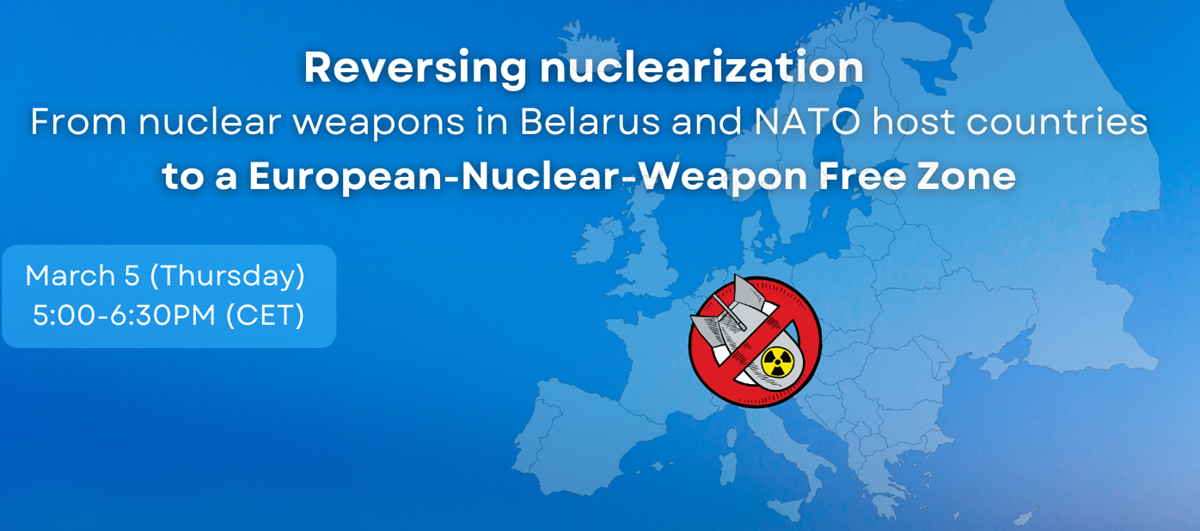
5 March -Online – Reversing nuclearization:
From nuclear weapons in Belarus and NATO host countries to a European-Nuclear-Weapon Free Zone
11am-12:30pm Eastern Time USA / 5pm-6:30pm CET

of the week – Advocating for a
nuclear free beach – https://www.samuellawrencefoundation.org/
The Samuel Lawrence Foundation advocates for a Nuclear Waste Free Beach at San Onofre, join us and take action!

10 March A LIVE WEBINAR THE REAL EFFECTS OF NUCLEAR POWER
What the Industry Isn’t Telling Us
1:00 PM Mountain, 2 pm Central, 3 pm Eastern. Live on the Keepers of the Water Facebook page

18 March Webinar @ 1 PM EST: An Assessment of SMR Projects: The Case of Canada
register for the zoom:
https://us02web.zoom.us/webinar/register/WN_o8BIIOUvQ2ONJR1nta65DQ#/registration

of the week – STOP SMALL MODULAR REACTORS IN CANADA
To see nuclear-related stories in greater depth and intensity – go to https://nuclearinformation.wordpress.com
-
Archives
- March 2026 (51)
- February 2026 (268)
- January 2026 (308)
- December 2025 (358)
- November 2025 (359)
- October 2025 (376)
- September 2025 (258)
- August 2025 (319)
- July 2025 (230)
- June 2025 (348)
- May 2025 (261)
- April 2025 (305)
-
Categories
- 1
- 1 NUCLEAR ISSUES
- business and costs
- climate change
- culture and arts
- ENERGY
- environment
- health
- history
- indigenous issues
- Legal
- marketing of nuclear
- media
- opposition to nuclear
- PERSONAL STORIES
- politics
- politics international
- Religion and ethics
- safety
- secrets,lies and civil liberties
- spinbuster
- technology
- Uranium
- wastes
- weapons and war
- Women
- 2 WORLD
- ACTION
- AFRICA
- Atrocities
- AUSTRALIA
- Christina's notes
- Christina's themes
- culture and arts
- Events
- Fuk 2022
- Fuk 2023
- Fukushima 2017
- Fukushima 2018
- fukushima 2019
- Fukushima 2020
- Fukushima 2021
- general
- global warming
- Humour (God we need it)
- Nuclear
- RARE EARTHS
- Reference
- resources – print
- Resources -audiovicual
- Weekly Newsletter
- World
- World Nuclear
- YouTube
-
RSS
Entries RSS
Comments RSS
 nuclear-news