Despite the $188 billion cost (and counting), engineers haven’t even been able to build a robot that can survive radiation inside the plant long enough to send back images of the inferno. Apparently nothing that moves can operate in such a hot and radioactive environment — much less a human, who would be dead seconds.
We do know that fuel in at least two out of three of the reactors melted right through the reactor floors. Time Magazine reported in 2011, “that means that…the fuel itself lies in a clump — either at the bottom of the pressure vessel, or in the basement below or possibly even outside the containment building. Engineers don’t know for sure…” Fuel rods won’t explode, but they can burn if exposed to air, producing massive clouds of radioactive smoke.
On February 13, 2017, muon tomography images offered a slightly clearerpicture, but not much more hopeful. TEPCO learned that radiation levels at reactor number two were actually emitting about 530 sieverts, not 73 sieverts, as they had expected.Administered to a human, a one sievert dose causes acute radiation poisoning, and a 10 sievert dose is fatal.
Although the disaster is local, the toxins travel. Unlike other environmental disaster areas (e.g. Love Canal) Fukushima Daiichi sheds toxins daily — widely — because every day TEPCO pours 400 tons of water over the fuel rods to keep them from overheating.
More than 962,000 tons of contaminated water are now stored on site. Last fall, TEPCO poured 300 million tons of it into the Pacific Ocean, into currents that reach the North American West Coast. After the 2011 earthquake, the tsunami wave and the wind spread contamination broadly across the Fukushima prefecture.
Unlike Russia, Japan doesn’t have enough land to be able to sequester the damaged plants and leave them alone for centuries — the half-life of some radioactive isotopes — even if reactor number two was stabilized, which it is not.
Instead, the Japanese government evacuated people and conducted massive decontamination programs, scraping and replacing the top two inches of soil, leaving 9,000,000 bags of contaminated soil all around the area. Now it is urging 100,000 displaced citizens to return to their cleaned up villages. Not everybody is convinced that the land is safe.
“Levels in nearby forests are comparable to the current levels within Chernobyl’s 30 kilometre exclusion zone, which, more than 30 years after the accident, remains formally closed to habitation…”
Fukushima has become one of the largest of the global nuclear sacrifice zones, such as Three Mile Island and Chernobyl, which have afflicted the world since 1930. That’s when uranium refining started in Hanford, Montana, which eventually provided fuel for the first atomic weapons.
These days, the whole town of Hanford is a toxic waste supersite, containing some 55 million gallons of some of the world’s most dangerous radioactive wastes. The entire congressional delegation for the area has petitioned President Trump to give top priority to Hanford clean-up funding, despite the staggering $2 billion cost annually for 30 or 40 years.
Nuclear power plants have an operating life of about 30 to 50 years. Most existing plants were built in the 1970s, before anybody actually had plans for how to de-commission them. However, Reuters reported in 2011, that along with its 104 operating commercial nuclear power plants, the US also had 23 plants in the process of being de-commissioned, at a cost of $500 million to $1 billion each, including 10 that had been “completely cleaned up.”
Seven of the remaining 13 reactors are in SAFSTOR — shut down, under guard, but still holding nuclear materials. In Canada, Quebec’s Gentilly-2 nuclear power plant and units 2 and 3 of the Pickering Nuclear Generating Station, Pickering, Ontario, are already in safe storage — essentially no-human-zones although not permanently sacrificed.
However, Fukushima Daiichi is different from other sacrifice zones because of the ongoing seething nuclear reaction in reactor number two, and because (unlike other zones where habitation is forbidden) Prime Minister Abe’s government wants people to live there.
PM Abe’s government and some media reports downplay radiation’s potentially horrifying effects on humans and babies not yet born. Public relations campaigns label former residents (mostly women, mostly mothers) who resist returning to the ostensibly decontaminated land as neurotically “radiophobic,” even though 174 children in Fukushima prefecture have been diagnosed with — or are suspected of having — thyroid cancer since the nuclear meltdown.
Meanwhile, as evidence emerges that TEPCO has lied about how serious the crisis is, radiation leaks into the Pacific Ocean and the world’s airshed, and one melted-down plant at Fukushima Daiichi threatens to burst into a catastrophic nuclear fire.
“For the global nuclear industry, the Fukushima disaster is an historic — if not fatal — setback,” said Worldwatch President Christopher Flavin. He introduced a draft copy of Worldwatch’s 2011 World Nuclear Industry Status Report.
Among other points, the report noted that every single nuclear power plant under construction in the world was chosen by central planners. Not one faced any competition from local markets or alternatives. And even during the nuclear binge building years, only 41 per cent of the approved power plants ever achieved operating status. Major delays and massive cost overruns were the rule.
In the foreword, Amory Lovins wrote that “long before Fukushima, nuclear power was dying of an incurable attack of market forces.” Wind and solar devices now offer more flexibility at half the price or less.
Indeed, Lovins said, “just as computing no longer needs mainframes, electricity no longer needs giant power plants.” Instead, the Pentagon prefers to rely on a variety of mass-produced generators networked in microgrids,” for resilience. So could the public.
More troubling, though, Lovins noted that the accident “vaporized” TEPCO’s balance sheet. “A 2007 earthquake had cost the company perhaps $20 billion; this one could cost it $100 plus billion. TEPCO is now broke and is becoming, in whatever form, a ward of the state.”
If the company is “a ward of the state,” that means its liabilities are too. Yet Japan’s government seems determined to repopulate Fukushima prefecture even as the doomed reactors overheat in the distance. Volunteer organizations like Greenpeace have to provide radioactivity monitoring for local air, water, soil and food.
On the other hand, what affects one nation affects us all. There has to be some point where the public stands up and says, “no more sacrifice zones!” The ongoing Fukushima Daiichi tragedy cries out for the United Nations to step in, take charge, and direct all the world’s best minds and resources to containing the disaster and rescuing the people who live there.
Fukushima to host Tokyo Olympics events to help recovery from nuclear disaster
Some baseball and softball events will be held about 70km from nuclear power plant that suffered triple meltdown in 2011, Guardian, Justin McCurry , 17 Mar 17, Fukushima has been chosen to host baseball and softball matches at the 2020 Tokyo Olympics, organisers said on Friday, a move they hope will boost the region’s recovery from the March 2011 nuclear disaster.
Azuma baseball stadium, about 70km north-west of the ruined Fukushima Daiichi nuclear power plant, will host at least one baseball game – possibly the opening match – and one or more softball fixtures, according to Yoshiro Mori, the 2020 organising committee president.
“By hosting Olympic baseball and softball events, Fukushima will have a great platform to show the world the extent of its recovery in the 10 years since the disaster,” Mori said in a statement……
Mori said the “fantastic idea” to hold baseball and softball matches in the affected area had originated in a meeting between the president of the International Olympic Committee (IOC), Thomas Bach, and Japan’s prime minister, Shinzo Abe, in October last year.
Two months later, however, the IOC initially declined to add Azuma to the main baseball venue in Yokohama.
Riccardo Fraccari, the president of the World Baseball Softball Confederation, welcomed the IOC’s change of heart, describing it as a “great step” that would to “inspire hope and highlight the regeneration in Fukushima”…..
The Fukushima prefectural government has offered to cover the costs of the refurbishment and renovation work needed to bring the 30,000-seat stadium up to Olympic standards, according to organisers……
No evacuation order has ever been in place in the part of Fukushima prefecture where the baseball stadium is located. The Azuma sports park complex served as an evacuation centre for people fleeing radiation caused by the triple meltdown triggered by a magnitude-9 earthquake and tsunami on 11 March 2011.
March 17, 2017 (Mainichi Japan) Tokyo Electric Power Company Holdings Inc. (TEPCO) has informally decided to decommission the No. 1 reactor at its Fukushima No. 2 Nuclear Power Plant, it has been learned.
In the wake of the March 2011 Great East Japan Earthquake and tsunami and ensuing meltdowns at the Fukushima No. 1 plant in Fukushima Prefecture, local bodies and residents of the area who suffered extensive damage requested that all four reactors at the No. 2 plant also be decommissioned.
TEPCO had avoided stating a clear position on the No. 2 plant’s reactors, but there had been pressure from the government and ruling coalition for it to make a decision. The company accordingly decided to decommission the plant’s No. 1 reactor, which suffered the most damage, and will consider what to do with the other three reactors in the future.
The No. 1 reactor of the Fukushima No. 2 plant began operating in 1982. It was flooded by tsunami on March 11, 2011, and all four reactors at the plant remain idled. The No. 2 plant suffered less damage than the No. 1 plant, and if it passed screening by the Nuclear Regulation Authority, its reactors could be restarted. But the Fukushima Prefectural Government and all 59 local assemblies have asked TEPCO and the government to decommission all reactors in the prefecture.
TEPCO has remained busy handling compensation claims relating to the Fukushima nuclear disaster and the disaster cleanup. If it were to decommission all of the No. 2 plant’s reactors, they would lose value and it would have to write down huge losses. Company president Naomi Hirose has therefore avoided taking a clear position on the issue, saying, “I would like to consider it and make a decision as a business operator.”
Last year, however, officials decided to create a fund to cover the huge cost of handling the nuclear disaster, which is expected to reach 21.5 trillion yen, nearly double the original prediction. There was accordingly pressure from the government for TEPCO to reach an early decision on the fate of the No. 2 plant’s reactors.
The No. 1 reactor at the No. 2 plant is the oldest of the plant’s four reactors. It temporarily lost its cooling functions in the March 2011 disaster, and suffered the most damage among the four reactors. TEPCO believes that by limiting decommissioning to one reactor for the time being, it will be able to hold the decommissioning cost below 100 billion yen, minimizing the impact on company finances and on decommissioning work at the Fukushima No. 1 plant. However, a decision to decommission only one reactor at the No. 2 plant is unlikely to win public approval.
Struggling With Japan’s Nuclear Waste, Six Years After Disaster https://www.nytimes.com/2017/03/11/world/asia/struggling-with-japans-nuclear-waste-six-years-after-disaster.html?_r=0 by MOTOKO RICHFUKUSHIMA DAIICHI NUCLEAR POWER STATION — Six years after the largest nuclear disaster in a quarter-century, Japanese officials have still not solved a basic problem: what to do with an ever-growing pile of radioactive waste. Each form of waste at the Fukushima Daiichi Nuclear Power Station, where three reactors melted down after an earthquake and a tsunami on March 11, 2011, presents its own challenges.
The estimated 6,000 cleanup workers at the site put on new protective gear every day. These hazmat suits, face masks, rubber gloves and shoe coverings are thrown out at the end of each shift. The clothing is compressed and stored in 1,000 steel boxes stacked around the site.
To date, more than 64,700 cubic meters of gear has been discarded, the equivalent of 17 million one-gallon containers. Tokyo Electric says it will eventually incinerate all this contaminated clothing to reduce the space needed to store it.
Branches and Logs From 220 Acres of Deforested Land The plant’s grounds were once dotted with trees, and a portion was even designated as a bird sanctuary. But workers have cleared about 220 acres of trees since the meltdown spewed radiation over them.
Now, piles of branches and tree trunks are stacked all over the site. Officials say there are about 80,000 cubic meters of this waste, and all of it will have to be incinerated and stored someday.
200,400 Cubic Meters of Radioactive RubbleExplosions during the meltdown filled the reactors with rubble. Workers and robots are slowly and carefully trying to remove this tangled mass of crushed concrete, pipes, hoses and metal.
Tokyo Electric estimates that more than 200,400 cubic meters of rubble — all of it radioactive — have been removed so far and stored in custom-made steel boxes. That is the equivalent of about 3,000 standard 40-foot shipping containers.
3.5 Billion Gallons of SoilThousands of plastic garbage bags sit in neat rows in the fields and abandoned towns surrounding the Fukushima plant. They contain soil that was scraped from land that was exposed to radiation in the days after the accident.
Japan’s Ministry of the Environment estimates that it has bagged 3.5 billion gallons of soil, and plans to collect much more. It will eventually incinerate some of the soil, but that will only reduce the volume of the radioactive waste, not eliminate it.
The ministry has already begun building a massive, interim storage facility in Fukushima prefecture and negotiating with 2,360 landowners for the thousands of acres needed to complete it. And that is not even a long-term solution: The government says that after 30 years it will need another site — or sites — to store radioactive waste.
1,573 Nuclear Fuel Rods
The ultimate goal of the cleanup is to cool and, if possible, remove the uranium and plutonium fuel that was inside the three reactors at the time of the disaster.
Hundreds of spent fuel rods are in cooling pools inside the reactors, and the company hopes to have cleared away enough rubble to begin removing them next year. The much bigger challenge will be removing the fuel that was in use in the reactor core at the time of the meltdown.
The condition and location of this molten fuel debris are still largely unknown. In one reactor where a robot was sent in January, much of the melted fuel is believed to have burned through the bottom of the inner reactor vessel and burrowed into the thick concrete foundation of the containment structure.
The plan is to completely seal the containment vessels, fill them with water and use robots to find and remove the molten fuel debris. But the rubble, the lethal levels of radiation and the risk of letting radiation escape make this an exceedingly difficult task.
In January, the robot sent into one of the reactors discovered radiation levels high enough to kill a person in less than a minute. Another had to be abandoned last month after debris blocked its path and radiation disabled it.
Tokyo Electric hopes to begin removing fuel debris from the reactor cores in 2021. The entire effort could take decades. Some say the radioactive material may prove impossible to remove safely and have suggested leaving it and entombing Fukushima under a concrete and steel sarcophagus like the one used at Chernobyl.
But the Japanese government and Tokyo Electric say they are committed to removing all the waste and cleaning the site, estimated at a cost of $188.6 billion.
“We want to return it to a safe state,” said Yuichi Okamura, general manager of the company’s nuclear power and plant siting division. “We promised the local people that we would recover the site and make it a safe ground again.”
Only 6% of Fukushima nuclear disaster compensation paid by TEPCO, Japan Today, MAR. 11, 2017 TOKYO —
The operator of the crippled nuclear complex in Fukushima Prefecture has only paid 6% of the compensation sought by municipalities in connection with the 2011 nuclear crisis, according to a recent prefectural tally.
The delay in payments to the 12 municipalities, designated by the government as evacuation zones, highlights the continuing challenge to their reconstruction efforts six years after the nuclear disaster, triggered by the massive earthquake and tsunami in northeastern Japan on March 11, 2011.
The tally found that Tokyo Electric Power Company Holdings Inc (TEPCO) had by the end of 2016 paid around 2.6 billion yen ($22.5 million) of the 43.3 billion yen demanded by the 12 local governments.
As some municipalities have been forced to shoulder most of the costs for TEPCO, local residents have raised concerns that the situation could delay reconstruction…….
Among the municipalities, the town of Futaba, where the Fukushima Daiichi nuclear plant is located and all of its residents remain evacuated, has received no compensation despite its demand for around 19.3 billion yen.
The town of Namie, where part of its evacuation order will be lifted at the end of the month, has received around 460 million yen, 4% of the amount demanded……
Dying robots and failing hope: Fukushima clean-up falters six years after tsunami
Exploration work inside the nuclear plant’s failed reactors has barely begun, with the scale of the task described as ‘almost beyond comprehension’, Guardian, Justin McCurry at Fukushima Daiichi nuclear power plant, 9 Mar 17. B
Barely a fifth of the way into their mission, the engineers monitoring the Scorpion’s progress conceded defeat. With a remote-controlled snip of its cable, the latest robot sent into the bowels of one of Fukushima Daiichi’s damaged reactors was cut loose, its progress stalled by lumps of fuel that overheated when the nuclear plant suffered a triple meltdown six years ago this week.
As the 60cm-long Toshiba robot, equipped with a pair of cameras and sensors to gauge radiation levels was left to its fate last month, the plant’s operator, Tokyo Electric Power (Tepco), attempted to play down the failure of yet another reconnaissance mission to determine the exact location and condition of the melted fuel.
Even though its mission had been aborted, the utility said, “valuable information was obtained which will help us determine the methods to eventually remove fuel debris”.
The Scorpion mishap, two hours into an exploration that was supposed to last 10 hours, underlined the scale and difficulty of decommissioning Fukushima Daiichi – an unprecedented undertaking one expert has described as “almost beyond comprehension”.
Cleaning up the plant, scene of the world’s worst nuclear disaster since Chernobyl after it was struck by a magnitude-9 earthquake and tsunami on the afternoon of 11 March 2011, is expected to take 30 to 40 years, at a cost Japan’s trade and industry ministry recently estimated at 21.5tr yen ($189bn).
The figure, which includes compensating tens of thousands of evacuees, is nearly double an estimate released three years ago……
Developing robots capable of penetrating the most dangerous parts of Fukushima Daiichi’s reactors – and spending enough time there to obtain crucial data – is proving a near-impossible challenge for Tepco. The Scorpion – so called because of its camera-mounted folding tail – “died” after stalling along a rail beneath the reactor pressure vessel, its path blocked by lumps of fuel and other debris.
The device, along with other robots, may also have been damaged by an unseen enemy: radiation. Before it was abandoned, its dosimeter indicated that radiation levels inside the No 2 containment vessel were at 250 sieverts an hour. In an earlier probe using a remote-controlled camera, radiation at about the same spot was as high as 650 sieverts an hour – enough to kill a human within a minute.
Shunji Uchida, the Fukushima Daiichi plant manager, concedes that Tepco acquired “limited” knowledge about the state of the melted fuel. …
Robotic mishaps aside, exploration work in the two other reactors, where radiation levels are even higher than in reactor No 2, has barely begun. There are plans to send a tiny waterproof robot into reactor No 1 in the next few weeks, but no date has been set for the more seriously damaged reactor No 3………
‘The situation is not under control’
On the surface, much has changed since the Guardian’s first visit to Fukushima Daiichi five years ago. Then, the site was still strewn with tsunami wreckage. Hoses, pipes and building materials covered the ground, as thousands of workers braved high radiation levels to bring a semblance of order to the scene of a nuclear disaster.
Six years later, damaged reactor buildings have been reinforced, and more than 1,300 spent fuel assemblies have been safely removed from a storage pool in reactor No 4. The ground has been covered with a special coating to prevent rainwater from adding to Tepco’s water-management woes.
Workers who once had to change into protective gear before they approached Fukushima Daiichi now wear light clothing and simple surgical masks in most areas of the plant. The 6,000 workers, including thousands of contract staff, can now eat hot meals and take breaks at a “rest house” that opened in 2015.
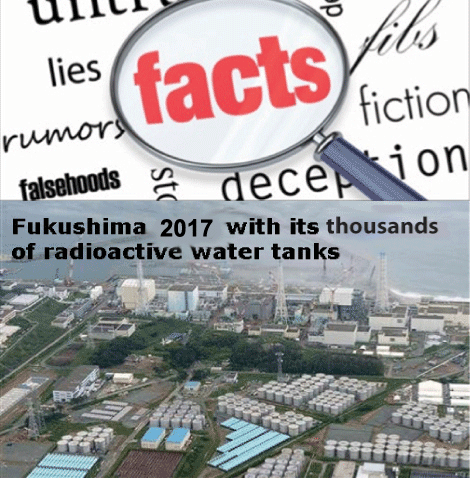
But further up the hill from the coastline, row upon row of steel tanks are a reminder of the decommissioning effort’s other great nemesis: contaminated water. The tanks now hold about 900,000 tons of water, with the quantity soon expected to reach 1m tons.
Tepco’s once-vaunted underground ice wall, built at a cost of 24.5bn yen, has so far failed to completely prevent groundwater from leaking into the reactor basements and mixing with radioactive coolant water.
The structure, which freezes the soil to a depth of 30 metres, is still allowing 150 tonnes of groundwater to seep into the reactor basements every day, said Yuichi Okamura, a Tepco spokesman. Five sections have been kept open deliberately to prevent water inside the reactor basements from rising and flowing out more rapidly. “We have to close the wall gradually,” Okamura said. “By April we want to keep the influx of groundwater to about 100 tonnes a day, and to eliminate all contaminated water on the site by 2020.”
Critics of the clean-up note that 2020 is the year Tokyo is due to host the Olympics, having been awarded the Games after Abe assured the International Olympic Committee that Fukushima was “under control”.
Mitsuhiko Tanaka, a former Babcock-Hitachi nuclear engineer, accuses Abe and other government officials of playing down the severity of the decommissioning challenge in an attempt to win public support for the restart of nuclear reactors across the country.
“Abe said Fukushima was under control when he went overseas to promote the Tokyo Olympics, but he never said anything like that in Japan,” says Tanaka. “Anyone here could see that the situation was not under control.
Terminal decline? Fukushima anniversary marks nuclear industry’s deepening crisis, Ecologist, Nuclear Monitor 10th March 2017 With the sixth anniversary of the Fukushima disaster falling on 11 March , nuclear lobbyists are arguing over solutions to the existential crisis facing nuclear power,writes Jim Green. Some favour a multinational consolidation of large conventional reactor designs, while others back technological innovation and ‘small modular reactors’. But in truth, both approaches are doomed to failure
Saturday March 11 marks the sixth anniversary of the triple-disaster in north-east Japan – the earthquake, tsunami and the Fukushima nuclear disaster.
And the news is not good. Scientists are wondering how on earth to stabilise and decontaminate the failed reactors awash with molten nuclear fuel, which are fast turning into graveyards for the radiation-hardened robots sent in to investigate them.
The Japanese government’s estimate of Fukushima compensation and clean-up costs has doubled and doubled again and now stands at ¥21.5 trillion (US$187bn; €177bn).
Indirect costs – such as fuel import costs, and losses to agricultural, fishing and tourism industries – will likely exceed that figure.
Kendra Ulrich from Greenpeace Japan notes in a new report that “for those who were impacted by the worst nuclear disaster in a generation, the crisis is far from over. And it is women and children that have borne the brunt of human rights violations resulting from it, both in the immediate aftermath and as a result of the Japan government’s nuclear resettlement policy.”
Radiation biologist Ian Fairlie summarises the health impacts from the Fukushima disaster: “In sum, the health toll from the Fukushima nuclear disaster is horrendous. At the minimum:
Over 160,000 people were evacuated most of them permanently.
Many cases of post-trauma stress disorder (PTSD), depression, and anxiety disorders arising from the evacuations.
About 12,000 workers exposed to high levels of radiation, some up to 250 mSv
An estimated 5,000 fatal cancers from radiation exposures in future.
Plus similar (unquantified) numbers of radiogenic strokes, CVS diseases and hereditary diseases.
Between 2011 and 2015, about 2,000 deaths from radiation-related evacuations due to ill-health and suicides.
An, as yet, unquantified number of thyroid cancers.
An increased infant mortality rate in 2012 and a decreased number of live births in December 2011.”
Dr Fairlie’s report was written in August 2015 but it remains accurate. More than half of the 164,000 evacuees from the nuclear disaster remain dislocated. Efforts to restore community life in numerous towns are failing. Local authorities said in January that only 13% of the evacuees in five municipalities in Fukushima Prefecture have returned home after evacuation orders were lifted.
Juan Carlos Lentijo of the International Atomic Energy Agency looks at tanks holding contaminated water and the Unit 4 and Unit 3 reactor buildings during a February 2015 tour of the tsunami-stricken Fukushima Daiichi nuclear power plant.
Almost six years after a tsunami caused a meltdown at the Fukushima Daiichi Nuclear Power Plant, the facility’s operator, Tokyo Electric Power (Tepco) faces overwhelming problems to clean up the site. Tepco now reports radiation in reactor 2 that would kill a worker in thirty seconds, and even destroys robots. Arjun Makhijani, the President of the Institute for Energy and Environmental Research and host Steve Curwood discuss the implications of this new report and the challenges of cleanup.
Arjun Makhijani is the President of the Institute for Energy and Environmental Research.
Transcript
CURWOOD: It’s Living on Earth, I’m Steve Curwood.
Six years after an earthquake and resulting tsunami devastated Fukushima, Japan and led to the meltdown of three nuclear power reactors there on the coast, radiation levels have reached a staggering 530 sieverts an hour, many times higher than any previous reading. Tepco, the plant’s operator, claims that radiation is not leaking outside reactor number two, site of these readings, but concedes there’s a hole in the grating beneath the vessel that contains melted radioactive fuel.
Joining us now to explain what it all means is Arjun Makhijani, President of the Institute for Energy and Environmental Research. Welcome back to Living on Earth Arjun.
MAKHIJANI: Thank you, Steve. Glad to be back.
CURWOOD: So, this report from TEPCO seems serious, maybe even ominous. What what exactly is going on?
MAKHIJANI: Well, they are exploring the molten core of the reactor in reactor number two with robots, and the robot called Scorpion went farther into the bottom of the reactor in an area called “the pedestal” on which the reactor kind of sits and measured much higher levels of radiation than before. The highest level was 73 Sieverts per hour before and this time they measured a radiation level more than seven times higher. It doesn’t mean it’s going up. It just was in a new area of the molten core that had not been measured before.
CURWOOD: Still, it sounds to me like it’s problematic, that six years after this meltdown there’s such a high reading.
MAKHIJANI: It is a very high reading; they may encounter even higher readings. The difficulty with this high reading is that the prospect that workers can actually go there, even all suited up, becomes more and more remote. Robots are going to have to do all this work – That was mostly foreseen – but the radiation levels are so high that even robots cannot survive for very long. So now they’re going to have to go back to the drawing board and redesign robots that can survive longer or figure out how to do the work faster, and it’s going to be more costly and more complicated to decommission the site.
The lid of Unit 4’s Primary Containment Vessel lies close to the reactor building. The reactor was shut down for maintenance at the time of the accident.
CURWOOD: Remind us, Arjun, please, of the human impact of this kind of radiation. What’s toxic to humans?
MAKHIJANI: Right. So, if you get high levels of radiation in a short period of time, four Sieverts is a lethal dose for about half the people within two months. So, in 530 Sieverts per hour would give you a lethal dose in less than 30 seconds.
CURWOOD: Wow.
MAKHIJANI: So, it’s a very, very, very high level of radiation. That’s why people cannot go into the reactor and work there. That’s not the end of the bad news, but that’s quite a bit of it.
CURWOOD: OK. All right, there is more bad news. I’m sitting down. Tell me.
MAKHIJANI: Yes, so the bottom of the reactor under the reactor there is a grating and then under the grating there’s the concrete floor, and what this robot discovered — It was supposed to go around the grating and survey the whole area, but it couldn’t because a piece of the grating was deformed and broken. So, now it appears that some of the molten fuel may have gone through the grating and maybe onto the concrete floor. We don’t know because even robotic surveys are now difficult, and a high radiation turns into heat, so the whole environment around the molten fuel is thermally very hot, and so whether it is going through the concrete, whether it is under the concrete, I don’t know that we have a good grip on that issue.
CURWOOD: So, Arjun, what’s going on with the reactors one and three? There have been published reports that TEPCO, Tokyo Electric Power Company that has these reactors, hasn’t really taken a good look at those reactors. What do you know?
MAKHIJANI: Well, they have to develop the robots, and I think that developing them, by looking at reactor two, and they’re finding these surprises, radiation levels much higher than previously measured. It shouldn’t actually be unanticipated. The big surprise here was that a part of the grating was gone, and so that the molten fuel would possibly have gone through the grating. So, I think similar surprises will await reactors one and three because each meltdown will have a different geometry.
Storing contaminated water in tanks at the Fukushima Daiichi site presents an ongoing risk, says Makhijani.
URWOOD: So, now what about the decay products here? We’re starting with the Uranium family, but we wind up with Cesium and Strontium – Strontium 90. What risk is there of Strontium 90 getting into groundwater there?
MAKHIJANI: Yeah, so the peculiar thing about a nuclear reaction is the initial fuel, Uranium, is not very radioactive. It’s radioactive but you can hold the uranium fuel pellets in your hand without getting a high dose of radiation. After it’s gone through the nuclear reaction – Fission, that’s what generates the energy – the fission products which result from splitting the Uranium atom are much more radioactive than Uranium, and Strontium 90 and Cesium 137 are two of the products that last for quite a long time, half-life 30 years, and are quite toxic. So, Strontium 90 is specially a problem when it comes in to contact with water. It’s mobilized by water. It behaves like calcium, so if it gets into like sea water and get into the fish, the bones of the fish, or human beings, of course, it gets into the bone marrow and bone surface, increases the risk of cancer, leukemia. So it’s a pretty nasty substance, and Strontium 90 has been contacted with water. You know, rainwater goes and contacts the molten fuel. Groundwater may be contacting the molten fuel. So, we have had Strontium 90 contamination and discharges into the ocean. They also collect the water. They’ve got about more than 1,000 tanks of contaminated water stored at the Fukushima site. By my rough estimate may be about 100 million gallons of contaminated water is being stored there.
CURWOOD: What happens if there’s an earthquake?
MAKHIJANI: That’s exactly right. So about a week into the accident, I sent a suggestion to the Japan Atomic Energy Commission that they should buy a supertanker, put the contaminated water into the supertanker, and send it off elsewhere for processing. They do have a site in the north of Japan which was supposed to be for plutonium separation, but it could be used to support the cleanup of Fukushima. But they rejected that proposal more than once and decided to build these tanks instead. They have a decontamination process on-site, and there are a very vast number of plastic bags on the site filled with contaminated soil. Nobody wants the stuff and nobody knows what’s going to happen with it.
CURWOOD: It’s six years after the original meltdown. How much of a disaster is Fukushima today?
MAKHIJANI: Well, Fukushima is possibly the longest running, continuous industrial disaster in history. It has not stopped because the risks are still there. This is going to take decades to decommission the site, and then what is going to happen with all this highly radioactive waste, ‘specially the molten fuel? Nobody knows.
CURWOOD: Arjun Makhijani is President of the Institute for Energy and Environmental Research. Thanks for taking time with us today, Arjun.
A total of 32,760 workers at the Fukushima No. 1 nuclear plant had an annual radiation dose exceeding 5 millisieverts as of the end of January, according to an analysis of Tokyo Electric Power Co. data.
A reading of 5 millisieverts is one of the thresholds of whether nuclear plant workers suffering from leukemia can be eligible for compensation benefits for work-related injuries and illnesses.
Of those workers, 174 had a cumulative radiation dose of more than 100 millisieverts, a level considered to raise the risk of dying after developing cancer by 0.5 percent. Most of the exposure appears to have stemmed from work just after the start of the crisis on March 11, 2011.
The highest reading was 678.8 millisieverts.
Overall, a total of 46,490 workers were exposed to radiation, with the average at 12.7 millisieverts.
The number of workers with an annual dose of over 5 millisieverts increased 34 percent from fiscal 2013 to 6,600 in fiscal 2014, when workloads grew to address the increase in radiation-tainted water at the plant. The number was at 4,223 in the first 10 months of fiscal 2015, which ends this month, on track to mark an annual decline.
A labor standards supervision office in Fukushima Prefecture last October accepted a claim for workers compensation by a man who developed leukemia after working at the plant, the first recognition of cancer linked to work after the meltdowns as a work-related illness. Similar compensation claims have been rejected in three cases so far, according to the labor ministry.
The average radiation dose was higher among Tepco workers at the plant than among workers from subcontractors in fiscal 2010 and 2011. Starting in fiscal 2012, the reading was higher among subcontractor workers than among Tepco workers.
The average dose for subcontractor workers was 1.7 times the level of Tepco workers in fiscal 2013, 2.3 times in fiscal 2014 and 2.5 times in fiscal 2015 as of the end of January.
A separate analysis of data from the Nuclear Regulation Authority showed that the average radiation dose of workers at 15 nuclear power plants across the country, excluding the Fukushima No. 1 and No. 2 plants, fell to 0.22 millisievert in fiscal 2014, when none of the plants was in operation, down 78 percent from 0.99 millisievert in fiscal 2010.
TEPCO Employees Get First Look Inside the Fukushima Nuclear Power Plant
The robots sent into Fukushima’s nuclear fallout site keep dying, Mashable, BY YVETTE TAN, 3 Mar 17, The robots sent in to investigate the nuclear fallout at Fukushima just aren’t good enough.
Tokyo Electric Power Company’s (TEPCO) head of decommissioning admitted on Thursday that more creativity was needed in developing its robots sent to the reactive zone……..earlier last month, a robot sent into Fukushima’s No. 2 reactor was forced to abort its mission after it was blocked by deposits — believed to be a mixture of melted fuel and broken pieces of structure.
Two previous robots had also failed in its missions after one was stuck in a gap and another was abandoned after being unable to find fuel during six days of searching.
As evacuees move back, Fukushima cleanup faces daunting obstacles, Science, By Dennis Normile Mar. 2, 2017 TOKYO—Six years into a decommissioning effort expected to last into the 2050s, an official leading the work on the stricken Fukushima Daiichi Nuclear Power Plant claims that cleanup crews are making “steadfast progress.” But thorny technical obstacles must be overcome.
On the eve of the sixth anniversary of the disaster, officials took pride in what they view as successful efforts to minimize the health threat to surrounding communities. Radiation from the crippled reactors is no longer having an impact outside the plant, Naohiro Masuda, head of decommissioning for Fukushima owner Tokyo Electric Power Co. (TEPCO), said today at a briefing here. He noted that evacuated residents are returning to their homes as decontamination work reduces exposure levels below thresholds. At the power plant, radiation levels are now so low that the 6000 workers slowly demolishing the damaged reactor halls need only wear typical construction site safety gear except when working near the three reactors that suffered meltdowns. And radiation levels just offshore remain below the limit for drinking water set by the World Health Organization, Masuda said. Given the progress, he reiterated that TEPCO is confident they can stick to a previously set roadmap that envisions completing the decommissioning 30 to 40 years after the accident. But doing so won’t be cheap. Last December, Japan’s Ministry of Economy, Trade and Industry revised its estimate of the total cost of decommissioning up to $188 billion.
Stemming ocean contamination has been a thorny challenge. Since early in the crisis, crews have circulated water through the damaged reactors to prevent overheating that could lead to further fuel melting. That water, and groundwater flowing through the site, is heavily contaminated and TEPCO has struggled to keep it from seeping into the Pacific. Schemes to divert groundwater away from the plant and freeze a wall of soil around the reactors down to bedrock—to contain contaminated water—have minimized leaks, Masuda said.
In the meantime, TEPCO has accumulated 960,000 tons of contaminated water stored in 1000 10-meter-tall tanks at the site. TEPCO has removed cesium, strontium, and more than 50 other radionuclides from that water. But they have been stymied by tritium, a radioactive hydrogen isotope in the water. Several experimental approaches to removing the tritium “were judged to be impractical,” Masuda said……
Another major hurdle is determining the condition and location of the melted fuel, much of which is believed to have dropped to the bottoms of the containment vessels where high radiation levels preclude human entry. Robotic investigations are proving problematic. In January, the camera on a robotic probe sent into the Unit 2 containment vessel was fried by radiation, though it did return important images before its demise. Then last month, a small robot on tanklike treads was sent through a 10-centimeter-diameter pipe into the vessel to investigate the presumed location of the damaged fuel. But it got tangled up in debris and was abandoned.
Over the past few weeks, the Japanese have attempted to send their Scorpion robot into the damaged containment vessel areas. These attempts have resulted in the rapid destruction of these specially designed radiation-detecting robots — but not before measurements were made… reliable measurements, that indicate radiation leaking at 530 seiverts per hour. Such readings were described as “unimaginable.” Why? Because human death is likely at just 10 seiverts per hour of radiation exposure.
This is all current news — yet our national media and federal government will not investigate it, talk about it, or help in developing a strategy to defeat the problem.
There is no greater clear and present danger to the future of humanity and other life on this earth than the out-of-control Fukushima disaster.
If we get to work on the problem, I am absolutely confident that our human ingenuity and resourcefulness will defeat it. We are, in our human potentiality, that good — if we will only do it.
On March 11, 2017, we will hit the 6th anniversary of the Fukushima nuclear disaster in Japan which featured the complete meltdown of three nuclear reactor cores due to these facilities being inundated by a 45-foot high tsunami wave caused by an earthquake. Sadly, the engineers and scientists trying to mitigate the ongoing damage have been unsuccessful at stopping the daily flow of radiation into the Pacific Ocean, which is simply one piece of the interconnected body of water I call the Earth Ocean.
The material of the melted cores, called corium, has sunk down into the earth below their shattered former containment vessels, and resides within the shallow water table below — which results in an ongoing flow of radioactive material pouring into the ocean. Apparently, there is no existing technological solution to this issue, and there are increasing measurements of radioactive material within the vast Pacific Ocean and all along the western coasts of the North and South American continents.
The Federal Government of the United States does not (publicly) monitor such radiation inflows, and therefore, any information about the contamination comes from various activities funded by crowd-source financing of various private and public-good organizations, etc.
This I find somewhat odd — in that the United States has, in recent days, deployed their radiation-sniffing jet to fly about over Europe in the hopes of identifying the source of highly abnormal radioactive particles of Iodine-131 that have been wafting about upon the winds since (apparently) early January 2017. At this moment, there is no explanation. So… we’ll deploy United States taxpayer resources to help track down the source of a European Iodine-131 leak — which, incidentally, has a half-life of about eight days — and will discuss the problem publicly … but we won’t (publicly) monitor our western coasts and air for an ongoing radiation catastrophe now six years old, emitting radioactive particles with half-lives of thousands of years. The Federal Government of the United States won’t even talk about it.
Is the idea (or attitude) then that since we have no ability to arrest or fix the unrelenting Fukushima poisoning of our planetary environment, that we will just not talk about or acknowledge it in a public way? Are we going to continue to buy the demonstrably false notion put forth by the U.S. government that the vast waters of the Pacific ocean will act to “dilute” the radioactive poison over time — when it is a scientific fact that radioactive particles are not “dilutable” and are, instead, cumulative?
Are we going to continue to disassociate the massive die-offs and poisoning of ocean life from the obvious source, the cumulative effects of Fukushima radiation? Are we going to continue to enjoy our seafood because the Federal Government says that the radioactive levels within it are “within safe limits”? Are we going to continue to label people like myself (of which there are many) as “conspiracy theorists” and uneducated alarmists who have been expressing concern over the Fukushima catastrophe since it occurred — people like me who know from objective observed and scientific fact that all is not well with what is going on (or not going on) at Fukushima?
Over the past few weeks, the Japanese have attempted to send their Scorpion robot into the damaged containment vessel areas. These attempts have resulted in the rapid destruction of these specially designed radiation-detecting robots — but not before measurements were made… reliable measurements, that indicate radiation leaking at 530 seiverts per hour. Such readings were described as “unimaginable.” Why? Because human death is likely at just 10 seiverts per hour of radiation exposure.
This is all current news — yet our national media and federal government will not investigate it, talk about it, or help in developing a strategy to defeat the problem. I would submit that the ongoing Fukushima environmental catastrophe is — by far — the most urgent danger to humanity that we face. This is not a localized Japanese problem — it is a world-wide environmental emergency that is getting worse every day.
If humanity does not have the current technology to defeat this problem, then we need to get our best and brightest minds together from across the world and develop technology to defeat it, immediately. It is absolutely unacceptable and irresponsible for the world to simply ignore what it going on — indeed, it is eventually suicidal. If President Trump does not begin to openly talk about the ongoing global emergency threat of Fukushima and advocate for a solution, then I, for one, will publicly part ways with him — on this issue alone.
There is no greater clear and present danger to the future of humanity and other life on this earth than the out-of-control Fukushima disaster. All other issues of debate and controversy are small potatoes in comparison. President Trump needs to rally support for an effective response on this—indeed, the sheer gravity of the destruction being done to the world provides a superb opportunity to bring together a truly unified global response to an issue that threatens humanity. Japan does not have the resources or technological ability to solve this problem by itself — and no individual nation does, or could. Just as if humanity found itself mortally in danger from a source beyond the Earth and would therefore unify to defeat it, so too must it view the Fukushima situation as a mortal danger to humanity from within.
If we get to work on the problem, I am absolutely confident that our human ingenuity and resourcefulness will defeat it. We are, in our human potentiality, that good — if we will only do it.
RECENT reporting of a huge radiation measurement at Unit 2 in the Fukushima Daichi reactor complex does not signify that there is a peak in radiation in the reactor building.
All that it indicates is that, for the first time, the Japanese have been able to measure the intense radiation given off by the molten fuel, as each previous attempt has led to failure because the radiation is so intense the robotic parts were functionally destroyed.
The radiation measurement was 530 sieverts, or 53,000 rems (Roentgen Equivalent for Man). The dose at which half an exposed population would die is 250 to 500 rems, so this is a massive measurement. It is quite likely had the robot been able to penetrate deeper into the inner cavern containing the molten corium, the measurement would have been much greater.
These facts illustrate why it will be almost impossible to “decommission” units 1, 2 and 3 as no human could ever be exposed to such extreme radiation. This fact means that Fukushima Daichi will remain a diabolical blot upon Japan and the world for the rest of time, sitting as it does on active earthquake zones.
What the photos taken by the robot did reveal was that some of the structural supports of Unit 2 have been damaged. It is also true that all four buildings were structurally damaged by the original earthquake some five years ago and by the subsequent hydrogen explosions so, should there be an earthquake greater than seven on the Richter scale, it is very possible that one or more of these structures could collapse, leading to a massive release of radiation as the building fell on the molten core beneath. But units 1, 2 and 3 also contain cooling pools with very radioactive fuel rods — numbering 392 in Unit 1, 615 in Unit 2, and 566 in Unit 3; if an earthquake were to breach a pool, the gamma rays would be so intense that the site would have to be permanently evacuated. The fuel from Unit 4 and its cooling pool has been removed.
But there is more to fear.
The reactor complex was built adjacent to a mountain range and millions of gallons of water emanate from the mountains daily beneath the reactor complex, causing some of the earth below the reactor buildings to partially liquefy. As the water flows beneath the damaged reactors, it immerses the three molten cores and becomes extremely radioactive as it continues its journey into the adjacent Pacific Ocean.
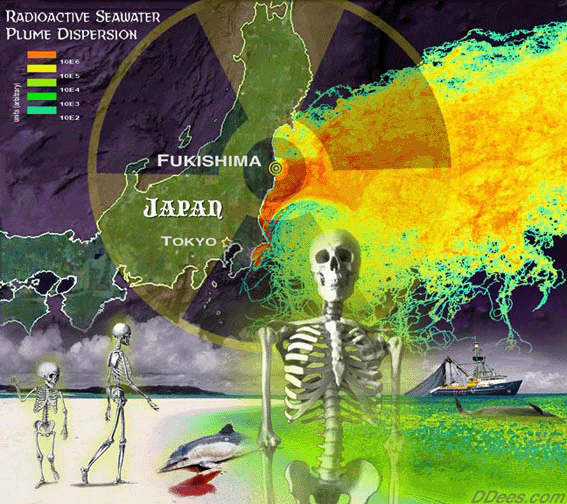
Every day since the accident began, 300 to 400 tons of water has poured into the Pacific where numerous isotopes – including cesium 137, 134, strontium 90, tritium, plutonium, americium and up to 100 more – enter the ocean and bio-concentrate by orders of magnitude at each step of the food chain — algae, crustaceans, little fish, big fish then us.
Fish swim thousands of miles and tuna, salmon and other species found on the American west coast now contain some of these radioactive elements, which are tasteless, odourless and invisible. Entering the human body by ingestion they concentrate in various organs, irradiating adjacent cells for many years. The cancer cycle is initiated by a single mutation in a single regulatory gene in a single cell and the incubation time for cancer is any time from 2 to 90 years. And no cancer defines its origin.
We could be catching radioactive fish in Australia or the fish that are imported could contain radioactive isotopes, but unless they are consistently tested we will never know.
As well as the mountain water reaching the Pacific Ocean, since the accident, TEPCO has daily pumped over 300 tons of sea water into the damaged reactors to keep them cool. It becomes intensely radioactive and is pumped out again and stored in over 1,200 huge storage tanks scattered over the Daichi site. These tanks could not withstand a large earthquake and could rupture releasing their contents into the ocean.
But even if that does not happen, TEPCO is rapidly running out of storage space and is trying to convince the local fishermen that it would be okay to empty the tanks into the sea. The Bremsstrahlung radiation like x-rays given off by these tanks is quite high – measuring 10 milirems – presenting a danger to the workers. There are over 4,000 workers on site each day, many recruited by the Yakuza (the Japanese Mafia) and include men who are homeless, drug addicts and those who are mentally unstable.
There’s another problem. Because the molten cores are continuously generating hydrogen, which is explosive, TEPCO has been pumping nitrogen into the reactors to dilute the hydrogen dangers.
As previously explained, these radioactive elements concentrate in the food chain. The Fukushima Prefecture has always been a food bowl for Japan and, although much of the rice, vegetables and fruit now grown here is radioactive, there is a big push to sell this food both in the Japanese market and overseas. Taiwan has banned the sale of Japanese food, but Australia and the U.S. have not.
Prime Minister Abe recently passed a law that any reporter who told the truth about the situation could be gaoled for ten years. In addition, doctors who tell their patients their disease could be radiation related will not be paid, so there is an immense cover-up in Japan as well as the global media.
The Prefectural Oversite Committee for Fukushima Health is only looking at thyroid cancer among the population and by June 2016, 172 people who were under the age of 18 at the time of the accident have developed, or have suspected, thyroid cancer; the normal incidence in this population is 1 to 2 per million.
However, other cancers and leukemia that are caused by radiation are not being routinely documented, nor are congenital malformations, which were, and are, still rife among the exposed Chernobyl population.
Bottom line, these reactors will never be cleaned up nor decommissioned because such a task is not humanly possible. Hence, they will continue to pour water into the Pacific for the rest of time and threaten Japan and the northern hemisphere with massive releases of radiation should there be another large earthquake.
Fukushima: a Lurking Global Catastrophe?http://nation.com.pk/international/21-Feb-2017/fukushima-a-lurking-global-catastropheRobert Hunziker – Year over year, ever since 2011, the Fukushima Daiichi nuclear meltdown grows worse and worse, an ugly testimonial to the inherent danger of generating electricity via nuclear fission, which produces isotopes, some of the most deadly poisonous elements on the face of the planet.
Fukushima Diiachi has been, and remains, one of the world’s largest experiments, i.e., what to do when all hell breaks loose aka The China Syndrome. “Scientists still don’t have all the information they need for a cleanup that the government estimates will take four decades and cost ¥8 trillion. It is not yet known if the fuel melted into or through the containment vessel’s concrete floor, and determining the fuel’s radioactivity and location is crucial to inventing the technology to remove the melted fuel,” (Emi Urabe, Fukushima Fuel-Removal Quest Leaves Trail of Dead Robots, The Japan Times, Feb. 17, 2017).
As it happens, “”inventing technology” is experimental stage stuff. Still, there are several knowledgeable sources that believe the corium, or melted core, will never be recovered. Then what?
According to a recent article, “Potential Global Catastrophe of the Reactor No. 2 at Fukushima Daiichi,” d/d Feb. 11, 2017 by Dr. Shuzo Takemoto, professor, Department of Geophysics, Graduate School of Science, Kyoto University: The Fukushima nuclear facility is a global threat on level of a major catastrophe.
Meanwhile, the Abe administration dresses up Fukushima Prefecture for the Tokyo 2020 Olympics, necessitating a big fat question: Who in their right mind would hold Olympics in the neighborhood of three out-of-control nuclear meltdowns that could get worse, worse, and still worse? After all, that’s the pattern over the past 5 years; it gets worse and worse. Dismally, nobody can possibly know how much worse by 2020. Not knowing is the main concern about holding Olympics in the backyard of a nuclear disaster zone, especially as nobody knows what’s happening. Nevertheless and resolutely, according to PM Abe and the IOC, the games go on.
Along the way, it’s taken Tokyo Electric Power Company (TEPCO) nearly six years to finally get an official reading of radiation levels of the meltdown but in only one unit. Analysis of Unit #2 shows radiation levels off-the-charts at 530 Sieverts, or enough to kill within minutes, illustrative of why it is likely impossible to decommission units 1, 2, and 3. No human can withstand that exposure and given enough time, frizzled robots are as dead as a doornail.
“A short-term, whole-body dose of over 10 sieverts would cause immediate illness and subsequent death within a few weeks, according to the World Nuclear Association” (Emi Urabe, Fukushima Fuel-Removal Quest Leaves Trail of Dead Robots, The Japan Times, Feb. 17, 2017).
Although Fukushima’s similar to Chernobyl Exclusion Zone in some respects, where 1,000 square miles has been permanently sealed off, Fukushima’s different, as the Abe administration is already repopulating portions of Fukushima. If they don’t repopulate, how can the Olympics be held with food served from Fukushima and including events like baseball held in Fukushima Prefecture?
Without question, an old saw – what goes around comes around – rings true when it comes to radiation, and it should admonish (but it doesn’t phase ‘em) strident nuclear proponents, claiming Fukushima is an example of how safe nuclear power is “because there are so few, if any, deaths” (not true). As Chernobyl clearly demonstrates: Over time, radiation cumulates in bodily organs. For a real life example of how radiation devastates human bodies, consider this fact: 453,391 children with bodies ravaged, none born at the time of the Chernobyl meltdown in 1986, today receive special healthcare because of Chernobyl radiation-related medical problems like cancer, digestive, respiratory, musculoskeletal, eye disease, blood disease, congenital malformation, and genetic abnormalities. Their parents were children in the Chernobyl zone in 1986 (Source: Chernobyl’s Legacy: Kids With Bodies Ravaged by Disaster, USA Today, April 17, 2016).
Making matters worse yet, Fukushima Diiachi sets smack dab in the middle of earthquake country, which defines the boundaries of Japan. In that regard, according to Dr. Shuzo Takemoto, professor, Department of Geophysics, Graduate School of Science, Kyoto University: “The problem of Unit 2… If it should encounter a big earth tremor, it will be destroyed and scatter the remaining nuclear fuel and its debris, making the Tokyo metropolitan area uninhabitable. The Tokyo Olympics in 2020 will then be utterly out of the question,” (Shuzo Takemoto, Potential Global Catastrophe of the Reactor No. 2 at Fukushima Daiichi, February 11, 2017).
Accordingly, the greater Tokyo metropolitan area remains threatened for as long as Fukushima Diiachi is out of control, which could be for generations, not years. Not only that, Gee-Whiz, what if the big one hits during the Olympics? After all, earthquakes come unannounced. Regrettably, Japan has had 564 earthquakes the past 365 days. It’s an earthquake-ridden country. Japan sits at the boundary of 4 tectonic plates shot through with faults in zigzag patterns, very lively and of even more concern, the Nankai Trough, the candidate for the big one, sits nearly directly below Tokyo. On a geological time scale, it may be due for action anytime within the next couple of decades. Fukushima Prefecture’s not that far away.
Furthermore, the Fukushima Diiachi nuclear complex is tenuous, at best: “All four buildings were structurally damaged by the original earthquake some five years ago and by the subsequent hydrogen explosions so should there be an earthquake greater than seven on the Richter scale, it is very possible that one or more of these structures could collapse, leading to a massive release of radiation as the building falls on the molten core beneath.” (Helen Caldicott: The Fukushima Nuclear Meltdown Continues Unabated, Independent Australia, February 13, 2017).
Complicating matters further, the nuclear site is located at the base of a mountain range. Almost daily, water flows from the mountain range beneath the nuclear plant, liquefying the ground, a sure-fire setup for cascading buildings when the next big one hits. For over five years now, radioactive water flowing out of the power plant into the Pacific carries isotopes like cesium 134 and cesium 137, strontium 90, tritium, plutonium americium and up to 100 more isotopes, none of which are healthy for marine or human life, quite the opposite in fact as those isotopes slowly cumulate, and similar to the Daleks of Doctor Who fame (BBC science fiction series, 1963-present) “Exterminate! Exterminate! Exterminate!”
Isotopes bio-concentrate up the food chain from algae to crustaceans to small fish to big fish to bigger humans. Resultant cancer cells incubate anytime from two years to old age, leading to death. That’s what cancer does; it kills.
Still, the fact remains nobody really knows for sure how directly Fukushima Diiachi radiation affects marine life, but how could it be anything other than bad? After all, it’s a recognized fact that radiation cumulates over time; it’s tasteless, colorless, and odorless as it cumulates in the body, whether in fish or further up the food chain in humans. It travels!
An example is Cesium 137 one of the most poisonous elements on the planet. One gram of Cesium 137 the size of a dime will poison one square mile of land for hundreds of years. That’s what’s at stake at the world’s most rickety nuclear plant, and nobody can do anything about it. In fact, nobody knows what to do. They really don’t.
When faced with the prospect of not knowing what to do, why not bring on the Olympics? That’s pretty good cover for a messy situation, making it appear to hundreds of thousands of attendees, as well as the world community “all is well.” But, is it? Honestly….
The Fukushima nuclear meltdown presents a special problem for the world community. Who knows what to believe after PM Abe lied to the IOC to get the Olympics; see the following headline from Reuters News: “Abe’s Fukushima ‘Under Control’ Pledge to Secure Olympics Was a Lie: Former PM,” Reuters, Sept. 7, 2016.– COUNTERPUNCH
“Abe gave the assurances about safety at the Fukushima plant in his September 2013 speech to the International Olympic Committee to allay concerns about awarding the Games to Tokyo. The comment met with considerable criticism at the time… Mr. Abe’s ‘under control remark, that was a lie,’ Koizumi (former PM) now 74 and his unruly mane of hair turned white, told a news conference where he repeated his opposition to nuclear power,” Ibid.
As such, a very big conundrum precedes the 2020 games: How can the world community, as well as Olympians, believe anything the Abe administration says about the safety and integrity of Fukushima?
Still, the world embraces nuclear power more so than ever before as it continues to expand and grow. Sixty reactors are currently under construction in fifteen countries. In all, 160 power reactors are in the planning stage and 300 more have been proposed. Pro-Nuke-Heads claim Fukushima proves how safe nuclear power is because there are so few, if any, deaths, as to be inconsequential. That’s a boldfaced lie.
Here’s one of several independent testimonials on deaths because of Fukushima Diiachi radiation exposure (many, many, many more testimonials are highlighted in prior articles, including USS Ronald Reagan sailors on humanitarian rescue missions at the time): “It’s a real shame that the authorities hide the truth from the whole world, from the UN. We need to admit that actually many people are dying. We are not allowed to say that, but TEPCO employees also are dying. But they keep mum about it,” Katsutaka Idogawa, former mayor of Futaba (Fukushima Prefecture), Fukushima Disaster: Tokyo Hides Truth as Children Die, Become Ill from Radiation – Ex-Mayor, RT News, April 21, 2014.
Greenpeace exposes high radiation risks in Fukushima village as govt prepares to lift evacuation order http://www.newkerala.com/news/fullnews-228867.htmlTokyo/ New Delhi, Feb 21: The Japanese government will soon lift evacuation orders for 6,000 citizens of Iitate village in Fukushima prefecture where radiation levels in nearby forests are comparable to the current levels within the Chernobyl 30km exclusion zone – an area that more than 30 years after the accident remains formally closed to habitation.
Seventy-five percent of Iitate is contaminated forested mountains, a Greenpeace statement claimed..
A survey team led by Greenpeace Japan recently found radiation dose rates at houses in the village of Iitate well above long-term government targets, with annual and lifetime exposure levels posing a long-term risk to citizens who may return. Evacuation orders will be lifted for Iitate no later than March 31, 2017, to be followed one year later by the termination of compensation payments.
The relatively high radiation values, both inside and outside houses, show an unacceptable radiation risk for citizens if they were to return to Iitate. Citizens returning to their irradiated homes are at risk of receiving radiation equivalent to one chest X-ray every week. This is not normal or acceptable, said Ai Kashiwagi, energy campaigner with Greenpeace Japan .
As Japan nears the six year anniversary of the nuclear disaster, the Japanese government last week confirmed that it has not yet conducted any assessments of lifetime exposure risks for citizens if they were to return to Iitate.
Recent reports suggest that the cost of cleaning up of Fukushima plant would cost more than 12lakh crores. If a developed country like Japan, known for its processes and systems, is finding it too difficult to handle the disaster, it makes little sense for India to go ahead and sign up for four more reactors at Kudankulam and elsewhere. In the words of George Santania Those who cannot remember the past are condemned to repeat it, says G. Sundarrajan of Poovulagin Nanbargal.
Life can never go back to normal for people living near nuclear power plants. But clearly, the world has failed to learn its lessons from nuclear accidents like those in Chernobyl and Fukushima. India, for instance, seems determined to add on to its nuclear power capacity despite putting the lives of millions of people at risk, says Nandikesh Sivalingam, climate and energy campaigner, Greenpeace India.
The fact remains that nuclear power is neither safe nor economical, and that India is grossly ill-prepared to handle a nuclear disaster. This was pointed out by Red Alert, a Greenpeace India report that released last year.
Last years Indo-Japan nuclear deal also negated the lessons learnt from Fukushima.
The deal to buy six AP1000 reactors was more of a last ditch effort to save Westinghouse/Toshiba from imminent meltdown. Now, after the meltdown, the future of the six nuclear reactors has put a question mark on the economic viability of nuclear power. Its reported that the cost of building these six reactors will be three to six times greater than the cost of building a solar photovoltaic plant of the same capacity.
It should also be noted that India is currently in a situation of surplus power witnessing massive installed overcapacity in the electricity sector. With the solar tariffs going down to record low levels, Indias energy needs for the next ten years can be fulfilled by cleaner and safer sources of energy in the form of solar and wind.
Greenpeace India stand by the victims of Fukushima who are being forced to return to the accident site for economic reasons. India must learn from the Fukushima disaster and its long lasting impacts on peoples lives and livelihoods and move away permanently from highly risky and economically unviable nuclear energy to safer, greener and cheaper energy sources like solar and wind.
Greenpeace has launched a public petition in solidarity with the Fukushima survivors campaigning for the restitution/protection of their human rights.










 nuclear-news