High radiation levels in Fukushima area, but the Japanese government is pushing people back there
Fukushima Residents Return Despite Radiation, Eight years after the nuclear meltdown, wary citizens are moving back to contaminated homesteads—some not by choice, Scientific American, By Jane Braxton Little January 16, 2019
 When the Fukushima Daiichi Nuclear Power Plant began spewing radioactive particles after it was clobbered by a tsunami in March 2011Kaori Sakuma fled. She bundled her infant and toddler into a car and left her husband and family in Koriyama, 44 miles west of the ruptured facility. “The truth is, I ran away,” she says. Confronting gas shortages and snarled roads, she transported her children 560 miles away to Hokkaido, about as far as she could get.
Radiation from the fuming plant spread over tile-roofed towns and rice paddies across an area the size of Connecticut. The meltdown 150 miles north of Tokyo drove more than 200,000 people out of the region. Most believed they were fleeing for their lives. Now, almost eight years after the accident, the government has lifted most evacuation orders. Nearly 122,000 people have been allowed to return to communities where weeds have overtaken parking lots. Most are elderly, relieved to be resuming their lives. Prime Minister Shinzo Abe is determined to end all evacuations by 2020, when Japan will host the Olympic Summer Games. The events will include baseball and softball competitions in Fukushima City, a mere 55 miles from the ruined reactors.
Around 35,000 other citizens still wait to return, but they and many others throughout northeastern Japan worry all of this is too soon. Radiation, which is generally linked to cancer, in some places continues to measure at least 5 millisieverts (mSv) a year beyond natural background radiation, five times the added level Japan had recommended for the general public prior to the incident. In certain spots radioactivity is as high as 20 mSv, the maximum exposure recommended by international safety experts for nuclear power workers.
In its haste to address the emergency, two months after the accident the Japanese government raised the allowable exposure from 1 mSv annually, an international benchmark, to 20 mSv. Evacuees now fear Abe’s determination to put the Daiichi accident behind the nation is jeopardizing public health, especially among children, who are more susceptible. Lifting most evacuations has also ended subsidies for evacuees, forcing many to return despite lingering questions.
As more people inside and outside the country absorb the radiation data, Japanese officials are confronting a collapse of public confidence. Before the accident residents in Japan (and the U.S.) were living with background radiation that averaged 3.1 mSv a year,most of it emanating naturally from the ground and space. In Japan and the U.S. many residents experience an additional 3.1 mSv annually, due mostly to medical testing. But the anxiety of Fukushima residents facing even higher levels is palpable. If the government is going to fully restore lives and livelihoods, it needs to regain their trust, says nuclear engineer Tatsujiro Suzuki, a professor at Nagasaki University and former vice chairman of the Japan Atomic Energy Commission. That, he says, should include respecting international safety standards for radiation and lowering the allowable level at least to 5 mSv, although he acknowledges “even 5 mSv is too high for children.”
……….Concern about children is one of the most controversial issues. When officials raised the allowable level of radiation to 20 mSv, including in schools, it was under the guise of giving people a measure of normalcy. But the May 2011decision became a flash point for opponents of the government’s handling of the accident. They were furious children would be subjected to the maximum radiation allowed for nuclear workers, spending day after day in buildings that increased their cancer risk to one in 200 people.
Sakuma was one of those who returned to Koriyama, from her outpost in Hokkaido. She did not want her young children to touch contaminated soil or water along their walk to school, so she carried them both on her small back. “We all want our kids to play in the dirt and pick flowers but I was afraid. We all were,” says Sakuma, now 46. ……https://www.scientificamerican.com/article/fukushima-residents-return-despite-radiation/
Russia’s Rosatom to manage accident plan at the Fukushima NPP
 Russia’s Rosatom wins two bids for accident management at Fukushima NPP http://tass.com/world/1039631, January 12, 2019, MOSCOW, Russia’s state nuclear corporation Rosatom has been engaged in the nuclear control plan at Japan’s stricken Fukushima nuclear power plant and has already won two bids in that project, Rosatom CEO Alexei Likhachev said in a televised interview with Rossiya’24 news channel on Saturday.
“We have been engaged by Japan to implement the nuclear accident management plan at the Fukushima NPP. We have won two tenders and are getting ahead,” he said.
In September 2017, Rosatom’s First Deputy CEO Kirill Komarov said that Rosatom offered help to Japanese counterparts in handling the crippled Fukushima NPP.
The nuclear disaster at the Fukushima-1 power plant in March 2011 was triggered by an earthquake-induced tsunami that knocked out vital reactor cooling systems. This resulted in three nuclear meltdowns, hydrogen explosions and a massive release of radioactive waste, which contaminated the surrounding area. Clean-up operations continue at the power plant and adjacent territories. According to the current action plan, full decommissioning of the station may take place only around 2040.
Thyroid cancer impact on children and teens following Fukushima nuclear accident
More than 3,600 people died from causes such as illness and suicide linked to the aftermath of the tragedy. OVER 180 TEENAGERS and children have been found to have thyroid cancer or suspected cancer following the Fukushima nuclear accident, new research has found.
A magnitude 9.0 quake – which struck under the Pacific Ocean on 11 March 2011 – and the resulting tsunami caused widespread damage in Japan and took the lives of thousands of people……..
Cancer concerns
The accident at the nuclear power station in 2011 has also raised grave concerns about radioactive material released into the environment, including concerns over radiation-induced thyroid cancer.
Ultrasound screenings for thyroid cancer were subsequently conducted at the Fukushima Health Management Survey.
The observational study group included about 324,000 people aged 18 or younger at the time of the accident. It reports  on two rounds of ultrasound screening during the first five years after the accident.
Thyroid cancer or suspected cancer was identified in 187 individuals within five years – 116 people in the first round among nearly 300,000 people screened and 71 in the second round among 271,000 screened.
The overwhelming common diagnosis in surgical cases was papillary thyroid cancer – 149 of 152 cases.
Worker death
In May, Japan announced for the first time that a worker at the stricken Fukushima nuclear plant has died after being exposed to radiation, Japanese media reported.
The man aged in his 50s developed lung cancer after he was involved in emergency work at the plant between March and December 2011, following the devastating tsunami.
The Japanese government has paid out compensation in four previous cases where workers developed cancer following the disaster, according to Jiji news agency.
However, this was the first time the government has acknowledged a death related to radiation exposure at the plant, the Mainichi daily reported.
The paper added the man had worked mainly at the Fukushima No. 1 nuclear plant and other atomic power stations nationwide between 1980 and 2015.
Following the disaster, he was in charge of measuring radiation at the plant, and he is said to have worn a full-face mask and protective suit.
He developed lung cancer in February 2016. https://www.thejournal.ie/thyroid-cancer-fukushima-nuclear-4364292-Dec2018/
International Atomic Energy Agency (IAEA) says Japan must urgently tackle Fukushima’s radioactive water buildup
 Reuters 13th Oct 2018 , Japan must urgently tackle a buildup of contaminated water at its Fukushima
nuclear plant, destroyed by an earthquake and tsunami more than seven years
ago, the International Atomic Energy Agency (IAEA) said on Tuesday. The
call after a site visit by IAEA experts follows last month’s admission by
plant owner Tokyo Electric Power (Tepco), that water treated there still
contained radioactive material, despite having said for years it had been
removed.
https://uk.reuters.com/article/us-japan-disaster-nuclear-water/iaea-pushes-japan-for-urgent-disposal-of-contaminated-fukushima-water-idUKKCN1NI14X?rpc=401&
Tepco to temporarily stop injecting water at Fukushima reactor
TEPCO to stop injecting water at Fukushima reactor https://www3.nhk.or.jp/nhkworld/en/news/20181109_10/ The operator of the Fukushima Daiichi nuclear power plant plans to temporarily stop injecting water into one of its damaged reactors to test the cooling of fuel debris.
Tokyo Electric Power Company announced it will conduct the 7-hour test at the No.2 reactor as early as March next year.
The unit is one of 3 in the 6-reactor facility that suffered a meltdown after the March 2011 earthquake and tsunami. The damaged reactors contain a mixture of molten nuclear fuel and structural parts.
TEPCO officials say water injections keep temperatures stable in the 3 reactors at around 30 degrees Celsius.
The planned experiment is aimed at checking how the debris is being cooled. It will be the first time to halt water injections into the reactor since they were stabilized after the accident.
TEPCO’s assessment says the reactor temperature would rise by around 5 degrees per hour if injections were halted by accident. But it says the rise will be limited to about 0.2 degrees per hour when natural heat radiation is taken into account.
TEPCO officials say they will begin cutting back on water injections by around half to 1.5 tons per hour for about a week as early as in January, before halting them completely in March after checking the results.
TEPCO estimates the 7-hour stoppage may raise the reactor temperature by about 1.4 degrees but says water injections will resume if the temperature rises more than 15 degrees.
Company officials say they want to assess changes in the temperature so they can use the data in future emergency cases, including earthquakes and tsunamis.
Fukushima nuclear disaster – whiteboard reveals the chaos in March 2011
“Stop monitoring, evacuate now,” an order said.
The next line follows, “1F3 (No. 3 reactor of Fukushima No. 1 plant) hydrogen explosion.”
“Don’t return here, head west,” another directive said.
Media representatives were invited on Nov. 8 for the first time to the emergency headquarters that was set up at the prefecture-run Environmental Radioactivity Monitoring Center of Fukushima here to monitor the radiation levels around the Fukushima No. 1 nuclear plant when a massive tsunami crippled the power supply on March 11, 2011.
The center was originally constructed as a facility to monitor radiation levels in the area as well as serve as an education center for nuclear power generation.
The headquarters were abandoned on the night of March 14, 2011, after the evacuation order was issued following the explosion at the No. 3 reactor building. No one since then has returned to use or tidy up the site………http://www.asahi.com/ajw/articles/AJ201811090033.html
PEACE BOAT AND GREENPEACE STILL CAMPAIGNING FOR FUKUSHIMA
|
https://metropolisjapan.com/peace-boat-and-greenpeace-still-campaigning-for-fukushima/
Metropolis interviews NGO leaders at the forefront of the recovery effort, BY SARAJEAN ROSSITTO OCTOBER 18, 2018 This past summer, while beaches in Fukushima were re-opening, UN experts were assessing how the nuclear disaster impacted people’s physical and mental health. The ending of government housing provision and living stipends for people from Fukushima in April 2017 greatly reduced the official numbers of disaster evacuees. Whatsmore, by making people from Fukushima invisible it gave the impression that problems were solved. I spoke with several NGO leaders about their work and the issues people from Fukushima face today. Meri Joyce, International Coordinator at Peace Boat, has been working on international programs and campaigns such as nuclear disarmament and Kazue Suzuki is an Energy Campaigner at Greenpeace Japan. The impossible choice of returning to areas too contaminated to safely live or face economic hardship only exacerbates the victimization of the displaced in Fukushima. The lack of support systems, Suzuki said, resulted in people falling into poverty. Joyce further explained that it is hard for people to put down roots even if more areas are designated as “safe” because hard and soft infrastructure were lacking. Even if school buildings are safe, who will work in those schools? If businesses get up and running, are there any customers? Greenpeace has served as witness to environmental risks in more than 55 nations for 47 years using non-violent direct action, advocacy and public education. Within days of 3/11, Amsterdam-based Greenpeace International dispatched experts to assist Greenpeace Japan with ocean radiation monitoring from a ship off the coast of Fukushima while other staff assessed terrestrial effects. Concerned that government radiation estimates were too conservative, they shared their radiation readings with governments, media and general public. To keep Fukushima visible, they release annual reports on radiation levels, the nuclear power industry and the socio-economic and health impacts the disaster on communities that depend on the nuclear power industry. Their 2017 report spotlighted rights’ violations — particularly those of women and children. A 2018 study shows that Fukushima radiation risks are expected to last into 2050 in some exclusion zone towns. Since its founding, about 35 years ago, Peace Boat has been trying to stimulate public discussion on energy, nuclear weapons and development at the local, national and international levels. Joyce shared examples of how issues have impacted their ship programs. Since 2008 they have invited Hiroshima and Nagasaki hibakusha (people who experienced atomic/nuclear bombings) to join Peace Boat cruises where they share their experiences at ports of call. Students on board learn from these elders while also engaging in dialogue about what should be done to build a nuclear-free future. Since 2011, voyages have included sessions on learning from Fukushima and, in 2014, they launched the Fukushima Youth Ambassadors program. This provides youth the opportunity to leave social pressures behind and learn about struggles people face all over the world, while also discovering more opportunities for their future. Students who joined as junior high students after the disaster are now in university and mentoring younger students. n January of 2012, in partnership with Greenpeace Japan (and others), Peace Boat organised the Global Conference on a Nuclear-Free World in Yokohama, to create a platform for a nuclear-free future and to build bridges between activists and ordinary citizens. An outcome of the Global Conference was the close collaboration between Peace Boat and the Fukushima Action Project (FAP), a local citizens’ group made up of residents and community leaders who have activated public engagement with government officials. The contents of the local nuclear power education center opened for school visits has been a focus point for dialogue. Some feedback has been incorporated, but given the gap in perspectives about nuclear power, FAP still works directly with the public. According to Joyce, an ongoing Peace Boat priority is to connect the local community to Tokyo and the international global community, so they support FAP by sharing access to the general public, international organizations and donors. The “Lessons from Fukushima” booklet, created by a group of organizations, including Peace Boat, has been translated into 14 languages. Reaching people in countries such as Turkey and Poland where the Japanese government has been promoting nuclear power is part of their global strategy. While the official stance is that Japan can provide the safest power due to the Fukushima experience, the booklet illustrates real experiences and impacts. Greenpeace Japan has been working with organizations such as Save the Children, Human Rights Now! and the Japan Bar Association to make the plight of people from Fukushima understood and have the voices of the people heard. They put pressure on the government by utilizing existing processes under international treaties and UN Human Rights systems. They have suggested new legislation in support of the victims such as free medical check-ups and treatment, radiation protection systems, establishment of the right to evacuate, dissemination of radiation protection information, participation of victims in decision making processes and the adaptation of UN principles for internally displaced persons. Both organisations have directly engaged policymakers and bureaucrats in dialogue on energy policy, but activating the public remains necessary. Suzuki explained that local activism has been important for keeping the restarts of power plants at bay. Joyce added that decisions to restart plants are at the local government levels, but they need our support here in the capital where the media is based and where national policy decisions are made. As this summer has shown, we do not know when the next disaster will strike and how our own lives may be affected, so we all need to get involved and not be under the false impression that everything is alright due to a lack of information. |
|
|
Japan will flush unsafe water from Fukushima nuclear plant into sea
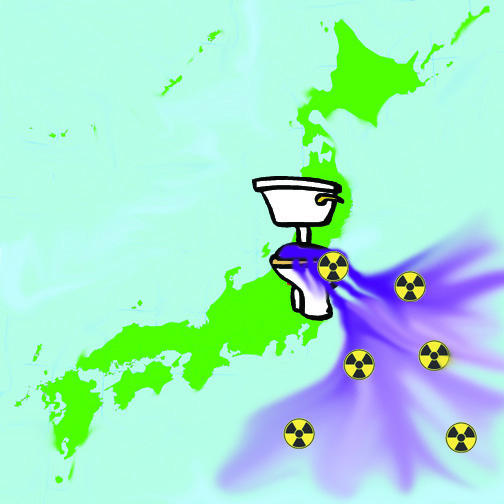 https://www.independent.ie/world-news/asia-pacific/japan-will-flush-unsafe-water-from-fukushima-nuclear-plant-into-sea-37429128.html, Julian Ryall, October 17 2018 Water the Japanese government is planning to release into the Pacific Ocean from the crippled Fukushima nuclear plant contains radioactive material well above legally permitted levels, according to the plant’s operator.
The government is running out of space to store contaminated water that has come into contact with fuel that escaped from three nuclear reactors after the plant was destroyed in the March 2011 earthquake and tsunami that struck north-east Japan.
Its plan to release the approximately 1.09m tons of water stored in 900 tanks into the Pacific has triggered a fierce backlash from local residents and environmental organisations, as well as groups in South Korea and Taiwan fearful that radioactivity from the second-worst nuclear disaster in history might wash up on their shores.
Tokyo Electric Power Co (Tepco), which runs the plant, has until recently claimed the only significant contaminant in the water is safe levels of tritium, which can be found in small amounts in drinking water, but is dangerous in large amounts.
The government has promised that all other radioactive material is being reduced to “non-detect” levels by the sophisticated advanced liquid processing system (ALPS) operated by Hitachi Ltd.
Documents provided to ‘The Daily Telegraph’ by a source in the Japanese government suggest, however, that the ALPS has consistently failed to eliminate a cocktail of other radioactive elements, including iodine, ruthenium, rhodium, antimony, tellurium, cobalt and strontium.
Hitachi declined to comment on the reports on the performance of its equipment. The Japanese government did not reply to multiple requests for comment.
A restricted document also passed to ‘The Telegraph’ from the Japanese government arm responsible for responding to the Fukushima collapse indicates that the authorities were aware that the ALPS facility was not eliminating radionuclides to “non-detect” levels.
That adds to reports of a study by the regional ‘Kahoko Shinpo’ newspaper which said confirmed that levels of iodine 129 and ruthenium 106 exceeded acceptable levels in 45 samples out of 84 in 2017.
Iodine 129 has a half-life of 15.7 million years and can cause cancer of the thyroid; ruthenium 106 is produced by nuclear fission and high doses can be toxic and carcinogenic when ingested.
In late September, Tepco was forced to admit that around 80pc of the water stored at Fukushima still contains radioactive substances above legal levels after the Ministry of Economy, Trade and Industry held public hearings in Tokyo and Fukushima at which local residents and fishermen protested against the plans.
Tepco has now admitted that levels of strontium 90, for example, are more than 100 times above legally permitted levels in 65,000 tons of water that has been through the ALPS cleansing system and are 20,000 times above levels set by the government in several storage tanks at the site.
Dr Ken Buesseler, a marine chemistry scientist with the US Woods Hole Oceanographic Institution, said it was vital to confirm precisely what radionuclides are present in each of the tanks and their amounts.
“Until we know what is in each tank for the different radionuclides, it is hard to evaluate any plan for the release of the water and expected impacts on the ocean”, he told the ‘Telegraph’.
Experts agree the danger posed by any release depends on the concentrations of radionuclides and subsequent contamination of fishery products.
The presence of strontium in the bones of small fish that might be consumed by humans could be a major concern. If ingested by humans, strontium 90 builds up in teeth and bones and can cause bone cancer or leukaemia.
The nuclear industry’s deceptive narrative about Fukushima earthquake in March 2011
The status of “Station Blackout” is a serious one.
“it will be many years before the Japanese people know exactly what happened at Fukushima Daiichi on 11 March 2011. One of the key mysteries was role, if any, the magnitude 9 earthquake played in damaging the plant’s reactor cooling systems. Until lethal levels of radiation inside the reactors fall and workers can carry out comprehensive investigations, the truth about the tremor’s impact will remain a subject of conjecture and contention”
Mr. Takamatsu states with expert authority that the pipes of cooling system ware not designed for the 50 second vibration of the magnitude quake. Barry Brook, kangaroo expert, disagrees and tells the world the quake caused no damage at Fukushima. Yet Mr. Brook must surely know the earthquake caused grid blackout. For reactors are all shut down by earthquakes. A solar plant would have kept generating until the last panel shattered. No one would have been evacuated from such a solar plant.
I submit that Prof. Barry Brook’s description of the effects of earthquake upon the Fukushima Diiachi on 11 March 2011 is totally ignorant of the facts as presented by many qualified experts and fly in the face of the independent commission set up by the Japanese Parliament (Diet). It is confirmed that expert investigators concern aspects of TEPCO’s explanations regarding the quake are “irrational”.
Thus any narrative based upon the nuclear industry view, in line with TEPCO’s may fairly be said to be “irrational”. For the industry view is that there is no possibility of quake damage to any structure or sub structure, such as coolant pipes and valves.
Earthquake Damage At Fukushima – is Industry’s Narrative Truthful or Certain? Nuclear History, 16 Oct 18 I am again going to contrast the statements made by Barry Brook in regard to the events and outcomes at Fukushima Daiichi in 2011 with the facts as presented by Mark Willacy. These facts are published in Willacy’s book, “Fukushima – Japan’s tsunami and the inside story of the nuclear meltdowns”, Willacy, M., Pan Macmillan, copyright 2013, Mark Willacy.
However, I will also include information related to the events which were first published and discussed in 2011. ………..
The earthquake generated the tsunami. What else did the earthquake cause?
In this blog I have included posts which give the IAEA considerations for the electrical grids which are connected to nuclear power plants. The IAEA states that the level of engineering and resilience built into such grids may be a significant additional cost for any nation considering generation to nuclear power.
It comes as no surprise then the electrical grid connected to the Fukushima Daiichi NPP failed for two reasons. 1. The earthquake caused all the nuclear reactors connected to the same grid to rapidly shut down. Thus the earthquake caused a blackout due to cessation of electrical generation. 2. The physical grid infrastructure – poles and wires – were damaged by the earthquake. At Fukushima this meant that more than one of the reactors was physically separated from the grid by the earthquake.
It can therefore be seen that the earthquake meant A. Fukushima Diiachi could not generate nuclear electricity as the quake had shut the reactors down. B. The Fukushima Diiachi Nuclear Power Plant was in Station Blackout for one reason: earth quake damage to nuclear infrastructure – the electrical grid. Continue reading
Fukushima’s stored water still contains radioactive iodine, cesium and strontium, as well as tritium
 Water stored at Fukushima nuclear plant still radioactive, https://abcnews.go.com/International/wireStory/water-stored-fukushima-nuclear-plant-radioactive-58147073 By MARI YAMAGUCHI, ASSOCIATED PRESS, The operator of Japan‘s wrecked Fukushima nuclear plant said Friday that much of the radioactive water stored at the plant isn’t clean enough and needs further treatment if it is to be released into the ocean.
Tokyo Electric Power Co. and the government had said that treatment of the water had removed all radioactive elements except tritium, which experts say is safe in small amounts.
They called it “tritium water,” but it actually wasn’t.
TEPCO said Friday that studies found the water still contains other elements, including radioactive iodine, cesium and strontium. It said more than 80 percent of the 900,000 tons of water stored in large, densely packed tanks contains radioactivity exceeding limits for release into the environment.
TEPCO general manager Junichi Matsumoto said radioactive elements remained, especially earlier in the crisis when plant workers had to deal with large amounts of contaminated water leaking from the wrecked reactors and could not afford time to stop the treatment machines to change filters frequently.
“We had to prioritize processing large amounts of water as quickly as possible to reduce the overall risk,” Matsumoto said.
About 161,000 tons of the treated water has 10 to 100 times the limit for release into the environment, and another 65,200 tons has up to nearly 20,000 times the limit, TEPCO said………
TEPCO only says it has the capacity to store up to 1.37 million tons of water through 2020 and that it cannot stay at the plant forever.
Some experts say the water can be stored for decades, but others say the tanks take up too much space at the plant and could interfere with ongoing decommissioning work, which could take decades.
Follow Mari Yamaguchi on Twitter at www.twitter.com/mariyamaguchi
Find her work at https://www.apnews.com/search/mari%20yamaguchi https://abcnews.go.com/International/wireStory/water-stored-fukushima-nuclear-plant-radioactive-58147073
Authorities deceive the public on radiation from Fukushima Daiichi
 Informal Labour, Local Citizens and the Tokyo Electric Fukushima
  Daiichi Nuclear Crisis: Responses to Neoliberal Disaster Management Adam Broinowski {extensive footnotes and references on original] September 2018, “……… (Official Medicine: The (Il)logic of Radiation Dosimetry On what basis have these policies on radiation from Fukushima Daiichi been made? Instead of containing contamination, the authorities have mounted a concerted campaign to convince the public that it is safe to live with radiation in areas that should be considered uninhabitable and unusable according to internationally accepted standards. To do so, they have concealed from public knowledge the material conditions of radiation contamination so as to facilitate the return of the evacuee population to ‘normalcy’, or life as it was before 3.11. This position has been further supported by the International Atomic Energy Agency (IAEA), which stated annual doses of up to 20 mSv/y are safe for the total population including women and children.43 The World Health Organisation (WHO) and United Nations Scientific Commission on the Effects of Atomic Radiation (UNSCEAR) also asserted that there were no ‘immediate’ radiation related illnesses or deaths (genpatsu kanren shi 原発 関連死) and declared the major health impact to be psychological.
While the central and prefectural governments have repeatedly reassured the public since the beginning of the disaster that there is no immediate health risk, in May 2011 access to official statistics for cancer-related illnesses (including leukaemia) in Fukushima and southern Miyagi prefectures was shut down. On 6 December 2013, the Special Secrets Protection Law (Tokutei Himitsu Hogo Hō 特定秘密保護法) aimed at restricting government employees and experts from giving journalists access to information deemed sensitive to national security was passed (effective December 2014). Passed at the same time was the Cancer Registration Law (Gan Tōroku Hō 癌登録法), which made it illegal to share medical data or information on radiation-related issues including evaluation of medical data obtained through screenings, and denied public access to certain medical records, with violations punishable with a 2 million yen fine or 5–10 years’ imprisonment. In January 2014, the IAEA, UNSCEAR and Fukushima Prefecture and Fukushima Medical University (FMU) signed a confidentiality agreement to control medical data on radiation. All medical personnel (hospitals) must submit data (mortality, morbidity, general illnesses from radiation exposures) to a central repository run by the FMU and IAEA.44 It is likely this data has been collected in the large Fukushima Centre for Environmental Creation, which opened in Minami-Sōma in late 2015 to communicate ‘accurate information on radiation to the public and dispel anxiety’. This official position contrasts with the results of the first round of the Fukushima Health Management Survey (October 2011 – April 2015) of 370,000 young people (under 18 at the time of the disaster) in Fukushima prefecture since 3.11, as mandated in the Children and Disaster Victims Support Act (June 2012).45 The survey report admitted that paediatric thyroid cancers were ‘several tens of times larger’ (suitei sareru yūbyōsū ni kurabete sūjūbai no ōdā de ōi 推定される有病数に比べて数十倍の オーダーで多い) than the amount estimated.46 By 30 September 2015, as part of the second-round screening (April 2014–March 2016) to be conducted once every two years until the age of 20 and once every five years after 20, there were 15 additional confirmed thyroid cancers coming to a total of 152 malignant or suspected paediatric thyroid cancer cases with 115 surgically confirmed and 37 awaiting surgical confirmation. Almost all have been papillary thyroid cancer with only three as poorly differentiated thyroid cancer (these are no less dangerous). By June 2016, this had increased to 173 confirmed (131) or suspected (42) paediatric thyroid cancer cases.47
The National Cancer Research Center also estimated an increase of childhood thyroid cancer by 61 times, from the 2010 national average of 1–3 per million to 1 in 3,000 children. Continue reading
Informal Labour, Local Citizens and the Tokyo Electric Fukushima Daiichi Nuclear Crisis
 Informal Labour, Local Citizens and the Tokyo Electric Fukushima Daiichi Nuclear Crisis: Responses to Neoliberal Disaster Management Chapter Author(s): Adam Broinowski Book Title: New Worlds from Below Book Sept 18 “………Conclusions From this discussion, it is evident how an advanced capitalist nation-state deploys a disposable population of informal labour to absorb the dangers inherent to the use of large-scale nuclear technologies and its private extractive and accumulation practices. Since its inception, nuclear power has been regarded by some as a symbol of Japan’s postwar civilisational progress.100 At the same time, the health of many thousands of people has been endangered in exposures to radiation while harms have been perpetrated upon local communities and nuclear workers and the environment more broadly as millions of people have been integrated within the centralising and concentrating dynamic of the transnational nuclear power industry.
On the mediated surface, Fukushima Daiichi has been used to prove to the world that a nuclear disaster of significant scale can be overcome and that people can survive and return to their normal lives. The government has concentrated on proving that it is safe for the Olympics, safe for tourism, safe to consume local produce, and safe to restart nuclear reactors (with 25 reactors expected to be supplying 20 per cent total energy by 2030). The neoliberal disaster model adopted, in which the state prioritises the profit of private corporations and their wealth-creating strategies while minimising public services and pursuing deregulation (e.g. of labour conditions), is indicated not only in the official intention to rebuild the local economy of Fukushima Prefecture, but also to expand, including through its transnational nuclear industry, Japan’s financial, military and industrial sector after Fukushima. This reflects the priority given to both the interests of the utilities, banks and construction companies involved in the reconstruction program, and those of multinational corporations, foreign governments and international regulatory and financial institutions involved in this sector.
At the same time, the sovereign duty to protect the fundamental needs of the population and reflect majority will is secondary to these priorities. Unlike a natural disaster, owing to the materiality of radiation that continues to be dumped and vented into the environment, facilitating the return to pre-disaster conditions by forgetting and rebuilding communities in contaminated areas is a practice of illusion. Despite the claims of the Abe administration and other nuclear promoters, Japan’s safety standards cannot adequately insure against the seismic activities or extreme weather events and their impacts on that archipelago. The authorities have furnished people with the means by which to normalise sickness and pathologise anxiety to justify the return to nuclear power reliance, while suppressing those who seek to resist it. The wealth of a healthy society and environment cannot be traded for the putative convenience and economic benefits of nuclear power generation as they are not comparable values. Official denial of the steady accumulation and exposure to ‘low-level’ internal radiation in a growing segment of the population only aggravates rather than protects the affected communities from the stresses related to Fukushima Daiichi. This inescapably leads to the need to address greater systemic problems that underlie such disasters.
As the previous organic life of village communities in contaminated zones is transformed into retirement villages and ad-hoc industrial hubs for temporary workers, this alienation from food, land, community, history, the human body and nature itself is a warning of the growing negative costs of the rapid expropriation and consumption of the planetary commons under a globalised system. Just as nuclear energy is not the solution to climate disruption caused by reliance on fossil fuels in a global capitalist economy, nor are radiation exposures comparable to everyday risks in modern society (i.e. transport accidents). If introducing ‘mistakes’ into the human genome is to be wagered against the daily conveniences of ‘modern’ life then this aspect of modernity is unsustainable. Although somewhat anthropocentric, it is a timely reminder that the Nobel Prize laureate (1946) Herman Müller stated in 1956, ‘the genome is the most valuable treasure of humankind. It determines the life of our descendants and the harmonious development of the future generations’.101
And so we return to the basic problem that no nuclear reactor can operate without radiation-exposed labour, particularly of informal or irregular workers. If these populations refused to work and joined in support with a network of translocal groups on informal and alternative life projects for greater self-sufficiency such as micro-financing, small-scale and permaculture farming on non-contaminated land, renewable and decentralised energy production and distribution, or campaigns for greater distribution of wealth, better public education and health improvement, these communities and workers could be active agents in devising models that could eventually become viable for adaptation to larger human populations. This application at scale cannot come too soon in the present context of imminent exhaustion of the planetary commons from the systemic demands for relentless economic growth and accumulation of wealth and power for the few.https://www.jstor.org/stable/pdf/j.ctt1pwtd47.11.pdf?refreqid=excelsior%3Af507747c78b2f0fba7a19d91222e4a72
For the first time, Japan acknowledges radiation death from Fukushima, and will compensate the family
 Fukushima disaster: Japan acknowledges first radiation death from nuclear plant hit by tsunami Japan has acknowledged for the first time that a worker at the Fukushima nuclear power plant, destroyed by an earthquake and tsunami more than seven years ago, has died from radiation exposure.
Key points:
- The man had worked at the plant since the earthquake and tsunami in 2011
- He was diagnosed with lung cancer in 2016, in his 50s
- The Health, Labour and Welfare Ministry ruled that compensation should be paid to the family
The Health, Labour and Welfare Ministry ruled that compensation should be paid to the family of the man in his 50s who died from lung cancer, an official said.
The worker had spent his career working at nuclear plants around Japan and worked at the Fukushima Daiichi plant operated by Tokyo Electric Power at least twice after the March 2011 meltdowns at the station.
He was diagnosed with cancer in February 2016, the official said. ……..
The ministry had previously ruled exposure to radiation caused the illnesses of four workers at Fukushima, the official said.
But this was the first death……
Tokyo Electric is facing a string of legal cases seeking compensation over the disaster.
The news came as the northern Hokkaido region was hit by a 6.7 magnitude earthquake, sparking concerns at the three-reactor Tomari nuclear plant, which lost power as a result of the earthquake.
The Tomari plant has been in shutdown since the Fukushima disaster.
The Fukushima crisis led to the shutdown of the country’s nuclear industry, once the world’s third-biggest.
Seven reactors have come back online after a protracted relicensing process.
The majority of Japanese people remain opposed to nuclear power after Fukushima highlighted failings in regulation and operational procedures in the industry.http://www.abc.net.au/news/2018-09-06/first-man-dies-from-radiation-from-fukushima-nuclear-disaster/10208244
Opposition to release of Fukushima radioactive tritium water into the sea; longterm storage the better option
 Fukushima water release into sea faces chorus of opposition https://mail.google.com/mail/u/0/#inbox?compose=DmwnWtDqNzxklZTsLVvsRFtgBQZHzxshPgMCgrVGpNqZnjrqDwNNWbPprDwxPlNFzCVZnfDvsQwVCitizens and environmental groups have expressed opposition to the idea of releasing into the ocean water tainted with tritium, a radioactive substance, from Tokyo Electric Power Company Holdings Inc.’s disaster-stricken Fukushima No. 1 nuclear power plant.“Long-term storage (of the tritium-containing water) is possible from technical and economic standpoints,” Komei Hosokawa, 63, an official of the Citizens’ Commission on Nuclear Energy, said at a public hearing held in Tokyo on Friday by a subcommittee of the Agency for Natural Resources and Energy. “The radiation levels in the water will decrease during the long-term storage,” he added.
At a similar hearing held the same day in Koriyama, Fukushima Prefecture, Aki Hashimoto, a housewife from the city, said, “I never want to see further worsening of ocean pollution from radiation.”
Opinions objecting to the release of the tritium-contaminated water into the ocean were also heard at a hearing held in the Fukushima town of Tomioka on Thursday.
After Friday’s hearings, Ichiro Yamamoto, who heads the subcommittee, told reporters that many participants in the hearings said the tainted water should continue to be held in storage tanks.
The subcommittee will study the option of keeping the water in the tanks, he added.
Tepco is lowering the radiation levels in contaminated water at the Fukushima No. 1 plant using special equipment, but the device cannot remove tritium.
The tritium-tainted water is stored in tanks within the premises of the power plant, which was heavily damaged in the March 2011 earthquake and tsunami.
In 2016, an expert panel of the Agency for Natural Resources and Energy discussed five methods to dispose of the tritium-tainted water —injection deep into the ground, release into the sea after dilution, release into the air through evaporation, conversion into hydrogen through electrolysis, and burying it after it is solidified.
The panel estimated that the ocean release is the cheapest option, costing up to about ¥3.4 billion.
Release of tritium-tainted water into sea is opposed by Fukushima fisheries group
 Fukushima fisheries group opposes release of tritium-tainted water into sea https://www.japantimes.co.jp/news/2018/08/30/national/fukushima-fisheries-group-opposes-release-tritium-tainted-water-sea/#.W4hrkSQzbGg
JIJI TOMIOKA, FUKUSHIMA PREF. – The head of a fisheries industry group in Fukushima Prefecture expressed opposition on Thursday to the idea of releasing water containing radioactive tritium from a crippled nuclear plant in the prefecture into the ocean.
The tritium-tainted water is from Tokyo Electric Power Company Holdings Inc.’s Fukushima No. 1 nuclear power plant, which was damaged heavily in the powerful earthquake and tsunami in March 2011.
“At a time when harmful rumors are still circulating in Japan and some countries continue to restrict imports (of Fukushima goods), releasing the tainted water into the sea will inevitably deliver a fatal blow to the Fukushima fishery industry,” Tetsu Nozaki, who leads the Fukushima Prefectural Federation of Fisheries Cooperative Associations, said.
His remarks came during a public hearing held by a subcommittee of the Agency for Natural Resources and Energy in the Fukushima town of Tomioka.
The hearing was for the canvassing of opinions on how to deal with the tritium-tainted water. Releasing it into the sea has been proposed as one option. Similar hearings will be held in the city of Koriyama, Fukushima, and Tokyo on Friday.
Using special equipment, Tepco is lowering the radiation levels in contaminated water at the plant, but the device cannot remove tritium. While the processed water is kept in tanks within the premises of the nuclear power station, the amount of tainted water continues to increase as the plant’s damaged reactors need to be cooled continuously. Tepco is about to run out of suitable sites to construct new storage tanks, according to the government.
Discussions on ways to deal with the tritium-contaminated water are underway at the subcommittee of the government agency.
In a June 2016 report, an expert panel of the agency said that releasing the polluted water into the sea after it is diluted with fresh water would be relatively cheap and time-efficient.
1 This Month
10 March A LIVE WEBINAR THE REAL EFFECTS OF NUCLEAR POWER
What the Industry Isn’t Telling Us
1:00 PM Mountain, 2 pm Central, 3 pm Eastern. Live on the Keepers of the Water Facebook page



18 March Webinar @ 1 PM EST: An Assessment of SMR Projects: The Case of Canada
register for the zoom:
https://us02web.zoom.us/webinar/register/WN_o8BIIOUvQ2ONJR1nta65DQ#/registration


of the week – STOP SMALL MODULAR REACTORS IN CANADA
To see nuclear-related stories in greater depth and intensity – go to https://nuclearinformation.wordpress.com
-
Archives
- March 2026 (119)
- February 2026 (268)
- January 2026 (308)
- December 2025 (358)
- November 2025 (359)
- October 2025 (376)
- September 2025 (258)
- August 2025 (319)
- July 2025 (230)
- June 2025 (348)
- May 2025 (261)
- April 2025 (305)
-
Categories
- 1
- 1 NUCLEAR ISSUES
- business and costs
- climate change
- culture and arts
- ENERGY
- environment
- health
- history
- indigenous issues
- Legal
- marketing of nuclear
- media
- opposition to nuclear
- PERSONAL STORIES
- politics
- politics international
- Religion and ethics
- safety
- secrets,lies and civil liberties
- spinbuster
- technology
- Uranium
- wastes
- weapons and war
- Women
- 2 WORLD
- ACTION
- AFRICA
- Atrocities
- AUSTRALIA
- Christina's notes
- Christina's themes
- culture and arts
- Events
- Fuk 2022
- Fuk 2023
- Fukushima 2017
- Fukushima 2018
- fukushima 2019
- Fukushima 2020
- Fukushima 2021
- general
- global warming
- Humour (God we need it)
- Nuclear
- RARE EARTHS
- Reference
- resources – print
- Resources -audiovicual
- Weekly Newsletter
- World
- World Nuclear
- YouTube
-
RSS
Entries RSS
Comments RSS
 nuclear-news