The ghost towns in Fukushima Prefecture
Split-Screen Documentary: Nuclear Ghost Town – After 8 Years
Fukushima’s ghost towns https://www.cbsnews.com/news/fukushima-daiichi-nuclear-disaster-ghost-towns-60-minutes-2019-07-28/
More than eight years after one of the worst nuclear disasters in history, towns around Japan’s nuclear power plant struggle to rebuild,
Fukushima’s wrecked reactors: radioactive water is in no way under control
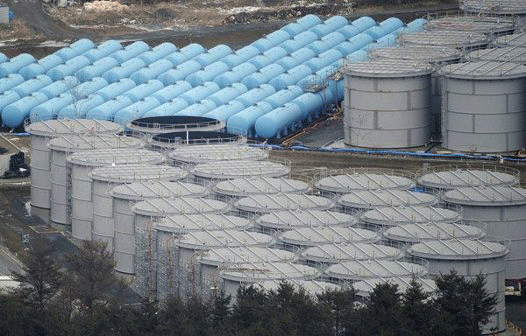
Toxic water level at Fukushima plant still not under control, THE ASAHI SHIMBUN, July 28, 2019 Almost six years after Prime Minister Shinzo Abe famously declared the contaminated water problem at the Fukushima No. 1 nuclear plant “under control,” today it remains anything but.
Tokyo Electric Power Co. (TEPCO) continues to face difficulties in dealing with water contaminated with radioactive substances at its crippled plant.
About 18,000 tons of highly contaminated water remain accumulated in reactor buildings and other places.
Abe made the declaration in September 2013 while Tokyo was bidding to win the 2020 Summer Games.
In reality, however, the situation is not under control even now.
In a meeting of the Nuclear Regulation Authority (NRA) in June, one of its members, Nobuhiko Ban, told TEPCO officials, “I want you to show whether you have a prospect (for the reduction of contaminated water) or you have given up.”
The water level did not fall as planned in an area of a basement floor at the No. 3 reactor building for two months. Asked why the level did not drop, TEPCO officials offered only vague explanations in the meeting. Ban made the remark out of irritation.
Highly contaminated water that has accumulated in reactor buildings and turbine buildings is a major concern at the Fukushima plant. In addition to water that was used to cool melted nuclear fuel at the No. 1, No. 2 and No. 3 reactors, groundwater also has flowed into those buildings through cracks.
The concentration of radioactive substances in the highly contaminated water is about 100 million times that of the contaminated water that has been processed and stored in tanks………
Eight years since the nuclear accident occurred, the volume of highly contaminated water in the buildings has fallen to 18,000 tons. TEPCO aims to reduce the volume further to 6,000 tons by the end of fiscal 2020.
However, work to decrease the water has not progressed as expected.
As for the area in the basement of the No. 3 reactor building, it is known that water used to cool melted nuclear fuel is flowing into the area. But why the water level does not drop only in that area is not known.
If the water level in the building remains high, highly contaminated water there could leak into the ground through cracks when the groundwater level outside the building drops. If the leaks occur, the entire effort to decrease the amount of highly contaminated water will be stalled.
The NRA is also requiring TEPCO to take anti-tsunami measures because if a huge tsunami engulfs the buildings again, it could send highly contaminated water pouring into the sea
However, anti-tsunami measures are also delayed…… http://www.asahi.com/ajw/articles/AJ201907280040.html
Fukushima – a nuclear catastrophe that continues
Expert says 2020 Tokyo Olympics unsafe due to Fukushima | 60 Minutes
Circular flow of 2011 Fukushima cesium through Pacific, back to Japan
July 8, 2019 (Mainichi Japan) TOKYO — Radioactive cesium released into the Pacific Ocean due to the March 2011 meltdowns at Fukushima Daiichi Nuclear Power Station is returning to Japanese shores via a shorter route than expected, according to a joint research initiative.
The findings were revealed by a team from the University of Tsukuba, the Japan Agency for Marine-Earth Science and Technology (JAMSTEC) and Kanazawa University.
Until now, it was thought that cesium from the Tokyo Electric Power Co. (TEPCO)-operated plant would be circulated around the Pacific by subtropical gyre currents for several decades before returning to Japanese waters. But in 2012, a year after the reactor core meltdowns, tests on seawater samples collected by the team showed increased cesium concentrations in East China Sea waters off Japan. Researchers say that the concentrations observed are too low to impact sea life.
The rate increased, peaking in 2014, and a year later high concentrations were also reported in the Sea of Japan. The team believes the cesium is now flowing around the Pacific Ocean again.
It is thought that seawater sank deeply into the sea after its density increased due to cooling by winter winds, causing the cesium to travel on a western-flowing underwater route.
Michio Aoyama, a visiting professor at the University of Tsukuba, said, “That the cesium would come back in such a short time was unexpected. We’ve found a previously unknown route.”
Senior JAMSTEC research scientist Yuichiro Kumamoto said of the project’s potential benefits, “Because it has visualized ocean circulation, the results could be used in the future for predictions on issues such as climate change.”
(Japanese original by Mayumi Nobuta, Science & Environment News Department)
Should Fukushima exclusion zone be widened?
FUKUSHIMA investigators were left “worried” after recording radiation levels 100 times normal, leading them to suggest the exclusion zone should be increased.Express UK , By CALLUM HOARE Jul 4, 2019 | “………… when Chernobyl researcher Yevgen visited as part of Amazon Prime’s “Radioactive Detectives” series, he was left shocked.
The narrator revealed in 2017: “Have the Japanese authorities determined the correct exclusion zone?
“The first big surprise is a completely unguarded borderline.
“Yevgen wants to carry out his first measurements here.
“He has to tell Kenzo that the radiation level exceeds the natural radiation 100 times over.
“The men are worried.”
Kenzo Hashimoto, a Japanese journalist claimed the exclusion zone needed to be increased as a result.
He said: “If the radiation is that high, the authorities should extend the border line even further.
“I don’t know exactly how the survey has been made – it seems very strange to me…….https://www.express.co.uk/news/world/1149129/fukushima-nuclear-disaster-japan-radiation-exclusion-zone-investigation-spt
Danger in foreign workers at Fukushim nuclear clean-up – Tepco abandons plans for them
|
The company noted that hiring foreign workers at the nuclear plant under a new specified skills visa category that took effect in April could result in work-related accidents and long-term health problems due to their lack of Japanese language skills and understanding of Japanese labor practices. The announcement followed a health ministry caution May 21 for TEPCO to carefully reconsider its policy of using foreign workers at the complex…….. The ministry had said that if TEPCO went ahead with hiring foreign workers, the company and its contractors involved in decommissioning had to take at least the same level of protective measures that apply to Japanese workers to ensure that they fully understand safety sanitation and avoid the health risk of excessive radiation exposure. Even though eight years have passed since the triple meltdown, radiation levels remain high in many areas of the Fukushima plant, especially around the reactor buildings. The decommissioning process that is expected to take years will involve a range of gargantuan tasks, one being the removal of melted nuclear fuel debris from the reactors. Under the recently revised immigration control law, foreign workers with specified skills are permitted to work at nuclear power plants. The ministry acknowledges that it is ultimately up to individual employers to decide whether or not to accept foreign workers on their payrolls. But experts in Japan and overseas who are keen for the new visa program to be a success have also voiced concerns about foreign workers at the Fukushima plant developing radiation-related health issues and being able to manage them after they return to their home countries….. Chief Cabinet Secretary Yoshihide Suga referred to the ministry’s caution at a May 21 news conference, saying that TEPCO should be prepared to fully address a range of health-related problems that may arise in the future. The utility notified dozens of its contractors at a meeting in late March that it will accept foreign workers at the Fukushima plant. Currently, about 4,000 people toil at the plant each day. Most areas of the complex are categorized as controlled areas to guard against radiation exposure. Under the law, workers at a nuclear facility must not be exposed to more than 100 millisieverts of radiation over five years and 50 millisieverts a year. http://www.asahi.com/ajw/articles/AJ201905220067.html |
|

Highly radioactive chimney at Fukushima No 1 plant to be taken apart
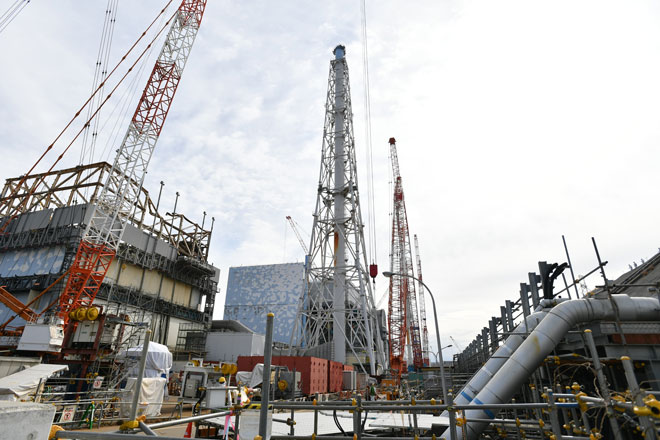
TEPCO to slice dangerous chimney at Fukushima plant http://www.asahi.com/ajw/articles/AJ201905100045.html, By CHIKAKO KAWAHARA/ Staff Writer, May 10, 2019 Tokyo Electric Power Co. plans to start work on May 20 to dismantle a 120-meter-tall, highly contaminated chimney that could collapse at the crippled Fukushima No. 1 nuclear power plant.
It will be the first highly radiated facility at the plant to be taken apart, the company said May 9.
The stack, with a diameter of 3.2 meters, was used for both the No. 1 and No. 2 reactors. TEPCO plans to remove the upper half of the chimney within this year to prevent the structure from collapsing.
The dismantling work will be conducted by remote control because the radiation level around the base of the chimney is the highest among all outdoor areas of the plant. Exposure to radiation at the base can cause death in several hours.
After the Great East Japan Earthquake and tsunami struck in March 2011, pressure increased in the containment vessel of the No. 1 reactor. Vapors with radioactive substances were sent through the chimney to the outside.
TEPCO also found fractures in steel poles supporting the chimney. The damage was likely caused by a hydrogen explosion at the No. 1 reactor building when the nuclear disaster was unfolding.
Since then, the chimney has been left unrepaired because of the high radiation levels.
Immediately after the nuclear accident, a radiation level exceeding 10 sieverts per hour was observed around the base of the chimney. In a survey conducted in 2015, a radiation level of 2 sieverts per hour was detected there.
TEPCO will use a large crane that will hold special equipment to cut the chimney in round slices from the top.
The company set up a remote control room in a large remodeled bus about 200 meters from the chimney. Workers will operate the special cutting equipment while watching footage from 160 video cameras.
Fukushima’s ghost towns
Nuclear wasteland Inside the ghost towns of Fukushima, Eight years on from the tsunami and nuclear meltdown, much of Japan’s Fukushima province remains derelict and deserted. Telegraph, 13 May 19
There was a chilling silence in the town of Tomioka in the days after the March 2011 Fukushima nuclear disaster.
Shoes were left in porches, half-read newspapers lay abandoned next to cups of tea, long gone cold. As night closed in on the seaside town, lights glared out from a few bare windows, while news of the ongoing crisis at the Fukushima No. 1 Nuclear Power Plant just six miles away drifted from a solitary radio.
Nobody was home.
Eight years on, little has changed. Before March 11, 2011 – the day the tsunami engulfed the nuclear facility, forcing the evacuation of more than 150,000 residents across the region – the town had a population of 15,960. Now, just a few hundred people have returned despite the lifting of the evacuation order in April 2017.
“Officially 835 have returned, but many are plant and other clean-up workers who are renting out abandoned houses,” says Takumi Takano, a local councillor who splits her time between Tomioka and temporary digs in Koriyama an hour’s drive away that she and her husband Kenichi have lived in since evacuating.
Of the remaining locals most are either elderly, or only return during the day, she says. Most worryingly, just 14 are children. When night falls, they return to “temporary” homes elsewhere, she says. “It’s like a ghost town.”
A similar situation is found throughout the entire evacuated region, where only 12,859 of the 100,510 residents who were living in the zone before the disasters have returned, a Cabinet Office official says. Like Tomioka, many of them are clean-up workers, local residents say.
…… After almost eight years, residents, especially those with young families, have settled elsewhere, securing new jobs and starting new schools or moving out of Fukushima entirely, says says Kenichi, a former worker at the devastated nuclear plant.. Many are put off returning by the severe shortage of medical facilities in the region.
Then there’s the radioactivity,” he says, as the couple sit outside their caravan, set up on the land of their recently demolished home, which backs on to a 130-square-mile “difficult-to-return-zone” that is still considered too highly contaminated to inhabit.
Eight years on, radioactivity levels have fallen in the reopened parts of Tomioka, though remain 20 times higher than before the disaster. “It’s much higher over there,” he says, pointing to the blockaded zone, where radiation levels exceed 3.8 microsieverts per hour – the designated threshold for issuing evacuation orders.
That zone is a legacy of the nuclear disaster, when multiple reactor meltdowns and explosions, triggered by a magnitude nine earthquake and towering tsunami, spread radioactive materials for hundreds of miles around……..
despite clean-up operations there to reduce radiation levels below the government-set target of 0.23 microsieverts (µSv) per hour, other legacies of the disaster – the crumbling houses and shops, corroding vehicles and overgrown fields, not to mention 16.5 million containers of contaminated earth collected at some 140,000 sites around the region – are impossible to avoid.
The 0.23 µSv figure is significant in that it adds up to an annual dosage level of one millisievert (mSv) (calculated on the premise that a resident spends eight hours a day outdoors), stipulated by the International Atomic Energy Agency as being safe for members of the public.
But while maintaining that level is complicated by recontamination from surrounding woodland, some experts argue the figure says little about the true dangers, or safety, of radiation exposure. That the Japanese government raised this to 20 mSv in the aftermath of the disasters adds weight to their argument…….
Misao Fujita, a doctor who performs thyroid scans at a clinic in Iwaki, about 30 miles south of the nuclear plant, says a connection between the cancers and radiation exposure cannot be ruled out and the screening effect is no reason to disregard the examinations.
“What we do know is that after Chernobyl, many children developed thyroid cancer, and if you take that into account and consider the high risk that Fukushima children were exposed to radiation then I think we should carry out such tests,” Dr Fujita says, adding that thyroid cancer normally occurs in one in one million children.
Noriko Tanaka, whose son is one of Dr Fujita’s patients, says exams revealing cysts in her son’s thyroid are a concern, not least because iodine-131 – a substance that causes thyroid cancer – was contained in the plume released by the Fukushima plant that landed on Iwaki after the disasters. At the time, she was pregnant with her son. “I worry because nobody knows for sure what the future holds,” she says……….
The issue of the one million tons of contaminated water being stored at the stricken nuclear plant is another worry for residents. After receiving assurances from Fukushima plant operator Tokyo Electric Power Company (TEPCO ) that the water had been successfully treated and stripped of all but one radioactive material, tritium, the government announced in 2017 it would start releasing the water into the ocean, despite protests, especially from local fisheries.
TEPCO released convoluted data to demonstrate the water’s safety, but was forced to backtrack last September when further tests showed the sums didn’t add up and 80 per cent of the water was in fact up to 20,000 times higher than the official safe threshold. Furthermore, it contained harmful radionuclides such as iodine, caesium and strontium.
Moreover, while the initial suggestion was that tritium was relatively harmless some studies have shown it to be a cause of infant leukaemia, says Ayumi Iida of NPO Tarachine, which independently analyses seawater samples taken from the ocean near Fukushima’s two nuclear plants.
“Tritiated water is easily absorbed and hazardous when inhaled or ingested via food or water,” she says. “There’s already data indicating infant leukaemia rates are higher near to nuclear plants, and tritium is known to cause DNA damage, so while there are claims that tritium is harmless, there are counterclaims it can adversely affect health, especially among young children.”…….
Shaun Burnie, a nuclear expert with Greenpeace says that discharging the water into the ocean is “the worst option” available, and one whose main consideration is economic.
“The only viable option, and it’s not without risks, is the long-term storage of the water in robust steel tanks over at least the next century, and the parallel development of water processing technology,” he says. ……….
“The reality is there is no end to the water crisis at Fukushima, a crisis compounded by poor decision-making by both TEPCO and the government,” says Mr Burnie.
Among more pressing issues, Mr Burnie says, is 400,000 cubic meters of sludge being stored within the Fukushima plant grounds that contains high concentrations of strontium – known as a “bone-seeker” because, if introduced into the body, it can accumulate in the bones in the same way as calcium does.
With the plant still generating waste, this sludge is expected to nearly double over the next 10 years, he adds.
Strontium releases into the environment from the plant were relatively small following the 2011 disaster, but significantly greater 30 months later, when in 2013 a large strontium-laced plume contaminated land as far away as Minamisoma – a city about 20 km from the plant, Mr Burnie says. Such an event could re-occur, he says.
“Is it a good idea to lift the evacuation orders? Absolutely not. The public are right to be concerned about the possibility of further offsite releases.”
They can also be forgiven for being sceptical over official reassurances that foodstuffs are safe, says Ms Iida of Tarachine, which also runs a produce-testing laboratory and has found “plenty” of items with levels of contamination exceeding the safe limits.
Meanwhile tests on samples of soil – which has no official safe threshold in Japan – have also revealed high levels of radiation in the area, she adds.
Namie’s Obori district, about six miles northwest of the nuclear plant and within the difficult-to-return-zone, is one place where soil radiation levels remain high. In woodland backing the pretty hamlet, which is famed for its pottery but has slowly surrendered to nature, the Telegraph recorded up to 127 µSv per hour – over 350 times the IAEA’s safe threshold……
Fukushima nuclear waste mess is by no means solved
THE OLYMPICS CLEAN-UP: FUKUSHIMA, OKINAWA, HOMELESSNESS 陳黃金菊05/05/2019 ENGLISH INTERNATIONAL MAY 2019 NUCLEAR PHYSICIST Hiroaki Koide has pointed out that although eight years have passed, there is still more than one million tons of irradiated water which still hasn’t been treated. The Tokyo Electric Power Company (TEPCO)’s “handling” method for this situation was to build a thousand sewage tanks to store the sewage. But as space was limited and the number of sewage tanks was also limited. As such, Koide asserts, “TEPCO will be compelled to release these waters into the sea in the near future.” [1] Moreover, with regards to the core meltdown of the reactor, the melted fuel rods remain unaccounted for.
As such, Koide has been staunch in advocating that the only solution to the Fukushima incident is a Chernobyl-style sarcophagus, covering the nuclear power plant. But he also admits, even in this case, “the containment of this disaster will not have been achieved even after all who are alive today have died.” [2]
Abe Shinzo issued an order for an end to an evacuation on April 1st, 2017, at the same time as he issued a compulsory repatriation policy. At this time, the town of Namie, 11.2 kilometers from the Fukushima nuclear power plant, has been described as a “ghost town.” As raised by now deceased mayor Baba Yushi before he died, after the end of the evacuation, 234 people—one percent of the population—returned to Namie to live. The majority of these were elderly, which is to say, the town lacked a working population. Without any means of transportation and open supermarkets. There was just one clinic. [3]
As a compensatory measure in line with the repatriation measure, TEPCO set a deadline, requesting that disaster victims assess their losses, and inform TEPCO of what kind of compensation they requested. Regarding this, the mayor of Namie stated that TEPCO never should have set this kind of deadline, but should account for the losses of disaster victims themselves.
What is even more incredible is that TEPCO could use “individual circumstances” as a way of avoiding the requests of disaster victims. For example, residents in twenty kilometers of the nuclear power plant were forcibly evacuated but TEPCO interpreted this instead as “voluntary evacuation”, and refused to pay compensation. [4] Even those who lost their real estate might not receive compensation, not to mention harms that could not be compensated for, such as those below the age of eighteen whose thyroids were inspected five years later, among them 172 were positive for or suspected of having thyroid cancer, and 131 had their thyroid glands removed by operation. [5]
At the same time, damages to the environment cannot be compensated. Who is it that would receive compensation? What kind of compensation would that be? Before the disaster, Fukushima’s agricultural industry and natural environment were comparatively famous. But after the disaster, farmers have been forced to the end of a rope, some of which have chosen death. [6] Completely clearing radiation from the land is also impossible, because in clearing remaining radiation in the forest, this would require cutting down all of the trees, and removing all of the topsoils. [7]
Protests by those who have developed thyroid cancer were criticized by the government, stating that their protests were causing “reputational damage”.[8] The government and TEPCO toss the ball to each other, and what is even stranger is that nobody seems to need to take responsibility. [9]…………..https://newbloommag.net/2019/05/05/olympics-fukushima-okinawa-eng/
1] See “The Fukushima Nuclear Disaster and the Tokyo Olympics”.
[2] Ibid.
[3] See “‘Save the Town’: Insolvable Dilemmas of Fukushima’s ‘Return Policy’”.
[4] Ibid.
[6] See the Green Citizen Action Alliance’s report “Environmental Front: Subscribing to 311 compensation” (〈環境前線:前仆後繼的311核災求償行動〉).
[7] See “Reconstruction Disaster: The human implications of Japan’s forced return policy in Fukushima”
[8] Ibid.
[9] See Tetsuya Takahashi’s book, Xisheng te tixi: Fudao ‧ Okinawa (2014, lit. The System of Sacrifice: Fukushima‧Okinawa), trans. Lee Yi-zhen.
[10] One can see the report “Decoding the US Military Bases in Japan with 9 Graphs” (九張圖解密日本美軍基地) in the News Lens and “Okinawa Government Sued by Japanese Government for ‘the Most Dangerous Military Bases’” (為了「全世界最危險的軍事基地」,沖繩縣政府被日本政府一狀告上法庭──觀光客看不到的美軍基地問題) in Crossing.
[11] One can see the report in UDN Global, “Okinawan Referendum: Say No to the US Military Again? The People Neglected by the Japanese Government” (沖繩基地公投:再次向美軍說NO?日美政府無視的43萬民意).
[12] See the editorial, “Henoko project clearly doomed; time to open talks with U.S” in Asahi and “US Military Base Threatens Biodiversity in Okinawa” in Truthout
Safety and language problems, as Tepco plans to bring in foreign workers for Fukushima clean-up

|
Editorial: Safety, language measures needed for foreigners to work at Fukushima plant https://mainichi.jp/english/articles/20190424/p2a/00m/0na/004000c 24 Apr 19, Tokyo Electric Power Co. (TEPCO) is preparing to bring in foreign workers with special technical skills to join decommissioning work on the disaster-stricken Fukushima Daiichi nuclear plant.
At present, an average of 4,000 employees of TEPCO and cooperating firms work at the facility every day. Laws and regulations stipulate that workers’ radiation exposure must be limited to 50 millisieverts in a single year, and 100 millisieverts over five years. No one is allowed to stay at the plant once they hit one of these caps, so waves of new employees must be brought in to maintain worker numbers. Decommissioning the Daiichi plant, which suffered a triple core meltdown in the wake of the March 2011 Great East Japan Earthquake and tsunami, is expected to take 30 to 40 years. Whether the companies involved can sustain sufficient staffing levels will be one factor that determines the success or failure of the project. When it comes to tapping foreign labor to make up the required numbers, the Justice Ministry — which has jurisdiction over Japan’s immigration system — has already declined to approve sending foreign technical intern trainees to work at the plant. One of the core tenets of the foreign technical trainee program is that the job placements must provide the trainees with skills they can use in their home countries, and working to decommission a devastated nuclear plant did not fit the bill. TEPCO is now turning its eyes to foreign workers with Category 1 work visas, one of the new residency statuses launched on April 1 and aimed at those with certain skills and experience. Technical trainees with three years’ experience in Japan can obtain this visa without a skills exam. However, there is a real risk of radiation exposure at the Daiichi plant, and the terminology used on-site is highly technical, making for a difficult environment. TEPCO and its partners must not treat the new foreign worker system as an employee pool they can simply dip into. The workers’ Japanese level is particularly a cause for worry. To obtain a Category 1 visa, applicants must speak Japanese at only a “daily conversational” level. However, anyone working at the Daiichi site must understand a slew of technical terms related to radiation and other facets of the decommissioning process, meaning a very high level of Japanese is absolutely indispensable. If foreign employees begin working there without having learned the necessary terminology, we believe there is a real risk they could be ordered to do jobs that exposed them to radiation. TEPCO has said it is up to its project partners whether they employ Category 1 foreign workers. In fact, the majority of people at Fukushima Daiichi are employed by one of the firms that make up the layers upon layers of subcontractors working on the decommissioning. Nevertheless, as the company heading the project, TECPO has a responsibility to oversee the conditions of every worker, right down to the bottom of the pyramid. Furthermore, if a foreign worker has been exposed to radiation overseas, that dose must be added to their sievert count at the plant. However, it is up to the worker to report any previous radiation exposure, which can make it difficult to properly track and manage their doses. If a worker develops a radiation-related illness after returning to their home country, will they be able to smoothly apply for workers’ accident compensation? This is also a serious worry. If Japan is to accept foreign workers to help decommission the Fukushima Daiichi plant, it is absolutely essential to create the appropriate environment, including measures to boost their Japanese skills and strengthen radiation exposure management. |
|
Hazardous removal of spent fuel rods is just one step in the Fukushima nuclear clean-up

|
Nuclear fuel removal is small step in cleanup at Fukushima http://www.asahi.com/ajw/articles/AJ201904190031.htmlApril 19, 2019 Tokyo Electric Power Co., the operator of the crippled Fukushima No. 1 nuclear power plant, has started removing radioactive fuel rods from the fuel storage pool for one of the three reactors that melted down in the 2011 nuclear disaster.Massive amounts of melted nuclear fuel debris remain in the cores or containment vessels of the No. 1 to No. 3 reactors, which melted down. In addition, many fuel rods, batched into assemblies, are stored in storage pools within the reactor buildings.
These pools could be seriously damaged if the plant is hit by another big earthquake or tsunami. Moving spent fuel from these pools to the safe common pool within the premises is an important step to preventing accidents and ensuring steady progress in the process of decommissioning the reactors. All the 1,535 nuclear fuel assemblies that were in the No. 4 reactor building, which did not melt down because it was shut down at the time of the accident, were removed by the end of 2014. Since workers could enter the building, the operation was conducted in a normal manner. By contrast, areas around the fuel storage pool for the No. 3 reactor remain inaccessible due to high levels of radiation. The situation requires the removal operation to be remotely conducted from a control room about 500 meters from the No. 3 reactor building. The work involves putting nuclear fuel assemblies into special containers under water and lifting them up with a crane and putting them down onto the ground for transportation to the common pool. This is a tricky and risky mission that has to be carried out with great care and caution by using a monitor. Initially, the process of removing the fuel rods from the storage pool for the No. 3 reactor was scheduled to start at the end of 2014. But it has been repeatedly postponed due to technical mishaps and other reasons. It was finally started after a delay of more than four years. The plant operator, known as TEPCO, plans to relocate all 566 nuclear fuel assemblies that have been kept in the storage pool in the No. 3 reactor building by the end of March 2021. To reduce the risks posed to the process by possible earthquakes and tsunami, it is desirable to carry out the work quickly. But making undue haste could cause problems and accidents that disrupt the process. Meeting the schedule should not be the top priority. Experience and expertise to be accumulated through the work with the No. 3 reactor will come in handy for the same fuel removal work with the Nos. 1 and 2 reactors, which could be initiated as early as in fiscal 2023, which starts in April 2023. The other two reactors, however, will pose even tougher challenges. The debris situation of the No. 1 reactor building is worse, while radiation levels within the No. 2 reactor building are higher. It is vital to obtain sufficient experience and know-how through the process of removing fuel rods from the No. 3 reactor. TEPCO needs to ensure steady progress in the process through effective and close information sharing with related manufacturers and other actors involved. No decision has yet been made as to what to do with the spent fuel after being transferred to the common pool. This is a complicated and knotty issue that does not lend itself to an easy, quick solution, just like the problem of a rapidly increasing amount of radiation-contaminated water the plant is generating as the reactors are being flooded to cool the melted fuel debris and underground water keeps flowing in the reactor buildings. In 2021, the utility plans to launch the even more challenging mission of removing melted fuel debris from one of the three reactors. Prime Minister Shinzo Abe recently visited the Fukushima No. 1 nuclear plant for the first time in five years and promised the government’s committed leadership for the efforts to decommission the reactors and deal with polluted water. The Abe administration should provide really strong and effective leadership for the long, grueling process in line with the prime minister’s pledge. Both the government and TEPCO have a duty to move the decommissioning process steadily forward while winning support from the local communities through sincere and serious dialogue. |
|
|
Japan has a new kind of visa to lure foreign blue collar workers for Fukushima clean-up
Japan Aims to Hire Foreigners for Nuclear Cleanup
The country’s largest utility is working to decommission the Fukushima plant amid radiation risks at the site of the 2011 disaster, WSJ , By Mayumi Negishi and Chieko Tsuneoka, April 18, 2019 TOKYO—Japan’s largest utility is looking to foreign blue-collar workers to help decommission its Fukushima Daiichi nuclear-power plant amid a labor shortage exacerbated by radiation risks at the site of the 2011 nuclear disaster.
Tokyo Electric Power Co., or Tepco, said Thursday it has informed dozens of contractors that foreigners could qualify for a new type of visa that allows manual workers to stay in the country for five years. Workers who enter areas with elevated radiation would need sufficient Japanese-language skills...(subscribers only) https://www.wsj.com/articles/japan-aims-to-hire-foreigners-for-nuclear-clean-up-11555595613
Japan’s massive task to clean up nuclear fuel pools of Fukushima stricken reactors
|
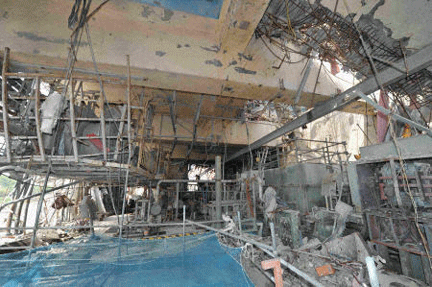
Japan begins massive nuclear pool clean-up after Fukushima disaster, https://www.abc.net.au/news/2019-04-15/japan-taking-nuclear-fuel-rods-from-fukushima-reactor/11009422 The operator of the tsunami-wrecked Fukushima nuclear plant has begun removing fuel from a cooling pool at one of three reactors that melted down in the 2011 disaster, a milestone in the decades-long process to decommission the plant.
Key points:
The process involves taking out spent nuclear fuel rods by using remote-controlled cranes to lift hundreds of radioactive cylinders from a highly contaminated reactor site. Tokyo Electric Power Co (TEPCO) said on Monday that workers started removing the first of 566 used and unused fuel units stored in the pool at Unit 3. The fuel units in the pools located high up in reactor buildings are intact despite the disaster, but the pools are not enclosed, so removing the units to safer ground is crucial to avoid disaster in case of another major quake. “The work is expected to be completed in March 2021, but safety is our first priority,” spokesman Joji Hara said. TEPCO says the removal at Unit 3 would take two years, followed by the two other reactors, where about 1,000 fuel units remain in the storage pools. If the rods are exposed to air or if they break, radioactive gases could be released into the atmosphere. The 2011 disaster forced 160,000 people to evacuate areas near the Fukushima plant, and many of them have never returned to the most contaminated areas. Obstacles to removing melted fuelRemoving fuel units from the cooling pools comes ahead of the real challenge of removing melted fuel from inside the reactors, but details of how that might be done are still largely unknown. Experts say the melted fuel in the three reactors amounts to more than 800 tons. Removing the fuel in the cooling pools was delayed more than four years by mishaps, high radiation and radioactive debris from an explosion that occurred at the time of the reactor meltdown. Workers are remotely operating a crane to raise the fuel from a storage rack in the pool and place it into a protective cask. The whole process occurs underwater to prevent radiation leaks. Each cask will be filled with seven fuel units, then lifted from the pool and lowered to a truck that will transport the cask to a safer cooling pool elsewhere at the plant. The work is directed remotely from a control room about 500 metres away because of still-high radiation levels inside the reactor building that houses the pool. Robotic removalIn 2014, TEPCO safely removed all 1,535 fuel units from the storage pool at a fourth reactor that was idle and had no fuel inside its core when the March 11, 2011, earthquake and tsunami occurred. Robotic probes have photographed and detected traces of damaged nuclear fuel in the three reactors that had meltdowns, but the exact location and other details of the melted fuel are largely unknown. In February, a remote-controlled robot with tongs removed pebbles of nuclear debris from the Unit 2 reactor but was unable to remove larger chunks, indicating a robot would need to be developed that can break the chunks into smaller pieces. TEPCO and government officials plan to determine methods for removing the melted fuel from each of the three damaged reactors later this year so they can begin the process in 2021. |
|
Okuma residents reluctant to return : much of the area still highly radioactive
Eight years after a triple meltdown at the Fukushima nuclear power plant, part of nearby Okuma has been declared safe for residents to return. But there has been no rush to go home as radiation levels remain high. The evacuation order for parts of Okuma was lifted by the Japanese government on Wednesday.
But just 367 of the town’s pre-2011 population of 10,341 have registered to go home, according to local media reports in Japan.
Okuma sits alongside the Fukushima Daiichi Nuclear Power Station and 40% of the town has been declared safe for a permanent return. But a survey last year found only 12.5% of former residents wanted to do so.
Prime Minister Shinzo Abe is to attend a ceremony in Okuma on Sunday to mark the occasion. But the government has been accused of promoting the return of residents to showcase safety ahead of the Tokyo Olympics next summer.
“This is a major milestone for the town,” Mayor Toshitsuna Watanabe said in a written statement. “But this is not the goal, but a start toward the lifting of the evacuation order for the entire town.”
Lingering radiation
There are plans to open a new town hall in May to encourage more people to go back to their town which was devastated by the earthquake, tsunami and triple meltdown at the plant in March 2011. But the town center near the main train station remains closed due to high radiation levels which exceed the annual exposure limit. There will be no functioning hospital for another two years.
Much of Okuma still records high radiation levels and is off-limits. All of nearby Futaba remains closed, with the former 40,000 residents unable to return home. In a report from an investigation published last month, environmental campaign group Greenpeace said “radiation levels remain too high for the safe return of thousands of Japanese citizen evacuees.”
Reluctance to return
The government lifted the evacuation order for much of neighboring Tomioka two years ago. But only 10% of Tomioka’s population has so far returned. Some 339 square kilometers (131 square miles) of the area around the plant are designated unsafe.
Fears of exposure to radiation remain high among former residents, especially those with children. In its report, Greenpeace accused the government of failure: “In the case of workers and children, who are in the frontline of hazards resulting from the Fukushima Daiichi nuclear disaster, the Japanese government continues to ignore international radioprotection recommendations.”
Part of the Okuma is being used to store millions of cubic meters of toxic soil collected during the decontanimation operation. Authorities say it will be removed by 2045 but no alternative storage site has yet been found.
In all, 160,000 people were evacuated out of the area when three of Fukushima’s six reactors went into meltdown, leading to radiation leaks.
Impossible at present to remove all fuel debris from stricken Fukushima nuclear reactors

However, the interior of the No. 2 reactor, which is most likely to be the first to go through the debris removal process, has turned out to be different from what had originally been expected, underscoring the difficulties entailing the removal work. Since many companies are involved in the process, how to pass down the know-how acquired over the course of the more than 30 year-decommissioning process also poses a challenge.
“At present, it is difficult to clearly say we are going to remove all fuel debris,” said Akira Ono, who leads the decommissioning project, at a regular press conference by TEPCO on March 28, while noting that the utility will not back down from its ultimate goal of full debris removal.
If TEPCO fails to take out all debris from the nuclear plant, the very premise for dismantling the facility and returning the plot to its original state will be undermined. Such a scenario would adversely affect the disaster recovery plans envisaged by the national government and the Fukushima Prefectural Government. While awareness about the difficulty of debris removal has been shared among concerned parties, the actual dismal situation had not been recognized until TEPCO conducted the first debris survey at the No. 2 reactor on Feb. 13.
In that survey, a remotely controlled special device that was injected into the No. 2 reactor’s containment vessel succeeded in lifting portions of sediment accumulated at the bottom, which were believed to be fuel debris. Officials involved were relieved because they “had been worried the material would not move at all,” according to Ono.
The radiation level of the material, measured at a distance of some 30 centimeters, was 7.6 sieverts per hour, far less than anticipated. If the sediment contained a good portion of nuclear fuel, the radiation doses ought to have been several hundred sieverts per hour, even eight years after the 2011 nuclear meltdowns.
This finding suggested that the sediment that TEPCO came in contact with in the survey was not the main nuclear fuel debris it was looking for. Many speculate that the surface of the sediment may mainly consist of metals including cladding tubes that used to cover nuclear fuels.
The question now is whether fuel debris exists beneath the surface of the sediment or if nuclear fuel still remains within the reactor pressure vessel, or even somewhere else. There are currently no prospects for TEPCO to ascertain an accurate distributions of debris.
The material that was lifted in the survey mostly comprised pebble-like sediment, weighing less than 1 kilogram in total. Meanwhile, fuel debris generated in the core meltdowns is estimated to total 237 metric tons at the No. 2 reactor alone and a combined 880 tons at the No. 1 through No. 3 reactors.
At the No. 2 reactor, TEPCO will conduct a more detailed survey on debris possibly in the latter half of this fiscal year and attempt to collect small amounts of samples. At the No. 1 reactor, several apparatus including a robot submarine will be used to launch a full-scale survey inside the reactor to try to collect debris this fiscal year. As for the No. 3 reactor, the power company is apparently planning to prioritize removal of spent fuel, as related devices have gone through a series of glitches.
Unlike the other reactors, the No. 2 reactor did not suffer a hydrogen explosion in the 2011 disaster. Therefore, the No. 2 reactor remains the primary candidate for the first full-scale debris removal work, which is hoped to start in 2021.
With regard to the No. 1 and No. 3 reactors, the utility has yet to be able to reach materials appearing to be debris. The decommissioning of the nuclear plant is scheduled to be completed in 2051, a full 40 years after the triple meltdowns, but a concrete path toward that goal is not yet in sight.
“We have no choice but to remove whichever debris we can,” said a senior official with the Ministry of Economy, Trade and Industry.
Naoyuki Takaki, professor of nuclear engineering at Tokyo City University, commented, “There could ultimately be a decision to stop debris removal after pulling out as much debris as possible. In that case, we would have no option but to consider building a sarcophagus like the one at the Chernobyl nuclear plant.”
(Japanese original by Toshiyuki Suzuki, Science & Environment News Department)
1 This Month
29 Jan. Thursday 7-8 p.m. Webinar – World’s Largest Nuclear Station in Port Hope, ON?
To see nuclear-related stories in greater depth and intensity – go to https://nuclearinformation.wordpress.com/


31st January – Challenging the War Machine – a DECLASSIFIED UK SUMMIT


Website of the Week
Now until to February 10, 2026 Radioactive waste storage in France: the debate is finally open! How to participate?
-
Archives
- January 2026 (283)
- December 2025 (358)
- November 2025 (359)
- October 2025 (376)
- September 2025 (258)
- August 2025 (319)
- July 2025 (230)
- June 2025 (348)
- May 2025 (261)
- April 2025 (305)
- March 2025 (319)
- February 2025 (234)
-
Categories
- 1
- 1 NUCLEAR ISSUES
- business and costs
- climate change
- culture and arts
- ENERGY
- environment
- health
- history
- indigenous issues
- Legal
- marketing of nuclear
- media
- opposition to nuclear
- PERSONAL STORIES
- politics
- politics international
- Religion and ethics
- safety
- secrets,lies and civil liberties
- spinbuster
- technology
- Uranium
- wastes
- weapons and war
- Women
- 2 WORLD
- ACTION
- AFRICA
- Atrocities
- AUSTRALIA
- Christina's notes
- Christina's themes
- culture and arts
- Events
- Fuk 2022
- Fuk 2023
- Fukushima 2017
- Fukushima 2018
- fukushima 2019
- Fukushima 2020
- Fukushima 2021
- general
- global warming
- Humour (God we need it)
- Nuclear
- RARE EARTHS
- Reference
- resources – print
- Resources -audiovicual
- Weekly Newsletter
- World
- World Nuclear
- YouTube
-
RSS
Entries RSS
Comments RSS
 nuclear-news