Virtual reality to be used to help decommission Fukushima
Virtual reality to be used to help decommission Fukushima plant http://ajw.asahi.com/article/0311disaster/fukushima/AJ201601080058 By TAKUYA ISAYAMA/ Staff Writer, 8 Jan 16 NARAHA, Fukushima Prefecture–A virtual reality system here that will assist in the decommissioning of the crippled Fukushima No. 1 nuclear power plant is preparing for full-scale operations this spring.
Located at the Naraha Remote Technology Development Center, the system features a 3.6-meter-high display that simulates 3-D images of the interiors of the reactor buildings at the Fukushima plant.
The research and training center was developed by the Japan Atomic Energy Agency as part of efforts for the lengthy decommissioning process, which is expected to take 30 to 40 years.
By using dedicated virtual reality goggles, researchers can view simulated 3-D images of the interiors of reactor buildings that are currently inaccessible to humans because of dangerous levels of radiation. The display shows estimated dose of radiation levels in millisieverts during planned work at the site in the upper part of the image.
The center also features a model of a reactor containment vessel to be used for training in decommissioning methods.
Food Contamination: When Political Interests Take Precedence Over People Interests
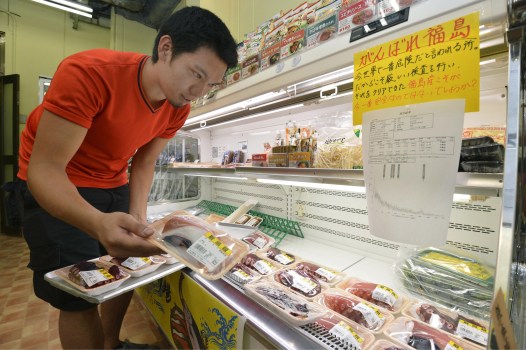
In recent years the Japanese Government has been heavily lobbying other nations to lift the radiation controls and security measures which those nations have been taken on the Fukushima and nearby prefectures food products imports since the March 2011 Fukushima disaster. Disaster which is still ongoing up to the present day, with its contamination omnipresent all over Eastern Japan.
There are two reasons behind such intense forceful lobbying. The first one of course is economic, to maintain the income generated by those exports. The second one is plainly political, to indirectly soothe the fears of the Japanese people themselves about the radiation contaminated food.
It seems that this lobbying is now making headways, as the European Commission finally decided to relax restrictions on some food imports from Fukushima. Such decision prioritizes political and economic considerations over the health of the European people, and dismisses as if they were non-existing all the available gathered scientific data about the devastating health effects of the Chernobyl radiation contaminated food on the Ukrainian and Belarussian populations during the past 30 years.
From the Japan Times:
EU due to start easing restrictions on food imports from Fukushima
The European Union will start easing restrictions Saturday imposed on Japanese food imports over the Fukushima nuclear disaster, including vegetables and beef produced in the prefecture, the farm ministry said.
Tsuyoshi Takagi, Cabinet minister in charge of rebuilding from the March 2011 quake, tsunami and nuclear crisis, on Friday welcomed the bloc’s decision. At present, all food items from Fukushima except alcoholic beverages must be shipped with radiation inspection certificates.
That requirement will be removed for vegetables, fruit excluding persimmons, livestock products, tea and soba, because the radiation levels of these items never exceeded permissible levels in 2013 and 2014, according to the farm ministry.
Other food from the prefecture such as rice, mushrooms, soybeans and some fishery products — excluding scallops, seaweed and live fish — will remain subject to the requirement.
The allowable limits are set at 100 becquerels per kilogram for vegetables and fruit, 50 Bq/kg for milk beverages and infant food, and 10 Bq/kg for drinking water, in accordance to Japanese standards.
The EU move follows the Agriculture, Forestry and Fisheries Ministry’s announcement in November that the bloc would ease the restrictions after gaining approval from the European Commission.
The decision also comes as the European Union and Japan are in the midst of negotiations for a free trade agreement. In the talks, Tokyo is seeking the elimination of duties on Japanese vehicles, while Brussels is looking to expand exports through the reduction of tariffs on pork, cheese, wine and other agricultural products.
“We will make persistent efforts so (restrictions) on all items (from Fukushima) will be eliminated,” Takagi said at a press conference Friday.
The minister added that he will continue to work with other countries to lift similar restrictions imposed after the triple meltdown at the Fukushima No. 1 nuclear power plant raised concerns over the safety of food produced in Japan.
The European Union will also remove restrictions on all food imports from Aomori and Saitama prefectures.
Aside from Fukushima, restrictions will remain in place for some items produced in 12 prefectures in northeastern, eastern and central Japan.
At least 14 countries, including Australia and Thailand, have abolished restrictions on Japanese food imports, while dozens of countries like South Korea maintain special rules.
This European decision can now be used by the Japanese Government as a leverage to immediately try to force its Asian neighbors to also lift their restrictive measures.
From the Free Malaysia Today:
Japan presses Singapore to ease restrictions on Fukushima imports
TOKYO: Japan pressed Singapore to ease its ban on Fukushima food imports, following the European Union’s move to relax restrictions on imports from the area, according to media reports on Sunday.
Japanese agriculture minister Hiroshi Moriyama said the Asian financial hub would take “proactive” steps to meet Tokyo’s request, after holding talks with Singapore’s minister for national development, reported Jiji Press.
On Saturday the EU began easing restrictions on Japanese food imports imposed after the 2011 Fukushima nuclear disaster.
Under the previous rule, the EU required all food products, excluding alcohol, from Fukushima prefecture to come with radiation inspection certification.
The EU continues to restrict the importation of items such as rice, mushrooms and some fishery products, however.
Singapore has banned imports of certain Fukushima products since 2011.
“I explained the EU’s step to ease” its restriction, Moriyama told Japanese journalists in Singapore.
“I asked for easing of the restriction based on scientific evidence,” Moriyama said, according to Jiji.
During the talks, Wong said Singapore “would take proactive steps by studying cases such as the EU’s latest step,” Moriyama told reporters.
Fukushima was a key agricultural area before the 2011 disaster, when a huge tsunami swamped reactors and sparked meltdowns, sending out plumes of radioactive material.
Thousands of people were evacuated and huge tracts of land were rendered unfarmable. The accident has left the Fukushima brand contaminated both domestically and internationally.
Tokyo has been encouraging countries across the globe to ease trade restriction on Japanese food products established after the Fukushima crisis.
At least 14 countries such as Australia and Thailand have abolished their restrictions on Japanese food imports, while dozens of nations continue to maintain select regulations, according to Kyodo News.
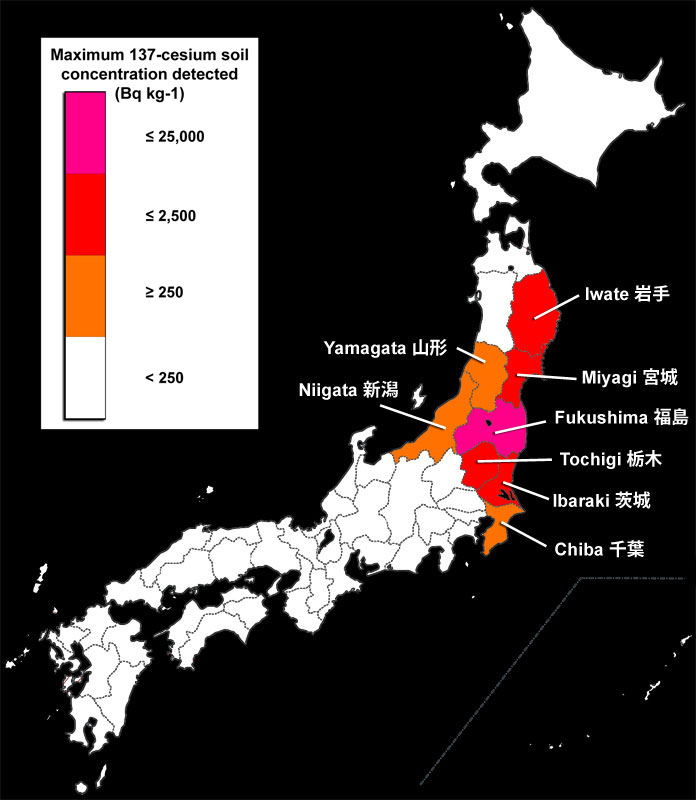
Today’s Fukushima Nuclear Evacuees Real Situation

For your information, as Abe’s government has tightened its grip on most of Japanese the media, the Fukushima nuclear evacuees situation is presented quite differently in the various Japanese media.
Abe’s regime has more or less gagged Asahi, has put more control on Japan Times, while Yomiuri is the Japanese equivalent of the Soviet era Pravda. The only major media who has managed somehow to keep some degree of independance and impartiality is the Mainichi.
As you may see the Japan Times article while having an added positive spin, leaves out many things untold:
Fukushima nuclear evacuees fall below 100,000. As the fifth anniversary of the March 2011 Fukushima nuclear crisis approaches, the number of residents of the northeastern prefecture who are still living as evacuees has fallen below 100,000, a survey by the prefectural government revealed Friday.
According to the survey, 56,463 evacuees were staying within Fukushima Prefecture as of the end of December, while 43,497 were outside the prefecture as of Dec. 10. The whereabouts of 31 were unknown.
The total came to 99,991 in the December survey, down from 121,585 last January.
The total peaked at 164,865 in May 2011, two months after Japan’s worst nuclear accident occurred at Tokyo Electric Power Co.’s tsunami-crippled Fukushima No. 1 nuclear power station.
The survey covered those staying in temporary housing facilities or taking shelter at relatives’ houses and other places. It excluded those who have bought houses in the areas they fled to or settled in public housing for disaster victims.
“Many people have started new lives where they were evacuated to, while others have returned to their homes,” a prefectural official said.
Source: Japan Times http://www.japantimes.co.jp/news/2016/01/09/national/fukushima-nuclear-evacuees-fall-100000/#.VpDnE1LzN_l
Whereas the Mainichi’s article has a much better in depth look at the evolving problems for evacuees.
Fukushima evacuees are Denied housing, and pushed back to the Contaminated zone
Nuclear evacuees surveyed about living in public housing later became non-eligible
Fukushima Prefecture included more people in surveys for 2013 estimates on demand for new public housing after the Fukushima No. 1 nuclear plant meltdowns than it ended up allowing into the housing, and the estimates based on those surveys were never publically released, it has been learned.
The estimates were reported in a document obtained by the Mainichi Shimbun. This document was created in May 2013 by a Tokyo consulting company paid around 30 million yen by the Fukushima Prefectural Government for the work. The estimates were based on fiscal 2012 surveys by the Reconstruction Agency and the Fukushima Prefectural Government of evacuees from 11 municipalities near the crippled plant.
The estimates were made based on three types of evacuees seeking a place in the housing: people wanting to live there until evacuation orders for their home municipalities were lifted; people wanting to live there after evacuation orders for their home municipalities were lifted but until a livable environment had been established; and people wanting to live in the housing permanently.
The estimated numbers of residences required for the three types of evacuees were between 3,136 and 5,663 for the first group; between 2,743 and 4,172 for the second group; and between 3,366 and 4,837 for the third group. Only the first category, however, matches up with the standards for “long-term evacuees” — the only type of evacuee allowed to apply for the residences. Additionally, two of the 11 municipalities covered by the estimates, the city of Tamura and the town of Naraha, had their evacuation orders lifted in April 2014 and September 2015, respectively, making their residents ineligible for the housing.
The units were first proposed during the Democratic Party of Japan administration, and in September 2012 the Fukushima Prefectural Government announced preparations to build the first 500 residences. At this point, the project was being funded from reconstruction funds, and which evacuees would be eligible for a place had not yet been decided. At the end of that year, however, the Liberal Democratic Party and Komeito took over the government, and at a January 2013 meeting on disaster recovery, Prime Minister Shinzo Abe ordered the creation of a plan to allow evacuees to return home quickly, and to secure homes for long-term evacuees. The Act on Special Measures for the Reconstruction and Revitalization of Fukushima was revised in April 2013 to allow special government funding for the new housing, and to restrict eligibility to long-term evacuees.
The unreleased documents obtained by the Mainichi state explicitly that “under the current system to restrict entry into publically-managed housing to long-term evacuees,” others hoping to keep living in the units after their evacuation orders have been lifted “may not be included.”
A representative for the Fukushima Prefectural Government said, “It’s not good to say that the national government ‘toyed with us’ by its policy shift, but the survey on evacuees’ wishes and the establishment of the new fund (with its eligibility restrictions) happened in parallel.” The official added that prefectural staff had to start applying the restrictions “in a hurry” to keep in line with national government policy.
The Fukushima Prefectural Government has announced 4,890 planned public housing units for nuclear disaster evacuees, but even when combined with around 2,800 such residences for tsunami survivors, the number of residences covers only 17 percent of the around 43,700 Fukushima households that remained without a permanent home as of the end of last year.
Source: Mainichi http://mainichi.jp/english/articles/20151205/p2a/00m/0na/013000c
While the Yomiuri Shimbun is currently promoting the government plan to use the evacuation zone as a nuclear waste cite as part of “reconstruction”. There is pressure on evacuated communities to accept waste storage and also for communities outside Fukushima to allow radioactive waste to be stored in their communities.
While the government has claimed it would treat all evacuees fairly, the actions behind the scenes show they never intended to do so.
The government collected surveys from evacuees to estimate how many people needed public housing in order to build enough units. Mainichi’s investigation and leaked documents show the government only allowed those from “difficult to return” areas to apply for the public housing. They built the number of units based on this decision. Now anyone from an area that has been reopened or that was a voluntary evacuees has been shut out of the housing availability.
This was the doing of the LDP and Shinzo Abe. When they took power in 2013 they rewrote the current laws dealing with the disaster to bar anyone but long term evacuees from accessing this housing.
“The unreleased documents obtained by the Mainichi state explicitly that “under the current system to restrict entry into publically-managed housing to long-term evacuees,” others hoping to keep living in the units after their evacuation orders have been lifted “may not be included.”
The prefectural government feels duped and there is now a drastic housing shortage five years after the disaster. 2016 also includes looming deadlines for people’s evacuee aid to run out.
Living restrictions for nearly 55,000 mandated evacuees will be lifted by March, 2017. This will affect nearly 75% of those currently subject to the Tokyo evacuation order of 2011. The plan also calls for continuing the ~$1,000 per month (per person) mental anguish stipend until March 2017, regardless of whether or not restrictions are lifted and/or residents return home before that date. In addition, the goverment”s free rent stipend for voluntary evacuees living outside Fukushima Prefecture will end in March 2017. Tokyo and Fukushima Prefecture say there will be some support for the voluntary evacuees living in a state of poverty, to be determined on a case-by-case basis.
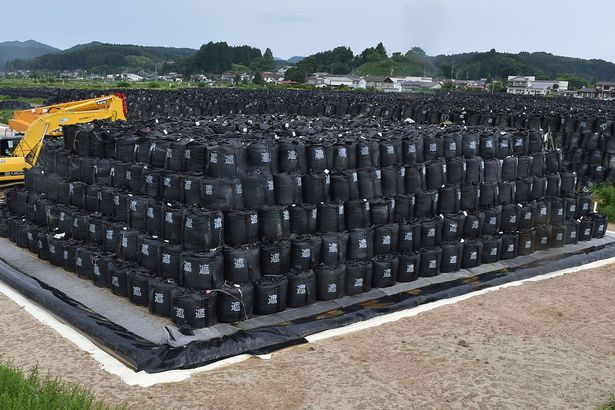
Japan’s nuclear safety watchdog not happy with safety of dry spent fuel casks at Fukushima
 NRA announced the dry cask for spent fuel of Fukushima plant might be overly vulnerable http://fukushima-diary.com/2015/12/nra-announced-the-dry-cask-for-spent-fuel-of-fukushima-plant-might-be-overly-vulnerable/ by Mochizuki , December 8, 2015 On 12/4/2015, NRA (Nuclear Regulation Authority) announced that the dry cask to store the spent fuel assemblies can be excessively vulnerable.
In order to stock the fuel assemblies of SFP 4 (Spent Fuel Pool of Reactor 4) in the common pool, Tepco transferred the fuel assemblies from the common pool to the dry cask.
By the end of October 2014, Tepco had stocked 28 dry casks to contain 1,412 fuel assemblies. They were planning to transfer additional 1,600 fuel assemblies to more 23 dry casks. NRA reports that only 11 casks of this issued type are in actual use in Fukushima plant.
According to NRA, there is a possibility that an internal part of dry cask doesn’t have enough strength. It was designed based on the standard of the Japan Society of Mechanical Engineers, however the standard was abolished this October, just before this scandal became public, because it did not have enough basis and overrated the strength.
https://www.nsr.go.jp/data/000131890.pdf
https://www.nsr.go.jp/disclosure/committee/roanshin_kakunen/00000003.html
Estimating Airborne Radionuclides from the Fukushima Daiichi Nuclear Power Plant Site
Post-Accident Sporadic Releases of Airborne Radionuclides from the Fukushima Daiichi Nuclear Power Plant Site , Environmental Science and Technology
| Steinhauser, G., Niisoe, T., Harada, K. H., Shozugawa, K., Schneider, S., Synal, H. A., Walther, C., Christl, M., Nanba, K.,Ishikawa, H., Koizumi, A. | |||
|
Journal Items, |
Xenon 133 peaks detected in Takasaki Station
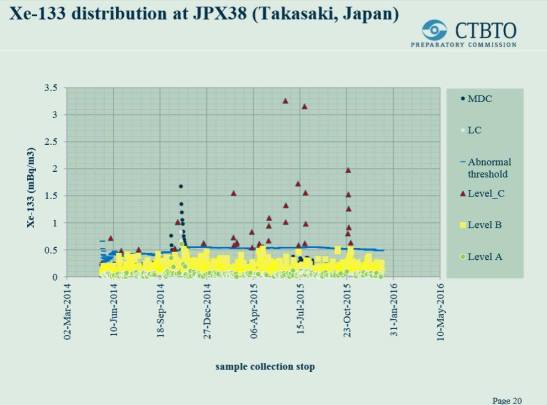
While speaking of the atomic testing in North Korea, CTBTO has inadvertently disclosed information on Fukushima.
One slide shows Xenon 133 peaks in Takasaki Station. Or xenon 133 is a fission product. The corium of Fukushima seems to know criticality phases in 2014 and 2015 (detection beyond normal = red triangles)
Which also explain why traces of Iodine-131 have been repeatedly found at various locations in Japan every year since 2011. Iodine-131 being a very short life radionuclide, it should not be present anymore after March 2011.
The highest peaks of xenon 133 were in May, June July 2015, corresponding to the Iodine-131 detections in sewage sludge in May 2015
Source: Fukushima Diary
Significant level of I-131 detected from dry sludge of Fukushima sewage plant after rain in May
Source : CTBO
Click to access Briefing_PrepCom_7_Jan_2016.pdf
Credits to Pierre Fetet & Paolo Scampa for these informations.
Fukushima No. 1 Nuclear Power Plant: radioactive water is rising
 Radiation-contaminated water at Fukushima plant on the rise http://mainichi.jp/english/articles/20151231/p2a/00m/0na/022000c (Mainichi Japan) FUKUSHIMA — Efforts to reduce the amount of radiation-contaminated water at the crippled Fukushima No. 1 Nuclear Power Plant have proven helpless, and the overall amount of such water has actually increased, it has been learned.

TEPCO started pumping up groundwater from the ocean-side drains in October, but gave up on releasing the water into the ocean after detecting a high concentration of radioactive materials and salt content in the water pumped from four of the five wells on the plant premises. Meanwhile, the amount of groundwater increased after its flow was stemmed by the 780-meter-long seaside impermeable wall, which is designed to prevent tainted groundwater from flowing out into the ocean. The resultant high water pressure warped the impermeable wall by about 20 centimeters, prompting TEPCO to reinforce the wall.
While TEPCO had boasted that it was able to significantly reduce risks at the plant thanks to the completion of the impermeable wall, the situation still remains unstable
“We ended up building extra tanks (due to the increase of overall contaminated water), but we will never leak such water to the outside,” Naohiro Masuda, president of TEPCO’s Fukushima Daiichi Decommissioning Co., told a press conference.
TEPCO aims to cut the influx of groundwater into reactor buildings to somewhere under 100 tons a day by the end of fiscal 2016, and ultimately make the daily increase of tainted water close to zero by the end of 2020 — the year of the Tokyo Olympics and Paralympics — by putting the multi-nuclide removal equipment called ALPS into operation. TEPCO is planning to complete the entire decommissioning process by 2041-2051.
1 This Month



26 September – International Day for the Total Elimination of Nuclear Weapons


PLEASE OPPOSE HR 8255 AND S.3639 – bills would accelerate satellite deployment, with no environmental review or safeguards – https://ncstd5li.quorum.us/campaign/169331/
To see nuclear-related stories in greater depth and intensity – go to https://nuclearinformation.wordpress.com
-
Archives
- September 2026 (233)
- August 2026 (330)
- July 2026 (355)
- June 2026 (287)
- May 2026 (306)
- April 2026 (356)
- March 2026 (251)
- February 2026 (267)
- January 2026 (308)
- December 2025 (358)
- November 2025 (359)
- October 2025 (375)
-
Categories
- 1
- 1 NUCLEAR ISSUES
- business and costs
- climate change
- culture and arts
- ENERGY
- environment
- health
- history
- indigenous issues
- Legal
- marketing of nuclear
- media
- opposition to nuclear
- PERSONAL STORIES
- politics
- politics international
- Religion and ethics
- safety
- secrets,lies and civil liberties
- spinbuster
- technology
- Uranium
- wastes
- weapons and war
- Women
- 2 WORLD
- ACTION
- AFRICA
- Atrocities
- AUSTRALIA
- Christina's notes
- Christina's themes
- culture and arts
- Events
- Fuk 2022
- Fuk 2023
- Fukushima 2017
- Fukushima 2018
- fukushima 2019
- Fukushima 2020
- Fukushima 2021
- general
- global warming
- Humour (God we need it)
- Nuclear
- RARE EARTHS
- Reference
- resources – print
- Resources -audiovicual
- Weekly Newsletter
- World
- World Nuclear
- YouTube
-
RSS
Entries RSS
Comments RSS
 nuclear-news