|
Excerpts from ‘Fukushima has an Ongoing Melt-Out’ On March 11, 2011, Pandora’s Box was opened. Japan Times, Commentary by Prof. Christopher Hobson of Waseda University: Apr. 24, 2014: […] many serious challenges lie ahead. There will be more leaks and problems at the No. 1 plant. There will also have to be the controlled release of contaminated water into the ocean. Public support and understanding will be needed through these difficult processes. For this to happen, Tepco needs to begin to rebuild its credibility with the public […] Tepco’s regaining the trust of Japan’s public is just as difficult a task as resolving the technical challenges in decommissioning the plant. The only way this might happen is […] to be more honest and transparent about the problems in Fukushima. |
Japan soon to start making ice wall around groundwater at Fukushima nuclear plant
Japan Tries Ice Wall to Stem Radiation Planned Frozen Barrier to Hold Back Water Contaminated by the Stricken Fukushima Daiichi Nuclear Plant WSJ, By MARI IWATA NARAHA, Japan—The idea of freezing ground to block the flow of water has been around for more than a century, but never has it been tried on the scale Japan plans at its stricken nuclear plant to hold back water contaminated by radiation.
As early as next month, workers are set to start installing pipes for a 1.5-kilometer-long and 30-meter-deep subterranean ice wall around four reactors of the Fukushima Daiichi nuclear plant here…….

The Fukushima effort is unprecedented because of the size of the apparatus—its electricity alone is projected to cost $1 million a month—and the period it is expected to operate. The Fukushima decommissioning is expected to take 40 years or longer.
The ice-wall plan has already met a hurdle. Continue reading
US nuclear companies keen to work on Fukushima clean-up
Kennedy vows U.S. help to Japan for Fukushima nuclear clean-up Planet Ark 5-May-14 Country: JAPAN Author: Yoko Kubota U.S. Ambassador to Japan Caroline Kennedy pledged U.S. support for the clean-up at Japan’s tsunami-wrecked Fukushima Daiichi nuclear power plant on Wednesday after her first visit to the site……..
Contaminated water accumulates at a rate of 400 tonnes a day at the plant as groundwater flows into the destroyed basements of the reactor buildings and mixes with highly radioactive water used to cool melted fuel.
Row upon row of huge blue and gray tanks that store contaminated water are lined up while pink, white and purple azalea bushes are in full bloom nearby. Overgrown plants curl onto the streets while pipes snake across the site where numerous cranes still stand.
About 1,200 to 1,300 tanks storing about 450,000 tonnes of contaminated water are on site and over the next two years Tepco wants to set up enough tanks to store 800,000 tonnes of water, said Kenichiro Matsui, a spokesman for the utility.
Up to 5,000 workers are on site each day, according to the Tepco spokesman, Matsui, up from about 4,000 a year ago. In future, that number is likely to increase to about 6,000, he said.
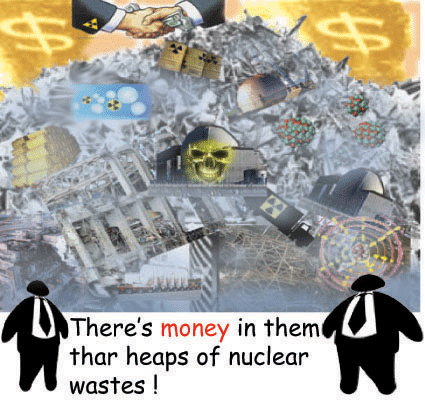 Overseas companies including U.S. ones are eager to get in on the clear-up work and the decommissioning of the six reactors at the wrecked plant but most contracts have gone to Japanese companies……..
It’s good that she’s here because the situation at the plant needs to be reported worldwide,” said one man who now works as a driver for plant workers after hitting his annual radiation exposure limit in his former job at the site.http://planetark.org/enviro-news/item/71554
Hundreds ill after Fukushima radioactive trash burned in major Japanese city

 Medical Expert: Hundreds ill after Fukushima nuclear plant rubble burned in major Japanese city — Suffering nosebleeds, problems with eyes, throats and skin — Gov’t: Radiation levels were ‘low enough’ to be safe (PHOTO) http://enenews.com/medical-expert-hundreds-ill-after-fukushima-nuclear-plant-rubble-burned-major-japanese-city-suffering-nosebleeds-problems-eyes-throats-skin-govt-radiation-levels-low-enough-be-safe?utm_source=feedburner&utm_medium=email&utm_campaign=Feed%3A+ENENews+%28Energy+News%29
Asahi Shimbun, May 13, 2014: The manga series [‘Oishinbo’] has been in print since 1983 [selling] 120 million copies […] the May 12 installment includes a segment in which residents of Osaka complain about health problems after a nearby incinerator processes rubble transported from the Fukushima No. 1 nuclear power plant.
Japan Times, May 13, 2014: Osaka Prefectural Government took issue with the assertion, expressed by a character based on real-life medical expert Eisuke Matsui, that about 800 people living around an incinerator there have been affected by burning tsunami debris tainted with radiation from Tohoku. […] Osaka Prefectural Government claimed that no local doctors or authorities have received reports of ill health due to debris incinerated in the city’s Maishima area, contradicting the assertion made by the manga’s character Matsui. […] At every stage of the disposal, the radiation level was stable and low enough to be safe, the government said. —CAPTION: [Matsui’s] character portrayed in the manga ‘Oishinbo’ claims that about 800 residents living near an incinerator in the city of Osaka have exhibited symptoms of illnesses caused by radioactive fallout
Kyodo News, May 13, 2014: Citing [an] expert [Oishinbo] said hundreds of people living near an incineration site in the city of Osaka […] experienced nosebleeds or unpleasant symptoms affecting their eyes, throats and skin.
“Extremely Unjust”: Osaka professor arrested — Publicly opposed burning radioactive debris
Doctor: 300 times more radiation released to atmosphere when burning debris than gov’t claims
From 2012: Fukushima will start burning radioactive waste — 100,000 Bq/kg to be incinerated
Watch — Gundersen: Lots of serious ramifications from burning of nuclear waste — We are basically creating Fukushima all over again (VIDEO)
Nose bleeding attacks prevalent in some people exposed to Fukushima nuclear radiation
Press Conference by Former Official: I’m bleeding from nose every day, many in Fukushima have similar symptoms — Author: My nose bled for days, it wouldn’t stop; Staff had same problem… Do people want me to lie? I can only write truth — Gov’t: The nosebleeds aren’t caused by nuclear crisis (PHOTO) http://enenews.com/press-conference-former-official-nose-bleeds-every-day-many-others-fukushima-developed-similar-symptoms-govt-nosebleeds-caused-nuclear-crisis-author-bleeding-nose-days-wouldnt-stop-others-same-s?utm_source=feedburner&utm_medium=email&utm_campaign=Feed%3A+ENENews+%28Energy+News%29
Jiji Press, May 10, 2014: Environment Minister Nobuteru Ishihara has criticized a manga story for linking nosebleeds to exposure to radiation […] He underscored the importance of keeping unfounded rumors in check [and] that doctors with special knowledge have denied a causal relationship between exposure to radiation after the nuclear accident and nosebleeds.
Mainichi, May 10, 2014: Katsutaka Idogawa, 67, [Futaba’s] former mayor […] is featured in the popular comic series “Oishinbo.” […] Idogawa says his nose bleeds regularly and that there are many others in Fukushima who have developed similar symptoms. […] Idogawa told a news conference on May 9 in Tokyo […] his nose bleeds every day, especially in the mornings. “There is no way I would retract my comments in the manga,” Idogawa said. Responding to Environment Minister Nobuteru Ishihara […] Idogawa commented, “The minister has no business with my physical condition.”
Author Tetsu Kariya interview, translated by Toshi Nakamura, Jan. 13, 2014: […] after I got back [from Fukushima] and was having dinner, I suddenly started bleeding from my nose, and it wouldn’t stop. I thought, “what on Earth?” I’ve rarely ever had a nosebleed so it was quite a shock. After that, I had nosebleeds at night for days after. But when I went to the hospital, they said “there’s currently no medical connection between nosebleeds and radiation” and they severed a capillary in my nose membrane with a laser. Also, after I went, I felt a great deal of fatigue. The staff who went with me and the chief of Futaba-machi suffered from nosebleeds and fatigue. They say the radiation levels are low so there’s no harm, but I wonder about that.
Statement from Tetsu Kariya summarized by Yoshihiro Kaneda, May 7, 2014: It is possible that those who have supported me would walk away from me. I don’t understand why people criticize the truth which I have collected data in Fukushima 2 years and I write it as it is. Do people want to close my eyes against the truth and write something good lies for somebody or other? […] I can only write the truth. I hate self-deceiving. Today’s Japanese society is surrounded by the atmosphere of hating inconvenient truth and desiring lies of feeling good.
Fukushima reactors molten fuel cores – where are they? Robots might find them
Robots To Investigate Fukushima N-reactors http://www.bernama.com.my/bernama/v7/wn/newsworld.php?id=1036936 TOKYO, May 9 (Bernama) — Tokyo Electric Power Co. (TEPCO) plans to use robots for investigating the inside of reactor containment vessels at its stricken Fukushima No. 1 nuclear power plant.
The investigation is expected to take place as early as in the fiscal second half that begins in October, sources were quoted as saying by Japan’s Jiji Press news agency.
Internal conditions of the containment vessels at the plant’s No. 1 to 3 reactors remain unknown.
If the robots — made by Hitachi Ltd. and others — are able to identify where melted nuclear fuel is located, this would lead to progress in work to decommission the plant damaged in the March 2011 earthquake and tsunami.
But it is unclear how much information can be obtained by the robots due to high radiation levels and steams inside the vessels.
TEPCO said the investigation is aimed at assessing temperatures and radiation levels inside the vessels.
The government plans to start removing melted fuel in 2020.
Fukushima groundwater radioactive contamination getting worse, but not properly measured
 Ongoing Impact of Wastewater from Fukushima Nuclear Power Station Ongoing Impact of Wastewater from Fukushima Nuclear Power StationHydro International, By Shunji Murai Professor Emeritus, University of Tokyo, Japan08/05/2014 Three years on from the Great East Japan Earthquake and Tsunami of 11 March 2011, air contamination is decreasing and is now concentrated in a limited area. Land contamination has also decreased through decontamination processes. However, despite all the efforts by Tokyo Electric Power Company (TEPCO) and the Japanese government, water contamination in surface and ground water is getting worse, simply because there are no effective countermeasures. ……. Even though the wastewater issue is taken seriously by Japanese people as well as people worldwide, the real status of the effect of the contamination is still unknown because neutral third-party organisations have no access to within a 20km radius of Fukushima NPS. The author has tried to make clear what the status of the wastewater issue is by using various sources including a Fishermen Union’s report, which appears to be more reliable than the government report or the report by TEPCO. http://www.hydro-international.com/news/id6913-Ongoing_Impact_of_Wastewater_from_Fukushima_Nuclear_Power_Station.html |
New research shows that TEPCO underestimated radioactive cesium released from Fukushima
 Radioactive cesium levels at Fukushima higher than TEPCO claims, Voice of Russia, 6 May 14 A new study conducted by Japanese researchers revealed that cumulative amount of radioactive cesium at the disaster-hit Fukushima nuclear power plant is nearly 1,5 times higher than previous estimates of the Tokyo Electric Power Co. (TEPCO), RIA Novosti reports. According to the research, between 17.500 and 20.500 terabecquerels of radioactive cesium-137 was released into the atmosphere from the Fukushima reactors against less than 13.600 terabecquerels declared by the plant operator TEPCO.
Earlier in April Japan’s Ministry of Economy, Trade and Industry issued a report that showed significant drop of radiation levels in areas surrounding Fukushima to under 20 millisieverts per year. These figures, however, exceed the long-term target of Japanese government of 1 millisievert per year.
………..: http://voiceofrussia.com/news/2014_05_09/Radioactive-cesium-levels-at-Fukushima-higher-than-TEPCO-claims-0913/
Fukushima’s ‘safety’ ice wall will not work according to PRO NUCLEAR Dale Klein and Barbara Judge
Nuclear expert doubts ice wall will solve Fukushima plant leaks http://www.japantimes.co.jp/news/2014/05/02/national/nuclear-expert-doubts-ice-wall-will-solve-fukushima-plant-leaks/#.U2QRuIFdWik
KYODO An international nuclear expert expressed skepticism Thursday over Tokyo Electric Power Co.’s plan to set up an ice wall to ultimately stop radioactive water from further increasing at the troubled Fukushima No. 1 nuclear complex.

“I’m not convinced that the freeze wall is the best option,” former U.S. Nuclear Regulatory Commission Chairman Dale Klein, who heads a supervisory panel tasked with overseeing the plant operator’s nuclear safety efforts, said in an interview with Kyodo News.
“What I’m concerned about is unintended consequences,” Klein said.
“Where does that water go and what are the consequences of that? I think they need more testing and more analysis,” he said.
Former British Atomic Energy Authority Chairwoman Barbara Judge, who was also present at the interview in Tokyo and is part of the panel, said there is a need to assess during summer whether the ice wall method would be effective. The remarks by the two overseas experts came at a time when concerns over the plan are being raised by Japan’s Nuclear Regulation Authority and engineering experts. Their opinions may cast a shadow on Tepco’s plan to begin operating the ice wall by the end of next March.
“No one has built a freeze wall this long for this period of time. Typically, you build a freeze wall for a few months,” Klein said.
Faced with a string of problems including radioactive water leaks at the Fukushima plant, Tepco is attempting to freeze 1.5 kilometers of soil around the basement areas of the Nos. 1 to 4 reactor buildings.
The ice wall is envisioned to block groundwater from seeping into the reactor buildings’ basement areas and mixing with highly toxic water used to cool the plant’s three crippled reactors.
“I am much in favor of the bypass system,” Klein said, referring to the groundwater bypass system in which Tepco pumps groundwater at the Fukushima plant to direct it into the sea to reduce the amount of water seeping into the reactor buildings.
“The freeze wall is expensive,” he said, urging Tepco and the government to look at the cost of building one and whether the plan is making the “best use of limited resources.” “I would encourage them to get international advice a little bit more,” Klein said about Tepco, in terms of its decontamination work and future plans to scrap the plant.
Klein also urged the company to work with and share information with relevant authorities in the United States and Britain given that those nations are experienced in water management and decontamination efforts at former military or weapons-related sites.
Tomioka a radioactive dead town in Fukushima Prefecture
AP: “This town is dead”… Locals feel Fukushima plant could explode any minute; Yearly ‘safe’ radiation levels exceeded “in a matter of a few hours” — TV: “Fukushima evacuees complain of health problems”; Nearly 70% of households affected http://enenews.com/ap-this-town-is-dead-we-feel-fukushima-plant-could-explode-any-minute-says-evacuee-yearly-safe-radiation-levels-exceeded-in-a-matter-of-a-few-hours-tv-evacuees-complain-of-health?utm_source=feedburner&utm_medium=email&utm_campaign=Feed%3A+ENENews+%28Energy+News%29
NHK WORLD,, Apr. 30, 2014: Fukushima evacuees complain of health problems […] nearly 70 percent of households that evacuated after the March 2011 disaster have members who complain of health problems. The prefecture polled more than 62,800 evacuee households. About one-third responded. [68%] said one or more of their members complain of health problems such as lack of sleep or depression.
AP,, Apr. 30, 2014: […] It’s difficult to imagine ever living again in Tomioka, a ghost town about 10 kilometres from the former Fukushima Dai-chi nuclear plant. […] The streets were abandoned […] The neighbourhood was eerily quiet except for the chirping of the nightingales. […] The long-term goal is to bring annual exposure down to one millisievert […] considered the safe level before the disaster, but the government is lifting evacuation orders at higher levels.
It says it will monitor the health and exposure of people who move back to such areas. In the yellow restricted zone […] a visitor exceeds one millisievert in a matter of a few hours. […] “The prime minister says the accident is under control, but we feel the thing could explode the next minute,” said Michiko Onuki, who ran a ceramic and craft shop out of their Tomioka home. “We would have to live in fear of radiation. This town is dead.” […] “I can survive anywhere, although I had a plan for my life that was destroyed from its very roots,” said [Tomioka city assemblyman Seijun] Ando, tears welling up in his eyes. […]
Japan’s government pressuring Fukushima evacuees to return: govt wants no criticism of nuclear power
The government has declared that the stipends, which range from a few hundred dollars to more than $1,000, will end next March, when temporary housing will also begin to be closed. Villagers who move back before then will receive a $9,000 bonus from Tepco, adding to the pressure to return
the evacuees will feel increasing pressure to go back from a government that wants to restore the preaccident status quo as much as possible to limit criticism of the powerful nuclear industry.
Forced to Flee Radiation, Fearful Japanese Villagers Are Reluctant to Return NYT, By MARTIN FACKLER APRIL 27, 2014 MIYAKOJI, Japan — Ever since they were forced to evacuate during the accident at the Fukushima Daiichi nuclear plant three years ago, Kim Eunja and her husband have refused to return to their hilltop home amid the majestic mountains of this rural village for fear of radiation.
But now they say they may have no choice. After a nearly $250 million radiation cleanup here, the central government this month declared Miyakoji the first community within a 12-mile evacuation zone around the plant to be reopened to residents. The decision will bring an end to the monthly stipends from the plant’s operator that have allowed Ms. Kim to relocate to an apartment in a city an hour away.
“The government and the media say the radiation has been cleaned up, but it’s all lies,” said Ms. Kim, 55, who is from South Korea, and who with her Japanese husband runs a small Korean restaurant outside Miyakoji. “I want to run away, but I cannot. We have no more money.”
She is not the only one. While the central government and national news media have trumpeted the reopening of Miyakoji as a happy milestone in Japan’s recovery from the devastating March 2011 accident, many residents tell a darker story. They insist their homes remain too dangerous or too damaged to inhabit and that they have not received enough financial compensation to allow them to start anew somewhere else…….
many evacuees have been forced to live in a state of limbo since the accident, unable to leave barracks-like temporary housing, or end their dependency on Tepco for monthly stipends to live in apartments outside the village. Tepco pays the stipends under orders from the government.
Now they feel growing pressure to return whether they want to or not. The government has declared that the stipends, which range from a few hundred dollars to more than $1,000, will end next March, when temporary housing will also begin to be closed. Villagers who move back before then will receive a $9,000 bonus from Tepco, adding to the pressure to return……..
Experts call Miyakoji a forerunner of the problems that will be faced by the 150,000 people displaced by the accident over all, as additional communities are reopened as a result of a $36 billion government-financed cleanup. They say the evacuees will feel increasing pressure to go back from a government that wants to restore the preaccident status quo as much as possible to limit criticism of the powerful nuclear industry.
“This is inhumane and irresponsible,” said Teruhisa Maruyama, a lawyer who leads the Support Group for Victims of the Nuclear Accident, a Tokyo-based legal organization that helps residents seek increased compensation.
Authorities had hoped that Miyakoji could serve as a model for repopulating the evacuated communities. So far, only about a third of residents have returned, and most of them are older villagers who feel they have less to worry about from the long-term cancer risks of radiation……..
“They want to say that everything is back to normal so they can keep their nuclear plants,” said Mr. Mizuochi, 57, who helps his wife at the restaurant. “Failing to compensate us for our losses is a way of pressuring us to go back.” http://www.nytimes.com/2014/04/28/world/asia/forced-to-flee-radiation-fearful-japanese-villagers-are-reluctant-to-return.html?_r=0
Fukushima “Disaster never seen in human history”
Journal: “Fukushima has an Ongoing Melt-Out” — “Is this not the worst possible outcome?” — “Nuclear fuel mixing with groundwater and leaking into sea” — “Disaster never seen in human history and imagined only in movies” — Tokyo Paper: “A situation in which massive accidents occur daily” http://enenews.com/journal-fukushima-has-an-ongoing-melt-out-is-this-not-the-worst-possible-outcome-nuclear-fuel-mixing-with-groundwater-and-leaking-into-sea-disaster-never-seen-in-human-history April 26, 2014

Japan’s Nuclear Decommissioning Institute calls for international help with Fukushima reactors
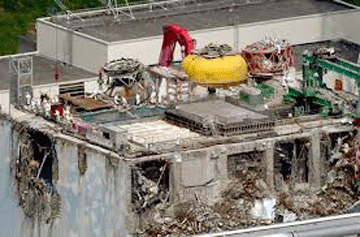 Japan seeking international assistance with Fukushima Daiichi fuel removal http://enformable.com/2014/04/japan-seeking-international-assistance-fukushima-daiichi-fuel-removal/ On Friday, officials from the International Research Institute for Nuclear Decommissioning (IRID) in Japan attending a seminar asked for input from engineers in Japan and across the world on removing melted nuclear fuel from the crippled reactors at the Fukushima Daiichi nuclear power plant.
Tokyo Electric plans to fill the containment vessels with water in order to shield the workers from the high levels of radiation they would be exposed to while retrieving the damaged fuel. The roadmap for decommissioning developed by the utility estimates fuel removal activities could begin by 2020, or later.
At the seminar, IRID officials announced to any engineers interested in giving their input that the plan to fill the containment vessels may not be feasible, as not all leaks may be located or plugged prior to fuel removal.
The announcement infers that the containment vessels may be more damaged than initially estimated by Tokyo Electric. Even if the containment vessels were able of holding the water there are also questions as to whether they would be structurally sound enough to hold the additional weight of the water required for shielding.
Engineers are invited to submit their input on technology that can identify and remove fuel debris in a highly radioactive atmosphere while protecting workers without the aid of shielding by water. The Japanese government will begin accepting proposals in June.
VIDEO: former Mayor Katsutaka Idogawa speaks out on the sick children of Fukushima
 VIDEO: Fukushima disaster: Tokyo hides truth as children die, become ill from radiation – ex-mayor RT.com April 21, 2014 The tragedy of the Fukushima nuclear plant disaster took place almost three years ago. Since then, radiation has forced thousands out of their homes and led to the deaths of many. It took great effort to prevent the ultimate meltdown of the plant – but are the after effects completely gone? Tokyo says yes; it also claims the government is doing everything it can for those who suffered in the disaster. However, disturbing facts sometimes rise to the surface. To shed a bit of light on the mystery of the Fukushima aftermath, Sophie Shevardnadze talks to the former mayor of one of the disaster-struck cities. Katsutaka Idogawa is on SophieCo today FULL TRANSCRIPT …………
SS: Your town is moving to a new location, to the neighboring city of Iwaki. Is it safe there? Do you see this as a new start for the people?
KI: I’d like to show you a table with radiation levels around Chernobyl. Radiation levels around Fukushima are four times higher than in Chernobyl, so I think it’s too early for people to come back to Fukushima Prefecture. Here you can see radiation levels in our region, Tohoku. This is ground zero, and the radiation radius is 50-100km, even 200km in fact. Fukushima Prefecture is at the very center. The city of Iwaki, where Futaba citizens moved, is also in Fukushima Prefecture. It is by no means safe, no matter what the government says. Exposing people to the current levels of radiation in Fukushima is a violation of human rights. It’s terrible.
SS: Evacuation advisories are being lifted for some cities in the Fukushima area, but you’re saying that the government is allowing this, despite the danger of radiation?
KI: Fukushima Prefecture has launched the Come Home campaign. In many cases, evacuees are forced to return. Here is a map of Fukushima Prefecture, with areas hit by radiation highlighted in yellow, and you can see that the color covers almost the entire map. Air contamination decreased a little, but soil contamination remains the same. And there are still about two million people living in the prefecture, who have all sorts of medical issues. The authorities claim this has nothing to do with the fallout. I demanded that the authorities substantiate their claim in writing but they ignored my request. There are some terrible things going on in Fukushima. I remember feeling so deeply for the victims of the Chernobyl tragedy that I could barely hold back the tears whenever I heard any reports on it. And now that a similar tragedy happened in Fukushima, the biggest problem is that there is no one to help us. They say it’s safe to go back. But we must not forget the lessons of Chernobyl. We must protect our children. I talked to local authorities in different places in Fukushima, but no one would listen to me. They believe what the government says, while in reality the radiation is still there. This is killing children. They die of heart conditions, asthma, leukemia, thyroiditis…Lots of kids are extremely exhausted after school; others are simply unable to attend PE classes. But the authorities still hide the truth from us, and I don’t know why. Don’t they have children of their own? It hurts so much to know they can’t protect our children……….
SS: The United Nations report on the radiation fallout from Fukushima says no radiation-related deaths or acute diseases have been observed among the workers and general public exposed – so it’s not that dangerous after all? Or is there not enough information available to make proper assessments? What do you think?
KI: This report is completely false. The report was made by a representative of Japan – Professor Hayano. Representing Japan, he lied to the whole world. When I was mayor, I knew many people who died from a heart attack, and then there were many people in Fukushima who died suddenly, even among young people. It’s a real shame that the authorities hide the truth from the whole world, from the UN. We need to admit that actually many people are dying. We are not allowed to say that, but TEPCO employees also are dying. But they keep mum about it……..http://rt.com/shows/sophieco/fukushima-disaster-radiation-children-74
Underground water flow a worry, as ground sinks below Fukushima’s crippled nuclear reactors
Top Nuclear Official: “Ground sinking” beneath Fukushima reactor buildings a concern — Gov’t experts looking closely at risks from changes to flow of underground water http://enenews.com/top-nuclear-official-ground-sinking-beneath-fukushima-reactor-buildings-a-concern-govt-experts-closely-looking-into-risks-from-changes-to-undergroud-water-flow
NHK WORLD, Apr. 21, 2014: Japan’s nuclear regulator and experts are questioning the safety of plans to build frozen walls to […] prevent groundwater from flowing beneath the reactor buildings. […] The government and TEPCO want to start construction in June. […] The NRA invited experts to a meeting last Friday […] NRA Commissioner Toyoshi Fuketa expressed concern about the risk of the ground sinking. […] They said all the risks need to be addressed further. The NRA decided to continue to closely look into the safety of the planned frozen walls.
NHK WORLD, Apr. 21, 2014: Some contamination in the groundwater drawn from near the Fukushima Daiichi nuclear plant is making the area’s fishermen uneasy, as the plant’s operator plans to release it into the sea. Tokyo Electric Power Company has a plan to pump up groundwater and release it into the Pacific Ocean […]
USGS: “More than 80 percent of the identified subsidence in the United States is a consequence of human impact on subsurface water”

See also:
- Asahi: Buildings at Fukushima plant can start floating from too much groundwater — Expert: Blocking groundwater with ice wall may weaken soil and cause buildings to topple (AUDIO)
- AP: Experts warn about ground sinking at Fukushima plant — Tepco Adviser: Reactor building structures likely degraded; “Containment degradation” concerns back in 2011
- Ex-Fukushima Nuclear Worker: Concern about land subsidence at plant due to pumping up groundwater — “I think Tepco knows”
- Expert: Land under Fukushima reactor buildings at risk of turning into liquid — Area near sea could become like mud
- Senior Scientist: Fukushima giant ‘ice wall’ to make crisis worse — Radioactive release into ocean from saltwater intrusion — Side effects ‘not good at all’ (AUDIO)
- BBC: Professor warns underground ice walls could become ‘neutron reflectors’ and cause nuclear chain
Japan’s government deceives evacuees to return before radiation readings disclosed
Radiation study on evacuation zones kept undisclosed for 6 months http://www.globalpost.com/dispatch/news/kyodo-news-international/140416/radiation-study-evacuation-zones-kept-undisclosed-6-mo The government kept undisclosed for six months a report on an individual radiation dose study in areas around the crisis-hit Fukushima Daiichi nuclear power plant, including a district recently released from an evacuation order.
The study, covering the city of Tamura and the villages of Kawauchi and Iitate, showed that the radiation level in many areas is still beyond 1 millisievert per year — a level the government is seeking to achieve at contaminated lands in the long term.
The government lifted an evacuation order imposed on the Miyakoji district in Tamura on April 1, but the content of the interim report, compiled in October, was not conveyed to the citizens or the local governments before the action was taken.
The government explained the content to local governments later, while the report was posted on the website of the Ministry of Economy, Trade and Industry on Monday. It also plans to release a final report on Friday. A government team tasked with supporting people affected by the crisis said it did not initially plan to release the interim report but decided to make it public because of the “high attention among residents.”
The team decided to conduct the radiation level study at 43 points in Tamura, Kawauchi and Iitate last July, hoping to address concerns among evacuees seeking to return to their homes.
The study showed that radiation levels measured by individual dosimeters tend to be about 70 percent of those estimated from air dose. Twenty-seven points were also found to be above 1 millisievert per year.
The outcome has raised concerns among the residents that have already returned to their homes.
A 65-year-old man living at his home in the Miyakoji district said, “It was premature to lift the evacuation order. We’ve been deceived.”
The 20-kilometer radius of the Fukushima plant and some areas beyond have been subject to evacuation orders in the wake of the nuclear crisis that began in March 2011.
The Miyakoji district became the first area excluded from the 20-km zone following decontamination and infrastructure restoration efforts.
1 This Month

of the week – Shut Down Drone Warfare!


Tell the Ukrainian Government to Drop Prosecution of Peace Activist Yurii Sheliazhenko

Petition to revoke the licensing of the Near Surface Nuclear Disposal Facility (NSDF) at Chalk River. https://www.ourcommons.ca/petitions/en/Petition/Details?Petition=e-7247
To see nuclear-related stories in greater depth and intensity – go to https://nuclearinformation.wordpress.com
-
Archives
- April 2026 (19)
- March 2026 (251)
- February 2026 (268)
- January 2026 (308)
- December 2025 (358)
- November 2025 (359)
- October 2025 (376)
- September 2025 (257)
- August 2025 (319)
- July 2025 (230)
- June 2025 (348)
- May 2025 (261)
-
Categories
- 1
- 1 NUCLEAR ISSUES
- business and costs
- climate change
- culture and arts
- ENERGY
- environment
- health
- history
- indigenous issues
- Legal
- marketing of nuclear
- media
- opposition to nuclear
- PERSONAL STORIES
- politics
- politics international
- Religion and ethics
- safety
- secrets,lies and civil liberties
- spinbuster
- technology
- Uranium
- wastes
- weapons and war
- Women
- 2 WORLD
- ACTION
- AFRICA
- Atrocities
- AUSTRALIA
- Christina's notes
- Christina's themes
- culture and arts
- Events
- Fuk 2022
- Fuk 2023
- Fukushima 2017
- Fukushima 2018
- fukushima 2019
- Fukushima 2020
- Fukushima 2021
- general
- global warming
- Humour (God we need it)
- Nuclear
- RARE EARTHS
- Reference
- resources – print
- Resources -audiovicual
- Weekly Newsletter
- World
- World Nuclear
- YouTube
-
RSS
Entries RSS
Comments RSS
 nuclear-news

