Fukushima: High radioactivity stops workers from fixing dangerous structure

 Japanese Journalist: Workers “very worried” about deformed 400 ft. structure falling on Fukushima reactor buildings and causing another crisis — Immediate repairs needed yet “can’t do anything” due to extreme radiation levels — Staff told to “constantly watch it” — One of site’s most dangerous places http://enenews.com/japan-journalist-workers-very-worried-about-deformed-400-ft-structure-falling-on-fukushima-reactor-buildings-needs-immediate-repair-yet-they-cant-do-anything-about-it-due-to-extr?utm_source=feedburner&utm_medium=email&utm_campaign=Feed%3A+ENENews+%28Energy+News%29 3 May 14
Fukushima Voice, May 28, 2014: Mako Oshidori in Düsseldorf “The Hidden Truth about Fukushima” […] The lecture, given in Japanese [on March 8, 2014] and translated into English.
Moderator: My name is Mariko. Welcome to a lecture by Mako Oshidori. […] A huge earthquake, followed by tsunami and the nuclear accident, has become an unprecedented disaster for the Japanese as well as the rest of the world. Moreover, this accident is not only out of control but continues to be in critical state. […]
Mako Oshidori: I am actually a journalist with the highest attendance rate at the TEPCO press conference. […] in 2013 when the Japanese central government decided to begin to restart nuclear power plants, the government placed a watch on me […] a piece of paper was distributed with a list of names […] such as the former prime minister Naoto Kan […] A researcher who was given the list and told not to approach anybody on it was friendly with me and told me the list included my name. Soon after that a mysterious man began to follow me. […]

Deformed ‘Stack’ Near Units 1 & 2
- Oshidori: I would like to talk about the current status of Fukushima Daiichi nuclear power plant. This is a chimney called a “stack” […] one of the places that I consider the most dangerous. It is 120 m tall. In December 2013, it was discovered the highest radiation level, 25 Sv/h, at the bottom of the stack. […] humans cannot go near it. The problem gets worse. TEPCO discovered deformities on 4 sides at 60 of the 120 meter height […] Some are totally severed. Ordinarily, this should be immediately repaired, but the bottom of the stack is 25 Sv/h […] they can’t do anything about it. What TEPCO is doing about this is they have appointed workers to constantly watch it. […] Workers on site are very worried about whether it would fall onto the reactor buildings. If it ever fell on Unit 1 or 2, all the workers would have to evacuate […] and it could lead to a severe accident necessitating evacuation […]
Record levels of strontium on basements of Fukushima nuclear reactors
Strontium reaches 500 Billion Bq/m³ in basements at Fukushima — Record levels reported at 5 locations near ocean — U.S. Senior Scientist: “We see strontium becoming more of concern… food chain will have to be studied more carefully” http://enenews.com/strontium-reaches-500-billion-bqm3-in-basements-at-fukushima-record-levels-reported-at-5-locations-near-ocean-u-s-expert-we-see-strontium-becoming-more-of-concern-food-chain-will-have-to?utm_source=feedburner&utm_medium=email&utm_campaign=Feed%3A+ENENews+%28Energy+News%29

JIJI PRESS,May 29, 2014: [TEPCO] said Thursday that it plans to improve a cesium adsorption system […] to enable it to remove strontium. The move is aimed at reducing risks when radioactive water leaks from storage tanks […] TEPCO plans to begin test operation of the improved SARRY system at the end of August. Highly radioactive water [is] accumulating in the basements of the No.1 to No. 4 reactor buildings [with] strontium levels standing at 40 million to 500 million becquerels per liter [500 billion becquerels per metric ton (Bq/m³)].
Results Published May 28, 2014 (Bq/liter):KUSP, May 30, 2014: [Ken Buesseler, Senior scientists at the Woods Hole Oceanographic Institution] doesn’t worry about cesium-containing fish swimming across the ocean and appearing in other fisheries. The situation is different for strontium-90 […] Strontium behaves like calcium, and it can replace calcium in your bones. “Instead of [cesium’s] 50 days, think of more like 500 days, a couple of years, before it would be released back through natural processes,” he says. […] In the ocean near the power plant, levels of strontium-90 have grown since the accident. But Buesseler says he hasn’t seen alarming numbers for strontium in fish yet. “Down the road, as we see strontium becoming more of concern, that isotope in the food chain will have to be studied more carefully,” he says. Buesseler hopes to monitor strontium levels in the ocean and seafloor near Japan in the future. Should that strontium move across the Pacific Ocean, it will take three years for it to reach the West Coast of the United States.
Amid serious doubts, the Fukushima ice wall construction starts
 Japan builds underground ice wall at Fukushima nuclear plant http://www.abc.net.au/news/2014-06-02/japan-builds-fukushima-underground-ice-wall/5495358 Japan has started work on an underground ice wall at the crippled Fukushima nuclear plant, freezing the soil under broken reactors to slow the build-up of radioactive water. The wall is intended to block groundwater from nearby hillsides that has been flowing under the plant and mixing with polluted water already there.
The Nuclear Regulation Authority, the national watchdog, last week authorised construction of the ice wall at Fukushima Daiichi, owned and operated by Tokyo Electric Power (TEPCO).
“We started construction of the frozen earth wall this afternoon,” a TEPCO official told a news conference in Tokyo on Monday.
The government-funded scheme will see 1,550 pipes laid deep in the soil through which refrigerant will be piped to create the 1.5-kilometre frozen wall that will stem the inflow of groundwater.
“We plan to end all the construction work in March 2015 before starting trial operations,” the company official said, adding that the ice wall could be fully operational several months after construction was completed.
The ice wall is the latest in a series of clean-up operations being carried out after the worst nuclear disaster in a generation, in which three reactors went into meltdown.
The idea of freezing a section of soil, which was proposed for Fukushima last year, has previously been used to build tunnels near watercourses.
However, scientists point out that it has not been done on this scale before nor for the proposed length of time.
Coping with the huge – and growing – amount of water at the tsunami-damaged plant is proving to be one of the biggest challenges for TEPCO.
As well as all the water used to keep broken reactors cool, the utility must also deal with water that makes its way along subterranean watercourses from mountainsides to the sea. Last month TEPCO began a bypass system that diverts groundwater into the sea to try to reduce the volume of contaminated water.
Full decommissioning of the plant at Fukushima is expected to take several decades.
An area around the site remains out of bounds, and experts warn that some settlements may have to be abandoned because of high levels of radiation following the March 2011 accident.
A cry for help on behalf of Fukushima’s children subjected to radiation
Official in Fukushima: “Please Please HELP US!” — Hot particles of melted fuel are inhaled by children everyday — We are forced to have it in our bodies — “Please let all people in the world know the life we are living” http://enenews.com/official-in-fukushima-please-please-help-us-hot-particles-of-melted-fuel-are-inhaled-by-children-everyday-we-are-forced-to-have-it-in-our-bodies-please-let-all-people-in-the-world-kno?utm_source=feedburner&utm_medium=email&utm_campaign=Feed%3A+ENENews+%28Energy+News%29
Excerpts from Oyama Koichi of the Minamisoma City Council, May 13, 2014 — Translation byDissensus Japan, May 25, 2014:
- I want to shout for all the people in this world: “Please Please HELP US!”
- The cause substance have been found. This is an aggregate of radionuclides which starts with Uranium [in] a nuclear reactor at more than 5000°C.
- This mixed metal contains four different substances, α・β・γ and also have the possibility to radiate neutron ray.
- No creature on earth never knew this substance.
- We are forced to have those strong substances inside our body without knowing where it exactly stays.
- To say that “Cesium has got the same system as potassium and it will be discharged from the body” is just a lie! […]
- We are all manipulated by the words “radiation” and “radiation doze” without knowing the real identity of radiation source. We are not told the real facts of being irradiated […]
- They only compare radiation doze and natural potassium contained in bananas and manipulated people as if it was a scientific study. I really want the scholars patronized by the government to be punished by the rancorous of all children on this earth. […]
- The informations say that hot particles were diffused and flied in all directions in Japan. The particles from hell is flying in the air and people don’t protect themselves anymore three years after the nuclear accident and children are aspirating those horrible particles everyday!!!
- PLEASE PLEASE PLEASE HELP US! Please let all people in the world to know the life we are living since the accident, everyday and today.
Fukushima radiation has caused genetic deformities in generations of butterflies
Japan Scientist: We gave butterflies food from Fukushima… then, they died; Deformities get worse with each generation — TV: “Truly horrifying… it doesn’t really even look like a butterfly anymore” (PHOTOS & VIDEO) http://enenews.com/japan-scientist-butterflies-fed-leaves-fukushima-died-deformities-worse-generation-tv-doesnt-look-like-butterfly-anymore-especially-scary-photos-video?utm_source=feedburner&utm_medium=email&utm_campaign=Feed%3A+ENENews+%28Energy+News%29
Vice on HBO, Season 2 Episode 10, May 24, 2014 (at 5:30 in):
- Dr. Joji Otaki, lead researcher, University of Ryukyus: We collected houseplant leaves from Fukushima, and those leaves are given to [butterfly] larvae collected from Okinawa… Those larvae aresupposed to be healthy. But they ate contaminated food from Fukushima. Then we see what happens.
- Vikram Ghandi, Vice: What happened?
- Otaki: They died.
- Ghandi: Dr. Otaki’s experiments have shown the truly horrifying effects contaminated food can have on living organisms.
- Otaki: You can see wrinkled wings.
- Ghandi: It doesn’t really even look like a butterfly anymore.
- Otaki: We found that mortality rate and abnormality rate of the 2nd generation is much higher — even worse in the 3rd generation.
- Ghandi: The evidence contaminated food has increasingly worse effects over the course of generations is especially scary since one of Fukushima’s primary industries is agriculture.
- Kazuya Tarukawa, farmer in Sukagawa 50 miles from Fukushima Daiichi: We had been growing produce that measured 3,000 [Bq/kg] without even knowing it. Selling such produce to the markets made me feel severely guilty.
- Ghandi: His father was consumed with guilt.
- Tarukawa: He hung himself from the tree.
Every day over 75 tons of highly radioactive liquid leaking at Fukushima
Official: Breach at Fukushima reactor blamed on saltwater corrosion — Over 75 tons of highly radioactive liquid flowing out everyday (PHOTOS & VIDEO) http://enenews.com/official-breach-at-fukushima-reactor-blamed-on-saltwater-corrosion-over-75-tons-of-highly-radioactive-liquid-flowing-out-everyday-photos-video?utm_source=feedburner&utm_medium=email&utm_campaign=Feed%3A+ENENews+%28Energy+News%29
Kyodo News, May 28, 2014: [Tepco] has identified the location of a leak at the bottom of the container in the No. 1 reactor […] water was leaking from a joint in a pipe […] The metal bellow joint is likely to have been corroded [“destruction of materials from chemical reaction“] by seawater [the Tepco official said.] The official denied the possibility that the leakage was caused because the earthquake damaged equipment. He said the company will continue to investigate if there are other areas of leakage nearby.
Jiji Press, May 28, 2014: Tepco said it had confirmed water was leaking from a pipe in the reactor containment vessel inside the plant’s No. 1 reactor building. The utility used a camera-mounted remote-controlled robot […] water was leaking from the vessel’s bottom near the pipe, at a rate of up to 3.2 tons per hour [76.8 tons/day]. In the No. 1 to No. 3 reactor buildings, highly contaminated water leaking from the vessels has amassed, preventing work to remove nuclear fuel.
NHK,May 27, 2014: The water is leaking from a point on a pipe leading to the containment vessel. An image taken by a robot probe shows a black area on the brown pipe. The leak point is above a donut-shaped unit called a suppression chamber where a robotic investigation detected flows of contaminated water last November. The chamber is in the lower part of the containment vessel. […] A contaminated water leak has also been found in the containment vessel of the Number 3 reactor. Officials say they will now investigate the suppression chamber and other parts of the Number 2 reactor.
Watch footage of the Unit 1 suppression chamber survey published on May 28 here
Continued cover-up of health effects of Fukushima radiation
Cancer Expert in Fukushima: “There has undoubtedly been radiation poisoning, people shouldn’t be living here”; Officials only focus is covering up crisis — TV: On playground, we found radiation levels 2,000% higher than displayed by gov’t monitoring post (VIDEO) http://enenews.com/cancer-expert-fukushima-undoubtedly-radiation-poisoning-people-be-living-officials-only-focused-covering-crisis-tv-playground-found-radiation-levels-2000-higher-nearby-govt-monitoring-post-displaye
Fukushima VICE
Vice on HBO, Season 2 Episode 10, May 24, 2014 (at 3:45 in):
Dr. Masamichi Nishio, MD, Hokkaido Cancer Center radiologist who was examining children at elementary school 40 miles from Fukushima Daiichi: There has undoubtedly been radiation poisoning, so people should not be living here. But the government will not say that out loud. All they wanted to do was cover-up what had been done. There is a lot of secrecy. […]
Kayoko Hashimoto, Fukushima resident: The figures don’t add up. They don’t match what the government is saying.
Vikram Ghandi, Vice: The whole concept of these stationary Geiger counters becomes suspect when only a few feet away the readings are twice as high. And when you move even further away, those government monitors start feeling completely irrelevant. Over here by the edge of the school… Whoa. Sh*t. So the reading is now 3.5 [microSv/hr]. That level is 20 times higher than the monitoring post around the corner — on the playground, at an elementary school.
Vikram Gandh’s ‘Debrief’, May 24, 2014:
Shane Smith, Vice: Vikram Gandhi went to Fukushima, where levels of radiation have been drastically downplayed by the Japanese government. […]
Ghandi: Our Geiger counter was reading measurements up to 900 times the measurements we found in Tokyo.
Tepco’s hopes that a giant ice wall will solve radiation leak problem
Japan building giant ice wall at Fukushima after all as TEPCO gets go ahead RT May 28, 2014 Japan’s nuclear authority will allow Fukushima’s nuclear power plant operator, TEPCO, to build an underground ice wall isolating radioactive water build-up. This is despite earlier concerns that the wall might cause the ground to sink.
The Nuclear Regulation Authority (NRA) no longer has reservations about the 32 billion yen (US$314 million) government-funded project, in which a giant “wall of ice” is to be built around the crippled Fukushima No. 1 nuclear plant’s four reactors, Kyodo news agency reported.
The plan, which involves 1.5 kilometers of pipes with coolant powerful enough to make the earth around it freeze, earlier raised concerns that it could cause trouble by making the ground near the reactors less stable.
TEPCO officials have, however, persuaded NRA experts that the ground around the ice wall may sink only up to 16 mm, posing no threat to its stability.
“I think we have been able to confirm today the scale of ground sinking, which is what we have most feared as side effects of building the wall,” NRA Commissioner Toyoshi Fuketa told Kyodo.
While accepting the operator’s explanation, the NRA still has issues to discuss with TEPCO, which include ways to accurately measure the level of radioactive water accumulating inside the reactor buildings. The issue of contaminated groundwater seeping through the ground and into the ocean has for years been one of the major problems faced by TEPCO. ……
Japan’s nuclear regulator OK’s dodgy government funde plan for ice wall around Fukushima nuke plant
Japan to create underground ice wall at crippled nuclear plant https://au.news.yahoo.com/thewest/world/a/23861341/japan-to-create-underground-ice-wall-at-crippled-nuclear-plant/ Tokyo (AFP) – Japan’s nuclear regulator on Monday approved a plan to freeze the soil under the crippled Fukushima nuclear plant to try to slow the build-up of radioactive water, officials said.
The Nuclear Regulation Authority examined plans by Tokyo Electric Power Co (TEPCO) to construct an underground ice wall at the Fukushima Daiichi nuclear plant starting in June, regulatory officials said.
The wall is intended to block groundwater from nearby hillsides that has been flowing under the plant and mixing with polluted water used to cool reactors that went into meltdown after an earthquake and tsunami in March 2011.
Under the plan, which is funded by the government, the firm will circulate a special refrigerant through pipes in the soil to create the 1.5-kilometre (0.9-mile)frozen wall that will stem the inflow of groundwater.

“We had some concerns, including the possibility that part of the ground could sink,” one official said on condition of anonymity.
“But there were no major objections to the project during the meeting, and we concluded that TEPCO can go ahead with at least part of the project as proposed after going through further necessary procedures.” However, TEPCO may have to review other parts of the project amid fears it might affect existing structures at the plant such as underground drains, he added.
The idea of freezing a section of the ground, which was proposed for Fukushima last year, has previously been used in the construction of tunnels near watercourses.
However, scientists point out that it has not been done on this scale before nor for the proposed length of time.
Coping with the huge — and growing — amount of water at the tsunami-damaged plant is proving to be one of the biggest challenges for TEPCO, as it tries to clean up the mess after the worst nuclear disaster in a generation.
As well as all the water used to keep broken reactors cool, the utility must also deal with the water that makes its way along subterranean watercourses from mountainsides to the sea.
Last week TEPCO began a bypass system that diverts groundwater into the sea to try to reduce the volume of contaminated water.
Full decommissioning of the plant at Fukushima is expected to take several decades. An area around the plant remains out of bounds and experts warn that some settlements may have to be abandoned because of high levels of radiation.
Thyroid cancer rates rise in Fukushima children
 50% jump in cancer in Fukushima children’s thyroids since last report 3 months ago — Now 90 cases suspected or confirmed — Gov’t Experts: “Difficult to determine” if cancers caused by nuclear disaster http://enenews.com/50-increase-in-cancer-in-fukushima-childrens-thyroids-since-last-report-3-months-ago-total-number-jumps-to-50-from-33-90-cases-suspected-or-confirmed?utm_source=feedburner&utm_medium=email&utm_campaign=Feed%3A+ENENews+%28Energy+News%29
Jiji Press, May 19, 2014: 50 Fukushima Children Confirmed as Thyroid Cancer Sufferers […] The cancer figure […] increased by 17 from the previously reported figure […] the panel said it is hard to think that there is a causal link between the children’s cancer and the March 2011 reactor meltdowns […]
Fukushima Voice, May 19, 2014: In summary, there were 17 more cancer cases confirmed since the last report on February 7th, 2014. The total number of cases confirmed or suspected of cancer is 90. Of these, 51 had surgeries as March 31, 2014 and 1 turned out to be a benign nodule, 49 were confirmed to be papillary thyroid cancer, and 1 still has no confirmed cytological diagnosis […] As usual, no information was offered such as the type of nodules […]
Total number of children whose initial examination results are confirmed: 287,056 […]
Assessment A1 148,182 (51.6%) (no nodules or cysts found)
Assessment A2 136,804 (47.7%) (nodules 5.0 mm or smaller or cysts 20.0 mm or smaller)
Assessment B 2,069 (0.7%) (nodules 5.1 mm or larger or cysts 20.1 mm or larger)
Assessment C 1 (0.0%) (requiring immediate secondary examination)
Japan Times, May 20, 2014: Number of Fukushima kids with thyroid cancer jumps by 17 from December […] 50 children in the prefecture have developed thyroid cancer [and] 39 children suspected of having developed cancer, sources said. The cancer figure was taken at the end of March […] the panel said it was difficult to determine that a causal link existed between the children’s cancers and the triple meltdown […] Once the results of the first round checkups become available, likely in August, the panel will again assess the thyroid cancer numbers and any possible connection between the cancers and the accident, the sources said.
17 new cases of thyroid cancers / 33 reported in Feb. 2014 = 51.5% increase
See also: Cancer Specialist in Fukushima: There are simply too many cases, I see a connection
Radiation levels in sea off Fukushima at record high
 Record high radiation in seawater off Fukushima plant, Japan Times, 17 May 14 Radiation has spiked to all-time highs at five monitoring points in waters adjacent to the crippled Fukushima No. 1 power station, plant operator Tokyo Electric Power Co. said Friday.
The measurements follow similar highs detected in groundwater at the plant. Officials of Tepco, as the utility is known, said the cause of the seawater spike is unknown.
Three of the monitoring sites are inside the wrecked plant’s adjacent port, which ships once used to supply it.
At one sampling point in the port, between the water intakes for the No. 2 and No. 3 reactors, 1,900 becquerels per liter of tritium was detected Monday, up from a previous high of 1,400 becquerels measured on April 14, Tepco said.
Nearby, also within the port, tritium levels were found to have spiked to 1,400 becquerels, from a previous high of 1,200 becquerels.
And at a point between the water intakes for the No. 1 and No. 2 reactors, seawater sampled Thursday was found to contain 840 becquerels of strontium-90, which causes bone cancer, and other beta ray-emitting isotopes, up from a previous record of 540 becquerels.
At two monitoring sites outside the port, seawater was found Monday to contain 8.7 becquerels and 4.3 becquerels of tritium. The second site was about 3 km away……… http://www.japantimes.co.jp/news/2014/05/17/national/record-high-radiation-in-seawater-off-fukushima-plant/#.U3ptgdJdWik
Spanner in the works for Fukushima’s planned ice wall against radiation
Work on frozen soil walls at Fukushima plant hits glitch Asahi Shimbun, May 17, 2014 By AKIRA HATANO/ Staff Writer Plans to start construction in June of frozen underground soil walls at the crippled Fukushima No.1 nuclear power plant are now askew after concerns were raised by the nation’s nuclear watchdog body.
The Nuclear Regulation Authority said plant operator Tokyo Electric Power Co. has yet to submit documents demonstrating the safety and efficacy of the project, which is unprecedented in scale.
Announced in May 2013, the frozen walls are intended to stem the flow of groundwater into the nuclear complex.
“Once the project is started, it will be difficult to turn back,” said Toyoshi Fuketa, an NRA commissioner who is screening the project planned by TEPCO and the central government. “We have to thoroughly examine every aspect of this project because it is such a drastic measure.” TEPCO has been grappling with ways to staunch the daily flow of 400 tons of groundwater into the plant complex. The groundwater mixes with melted nuclear fuel debris and has significantly raised the volume of contaminated water that TEPCO has to deal with, in addition to tons of highly radioactive water used to cool the reactors.
The technique to build the walls of frozen soil is similar to a method used in the construction of tunnels.
A series of steel pipes that contain a liquid at minus 30 degrees spaced at 1-meter intervals will be placed around the buildings housing the four reactors, as well as the turbine buildings.
Stretching 1,500 meters, the frozen walls are expected to cut the inflow of groundwater to 130 tons from the current 400 tons a day.
TEPCO and the government plan to begin the actual freezing of soil in March 2015, with the expectation the walls could last for seven years.
The government has provided 32 billion yen ($313 million) in funding for the project…….
Fuketa pointed out at a review meeting that the document fell far short of providing the necessary safety assurances to pass screening.
The NRA told the utility to provide answers to 24 items that the watchdog is concerned about, such as the possibility of land sinking, leaks of contaminated water and countermeasures in the event the frozen soil thaws.
The NRA is also demanding that TEPCO explain how the construction of the walls of frozen soil will be able to cut the volume of contaminated water…….http://ajw.asahi.com/article/0311disaster/fukushima/AJ201405170031
Japan to check lefelong health of 20,000 Fukushima nuclear workers
 Lifelong health checks planned for 20,000 workers at Fukushima plant http://ajw.asahi.com/article/0311disaster/fukushima/AJ201405170037 THE ASAHI SHIMBUN 17 May 14, The government will look for increased rates of leukemia and other cancers linked to radiation exposure as part of a lifelong study of 20,000 workers mobilized in the recovery effort after the 2011 nuclear disaster.
The Ministry of Health, Labor and Welfare study is projected to be still continuing 60 years from now because many of the workers are in their early 20s. The triple meltdown at the Fukushima No. 1 nuclear power plant was triggered by the March 11, 2011, Great East Japan Earthquake and tsunami. The individuals taking part in the study worked at the plant between March 14 and Dec. 16 of that year.
A panel of experts on May 16 approved the ministry’s plan, including the methodology of the study, the subjects to be covered and conditions to be checked.
Under the plan, blood and liver function tests will be conducted once a year during routine health checks. Every three to five years, doctors will check for signs of kidney failure.
The ministry plans to start the study on a trial basis during the current fiscal year, which will then be expanded on a full-scale basis in fiscal 2015.
The ministry will decide at a later date which entity it will contract to carry out the study.
During the nine-month period in question, the government raised the safety limit for radiation exposure in cases of emergency from 100 millisieverts to 250 millisieverts.
Of the 20,000 workers, 174 were exposed to radiation doses that exceeded the safety limit of 100 millisieverts over five years for those working under normal conditions.
Fukushima’s ice wall – massive cost, massive drain on electricity
Record high radiation in seawater off Fukushima plant, Japan Times, 17 May 14 “………..Tepco is struggling to reduce contamination at the poorly protected plant, which was damaged by the March 2011 earthquake and tsunami. Measures include plans to build a gigantic underground ice wall around the plant to keep the daily flow of groundwater from entering the cracked reactor buildings and mingling with the highly radioactive cooling water in their basements.
The ice wall project is expected to cost ¥31.9 billion and will put a massive burden on the power grid when completed: It will need about 45.5 million kilowatt-hours of electricity to operate, equal to annual power consumption of 13,000 average households.
The project involves freezing the soil into barricades 30 meters deep and 2 meters thick for a distance of 1,500 meters around the buildings housing reactors 1 through 4.
The soil will be frozen by sinking pipes into the ground and running liquids through them at a temperature of minus 30 degrees.
On Friday, the Ministry of Economy, Trade and Industry and contractor Kajima Corp. demonstrated a miniature ice wall to reporters at the site.
“We can confirm the frozen soil’s effect in blocking water,” a ministry official said afterwards.
The department aims to begin construction next month. But the Nuclear Regulation Authority has not approved the plan, saying its backers have so far provided insufficient reassurances about public safety. International nuclear experts have also expressed concern about the effectiveness of the plan. http://www.japantimes.co.jp/news/2014/05/17/national/record-high-radiation-in-seawater-off-fukushima-plant/#.U3ptgdJdWik
Tepco to start dumping Fukushima water into the ocean next week
Japan’s TEPCO to Start Dumping Fukushima Water into Ocean Next Week MOSCOW, May 16 (RIA Novosti) – Tokyo Electric Power (TEPCO), the operator of the crippled Fukushima nuclear power plant, plans to begin releasing underground water near the facility into the Pacific Ocean as early as next Wednesday, The Asahi Shimbun reported Friday.
The first water to be released will total around 560 tons, the agency said citing an official from the Ministry of Economy, Trade and Industry. TEPCO will begin releasing the water as soon as it presents results of radiation tests to local government and the fishing industry.
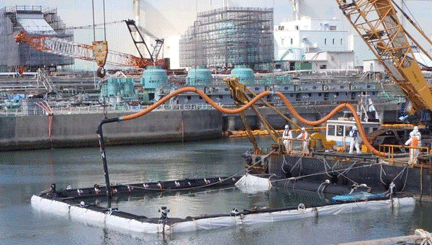
Initial talks between the government and TEPCO agreed that only water with 1,500 becquerels of radiation or less per liter could be released. Tests conducted by TEPCO and two outside agencies have revealed that the Fukushima underground water met the standards, averaging 220 to 240 becquerels of tritium per liter.
TEPCO began pumping out groundwater from the Fukushima nuclear plant in April in an effort to prevent further radioactive leaks.
The company continues to grapple with the problem of contaminated water storage, with about 450,000 tons of highly-radioactive water currently being stored in Fukushima’s underground facilities and tanks. Experts say some 15,000 tons is also being held in a service tunnel. According to recent estimates, up to 400 tons of contaminated water from the damaged plant is seeping into the Pacific Ocean every day.
In an effort to prevent further irradiation, TEPCO has adopted a plan to draw off groundwater from the plant. The fallout from Fukushima is later to be sent for analysis that will determine whether it is safe to be disposed of by dumping into the ocean.
The practice will allow the operator to reduce the accumulation of radioactive water at the plant by 100 tons a day……..https://news.google.com/news?ncl=d_uao6qIU8QsFkM74lsq0LkpKVl4M&q=radiation&lr=English&hl=en&sa=X&ei=l7N2U52sB8mtlQXZ_4HYBw&sqi=2&pjf=1&ved=0CDsQqgIwAw
1 This Month
10 March A LIVE WEBINAR THE REAL EFFECTS OF NUCLEAR POWER
What the Industry Isn’t Telling Us
1:00 PM Mountain, 2 pm Central, 3 pm Eastern. Live on the Keepers of the Water Facebook page



18 March Webinar @ 1 PM EST: An Assessment of SMR Projects: The Case of Canada
register for the zoom:
https://us02web.zoom.us/webinar/register/WN_o8BIIOUvQ2ONJR1nta65DQ#/registration


of the week – STOP SMALL MODULAR REACTORS IN CANADA
To see nuclear-related stories in greater depth and intensity – go to https://nuclearinformation.wordpress.com
-
Archives
- March 2026 (99)
- February 2026 (268)
- January 2026 (308)
- December 2025 (358)
- November 2025 (359)
- October 2025 (376)
- September 2025 (258)
- August 2025 (319)
- July 2025 (230)
- June 2025 (348)
- May 2025 (261)
- April 2025 (305)
-
Categories
- 1
- 1 NUCLEAR ISSUES
- business and costs
- climate change
- culture and arts
- ENERGY
- environment
- health
- history
- indigenous issues
- Legal
- marketing of nuclear
- media
- opposition to nuclear
- PERSONAL STORIES
- politics
- politics international
- Religion and ethics
- safety
- secrets,lies and civil liberties
- spinbuster
- technology
- Uranium
- wastes
- weapons and war
- Women
- 2 WORLD
- ACTION
- AFRICA
- Atrocities
- AUSTRALIA
- Christina's notes
- Christina's themes
- culture and arts
- Events
- Fuk 2022
- Fuk 2023
- Fukushima 2017
- Fukushima 2018
- fukushima 2019
- Fukushima 2020
- Fukushima 2021
- general
- global warming
- Humour (God we need it)
- Nuclear
- RARE EARTHS
- Reference
- resources – print
- Resources -audiovicual
- Weekly Newsletter
- World
- World Nuclear
- YouTube
-
RSS
Entries RSS
Comments RSS
 nuclear-news