International companies attempting to remove tritium from toxic water at Fukushima nuclear plant
 Three firms picked to help tackle toxic water at Fukushima No. 1 http://fukushimaemergencywhatcanwedo.blogspot.com.au/2014/08/three-firms-picked-to-help-tackle-toxic.html by dunrenard Aug 26, 2014 The government picked three overseas companies Tuesday to participate in a subsidized project to determine the best available technology for separating radioactive tritium from the toxic water building up at the Fukushima No. 1 nuclear plant.
Thus tritium-laced water is expected to accumulate at the plant in the absence of any method to remove the isotope.
The three firms chosen from 29 applicants are U.S. firm Kurion Inc., which offers technologies to treat nuclear and hazardous waste; GE Hitachi Nuclear Energy Canada Inc., a joint venture of Hitachi Ltd. and U.S. firm General Electric Co.; and Federal State Unitary Enterprise RosRAO, a Russian radioactive waste management firm.
The government will provide up to ¥1 billion for each examination of the technologies and running costs, and consider whether any of them can be applied to treat the water at Fukushima No. 1, the industry ministry said.
The three companies are to conclude their experiments by the end of March 2016, a ministry official said.
The official cautioned there is no guarantee that any of the technologies will be put to practical use.
Source: Japan Times
http://www.japantimes.co.jp/news/2014/08/26/national/three-firms-picked-help-tackle-toxic-water-fukushima-1/
Fukushima situation is a continuing international crisis, requiring international help
“There should be an international consortium of global experts from France, from Russia, from the United States, and Canada, putting their heads together with the Japanese and working out solutions,” she said.
Others believe that Japan needs to look northwest, towards the Kremlin. Chernobyl gave Russia and Ukraine a level of experience in handling nuclear failures that stands apart from most of the world
NO ONE WANTS YOU TO KNOW HOW BAD FUKUSHIMA MIGHT STILL BE VICE By Johnny Magdaleno Aug 19 2014 “…………When I asked past Nobel Peace Prize nominee Dr. Helen Caldicott these questions, she was quick to respond: “Because money matters more than people.”
 Dr. Caldicott was a faculty member at Harvard Medical School when she became president ofPhysicians for Social Responsibility, an American organization of doctors against nuclear warfare, climate change, and other environmental issues, in 1978. The organization, along with its parent body the International Physicians for the Prevention of Nuclear War, won the Nobel Peace Prize in 1985, a year after Caldicott left.
Last September, Caldicott organized a symposium at the New York Academy of Medicine entitled, “The Medical and Ecological Consequences of Fukushima,” and has a book coming out on the issue this October. Her expertise on the subject is founded on academic research, but also her lifelong role as a doctor practicing preventative medicine in the nuclear age.
“Japan produces parts for nuclear reactors, like reactor containment vessels,” she said in an interview with VICE. “They’re heavily invested in nuclear power, even though they actually have access to nine times more renewable energy than Germany.”
Although Caldicott says what separates Fukushima from Chernobyl is the continuous leakage of radioactive material, in her eyes they’re unified by an institutionalized effort to keep the veil from lifting. Continue reading
Local leaders want full disclosure of testimony of Fukushima nuclear plant manager
Local leaders seek disclosure of testimony by former nuclear plant chief THE ASAHI SHIMBUN 21 Aug 14 Leaders of local governments near the stricken Fukushima No. 1 nuclear power plant want the testimony given by the plant manager months after the accident to be disclosed.
The Asahi Shimbun ascertained that eight local leaders want full disclosure after seeking the views of the Fukushima governor and heads of 13 cities, towns and villages located within 20 kilometers of the plant and areas outside the 20-km radius where radiation levels were more than 20 millisieverts per year.
Masao Yoshida was plant chief when the March 11, 2011, Great East Japan Earthquake and tsunami set off the nuclear accident.
He gave hours of testimony to the government’s Investigation Committee on the Accident at the Fukushima Nuclear Power Stations, and died in July 2013 from esophageal cancer. Tokyo Electric Power Co., operator of the plant, said Yoshida’s cancer was not related to radiation exposure.
The survey also revealed that five of the leaders said there would be no problem if their own interviews with the government investigation panel were made public.
After the onset of nuclear crisis, the government’s investigation panel interviewed 770 officials and others involved in the disaster.
Although the central government currently plans to publicly disclose part of those records by the end of the year, it will not release the contents of Yoshida’s interview, citing Yoshida’s request not to disclose his testimony……http://ajw.asahi.com/article/0311disaster/fukushima/AJ201408210044
High radiation levels 60 km from Fukushima nuclear plant
 Gov’t: Radiation level 60 km from Fukushima plant is as high as the most contaminated areas in Chernobyl — “Fukushima far exceeded any crisis previously encountered” — “A risk of destruction of the society” — Expert: “It’s unprecedented in scale and duration” (VIDEOS)http://enenews.com/govt-radiation-level-60-km-fukushima-plant-high-contaminated-areas-chernobyl-fukushima-exceeded-crisis-previo
Interview with Dr. Brad Sample, ecotoxicologist and Hazard/Risk Assessment Editor for ‘Environmental Toxicology and Chemistry’(at 8:10 in): “The event [at Fukushima Daiichi] is unprecedented in scale and duration.” >> Full interview here
IRSN News Magazine – Fukushima special report (pdf): “The Fukushima disaster far exceeded any crisis previously encountered”
Fukushima Accident — Contamination of People and the Environment, IRSN (emphasis added):
- 6:45 in — Didier Champion, IRSN: “Japanese authorities… measured… 15 million Bq/m2 for Cs-137 for example. This isquite comparable to that we see in the most contaminated areas around the Chernobyl accident.”
- 7:00 in — Researchers have mapped the contamination of soil… It goes far beyond the evacuation zone, and extends to more than 80 miles away — agricultural and urban areas inhabited by hundreds of thousands of people.
- Watch video here
Jacques Repussard, IRSN Director General (at 5:15 in): “These are such serious accidents covering so many aspects of life in a country… The ability of associations, of local elected officials, to act in an intelligent and in an efficient manner, is a great resource. And also a factor in social cohesion in a disuniting situation, wherethere is a risk of destruction of the society.” >> Watch video here
Fukushima Accident — Response of the Japanese Society, IRSN (at 1:30 in): 60 kilometers from the power plant, farmers organized themselves collectively [and] turned to a researcher in bioscience from Dokkyu Medical University [Dr. Shingo Kimura]… They travel the region to measure contamination on roadsides, in fields, and even within homes… Along this road the dosimeter shows a gamma wave radiation level at more than 50 microsieverts per hour — a tremendous level akin to the highest contamination from Chernobyl. [0.03 microsieverts per hourbefore 3/11] >> Watch video here
Huge amounts of Fukushima radioactive fallout are still bound to organic material
 Gov’t Expert: Fukushima hot particles can’t be dissolved, even with hot nitric acid! — Huge amounts of fallout are still bound to organic material… “we have very little knowledge about this” — “Reaction is irreversible”(PHOTO) http://enenews.com/govt-expert-fukushima-radioactive-material-be-dissolved-hot-nitric-acid-huge-amounts-fallout-bound-organic-material-very-little-knowledge-about-reaction-irreversible?utm_
Journal of Radioanalytical and Nuclear Chemistry,Volume 295, Issue 3, 2013 (emphasis added): […] radionuclides were emitted from the FDNPP as airborne ‘hot’ particles […] Subsequent interaction of the ‘hot’ particles with water (e.g. rainfall) dissolved and strongly fixed the radiocesium on rock and soil particles, thus changing the radiocesium into insoluble forms. […] Consequently, ‘hot spots’ were studded on the rock surface rather than being uniformly distributed. […] Leaching experiments demonstrated that radiocesium in rock, soil and river suspended sediment was fairly insoluble, showing that the adsorption [binding of particles to a surface] reaction is irreversible. The micro-scale heterogeneous distribution of radiocesium […] was due to the presence of ‘hot’ particles in aerosols. […] ‘hot’ particles in the aerosols [experienced] irreversible adsorption onto the soil particle complex […]
Agricultural Implications of the Fukushima Nuclear Accident – Radiocesium Absorption by Rice in Paddy Field Ecosystems (pdf), 2013:Unexpectedly, we found that the fallout was relatively insoluble and only a small percentage of the radiocesium could be extracted by a boiling water treatmentfollowed by nitrate leaching. We have very little knowledge about this fallout, including its chemical form and properties, but huge amounts of this relatively insoluble radioactive fallout are still bound to organic matters […]
Presentation by Yasuhito Igarashi of Japan’s Meteorological Research Institute at IAEA’s expert meeting (pdf), February 2014: Mar. 14-15 sample contained insoluble materials not only in water but hot nitric acid! […] They are insoluble; even refractory to conc. nitric acid. […] They would persist for a long time in the environment as well as in living organisms.
Scientific Reports (Nature Publishing Group) — Emission of spherical cesium-bearing particles from an early stage of the Fukushima nuclear accident, Aug. 30, 2013: We analyzed the water solubility of Cs Particle 1 by comparing the particle’s shape before and after exposure to water. The results show that there was no change in shape, suggesting that the particle was insoluble to water at least during atmospheric transportation.
American Chemical Society Publication, Analytical Chemistry — Detection of uranium and chemical state analysis of individual radioactive microparticles emitted from the Fukushima nuclear accident… (Tokyo Univ., Japan’s Meteorological Research Institute), August 1, 2014: We explored the possible sources of the 14 elements (Cr, Mn, Fe, Zn, Rb, Zr, Mo, Ag, Sn, Sb, Te, Cs, Ba, and U) found within the microparticles […] These particle natures suggest that they could have relatively long-term impact on the environment, i.e., the release of soluble radioactive Cs into the environment as these insoluble glassy particles degrade. Similar radioactive particles have been detected in soils, plants, and mushrooms […] it is probable that [these particles are] the same as the microparticles characterized in our study.
Tepco dumps AREVA’s ineffective radiation decontamination system
” Tokyo Electric has determined that it will cease use of AREVA’s decontamination system, which uses chemicals to remove radioactive materials from water, as it has not lived up to expectations since it was installed. The utility will file an application with the Nuclear Regulation Authority in order to scrap the system.
The decontamination system was set up in June 2011, three months after the onset of the Fukushima Daiichi nuclear disaster. The design was so complicated that it took 50 welders more than a month to put the system together. In the first three months, the system processed 76,000 tons of contaminated water, but was repeatedly forced to be shut down by a variety of problems.
For the last three years the system has been unused and kept out of operations and in the meantime, TEPCO has introduced a new system to process the ever-accumulating amounts of contaminated water…
View original 236 more words
Thyroid cancer in Fukushima children: an inconvenient fact for Japan’s government
 Japan Professor: Outbreak of cancer is now underway in Fukushima children; Clear evidence of an epidemic — All of Japan is still being exposed to nuclear radiation — Gov’t Official: It will be ‘disastrous’ if we have to conclude there’s an actual increase in thyroid cancer from Fukushima http://enenews.com/japan-professor-outbreak-cancer-fukushima-children-clear-evidence-epidemic-underway-all-japan-being-exposed-nuclear-radiation-govt-official-will-be-disastrous-conclude-actual-increase-thyroid-ca?utm_source=feedburner&utm_medium=email&utm_campaign=Feed%3A+ENENews+%28Energy+News%29
Excerpts from a report by Dr. Yuri Hiranuma, a physician specializing neuromusculoskeletal medicine, published by Fukushima Voice version 2e, Aug 3, 2014:
[At the July 16, 2014 Expert Meeting Regarding the Status of Health Management of Residents Following the Tokyo Electric Fukushima Daiichi Nuclear Power Plan Accident, held by the Ministry of the Environment]
- Toshihide Tsuda, a physician and an epidemiologist at Okayama University, has just emphatically stated that in certain Fukushima municipalities there was a clear evidence of a thyroid cancer epidemic […] Calling this an “outbreak, occurring only 3.1 to 3.2 years after the accident” […] “outbreak” of thyroid cancers in Fukushima children cannot be explained by the “screening effect,” when the data is analyzed and compared with the national cancer statistics as well as within Fukushima Prefecture against municipalities with the lowest exposure dose. Critical of the commonly accepted notion that health effects do not occur below 100 mSv, Tsuda presented numerous published studies that proved otherwise. […] “This Expert Meeting has not brought up these studies so I must do it” […] Tsuda also said that the Expert Meeting should consider the fact that all age groups including pregnant women were still being exposed to radiation in Fukushima Prefecture. […] Tsuda said, “We are all being exposed to radiation in Japan” […]
- [Committee] Chairman Shigenobu Nagataki, emeritus professor at Nagasaki University, a former chairman of Radiation Effects Research Foundation, and a mentor to infamousShunichi Yamashita [said] “Committee members, please do not hesitate to ask questions. Given what was just stated, it will be disastrous for this committee to have to conclude that there is an actual increase in thyroid cancer (due to the Fukushima accident).” […] if the Expert Meeting were seriously considerate of the disaster victims […] why would it be disastrous for this Expert Meeting to have a conclusion that cases of thyroid cancers might be increasing? […]
Excerpts from an article by Japanese independent media outlet OurPlanet-TV summarizing the July 16 meeting, translated by Dr. Yuri Hiranuma, Aug. 3, 2014:
- Professor Shinzo Kimura [who conducted] field investigations in Chernobyl, reported that currently there are many cases of thyroid cancer […] more than 250 km away from Chernobyl
- Matsumoto City Mayor Sugenoya, who has provided medical care to children with thyroid cancer in Belarus [said] even in areas contaminated with low-level radiation with an annual radiation level below 1 mSv, residents showed a depressed immune function, hematopoietic disorders, and perinatal abnormalities [and] medical personnel are not allowed to refer to the Chernobyl accident.
- Okayama University Professor Tsuda pointed out that there is no end of the number of researchers who say, “No cancer occurrence is expected from radiation exposure dose under 100 mSv,” after the Fukushima accident. Tsuda candidly said researchers should refrain from making such statements. […] As of the end of March 2014 [Nakadori, the central region of Fukushima that is 40-80 km from the Daiichi plant] had the highest detection rate [of thyroid cancer,] as much as 11 times higher than Aizu [western region of Fukushima, over 80 km from the plant]. […] thyroid cancers from municipalities other than Aizu region showed rates which were 15 to 40 times higher [than data from the National Cancer Center]. He sounded an alarm […] “It’s only been 3.1 to 3.2 years but there are so many cases observed in Fukushima. We need to take immediate countermeasures.” […] “They are still exposed to radiation. We can’t wait until the results come out. […] All of us as well as Fukushima residents are being exposed to radiation.”
- During this session, the audience applauded several times when witnesses spoke.
Ever- increasing radioactive water at Fukushima: they have no idea how to fix this
TV Host: I’m studying Fukushima every day — “They have no idea what they’re going to do… There’s no solution… It’s a nightmare” — Tens of thousands of gallons of radioactive water spill into Pacific Ocean each day — “We really need to shut down all reactors” (VIDEO) http://enenews.com/tv-host-im-studying-fukushima-every-day?utm_source=feedburner&utm_medium=email&utm_campaign=Feed%3A+ENENews+%28Energy+News%29

*NSFW* — Joe Rogan Experience, Aug. 2, 2014 (at 2:21:00 in):
- Abby Martin, host of RT’s ‘Breaking the Set’: I want to ask you, have you seen the VICE special on Fukushima? Oh my good god… Even though I study this sh*t every day I did not realize – until you see it, until you see that VICE special, and you see the tanks — how every day they’re filling this whole reactor up with fresh water, draining the radioactive water multiple times a day, storing it in hundreds of tanks. They’re going to run out of room. All the tanks are leaking. They’re spilling like 30,000 gallons of radioactive water into the Pacific Ocean water every day [According to the Washington Post, “400 (metric) tons of toxic water is flowing daily into the Pacific”, equal to 105,669 gallons]. They have no idea what the f*ck they’re going to do… There’s no solution — and what are they going to f*cking do? … It’s a f*cking nightmare… Look at Chernobyl; they have this giant sarcophagus that’s cracking… Why are we dealing with an energy that we can’t harness properly? … Clearly we don’t what the f*ck we’re doing with it.
- Joe Rogan, host: You know all it does is make steam?
- Martin: Yeah, that’s what’s so crazy, when you see what it really just is.
- Rogan: Ithought that it did something like made electricity with the nuclear — splitting atoms, and it just goes through the wires. No, they’re making steam… Couldn’t they do that in a better way? Seems like a lot of waste to make steam… What are you a**holes doing? You guys are making some sh*t that you can never shut off… They’re all over the place, too. The really bizarre thing is when you drive down the California coast, and you realize that we are on a fault — California moves all the time — then you go on the way to San Diego, there’s a f*cking nuclear power plant that’s right there! … Once those things go bad, they’re bad forever. So you have, as of now there’s only two spots, but those two spots are toast. Chernobyl and Fukushima are f*cking toast. Those areas are f*cked for 100,000 years. Then you have the storage of the nuclear waste from all the other places that are still operational… What the f*ck. This is less than 100 years of splitting atoms… and you already have two spots that are broken. If you could look at the future and you look at potential spots to go wrong… we’re going to f*ck up a huge percentage of the world with this power source… Maybe that solar thing is something you guys want to look at?
Martin: The thing is, it’s not working. I think that we really do need to shut down all the reactors… At the end of the day, is it worth the risk? To have this sh*t out there for a million years — is it worth it, when we do have other sources?
Full interview here
Tepco runnng out of space for radioactive water: it’s to be dumped in Pacific Ocean
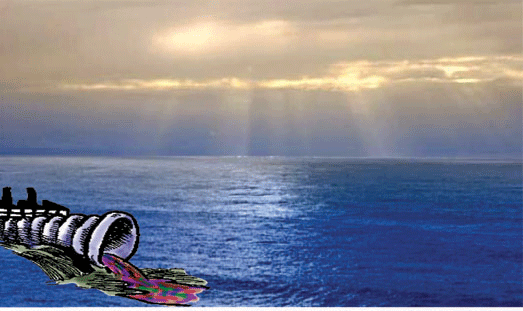 ‘‘Shock’: Water underneath Fukushima reactors to be dumped in ocean — Attempts to deal with problem have ‘failed’ — Officials: It’s better than radioactive substances just “spilling directly into the ocean” like it is now (VIDEO) nenews.com/shock-water-fukushima-reactors-be-dumped-ocean-attempts-deal-problem-failed-officials-better-allowing-contamination-spill-directly-ocean-like-video?utm_source=feedburner&utm_medium=email&utm_campaign=Feed%3A+ENENews+%28Energy+News%29
AFP, Aug. 7, 2014 (emphasis added): Tepco ‘running out of space’ for tainted water — [Tepco] on Thursday unveiled a plan to dump scrubbed water directly into the ocean, sparking concerns over whether it would be properly decontaminated. […] {Tepco] has admitted that it’s running out of space. It is also fighting to contain contaminated groundwater around the plant from seeping into the ocean […] [Tepco] said it now wants to start pumping out the underground water, purify it […] and then release it […] the firm has long faced criticism over delays in disclosing key information […]
NHK, Aug. 6, 2014: Highly radioactive water […] is seeping into the earth and mixing with ground water. Experts estimate around 200 [or 400] tons of contaminated ground water are leaking into the ocean each day. [Tepco wants] to decontaminate ground water collected at wells near reactor buildings before releasing it into the ocean. […] They say their plan is an improvement on the current situation, as contaminated water is spilling directly into the ocean.
Yomiuri Shimbun, Aug 7, 2014: Groundwater to be pumped up from some of the subdrain pits includes high levels of tritium, a radioactive substance thatcannot be removed […] However, TEPCO believes it is possible to […] meet standards if the water is mixed in tanks with water pumped from other subdrain pits.
Kyodo, Aug 7, 2014: Tepco to collect toxic groundwater at Fukushima, dump in ocean after treatment […] it is unclear whether [the plan] will work as smoothly as expected, one of the officials admitted. […] Radioactive substances such as tritium and cesium have been detected [but] TEPCO says it aims to clean the water to a level that would do no harm to the environment, but tritium will remain untreated […]
Asahi Shimbun, Aug 7, 2014: [Tepco] wants to dump decontaminated water […] into the ocean. [TEPCO] is in talks with government ministries to pump contaminated water found around the buildings […] process it […] then release it […] “We would never consider dumping the water into the ocean unless we received the consent of local residents,” a TEPCO official said. […] it would be the first time […] for contaminated water to be dumped into the ocean after it has been purified. […] “The water close to the plant buildings is already contaminated,” the official said. “Fishermen are sure to raise objections” […]
Bloomberg, Aug 4, 2014: [E]stimates […] suggest filtering the isotope strontium out of stored water will take more time [than Tepco’s March 31, 2015 deadline.] Strontium has been linked to leukemia and can enter the food chain […] Delays in the cleanup could extend a South Korean ban on Japanese seafood imports […] Michael Friedlander, a former nuclear engineer [said] “They’re basically accumulating vast quantities of radioactive material that isn’t in control” […] Corrosion has delayed full use of a filtration system known as ALPS […] Tepco said aplan to divert groundwater into the sea […] has so far failed […]
NHK, Aug. 7, 2014: [TEPCO] is running a so-called bypass system […] But groundwater continues to flow into the reactors’ buildings and become contaminated. Part of it is believed to be seeping into the nearby Pacific Ocean. […] In the closed-door meeting, the officials are said to have explained that they plan to collect contaminated groundwater both at wells near reactor buildings and […] a coastal embankment. […] Fisheries association head Hiroyuki Sato told reporters that fishermen were shocked to hear that the measure is needed […]
Fukushima’s nuclear fuel found 15 miles from Tokyo suburbs
Nuclear fuel found 15 miles from Tokyo suburbs — Fukushima uranium in ‘glassy’ spheres transported over 170 km — Structural materials from the nuclear reactors also present (PHOTOS) http://enenews.com/nuclear-fuel-found-15-miles-tokyo-suburbs-fukushima-uranium-glassy-spheres-transported-170-km-structural-materials-nuclear-reactors-present-photos
Fukushima Diary, Aug 9, 2014: NHK admitted pieces of fuel rods and reactor vessels blasted to at least Ibaraki to contain Uranium & Zirconium […] NHK announced that pieces of nuclear fuel […] were blasted to at least 130km away from Fukushima nuclear plant. It was 2μm diameter particle. The ball-looking shape proves it was molten in high temperature and quickly cooled down […] the same material as nuclear fuel and the structure inside the vessels. These were collected from 3/14 ~ 3/15/2011 in Tsukuba city Ibaraki prefecture by the study group of Science Univ. of Tokyo. […]
NHK News (Translation by SysTran), Aug 9, 2014: Scattering of uranium fuel in a nuclear reactor damage […] in the Ibaraki prefecture immediately after the accident of Fukushima Daiichi Nuclear Power Station has occurred, the material of the structure of other nuclear reactor of uranium is detected […] it’s a result that confirms that damage to the reactor massive had progressed […] Research group of Izumi Nakai professors from Tokyo University of Science […] the dust in the atmosphere […] collected at Tsukuba, Ibaraki Prefecture […] 130 km from the nuclear power plant over the next morning from the night of March 14 […] It is a result, in addition to the radioactive cesium, zirconium material of the fuel rods and uranium, and iron of the material of the pressure vessel, material that matches the structure of the nuclear reactor and nuclear fuel has been detected. It is that dust that these shows feature when it is cold suddenly you have to be in the ball-shaped of about 2 micrometers in diameter, and is released after external melted at high temperatures. […]
American Chemical Society Publication, Analytical Chemistry — Detection of uranium and chemical state analysis of individual radioactive microparticles emitted from the Fukushima nuclear accident using multiple synchrotron radiation X-ray analyses, Yoshinari Abe , Yushin Iizawa , Yasuko Terada , Kouji Adachi , Yasuhito Igarashi , and Izumi Nakai (Tokyo University, Japan Synchrotron Radiation Research Institute, Meteorological Research Institute), August 1, 2014 (emphasis added): […] analyses revealed the detailed chemical nature of radioactive aerosol microparticles emitted during the Fukushima Daiichi Nuclear Power Plant (FDNPP) accident, resulting in better understanding of what occurred in the plant during the early stages of the accident. Three spherical microparticles (~2 μm Φ) containing radioactive Cs were found in aerosol samples collected on March 14th and 15th, 2011, in Tsukuba, 172 km southwest of the FDNPP […] 10 heavy elements [were] in all three particles: Fe, Zn, Rb, Zr, Mo, Sn, Sb, Te, Cs, and Ba. In addition, U was found for the first time in two of the [three] particles […]implying that U fuel and its fission products were contained in these particles […] These results strongly suggest that the FDNPP was damaged to emit U fuel and fission productsoutside the containment vessel as aerosol particles. […] individual particles revealed that they were present at high oxidation states, i.e., Fe3+, Zn2+, Mo6+, and Sn4+ in the glass matrix […] These radioactive materials in a glassy state possibly remain in the environment longer than those emitted as water soluble radioactive Cs aerosol particles.
Plutonium contamination at Fukushima becomes ever more alarming
 ‘Increasing alarm’ at Fukushima: Trenches filled with thousands of tons of plutonium contaminated liquid leaking into ocean — ‘Biggest risk’ at plant — ‘Exceptionally difficult’ problem — ‘Constant flow’ in and out of trenches — ‘Racing to stop’ more from coming in (PHOTO) http://enenews.com/japan-officials-increasingly-alarmed-thousands-tons-plutonium-contaminated-liquid-fukushima-trenches-leaking-ocean-biggest-risk-plant-exceptionally-difficult-problem?utm_source=feedburner&utm_medium=email&utm_campaign=Feed%3A+ENENews+%28Energy+News%29
Wall St. Journal, Aug 7, 2014(emphasis added): [Shunichi Tanaka, chairman of the Nuclear Regulation Authority] said [Tepco] needs to get its priorities straight when it comes to work to decommission […] Fukushima Daiichi […] “The biggest risk is the trench water. Until that matter is addressed, it will be difficult to proceed with other decommissioning work,” [Tanaka] said on Wednesday at his weekly news conference. “It appears that they are getting off track,” he told reporters. Tepco has been trying to remove some 11,000 metric tons of water that contains dangerous radioactive materials such as uranium and plutonium from a trench that runs from the Fukushima Daiichi plant’s No.2 reactor building. […] “What if another tsunami hits the plant and the highly contaminated water in the trench is discharged…
NHK, July, 30, 2014: TEPCO initially planned to freeze radioactive wastewater that’s been flowing into underground utility tunnels [trenches] at the plant. It hoped the measure would prevent the wastewater from mixing with groundwater and flowing out to sea. But 3 months into the project, the water hasn’t frozen as planned.
Nuclear Engineering International,August 7, 2014: TEPCO has admitted that it has having problems with freezing contaminated water flowing in trenches […] The water in the trenches is […] coming into contact with nuclear material[…] because the water flows in and out of the trenches because of water pumping operations, it has proved ‘exceptionally difficult’ to freeze, TEPCO said. This was despite increasing the flow of coolant, adding ice and dry ice to the trench water[…]
Kyodo, Aug. 5, 2014: Tepco is racing to stop the buildup of radioactive cooling water in the trenches. […] Tepco inserted refrigeration rods in the trenches to try to freeze the water butabandoned the effort after more than three frustrating months. […] Though [Tepco has now put] 58 tons of ice in the trenches, the utility has “yet to see” whether it will work […] The new method was introduced after an increasingly alarmed Nuclear Regulation Authority urged the company last month to take additional steps as soon as possible […]
World Nuclear News, July 24, 2014: New approaches to removing the contaminated water from trenches […] after attempts to freeze it failed. […] The trenches contain highly-contaminated water that has flowed from the main power plant buildings […] Tepco said that, despite the success of early experiments, “it has proved exceptionally difficult” to freeze the trench water. This, it said, is due to the constant flow of water into and out of the trench […]
Tepco under-reported Fukushima release of plutonium – by 200 times!
 New report estimates 278 trillion Bq of plutonium released from Fukushima reactors — Over 200 times higher than amount reported by Tepco — “Highly radiotoxic when incorporated into human body” as it decays http://enenews.com/new-report-estimates-278-trillion-bq-of-plutonium-released-from-fukushima-reactors-over-200-times-higher-than-amount-reported-by-tepco?utm_source=feedburner&utm_medium=email&utm_campaign=Feed%3A+ENENews+%28Energy+News%29
Evaluation of the Fukushima Accident Source Term through the fast running code RASCAL 4.2(pdf),ENEA Bologna Research Centre, May 23, 2014: This Report presents the results of the application of the fast-running US-NRC direct code RASCAL 4.2 to the estimation of the Fukushima Source Term. […] it is plausible that the ventings that TEPCO announced during the accident as being conducted from the wetwell were, as a matter of fact and because of the degraded conditions of the plants, conducted actually from the drywell. […] wetwell properties imply releases which can be several oder of magnitudes lower than those from the drywell […] it can clearly be seen that the most probable path is the combination of Drywell+Direct option […] the true venting path, i.e. from Drywell instead of from Wetwell, is an extremely important issue. […] in several instances when TEPCO tried to operate venting, in order to release pressure outside the building through the stack, it proved impossible […] there are many indications that probably the radioactive material escaped from the drywell; this may have occurred without TEPCO’s immediate knowledge and because of several factors; for example: structural damages to the pipings connecting drywell to torus room (vent piping bellows), due either to the earthquake, and/or to the too violent pressure and temperature increase in the D/W; leakages through the top head manhole, the top head flange, the piping penetrations, the electrical wiring penetrations, the personal airlocks, the S/C manholes, the machine hatches, etc. […] The value of 1%/h was chosen by ENEA because of the possible highly damaged conditions of the Fukushima NPPs due to the BDB [Beyond Design Basis] earthquake.
> Table 7. Cumulative Source Term (Bq) TEPCO MELCOR
- Pu-241 Total = 1.2E+12 (1,200,000,000,000 Bq)
> Table 7. Cumulative Source Term (Bq) ENEA RASCAL 4.2
- Pu-241 Unit 1 = 6.52E+13 (65,200,000,000,000 Bq)
- Pu-241 Unit 2 = 1.86E+14 (186,000,000,000,000 Bq)
- Pu-241 Unit 3 = 2.67E+13 (26,700,000,000,000 Bq)
- Pu-241 Total = 2.78E+14 (278,000,000,000,000 Bq)
Environmental Science & Technology (American Chemical Society), July 11, 2014: [S]tandard alpha spectrometry techniques […] are not able […] to measure 241Pu.
Boreal Environment Research (pdf), Feb. 28, 2014: The 241Pu isotope was introduced into the environment from […] accidents that released nuclear reactor fuel, such as […] the 2011 Fukushima catastrophe. As compared with other Pu isotopes in the environment that are alpha-emitting and long-lived, 241Pu is a short-lived isotope with a half-life of 14.35 years […] 241Pu decays to the alpha emitter 241Am, that has a much longer half-life (432.2 years) and is highly radiotoxic when it is incorporated into either the human or animal body. […] The 241Pu isotope has been studied less extensively than the α-emitting Pu isotopes for several reasons. Activity concentration of 241Pu cannot be determined from the same alpha spectrum as the Pu isotopes 238, 239, and 240, and extra effort is needed in order to analyze 241Pu concentration of a sample. Actually, 241Pu emits alpha particles, but they have so low probability (0.002%) that 241Pu cannot be measured directly by α-spectrometry […]
Melted nuclear fuel cores leaking radiation directly into groundwater at Fukushima
 Official: “Unfortunately, the fuel itself is exposed” at Fukushima — Scientist: Our tests show contamination isn’t going away… reactors are leaking out into ocean… there’s still a problem — PBS: Plume of water tainted with radiation is reaching to other side of Pacific (VIDEO) http://enenews.com/official-fuel-exposed-fukushima-scientist-tests-show-contamination-going-away-reactors-leaking-ocean-problem-pbs-plume-water-tainted-radiation-reaching-other-side-pacific-video?utm_source=feedburner&utm_medium=email&utm_campaign=Feed%3A+ENENews+%28Energy+News%29
PBS NewsHour’s ‘Return to Fukushima’, Aug 6, 2014: NewsHour science correspondent Miles O’Brien […] has traveled to Fukushima three times and six times entered the exclusion zone, which he described as a “post-apocalyptic landscape of abandoned towns, frozen in time.” We’ve stitched his latest reports together into this documentary-length video. They include his tour of the hazardous Fukushima Daiichi nuclear power plant and a look at the health of marine life off the coast of Japan […] Plus, a never-before-seen exclusive tour of Fukushima Daini, Daiichi’s sister plant, which narrowly escaped the same fate.
- 3:30 in – Miles O’Brien, PBS: 3 of [Fukushima Daiich’s] cores are now melted down, still steaming hot, their steel containment structures breached. Engineers believe some of the nuclear fuel has melted right through the steel containment vessels on to a concrete basement floor, where it is exposed to groundwater. […] Each and every day, about 100,000 gallons of fresh groundwater seeps into the basements of the plant, where it becomes contaminated with a witch’s brew of radionuclide. […] No one disputes the plant is steadily leaking radiation-tainted water into the sea.
- 14:00 in – O’Brien: [Naohiro Masuda, leader of Fukushima Daiichi’s decommissioning company and head of Fukushima Daiini during 3/11] explained where the melted nuclear fuel has gone.
- 14:05 in — Masuda: Unfortunately, the fuel itself is exposed.
- 14:10 in — O’Brien: Melted through?
- 14:15 in — Masuda: Melted through the pressure vessel, and coming down to this room and it goes down to the floor.
- 17:30 in — Crystal Breier, Woods Hole Oceanographic Institution: This is Fukushima water, this is from our cruise this past September. We found there’s still contamination. […] It’s been persistent, it hasn’t gone away. It’s indicating that the reactors are leaking out more cesium — and there is still a problem.
- 18:15 in – O’Brien: The plume of water tainted with radiation from Fukushima is only now reaching the other side of the Pacific. This has prompted an online tsunami of pseudoscience, blog rumors and wild accusations […]
- 32:45 in – O’Brien: Of course local health officials have been following the evacuees in the Fukushima region and they say there have been more than 1,600 deaths attributed to stress. In the end, perhaps the biggest risk associated with nuclear energy might very well be the fear of nuclear energy. Thanks for watching.
- Watch the PBS broadcast here
Proper research urgently needed into medical effects of Japan’s nuclear meltdowns
issue under the rug, predicting any harmful effects of the catastrophe is “unlikely.”
The UN panel made a very broad assumption about the worst nuclear catastrophe in history (or worst since Chernobyl) – and did this BEFORE research is done. However, a local health study raises alarm bells. Fukushima Medical University found 46% of local children have a pre-cancerous nodule or cyst, and 130 have thyroid cancer, vs. 3 expected. Incredibly, the University corrupts science by asserting the meltdown played no role in these high figures.
But Japanese studies must go far beyond childhood thyroid diseases. Japan isn’t the only site to study, as the fallout from the meltdown spread across the northern hemisphere.
In 2011, we estimated 13,983 excess U.S. deaths occurred in the 14 weeks after Fukushima, when fallout levels were highest – roughly the same after Chernobyl in 1986. We used only a sample of deaths available at that time, and cautioned not to conclude that fallout caused all of these deaths.
Final figures became available this week. The 2010-2011 change in deaths in the four months after Fukushima was +2.63%, vs. +1.54% for the rest of the year. This difference translates to 9,158 excess deaths – not an exact match for the 13,983 estimate, but a substantial spike nonetheless.
Again, without concluding that only Fukushima caused these deaths, some interesting patterns emerged. The five Pacific and West Coast states, with the greatest levels of Fukushima fallout in the U.S., had an especially large excess. So did the five neighboring states (Arizona, Idaho, Montana, Nevada, and Utah), which received the next highest levels.
Most of the spring 2011 mortality increase were people over 80. Many of these elderly were in frail health; one possibility is that the added exposure to radioactive poison sped the dying process.
Fukushima radiation is the same as fallout from atom bomb explosions, releasing over 100 chemicals not found in nature. The radioactive chemicals enter the body as a result of precipitation that gets into the food chain. Once in the body, these particles harm or kill cells, leading to disease or death.
Once-skeptical health officials now admit even low doses of radiation are harmful. Studies showed X-rays to pregnant women’s abdomens raised the risk of the child dying of cancer, ending the practice. Bomb fallout from Nevada caused up to 212,000 Americans to develop thyroid cancer. Nuclear weapons workers are at high risk for a large number of cancers.
Rather than the UN Committee making assumptions based on no research, medical research on changes in Japanese disease and death rates are needed – now, in all parts of Japan. Similar studies should be done in nations like Korea, China, eastern Russia, and the U.S. Not knowing Fukushima’s health toll only raises the chance that such a disaster will be repeated in the future.
Joseph Mangano is Executive Director of the Radiation and Public Health Project.
Janette D. Sherman MD is an internist and toxicologist, and editor of Chernobyl: Consequences of the Catastrophe for People and the Environme
Dr Helen Caldicott on the authorities’ concealment of medical effects of Fukushima catastrophe
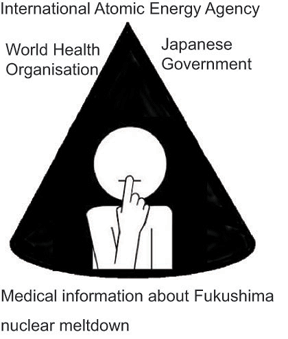
UN, Japan, Concealing Extent of Fukushima Catastrophe MWC News, By Sherwood Ross Friday, 01 August 2014 Japanese and United Nations authorities have placed “a cone of silence” over medical information an endangered Japanese public is entitled to have about the Fukushima nuclear plant meltdown.
“It is obvious that there is collaboration between the World Health Organization(WHO) and the International Atomic Energy Agency(IAEA) and also the Japanese government…to hide, to lie, and to cover-up vital medical information that must be made available to the Japanese population,” says Dr. Helen Caldicott, the medical doctor who has been showered with honors and awards for her long-time opposition to the dangers of nuclear power manufacture and nuclear war.
“Many doctors have been ordered not to inform their patients that their symptoms could be related to radiation, leaving them in a state of despair,” Dr.Caldicott says. (They) “need to know the truth about their situation and that of their children.”
Dr. Caldicott, who has received 21 honorary doctorates for her work, says that to make matters worse, Japan Prime Minister Shinzo Abe “has passed a secrecy law which will almost certainly intimidate the media from keeping a very close watch over the tenuous (nuclear) plant.”
The government, she says, and Tokyo Electric Power Co.(TEPCO), “have been reluctant to divulge reliable data and information about radioactive releases, the ongoing state of the severely damaged reactors, the continuous outflow of radioactive water into the sea, and the possibility of a serious accident and radiation release in the event of another earthquake greater than 7 on the Richter scale which could well trigger the collapse of the seriously damaged buildings numbers 3 and 4.”
Damaged Building 3 contains over 100 tons of molten radioactive fuel which “would almost certainly release massive quantities of radioactive elements…threatening millions of people with radioactive contamination,” Dr. Caldicott points out.
She goes on to say that if precariously damaged Building 4 should collapse, 400 tons of extremely radioactive fuel will plunge 100 feet to the ground, releasing its cooling water with possible ignition of the fuel. This could release ten times more cesium than was released at Chernobyl or the equivalent of 14,000 Hiroshima-sized bombs.
What’s more, of the 800,000 healthy youngsters called “liquidators” brought in by the Government from around Russia to fight the burning reactor, within 19 years more than 120,000 were dead.
Dr. Caldicott urged the public to “demand that TEPCO and the Japanese government continually inform the public about the events that are and will be occurring at the Fukushima reactors, without cover-ups and denials of the facts.”
Should another major release of radiation occur, she said, the public must be informed immediately and evacuation begun immediately. http://mwcnews.net/focus/politics/44145-fukushima-catastrophe.html#sthash.5cgmPLZn.dpuf
1 This Month
10 March A LIVE WEBINAR THE REAL EFFECTS OF NUCLEAR POWER
What the Industry Isn’t Telling Us
1:00 PM Mountain, 2 pm Central, 3 pm Eastern. Live on the Keepers of the Water Facebook page



18 March Webinar @ 1 PM EST: An Assessment of SMR Projects: The Case of Canada
register for the zoom:
https://us02web.zoom.us/webinar/register/WN_o8BIIOUvQ2ONJR1nta65DQ#/registration


of the week – STOP SMALL MODULAR REACTORS IN CANADA
To see nuclear-related stories in greater depth and intensity – go to https://nuclearinformation.wordpress.com
-
Archives
- March 2026 (99)
- February 2026 (268)
- January 2026 (308)
- December 2025 (358)
- November 2025 (359)
- October 2025 (376)
- September 2025 (258)
- August 2025 (319)
- July 2025 (230)
- June 2025 (348)
- May 2025 (261)
- April 2025 (305)
-
Categories
- 1
- 1 NUCLEAR ISSUES
- business and costs
- climate change
- culture and arts
- ENERGY
- environment
- health
- history
- indigenous issues
- Legal
- marketing of nuclear
- media
- opposition to nuclear
- PERSONAL STORIES
- politics
- politics international
- Religion and ethics
- safety
- secrets,lies and civil liberties
- spinbuster
- technology
- Uranium
- wastes
- weapons and war
- Women
- 2 WORLD
- ACTION
- AFRICA
- Atrocities
- AUSTRALIA
- Christina's notes
- Christina's themes
- culture and arts
- Events
- Fuk 2022
- Fuk 2023
- Fukushima 2017
- Fukushima 2018
- fukushima 2019
- Fukushima 2020
- Fukushima 2021
- general
- global warming
- Humour (God we need it)
- Nuclear
- RARE EARTHS
- Reference
- resources – print
- Resources -audiovicual
- Weekly Newsletter
- World
- World Nuclear
- YouTube
-
RSS
Entries RSS
Comments RSS
 nuclear-news