Censorship of scientific findings on Fukushima radiation
 NYTimes: Gov’t scientist not allowed to publish findings that Fukushima cesium-137 levels could be 10,000 times higher than after Chernobyl in Pacific surface waters — Japan researchers pressured to downplay disaster’s impact — Professors obstructed when data might cause public concern http://enenews.com/nytimes-govt-scientist-allowed-publish-findings-fukushima-cesium-137-could-be-10000-times-higher-pacific-surface-waters-after-chernobyl-japan-researchers-pressure-downplay-disasters-impact-profe?utm_source=feedburner&utm_medium=email&utm_campaign=Feed%3A+ENENews+%28Energy+News%29
New York Times,, Mar. 16, 2014: […] As a senior scientist at the Japanese government’s Meteorological Research Institute, [Michio Aoyama] said levels of radioactive cesium 137 in the surface water of the Pacific Ocean could be 10,000 times as high as contamination after Chernobyl […] as Mr. Aoyama prepared to publish his findings […] the director general of the institute called with an unusual demand — that Mr. Aoyama remove his own name from the paper. Continue reading
Are the people of Japan, especially the children, OK?
 Gundersen: Fukushima will be bleeding into Pacific for next 100 years — Such a worldwide catastrophe — Molten cores being released into groundwater and moving off site — ‘Radioactive lake’ developing beneath reactors — New Yorker: “Human disaster that may never end” (VIDEO) http://enenews.com/gundersen-fukushima-wil-lbe-bleeding-into-pacific-for-next-100-years-such-a-worldwide-catastrophe-molten-cores-being-released-into-groundwater-and-moving-off-site-radioactive-lake-develo?utm_source=feedburner&utm_medium=email&utm_campaign=Feed%3A+ENENews+%28Energy+News%29
Fairewinds Energy Education, Mar. 12, 2014:
Arnie Gumdersen, Fairewinds chief engineer (at 0:45 in): Is most of the cleanup complete? Are the people of Japan, especially the children, OK? Are the Japanese evacuees returning home? And, are the oceans OK? Sadly the answers are no.
Gundersen (at 5:15 in): The aftermath of this catastrophe remains as hazardous as ever. The power plant site itself, entire sections of the surrounding Fukushima Prefecture and the Pacific Ocean are contaminated in ways that humans never imagined, so no method of mitigation exists. The Fukushima catastrophe will continue to be life-threatening and continue to cause extreme hardship for Tepco employees and cleanup workers,the former Fukushima residents, who and the Pacific ocean — its habitats and its on the ecosystem […] The reactors continue to release the radioactive remnants from the molten cores into the surrounding groundwater that’s migrating off site. […] Tokyo Electric appears to have little control over the deteriorating environment, and it behaves like the victim, rather than the perpetrator of the greatest industrial mishap of all time. What will the future bring? The Fukushima Daiichi site will continue to bleed radiation into the Pacific Ocean for 100 years. As contaminated water beneath the site slowly evolves into a radioactive lake. […] Most likely the cleanup of the entire site is at least a century away, if ever. How has this calamity evolved into such a worldwide catastrophe? It happened because the Japanese government chose to protect Tepco, its financial interest and the goals of the nuclear power industry.
The New Yorker, Mar. 11, 2014: “A story of human disaster that may never end.” Seattle Weekly, Mar. 11, 2014: “The 3/11 snowfall was the beginning of Japan’s nuclear winter.”
In Fukushima region, people are radiation guinea pigs
 Official: Japan will be ruined if public doesn’t realize they’re being exposed to Fukushima radiation — “99.99% of the people are being sacrificed” — Rest of world will be taken down too (AUDIO) http://enenews.com/lawmaker-if-japanese-cant-face-truth-thattheir-exposure-could-be-ruined-by-fukushima-radiation-will-take-rest-of-world-down-with-it-99-99-of-the-people-are-being-sacrificed-audio?utm_source=feedburner&utm_medium=em
Forum with Michael Krasny on KQED, Mar. 10, 2014 — Kenji Kushida, Stanford University (at 43:00 in): This crisis doesn’t stop, it keeps on going, there’s no easy solution in sight. […] This current situation is basically unprecedented.
Message from Arao Shunsuke, Fukushima resident, , Mar. 10, 2014: […] Fukushima Daiichi is nowhere near under control, there are still massive problems […] we must be prepared for a long term battle which will go beyond the present generation. […] in Nakadori and other places in Fukushima, a million people are being forced to live exposed […] Many citizens of Fukushima mutter “we are guinea pigs.” […] Meanwhile TEPCO has not taken any responsibility for spreading radiation not just throughout Fukushima, but throughout the world. […] From the point of view of disposal of the radioactive waste also, people are realizing that we are nearing the point of collapse. […] We are continuing our journey on this small but beautiful planet, through the limitless universe. All of us must join our strength so that this delicate vehicle, which we are riding, which we have borrowed from our children and grandchildren, can be protected and handed over to them intact.
‘Nuclear Hotseat’ hosted by Libbe HaLevy,, Mar. 10, 2014 (at 49:30 in) — Taro Yamamoto, celebrity and lawmaker elected in 2013 to represent the Tokyo district in Japan’s Upper House: “Idiotic ideas — like restarting the nuclear plants — are being considered here in Japan. It really boils down to exposure to radiation. Why is nuclear dangerous? Because it exposes people to radiation […] in Japan you can talk about nuclear energy, but the subject off radiation is taboo. You almost never here the subject discussed on TV or the mass media. In various places the true situation about radiation exposure is being hidden. If Japanese people can’t face up to this problem then this country will be ruined. It will take the rest of the world down with it. […] I think it is wrong that people’s lives are being sacrificed because of money and the company profits. […] 99.99% of the people are being sacrificed.”
Record high radiation in 8 locations at at Fukushima Daiichi
 Jiji: Highly radioactive groundwater now flowing under Unit 1 — Levels skyrocket since last test, now 1,000s of times higher — 8 locations hit record in recent days at Fukushima Daiichi http://enenews.com/jiji-highly-radioactive-groundwater-now-flowing-under-fukushima-unit-1-levels-skyrocket-since-last-test-now-1000s-of-times-higher-8-locations-hit-record-in-recent-days
Jiji Press, Jan. 24, 2014: Tainted Water May Also Have Leaked from No. 1 Reactor at Fukushima N-Plant — Highly radioactive water accumulated in the basement of the turbine building of the No. 1 reactor […] may have contaminated groundwater, experts said Friday. […] TEPCO has explained that the groundwater may have been contaminated by highly radioactive water in underground cable tunnels of the No. 2 and 3 reactors […] however, 5,600 becquerels of radioactive tritium per liter was detected in groundwater taken on Sunday from an observation well near the turbine building of the No. 1 reactor. No radioactive tritium was detected in water collected in mid-November. […]
8 groundwater locations hit new highs for tritium since January 6 (Bq/liter):
0-2: 4,700 <1/12>
0-3-2: 73,000 <1/16>
0-4: 46,000 <1/12>
1-8: 12,000 <1/6>
1-17: 31,000 <1/16>
2-2: 660 <1/8>
2-7: 1,100 <1/17>
3-5: 170 <1/8>
The harsh facts on U.S.S. Reagan’s sailors affected by Fukushima radiation
Is Nuclear Experimentation Fascism? OpEdNews 1/22/2014 By Ethan Indigo Smith (about the author) “…the crew of the U.S.S. Reagan. The U.S.S. Reagan was exposed to radiation after being redirected towards Japan to provide support immediately after the massive Tōhoku earthquake and tsunami off the coast of Japan.
According to an article in the New York Post, Senior Chief Michael Sebourn, a radiation-decontamination officer who tested the aircraft carrier for radiation found that “levels were incredibly dangerous and at one point, the radiation in the air measured 300 times higher than what was considered safe.” The article continues: “The former personal trainer has suffered a series of ailments, starting with severe nosebleeds and headaches and continuing with debilitating weakness” has lost 60 percent of the power in the right side of his body and his limbs have visibly shrunk.” As Senior Chief Michael Sebourn stated, “I’ve had four MRIs, and I’ve been to 20 doctors” No one can figure out what is wrong.” He has since retired from the Navy after 17 years of service.
And he is not alone. According to The Post, “crew members on the aircraft carrier and a half-dozen other support ships are battling cancers, thyroid disease, uterine bleeding and other ailments.” Of the 5,000 sailors on board, at least 70 have contracted some form of radiation sickness, and of those, “at least half” are suffering from some form of cancer,” said lawyer, Paul Garner, who is representing the sailors in a lawsuit against the operators of the Fukushima Daiichi energy plant. “We’re seeing leukemia, testicular cancer and unremitting gynecological bleeding requiring transfusions and other intervention,” said Garner.
In a Voice of Russia report, Mr. Garner elaborated: “it seems that there’s too many people at the same place at the same time without any family background or any reason to believe that they had these issues to now show up with these significant cancers and beyond. So we feel that time will tell in many instances”. especially, because they all had physicals and were all in top health.”
Navy sailor Lindsay Cooper, who was also present on the U.S.S. Reagan, stated that crew members suffered from excruciating diarrhea at the time. “People were s-“-tting themselves in the hallways,” Cooper recalled. “Two weeks after that, my lymph nodes in my neck were swollen. By July, my thyroid shut down.”
When asked about the U.S.S. Reagan’s ability to detect radiation early, sailor Cooper stated “we have a multimillion-dollar radiation-detection system, but” it takes time to be set up and activated”. She went on to describe that after being exposed, “we couldn’t go anywhere. Japan didn’t want us in port, Korea didn’t want us, Guam turned us away. We floated in the water for two and a half months” until Thailand took the stricken sailors in……..http://www.opednews.com/articles/Is-Nuclear-Experimentation-by-Ethan-Indigo-Smith-Fukushima_Nuclear-Cover-up_Nuclear-Meltdown_Nuclear-Waste-140122-627.html
Wrecked Fukushima Daiichi nuclear power plant is in a continuing crisis
a constant flow of water is necessary to keep the molten uranium from heating up. TEPCO has built thousands of tanks to store the daily flood of contaminated water, but it is running out of space.
“The tanks have mushroomed all over the power plant,” McNeill said. “Because if they don’t keep it cool, it heats up, radiation escapes and then we’re back to square one.”
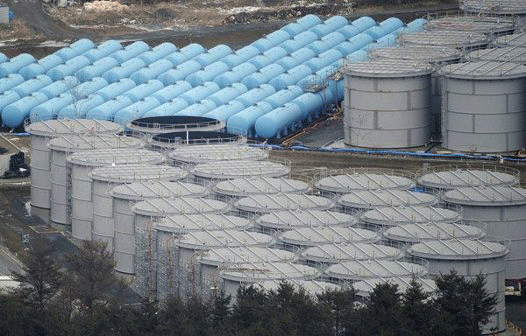
Is Fukushima at risk for another nuclear disaster?, Aljazeera America, 9 Jan 14 by Michael Okwu Nearly three years after the nuclear catastrophe at the Fukushima Daiichi Nuclear Power Plant, there remains concern about whether another disaster is right around the corner. America Tonight
At the Fukushima Daiichi plant, the Tokyo Electric Power Co., or TEPCO, is struggling to contain the ongoing nuclear disaster. Since the catastrophe almost three years ago, there has been disagreement about whether the plant is safe.
The official line from the Japanese government is that the situation is under control.
“The government is moving to the forefront and we will completely resolve the matter,” said Prime Minister Shinzo Abe in September, just before Tokyo was awarded the 2020 Summer Olympics.
But others, such as then–Tokyo Gov. Naoki Inose, have said the situation is “not necessarily under control.”…..
‘An ongoing crisis’ Journalist David McNeill has been covering Japan since 2000. America Tonight
“I think this is an ongoing crisis,” said David McNeill, a journalist who has lived in Japan since 2000 and has been covering the Fukushima disasterfrom the beginning. “What you’ve had is a series of ad hoc strategies designed to deal with the crisis that’s right in front of you.” Continue reading
Cause of steam from Fukushima reactor 3 – corium burning through containment?
 Nuclear Chemistry Expert: Steam at Fukushima reactor could be from corium burning through containment into groundwater http://enenews.com/nuclear-chemistry-expert-steam-at-unit-3-could-be-from-corium-burning-throug-containment-into-underlying-groundwater
| Judy Haar, former nuclear industry worker with a master’s degree in nuclear chemistry, Jan. 6, 2014: […]the story continues to linger, and the speculations have not stopped. […] With a high potential of fear-mongering, just the facts, please. […] First noticed in July, 2013, the plant, [Fukushima Daiichi] Reactor 3, suddenly started releasing steam. […] TEPCO […] hypothesized it was caused by rain waters seeping into the reactors damaged containment vessel which hit thermal hot spots […] On December 19, 24, 25, and 27, Reactor 3 started releasing steam, again. […] this is a strong indicator of the fragile state the site is in […] Reactor 3 ran on a mix of uranium and uranium/plutonium mixed fuel […] which experienced a complete meltdown. We don’t know for sure at this time, but the corium could have burned its way through the reactor vessel due to extreme heat, thus reaching the underlying ground water and producing steam. […] |
In the months after 3/11, Haar concluded, “The Answer is Clear: Nuclear Power is Safe — The three major reactor accidents have shown the industry that even among the worst accidents, few and far between, there is little loss of life, as compared to other fuels.”
And it appears Tepco won’t be the only company in the area emitting plumes related to hot radioactive material — NHK WORLD, Jan. 6, 2014: Nuclear waste incinerator to be built in Ibaraki […] The personnel of JCO, a subsidiary of Sumitomo Metal Mining, began constructing an incinerator to dispose of low-level radioactive substances at its plant in Tokai Village, Ibaraki Prefecture, on Monday. The firm lost its business license for such processing after 2 workers died of radiation poisoning during the disposal process in September, 1999. More than 660 others in and around the plant, including residents, were exposed to radiation. […] The firm is hoping to begin using the incinerator in November […] Used work clothes and documents are among the item to be treated. […] The firm’s officials say the facility’s air-filtering system will prevent any radioactive substances from leaking outside. […]
Rebellious Fukushima farmer who cares about his cows
ABC News: Gov’t, scientists ‘baffled’ over white spots on cows around Fukushima plant — Farmer: No one knows what they are, I think it’s from radiation; “Our town’s contaminated like Chernobyl… We were just thrown away like trash” — Officials order the animals to be slaughtered (VIDEOS) http://enenews.com/abc-news-govt-baffled-over-white-spots-on-cows-around-fukushima-plant-farmer-no-one-knows-what-they-are-i-think-its-from-radiation-our-towns-contaminated-like-chernobyl-we-were-j
ABC News (Australian Broadcasting Corporation), Jan. 4, 2014 (Emphasis Added):
Mark Willacy, ABC News (Australia) correspondent: He calls himself […] the leader of the Fukushima nuclear resistance movement […]
Masami Yoshizawa, ‘Ranch of Hope’ 14 km from Fukushima Daiichi: I won’t obey what the government says, because we were betrayed. Our community was destroyed by the nuclear disaster. […]
What we saw and heard in Fukushima, “The Ranch of Hope”, Namie
Willacy: A radiation decontamination team arrives […] Yoshizawa has defied a government order to slaughter his cows.
Yoshizawa: Instead of being slaughtered, these cattle should be used to study the long-term effects of radiation. Killing them is destroying evidence. […]
Willacy: Scientists have descended on his property, saying it is important his herd is studied. […] Some of Yoshizawa’s cattle have developed white spots. The ministry of agriculture has begun an investigation, but so far everyone is baffled.
Yoshizawa: “I showed these spots to many vets who came to my farm. But none of them knows what they are. I think it’s the result of radiation.” […]
Masami Yoshizawa in Tokyo last May, published Dec. 26, 2013 13 (at 5:30 in): Our town is over. The end. It is like Chernobyl. […] Our town has been contaminated like Chernobyl. […] Our lives are totally destroyed. How depressed we are! So sad and empty. […] We were just thrown away like the trash. […] With all the rest of my life, I would like to fight against TEPCO and the government.
Steam from Fukushima nuclear reactor no.3 is still an important matter
Nuclear Expert: Why Steam From Reactor 3 at Fukushima Matters nsnbc International, Susanne Posel (OC) 5 Jan 14– In September of 2013, steam was observed coming from Reactor 3. The average temperature in Fukushima was 30 degrees Celsius (86 degrees Fahrenheit) during the daytime high. Gordon Edwards, president of the Canadian Coalition for Nuclear Responsibility (CCNR) spoke about the steam and warned that it could be indicative of an under-reported problem. Edwards explained that “nobody quite understands what’s going on . . . in fact there’s been several incidents of steam escaping.”…….
On 17 December 2013, TEPCO began to “remove fuel assemblies from the Reactor 3 Spent Fuel Pool, (and began with the) removal of large-size debris in the Spent Fuel Pool”. Not long after TEPCO began this operation, steam once again began to emanate from Reactor 3.
Since 24 December 2013, reports, directly from TEPCO’s website, have confirmed that steam has been emanating from Rector 3. The daytime high temperature during the 3 days in question was 6 degrees Celsius or43 degrees Fahrenheit.
Over the course of 3 days, reports continued, claiming that no “abnormal plant conditions” have been identified at Rector 3, where the steam has been observed via a camera.
A recent commentary on the steam rising from Rector 3, claims that because it is currently winter in “much of the northern hemisphere” that the steam is simply “hot water vapor [being] released daily”, from the devastated Fukushima nuclear plant.
Under normal conditions, with temperature differences between the environment and the nuclear plant, this explanation would make sense. Although the steam, rising from Reactor 3, is undeniably more visible during the winter months, it is certainly not just ordinary “hot water vapor” as some media outlets may suggest.
Indeed, the winter weather water vapor theory does not account for TEPCO surveillance cameras recording steam rising from Reactor 3 in the middle of summer, as was shown in this video.
The specific elements contained within the steam should be the focal point of discussion in terms of properly appreciating the potential consequences yet to manifest at Reactor 3.
In 2011, at Reactor 3, the water in the reactor vessel evaporated. Fuel became uncovered, and heated up to a temperature of 2,300 degrees Celsius. It mixed with the materials of the structure to form magma called Corium.
The Corium flowed down to the bottom of the reactor vessel, which is made of steel. According to Japanese investigators, the Corium pierced the reactor vessel before falling on the concrete basement inside the containment.
Questions about how much erosion to the concrete has occurred because of the Corium still remain unanswered. The steam emanating from Reactor 3 is most assuredly radioactive. In fact, TEPCO lied at first about Corium melting through concrete and steel casings.
The Institute of Applied Energy (IAE) pointed out that, at least in Reactor 1, the Corium did indeed melt through the barriers, causing the vessel to “tilt”.
Reactor 3 could be showing sings that Corium may be the cause of a possible future disaster if the Corium comes into contact with radioactive water, causing a violent reaction such as a steam explosion…….. http://nsnbc.me/2014/01/04/nuclear-expert-steam-reactor-3-fukushima-matters/
Fukushima nuclear reactor No 3 gives off new plumes of steam
Plumes of Mysterious Steam rise from Crippled Fukushima Nuclear Reactor By Russia Today
Global Research, January 03, 2014 Fresh plumes of most probably radioactive steam have been detected rising from the reactor 3 building at the crippled Fukushima nuclear plant, said the facility’s operator company.
The steam has been detected by surveillance cameras and appeared to be coming from the fifth floor of the mostly-destroyed building housing crippled reactor 3, according to Tokyo Electric Power Co (TEPCO), the plant’s operator.
The steam was first spotted on December 19 for a short period of time, then again on December 24, 25, 27, according to a report TEPCO published on its website.
The company, responsible for the cleanup of the worst nuclear disaster since Chernobyl, has not explained the source of the steam or the reason it is rising from the reactor building. High levels of radiation have complicated entry into the building and further inspection of the situation…….
Japan quietly removing debris from Reactor 3 Spent Fuel Pool at Fukushima I Nuclear Power Plant
 Fukushima I NPP Reactor 3: Debris Removal from Spent Fuel Pool Has Started JANUARY 1, 2014 There were a few news outlets in late November and early December last year that reported TEPCO would start removing the debris from the Reactor 3 Spent Fuel Pool at Fukushima I Nuclear Power Plant in mid December. Hardly anyone paid attention. (No one probably thought it was possible.) Then there was no news of it actually starting.
Well, news or not, the work started on December 17, 2013. That information was shared at the meeting on December 26, 2013 on “Roadmap to Decommissioning”, which was available via live feed on the net. However, unless you are one of the dwindling number of reporters and net citizens who continue to follow the accident by attending/watching such meetings, you wouldn’t know……..(excellent graphics)…
Kyodo also reports that two cranes will be used, and up to 11 monitoring cameras will be used. All the work will be done by remote-controlled vehicles and equipment. No information whether the human workers are to be posted near the work for further safety monitoring.
All of the MOX fuel that TEPCO had at the plant was in the reactor itself at the time of the accident. http://ex-skf.blogspot.com.au/2014/01/fukushima-i-npp-reactor-3-debris.html
Steam from Fukushima reactor No. 3 is not due to explosion, but to hot radioactive rubble
Gundersen: Very visible steam at Fukushima Unit 3 is from constant radioactive releases — Coming from hot rubble, not related to new explosion http://enenews.com/gundersen-very-visible-steam-releases-at-fukushima-unit-3-are-radioactive-coming-from-hot-rubble-not-new-meltdown-or-explosion
Fairewinds Energy Education, , Jan. 1, 2014: […] the Internet has been flooded with conjecture claiming that Fukushima Daiichi Unit 3 is ready to explode. Fairewinds Energy Education has been inundated with questions about the very visible steam emanating from Fukushima Daiichi Unit 3. […] Hot water vapor has been released daily by each of the four Fukushima Daiichi nuclear power plants since the accident. We believe that is one of the reasons TEPCO placed covers over Daiichi 4 and 1. […] radioactive rubble (fission products) was left in each unit […] heat from this ongoing decay of radioactive rubble is constantly releasing moisture (steam) and radioactive products into the environment. […] [Unit 3] is still producing slightly less than 1 megawatt (one million watts) of decay heat […] it is creating radioactive steam […] hot radioactive releases […] have occurring [sic] for the entire 33 months […] The difference now is that the only time we visibly notice these ongoing releases is on the cold days […]
The Ecologist reported on this unsubstantiated rumor which was then used as a source by ‘Gizmodo. The Ecologist has now changed their original report without any notice or explanation.Here’s the original ending: “The Turner Radio Network is advising people on the West Coast of North America to”prepare for the worst” in case a meltdown of the waste fuel is in fact commencing. No official warnings have been released on either side of the Pacific.”
Fukushima nuclear reactor No 3 could be melting down now, TEPCO admits
TEPCO Quietly Admits Reactor 3 Could Be Melting Down NOW nsnbc International Susanne Posel (OC) , 30 Dec 13, – The Turner Radio Network (TRN) has issued a report regarding the Fukushima Daiichi Nuclear Power Plantstating that it is expected to affect the entire Northern Hemisphere.
According to the report: “Persons residing on the west coast of North America should IMMEDIATELY begin preparing for another possible onslaught of dangerous atmospheric radiation from the Fukushima nuclear disaster site in Japan.”
TEPCO has confirmed via camera surveillance, that steam has begun to pour from Reactor 3, although they have “not been identified abnormal plant conditions.”
TEPCO is reporting that “radioactive steam has suddenly begun emanating from the previously exploded nuclear reactor building #3 at the Fukuishima disaster site in Japan.”
The corporation is not clear on the details of the sudden change at Reactor 3 because of “lethal radiation levels in that building.”
Summations from experts conclude that this may “be the beginning of a ‘spent fuel pool criticality (melt down)’ involving up to 89 TONS of nuclear fuel burning up into the atmosphere and heading to North America.” Steam has been viewed coming from Reactor 3.
Educated guesses suggest that the steam is “coming from what’s left of the fifth floor of the mostly-destroyed building.”
TEPCO has admitted that “they do not know why this steam is being generated, but matter-of-factly revealed on December 28 that the steam was first spotted on December 19 for a short period of time, then again on December 24 and again on December 25.”
The accord is that “pellets of radioactive fuel, ejected when the reactor exploded, went into the spent fuel pool located above the reactor and have begun melting down so seriously that they are boiling off the water in the spent fuel pool.”
Should this be the case “the situation could escalate rapidly out of control.”
TRN is warning of preparatory measures that should be taken by those living on the West Coast of America because after the “releasing 89 tons of deadly radioactive fuel directly into the air”, it would be a matter or 2 to 3 days before the deadly material would fry North America “by [the] levels of airborne radiation and ‘hot particles’ which could kill………http://nsnbc.me/2013/12/30/tepco-quietly-admits-reactor-3-melting-now/
Mystery of steam rising from Fukushima nuclear reactor No 3
Mystery Steam Over Fukushima Could Be Sign Of Another Meltdown http://www.gizmodo.com.au/2014/01/radioactive-mystery-steam-over-fukushima-could-mean-another-meltdown/ ASHLEY FEINBERG 2 Jan 14, The newest update in the highly disconcerting series of devastating failures that is the Fukushima cleanup effort is troubling to say the least. Tepco has confirmed that (unexplained) plumes of steam have been rising from the mangled remains of Reactor Building 3. In other words, there’s a chance Fukushima could be in the middle of another meltdown.
The thing is no one has been able to find out the exact cause of the rising, mysterious radioactive steam because the combination of physical damage and, more importantly, lethal radiation levels have made investigating the reactor impossible. Tepco has known that a followup meltdown was a severe possibility though. The Reactor 3 fuel storage pond is still home to about 80 tonnes of plutonium-based mixed-oxide fuel according to the The Ecologist, and should that fuel storage pond dry out, the highly radioactive rods will melt down with devastating results.
Still, there are two other slightly less severe possibilities outlined by The Ecologist. First, the molten fuel could have burnt its way through the base and into the soil below, producing steam as it comes into contact with groundwater (while simultaneously releasing radioactive contaminants into the ocean). Second, reactor rod fragments could have come into contact with rainwater, producing extreme amounts of heat and, consequently, steam. As The Ecologist notes, “Of the three choices this is probably the least serious.”
While some of the possible outcomes might be better than others, nothing we’re facing is exactly ideal. But of course, that seems to be the recurring theme for Tepco’s efforts at containing the Fukushima disaster. Why change now. [Tepco viaThe Ecologist via Fark]
Gloom of Fukushima’s ghost areas
Fukushima ghost towns struggle to recover amid high radiation levels Post-tsunami reconstruction and radiation cleanup could take 10 years, but officials say something has been permanently lost Simon Tisdall in Namie The Guardian, Thursday 2 January 2014 Nearly three years after a major earthquake, tsunami and nuclear radiation leak devastated coastal and inland areas of Japan’sFukushima prefecture, 175 miles north-east of Tokyo, Namie has become a silent town of ghosts and absent lives.
Namie’s 21,000 residents remain evacuated because of continuing high radiation levels, the product of the March 2011 disaster at the Fukushima Daiichi nuclear power station, six miles to the south. Homes, shops and streets are deserted except for the occasional police patrol or checkpoint…..
Namie is nobody’s town now. Nobody lives here, and nobody visits for long. Even the looters have stopped bothering, and no one knows exactly when the inhabitants may be allowed to return permanently – or whether they will want to.
The 2011 catastrophe faded from world headlines long ago, but in Namie, Tomioka, Okuma, Futaba and other blighted towns in the 20-mile evacuation zone around the Fukushima plant, it is a disaster that never ends……..
For Fukushima’s displaced population, the effects of the disaster continue to be deeply felt. The evacuation area was subdivided earlier this year into three zones of higher or lower radiation risk. In the worst affected zone, return will not be allowed before 2017 at the earliest.
In other areas, families and businesses face difficult decisions about whether or not to go back. At present, no one is even allowed to stay overnight. Locals say that whatever happens, many younger people will not return.
There is little or no trust in official pronouncements, given the failure of the Fukushima Daiichi operator, Tokyo Electric Power Company (Tepco), to take adequate measures to protect the plant against the tsunami and the company’s unimpressive post-disaster record.
There are suspicions that the government knows some towns may never be safe to live in again, but refuses to admit it in order to protect Japan’s unpopular nuclear power industry. There is also a sense that Fukushima’s victims have been forgotten……Nobody has died directly as a result of the nuclear disaster, but a close eye is being kept on the incidence of thyroid cancer in children, following the experience of Chernobyl…….
Tetsurou Eguchi, the deputy mayor of Minamisoma City, said the radiation-related cleanup was likely to take another five to six years and could cost as much as ¥350bn (£2bn), much of which would come from the national government. Post-tsunami reconstruction would take up to 10 years. But something intangible had been permanently lost, he said. “When it comes to the economy, and individual and social life, it is very difficult to recover this, compared with how it used to be.”
The most challenging problem, he said, was decontamination. “Basically [the radioactive fallout] is not in the air any more. It’s in the soil.” The area was dependent economically on small businesses, agriculture, fishing and tourism, including the famous annual Soma Nomaoi samurai festival, he said. All had been seriously affected…….
“I don’t think Fukushima is fully supported by the whole country. And that’s what the citizens here think.” http://www.theguardian.com/environment/2014/jan/01/fukushima-ghost-towns-high-radiation-levels-tsunami
1 This Month

of the week – Shut Down Drone Warfare!


Tell the Ukrainian Government to Drop Prosecution of Peace Activist Yurii Sheliazhenko

Petition to revoke the licensing of the Near Surface Nuclear Disposal Facility (NSDF) at Chalk River. https://www.ourcommons.ca/petitions/en/Petition/Details?Petition=e-7247
To see nuclear-related stories in greater depth and intensity – go to https://nuclearinformation.wordpress.com
-
Archives
- April 2026 (19)
- March 2026 (251)
- February 2026 (268)
- January 2026 (308)
- December 2025 (358)
- November 2025 (359)
- October 2025 (376)
- September 2025 (257)
- August 2025 (319)
- July 2025 (230)
- June 2025 (348)
- May 2025 (261)
-
Categories
- 1
- 1 NUCLEAR ISSUES
- business and costs
- climate change
- culture and arts
- ENERGY
- environment
- health
- history
- indigenous issues
- Legal
- marketing of nuclear
- media
- opposition to nuclear
- PERSONAL STORIES
- politics
- politics international
- Religion and ethics
- safety
- secrets,lies and civil liberties
- spinbuster
- technology
- Uranium
- wastes
- weapons and war
- Women
- 2 WORLD
- ACTION
- AFRICA
- Atrocities
- AUSTRALIA
- Christina's notes
- Christina's themes
- culture and arts
- Events
- Fuk 2022
- Fuk 2023
- Fukushima 2017
- Fukushima 2018
- fukushima 2019
- Fukushima 2020
- Fukushima 2021
- general
- global warming
- Humour (God we need it)
- Nuclear
- RARE EARTHS
- Reference
- resources – print
- Resources -audiovicual
- Weekly Newsletter
- World
- World Nuclear
- YouTube
-
RSS
Entries RSS
Comments RSS
 nuclear-news