Crisis of Fukushima No 4 reactor a worry for entire world
Japan Experts: Fukushima Unit 4 is the immediate crisis… entire world is concerned — No good solution for speeding up fuel removal http://enenews.com/japan-experts-fukushima-unit-4-immediate-crisis-entire-world-concerned-good-solution-speeding-fuel-removal
Report from Jiji on January 30, 2013 meeting of the Fukushima accident council with summary translation by Fukushima Diary:
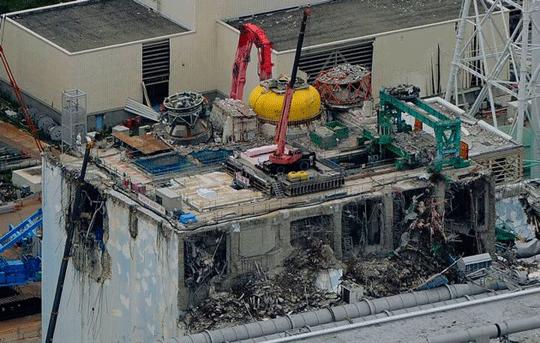
[…] Mr. Kurokawa, the chairman of the governmental accident investigation committee commented the SFP of reactor 4 is the crisis in front of us. The entire world is concerned about that.
Mr. Kitazawa, the chairman of the council stated it takes a while to remove all the spent fuel from the pool. There is no appropriate solution for that.
Systran Translation
[…] The same nuclear plant 4 the anxiety for the used nuclear fuel pool of the machine was shown from the group of members […]
[…] Kurokawa which is National Diet accident pitch chairman is clear Science Council of Japan former chairman “the crisis which is immediately. The inside of the world feels concern” […]
[…] Chairman Hiroshi Kitazawa who serves the chairman of intellectual person meeting, points out that time is required for the fuel removal. “There is no good solution method” […]
See also: TV: Gov’t seeking to empty Fukushima No. 4 fuel pool much sooner than planned — Worries it could become ‘unsafe’ (VIDEO
Fukushima area: radioactivity in 79 tested cattle
 Discovery.com: Radioactive Cattle Found Near Fukushima — “In the event of a nuclear Armageddon, don’t eat the steak” — Newborns, fetuses concentrating contamination http://enenews.com/discovery-radioactive-cattle-found-near-fukushima-in-the-event-of-a-nuclear-armageddon-dont-eat-the-steak-newborns-fetuses-concentrating-contamination
Title: Radioactive Cattle Found Near Fukushima
Source: Discovery News
Author: Tim Wall
Date: Jan 30, 2013
Radioactive Cattle Found Near Fukushima
[…] Now, nearly two years after the disaster, those abandoned cattle were found to be contaminated with radioactive elements. Traces of radioactive cesium, silver and tellurium were found in the 79 cattle analyzed by a scientific team led by Nagoya University engineer Toshio Fukuda and published in the journal PLOS ONE.
Fetuses and calves had radioactive materials concentrations up to 1.5 times higher than the adults. The calves had been born, and the fetuses conceived, after the disaster.
In the event of a nuclear Armageddon, don’t eat the steak. Radioactive elements collected most heavily in the cattle’s skeletal muscle. […]
See also: Gov’t to begin testing fetuses for gene mutations in “Fukushima Genomic Analysis”
Fukushima Genomic Analysis will test three generations for gene mutations
Gov’t to begin testing fetuses for gene mutations in “Fukushima Genomic Analysis” http://enenews.com/govt-to-begin-testing-fetuses-for-gene-mutations-in-fukushima-genomic-analysis
September 9th, 2012
http://www.minpo.jp/news/detail/201209073518 …
Source: http://www.minpo.jp/news/detail/201209073518
Grandparents will also be investigated if possible in order to investigate three generations of gene mutations
Over 5 months, radiation in Fukushima soil nearly doubled
TV: Radiation levels nearly doubled in Fukushima soil sample over 5-month period (VIDEO) http://enenews.com/watch-radiation-levels-doubled-fukushima-soil-sample-5-month-period-video
Title: ReUpload. Full Version Upload was Rejected !!! 音声入りが上がりません
Source: guardianofmiyagi
Date: Jan 24, 2013
Riverside soil samples from same location in Aizu, Fukushima (~100 kilometers west of Fukushima Daiichi)
December 2011: 8,790 becquerels per kilogram of cesium 134 & 137
April 2012: 17,000 becquerels per kilogram of cesium 134 & 137
Watch the video here
Radioactive water to be dumped into Pacific Ocean by TEPCO
 TEPCO plans to dump water stored at Fukushima Daiichi into
  Pacific http://enformable.com/2013/01/tepco-plans-to-dump-water-stored-at-fukushima-daiichi-into-pacific/ TEPCO has announced that it plans to dump contaminated water into the Pacific Ocean after processing it to reduce radioactive materials to legally permissible levels. By “processing”, TEPCO means once-high radioactive content has been reduced considerably, but not completely.
The plant has already released enormous amounts of highly contaminated water directly into the ocean from a plethora of leaks from the reactor buildings. Outside experts are seriously concerned about the contaminated water that is released, and have warned there may well be lasting impact on the environment.
The utility says the operation is necessary due to concerns that they will run out of capacity to store highly contaminated water which continues to accumulate. After the water has passed through the crippled units, it is processed through the SARRY system to remove cesium, but other systems designed to remove other radioactive materials have been overwhelmed by the complexity and concentration of contamination found at Fukushima Daiichi.
TEPCO estimates show that the volume of contaminated water required to be stored on site will likely triple over the next three years.
Questions have been raised if TEPCO would be able to gain the necessary approval from local municipalities and other parties who have raised concerns about plans to dump the water into the ocean.
In December 2011, the utility was forced to scrap a previous plan to dump water into the sea following fierce protests from fishing groups.
Radioactvity increasing in water at Fukushima Unit No. 2 nuclear reactor
Report: Radioactivity levels rising at Fukushima Unit No. 2 sub-drain since November http://enenews.com/report-radioactivity-levels-rising-at-fukushima-unit-no-2-sub-drain-since-november
January 22nd, 2013
Title: Contaminated water still a serious issue at Fukushima Daiichi
Source: Enformable
Date: Jan 22, 2013
[…] over 220,000 metric tons of contaminated water have been collected and stored on site, still another 75,000 tons remains in the reactor buildings. Every day at least another 40 tons of contaminated water are created […]
The utility has been so far unable to prevent the contaminated water injected into the damaged reactors from flowing out of the buildings into the environment and even escaping directly into the ocean. […]
The levels of radioactivity measured near the Unit 2 Sub-Drain have been on the rise since November […] it is critical to control the seeping of contamination through the local groundwater.
See Tepco’s report here
Fukushima radiation in seafood chain – record level in rockfish
 Record cesium levels measured in Fukushima rockfish, signaling radiation woes in food chain far from over in Japan, Part of: Nuclear meltdown in Japan Less than two months shy of the second anniversary of the devastating triple nuclear meltdown at Japan’s coastal Fukushima Daiichi plant, a fish containing more than 2,500 times Japan’s legal limit for radiation has been caught by the plant’s operator in waters near the wrecked facility. Bellona, Charles Digges, 21/01-201
The ‘murasoi’ fish, similar to a rockfish – indicating an amount of cesium measuring 254,000 Becquerel per kilogram, or 2,540 times Japans limit for radiation in seafood – was caught at a port inside the plant by its owner, Tokyo Electric Power Co. (TEPCO) Friday, according to AFP.
The utility also released a photo of the fish, caught near an unloading point north of the No. 1 through No. 4 reactors. No fishermen operate in the nuclear plant’s port.
Friday’s catch shatters the previous record for wildlife contamination as a result of radioactive contamination, which was was 25,800 Becquerel of cesium per kilogram found in two greenlings caught about 20 kilometers north of the plant in August 2012, the Asashi Shimbun newspaper reported.
Other countries are also increasingly distressed by the amount of irradiated marine life turning up near their coastlines along the Pacific Rim: Over the summer, Russia’s state English language television station RT reported concern over fish caught off its coast near Japan.
In May, a tuna contaminated by low levels of radiation was found near the California coast, Reuters reported……. http://www.bellona.org/articles/articles_2012/fukushima_rockfish
Japan’s govt confirms cases of badly done nuclear decontamination work
CROOKED CLEANUP: Government confirms 5 cases of shoddy decontamination
work January 18, 2013 THE ASAHI SHIMBUN
The Environment Ministry on Jan. 18 said that there have been five
cases of shoddy decontamination work around the crippled Fukushima No.
1 nuclear power plant and has punished the general contractors
involved in the cleanup effort.
In the five instances, three general contractors were ordered to take
corrective actions, the ministry said on Jan. 18 in its report on the
investigation into the central government-commissioned work, following
reports of the suspected such dumping of potentially radioactive
debris. Two other contractors were given guidance on following proper
procedures.
The ministry also announced that countermeasures would be taken for
preventing illegal dumping in the future….
http://ajw.asahi.com/article/0311disaster/fukushima/AJ201301180075
Fukushima fish – radiation levels 2500 times the legal limit
 Record high radiation level found in fish http://www.news.com.au/breaking-news/world/record-high-radiation-level-found-in-fish/story-e6frfkui-1226557111874#ixzz2IRxmSfvD January 19, 2013
Tokyo Electric Power Co (TEPCO) said caesium equivalent to 254,000 becquerels per kilogram – or 2540 times more than the government seafood limit – was detected in a “murasoi” fish.
The fish, similar to rockfish, was caught at a port inside the Fukushima plant, a TEPCO spokesman said.
The Fukushima Daiichi nuclear plant was battered by a towering tsunami following a huge earthquake on March 11, 2011, causing reactor meltdowns which spewed radioactive contamination into the atmosphere.
Fishing around Fukushima was halted and the government banned beef, milk, mushrooms and vegetables from being produced in surrounding areas.
Radioactive groundwater leaking into Fukushima reactors
Tepco Official in US: “We are still seeing leakage” — Contaminated groundwater seeping into reactor areas http://enenews.com/tepco-official-leakage-contaminated-groundwater-seeping-reactor-areas
Title: Fukushima recovery aided by SRS cleanup technology
Source: The Augusta Chronicle
Author: Rob Pavey
Date: Jan. 15, 2013

[…] Even after almost two years of nonstop cleanup work, managing the flow of water contaminated with radiation continues to be one of site’s most significant challenges, [Masumi Ishikawa, TEPCO’s general manager for radioactive fuel management] said.
“We are still seeing leakage,” he said. “That is an important challenge we must meet.”
Maintaining the essential flow of cooling water to the melted reactors, he said, has been complicated by the need to remove and treat contaminated groundwater that has seeped into the reactor areas since the March 2011 earthquake and tsunami.
[…] Ishikawa said the plant site will almost certainly play some sort of role in the future.
“Our new prime minister explicitly has said, Japan’s revitalization will not happen without the revitalization of Fukushima Dai-ichi,” he said.
See also: ‘Impermeable wall’ between leaking Fukushima reactors and ocean yet to be built — Tepco still working on silt fence (PHOTO)
Cesium near Fukushima now 10 times higher than previous highest measurement
 Over 1,000,000 Bq/kg of cesium near Fukushima plant — 10 times higher than highest measurement in prior soil survey
http://enenews.com/1000000-bqkg-cesium-fukushima-plant-10-times-higher-highest-reading-prior-soil-survey
January 12th, 2013
Environment Ministry’s radioactive monitoring in Fukushima with summary translation by Fukushima Diary:
http://www.env.go.jp/jishin/monitoring/result_pw130110-1.pdf
Soil sampled on Oct. 25, 2012 from beside an reservoir in Okuma
Cs-134 : 400,000 becquerels per kilogram (Bq/kg)
Cs-137 : 650,000 Bq/kg
Combined Cs-134, -137: 1,050,000 Bq/kg
Nikkei’s report on the monitoring says the highest t reading was 96,000 Bq/kg of Cs-134 and -137 during last summer’s research, detected in soil from a reservoir in Namie.
Full radiation decontamination of Fukushima region an impossible task
Asahi: We are reminded anew of the huge scale of contamination released from Fukushima plant — Impossible to recover pre-disaster environment — Radiation levels not dropping in certain areas http://enenews.com/asahi-reminded-anew-huge-scale-contamination-released-fukushima-plant-impossible-recover-pre-disaster-environment-radiation-levels-dropping-areas
(Subscription Only) Title: EDITORIAL: More data needed to make decontamination work effective
Source: Asahi
Date: January 09, 2013
Decontamination work is in progress in areas affected by the March 2011 accident at the Fukushima No. 1 nuclear power plant, but cases have been uncovered of workers dumping contaminated soil, vegetation and water into nearby rivers or other places without properly collecting them.
[…] One problem is that radiation levels are not dropping in certain areas. Another problem is that additional manpower is required, but hiring more workers isn’t financially viable.
Thinking about those problems, we are reminded anew of the huge scale of contamination caused by the Fukushima nuclear disaster.
It is impossible to recover the pre-disaster environment, and it is unrealistic to think that all affected areas can be decontaminated. […]
Poor conditions, poor morale of Fukushima radiation clean-up workforce
Fukushima ‘decontamination’ workers threatened — We were punished if we tried to resist http://enenews.com/fukushima-decontamination-workers-threatened-we-were-punished-if-we-tried-to-resist
January 9th, 2013
(Subscription Only) Title: CROOKED CLEANUP: Decontamination workers say cutting corners came naturally
Source: THE ASAHI SHIMBUN
Author: Compiled from reports by Tamiyuki Kihara and Toshio Tada
Date: January 09, 2013
[… Workers] cited a lack of training, unreasonable deadlines, threats of isolation, and persistent feelings that their efforts were pointless. […]
Asahi Shimbun reporters and the company have received more than 100 e-mails and phone calls from people involved in the decontamination project in Fukushima Prefecture. […]
50-year-old worker involved in decontaminating Tamura between Nov. 5 and Dec. 28 who was born in Fukushima Prefecture and graduated from Waseda University in Tokyo
“We were pressed to finish the work as quickly as possible”
“If we tried to resist, we would become isolated from other workers, although it did not reach the extent of losing the job”
“With sub-zero temperatures in the mountains, being placed in such circumstances would have led to feelings of loneliness among many people”
“Radiation levels returned even after we completed the work, so there was a sense that what we were doing was worthless”
“There will be no end to the shoddy work even if oversight is strengthened”
Inadequate radiation checkups for population near Fukushima area
As radiation fears dwindle, so do checkups Doctor wants more residents
to get followup full-body scans, Japan Times, By MIZUHO AOKI, 10 Jan
13, “……..As residents have come to understand more about radiation
and that their internal exposure levels are low, an air of calm has
been noticeable. At the same time, residents’ interest in knowing
their exposure levels has waned.
“I’m surprised to see such a dramatic loss of interest in just about a
year and a half,” said Tsubokura, 30, who works several days a week at
Minamisoma hospital and the rest of the week at the University of
Tokyo. “The biggest issue we have now is finding ways to secure
continuous checkups for internal radiation exposure.” Continue reading
Fukushima cleanup led by company that built the nuclear reactors
 NY Times: Japan’s cleanup denounced — “A disgrace… absolutely irresponsible” — Company that built all six Fukushima reactor buildings is leading ‘decontamination’ http://enenews.com/nytimes-japans-cleanup-denounced-disgrace-absolutely-irresponsible-company-built-all-six-fukushima-reactor-buildings-control-decontamination
January 8th, 2013
Title: Japan’s Cleanup After a Nuclear Accident Is Denounced
Source: NYTimes
Author: HIROKO TABUCHI; Makiko Inoue contributed reporting
Date: January 7, 2013
The decontamination crews at a deserted elementary school here are at the forefront of what Japan says is the most ambitious radiological cleanup the world has seen […]
Recent reports in the local media of cleanup crews dumping contaminated soil and leaves into rivers has focused attention on the sloppiness of the cleanup.
[…] the central and local governments have handed over much of the 1 trillion yen decontamination effort to Japan’s largest construction companies. […]
Kajima also built the reactor buildings for all six reactors at the Fukushima Daiichi plant, leading some critics to question why control of the cleanup effort has been left to companies with deep ties to the nuclear industry. […]
“What’s happening on the ground is a disgrace” -Masafumi Shiga, president of Shiga Toso, a refurbishing company based in Iwaki, Fukushima
“This isn’t decontamination — it’s […] absolutely irresponsible” -Tomoya Yamauchi, an expert in radiation measurement at Kobe University
See also: Gundersen: Truly appalling nuclear event in Japan — A lot of people are very, very concerned (AUDIO)
1 This Month

of the week – Shut Down Drone Warfare!


Tell the Ukrainian Government to Drop Prosecution of Peace Activist Yurii Sheliazhenko

Petition to revoke the licensing of the Near Surface Nuclear Disposal Facility (NSDF) at Chalk River. https://www.ourcommons.ca/petitions/en/Petition/Details?Petition=e-7247
To see nuclear-related stories in greater depth and intensity – go to https://nuclearinformation.wordpress.com
-
Archives
- April 2026 (68)
- March 2026 (251)
- February 2026 (268)
- January 2026 (308)
- December 2025 (358)
- November 2025 (359)
- October 2025 (376)
- September 2025 (257)
- August 2025 (319)
- July 2025 (230)
- June 2025 (348)
- May 2025 (261)
-
Categories
- 1
- 1 NUCLEAR ISSUES
- business and costs
- climate change
- culture and arts
- ENERGY
- environment
- health
- history
- indigenous issues
- Legal
- marketing of nuclear
- media
- opposition to nuclear
- PERSONAL STORIES
- politics
- politics international
- Religion and ethics
- safety
- secrets,lies and civil liberties
- spinbuster
- technology
- Uranium
- wastes
- weapons and war
- Women
- 2 WORLD
- ACTION
- AFRICA
- Atrocities
- AUSTRALIA
- Christina's notes
- Christina's themes
- culture and arts
- Events
- Fuk 2022
- Fuk 2023
- Fukushima 2017
- Fukushima 2018
- fukushima 2019
- Fukushima 2020
- Fukushima 2021
- general
- global warming
- Humour (God we need it)
- Nuclear
- RARE EARTHS
- Reference
- resources – print
- Resources -audiovicual
- Weekly Newsletter
- World
- World Nuclear
- YouTube
-
RSS
Entries RSS
Comments RSS
 nuclear-news