Fukushima’s radioactive water storage space nearly full, and leaking
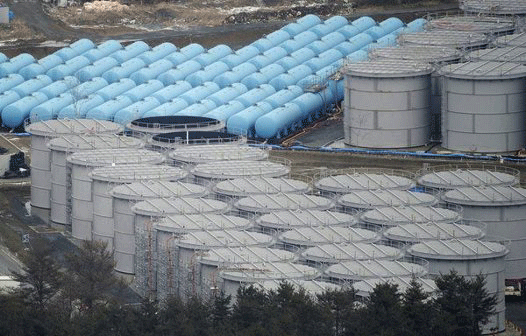 No thanks to Tepco’s ongoing failures, the Fukushima disaster is nowhere near over
The most pressing problem aside from stopping the leaks is that storage space for the irradiated water is running out—the Wall Street Journal reports(paywall) that 310,000 of the 350,000 tons of storage space at the site are now occupied, and at least one tank has been leaking. Neither Tepco nor the Japanese government have a long-term solution to the problem.
Two years after the tsunami, Fukushima is still leaking radiation and Tepco is still clueless http://qz.com/102992/two-years-after-the-tsunami-fukushima-is-still-leaking-radiation-and-tepco-is-still-clueless/ By Jake Maxwell Watts @jmwatts_ July 11, 2013 Radioactive water has been steadily leaking into the sea around the damaged Fukushima Daiichi nuclear power plant ever since it was hit by an earthquake and tsunami in March 2011, Japan’s nuclear watchdog announced on Wednesday. Plant operator Tokyo Electric Power Co, widely reviled for its inept response to the disaster, had long insisted that no leakage was taking place; in recent days it has backtracked to saying that it is “not sure” if there’s a leak.
The levels of cesium detected by the nuclear regulator are high enough to cause significantly increased rates of cancer, but are not an immediate threat to public health because they are in a remote location.
Tepco has been pumping water into three reactors for the past two years in an attempt to cool them, creating enough radioactive water to fill an Olympic-sized swimming pool every week. Now it seems that at least some of that contaminated water has also been flowing into the sea. Continue reading
Fukushima radiation seeps into the ocean
The threat of radioactive substances spreading into the Pacific Ocean has prompted concerns from Japan’s neighbors
 Toxic water at Fukushima likely contaminating sea – Japan’s nuclear watchdog RT.com July 10, 2013 Japan’s nuclear watchdog says that highly contaminated radioactive water is likely seeping into the ground from the crippled Fukushima Daiichi nuclear reactors and contaminating the Pacific Ocean.
Shunichi Tanaka, chairman of the Nuclear Regulation Authority (NRA), said the contamination is “strongly suspected” and has been occurring since March 2011, when a massive earthquake and tsunami triggered three meltdowns in the Fukushima plant.
“I think contamination of the sea is continuing to a greater or lesser extent,” Tanaka said. “It was contaminated at the time of the accident, but I think it has been continuing for the last two years. Coming up with countermeasures against all possible scenarios is a top priority.”
The plant operator, Tokyo Electric Power Co. (Tepco), claims that the source of contamination is the pit from which radioactive water is leaking into the sea. However, Tanaka believes that this may be not the only source of contamination. Continue reading
Radioactive cesium levels 90% higher in Fukushima groundwater
 Fukushima Groundwater Shows Record Radiation Levels HUFFINGTON POST, Reuters 07/09/2013 “……SITUATION WORSENS Tokyo Electric Power Co, the operator of the Fukushima station, hit by the March 2011 earthquake and tsunami, said that an observation well between the damaged reactor No. 2 and the sea showed levels of radioactive caesium-134 were 90 times higher on Monday than they had been the previous Friday.
Tokyo Electric, also known as Tepco, said it detected caesium-134 at 9,000 becquerels per litre, 150 times above Japan’s safety standard. A becquerel is a measure of the release of radioactive energy. The reading for caesium-137, with a half life of 30 years, was some 85 times higher than it had been three days earlier.
The latest findings, 25 metres from the sea, come a month after Tepco detected radioactive caesium in groundwater flowing into its wrecked plant far from the sea on elevated ground. The level of caesium found in June was much lower than the amount announced on Tuesday.
The spike, combined with recent discoveries of high levels of radioactive elements like tritium and strontium, suggest that contaminated water is spreading toward the sea side of the plant from the reactors sitting on higher ground…..
Fukushima groundwater has radioactive contamination
Toxic radiation detected in groundwater at Fukushima nuclear plant Raw Story France-Presse July 7, 2013 Toxic radioactive substances have once again been detected in groundwater at the crippled Fukushima nuclear plant, its Japanese operator said on Sunday, the latest in a series of incidents at the tsunami-battered complex.
Tokyo Electric Power Co (TEPCO) said tests showed that tritium, a radioactive isotope of hydrogen used in glow-in-the-dark watches, was present at levels 10 times the permitted rate. “From test samples on July 5… we detected a record high 600,000 becquerels per litre” of tritium, 10 times higher than the government guideline of 60,000 becquerels per litre, TEPCO said in a statement….
The new readings came after TEPCO said in late June that it had detected the highly toxic strontium-90, a by-product of nuclear fission that can cause bone cancer if ingested, at levels 30 times the permitted rate. At the time it had detected tritium at around eight times the allowed level, or 500,000 becquerels per litre.
The substances, which were released by the meltdowns of reactors at the plant in the aftermath of the huge tsunami of March 2011, were not absorbed by soil and have made their way into underground water.
Subsoil water usually flows out to sea, meaning these two substances could normally make their way into the ocean, possibly affecting marine life and ultimately impacting humans who eat sea creatures…. http://www.rawstory.com/rs/2013/07/07/toxic-radiation-detected-in-groundwater-at-fukushima-nuclear-plant/
Once again, a rat causes equipment failure at Fukushima nuclear reactor
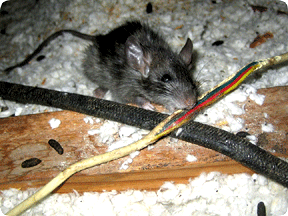 Rat causes equipment breakdown at Fukushima No. 2 nuclear plant http://enenews.com/rat-equipment-breakdown-fukushima-2-nuclear-plant
Title: TEPCO reports another rat problem, this time at Fukushima No. 2 plant
Source: THE ASAHI SHIMBUN
Date: July 04, 2013
A rat caused a battery charger to break down in an emergency gas turbine generator vehicle at the Fukushima No. 2 nuclear plant, the latest rodent-related problem to hit Tokyo Electric Power Co.
The rat is believed to have entered the vehicle through a 3- to 4-centimeter opening for cables and then shorted a switchboard, a TEPCO official said July 3. […]
The gas turbine generator vehicle was deployed for emergency use at the No. 2 plant after the Great East Japan Earthquake […]
See also: NYT: Rat Chase Again Bedevils Fukushima Nuclear Plant — Power lost to spent fuel pool for hours
Highest radiation levels for 12 months found at Fukushima
 Fukushima records highest radiation level in a year http://www.straight.com/blogra/398066/fukushima-records-highest-radiation-level-year by CHARLIE SMITH on JUL 4, 2013 You might think that radiation levels would be falling more than two years after Japan’s most serious nuclear disaster since the bombing of Nagasaki in the Second World War.
But on a rooftop in Fukushima, radioactive cesium levels were at the highest levels observed in the past year, according to the Asahi Shumbun newspaper. The publication reported that University of Tokyo associate professor Ryoji Enomoto found moss with 1.7 million becquerels just over 50 kilometres from a crippled nuclear-power plant.
This was confirmed by a nonprofit group, the newspaper noted. According to an article by David Chandler of the Massachusetts Institute of Technology, a dose of 500 millisieverts can cause symptoms of radiation poisoning. It’s not easy converting becquerels, which measures radiation emitted, to millisieverts, which measure biological damage.
But you would likely want to move if levels of 1.7 million becquerels were ever detected in your neighbourhood.
Scientists detect highest cesium levels in a year in Fukushima http://ajw.asahi.com/article/0311disaster/fukushima/AJ201307040081 July 04, 2013 FUKUSHIMA–Radioactive cesium levels found in moss on a rooftop in downtown Fukushima exceeded 1.7 million becquerels, the highest levels detected in a year, researchers said. Continue reading
Radioactive water being pumped into Fukushima nuclear building
Report: Contaminated water purposely being pumped into basement of Fukushima reactor’s turbine building http://enenews.com/report-contaminated-water-purposely-being-pumped-into-basement-of-fukushima-reactors-turbine-building
Title: Water in all leaky trenches at No. 1 routed to other storage, Tepco says
Source: Kyodo, JIJI
Date: July 3, 2013
Water in all leaky trenches at No. 1 routed to other storage, Tepco says
Tokyo Electric Power Co. has finished pumping out radioactive water from all seven of its huge covered trenches at the crippled Fukushima No. 1 nuclear plant […]
[…] It was found that the highly radioactive water that had been pumped into the trenches, which are triple-lined, was seeping into the ground. […]
The less-contaminated water was pumped into the basement of the reactor 6 turbine building and will eventually be transferred to above-ground containers, Tepco said late Monday. […]
See also: Japan Engineer: Fukushima contaminated water to go in giant pit — “It can easily be discharged underground” (VIDEO)
Tepco’s nuclear decommissioning plan rubbished by regulators
There is apparently no “Plan B” if the fuel debris cannot be removed. The Agency for Natural Resources and Energy said in the meeting that the reason why the concrete steps toward removing the fuel debris ahead of schedule was not mentioned in the roadmap was because they couldn’t figure out those steps yet.
NRA has been consulted, never mind that the commissioners and experts blasted their plan. For TEPCO and the government, particularly the government, a mere gesture of consulting with NRA is more than enough for procedural purposes.
Looking at TEPCO’s plan for fuel debris removal, as posted at NRA’s site, it is painfully clear that TEPCO was told by the Agency what to write (garbage).
Japan’s Nuclear Regulatory Authority Blasts #Fukushima I Nuke Plant Revised Plan for Decommissioning As “Pie In The Sky” http://ex-skf.blogspot.jp/2013/06/japans-nuclear-regulatory-authority.html The original Japanese is “drawing a picture of mochi (sticky rice cake)” – it may look nice but can’t be eaten.
Sadly, their severe criticism won’t make a bit of difference. Continue reading
Strange thyroid cysts in 30% of Fukushima children
 Former head doctor of National Cancer Center,”Thyroids of Fukushima children look like honeycomb from too much cysts” http://fukushima-diary.com/2013/06/former-head-doctor-of-national-cancer-centerthyroids-of-fukushima-children-look-like-honeycomb-from-too-much-cysts/ by Mochizuki on June 28th, 2013
Dr. Matsue is the chief of this clinic. He stated thyroids of Fukushima children have countless numbers of cysts to look like honeycomb. <Translate>
(In the thyroid test of Fukushima children) Shockingly about 30% of the children have thyroid cysts. It was also 35% from Fukushima prefectural government’s test. Prefectural government’s test probably misses small cysts of 1~2mm because their test is too quick, but the cysts rate was almost the same. However, <Translate>
Countless numbers of small cysts were found in the thyroids of about half of those 30% children, which is not reported in the prefectural government’s test. I thought it was like “honeycomb”, I have never seen such a thing.
Recently, a clinic in Kobe tested the thyroid of the children who evacuated from Fukushima..
<Translate>
The doctor in Kobe also reported about the “honeycomb looking thyroids”. What the world is that ? It’s no less than the half of the thyroids. The half-life of I-131 is 8 days, but it’s not strange if it causes any thyroid abnormality. Rationally thinking, it has something to do with radiation. <Translate>
“Accumulated I-131 might have changed the structure of the thyroid.” http://togetter.com/li/481810?page=1
Lethal MOX fuel to be removed from Fukushima reactor No.3 starting in 2020
Kyodo: Melted fuel from Fukushima Reactor 3 “is the highly lethal mixed uranium-plutonium oxide (MOX)” — Unit to be last to attempt fuel removal says new plan http://enenews.com/kyodo-melted-fuel-fukushima-reactor-3-highly-lethal-mixed-uranium-plutonium-oxide-mox-be-removed-last-new-plan
Title: Melted fuel removal at Fukushima plant seen optimistically starting in 2020
Source: Kyodo News
Date: June 28, 2013
Work to remove melted fuel from the three crippled reactors at Tokyo Electric Power Co.’s Fukushima No. 1 nuclear plant could start in 2020, the government and Tepco optimistically said Thursday, based on a revised, albeit vague, plan to decommission the stricken complex, a process expected to take decades. […]
The second phase of the decommissioning, based on the revised plan, will entail the removal of the melted fuel from crippled reactors 1 and 2 starting in fiscal 2020 if possible, followed by work to start removing the melted fuel inside reactor 3 in the latter half of fiscal 2021 at the earliest. Reactor 3′s fuel is the highly lethal mixed uranium-plutonium oxide (MOX) fuel. […]
The extractions may be delayed if proper equipment isn’t available to deal with the three stricken reactors, whose levels of damage and radiation differ. […]
Another scenario points to starting the fuel removal of reactor 1 in fiscal 2022, that of reactor 2 in fiscal 2024 and reactor 3′s fuel in fiscal 2023. […]
See also: Asahi: Locations and condition of melted Fukushima fuel unknown — Mainichi: 450 tons of scattered radioactive rods… unknown where holes in reactors are… plans may be delayed
Big rise in radioactive sea-water: groundwater near Fukushima seeping to ocean?
Radioactive material “soars” in ocean near Fukushima plant — Tepco: Contaminated groundwater leaking into Pacific? http://enenews.com/radioactive-material-soars-in-ocean-near-fukushima-plant-tepco-contaminated-groundwater-leaking-into-pacific
Title: Tritium samples in sea near No. 1 soar
Source: Japan Times
Author: Reiji Yoshida
Date: Jun 25, 2013
The density of radioactive tritium in samples of seawater from near the Fukushima No. 1 nuclear plant doubled over 10 days to hit a record 1,100 becquerels per liter, possibly indicating contaminated groundwater is seeping into the Pacific, Tokyo Electric Power Co. said.
The latest sample was taken June 21 from the sea near a water intake point east of the reactor 1 turbine building. […]
Tepco said late Monday it was still analyzing the water for strontium-90 […]
[…] during a news conference Monday in Tokyo, Masayuki Ono, a Tepco executive and spokesman, this time did not deny the possibility of leakage into the sea, while he said Tepco is still trying to determine the cause of the spike.
See also: TV: Groundwater shows massive spike in radioactive material at Fukushima plant — Strontium-90 up over 10,000% in past few months — Tepco apologizes (VIDEO)
Errors made by Japanese authorities in estimating Fukushima radiation exposure
Exposure data wrong for 16,000 in Fukushima KYODO HTTP://WWW.JAPANTIMES.CO.JP/NEWS/2013/06/26/NATIONAL/RADIATION-EXPOSURE-DATA-INACCURATE-FOR-16000-FUKUSHIMA-RESIDENTS/#.UC0KSDTWO6I JUN 26, 2013 FUKUSHIMA – Fukushima Prefecture and the National Institute of Radiological Sciences have said they erroneously estimated the radiation exposure of 16,118 people in a survey covering the first four months after the outbreak of the March 2011 disaster at the Fukushima No. 1 nuclear plant.
Among the roughly 420,000 people authorities have so far finished compiling data on, recalculations show 12,469 received higher doses and 3,649 lower doses than previously estimated.
The margins for revisions range from plus 0.4 millisievert to minus 0.2 millisievert. As a result of the revisions, it was learned that some people were exposed to more than 1 millisievert — the annual limit set by the government for ordinary citizens.
People polled were asked to answer in detail where they were between March 12 and July 11, 2011. Based on their whereabouts, the institute estimated their cumulative amount of external exposure by adding up daily radiation levels measured at their locations over the four months.
Used as reference were actual radiation readings at a number of monitoring posts in the prefecture as well as projections of the spread of radioactive substances by the SPEEDI computer simulation system.
But in some cases, the dates in the survey failed to match those in the reference data.
Experts cast doubt on recent UN press release about Fukushima radiation
 Expert: UN’s Fukushima study “absolutely ridiculous” — “Absolutely unacceptable” to claim no observable increase in cancer rates is expected — “Dose estimates don’t reflect the real dose of radiation” http://enenews.com/expert-uns-fukushima-study-absolutely-ridiculous-absolutely-unacceptable-to-claim-no-observable-increase-in-cancer-rates-is-expected-dose-estimates-dont-reflect-the-real-dose-of-r
Title: Japan’s Fukushima debate: How will the meltdown affect the health of residents?
Source: Christian Science Monitor
Author: Justin McCurry, Correspondent
Date: June 21, 2013
[…] In a recent draft report, the UN Scientific Committee on the Effects on Atomic Radiation (UNSCEAR) said it expected to see no noticeable rise in cancer rates, adding that the swift evacuation of people living in a 20-kilometer (12-mile) radius of the plant had sharply reduced radiation exposure.
[…] some scientists accuse the UN of using faulty methodology.
Alexey Yablokov, author of “Chernobyl: Consequences of the Catastrophe for People and the Environment,” says UNSCEAR’s claim that there would be no observable increase in cancer rates was “absolutely unacceptable.”
The UN bodies’ calculations, he says, had been made using flawed estimates of average radiation doses among Fukushima residents. “The average dose estimates don’t reflect the real dose of radiation [received by Fukushima residents],” he said during a recent visit to Tokyo.
“How did they estimate the average? It’s impossible, because on the first day of the accident the level of radiation was thousands of times higher,” says Dr. Yablokov. “How do you calculate how many minutes people spent inside and outside their houses at that time, or how much air they breathed? It’s absolutely ridiculous.” […]
See also: Fairewinds: Thyroid data means much more radiation must have come out of Fukushima reactors than anyone reported — Medical professionals are talking about how many cancers have started showing up (AUDIO)
Groundwater near Fukushima found to have radioactive strontium 90
(includes video )Radioactive Strontium-90 found in groundwater near Fukushima nuclear reactor Japan’s damaged Fukushima Daiichi Nuclear Plant reports a toxic substance in groundwater as the country’s new guidelines for nuclear reactivation are approved. NBCNews.com’s Dara Brown reports. By Arata Yamamoto, Producer, NBC News TOKYO, Japan – High levels of toxic Strontium-90 have been found in groundwater at the tsunami-stricken Fukushima nuclear power plant, its operator said Wednesday.
Tokyo Electric Power (Tepco), which has been struggling to clean up the plant, said nearly 30 times the permitted level of the radioactive isotope was discovered in a well dug last month outside the turbine hall of Reactor No.2.
The company said it had not detected any rise in the levels of Strontium-90 in sea water, and that it believed the substance was trapped during the initial 2011 nuclear fallout.
It plans to inject chemicals into the ground between the well and shore to prevent any leaks into the ocean…..
Radiation levels high – 45 miles from Fukushima nuclear reactors
Experts: Shock during first trip to Fukushima — Radiation levels so high far away from reactors that full protection suit would be used in U.S., yet people were walking around — “Contamination far more widespread than most understand” http://enenews.com/experts-shock-during-first-trip-to-fukushima-radiation-levels-so-high-far-away-from-reactors-that-full-protection-suit-would-be-used-in-u-s-yet-people-were-walking-around-contamination-far
Title: Cleanup From Fukushima Daiichi: Technological Disaster Or Crisis In Governance?
Source: Fairewinds Energy Education
Author: Art Keller
Date: June 13, 2013
[…] Shortly after arrival on their first trip to Japan, the group headed for Shirikawa, a city 45 miles west and a few miles south of the Daiichi nuclear plant. [Sam Engelhard, an industrial hygenist and certified radiation protection technologist,] was shocked as soon as he unpacked his radiation sensor gear and turned it on. Here they were almost 50 miles from the accident site and in the opposite direction of the prevailing winds, and the crew’s radiation alarms immediately started going off.
“The radiation levels we were seeing were 1,000 times background, higher in spots,” Engelhard said. “If we had been working on a site this contaminated in the US, we would have been fully suited up in radiation protection suits, gloves, and respirators. Yet people were walking around and going about their business, with no idea of how contaminated everything around them was.” […]
[Kevin Wang of Califonia-based company PowerPlus] believes the Fukushima radiological contamination far more widespread that most Japanese understand. “One thing I heard so often during my trips to Japan that it became a mantra, was that ‘Fukushima is a Japanese problem and we have to fix it ourselves.’ So far, I haven’t seen any evidence that the government is taking the right steps to fix things. Instead, the wounded pride of government officials, and a lack of understanding at the urgency of the problem, prevented Japan from taking the steps they needed to.” […]
1 This Month

of the week – Shut Down Drone Warfare!


Tell the Ukrainian Government to Drop Prosecution of Peace Activist Yurii Sheliazhenko

Petition to revoke the licensing of the Near Surface Nuclear Disposal Facility (NSDF) at Chalk River. https://www.ourcommons.ca/petitions/en/Petition/Details?Petition=e-7247
To see nuclear-related stories in greater depth and intensity – go to https://nuclearinformation.wordpress.com
-
Archives
- March 2026 (244)
- February 2026 (268)
- January 2026 (308)
- December 2025 (358)
- November 2025 (359)
- October 2025 (376)
- September 2025 (257)
- August 2025 (319)
- July 2025 (230)
- June 2025 (348)
- May 2025 (261)
- April 2025 (305)
-
Categories
- 1
- 1 NUCLEAR ISSUES
- business and costs
- climate change
- culture and arts
- ENERGY
- environment
- health
- history
- indigenous issues
- Legal
- marketing of nuclear
- media
- opposition to nuclear
- PERSONAL STORIES
- politics
- politics international
- Religion and ethics
- safety
- secrets,lies and civil liberties
- spinbuster
- technology
- Uranium
- wastes
- weapons and war
- Women
- 2 WORLD
- ACTION
- AFRICA
- Atrocities
- AUSTRALIA
- Christina's notes
- Christina's themes
- culture and arts
- Events
- Fuk 2022
- Fuk 2023
- Fukushima 2017
- Fukushima 2018
- fukushima 2019
- Fukushima 2020
- Fukushima 2021
- general
- global warming
- Humour (God we need it)
- Nuclear
- RARE EARTHS
- Reference
- resources – print
- Resources -audiovicual
- Weekly Newsletter
- World
- World Nuclear
- YouTube
-
RSS
Entries RSS
Comments RSS
 nuclear-news