Bloomberg: Tepco considered shooting firearms at No. 3 reactor building
Bloomberg: Tepco considered shooting firearms at No. 3 reactor building
August 7th, 2012 By ENENews Title: Tepco Weighed Using Firearms to Avoid Fukushima Explosion
Source: Bloomberg
Author: By Tsuyoshi Inajima and Yuji Okada
Date: Aug 7, 2012
As the first hydrogen explosion rocked the Fukushima Dai-Ichi nuclear plant, Tokyo Electric Power Co. (9501) officials scrambled to prevent a second blast, at one point weighing the use of firearms to shoot a hole in the reactor building to release the pressure.
[…]
Officials were discussing methods to release hydrogen gas building up inside the facility housing the No. 3 reactor after the first explosion rocked the No. 1 unit on March 12, 2011. Videos show officials considering the use of firearms and a helicopter to drop an object into the reactor housing to make a hole, with those who proposed the actions at one point suggesting they may sound “wild” or “absurd.”
[…]
Some in the U.S. government were coming up with similar plans:
« WSJ: Tepco managing director says “evacuate the workers from the site” after Reactor No. 3 exploded — “Bulk of footage is available for viewing only by select journalist” Radioactive cesium reported in Kellogg’s cereal from Japan — Almost 20 becquerels per kilogram »
Tepco Tapes: Fukushima chief calls out ‘mayday, mayday’ when Reactor No. 3 exploded http://enenews.com/tepco-tapes-fukushima-chief-calls-out-mayday-mayday-when-reactor-no-3-exploded-hq-started-to-respond-as-if-he-said-he-was-going-out-to-lunch-video — HQ started to respond as if he said he was going out to lunch (VIDEO)
Published: August 6th, 2012 at 10:53 am ET
By ENENews Video of when Reactor 3 exploded posted on Nikkei.com with summary translation by EXSKF:
It was more like Plant Manager Yoshida was calling “mayday, mayday” when Reactor 3 blew up. The people at TEPCO HQ didn’t seem to comprehend what Yoshida was saying for several seconds, and started to respond as if Yoshida had just said he was going out to lunch.
They started to say “hai”, “hai” – OK, yes -, then “Uh… so it’s the same as Reactor 1? OK it’s an emergency. I will issue emergency communication then…”
[…]
Wikipedia: Mayday is an emergency procedure word used internationally as a distress signal in voice procedure radio communications. […] It is used to signal a life-threatening emergency primarily by mariners and aviators, but in some countries local organisations such as police forces, firefighters, and transportation organizations also use the term.
Nikkei has 9 videos (Japanese only) posted here
Fukushima – deception in the workplace
 Asahi: Disturbing picture emerging as nuclear employees come out of the woodwork — Fukushima workers report groups clocking in with no dosimeters http://enenews.com/asahi-disturbing-picture-emerging-nuclear-employees-woodwork-fukushima-workers-report-groups-clocking-dosimeters August 6th, 2012
By ENENews (Subscription Only) Title: Nuclear power plants: A hidden world of untruths, unethical behavior
Source: Asahi AJW
Author: Compiled from reports by Miki Aoki, Toshio Tada and Tamiyuki Kihara
The long and the short of it is this: Nuclear power plants probably would not operate properly in Japan if workers were not willing to sacrifice their health, and possibly their lives.
It emerges that workers at nuclear plants routinely resorted to ingenious ways to conceal the true levels of radiation to which they were exposed–simply to go on earning a living. Continue reading
When radioactive cesium enters body, 75% lodges in muscle tissue
including heart http://enenews.com/when-radioactive-cesium-enters-body-75-lodges-in-muscle-tissue-including-heart May 6th, 2012 By ENENews
The Worst Yet to Come? Why Nuclear Experts Are Calling Fukushima a
Ticking Time-Bomb
Alternet
Brad Jacobson
May 4, 2012
[…] Nuclear experts noted that other lethal radioactive isotopes
would also be released in such a fire, but that the focus is on
cesium-137 because it easily volatilizes and spreads pervasively, as
it did during the Chernobyl accident and again after the disaster at
Fukushima Daiichi last year.
With a half-life of 30 years, it gives off penetrating radiation as it
decays and can remain dangerous for hundreds of years. Once in the
environment, it mimics potassium as it accumulates in the food chain;
when it enters the human body, about 75 percent lodges in muscle
tissue, including the heart. […]
July 2012: Fukushima Man has 20,000 becquerels of cesium in body — Wife has 10,000 Bq http://enenews.com/july-2012-fukushima-man-20000-becquerels-cesium-body-wife-10000-bq August 5th, 2012
By ENENews August 4, 2012 report in the Asahi Shinbun with summary translation by Fukushima Diary:
A hematological physician in Minamisoma general hospital (23km from Fukushima plant) wrote on his blog that he measured 20,000 Bq/body from a man in 70s living in Fukushima by WBC (Whole body counter) though it was already July 2012. This is the total of Cs-134 and Cs-137.
He measured 10,000 Bq/body from the wife as well. It’s about 300 Bq/Kg.
Discrimination, mental health issues, among Fukushima’s brave clean-up workers
 Doctors: Japan Nuclear Plant Workers Face Stigma By MALCOLM FOSTER Associated Press abc News, TOKYO August 5, 2012 (AP) A growing number of Japanese workers who are risking their health to shut down the crippled Fukushima Dai-ichi nuclear power plant are suffering from depression, anxiety about the future and a loss of motivation, say two doctors who visit them regularly.
But their psychological problems are driven less by fears about developing cancer from radiation exposure and more by something immediate and personal: Discrimination from the very community they tried to protect, says Jun Shigemura, who heads a volunteer team of about ten psychiatrists and psychologists from the National Defense Medical College who meet with Tokyo Electric Power Co. nuclear plant employees. Continue reading
Much uncertainty in predicting cancer deaths from Fukushima radiation
Trying to Tally Fukushima, NYT, By MATTHEW L. WALD, 19 July 12 “….In the slippery question of “How bad was Fukushima,” two Stanford University researchers have published a paper that casts the accident in a new light. It still seems hazy, though …… The study’s significance is not clear. The International Commission on Radiological Protection, the body from which the United States draws most of its radiation limits, warned of the limitations of such predictions in a 2007 position paper.
It said that calculating the collective radiation dose of the whole population and then trying to derive numbers on risks from it presented problems. “Collective effective dose is not intended as a tool for epidemiological risk assessment,” the group said, “and it is inappropriate to use it in risk projections.”
“The aggregation of very low individual doses over an extended time period is inappropriate, and in particular, the calculation or the number of cancer deaths based on collective effective doses from trivial individual doses should be avoided,” that paper added…
Fukushima reactor No 1 refuelling floor too radioactively hot for humans to enter
 Former Fukushima Daiichi Worker: My best guess is explosion had to blow lid off pressure vessel at Reactor 1 http://enenews.com/former-fukushima-daiichi-worker-my-best-guess-is-explosion-had-to-blow-lid-off-pressure-vessel-at-reactor-1 August 2nd, 2012 By ENENews Chris Canine has 15 years experience as a Health Physics Technician, Chemist and Radiation Safety Instructor. He has worked at over 20 plants throughout the United States, Japan and Mexico — including Fukushima #1 and #2 in the late 1970′s.
August 1, 2012 comment on ‘Tepco planning to float a balloon inside Reactor 1 in early August — Inspecting top floor with spent fuel pool‘
Tepco is basically saying that the refueling floor is still too radioactively hot for any human to enter. There was no fire in that spent fuel pool, and we never heard that it was like unit #3 and blew the lid off the pressure vessel. So why are radiation levels so high? During normal operations there is little radiation on the refueling floor because there is really nothing there. The fuel in the pool is under water with no dose on the surface, and the reactor is buried under cement and steel. My best guess is that the hydrogen explosion had to blow the lid off this reactor also. With radioactive gasses and particulates coming out of the reactor the cover was put on the building to limit the releases out onto the site. But as the cover kept in a lot of this radioactive material the refueling floor is so contaminated that it is no longer a place where humans can work or even walk through.
Find the answer why they put a cover on only this building and that will tell you the condition of this unit.
?TV program “NEWSROOM” reveals truth about Fukushima event?
New Episode of HBO’s ‘Newsroom’ Centered on Fukushima Cover-up: “It’s a lot worse than they’re telling you” — Level 5 vs Level 7 is “the difference between life and gruesome death” August 3rd, 2012 By ENENews Title: The Newsroom
Source: Salon.com
Author: Willa Paskin
Date: July 31, 2012
Sunday’s episode was set during the meltdown of the Fukushima nuclear reactor. Sloan — who, like Munn, speaks fluent Japanese — learned from a spokesperson of the nuclear plant, off the record, that the problems with the reactor would likely be upgraded from a Three Mile Island-size disaster to a Chernobyl-size one. Filling in for an anchor on one of the prime-time news shows, Sloan, all fired up by a pep talk from Will McAvoy, manhandled and bullied her two guests, the spokesperson and his translator, repeatedly correcting the translator’s translations, eventually breaking into Japanese herself, and finally revealing the information she had gotten off the record without any on-air confirmation that this was actually true. Continue reading
Plan to “fix” Fukushima site may cause more problems
US nuclear experts were concerned over Japan’s plan to ‘goop’ Fukushima Daiichi with ‘Fix It’ — “Can form a glue-like material (peanut butter!) and may cause more problems” http://enenews.com/us-nuclear-experts-were-concerned-over-japans-plan-to-goop-fukushima-daiichi-with-fix-it-can-form-a-glue-like-material-peanut-butter-and-may-cause-more-problems August 2nd, 2012 By ENENews Title: April 5th, 2011 – Japan Plans to “Goop” the Site With a Material Called “Fix It” – As a Way to Fix Ground and Building Loose Contamination Source: Enformable Date: August 2, 2012 Japan Team and Consortium 3:00 am Phone Call (RST log 2040) INPO Bob Ryan EPRI Steve Modine Japan Team
Japan plans to “Goop” the site with a material called “Fix It” it is purported to be used as a way to fix ground and building loose contamination. TEPCO Japan is planning to perform this action in the future. RST has some preliminary product information and has passed this to the
Consortium.
RST and Consortium 11:00 am Phone Call
INPO:
Organic compounds like the one suggested by the Japanese when exposed to radiation. can form a glue-like material (peanut butter!) and may cause more problems
water is the best solution for now
???: Any other compound available?
TEPCO is planning a test before using their compound – INPO’s concern is that it will take time for radiations effects (-few days?)
INPO: Concern with this method are (1) impact on heat transfer in the spent fuel pool, and (2) effect on the remote devices
IAEA’s conflict of interest in advising about radiation and health
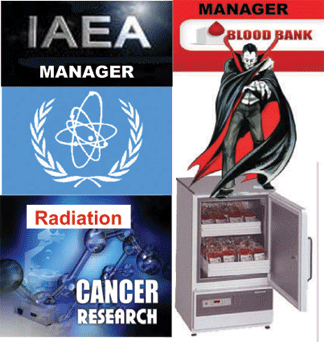 In fact, researchers have been surprised to find that genetic damage, and above all perigenetic damage, which is responsible for genomic instability, to descendants is far worse than to parents; and this risk increases from one generation to the next.
After a year, [for Fukushima’s children] the damage caused by the mixture of internal and external radiation to children should be measured, by comparison with data from before 2011 in the same areas, or by comparing data with communities further away, that were spared the radioactive fallout. Birthweight, incidence of stillbirth, perinatal mortality up to 28 days, birth deformities (heart problems should be investigated later), and among the genetic diseases, Down’s syndrome, should all be studied.
In order to achieve its objectives, the IAEA cannot admit that these serious and common illnesses were caused by ionising radiation, because once known, it would prevent the development of the nuclear industry throughout the world.
The IAEA is therefore a poor source of advice for national health authorities
 Fukushima, Precious Time Has Been Lost http://readersupportednews.org/opinion2/303-211/12736-fukushima-precious-time-has-been-lost RSN, By Dr. Michel Fernex, The Fukushima Collective Evacuation Trial 02 August 12
It is a privilege to be able to lend personal support to the Fukushima Evacuate Children Lawsuit. There is no better measure of the moral health of a society than how it treats the most vulnerable people within it, and none or more vulnerable, or more precious, than
children who are the victims of unconscionable actions. For Japan, and for all of us, this is a test that we must not fail. (Noam Chomsky 12 Jan. 2012)
What should WHO have done after Chernobyl?” asked Dr Nabarro in 2002 when he was Acting Director-General of the World Health Organization. I replied immediately, and then confirmed it in writing: “Convene a Scientific Working Group on Ionising Radiation and Genetics” like the one in 1956, and add the words “and Genomic Instability”. Continue reading
Fukushima children – physical and mental health issues
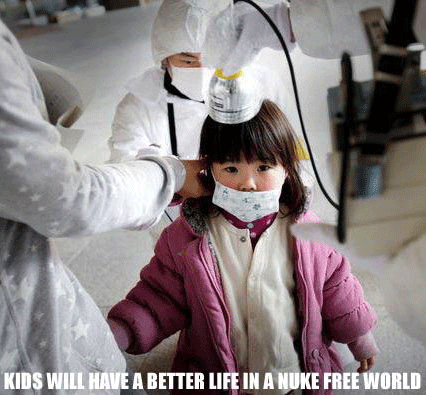 Kids’ safety key worry in Fukushima,Japan Times, Attendees of latest public hearing on energy fear low-level radiation, By NATSUKO FUKUE, 3 Aug 12, FUKUSHIMA — A year and half after the start of the nuclear crisis, many who attended the government’s latest public hearing on energy policy in Fukushima on Wednesday still expressed concern about the impact of radiation on their children……what concerns many parents in Fukushima is their children’s exposure to low levels of radiation…..
A 50-year-old woman living in Koriyama, Fukushima Prefecture, told The Japan Times after the public hearing that she fears young people will be harmed by the radiation, and that discrimination against Fukushima residents will continue.
“I’ve tried to prepare myself mentally for the discrimination my son may face when he looks for a job or when he gets married, just because he was in Fukushima last March,” said the woman, who withheld her name. Continue reading
TEPCO will float balloon inside Fukushima reactor No.1
Tepco planning to float balloon inside Reactor 1 in early August — Inspecting top floor with spent fuel pool http://enenews.com/tepco-planning-float-balloon-inside-reactor-1-early-august-inspecting-top-floor-spent-fuel-pool August 1st, 2012 By ENENews
(Subscription Only) Title: TEPCO floats balloon plan to inspect reactor’s top floor
Source: AJW by The Asahi Shimbun
Date: July 31, 2012
[Tepco] plans to inspect the top floor of the No. 1 reactor building using a balloon equipped with cameras, possibly in early August.
The plan.. is part of preparations for extracting nuclear fuel from a spent fuel storage pool on the top floor of the No. 1 reactor building….
Inspection from above is difficult, because the No. 1 reactor building has been encased in a protective shield since October.
TEPCO plans to inspect the top floor of the building by floating a balloon equipped with four cameras through an opening in the ceiling that extends from the ground floor to the fifth floor….
Fukushima workers made to cover radiation dosimeters with lead plates

 Criminal? Fukushima Daiichi workers told to rip open radiation protection suits and insert lead plates — “Make sure nobody sees what you are doing” — Threatened with being fired ENE News July 21st, 2012 Follow up to: Fukushima Daiichi workers ordered to cover dosimeters with lead plates (PHOTO)
(Subscription Only) Title: TEPCO subcontractor used lead to fake dosimeter readings at Fukushima plant Source: AJW by The Asahi Shimbun Authors: Jun Sato, Chiaki Fujimori, Miki Aoki, Tamiyuki Kihara and Takayuki Kihara Date: July 21, 2012
Workers at the crippled Fukushima No. 1 nuclear plant were ordered to cover their dosimeters with lead plates to keep radiation doses low enough to continue working under dangerous conditions, the Asahi Shimbun has learned….. Continue reading
Further cheating by TEPCO on Fukushima radiation monitoring
 Tokyo Paper: Thick iron shielding placed below radiation monitoring post — Dose was double 5 meters away http://enenews.com/tokyo-paper-thick-iron-shielding-below-radiation-monitoring-post-journalist-dose-doubled-5-meters-away August 1st, 2012 By ENENews
Follow-up to: Japan TV: Monitoring posts show far lower radiation dose — Levels shoot up just steps away
Tokyo Shinbun article from March 2012 with summary translation on July 31, 2012 by Safecast member ‘the_STIG’ who lives in Japan:
Journalist Shoji Ozawa reported that surface soil had been replaced and that a thick iron shielding had been placed below a monitoring post in Iitate that measured 1.2uSv. He measured 2.4uSv when he walked 5m away from the post. The Ministry of Education currently publishes less than 1uSv for Iitate. Professor Imanaka of Kyoto University said that the current monitoring posts are not usable at all.
1 This Month

of the week – Shut Down Drone Warfare!


Tell the Ukrainian Government to Drop Prosecution of Peace Activist Yurii Sheliazhenko

Petition to revoke the licensing of the Near Surface Nuclear Disposal Facility (NSDF) at Chalk River. https://www.ourcommons.ca/petitions/en/Petition/Details?Petition=e-7247
To see nuclear-related stories in greater depth and intensity – go to https://nuclearinformation.wordpress.com
-
Archives
- April 2026 (68)
- March 2026 (251)
- February 2026 (268)
- January 2026 (308)
- December 2025 (358)
- November 2025 (359)
- October 2025 (376)
- September 2025 (257)
- August 2025 (319)
- July 2025 (230)
- June 2025 (348)
- May 2025 (261)
-
Categories
- 1
- 1 NUCLEAR ISSUES
- business and costs
- climate change
- culture and arts
- ENERGY
- environment
- health
- history
- indigenous issues
- Legal
- marketing of nuclear
- media
- opposition to nuclear
- PERSONAL STORIES
- politics
- politics international
- Religion and ethics
- safety
- secrets,lies and civil liberties
- spinbuster
- technology
- Uranium
- wastes
- weapons and war
- Women
- 2 WORLD
- ACTION
- AFRICA
- Atrocities
- AUSTRALIA
- Christina's notes
- Christina's themes
- culture and arts
- Events
- Fuk 2022
- Fuk 2023
- Fukushima 2017
- Fukushima 2018
- fukushima 2019
- Fukushima 2020
- Fukushima 2021
- general
- global warming
- Humour (God we need it)
- Nuclear
- RARE EARTHS
- Reference
- resources – print
- Resources -audiovicual
- Weekly Newsletter
- World
- World Nuclear
- YouTube
-
RSS
Entries RSS
Comments RSS
 nuclear-news