The impediments to India’s nuclear power dream
India’s Ambitious Nuclear Power Plan – And What’s Getting in Its Way, The country has an ambitious three-stage nuclear power production plan. The Diplomat, By Niharika Tagotra, September 09, 2020 As India embarked on its commercial nuclear power production in 1969, its nuclear power program was conceived to be a closed fuel cycle, to be achieved in three sequential stages. These stages feed into each other in such a way that the spent fuel generated from one stage of the cycle is reprocessed and used in the next stage of the cycle to produce power. This kind of a closed fuel cycle was designed to breed fuel and to minimize generation of nuclear waste. The stage at which India is currently at in its nuclear power production cycle will be a major determinant of the future of nuclear power in India.
Additionally, the nuclear power sector in India has witnessed its share of controversies and protests over issues of land ownership, location, as well as the safety and security of power plants in the event of natural or man-made disasters. These have also contributed to the time and cost overruns of India’s nuclear power projects. Another very important contributing factor to the state of nuclear energy in India has been the global retrenchment in the sector following the Fukushima Daiichi nuclear disaster of 2011. That event led to a situation where countries rolled back significantly on their nuclear power programs and global nuclear majors like Areva and Westinghouse declared bankruptcy………… https://thediplomat.com/2020/09/indias-ambitious-nuclear-power-plan-and-whats-getting-in-its-way/
India and China both have a nuclear no-first-use policy- nuclear war between them is less likely
India–China border dispute: the curious incident of a nuclear dog that didn’t bark, Bulletin of the Atomic Scientists, By Ramesh Thakur, Manpreet Sethi, September 7, 2020 On June 15, nuclear-armed China and India fought with fists, rocks, and clubs along the world’s longest un-demarcated and contested boundary. Twenty Indian soldiers were killed; Indian estimates put the Chinese dead at around 40. The two countries remain in a state of military standoff.
Like the case of the dog that didn’t bark, which interested the great fictional detective Sherlock Holmes, the nuclear dimension of the recent border clashes was conspicuous by its invisibility. This may be in part because of the nuclear no-first-use policy expressed in the official nuclear doctrines of both countries. At a time when geopolitical tensions are high in several potential nuclear theaters, the nuclear arms control architecture is crumbling, and a new nuclear arms race is revving, there is a critical need to look for ideas that can prevent potential crises from escalating. Other nuclear powers can learn from China’s and India’s nuclear policies.
The normalization of nuclear threats. Over the last few years, leaders of many of the nuclear weapons states have taken to nuclear bluster. After the outbreak of the Ukraine crisis and annexation of Crimea in 2014, facing hostile Western criticism, Russian President Vladimir Putin pointedly remarked, “Russia is one of the most powerful nuclear nations”—a subtle but clear nuclear warning to the West. In July 2016, asked in Parliament if she would be prepared to authorize a nuclear strike that could kill 100,000 people, British Prime Minister Theresa May unwaveringly answered, “Yes.” And who can forget the tit-for-tat exchange of belligerent rhetoric by US President Donald Trump and North Korean leader Kim Jong-un in 2017 before the blossoming of their bromance in 2018?
In February 2019, after an attack on Indian paramilitary forces at Pulwama led to a clash between the air forces of India and Pakistan, Pakistan’s Prime Minister Imran Khan warned of the possibility of a nuclear war. Indian Prime Minister Narendra Modi, caught in the heat of an election campaign, responded that India’s nukes were not reserved for celebrating the fireworks festival of Diwali. After India revoked Kashmir’s autonomous status that August, Khan reiterated that nuclear war was a real risk. His foreign minister repeated the warning in Geneva later that same year.
This rhetoric, besides being dangerous, has given rise to another problem. The more the leaders of the nuclear armed states revalidate the role of nuclear weapons in their national security, the more they embolden calls of nuclear weapons acquisition in other countries like Germany, Japan, South Korea and Australia.
China and India’s nuclear reticence. This is where China and India, in the midst of a military crisis, provide a striking contrast. Neither side has drawn attention to its nuclear weapons in the 2020 border clashes. Nor have many analysts across the globe expressed alarm that the prolonged state of disquiet between the two could spiral out of control into a nuclear exchange……….
China, India, and no first use. An important dimension, however, that has been underestimated in explaining the two countries’ apparent nuclear sobriety is the similarity in their approach to nuclear weapons and deterrence.
They are the only two of the nine nuclear armed states with the stated commitment to a no-first-use policy, and the force postures to match. …….
In 2014, China and India called for negotiations on a no-first-use convention among the world’s nuclear powers. It might be time for the United States and other countries to give it a serious look. Indeed, the China–India border standoff demonstrates the practical utility of a nuclear policy centered on no-first-use and merits wider international attention. https://thebulletin.org/2020/09/india-china-border-dispute-the-curious-incident-of-a-nuclear-dog-that-didnt-bark/
The dangerous and deadly toll of uranium mining, on Indian communities

Child with cerebral palsy, in uraniummining region Dungridih village. Jaduguda, photo by Subhrajit Sen.
[Photos] Suffering in the town powering India’s nuclear dreams. Mongabay, BY SUBHRAJIT SEN ON 4 SEPTEMBER 2020
- Uranium is a vital mineral for India’s ambitious nuclear power programme. Out of the seven states with uranium reserves, Jharkhand and Andhra Pradesh have currently operating mines.
- In Jharkhand’s Jaduguda region, which has India’s oldest uranium mines, local communities narrate stories of suffering due to degrading health and the environment. The government, however, denies any ill-impact of uranium mining on people.
- The Indian government is aiming to increase uranium exploration and mining.
- This photo essay features images taken between 2016-2019 of residents of villages around uranium mines in Jharkhand. Some of these photos contain sensitive content.
Anamika Oraom, 16, of village Dungridih, around a kilometre away from Narwa Pahar uranium mine in Jharkhand, wants to study. But she cannot, owing to severe headaches that come up periodically, triggered by a malignant tumour on her face. Sanjay Gope, 18, cannot walk and is confined to his wheelchair. Haradhan Gope, 20, can study, walk, talk, but owing to a physical deformity, his head is much smaller in proportion to his body.
There are many more, young and old, in the village Bango, adjacent to Jaduguda uranium mine in Jharkhand, whose lives and death highlight the ill-effects of uranium mining, say the villagers.
Uranium is a naturally occurring radioactive mineral and is vital to India’s nuclear power programme. At present (till August 31, 2020), India’s installed nuclear power capacity is 6780 megawatts (MW). The country aims to produce 40,000 MW of nuclear power by 2030.
The Uranium Corporation of India Limited (UCIL) is involved in the mining and processing uranium ore in the country. According to the UCIL, mining operations at Jaduguda began in 1967, and it is India’s first uranium mine.
In the 25-kilometre radius of Jaduguda, there are other uranium deposits at Bhatin, Narwa Pahar, Turamdih, Banduhurang, Mohuldih, and Bagjata. While UCIL claims that Jaduguda mine has created a large skill base for uranium mining and the mining industry, local communities point out that their lives and land have changed irreversibly.
The villagers complain that the hills surrounding Jaduguda, dug up to create ‘tailing ponds,’ have proven to be a severe health hazard. A tailing pond is an area where leftover material is stored after the excavated ore is treated to extract uranium. Communities argue that these ponds have led to groundwater and river contamination.
Namita Soren of village Dungridih said, “This radioactive element has become a part of our daily life.”
“Children are born with physical disabilities or people with cancer. But our sorrow doesn’t end there,” said Soren who had three miscarriages before giving birth to a child born with physical deformities.
Ghanshyam Birulee, the co-founder of the Jharkhandi Organisation Against Radiation (JOAR), said that villagers earlier marked certain forest areas as ‘cursed’ – a woman passing through the area was believed be affected by an evil gaze and suffer a miscarriage or people would feel dizzy. These areas coincided with the forest spaces around tailing ponds. In cultural translation, the regions surrounding tailing ponds became infested with ‘evil spirits.’ But as the people became more aware, they connected their misery to the mining operations.
A 2003 study by Tata Institute of Social Sciences emphasised that 18 percent of women in the region suffered miscarriages/stillbirth between 1998 and 2003, 30 percent reported some sort of problem in conception, and most women complained of fatigue and weakness.
When asked the reason for opposing the UCIL’s mining project, Birulee said, “Before mining started, people never used to have diseases like these – children were not handicapped, women were not suffering from miscarriages, people didn’t have tuberculosis or cancer. People had ordinary illnesses, cold and cough, that got cured by traditional medicines. But today, even the doctors are not able to diagnose diseases. It all emerged after uranium mining started.”
India has uranium reserves in Rajasthan, Jharkhand, Chhattisgarh, Meghalaya, Telangana, Andhra Pradesh, and Karnataka. It is currently operating mines in Jharkhand and Andhra Pradesh. The country has a detailed plan to become self-sufficient in uranium production by achieving a nearly ten-fold rise by 2031-32, including expansion from existing mines and opening new mines. However, to augment supply until then, it has signed a long-term contract with Uzbekistan (in 2019) to supply 1,100 metric tons of natural uranium ore concentrates during 2022 -2026. Similar agreements have been signed with overseas suppliers from various other countries like Canada, Kazakhstan, and France to supply uranium ore.
No help from the government or politicians
Birulee feels that the political class is aware of the problem but that has not translated into safeguarding villagers’ lives. “Whoever is elected from here – legislator or parliamentarian – has never raised our issue about radiation either in the state legislature or parliament. If they raise our issue, I am sure the government will take some action to resolve people’s issues,” said Birulee.
In March 2020, Bharatiya Janata Party leader Rajiv Pratap Rudy asked Prime Minister Narendra Modi in Lok Sabha about public health hazards due to India’s uranium mines.
Rudy asked whether the central government has reports of hazardous activities like radioactive slurry being stored in the open, causing health hazards to people residing in adjacent areas of uranium mines in the country, and, if so, the action taken on it.
While replying to the question, Minister of State for Personnel, Public Grievances and Pensions and Prime Minister’s Office, Jitendra Singh, refuted any such impact. ………..
Birulee reflects on the opposing conditions that he has witnessed. For him, it is impossible to leave behind his land, livelihood, and traditions. But for people close to the mines and tailing ponds, “the only solution is that from this region – from this radiation zone – people should be rehabilitated to a safer place. Else they’ll be surrounded by the same problems.”
Local livelihood options impacted
The people note that displacement and then deforestation for uranium mining robbed them of their land and livelihood, and later cursed them with health impacts.
Though the company and those in power deny any ill-impact on local ecology and livelihood, locals alleged that small-scale production of bidis is also hampered due to the low quality of tendu leaves. They suspect that the trees have been exposed to contaminated groundwater.
Villagers said that with expansion of mining large tracts of sal, sarjom, and teak trees are being wiped out. The trees are essential for the communities’ sacred rituals and traditional activities.
Ashish Birulee, photojournalist and member of JOAR, said that the route for transporting uranium ore is the same used by the public. He says the resulting pollution from the dust has a long-term impact on health and ecology.
Ashish adds that the mining company cannot ignore the most significant factor – the experience of people living in this area. “The experience of people is nothing less than any study or research. It can’t be denied. UCIL is not ready to admit that there are problems. It is because if it admits it would have to compensate people. Peoples’ experience shows that before 1967 there were no such issues, but it started after mining took off. If you look at the population of Jaduguda, there are a lot of people with disabilities. But if you go about 15 kilometres away, there are no such problems.”
“As far as a solution is concerned, once you start mining at any place, there is no solution. The company will mine here till the uranium ore exists. It has a lease for 45-50 years and after mining is over here, it will move to a new mine and extract resources. But the mining waste will be left here,” said Ashish. …… https://india.mongabay.com/2020/09/photos-suffering-in-the-town-powering-indias-nuclear-dreams/
Scientists conduct first in situ radiation measurements 21 km in the air over Tibetan Plateau
Scientists conduct first in situ radiation measurements 21 km in the air over Tibetan Plateau https://phys.org/news/2020-08-scientists-situ-km-air-tibetan.html by Li Yuan, Chinese Academy of Sciences, 24 Aug, 20, Radiation variations over the Tibetan Plateau (TP) are crucial for global climate and regional ecological environment. Previous radiation studies over the TP were widely based on ground and satellite measurements of the radiation budget at the surface and at the top of the atmosphere.
In situ vertical radiation measurements from the surface up to the upper troposphere and lower stratosphere (UTLS), about 10 to 22 km in altitude, are rare over the TP or even over a large territory of China.
Dr. Zhang Jinqiang from the Institute of Atmospheric Physics (IAP) of the Chinese Academy of Sciences (CAS), in collaboration with scientists from the Aerospace Information Research Institute of CAS, developed a balloon-based measurement system to measure stratospheric radiation
This original system, for the first time, provides in situ measurements of multiwavelength radiation profiles from the surface up to the UTLS over the TP. Using this system, scientists can study how and why radiation profiles vary over the TP during the Asian summer monsoon period.
The observation campaigns were conducted three times in the summer of 2018 and 2019, of which the longest flight observation lasted more than 30 hours and achieved a breakthrough of diurnal radiation variation in the UTLS.
According to the team, the stratospheric balloon-based radiation profiles, combined with simultaneous operational radiosondes, ground measurements, satellite retrievals and radiative transfer model simulations, are valuable because the data can be used to study radiation variations and the radiative forcings of clouds and aerosols over the TP during the Asian summer monsoon period. The radiation retrievals from the radiative transfer model simulations and satellite observations are also validated.
“The results of these campaigns can improve our understanding of radiation properties in the UTLS and help us better comprehend the thermal conditions associated with clouds and aerosols over the TP during the Asian summer monsoon period,” said Zhang.
Their findings were published in Environmental Research Letters, Journal of Environmental Sciences and Atmospheric Pollution Research.
A Pakistan threat of nuclear war with India
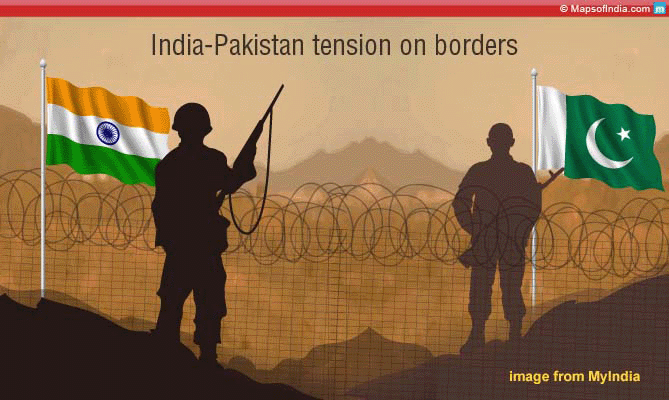 Pakistan minister Sheikh Rasheed Ahmed threatens India with nuclear war, Scroll, Ahmed said Pakistan would opt for a nuclear conflict because the Indian Army was far superior in conventional weapons. Scroll In 21 Aug 20 Pakistan minister Sheikh Rasheed Ahmed threatens India with nuclear war, Scroll, Ahmed said Pakistan would opt for a nuclear conflict because the Indian Army was far superior in conventional weapons. Scroll In 21 Aug 20
Pakistan Railway Minister Sheikh Rasheed Ahmed on Thursday threatened India with nuclear war. Speaking to Samaa TV, he said if India attacks Pakistan, it will descend into an “atomic war”. Ahmed said the Pakistan Army was far inferior to India’s in conventional weaponry, and would therefore have to use a nuclear bomb. “This will be a bloody, last and atomic war,” he said. “Our [nuclear] weapon will be very calculated, miniature and perfect, and will target India while protecting the lives of Muslims.” Ahmed claimed that Pakistan now has nuclear weapons that can reach Assam. “Pakistan does not possess enough conventional weapons, so India knows that [in a war], whatever will happen, will happen.” ………. The Pakistani minister’s views are a departure from Prime Minister Imran Khan’s opinion about a war between New Delhi and Islamabad. Khan has stated on two separate occasions that a war between the two nuclear-armed countries would not end well. https://scroll.in/latest/971015/pakistan-minister-sheikh-rasheed-ahmed-threatens-india-with-nuclear-war |
|
China feels India’s nuclear weapons programme driven by prestige: US report
China feels India’s nuclear weapons programme driven by prestige: US reportThe Carnegie report stressed China’s views on the issue are largely unknown
The Chinese state-run media continues to play up deployment of new artillery and other weapon systems near the border with India. However, despite the tension, references to nuclear weapons have been subdued in both nations.
A US think tank, the Carnegie Endowment for International Peace, on August 19 published a report on the Chinese perspective on nuclear weapons in the context of ties with India.
The Carnegies report noted while India’s perspectives on nuclear weapons are “relatively well documented,” China’s views on the issue are largely unknown.
The Carnegie report is based on interviews with “dozen Chinese academics, researchers, and military officers who work either on South Asia or on nuclear policy” and review of Chinese literature published in the last decade……..
Nukes for prestige?
On the issue of India’s nuclear weapons, the Chinese experts interviewed in the Carnegie report felt the systems are “for general deterrence and not for actual employment”……….
The experts interviewed in the Carnegie study felt a border conflict between India and China was unlikely to escalate into a nuclear exchange. Both India and China have declared ‘no first use’ of nuclear weapons.
………. The US factor
A point of concern expressed by the Chinese analysts was the possibility of India and the US strengthening strategic ties.
“While Chinese analysts largely dismiss India’s homegrown development of new military capabilities, they express concern about the prospect of US-India collaboration on defence projects. Chinese experts are particularly wary of US-India missile defence cooperation and the possibility that it could create a networked system. If such a system was to emerge, they would see India as a de facto security ally of the United States,” the Carnegie report noted. https://www.theweek.in/news/world/2020/08/19/china-feels-indias-nuclear-weapons-programme-driven-by-prestige-us-report.html
India’s nuclear power industry – unsafe and shrouded in secrecy
 The alarming safety record of India’s nuclear power plants https://tribune.com.pk/article/97109/the-alarming-safety-record-of-indias-nuclear-power-plants In 2016, an emergency was declared when the nuclear plant at Kakrapar was shut down after a major water leak, Syed Zain Jaffery, July 28, 2020
The Indian nuclear power industry is still veiled in confidentiality and opacity while refusing to reveal its safety details. Prominent environmental watchdogs have already voiced apprehensions about safety standards adopted by the nuclear establishment, where technical negligence or poor maintenance is commonplace, and regulatory bodies in India habitually sweep major nuclear accidents under the carpet. The production of nuclear energy is regulated in secrecy by a government body known as the Nuclear Power Corporation of India (NPCIL).
It is no mystery as to why India is reluctant to establish a completely autonomous and politically neutral nuclear oversight authority to discretely operate from the industry it oversees. The nuclear disaster in Fukushima demonstrated the significance of independent nuclear oversight. India’s persistent refusal to create an independent regulatory body shows a lack of confidence in maintaining standards which are internationally recognised.
The former chairman and managing director of Nuclear Power Corporation, S.K. Jain, was of the view that,
This entire episode shows the lack of awareness in India regarding upholding proper safety procedures through a timely tackling of any evolving threats.
Alarmingly, Indian nuclear engineers failed to investigate the exact reason for the leakage. The central government unpublicised the incident and did not even allow ordinary citizens to use geiger-counters to measure radiation. Shockingly, New Delhi has prohibited the use of geiger-counters, which is a global norm, under the vague excuse of national security. An on-site emergency at Kakrapar nuclear power plant and the circumstance that led to the major leakage raises many questions regarding Indian nuclear expertise.
Syed Zain Jaffery The author holds a Masters degree from NUST, Islamabad and writes about current affairs and politics.
India has not committed to the great transition to nuclear power it once envisioned.
90 Coronavirus cases among India’s nuclear workers, most at Rooppur Nuclear Power Plant
Rooppur Nuclear Power Plant: Rising infections among workers, Daily Star, Ahmed Humayun Kabir Topu, 10 July 20, More and more workers of different sub-contracting firms at Rooppur Nuclear Power Plant in Ishwardi upazila are getting infected with the novel coronavirus.
Upazila Health Officer Dr AFM Asma Khatun said 103 people in the upazila have been diagnosed with the virus till July 6. Of them, around 90 workers were infected with Covid-19 in the last three days. The majority of the workers who tested positive for coronavirus work at Paharpur Cooling Tower Ltd, a sub-contracting firm of the Rooppur project.
The number of Covid-19 patients has increased as over 800 employees of the sub-contracting firms at the plant gave samples to the labs of different government and private institutions for Covid-19 testing in the last few days, said the doctor, adding that the number of infected workers is increasing every day.
Most of the Covid-19 patients are the workers of Paharpur Cooling Tower Ltd, a sub-contracting firm of the plant, said Dr Asma Khatun, adding that the authorities of different sub-contracting firms at Rooppur Nuclear Power Plant have collected samples of several hundred workers and sent those to the lab of a private institution in Dhaka for coronavirus testing but they are yet to get copy of the test reports from the private institution. …… https://www.thedailystar.net/city/news/rooppur-nuclear-power-plant-rising-infections-among-workers-1927965
No economic benefit in nuclear power for India
 NMIMS-FPJ webinar: Nuclear energy not for countries looking at economic development, https://www.freepressjournal.in/fpj-initiatives/nmims-fpj-webinar-nuclear-energy-not-for-countries-looking-at-economic-developmentBy FPJ Web Desk 1 July 20, If India is looking at development by increasing power consumption, it is essential that it opts for cheaper forms of energy, stated nuclear expert M V Ramana, at a webinar ‘The future of nuclear energy’. He stressed that in such a case nuclear is not the right choice. Ramana is Director of the Liu Institute for Global Issues at the School of Public Policy and Global Affairs, University of British Columbia.
Speaking at the third session of a series ‘The future of energy’ organised by NMIMS-FPJ in association with Tata Power, Ramana said, “If you were looking at (economic) development by providing power to hundreds of villages that do not have power, then nuclear energy is a very bad choice. For development, you need cheap energy but you have (nuclear energy which is) an expensive form of energy.”
He revealed today it costs somewhere between USD 10-15 billion to build a nuclear power plant. However, the power produced by this plant is at the cost of USD 100 per MW hour. This is three times higher the cost of solar and wind energy, he added. “Solar and wind energy today are selling at USD 30-35 per megawatt hour (MWh).” After including storage costs and other costs, solar and wind energy continues to be cheaper and will cost over USD 50 per MWh.
He went on to add while nuclear plants are complicated, the fast breeder reactor is a lot more complex. Countries like the United States, Germany, the United Kingdom, others had fast breeder reactors programmes, which they gave up. “For historical and sociological reasons, India has said it is a very important part of our programme and pours in a lot of resources into that. Even if you are supporting nuclear energy, this is not the technology that you should be focussing on,” he advised. https://www.freepressjournal.in/fpj-initiatives/nmims-fpj-webinar-nuclear-energy-not-for-countries-looking-at-economic-development
Explaining the India-China conflict
|
Nuclear powers, a disputed border and an uneasy truce: Explaining the India-China conflict A border clash between the two nuclear armed neighbors has drawn the world’s gaze to a disputed region in the Himalayas NBC News, June 20, 2020, By Saphora Smith High up in the Himalayas, Indian and Chinese armed forces warily eye each other across a disputed border region that has become the scene of a tense standoff between the two nuclear powers. The conflict in the remote Galwan Valley that spans their shared border sparked into life Monday with the killing of 20 Indian soldiers, the first reported deaths in 45 years. China has not disclosed whether its forces suffered any casualties, according to a report in its state-run newspaper, the Global Times. The deaths have drawn the world’s gaze to a region that the two most populous countries have been contesting for decades. The implications go far beyond the lonely snowcapped mountains of this geopolitically complex region.
………Thousands of troops have been camped either side of the Galwan Valley, in the mountainous region of Ladakh, for weeks.
The tense standoff started in early May, when Indian officials said Chinese soldiers crossed the boundary in Ladakh at three different points, erecting tents and guard posts and ignoring verbal warnings to leave, according to The Associated Press. That triggered shouting matches, stone-throwing and even fistfights between the two sides, much of it replayed on television news channels and social media, the news agency reported……. Among the reasons raised by analysts include China’s objection to India’s construction of a road through the Galwan Valley connecting the region to an airstrip, New Delhi’s increasing close alliance with Washington, and Beijing’s support for Pakistan in its dispute with India over the Kashmir region. ……… https://www.nbcnews.com/news/world/nuclear-powers-disputed-border-uneasy-truce-explaining-india-china-conflict-n1231310 |
|
|
India will follow with nuclear weapons testing, if USA resumes testing
If the Donald Trump Resumes U.S. Nuclear Weapons Testing, India Will Follow, Hasan Ehtisham, The National Interest•June 13, 2020
On May 15, according to media reports, the Trump administration conducted serious discussions on whether or not to break the informal ban to carry out a nuclear test explosion. Washington’s intent to resume nuclear testing threatens to elevate already grown strategic tensions with China, Russia, and others. Some analysts comprehended that this is a proper course to influence Russia and China to support Washington’s plan for trilateral talks related to nuclear arms controls and disarmament issues. ……
The head of the Comprehensive Nuclear-Test-Ban Treaty Organisation (CTBTO), Lassina Zerbo, has presaged that any attempt by the United States to recommence nuclear testing would have serious ramifications for global peace and security. While mentioning CTBTO’s close relationship with the U.S. National Laboratories, Zerbo categorically precluded the notion of any requirement for nuclear testing. Chinese Foreign Ministry spokesperson Zhao Lijian has also shown “grave concerns about the report.” He urged the Trump administration to meet its “due obligations and honour its commitment by upholding the purpose and objective of the CTBT.” During the contemporary strategic competition of major powers, an uncertain situation has emerged about any sort of political gains for Washington against Moscow or Shanghai with a nuclear test. The most plausible consequence of a nuclear explosion by the United States at this point will facilitate other countries to resume nuclear testing. Washington will be criticized by other nuclear weapons states for violating the nuclear test moratorium practiced since 1998 by all countries, except North Korea.
Robert Rosner, a professor of physics at the University of Chicago, has evaluated that after the United States others will also resume nuclear testing and “the crucial question is: Who are the others?” In the South Asian strategic scenario, India will be that other country. India, one of the world’s fastest developing nuclear weapons states, has long been waiting for such a mistake, particularly from the United States, so that it could revoke the pledge of nuclear non-testing. It has been unable to do so just because it aspires to become part of the Nuclear Suppliers Group (NSG) and other global regimes. Once the United States resumes nuclear testing, India will find it easier to further demonstrate its nuclear weapon capability.
This latest paradigm shift by the United States allows India to conduct more nuclear testing to assess the design of its thermonuclear weapon which it claimed to have detonated on May 11, 1998, in the Operation Shakti-1. Numerous international experts believe that the results of the thermonuclear test were highly inflated and doubt that the device successfully ignited the second fusion stage of the explosion. The scientist community who coordinated the Operation Shakti-1 in 1998 has concluded that the test was a failure, as the yield of the fusion device never produced the desired results.
Nuclear pundits in India have already materialized a comprehensive and robust nuclear facility to meet any kind of eventuality that could provide India with an opportunity to carry out further nuclear tests. For instance, in 2012, India’s secret nuclear city at Challakere, Karnataka was revealed by independent researchers. Experts have shown apprehensions that the facility will be a major complex of nuclear centrifuges under military control, along with atomic research laboratories, weapons and aircraft testing sites. Once it starts functioning, the facility would enable India to modernize its existing nuclear warheads and the nuclear fuel from domestic reserves will be used for a thermonuclear weapon. India is also working on a uranium enrichment plant from which it will be able to produce about twice as much weapons-grade uranium as New Delhi will need for its operational nuclear weapon programme. That significant excess of the enriched uranium would be used for the development of thermonuclear weapons.
India has already done the necessary homework to manipulate any step the United States may take in the near future. The Defence Research and Development Organisation (DRDO) has signaled the capacity to conduct more nuke tests at short notice. If India alters the status of its moratorium on nuclear testing, then it would not only upset the deterrence balance but most significantly it would start a fresh nuclear arms race in South Asia. Under the pretext of growing Indo-US strategic relations in the region, the U.S. is offering a free ride to India to enhance the nuclear capability by resuming nuclear testing. It is strategically prudent for the U.S. national interest to uphold its commitments regarding the unilateral pledge of nuclear non-testing while ratifying the CTBT. The United States should also press India to continue its moratorium on nuclear weapons testing which was the primary prerequisite for the U.S.-India nuclear deal of 2008. It will reinforce the global standards against nuclear testing and encourage regional stability. https://news.yahoo.com/donald-trump-resumes-u-nuclear-120000804.html
Hasan Ehtisham is the M. Phil Scholar of Defence and Strategic Studies at Quaid-e-Azam University in Islamabad, Pakistan.
Nuclear power plants in the path of oncoming Cyclone Nisarga

Concerns raised over nuclear and chemical plants in  Maharashtra as cyclone Nisarga heads towards the state Opindia, 2 June, 2020, OpIndia Staff As the Cyclone Nisarga is heading towards the coasts of Maharashtra, a huge concern has been expressed regarding the nuclear and chemical plants that may come in its direct path. Expectedly, the cyclone will enter the coasts late Tuesday night or early Wednesday. Maharashtra as cyclone Nisarga heads towards the state Opindia, 2 June, 2020, OpIndia Staff As the Cyclone Nisarga is heading towards the coasts of Maharashtra, a huge concern has been expressed regarding the nuclear and chemical plants that may come in its direct path. Expectedly, the cyclone will enter the coasts late Tuesday night or early Wednesday.
Chief Minister Uddhav Thackeray while updating about the cyclone said, “Care is being taken to prevent power outages. Precautions are being taken at chemical units and nuclear power plants in Palghar and Raigad.” Maharashtra posses a string of chemical and nuclear plants. In Palghar, the oldest Tarapur Atomic Power Plant complex and other power units are present while Mumbai has the BARC set up and Raigad houses power, petroleum, chemicals, and other major industries besides the Mumbai port trust, the Jawaharlal Nehru Post trust and vital installations of the navy. People living in non-pucca houses have been shifted to safer shelters for them and slum dwellers have been asked to vacate for their own safety. As per reports, 50 patients were shifted from the Bandra Kurla complex COVID-19 hospital to the Goregaon NESCO hospital. Rescue operations underway…….. The Indian Meteorological Department announced that depression in the Arabian Sea may develop into a cyclonic storm in the next 12 hours and further intensify into a severe cyclonic storm within 24 hours. The deep depression – ‘Cyclone Nisarga’, which is headed towards the coasts in Maharashtra and Gujarat, is likely to hit the western coast on Wednesday……. https://www.opindia.com/2020/06/cyclone-nisarga-creates-concerns-for-nuclear-and-chemical-plants-maharashtra/ |
|
Climate: Cyclone Amphan disaster in India, Bangladesh
|
Cyclone Amphan leaves thousands homeless in eastern India as PM Narendra Modi offers help, SBS News, 23 May 20, Authorities have begun assessing damage and clearing roads in the wake of Cyclone Amphan, which has killed more than 90 people and left millions displaced in eastern India and Bangladesh.
Several thousand people have been left homeless after the most powerful cyclone in more than a decade hit India and Bangladesh this week, as Indian Prime Minister Narendra Modi visited the area on Friday and pledged aid. Cyclone Amphan killed at least 96 people, officials said, after it swept in from the Bay of Bengal on Wednesday. Eighty fatalities were in the eastern Indian state of West Bengal and 16 were in neighbouring Bangladesh, after winds of up to 185 km per hour caused flooding, blew away roofs, uprooted trees and ripped up power lines…… The total death toll is expected to rise as communications are restored and authorities reach villages cut off by blocked roads, particularly in India’s low-lying Sundarbans delta, home to four million people and thick mangrove forests that are a critical tiger habitat. In the Sundarbans’ Gosaba, an administrative area of the river delta that juts into the sea, the storm completely destroyed around 26,000 homes and damaged another 14,000, local disaster management official Pradip Kumar Dalui said. The cyclone also damaged some 19 kilometres of embankments around Gosaba, causing 13 breaches that led salty water to inundate swathes of land, Prime Minister Modi said. …. https://www.sbs.com.au/news/cyclone-amphan-leaves-thousands-homeless-in-eastern-india-as-pm-narendra-modi-offers-help |
|
Nuclear war between India and Pakistan very unlikely
|
‘Very dim chances of India, Pakistan nuclear war’
2 neighbors became nuclear power in May 1998 triggering new arms race in region, AA, Aamir Latif |15.05.2020 KARACHI, PakistanPakistan’s top nuclear scientist sees “very dim” chances of a nuclear war with neighboring India despite mounting tensions between the two arch-rivals in recent months. “I won’t say a zero chance but there are very dim chances of a war between the two neighbors involving nuclear arsenal despite escalating tensions,” Samar Mubarakmand, a former chairman of Pakistan Atomic Energy Commission (PAEC), and head of a team of the scientists that conducted six “successful” nuclear tests in remote Chaghi district of southwestern Balochistan province on May 28, 1998……… “The leadership of both countries are fully aware of the catastrophe a nuclear war can cause. They won’t go for that option no matter how tense the situation is,” observed Mubarakmand, who served at PAEC from 1962 to 2007 and played a key role in developing the country’s nuclear program. Conventional provocations, he said, would continue between the two longtime rivals but, he reckoned, both sides would not “cross the limit” to go for nuclear option. Both countries have long been reeling from poverty, illiteracy, and other health and economic issues. Wars or undue competition in arms race are not in the interest of the two nations,” he maintained. Nuclear powers India boasts the world’s third-largest army after the US and China, with an active troop strength of over 1.3 million. Pakistan, meanwhile, stands eighth on the list with a 600,000-man army……… https://www.aa.com.tr/en/asia-pacific/-very-dim-chances-of-india-pakistan-nuclear-war/1841657 |
|
|
1 This Month
To see nuclear-related stories in greater depth and intensity – go to https://nuclearinformation.wordpress.com/
12 February – Webinar The Big Push: New Nuclear Projects in Canada
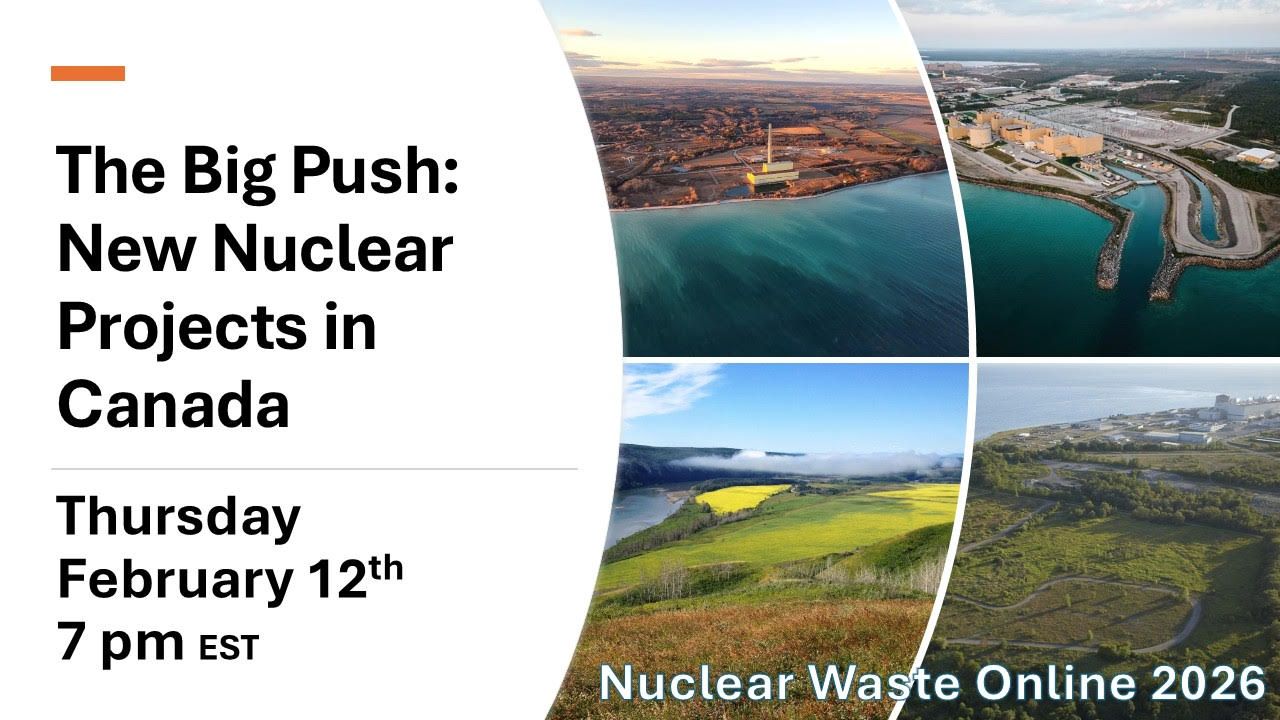
Thursday, February 12, 7 pm Eastern | 2nd of 4 sessions in the 2026 Nuclear Waste Online webinar series
Join a webinar on the push for new nuclear generation in Canada. Go to Northwatch.org to register or use the registration link https://us02web.zoom.us/webinar/register/WN_ZfWOf1GITqSRIZX8CB-A9w

-
Archives
- February 2026 (115)
- January 2026 (308)
- December 2025 (358)
- November 2025 (359)
- October 2025 (376)
- September 2025 (258)
- August 2025 (319)
- July 2025 (230)
- June 2025 (348)
- May 2025 (261)
- April 2025 (305)
- March 2025 (319)
-
Categories
- 1
- 1 NUCLEAR ISSUES
- business and costs
- climate change
- culture and arts
- ENERGY
- environment
- health
- history
- indigenous issues
- Legal
- marketing of nuclear
- media
- opposition to nuclear
- PERSONAL STORIES
- politics
- politics international
- Religion and ethics
- safety
- secrets,lies and civil liberties
- spinbuster
- technology
- Uranium
- wastes
- weapons and war
- Women
- 2 WORLD
- ACTION
- AFRICA
- Atrocities
- AUSTRALIA
- Christina's notes
- Christina's themes
- culture and arts
- Events
- Fuk 2022
- Fuk 2023
- Fukushima 2017
- Fukushima 2018
- fukushima 2019
- Fukushima 2020
- Fukushima 2021
- general
- global warming
- Humour (God we need it)
- Nuclear
- RARE EARTHS
- Reference
- resources – print
- Resources -audiovicual
- Weekly Newsletter
- World
- World Nuclear
- YouTube
-
RSS
Entries RSS
Comments RSS
 nuclear-news