Nuclear power and democracy in conflict in India
 Safety record at Kalpakkam facility
*In 1987, a refuelling accident ruptured the reactor core.
*In 1991, workers were exposed to a radioactive heavy water leak.
*In 1999, another leak exposed 42 workers.
*In 2002, 100 kg of radioactive sodium leaked.
*In 2003, high-level radioactive waste was released into a work area, exposing six workers to nuclear radiation.
 How pertinent is the nuclear option? Deccan Chronicle October 8, 2011 , By R. Mohan Democratic protests against nuclear plants are the flavour of the season.What began in Jaitapur has come down south to Koodankulam in Tamil Nadu and protests are bound to spread across the country to wherever nuclear power plants are being planned.
There is a fundamental conflict here between the aims of the government to arm the country with clean nuclear energy and the people’s fears over nuclear power plant catastrophes fanned further by the Fukushima experience. Continue reading
AREVA ahead in the scramble to sell off nuclear reactors to India
 Areva In ‘Full-Scale’ Talks To Build Nuclear Power Plants In India, WSJ, By Eric Yep MUMBAI (Dow Jones)-–Areva S.A. (ARVCY) is “in the middle of full-scale discussions” to build nuclear power plants in India, said Arthur De Montalembert, chairman of its local unit, despite its U.S. rivals going slow on their Indian plans due to concerns over a nuclear liability law.
Areva’s talks with Nuclear Power Corp. of India Ltd. may give an edge to the French state-controlled nuclear equipment supplier over its U.S. rivals, GE Hitachi Nuclear Energy and Westinghouse Electric Co., whose plans were delayed after the Indian government adopted the law that makes both equipment suppliers and plant operators liable to accident compensation claims.
Equipment suppliers, which are eyeing India’s multi-billion-dollar nuclear power market, have sought changes in the law. Continue reading
India’s Prime Minister cannot be trusted about nuclear power
The disaster potential of nuclear power plants is of concern to the entire nation and not the people of Kudankulam or Jaitapur alone. The Prime Minister disallowed the demand for a national debate when he slyly negotiated the India-US civil nuclear cooperation agreement …
India,…, must reassess its policy.
 Discard this secrecy, THE PIONEER , 08 OCTOBER 2011 PM can’t be trusted on N-power plants The Prime Minister’s response to the protest against the 1000 MWe nuclear power plant which is being set up at Kudankulam in Tamil Nadu is typically that of a file-pushing babu: Unimaginative, bureaucratic and non-committal. It is understandable that having single-mindedly pursued the opening up of India’s civil nuclear sector to foreign collaboration, Mr Manmohan Singh should continue to insist that the nation’s deliverance lies in boosting the generation of atomic power. … Continue reading
India’s nuclear power plans derailed by safety fears
“What you see in Koodankulam and Jaitapur will be repeated in other nuclear parks earmarked for reactors from US suppliers,”
 India’s nuclear future put on hold, Safety fears derail plan to import reactors., Nature News, 8 Oct 11K. S. Jayaraman An increase in anti-nuclear sentiment after the Fukushima disaster in Japan in March has stalled India’s ambitious plan for nuclear expansion.
The plan, pushed forward by Prime Minister Manmohan Singh, aims to use reactors imported from the United States, France and Russia to increase the country’s nuclear-power capacity from the present 4,780 megawatts to 60,000 megawatts by 2035, and to provide one-quarter of the country’s energy by 2050. But now there are doubts that the targets will ever be met if safety fears persist….. Continue reading
Koodankulam anti nuclear struggle will spread beyond the region
 The significance of the struggle waged by villagers in the south of Tamil Nadu stretches well
beyond the Koodankulam nuclear project itself.
because the Koodankulam project is closely intertwined with plans for expansion of the Kalpakkam complex, the struggle is bound to reverberate throughout the state of Tamil Nadu and beyond…
Anti-Nuclear Struggle Has Large Fallout, International News magazine, Peter Custers LEIDEN, the Netherlands, Oct 5 (IPS) – The anti-nuclear struggle in India did not gain the same national prominence as the hunger strike waged by Anna Hazare against rampant corruption among India’s top politicians. Yet a landmark it surely was in the history of India’s nuclear programme. Continue reading
Concern over India’s Kalpakkam nuclear reprocessing facility
Indian peace activists have expressed suspicions that the plutonium separated at Indian civilian reprocessing facilities will be diverted and used to increase the country’s stock of atomic weapons.
Technological preparations towards the building of a full-scale fast breeder reactor at Kalpakkam are reportedly in an advanced stage.
Anti-Nuclear Struggle Has Large Fallout, International News Magazine, 05 October 2011 Peter Custers “……..The Kalpakkam complex does not just harbour a nuclear power plant, but also a reprocessing facility- a plant where nuclear fuel rods, after they have outlived their use in reactors, are chemically treated so as to extract raw materials for re-use as energy source.
Storage of such high-level waste in tanks has resulted in catastrophic accidents, Continue reading
USA nuclear companies up against India’s Nuclear Liability Law
India-U.S. Nuclear Growth May See More Delays, WSJ, By ERIC YEP MUMBAI – U.S.-based companies hoping to cash in on India’s plans to increase its number of nuclear reactors could face more delays despite the government’s efforts to bring the country’s liability rules for nuclear accidents in line with global norms.
U.S. companies had expected big contracts to flow from India’s nuclear expansion after a New Delhi-Washington agreement in 2005 and a subsequent waiver from the Nuclear Suppliers’ Group on the transfer of nuclear technology to India.
But last year India’s parliament passed a liability law making both equipment suppliers and reactor operators liable to accident compensation claims, stalling the entry of companies like GE Hitachi Nuclear Energy and Westinghouse Electric Co. Continue reading
India’s Kudankulam anti-nuclear movement widens
Vehicle march from Kerala against Kudankulam nuclear plant, ROY MATHEW THIRUVANANTHAPURAM, October 3, 2011 Anti-nuclear activists under the aegis of Solidarity Council supporting Kudankulam anti-nuclear movements began a vehicle march to Kudankulam from here on Sunday morning. Continue reading
Kudankulam protest will re-ignite if nuclear building continues
Anti-nuke activists threaten to revive stir, Times of India TNN | Oct 3, 2011, TIRUNELVELI: Ten days after the agitation against the construction of a nuclear plant at coastal Kudankulam in southern Tamil Nadu was withdrawn, the anti-nuclear plant activists have threatened to revive the protest if the ongoing work in the multi-crore Kudankulam Nuclear Power Project (KKNPP), was not suspended.
The activists, who spearheaded the 12-day protest by the villagers, have threatened that they would embark on a mass fast from October 9, if theCentral government failed to suspend the ongoing commissioning work in the nuclear plant by October 7.
Representatives of non-governmental organisations, social activists, anti-nuclear plant groups and community leaders took the decision at the consultative meeting held in Kudankulam to discuss about the future course of action on the project on Sunday. A group of activists from Kerala also visited Kudankulam to express their solidarity with the anti-nuke protestors here. “This time around we are planning to take the protest across the state rather than restricting it to Kudankulam or Idinthakarai,” said S Sivasubramanian, an anti-nuclear plant activist….. http://timesofindia.indiatimes.com/city/madurai/Anti-nuke-activists-threaten-to-revive-stir/articleshow/10213344.cms
India’s clash between democracy and nuclear power
The government is not able to comprehend the scale of challenge it’s facing at the moment.. Is Democracy Thwarting India’s Nuclear Power Ambitions?, WSJ, By Megha Bahree, SEPTEMBER 26, 2011, India’s democratic process is changing the country’s nuclear energy program at startling speed.
First it was protests at the proposed nuclear power plant at Jaitapur in Maharashtra. Now it’s protests at the plant under construction at Kudankulam in Tamil Nadu, and at practically every site across the country that has been designated for a new power plant. And at most places, people’s concerns about the risks of nuclear power are clashing with the government’s plans to power the country with nuclear energy….. Continue reading
Indian public willing to pay more for renewable energy
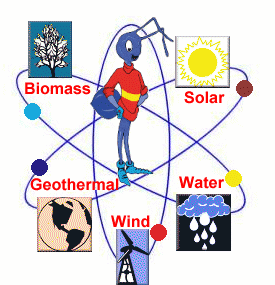 Majority of survey respondents (90 percent) argued government should support renewable energy. A significant share (82 percent) of survey respondents overwhelmingly supports renewable energy projects…..
Indians Ready to Pay More for Electricity from Renewable Energy Sources: Mercom Survey, Technology World, Rajani Baburajan 24 Sept 11 A recent survey conducted by Mercom Capital Group on renewable energy awareness in India finds that only 56 percent of Indian consumers have heard of ‘renewable energy’ or ‘clean energy.’ Further only 27 percent of customers have heard of ‘energy efficiency.’
Kudankulam nuclear power project in earthquake prone area
 ‘Project unwise as area quake-prone’, Times of India, TNN | Sep 26, 2011, MADURAI: Activists opposing the Kudankulam nuclear power plant have alleged that the implementing authority has violated certain essential rules in the establishment of the project. Anti-nuclear committee member Dr R Ramesh has claimed that Kudankulam Nuclear Power Project officials got a No-Objection Certificate (NOC) for setting up two reactors for generating 440 mega watts of power but had instead built two 1,000 mega watt units. He urged the state government either to suspend or cancel the NOC granted to the plant. Continue reading
India evacuates over 2,000 to test its nuclear capable missile
India tests nuclear-capable missile, Dawn.com 26 Sept 11, BHUBANESHWAR: India tested a medium-range nuclear-capable missile along its eastern coast on Saturday, an official said, as part of the nation’s efforts to build up its atomic deterrent…..
With a striking range of 434 miles, the missile uses solid propellant and is capable of carrying a 1,000 kilogram warhead. Due to security concerns, authorities evacuated over 2,000 people, including women and children living close to the testing range, and shifted them to temporary shelters.. http://www.dawn.com/2011/09/25/india-tests-nuclear-capable-missile-3.html
Doubts on safety of Koodankulam nuclear project, and of others too
“there should be a moratorium on all further nuclear activity, and revocation of recent clearances for nuclear projects”, given without regard to India’s ramshackle infrastructure and largely untested emergency procedures…
The issue is far larger than just Koodankulam. There are lingering doubts about the safety measures being reliable, workable and effective….
Discordant voices on safety of nuclear power, THE HINDU, B.S.RAGHAVAN, 22 SEPT 11, Following the agitation, including mass fasting, by the people of Idinthakarai, the village adjacent to the Koodankulam atomic power project, who are in panic over the possibility of the occurrence of a disaster similar to the one at Fukushima and consequent dangers from radiation, there has been a cacophony of voices over the pros and cons of nuclear power. Continue reading
India’s new Nuclear Regulator will be a tame instrument of government
“This is an unprecedented directive which coerces and demands obedience from the Regulatory Authority.
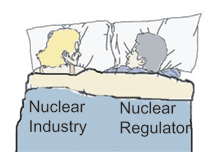 CPI-M flays nuclear safety authority bill, The Economic Times, 21 Sept 11, NEW DELHI: The CPI-M on Wednesday denounced the proposed Nuclear Safety Regulatory Authority Bill and asked the government to “set up a genuinely independent nuclear safety regulatory authority”. Continue reading
 1 This Month
19 February – VIRTUAL EVENT-Decision Time: AI and Our Nuclear Arsenal
12:45 p.m. Central / 1:45 p.m. Eastern
To see nuclear-related stories in greater depth and intensity – go to https://nuclearinformation.wordpress.com

-
Archives
- February 2026 (170)
- January 2026 (308)
- December 2025 (358)
- November 2025 (359)
- October 2025 (376)
- September 2025 (258)
- August 2025 (319)
- July 2025 (230)
- June 2025 (348)
- May 2025 (261)
- April 2025 (305)
- March 2025 (319)
-
Categories
- 1
- 1 NUCLEAR ISSUES
- business and costs
- climate change
- culture and arts
- ENERGY
- environment
- health
- history
- indigenous issues
- Legal
- marketing of nuclear
- media
- opposition to nuclear
- PERSONAL STORIES
- politics
- politics international
- Religion and ethics
- safety
- secrets,lies and civil liberties
- spinbuster
- technology
- Uranium
- wastes
- weapons and war
- Women
- 2 WORLD
- ACTION
- AFRICA
- Atrocities
- AUSTRALIA
- Christina's notes
- Christina's themes
- culture and arts
- Events
- Fuk 2022
- Fuk 2023
- Fukushima 2017
- Fukushima 2018
- fukushima 2019
- Fukushima 2020
- Fukushima 2021
- general
- global warming
- Humour (God we need it)
- Nuclear
- RARE EARTHS
- Reference
- resources – print
- Resources -audiovicual
- Weekly Newsletter
- World
- World Nuclear
- YouTube
-
RSS
Entries RSS
Comments RSS
 nuclear-news