Indian government’s nuclear attack on democracy

 Nuking democracy at Kudankulam Financial Chronicle, By Praful Bidwai Oct 03 2012 Is nuclear power going to be promoted in India only at gunpoint, and in brazen violation not just of people’s fundamental rights, but also of the norms and rules to be set by an independent safety regulator?
Going by what the government, department of atomic energy, Nuclear Power Corporation (NPCIL), and Atomic Energy Regulatory Board (AERB) are doing at Kudankulam in Tamil Nadu, the answer is an emphatic yes.
To start with, the AERB is not an independent agency. As shown by the Comptroller and Auditor-General’s recent report, it’s slavishly subservient to the government and DAE-NPCIL. Nor has it evolved transparent safety norms. Its integrity is in grave doubt. It does not disclose information that’s vitally important to public safety. Critical documents on safety codes/ guidelines have disappeared from
its website, for example,…
… the state and central police have unleashed repression against Kudankulam’s grassroots protesters. Although there hasn’t been a single violent incident, the police have lodged first information reports against several thousand people, charging many with sedition and waging war against the State, on this scale, probably for the first time since independence. On September 10, they attacked peaceful unobtrusive protesters with batons and
tear-gas. They literally drove many agitators into the sea, molested women, looted homes and killed a fisherman.
A fact-finding team led by Justice BG Kolse-Patil describes this as a “reign of terror”, with
“totally unjustified” physical abuse, vindictive detention of 56 people including juveniles, and sexual harassment. Such police behaviour “has no place in a country that calls itself democratic”.
This comes on top of systematic demonisation of the protesters as “foreign-inspired”, repeated harassment of their sympathisers, and deportation of three Japanese activists, who wanted to express solidarity with them. Such repression is becoming routine in India and undermining democracy. That’s the additional price nuclear power will extract from us.
http://wrd.mydigitalfc.com/op-ed/nuking-democracy-kudankulam-443
India’s nuclear energy program just not happening
 India’s ticking nuclear crisis: Part I Charu Sudan Kasturi, Hindustan Times New Delhi, September 30, 2012 India has missed its five-yearly nuclear power generation target by 74%, its plans crippled by the protests at Kudankulam and other nuclear plant sites that have left the country’s energy security roadmap under a cloud of uncertainty. The government had set an already modest target of adding 3380 MW of additional nuclear power by 2012 to the country’s 3900 MW capacity at the start of the 11th Five Year Plan in 2007.
But failure to convince local people and activists at almost every site handpicked for a nuclear plant has left the Nuclear Power Corporation of India Limited (NPCIL) with only 880 MW to show as nuclear power added over the past five years.
Similar protests over the coming few years could seriously jeopardize India’s current energy security strategy, energy economists, government experts and NPCIL officials have cautioned.
Punjab goes all out for solar power
 Punjab to set up solar photo-voltaic power packs across state: http://www.hindustantimes.com/Punjab/Chandigarh/Punjab-to-set-up-solar-photo-voltaic-power-packs-across-state/SP-Article1-937965.aspx Majithia Punjab is all set to set up solar photo-voltaic power packs in households across the state in a major move to encourage use of solar energy for basic electricity needs, Non-Conventional Energy
Minister Bikramjit Singh Majithia said on Sunday. He said the government was making all
efforts to fulfill the gap in demand and supply of electricity by installing more generating capacity in the renewable energy sector as well as conventional sector.
Majithia said Punjab has considerable sun light available for more than 330 days in a year and this abundant energy could be utilised for generation of power during the day time through solar photo-voltaic power plants.
He said the state is endowed with vast potential of solar energy estimated at 4-7 KWH per one sq mt of solar insulation level and added that Punjab government was committed to tap this resource.
He also said the Punjab Energy Development Agency (PEDA) has planned installation of Solar Power Packs at households in the state of capacity 500Wp to 1000Wp.
Majithia said the Ministry of New & Renewable Energy has sanctioned the Central Financial Assistance of Rs. 3.03 crore as first installment and with total project cost of Rs. 10 crore.
He said that besides generating power, Solar Photo-voltaic Power Packs were environment friendly and carbon neutral and were easily produced and consumed.
The Punjab government has set up Akshey Urja shops in all districts of the state, where people can buy these at 30 % subsidy.
India interrogates, deports visitors who have anti nuclear opinions
The three activists were going to visit India for only a few days. They had hoped to avail of the tourist visa on arrival to visit the “temples of modern India”. They came in solidarity, good will and peace. Neither they nor their friends in India had imagined that being “anti-nuclear” would be seen as a threat by the Indian government.
 Are you going to Kudankulam? http://www.dnaindia.com/analysis/column_are-you-going-to-kudankulam_1745780 29 Sept 12, Bela Bhatia | Agency: DNA , September 27, 2012 On Tuesday this week, three Japanese visitors who are part of the anti-nuclear movement in Japan were refused entry to India and deported on arrival at Chennai. Reading the account sent by them from Kuala Lumpur makes for not-exactly-pleasant reading.
“When we got off the plane and approached the immigration counter, one personnel came to us smiling… [and took] us to the immigration office. [There were more than five personnel there.] … one asked me [Yoko Unoda] whether I am a member of No Nukes Asia Forum Japan. ‘You signed the international petition on Kudankulam, didn’t you?’ … another person asked, ‘Mr Watarida … he is involved in the anti-nuclear movement in Kaminoseki, right?’
‘Are you going to Kudankulam? Who invited you all? … Who will pick you up at Tuticorin airport? [they had a copy of the itinerary of the domestic flight] Tell me their names. Tell me their telephone numbers. Continue reading
No worries! India’s government says it can handle Fukushima type disaster
 Kudankulam can handle Fukushima type disaster: NPCIL tells SC First Post India 27 sept 12, New Delhi: The Supreme Court was Thursday told that the Kudankulam Nuclear Power Project (KNPP) in Tamil Nadu was absolutely safe and fully equipped to deal even with Fukushima type of accident.
The Nuclear Power Corporation of India Limited (NPCIL) told the apex court bench of Justice KS Radhakrishnan and Justice Dipak Misra that KNPP was “absolutely safe” even without the 17 recommendations by the Atomic Energy Regulatory Board (AERB), which were being put in place out of abundant caution….. Pointing to the rarity of such incidents at nuclear power plants, the NPCIL said that there had been only three major nuclear plants accidents that includes 1979 Three Mile Island accident, 1985 Chernobyl disaster and 2011 Fukushima Daiichi nuclear disaster…. http://www.firstpost.com/india/kudankulam-can-handle-fukushima-type-disaster-npcil-tells-sc-471173.html
Democratic freedoms trampled: the sorry story of India’s Kudankulam nuclear power project
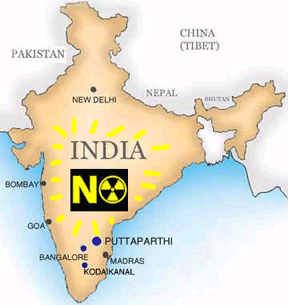 Despite mass opposition, India pushes ahead with operationalizing nuclear plant WSWS, By Arun Kumar and Kranti Kumara 27 September 2012 Despite mass protests by villagers, the Indian government in partnership with the Tamil Nadu state government is pushing ahead with the loading of nuclear fuel at the recently built 2000 MW Kudankulam Nuclear Power Plant (KNPP) located on the Tamil Nadu coast.
This massive power plant is a joint venture between India and Russia and has cost 172 billion Rupees (about $3.2 billion) to build. The plant currently houses two nuclear pressurized water reactors (PWR) reactors, each capable of driving a 1000 MW electric generator. But there are plans to construct four additional reactors at the site…..
Despite the deep misgivings of the population, the Indian elite, without any democratic debate, is rushing feverishly ahead, claiming that nuclear plants are essential to satisfying growing domestic electricity needs.
This particular plant is causing great concern among villagers and fishermen living in its vicinity, because it is situated right next to the ocean just like the Japanese Fukushima plant. Built at the southern tip of the state, KNPP is highly vulnerable to undersea earthquakes and tsunami that are an ever-present danger in the Indian Ocean region. That such concerns are far from hypothetical was demonstrated when the plant installations got inundated from ocean waves unleashed by the massive undersea earthquake that occurred in the Indian Ocean in 2004….
Last April witnessed a particularly brutal response by joint forces deployed by the Indian and the state governments. The police cut off water, food and power-supply to protesting villagers and imposed a curfew in the villages where the agitation has been centered. Nearly 200 people were arrested including women and children. Subsequently protests abated somewhat as the People’s Movement against Nuclear Energy (PMANE), which has led the agitation, called it off in the hope that the Tamil Nadu and Indian judiciaries would intervene on its behalf.
However, by late August the Madras High Court gave the green light to the Indian government to proceed with the steps it needs to take to make the plant operational. An appeal was then filed by an anti-nuclear activist with the Indian Supreme Court asking the court to halt further progress on operationalizing the plant, since 11 of the 17 critical safety measures recommended by the government’s own Atomic Energy Regulatory Board (AERB) had not been implemented.
Around this time, widespread protests resumed and the police responded with still greater violence. On Sept. 10 a protesting fisherman, 48 year-old Antony John, was shot dead. A young girl was also trampled to death when police resorted to charges to break up the protests. To observe and terrify those conducting a water protest, the Coast Guard flew low-flying aircrafts. One of the protesting fisherman named Sathyam panicked when a surveillance aircraft flew low, then slipped hitting his head against a boulder and subsequently died. Sathyam’s funeral became a rallying point for opposition to the nuclear power plant attracting large number of villagers from neighbouring areas.
Earlier this month, India’s Supreme Court refused to even hear the petition against operationalizing KNPP. In so doing, the court ignored publicly available evidence of shoddy workmanship, the dangers inherent from using an untested reactor design, and the fact that over 1 million people live within a 30 Km. radius of the plant, which violates even the AERB’s feeble safety regulations.
Following this, the Indian government proceeded post-haste to begin loading enriched-uranium fuel rods into one of the reactors. The government has said that it expects the fuel loading to be complete by Sept. 28 and the plant fully operational soon afterwards.
This move provoked the villagers into intensifying their agitation.
On Saturday, Sept. 22, over 500 fishing boats laid siege for several hours to the Tuticorin port about 100 Km north of KNPP. This port is used for unloading nuclear fuel rods from ships for transportation to the reactor at the plant. Simultaneously other protestors including villagers led by PMANE undertook “Jal Satyagraha” (Water Agitation), by standing in waist-deep water in the ocean near the plant and forming a human chain.
Solidarity protests also sprung up across the state. But the police repression has continued unabated with arrest warrants being issued for activist-leaders, many of whom including PAME leader Udayakumar have now gone into hiding. Under the pretext of looking for protest leaders, the police in bands of 10 have gone on a rampage, breaking down doors and ransacking the houses of villagers living in the Kudankulam area. This is clearly an attempt by the government to terrorize the populace into submission.
Kudankulam has been practically sealed off by armed policemen who are allowing only the transport of essential goods into the area. Public transport has also been barred from entering some of the areas surrounding the plant.
To the consternation of the authorities, the protests have now snowballed with growing numbers of people, including students, advocates and villagers, joining protests across the state and even in the Bangalore, the capital of the neighbouring state of Karnataka. … http://www.wsws.org/articles/2012/sep2012/indi-s27.shtml
Indian villagers have sound reasons to distrust their government
 Despite mass opposition, India pushes ahead with operationalizing nuclear plant WSWS, By Arun Kumar and Kranti Kumara 27 September 2012“…….It is not just the safety of the plant that the villagers are angry about. While the Indian government has spent huge amounts to build ultra-modern facilities for the nuclear plant’s employees, including a fully-equipped hospital, villagers are barred from using them. Most of the villagers and fishermen live in squalor and poverty lacking even basic facilities such as running water.
Moreover the villagers put no faith in the ability of the Indian elite to manage a nuclear accident given the government’s display of a mixture of incompetence and callousness during and after the 1984 Union Carbide disaster in Bhopal. The uncontrolled release of toxic gas at Bhopal, which caused over half a million casualties including over 20,000 deaths, was the worst industrial disaster in world history. Even after the passage of 38 years, the government has left the plant site and its surroundings severely contaminated with toxic substances. No one has been held criminally responsible and the Indian government has essentially connived to this mass crime by agreeing to accept a measly $470 million in compensation from Union Carbide.
Despite this horrible precedent, the Indian government has agreed that the Russian firm that has supplied and built KNPP’s reactor will have zero liability in the event of an accident
In a desperate attempt to justify the state suppression of the protests, Prime Minister Manmohan Singh has brazenly declared that the anti-nuclear protestors are acting at the behest of United States-based Non-Governmental Organisations (NGOs) that want to derail India’s “progress”.
The Indian establishment is justifying its single-minded pursuit of nuclear power plants by claiming that it will help reduce the chronic electricity shortage that afflicts the country. Such arguments are duplicitous as there are far more cost-efficient ways to produce electricity than from nuclear power plants.
But motives other than providing cheap electricity are propelling the Indian elite to expand the country’s nuclear power industry—first and foremost its drive to increase its arsenal of nuclear weapons. With the signing of the India-US Nuclear Accord in 2008, the Indian elite can now utilize domestic uranium reserves for weapons production while obtaining and gaining expertise in the latest state-of-the-art nuclear technology. http://www.wsws.org/articles/2012/sep2012/indi-s27.shtml
India’s government upset that Sri Lanka worries about nuclear radiation
India to discuss Kudankulam safety with Sri Lanka Sachin Parashar, TNN | Sep 29, 2012, NEW DELHI: Taken aback by what it describes as “propaganda” in Sri Lanka against the Kudankulam nuclear power plant, India has offered to discuss the safety aspect of the pressurized water reactors with Lankan authorities.
The dialogue mechanism between the two nations for cooperation on nuclear issues
will include talks on Kudankulam safety when a Sri Lankan committee visits India later this year.
“The safety aspect will be a part of the broader agenda for talks over cooperation in nuclear energy but we are already telling them that India will abide by all international conventions over nuclear safety at Kudankulam,” said an official dealing with Sri Lanka. Although the
government in Sri Lanka has not raised any objection to the reactors, the Indian establishment in Colombo has been stunned by a spate of reports in the local media — in the run-up to loading of fuel in the first unit at Kudankulam – about how these reactors were going to adversely impact the island nation….. http://timesofindia.indiatimes.com/india/India-to-discuss-Kudankulam-safety-with-Sri-Lanka/articleshow/16596952.cms
Supreme Court might halt Kudankulam nuclear power project
Kudankulam nuclear plant can be stopped if not found safe: Supreme
Court http://economictimes.indiatimes.com/news/politics/nation/kudankulam-nuclear-plant-can-be-stopped-if-not-found-safe-supreme-court/articleshow/16576138.cms
27 Sept 12, NEW DELHI: The Supreme Court today made it clear that it can stop
commissioning of the Kudankulam nuclear power plant if it finds that the mandatory safety requirements for it have not been put in place.
A bench of justices K S Radhakrishanan and Deepak Misra said the safety of plant and the people living in its vicinity is its prime concern and issued notices to the Centre and Tamil Nadu Pollution Control Board on a plea challenging the environmental clearance given
to the controversial project. Continue reading
Fishing boats: protest against uranium fuel loading for Kudankulam
Fishermen protest against Indian nuclear plant The Nation By: AFP | September 23, 2012 CHENNAI – Indian fishermen and anti-nuclear activists on Saturday mounted a sea protest against an atomic power plant following violent demonstrations earlier this month, police said.
Some 3,000 fishermen and anti-nuclear activists in 500 fishing boats sought to block a port in southern Tamil Nadu state to protest against the loading of uranium at the under-construction power plant, police said.
Tuticorin port spokesman V. Satyarajan described the protest as “peaceful” and said there was no disruption to traffic at the port from the attempted blockade off Tuticorin town, 100 kilometres (62 miles) from the project. Witnesses said the boat-borne protesters shouted anti-nuclear slogans and demanded an end to the loading of uranium at the Russian-backed project.
“We will continue to protest until the nuclear plant is shut down,” said Subash Fernando, one of the leaders of the sea protest. On land, demonstrators from villages near the plant formed a human chain in Tuticorin to protest against the loading of the fuel rods. Earlier this month, one fisherman was shot dead by police as hundreds of protesters clashed with armed officers.
Last week, India’s Supreme Court denied a request to suspend the loading of the rods at the plant which opponents say poses a danger to local people…..
http://www.nation.com.pk/pakistan-news-newspaper-daily-english-online/international/23-Sep-2012/fishermen-protest-against-indian-nuclear-plant
250 arrested in Tuticorin as India’s govt cracks down on anti nuclear movement
Kudankulam protest: 250 anti- nuclear activists arrested Zee News, September 16, 2012, Kudankulam (TN): Around 250 people were arrested in Tuticorin when they attempted to set out on a march to express solidarity with anti-nuclear agitators here who on Sunday buried themselves upto waist in beach sand, in a new form of protest against loading of fuel in Kudankuklam plant.
A ‘solidarity march’ by cultural leaders from Kerala to Kudankulam to express support with the anti-nuclear activists here was also stopped on the state’s border with Tamil Nadu.
Leader of Peoples Movement Against Nuclear Energy (PMANE), which is spearheading the protest here, meanwhile, offered unconditional talks with the central and state governments and said they were ready to give up the agitation if the government assured that fuel would not be loaded for now. ….. Continue reading
India: Police block march of peaceful anti nuclear writers and activists
Kerala marchers stopped Deccan Chronicle, September 17, 2012 Thiruvananthapuram | Chennai The Kerala-Kudankulam march led by writers and social activists on Sunday to express solidarity with the anti-nuclear protests in Kudankulam was blocked by the police near the Kerala-Tamil Nadu border at Inchivila.
Kerala Anti-Nuclear Support Group, which organised the march, then tried to bus the activists to the protest site.
But this attempt was also derailed when the bus was stopped and asked to return by TN police before Kudankulam.
The march, undertaken by over 200 people, was inaugurated by poetess Sugatha Kumari at Parassala. Other noted personalities who took part in the march were: writer Sara Joseph, former diplomat M.K. Bhadrakumar, Latin Diocese Vicar-General Eugene Pereira, social activist B.R.P. Bhaskar, Gandhian P. Gopinathan and former naxallite K. Ajitha…… http://www.deccanchronicle.com/channels/nation/south/kerala-marchers-stopped-454
India: opposition to nuclear power despite government repression of protestors
 India’s Judiciary creates scam over Kudankulam The Canadian, 17 SEPTEMBER 2012 There is no reason why the judiciary, the conscience of the nation, should willingly play pro-regime roles by opposing people’s and humanity concerns……
as national support for the five-year-long campaign against the Jaitapur plant snowballed. The National Committee in Solidarity with the Jaitapur Struggle – comprising leaders like Prakash Karat, AB Bardhan, Sitaram Yechury and Ram Vilas Paswan, independent experts and intellectuals – trenchantly criticised the project, based on French company Areva’s troubled European Pressurised Reactors (EPRs).
The grounds of protest against the 9,800 MW plant in Maharashtra are somewhat similar to those being echoed in Tamil Nadu. The protestors argue that the plant will damage local ecology, their consent for the plant wasn’t sought and also speak of the obvious fear of how a potential accident at the plant could affect them. While the issue is currently not in the headlines anymore, the agitators in the Ratnagiri district of Maharashtra are no doubt closely following the developments in Kudankulam……
Regime-Judiciary Nexus
When the Madras High court refused to stay the deadly fuelling operation in the nuclear terror plant, the people of Kudankulam and the humanity at large, besieged by nuclear terror operations of state, still had hopes of getting justice from Supreme court but when apex court also sided with the state terror operators and delivered an interim judgment in favour of state nuclear terror intent against the people, humanity has become shaky, felt betrayed yet again, losing trust in the judicial ability in justice delivery. As suggested by the regime and nuclear mafias, the courts have protected the transnational nuclear mafias.
Declining to put on hold for now the loading of fuel rods in one of the two reactors of Kundankulam nuclear power plant in Tamil Nadu, the Supreme Court Thursday Sep 13 said it would hear Sep 20 the plea seeking to restrain the central government.
The apex court’s decision came as hundreds of people from Tamilnadu’s Idinthakarai village, the epicentre of the protests against the Kudankulam Nuclear Power Plant (KNPP), stood in the sea water Thursday to protest moves to load uranium fuel in one of the two reactors.
Justice K. S. Radhakrishnan and Justice Dipak Misra declined to pass any immediate order on a petition seeking to restrain the government from going ahead with the loading of nuclear fuel rods in the reactor of the plant. The court said it would hear Sep 20 the plea seeking to restrain the central government from doing so.
Judiciary mischief is perhaps the worst kind of menace and brute evil. Madras High court seems have created the basis for the Supreme court to promote state nuclear terror agenda. Supreme Court has just said the regime must ensure security and safety of the people and the regime knows it has to just file another affidavit stating that people are safe. In other words, the judiciary has clearly offered the regime and nuclear mafias to ensure safety of the people by killing them so that they need not to live until the nuclear plant blasts.
The nuclear terror project was cleared in haste in violation of the recommendations of an official Task Force, and without even the fig leaf of an Environmental Impact Assessment (EIA) report. The NPCIL has refused to furnish to the public the site evaluation and safety analysis reports, although so directed by the Central Information Commission………http://www.agoracosmopolitan.com/news/intrnational/2012/09/17/4465.html
Solar lighting for Delhi’s historic sites
Delhi’s monuments will be lit by solar energy Zee News, September 16, 2012, New Delhi: More and more of the capital’s best known monuments may now be illuminated through solarenergy.
Building on the experience gained over the last three years and keen on promoting the use of environment-friendly solar energy, the Delhi government plans to light up more of the capital’s historical sites through cheap and plentiful energy from the sun.
The 13th century Qutub Minar, the 17th century red sandstone Red Fort and the 16th century Humayun’s Tomb – all declared UNESCO World Heritage Sites – are among the six sites where the Delhi government plans to install solar power plants to replace conventional sources of electricity. Continue reading
Peaceful anti nuclear protestors from Kerala stopped by large police presence at border
The activists, writers and poets from Kerala, including writers Sugathakumari and Sara Joseph, social activist K Ajitha, environmental activist C R Neelakantan had sought permission from the Kerala police to take out a march from Parasalai to Idinthakarai, but were denied permission.
KKNPP: Kerala activists try to enter TN http://timesofindia indiatimes.com/city/madurai/KKNPP-Kerala-activists-try-to-enter-TN/articleshow/16429530.cms TNN | Sep 17, 2012, TIRUNELVELI: A group of activists from Kerala, who took out a march to Idinthakarai were prevented from entering the Tamil Nadu border at Kaliyakkavilai in Kanyakumari district on Sunday. Continue reading
1 This Month
19 February – VIRTUAL EVENT-Decision Time: AI and Our Nuclear Arsenal
12:45 p.m. Central / 1:45 p.m. Eastern
To see nuclear-related stories in greater depth and intensity – go to https://nuclearinformation.wordpress.com

-
Archives
- February 2026 (161)
- January 2026 (308)
- December 2025 (358)
- November 2025 (359)
- October 2025 (376)
- September 2025 (258)
- August 2025 (319)
- July 2025 (230)
- June 2025 (348)
- May 2025 (261)
- April 2025 (305)
- March 2025 (319)
-
Categories
- 1
- 1 NUCLEAR ISSUES
- business and costs
- climate change
- culture and arts
- ENERGY
- environment
- health
- history
- indigenous issues
- Legal
- marketing of nuclear
- media
- opposition to nuclear
- PERSONAL STORIES
- politics
- politics international
- Religion and ethics
- safety
- secrets,lies and civil liberties
- spinbuster
- technology
- Uranium
- wastes
- weapons and war
- Women
- 2 WORLD
- ACTION
- AFRICA
- Atrocities
- AUSTRALIA
- Christina's notes
- Christina's themes
- culture and arts
- Events
- Fuk 2022
- Fuk 2023
- Fukushima 2017
- Fukushima 2018
- fukushima 2019
- Fukushima 2020
- Fukushima 2021
- general
- global warming
- Humour (God we need it)
- Nuclear
- RARE EARTHS
- Reference
- resources – print
- Resources -audiovicual
- Weekly Newsletter
- World
- World Nuclear
- YouTube
-
RSS
Entries RSS
Comments RSS
 nuclear-news