Anger in India, as government goes for a “sweetheart deal” with US nuclear companies
 ‘Sweetheart’ nuclear deal for US companies sparks furore Indrani Bagchi, TNN | Sep 20, 2013, NEW DELHI: The government’s effort to find an honourable way around the constraint of the nuclear liability law without actually violating it ran into rough weather on Thursday with the opposition accusing it of seeking to dilute the law for the sake of US and other foreign suppliers.
 nuclear plant, to allege that the government was seeking to dilute the provision in the nuclear liability law that would hold foreign reactor suppliers liable in cases of mishaps caused by faulty and defective equipment………. Continue reading
 India’s Opposition Party critical of PM’s gift to US nuclear companies
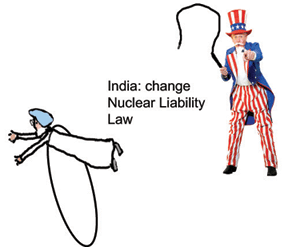 PM compromising on nuclear act is India’s gift to US companies: BJP http://www.firstpost.com/politics/pm-compromising-on-nuclear-act-is-indias-gift-to-us-companies-bjp-1120813.html?utm_source=ref_article Sep 19, 2013 New Delhi: The BJP today said reports of India compromising on crucial clauses in the Nuclear Liability Act regarding fixing of liability is “worrisome” and alleged Prime Minister Manmohan Singh has allowed this to give a gift to American companies during his forthcoming visit to the US.
The main opposition insisted a decision on the issue should be taken after due diligence and no step should be taken that imperils the safety of Indians or compromises the nation’s security.
“The reported media observation that government is trying to compromise the importance of Section 17 (b) of the Nuclear Liability Act passed by Parliament is very worrisome and a cause of serious concern,” Deputy Leader of BJP in Rajya Sabha Ravi Shankar Prasad told PTI.
He maintained that Section 17 (b) of the Nuclear Liability Act specifically fixes the responsibility of the manufacturer of nuclear reactors and provides for their liability in the event of an accident involving design or manufacturing fault. The Opposition parties, including the Left, have been up in arms against an opinion of Attorney General Goolam Vahanvati to the Department of Atomic Energy that it is for the operator of a nuclear plant in India to decide whether it wished to exercise the “right of recourse” provided under Section 17 of the Act. “By this, the whole liability of the manufacturer is sought to be compromised and the entire mandate of Parliament is being disobeyed,” Prasad said.
Manmohan Singh tries to kow tow to USA on Nuclear Liability Law
Since 17(b) suggests Parliament intended to hold suppliers responsible even if there is no contractual liability, it is not clear how a public sector undertaking like NPCIL, which is answerable to Parliament, could give its suppliers a free pass.
Manmohan may carry nuclear liability dilution as gift for U.S. companies THE HINDU, SANDEEP DIKSHITJ. VENKATESAN It is for operator to exercise ‘right of recourse’ under section 17 of Civil Liability for Nuclear Damage Act
Under sustained pressure from the Obama administration, the Manmohan Singh government is looking to use the opinion of the Attorney- General to effectively neutralise a key provision of India’s nuclear liability law that would hold American reactor suppliers liable in the event of an accident caused by faulty or defective equipment.
In an opinion to the Department of Atomic Energy, which referred the matter to him on September 4, Goolam Vahanvati has said it is for the operator of a nuclear plant in India to decide whether it wished to exercise the ‘right of recourse’ provided to it by section 17 of the Civil Liability for Nuclear Damage Act.
The AG’s opinion effectively paves the way for the Nuclear Power Corporation of India Ltd, which will operate any nuclear plant using imported reactors, to repudiate a right that Parliament explicitly wrote into section 17(b) of the law to ensure that foreign suppliers don’t get away scot-free if a nuclear accident is traced back to “equipment or material with patent or latent defects or sub standard services.” Continue reading
A weapons proliferation threat: India’s nuclear submarine
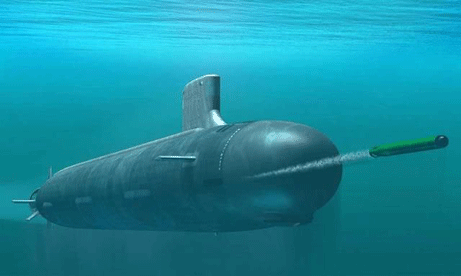 India’s Undersea Nuclear Deterrent Poses Proliferation Challenges WPR, By Yogesh Joshi, on 18 Sep 2013 Despite India’s graduation from outlier to tepidly accepted member of the global nuclear order, one area of New Delhi’s nuclear activities continues to raise alarm: its undersea nuclear deterrent. India unveiled its first nuclear submarine, the INS Arihant, in July 2009. Though the ship was largely indigenous, Russia helped in designing the miniaturized nuclear reactor. Just last month, the nuclear reactor in INS Arihant went critical, clearing the way for its final operational trials in the Bay of Bengal. India has designs to produce four to five nuclear submarines by the end of this decade. When integrated with nuclear-tipped sea-launched ballistic missiles (SLBMs), these submarines will provide India with an underwater nuclear deterrent capability.
This technical development has posed two new challenges to the nuclear nonproliferation regime. First, the highly enriched uranium (HEU) used in naval nuclear propulsion for India’s nuclear submarines could be diverted for weapons purposes. India has a dedicated enrichment facility for its naval nuclear program at Rattehali, and some of the uranium from this facility was used for India’s 1998 nuclear weapons tests. According to Princeton nuclear scientist and scholar M.V. Ramana, Rattehali has the capacity to produce 22 kilograms of 90 percent enriched uranium annually, or the equivalent of 40-70 kilograms of 45 percent enriched uranium. However, new analysis reveals (.pdf) that qualitative changes in India’s enrichment technology may have increased this capacity to 48 kilograms of 90 percent enriched uranium annually. This capacity is destined to grow as India prepares to launch more nuclear submarines in the future. ..(.subscrbers only) http://www.worldpoliticsreview.com/articles/13222/india-s-undersea-nuclear-deterrent-poses-proliferation-challenges
India again tests long range nuclear capable missile
 India boosts arsenal with nuclear-capable missile test (VIDEO) RT.com, September 15, 2013 India has conducted a second test firing of a nuclear-capable missile with a range of 5,000 kilometers. New Delhi is struggling to challenge Beijing in the race for missile dominance in Asia.
“The country has established ICBM capability with the successful second test,” said Avinash Chander, a scientific advisor to Defense Minister AV Antony, adding that the next launch would be canister-based.
‘Agni-V’ long-range ballistic missiles are about 17 meters long, with a diameter of 2 meters and a launch weight of about 50 tons, The Indian Express reported. It can carry a nuclear warhead of over 1 ton.
The missile was test-fired from Wheeler Island, off the coast of Odisha. Missile scientist and ‘Agni 5’ chief designer V.G. Sekaran said the test was an “overwhelming success and showed the reliability and maturity of the sub-systems,” the Hindu newspaper reported.
Only Russia, the US, China, France and Britain, reportedly along with Israel, which has never officially admitted to having an nuclear arsenal of its own, are believed to have such long-range weapons……http://rt.com/news/india-tests-nuclear-missile-882/
USA desperate to save its nuclear industry from being accountable for any accidents in India
‘Nuclear liability law poses challenge to Indo-US nuke deal’ Zee News, September 13, 2013, Washington: India’s nuclear liability law posed a tough challenge for implementing the “transformational” Indo-US nuclear deal though there is a very strong desire to move forward, Nisha Desai Biswal, President Barack Obama’s Indian-American nominee for a key post in South Asia, said. “I think that the 123 agreement was a transformational agreement between the relationship between the United States and India, she said at her confirmation hearing for the post of Assistant Secretary of State for South and Central Asia.
“But since that deal was enacted, I think that there has been very slow and halting progress because of the nuclear liability law in India and the hindrances that that has posed to advancing civil nuke cooperation,” she said yesterday.
…..India’s Civil Liability for Nuclear Damage Law allows the operator of a nuclear plant to seek damages from the supplier in case of a nuclear incident due to supply of equipment with latent and patent defects or sub-standard services. The US says the Indian law is not consistent with the Convention on Supplemental Compensation (CSC). http://zeenews.india.com/news/nation/nuclear-liability-law-poses-challenge-to-indo-us-nuke-deal_876374.html
Farmers of Yadgir district, India, take up legal battle against uranium mining
 Uranium mining: State defies Centre http://www.deccanchronicle.com/130908/news-current-affairs/article/uranium-mining%E2%80%88state-defies-centre DC | K.N. Reddy Gulbarga: Upset with the decision of authorities of the revenue department to resume acquisition of land around Saidapur, Diggi and Gogi villages for extraction of Uranium, farmers of Yadgir district have decided to resume their agitation as well as approach the court for justice.
Farmers were relieved when the Union ministry of environment and forests issued an order scrapping the mining unit three months ago. District authorities, however, continued with the process of acquisition of land after halting it temporarily.
According to information available, the district authorities have acquired 163 acres and four guntas of land in Saidapur and Diggi for mining Uranium.
The plant would be set up on a hillock where the borders of Saidapur, Umaradoddi and Diggi villages meet. While 46 acres and 15 guntas have been acquired in Saidapur village, followed by 116 acres and 32 guntas in Diggi village limits, and 49 acres and 19 guntas under Gogi and Umaraddi village limits.
“We cannot even buy a 30 X 40 ft site in our village with the compensation amount awarded for an acre of our land. How can we accept this? We will launch an agitation against this” says Bhimareddy Patil, President of Raithara Horata Samiti.
When contacted, deputy commissioner of Yadgir F M Jamadar admitted that authorities have resumed acquisition of land acquisition. “We are doing this as we have not received any intimation from the government directing us to stop the land acquition process,” he added.
Asked about the order of the Union government, scrapping the unit, Jamadar said “the Centre may have issued the order asking Uranium Corporation of India Limited to wind up the project. But we have received no information to stop the land acquition process.”
India, Japan, negotiating purchase of nuclear reactors
 India, Japan to restart nuclear talks today NEW DELHI, DHNS: Sep 3, 2013 India will continue to stonewall pressure from Japan to convert its unilateral moratorium on nuclear tests into a bilateral commitment, even as the two countries are set to restart negotiations on a proposed agreement for cooperation in civilian use of atomic energy on Tuesday.
Over two years after the accident at its Fukushima Daiichi nuclear plant prompted Japan to pause talks with India for a bilateral civil nuclear cooperation agreement, the process is now set to resume. The negotiations, however, are likely to be tough, as New Delhi will resist Tokyo’s pressure to add a clause to the agreement providing for termination of bilateral cooperation in the event of a nuclear test conducted by India.
Sources told Deccan Herald that India would also insist on protecting its right to reprocess the fuel spent on nuclear reactors to be procured under the agreement with Japan.
Two officials of the Ministry of External Affairs—Joint Secretary (East Asia) Gautam Bambawale and Joint Secretary (Disarmament) Bala Venkatesh Varma—are in Tokyo to restart the talks……. http://www.deccanherald.com/content/354971/india-japan-restart-nuclear-talks.html
No great future for nuclear power in India
Nuclear: Playing a marginal role http://www.thehindubusinessline.com/industry-and-economy/nuclear-playing-a-marginal-role/article5082669.ece 1 Sept 13, M. RAMESH Limping all the way, the first unit of the 2,000 MW Kudankulam Nuclear Power Project in Tamil Nadu achieved criticality on July 13, two decades after it was conceived.
With it, the country’s total nuclear power capacity has risen to 5,780 MW. Assuming that Kudankulam’s second unit will start producing electricity eventually, the number will increase by 1,000 MW.
Currently, there are five nuclear power plants coming up: Rawatbatta in Rajasthan (two units of 700 MW each), Kakrapar in Gujarat (2×700 MW), and Kalpakkam in Tamil Nadu (one prototype fast breeder reactor of 500 MW). Together, these add up to 4,300 MW. When they are all on stream — scheduled to happen by 2016 — India’s nuclear power capacity will be a little over 10,000 MW.
The nuclear establishment, though, has been speaking of 20,000 MW by 2020 and 60,000 MW by 2032. However, the road beyond the first 10,000 MW is rough, for reasons, economic and human.
On paper, the plans involve the Russians, the French and the Americans. Kudankulam 3 & 4, and perhaps 5 & 6, have been offered to the Russians (Rosatom); Chhayamithi Virdi in Gujarat and Kovvada in Andhra Pradesh to the Americans (Westinghouse and GE, respectively); and Jaitapur, Maharashtra, to the French (Areva), for six units of 1,650 MW each.
The Nuclear Power Corporation of India will build these plants, with reactors supplied by the companies. NPCIL also plans a bunch of 700 MW projects in several places.
But the future looks bleak. Kudankulam 3 & 4 are estimated to cost Rs 40,000 crore. Negotiations will take years and the exchange rate of the US dollar, in which prices are denominated, is certain to be higher. The very economic viability of these projects is thus under question.
There will also be protests and litigation. India has a track record of 325 reactor years of safe operation. However, that is not going to stop protestors.
Secrecy and inadequacy in India’s nuclear regulation
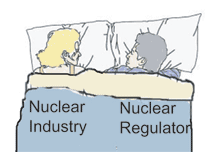 INADEQUACY of Indian Nuclear Regulation Manifest in Reactor Accident IEEE Spectrum, By Bill Sweet
29 Aug 2013 It is no secret that India still lacks a politically independent nuclear oversight authority that is well separated from the industry it oversees. The Fukushima nuclear catastrophe was a recent reminder of just how important it is to have independent nuclear oversight, a lesson already driven home a generation before by the serious U.S. accident at Three Mile Island (TMI). The stubborn refusal of India’s government to set up the kind of regulatory authority that is so obviously needed means, in effect, that one cannot have real confidence in a nuclear program that could in principle be one of the world’s most important.
A telling but little-known and little-discussed example of what can happen under weak regulatory circumstances was a serious accident that took place at India’s Narora reactor in March 1993,, an incident that “came close to joining Chernobyl and Fukushima in the annals of industrial civilization,” as writer Madhusree Mukerjee put it in a recent review of M.V. Ramana’s The Power of Promise: Examining Nuclear Power in India (Penguin/Viking, 2012)……….
Book ‘The Power of Promise’ -India’s nuclear industry rotten to the core
 In case of a catastrophic accident, almost the entire fiscal burden will be borne by Indians – as will, of course, all the death and despair. What is worse, as Ramana points out, the reactor suppliers now have diminished incentive to ensure quality and safety……
A rotten core 26 August 2013 By Madhusree Mukerjee M V Ramana’s book dissects India’s nuclear-power lobby to expose its lies and deceit. “……The delusions If the majority of Indians are unaware of the risks, it may be because they have been always kept in the dark about nuclear matters. Ramana demonstrates that the nuclear establishment in India has insulated itself from the people it purports to serve by means of a culture of secrecy and mendacity that obscures the true fiscal, environmental and human cost of nuclear energy. By publishing The Power of Promise, he has opened the windows of a long-shuttered room and let the sunlight stream in.
Nuclear deterrence – a dangerous myth
 Nuclear deterrence is overrated, THE HINDU RAMESH THAKUR , 23 Aug 13 The real risks and costs of having these weapons, both monetary and human, far outweigh their security benefits The Indian Navy has figured in three recent, global news items. The launch of the indigenously developed aircraft carrier, INS Vikrant, expected to be operational by 2018, makes India only the fifth country after the United States, Russia, the United Kingdom and France to have such capability. …. The strategic rationale is to acquire and consolidate the three legs of land, air and sea-based nuclear weapons to underpin the policy of nuclear deterrence. Unfortunately, however, the whole concept of nuclear deterrence is deeply flawed.
Desensitised
Nuclear weapons are uniquely destructive and hence uniquely threatening to our common security. There is a compelling need to challenge and overcome the reigning complacency on the nuclear risks and dangers, to sensitise policy communities to the urgency and gravity of nuclear threats and the availability of non-nuclear alternatives as anchors of national and international security.
A nuclear catastrophe could destroy us any time. Because we have learnt to live with nuclear weapons for 68 years, we have become desensitised to the gravity and immediacy of the threat. The tyranny of complacency could yet exact a fearful price if we sleepwalk our way into a nuclear Armageddon. It really is long past time to lift the shroud of the mushroom cloud from the international body politic. Continue reading
Effect of public opposition to nuclear power, USA project in India cancelled
US company nukes Rs 2724 cr nuclear parts project at Vizag Manish & Swati Rathor, TNN | Jul 26, 2013, “….. US player Brighton Energy Corporation Ltd’s Rs 2724 crore megaproject to make forged steel components for use in nuclear power plants was to come up inVisakhapatnam district. According to officials of the Andhra Pradesh Industrial Infrastructure Corporation (APIIC), the project planned by US player in Nakkapalli mandal of the district has been shelved. ….
Nuclear nationalism – the dangerous hubris
The dangers of nuclear hubris, Praful Bidwai Thursday, Jul 25, 2013, Agency: DNA Nuclear weapons and aggression always go together. So do nuclear weapons, hubris and machismo. Aggressiveness — and readiness to wreak mass destruction or inflict great cruelties upon an adversary’s civilians — lies at the heart of the nuclear weapons rationale, the acceptance and normalisation of their mind-numbing violence, and the development and deployment of such armaments, whether they are used or not.
Nuclear deterrence seeks security through terror, by threatening the enemy with “unacceptable” damage. As the Dr Strangelove film shows, nuclear scientists and experts quintessentially, yet naturally, imbibe deeply cynical, male-supremacist and pathologically aggression-prone attitudes. Many of them personally, literally, exude violence.
Criminal charges against India’s Kudankulam anti nuclear protestors
Kudankulam: Criminal cases against nuclear plant protestors to stay A Subramani, TNN | Jul 23, 2013 CHENNAI: The situation in Kudankulam is neither conducive nor ripe for withdrawal of criminal cases registered against the anti-nuclear power plant activists, the Tamil Nadu government informed the Madras high court on Tuesday.
When three PILs seeking fulfillment of 15 conditions laid down by the Supreme Court prior to the operationalisation of the nuclear power plant and also for withdrawal of cases against the agitating activists came up for hearing before the first bench, advocate general of Tamil Nadu A L Somayaji said: “The stage is not ripe for withdrawal of criminal cases already filed.”
Somayaji told the bench comprising acting Chief Justice R K Agrawal and Justice M Sathyanarayanan that the agitators faced cases for snatching a pistol, holding ‘marana porattam’ (stir unto death) and fishing boycott. He said their agitations continued even after the apex court ruling and they were targeting the unit-II of the plant as well.
Pointing out that the tenor of the apex court’s condition no. 14 that endeavours should be made to withdraw cases against the agitators was different from other conditions such as AERB and NPCIL clearances for operationalisation of the plant, Somayaji said there was no positive sign for the state government to drop the cases. ……http://timesofindia.indiatimes.com/city/chennai/Kudankulam-Criminal-cases-against-nuclear-plant-protestors-to-stay/articleshow/21280617.cms?
1 This Month
19 February – VIRTUAL EVENT-Decision Time: AI and Our Nuclear Arsenal
12:45 p.m. Central / 1:45 p.m. Eastern
To see nuclear-related stories in greater depth and intensity – go to https://nuclearinformation.wordpress.com
-
Archives
- February 2026 (141)
- January 2026 (308)
- December 2025 (358)
- November 2025 (359)
- October 2025 (376)
- September 2025 (258)
- August 2025 (319)
- July 2025 (230)
- June 2025 (348)
- May 2025 (261)
- April 2025 (305)
- March 2025 (319)
-
Categories
- 1
- 1 NUCLEAR ISSUES
- business and costs
- climate change
- culture and arts
- ENERGY
- environment
- health
- history
- indigenous issues
- Legal
- marketing of nuclear
- media
- opposition to nuclear
- PERSONAL STORIES
- politics
- politics international
- Religion and ethics
- safety
- secrets,lies and civil liberties
- spinbuster
- technology
- Uranium
- wastes
- weapons and war
- Women
- 2 WORLD
- ACTION
- AFRICA
- Atrocities
- AUSTRALIA
- Christina's notes
- Christina's themes
- culture and arts
- Events
- Fuk 2022
- Fuk 2023
- Fukushima 2017
- Fukushima 2018
- fukushima 2019
- Fukushima 2020
- Fukushima 2021
- general
- global warming
- Humour (God we need it)
- Nuclear
- RARE EARTHS
- Reference
- resources – print
- Resources -audiovicual
- Weekly Newsletter
- World
- World Nuclear
- YouTube
-
RSS
Entries RSS
Comments RSS
 nuclear-news