Bomb explosion near Kudankulam nuclear reactor – 6 killed
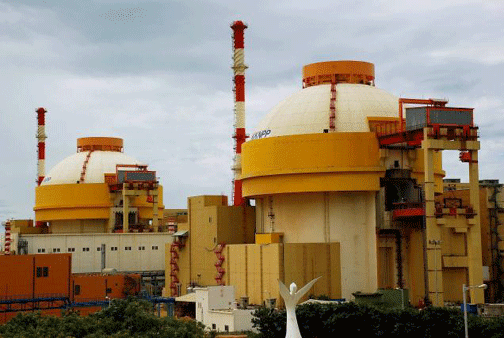 Bomb explodes near Indian nuclear reactor,THE AUSTRALIAN, ROBIN PAGNAMENTA THE TIMES NOVEMBER 29, 2013 A BOMB has exploded close to India’s biggest nuclear power station, killing six people and prompting a police investigation into whether it was linked with anti-nuclear protests in the area. The device exploded in a village close to Kudankulam in the southern state of Tamil Nadu, destroying at least two houses and seriously injuring three people. Among the six killed were a woman and three young children.
Vijayendra Bidari, a police spokesman, said the house in which it exploded was being used as a “bomb-making facility” in a village where anti-nuclear activists had been operating. He said the bomb apparently detonated accidentally as the suspected activists were building it. Two unexploded bombs were recovered from the site. The blast occurred about 1km from the Russian-built plant, which started operating last month – six years later than was planned – despite protests from locals who fear a nuclear accident.
Kudankulam lies in a seismically active area and the coastal zone was affected by the 2004 tsunami. Activists fear there could be a repeat of the 2011 Fukushima nuclear disaster in Japan.
SP Udayakumar, the founder of the People’s Movement Against Nuclear Energy, the main anti-nuclear group in the region, denied involvement in the bomb-making. “We made it clear immediately that we have nothing to do with the bomb blasts,” he said.
- Mr Udayakumar said he believed gangs associated with illegal mining were behind the blasts. – ………:
- –
India’s Jaitapur nuclear power plans hit financial problems
 Plans for Western India Nuclear Project Hit Hurdle -Official By Saurabh Chaturvedi MUMBAI--India’s plans for setting up one of the country’s biggest nuclear power projects in its western region have been hampered due to a rise in the cost of equipment to be secured from French supplier Areva S.A. (AREVA.FR), a senior Indian government official said Thursday.
India’s state-owned monopoly Nuclear Power Corp. had signed an initial pact  with Areva in 2010 for the supply and installation of equipment needed for building two nuclear power reactors of 1,650 megawatts each at Jaitapur in the western state of Maharashtra. The plan is to eventually build a total of six reactors with a combined capacity of 9.9 gigawatts, which would be the biggest nuclear power complex in India at a single location.
But the cost of the equipment has risen due to the higher cost of borrowing as well as a slide in the rupee’s value against the U.S. dollar this year, which would more than double the cost of electricity generation from an initial estimate of about 4 rupees (6.4 U.S. cents) per unit.
“The price of electricity from the project once it becomes operational can not be more than 6.50 rupees,” said R.K. Sinha, chairman of India’s Atomic Energy Commission, the country’s top nuclear policy making body. “Negotiations are still on.”
An Areva India executive, who declined to be named, said negotiations on the sale of the equipment are still under way, while Areva India chairman and managing director Erwan Hinault didn’t immediately respond to emailed queries.
Nuclear Power Corp. had earlier expected to sign an agreement with Areva for the supply of equipment for the first two reactors by end-2012, but negotiations remained inconclusive. Global nuclear equipment companies such as Areva, GE Hitachi Nuclear Energy and Westinghouse Electric Co. have been keen to capitalize on India’s plans to spend billions of dollars to boost its nuclear power capacity. More than half of India’s 228 gigawatts of total power generation capacity is based on coal, which is in short supply…. http://online.wsj.com/article/DN-CO-20131128-003020.html?dsk=
Intrepid Medha Patkar aims to stop nuclear power project in Srikakulam district of Andhra Pradesh.
 Medha Patkar raises pitch against proposed nuclear plant in AP Zee News, November 27, 2013, Srikakulam (AP): Activist Medha Patkar has opposed a nuclear power plant coming up at Kovvada village in Srikakulam district of Andhra Pradesh.
She was addressing a meeting of local fishermen who are opposing the project, fearing displacement.
“The government’s move of ordering acquisition of about 2,000 acres of land for the nuclear plant is nothing but violation of human rights,” she alleged.
Local leaders have alleged that around 9,000 local fishermen families will lose their livelihood if the project comes up. ……….http://zeenews.india.com/news/andhra-pradesh/medha-patkar-raises-pitch-against-proposed-nuclear-plant-in-ap_892835.html
Renewable energy agreement between India andBelgium
India, Belgium agree to promote renewable energy cooperation By PTI | 27 Nov, 2013, NEW DELHI: India and Belgium agreed to strengthen, promote and develop renewable energy cooperation besides exploring joint research opportunities in the sector. The decision was made during a bilateral meeting between New and Renewable Energy minister Farooq Abdullah and Princess Astrid of Belgium. Princess Astrid is currently on a visit to India as head of a large Belgian Economic Mission.
“After detailed discussions, the two sides agreed to start work on a MoU in the field of renewable energy between both the governments in order to strengthen, promote and develop renewable energy cooperation between the two countries on the basis of equality and mutual benefit,” it said.
Briefing the visiting delegation on the energy situation in India and rapid growth in this sector, Abdullah spoke about India’s plan of adding over 30GW of renewable energy in its energy mix in the next five years.
Offering all possible assistance to enhance cooperation in this sector, Abdullah also highlighted India’s conducive and investor friendly policy framework for promoting renewable energy in a big way. The minister also talked about the success of the wind programme as well as the significant cost reductions in solar energy through the Jawahar Lal Nehru National Solar Mission. http://economictimes.indiatimes.com/articleshow/26476932.cms?utm_source=contentofinterest&utm_medium=text&utm_campaign=cppst
6 deaths in explosion near Kudankulam Nuclear Power Project.
Explosion at Idinthakarai claims 6 lives, THE HINDU P. SUDHAKAR 26 NOV 13, Six persons, including two children and a woman, were killed and a few others injured seriously on Tuesday evening when country bombs exploded in a house at Tsunami Colony at Idinthakarai, the epicentre of protests against the Kudankulam Nuclear Power Project.
Police fear the toll could rise as people might have been trapped under debris.
One presumption is that that the country bombs exploded when the miscreants were engaged in making a bomb in the house. Police suspect the explosion could be because of rivalry between two groups who hail from Kooththenkuzhi, about 6 km from Idinthakarai…….http://www.thehindu.com/news/national/tamil-nadu/5-killed-in-blast-at-hub-of-antikudankulam-protests/article5394541.ece
Japan, USA, France, (not India) gain from nuclear sales to India
India shouldn’t buy what Japan is selling, Live Mint, 4 Nov 13, Materials of substandard quality have already been installed in Kudankulam plant, says former chairman of AERB Pankaj Mishra ……… there are also broader political and economic compulsions behind the new proliferation of nuclear technologies.Japan’s conservative leaders want to preserve their nuclear option, even if that risks provoking South Korea and a devastating arms race in north Asia. Worried by Japan’s unused plutonium supply, the US, as the Wall Street Journal reported in May, is pushing to restart nuclear reactors in Japan.

India’s nuclear industry not really safe – new book
In recent years, some of the crucial Russian suppliers of components to the plant have been detained in Russia and indicted for shoddy business practices.
 A new book, The Power of Promise: Examining Nuclear Energy in India by Princeton University physicist M.V. Ramana, takes a sober—and sobering—look at the fantasies and perils attached to this mirage, and finds the promise of nuclear energy empty in every way: environmental, economic and technological.
The more disturbing parts of Ramana’s book deal with the neglect of safety by the nuclear establishment. Recounting various alarming “incidents” in recent decades, he inspires little confidence in India’s ability to avoid a major disaster such as Chernobyl or Fukushima.
 India shouldn’t buy what Japan is selling, Live Mint, 4 Nov 13, Materials of substandard quality have already been installed in Kudankulam plant, says former chairman of AERB Pankaj Mishra
  An obsession with nuclear power makes many political elites secretive, ruthless and delusional, even as their cherished projects threaten millions of people with disaster. But the egregious examples I have in mind here aren’t Iran, Pakistan and North Korea. They are Japan and India, two countries with democratic institutions.
India is NOT watering down its Nuclear Liability Law to suit USA’s nuclear salesmen
India in 2010 passed a law making suppliers of nuclear reactors and other equipment liable for any accidents. This spooked companies that wanted to sell nuclear technology
Local media last month reported that the government may dilute the nuclear-liability law in order to push through the deal with Westinghouse.
“No compromise of any kind has been made,” said the official at the Department of Atomic Energy. “All these reports are false.”
 India Official: Won’t Relax Nuclear-Liability Rules Nuclear Power Corp. of India, Westinghouse Sign Preliminary Contract WSJ, By BIMAN MUKHERJI 2 Oct 13
NEW DELHI—India won’t relax a law holding suppliers of nuclear-power equipment responsible for accidents, a senior government official said Thursday, denying media reports that suggested it could bend rules to allow a reactor-supply deal with Westinghouse Electric Co. to go through.
State-run Nuclear Power Corp. of India Ltd. signed a preliminary contract with U.S.-based Westinghouse late last month, the Indian company said. Westinghouse didn’t reply to emailed questions. Continue reading
USA – India nuclear sales deal
 India, US seal first commercial deal on civil nuclear power http://zeenews.india.com/news/delhi/india-us-seal-first-commercial-deal-on-civil-nuclear-power_879777.html 28 Sept 13 Washington: India and the US have reached the first commercial agreement on civilian nuclear power, five years after a landmark deal between the two countries was clinched.
Addressing a joint media interaction after talks with Prime Minister Manmohan Singh, President Barack Obama disclosed that the two countries have sealed the agreement.
“We’ve made enormous progress on the issue of civilian nuclear power, and in fact, have been able to achieve just in the last few days an agreement on the first commercial agreement between a US company and India on civilian nuclear power,” Obama said.
 India’s nuclear operator NPCIL (Nuclear Power Corporation of India Limited) and US firm Westinghouse have signed an agreement that will pave the way for setting up an atomic plant in India.
However, there was no word on the tough nuclear liability clause in the Indian laws over which the US firms had strong objections.
There was a major uproar in India last week over the agreement because of apprehensions that it entailed bypassing the Civil Nuclear Liability Law in place in the country by waiving the operator’s right to recourse with the supplier.
Rural India’s growing opposition to nuclear power
“We have not forgotten the criminal record of ‘Union Carbide’s now Dow Chemical’ in theBhopal gas tragedy and the shameless episode of Indian politicians letting the culprits goes Scott-free: both physically and in terms of adequate liability for the horrendous disaster,” the activists stated.
Communities near the existing nuclear facilities in Tarapur, Rawatbhata, Kalpakkam, Kaiga, Kakrapar and Hyderabad have also been raising voices against radiation leaks and their harmful effects. Existing and proposed new uranium mines in Jharkhand, Andhra Pradesh and Meghalaya have also met with massive protests.

Mith Virdi Nuclear Power Project faces opposition from villagers http://economictimes.indiatimes.com/news/news-by-industry/energy/power/mith-virdi-nuclear-power-project-faces-opposition-from-villagers/articleshow/22929250.cms By Mitul Thakkar, ET Bureau | 23 Sep, 2013 NEW DELHI: Activists against proposed nuclear power project at Mith Virdi in Bhavnagar district of Gujarat are planning a 40 km rally with participation from over 50 villages to mark their protest. Bhavnagar Jilla Gram Bachao Samiti, Gujarat Anu-urja Mukti Andolan and Paryavaran Suraksha Samiti are taking the lead in the protests against 6,000 mw nuclear fired power project. They decided to register their opposition through rally after they learnt that the government of India is moving to further dilute the Nuclear Liability Act to seal the nuclear deal with the US government during Prime Minister’s visit to Washington soon.
Farmers’ movement aims to stop India’s Mithivirdi nuclear plant
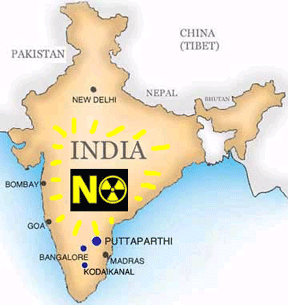 Farmers protest against Mithivirdi nuclear plant http://timesofindia.indiatimes.com/city/rajkot/Farmers-protest-against-Mithivirdi-nuclear-plant/articleshow/22951094.cms TNN | Sep 23, 2013, RAJKOT: Farmers from 30 villages located around the proposed site of 6,000 MW nuclear power plant in Mithivirdi, about 40 km from Bhavnagar, took out the protest rally fromJaspara village to Bhavnagar against the move to set up the power plant.
Throughout their 40km yatra, farmers shouted slogans like ‘Amne pani apo, anu-vijali nahi’ (we want water, not nuclear power) and ‘Jan daisu, zamin nahi’ (we will give our lives, but not land).
Among those who participated in the rally were former BJP MLA from Mahuva Dr Kanubhai Kalsaria and former minister of state for home Gordhan Zadaphia.
“If you want to give us anything, give us irrigation water and we will be happy practicing agriculture,” an agitating farmer from Jaspara village Sonal Gohil said.The farmers have been claiming that the major chunk of 777.8 hectares of land that is proposed to be acquired for the nuclear plant is fertile.
Activists, including veteran Gandhian Chunibhai Vaidya, Dr Kalsaria, former finance ministerSanat Mehta and Rohit Prajapati have been leading the agitation against the project since 2010. They have been raising concerns on threat of radiation.
Over 290 farmers submitted their affidavits saying they don’t want a power plant at the cost of their fertile land to district collector Pravin Solanki.
The plant is proposed to be built by acquiring land in Jaspara, Mandva, Khadpar and Mithivirdi villages. The project is to be implemented in three phases.
Prime Minister Abe on nuclear marketing visit to India
Shinzo’s Delhi visit is an extension of his 2007 secret deal with Dick Cheney in Tokyo where a quadrilateral alliance in the Asia-Pacific region was sealed with the US, Japan, Australia and India as partners to contain and confront China and its allies North Korea and Russia. The nuclear mafia rules OK!
 The Japan-India Nuclear Energy Deal Manmohan Singh’s Atomic Pile May Become Critical after Shinzo Abe’s Deal By Arun Shrivastava Global Research, September 22, 2013 Japanese Prime Minister Shinzo Abe is coming to India to discuss a ‘range of issues;’ the truth is that he is coming here as chief salesman of global nuclear industry, now collapsing under the collective onslaught of nuclear scientists, nuclear power plant engineers, physicists, investigative journalists and people.
Shinzo is known for many things: dogged attempts at reviving Japan’s nuclear industry, his alleged connections with Japan’s notorious mafia, Yamaguchi-gumi. Continue reading
India’s Dept of Atomic Energy wants help in winning hearts and minds towards nuclear power
More important, DAE touched upon the growing protest against nuclear energy in India and told US industry members they would have to address ideological opposition in this regard and also safety- related concerns and public awareness. US industry would also have to tackle issues relating to land acquisition and resource mobilisation.
DAE invites US firms to be part of India’s nuclear story http://www.business-standard.com/article/economy-policy/dae-invites-us-firms-to-be-part-of-india-s-nuclear-story-113092000753_1.html Sanjay Jog | Mumbai September 23, 2013 A high-level delegation of the Department of Atomic Energy (DAE) in Vienna rolled out a red carpet for US industry to invest in the nuclear capacity addition programme. India proposes to increase its nuclear capacity to 63,000 Mw by 2032 from the present level of 4,780 Mw, with a mix of indigenous reactors and also through foreign technical cooperation.
The DAE, however, in no uncertain terms told the US industry delegation the companies would have to meet Indian regulatory requirements. Indian laws would be applicable to them, though the presentation did not make a mention of the civil nuclear liability law.
A couple of global nuclear reactor supplier companies have raised serious objections against our civil nuclear liability law. The DAE team, led by Atomic Energy Commission (AEC) chief R K Sinha, was in Vienna to attend the International Atomic Energy Agency’s 57th general conference between September 16 and 19. Continue reading
Serious legal problems for India in weakening Nuclear Liability

The Act does have its flaws but it has raised some key challenges to international liability principles that historically insulated the supplier from liability in practically all situations. It should be borne in mind that these provisions will be interpreted by an Indian court in the context of a nuclear incident. Any watering down of the law by the operator offering waivers of statutory provisions would only increase the ambiguities, and is in no one’s interests, including those of the foreign suppliers.
Don’t waver now on nuclear liability THE HINDU, MOHIT ABRAHAM M. P. RAM MOHAN , 20 SEPT 13, India’s Civil Liability for Nuclear Damages Act, 2010 (the Act), was a watershed moment in international nuclear liability jurisprudence because of the unique way in which
 it dealt with supplier liability. Up until this enactment, all liability in relation to a nuclear power plant was channelled exclusively to the operator. The only two situations in which a operator could claim a subsequent right of recourse against a supplier under international liability law as well as under domestic law of other countries were i) where the nuclear incident arose out of an act or omission by the supplier with an intent to cause damage (which is covered under Section 17(c) of the Act); and ii) a contractual right of recourse (which is covered under Section 17(a) of the Act).
The Act however, also introduced a novel concept of supplier liability in Section 17(b) by which the operator would have the ability to reclaim any compensation it may pay, from a supplier, if the product supplied has patent or latent defects or the service provided is substandard.
Section 17(b)
This expanded concept of supplier liability is vehemently resisted by major supplier countries including the United States, Russia and France, Continue reading
“Confidentiality Agreement” on nuclear sales USA to India
Decks cleared for nuclear pact with US firmIndrani Bagchi, TNN | Sep 21, 2013 NEW DELHI: India and the US have cleared the decks for a pre-early works agreement betweenNPCIL and US nuclear company, Westinghouse. National security adviser (NSA) Shivshankar Menon said, “The two sides have resolved all government-to-government permissions and understandings required for enabling commercial negotiations”. The two sides signed a “confidentiality agreement” last week that would allow both sides to share confidential data with each other.

Speaking at an event at Aspen Institute on Friday, Menon said the Atomic Energy Regulatory Board (AERB) will soon begin safety evaluations of Westinghouse’s AP1000 nuclear reactor that they propose to sell to India.Westinghouse is already building four of these reactors in China, the first of which is expected to begin operations next year…… http://timesofindia.indiatimes.com/india/Decks-cleared-for-nuclear-pact-with-US-firm/articleshow/22828566.cms
1 This Month
19 February – VIRTUAL EVENT-Decision Time: AI and Our Nuclear Arsenal
12:45 p.m. Central / 1:45 p.m. Eastern
To see nuclear-related stories in greater depth and intensity – go to https://nuclearinformation.wordpress.com

-
Archives
- February 2026 (141)
- January 2026 (308)
- December 2025 (358)
- November 2025 (359)
- October 2025 (376)
- September 2025 (258)
- August 2025 (319)
- July 2025 (230)
- June 2025 (348)
- May 2025 (261)
- April 2025 (305)
- March 2025 (319)
-
Categories
- 1
- 1 NUCLEAR ISSUES
- business and costs
- climate change
- culture and arts
- ENERGY
- environment
- health
- history
- indigenous issues
- Legal
- marketing of nuclear
- media
- opposition to nuclear
- PERSONAL STORIES
- politics
- politics international
- Religion and ethics
- safety
- secrets,lies and civil liberties
- spinbuster
- technology
- Uranium
- wastes
- weapons and war
- Women
- 2 WORLD
- ACTION
- AFRICA
- Atrocities
- AUSTRALIA
- Christina's notes
- Christina's themes
- culture and arts
- Events
- Fuk 2022
- Fuk 2023
- Fukushima 2017
- Fukushima 2018
- fukushima 2019
- Fukushima 2020
- Fukushima 2021
- general
- global warming
- Humour (God we need it)
- Nuclear
- RARE EARTHS
- Reference
- resources – print
- Resources -audiovicual
- Weekly Newsletter
- World
- World Nuclear
- YouTube
-
RSS
Entries RSS
Comments RSS
 nuclear-news