Punjab Chief Minister Amarinder Singh warns on Pakistan’s readiness to use nuclear weapons
|
Pakistan will not hesitate to go nuclear in war with India: Amarinder Singh, “Whether it was one killed or 100, the message has gone out loud and clear that India will not let the killing of its soldiers and citizens go unpunished,” Singh said. Economic Times , 4 Mar 19, AMRITSAR: Punjab Chief Minister Amarinder Singh on Monday warned that Pakistan would not hesitate to use its nuclear arsenal if it felt it was losing out against India in a conventional war. Pointing out that both India and Pakistan were nuclear powers, he said it was not in either country’s interest to use the weapons of mass destruction but Islamabad could indulge in such a misadventure, if faced with defeat in other battles. ….. https://economictimes.indiatimes.com/news/politics-and-nation/pakistan-will-not-hesitate-to-go-nuclear-in-war-with-india-amarinder-singh/ |
|
|
The possibility of nuclear war between India and Pakistan
COULD THE CONFLICT BETWEEN PAKISTAN AND INDIA LEAD TO NUCLEAR WAR? Experts say it’s unlikely, but Pakistan’s lack of a “No First Use” doctrine for nuclear weapons means it’s not impossible. Pacific Standard, JACK HERRERA, FEB 27, 2019
In 1999, Pakistan’s foreign minister explained why the country refused to adopt a No First Use policy, declaring that Islamabad would use “any weapon” in its arsenal to defend the country. Today, experts believe that, unlike India, Pakistan could plausibly deploy a nuclear weapon in response to a conventional attack. Pakistan maintains a smaller army and less weaponry than India, and would likely be overwhelmed if the Indian military invaded Pakistani territory with its full force. Facing loss of territory and national collapse, Islamabad could decide to launch a nuclear weapon against India in an attempt to even the playing field………
Missiles That Could Kill Millions: India’s Nuclear Weapons Program, Explained,
Over 100 nukes and counting.
India has 130 to 140 nuclear warheads—and more are coming, according to a new report. “India is estimated to have produced enough military plutonium for 150 to 200 nuclear warheads, but has likely produced only 130 to 140,” according to Hans Kristensen and Matt Korda of the Nuclear Information Project at the Federation of American Scientists. “Nonetheless, additional plutonium will be required to produce warheads for missiles now under development, and India is reportedly building several new plutonium production facilities.”
In addition, “India continues to modernize its nuclear arsenal, with at least five new weapon systems now under development to complement or replace existing nuclear-capable aircraft, land-based delivery systems, and sea-based systems.”…….
It’s an ambitious program. “The government appears to be planning to field a diverse missile force that will be expensive to maintain and operate,” the report points out.
“Never Recognised India, Pakistan As Nuclear Countries,” Says China
https://www.ndtv.com/india-news/china-never-recognised-india-pakistan-as-nuclear-countries-2001316
“China has never recognised India and Pakistan as nuclear countries. Our position on this has never changed,” Chinese Foreign Ministry spokesman Lu Kang told a media briefing in Beijing.
“China has never recognised India and Pakistan as nuclear countries. Our position on this has never changed,” Chinese Foreign Ministry spokesman Lu Kang told a media briefing in Beijing.
He was replying to a question whether China would recognise North Korea as a nuclear state like India and Pakistan as talks between Trump and Kim at the second summit in Hanoi broke down over Pyongyang’s refusal to give up two nuclear processing plants.
China has been blocking India’s entry into the 48-member Nuclear Suppliers Group (NSG) on the ground that New Delhi has not signed the Nuclear Non-Proliferation Treaty (NPT).
After India applied for NSG membership, Pakistan too applied for the same following that China has called for a two-step approach which states that NSG members first need to arrive at a set of principles for the admission of non-NPT states into the NSG and then move forward discussions of specific cases.
Tensions in Kashmir: Pakistan readies for war
 Pakistan readies military, hospitals for war with its nuclear rival India after Pulwama terror attack, Business Insider
Indian and Pakistan relations have again reached a dangerous level.
If Pakistan Attacks With One Nuclear Bomb, India Can Finish Us With 20, Says Pervez Musharraf
Addressing a press conference in UAE, Pakistan’s former president said that Indian and Pakistan relations have again reached a dangerous level. News18.com February 25, 2019, New Delhi: India could “finish” Pakistan with 20 bombs if Islamabad decides to launch even a single nuclear attack on the neighbouring country, former Pakistan president Pervez Musharraf has said.
Addressing a press conference in UAE, Pakistan’s former president further said that if India launched any attack in Kashmir, Pakistan could respond in other areas in Sindh and Punjab and “could teach them a lesson”.
India: Union ministry of mines protects beaches from mining for thorium
 Private firms jolted by beach sand mining ban, Times of India M K Ananth , 24 Feb 19, MADURAI: Environmentalists fighting against rampant illegal sand mining have hailed the gazette notification by the Union ministry of mines changing the rules that earlier allowed private companies to mine rare earth minerals found on beach sand. They said the notification was much awaited and would help save the coastal treasures.
India ‘Reluctant’ Nuclear Weapon State, Committed to No-first-use Policy
India ‘Reluctant’ Nuclear Weapon State, Committed to No-first-use Policy, Says Manmohan Singh
The former prime minister referred to today’s nuclear age ‘as an age of asymmetry, asymmetry in terms of doctrines, arsenals and technology’.
The former prime minister referred to today’s nuclear age “as an age of asymmetry, asymmetry in terms of doctrines, arsenals and technology”.
With escalating tensions between India and Pakistan, could India consider a pre-emptive nuclear strike?
|
Is a pre-emptive nuclear strike on the table? https://www.livemint.com/news/india/is-a-pre-emptive-nuclear-strike-on-the-table-1550771055043.html 21 Feb 2019, India has had a long-standing policy of nuclear restraint and is believed to pursue a no first use policy
Any escalation of tensions between the nuclear-armed neighbours can have massive implications for both South Asian and global security. There has been a considerable escalation of tension between nuclear-armed India and Pakistan in the aftermath of the Pulwama attack. While the outbreak of a full-fledged conflict is no more than a distant possibility, a paper by Christopher Clary and Vipin Narang, published in the Massachusetts Institute of Technology’s journal International Security, considers the likelihood of a pre-emptive nuclear strike by India in response to Pakistan’s continued aggression as a ‘counterforce’ strategy. India has had a long-standing policy of nuclear restraint and is believed to pursue a no first use policy. However, the authors suggest that, since 2003, India has devoted considerable resources to develop nuclear capabilities far in excess of what is required for mere retaliation. In addition to these enhanced capabilities, there has been a host of public comment from both serving and retired Indian national security officials about the possibilities and strategic importance of a pre-emptive nuclear strike. These strikes, the authors argue, could potentially limit the capabilities of Pakistan’s nuclear arsenal. However, this shift in policy, or even a perceived shift, would carry major risks. It could potentially lead to an arms race in the subcontinent, and also create a vicious geo-political environment that would provide incentives for both sides to mobilize nuclear weapons first. The authors also warn that a pre-emptive strike may not destroy enough Pakistani nuclear weapons on the ground, leaving Indian defence systems vulnerable to a retaliatory nuclear attack from Pakistan. As such, though tensions are running high in the aftermath of the Pulwama attack, there is need for caution in determining the way forward. Any escalation of tensions between the nuclear-armed neighbours can have massive implications for both South Asian and global security. |
|
The real nuclear crisis: danger of India-Pakistan nuclear war
 Billions Dead: That’s What Could Happen if India and Pakistan Wage a Nuclear War, This is the real nuclear crisis the world is missing. National Interest, rmed with what they believe is reasonable intelligence about the locations of Pakistan’s strategic forces, highly accurate missiles and MIRVs to target them, and a missile defense that has a shot at cleaning up any Pakistani missiles that survived the first strike, Indian leaders might be tempted to launch a counterforce first strike.
With the world’s attention firmly fixated on North Korea, the greatest possibility of nuclear war is in fact on the other side of Asia.
That place is what could be called the nuclear triangle of Pakistan, India and China. Although Chinese and Indian forces are currently engaged in a standoff, traditionally the most dangerous flashpoint along the triangle has been the Indo-Pakistani border. The two countries fought three major wars before acquiring nuclear weapons, and one minor one afterwards. And this doesn’t even include the countless other armed skirmishes and other incidents that are a regular occurrence.
At the heart of this conflict, of course, is the territorial dispute over the northern Indian state of Jammu and Kashmir, the latter part of which Pakistan lays claim to. Also key to the nuclear dimension of the conflict is the fact that India’s conventional capabilities are vastly superior to Pakistan’s. Consequently, Islamabad has adopted a nuclear doctrine of using tactical nuclear weapons against Indian forces to offset the latter’s conventional superiority………https://nationalinterest.org/blog/buzz/billions-dead-thats-what-could-happen-if-india-and-pakistan-wage-nuclear-war-44682
India’s submarine rivalry with China in the second nuclear age
The Strategist , 15 Feb 2019|Ramesh Thakur There are substantially fewer nuclear weapons today than at the height of the Cold War. Yet the overall risks of nuclear war—by design, accident, rogue launch or system error—have grown in the second nuclear age. That’s because more countries with fragile command-and-control systems possess these deadly weapons. Terrorists want them, and they are vulnerable to human error, system malfunction and cyberattack.
The site of great-power rivalry has shifted from Europe to Asia with crisscrossing threat perceptions between three or more nuclear-armed states simultaneously. With North Korea now possessing a weaponised ICBM capability, the US must posture for and contend with three potential nuclear adversaries—China, Russia and North Korea.
The only continent to have experienced the wartime use of atomic weapons, Asia is also the only continent on which nuclear stockpiles are growing. The total stockpiles in Asia make up only 3% of global nuclear arsenals, but warhead numbers are increasing in all four Asian nuclear-armed states (China, India, North Korea and Pakistan). None of them has yet ratified the Comprehensive Nuclear-Test-Ban Treaty, although China is a signatory. Asia stands alone in nuclear testing in this century.
The Cold War nuclear dyads have morphed into interlinked nuclear chains, with a resulting greater complexity of deterrence relations between the nuclear-armed states. Thus, as I’ve previously argued, the tit-for-tat suspensions of the Intermediate-Range Nuclear Forces Treaty by the US and Russia has a significant China dimension. The nuclear relationship between India and Pakistan is historically, conceptually, politically, strategically and operationally deeply intertwined with China. While Pakistan’s nuclear policy is India-specific, the primary external driver of India’s policy has always been China.
……….the race to attain a continuous at-sea deterrence capability through nuclear-armed submarines is potentially destabilising in Asia because the regional powers lack well-developed operational concepts, robust and redundant command-and-control systems, and secure communications over submarines at sea……… https://www.aspistrategist.org.au/indias-submarine-rivalry-with-china-in-the-second-nuclear-age/
India’s Kudankulam nuclear power station means big debt to Russia
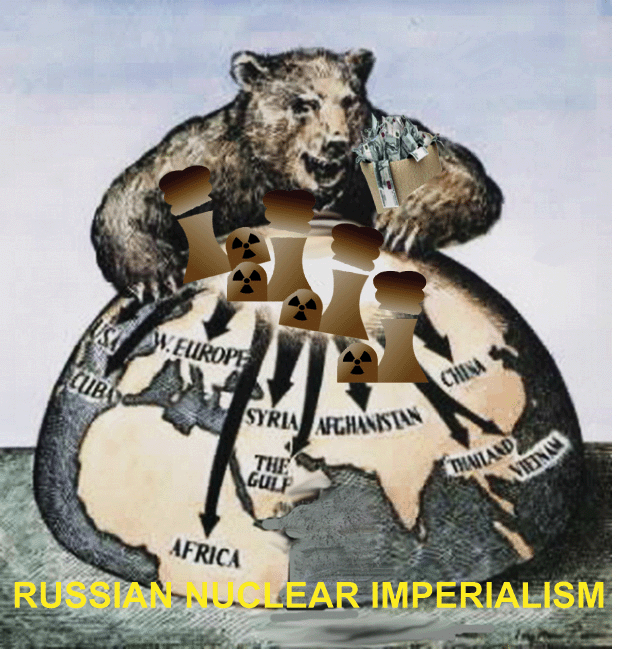 Kudankulam: Nuclear power utility struggles to repay Russia for supplies https://indianexpress.com/article/india/kudankulam-nuclear-power-utility-struggles-to-repay-russia-for-supplies-5563744/ The sanctioning of lower than requisite funds comes at a time when NPCIL’s budgetary support requirement has gone up in light of the utility taking up 10 new projects that had been cleared by the government in May 2017. by Anil Sasi |New Delhi February 1, 2019 Inadequate budgetary support to the strategic nuclear energy sector over the last two financial years has squeezed funds earmarked under the investment head for the Nuclear Power Corporation of India Limited (NPCIL), resulting in India’s frontline nuclear utility slipping back on its repayment obligations to the Russians for equipment supplies to the Kudankulam nuclear project.
The sanctioning of lower than requisite funds comes at a time when NPCIL’s budgetary support requirement has gone up in light of the utility taking up 10 new projects that had been cleared by the government in May 2017.
The problem of non-payment of Russian credit on account of a reduction in the provision for Russian credit to NPCIL was discussed before a parliamentary panel, responding to which the Department of Expenditure in the Finance Ministry subsequently “conveyed” the concerns to the Budget Division of the Department of Economic Affairs in the same Ministry for “further necessary action”.
Under a credit arrangement between the governments of Russia and India, as soon as equipment leaves Russia for Indian projects such as the nuclear station in Kudankulam, that much money is released by the Russian government to the suppliers, which then becomes a loan on the Government of India. This loan is then supposed to be routed to NPCIL by way of a budgetary provision. Against that, the same money would be given back to the Government of India so that it becomes a loan on NPCIL.
This arrangement has come under strain due to the reduction in budgetary allocation under the ‘investment in PSUs’ head, which has affected the loans payable to NPCIL towards ‘Russian credit utilisation’ that is outstanding in the books of the Controller of Aid Accounts and Audit. The CAAA is the division within the Department of Economic Affairs entrusted with the responsibility for withdrawal of loan and grant proceeds for all official development assistance where India is the recipient.
While the extent of the slip-up in the payment obligation to the Russians could not be ascertained, the trend was seen as serious enough for the Parliamentary Standing Committee on Science and Technology, Environment and Forests to flag this an issue to which the Ministry of Finance responded in the affirmative, a senior government official involved in the exercise confirmed. Queries sent to K N Vyas, Secretary of the Department of Atomic Energy and Chairman of the Atomic Energy Commission, did not elicit a response.
According to official estimates, while budgetary support to NPCIL had gone up from Rs 370 crore in the budget estimate for 2017-18 to Rs 1435 crore in the revised estimate for the year (entailing a total of Rs 685 crore under the investment head and Rs 750 crore as loan), the actual requirement in form of budgetary support submitted by the DAE was thrice that amount — Rs 4305 crore. The higher amount, official said, was primarily on account of a shortfall of earlier years in receipt of equity to the tune of Rs 402 crore and obligations under the Russian Credit of Rs 3,903 crore.
For 2018-19, while the allocation was hiked to Rs 1,665 crore in the budget estimate, it still left a funding gap of around Rs 2,870 crore, according to DAE estimates. The situation was exacerbated by 10 new projects based on the indigenous 700 MWe (mega watt electric) pressurised heavy water reactors (PHWRs) that had been sanctioned in mid-2017, due to which budgetary support requirement had also increased.
NPCIL is currently operating 22 commercial nuclear power reactors with an installed capacity of 6,780 MWe, while it has another eight reactors under various stages of construction totaling 6200 MWe capacity.
Russia and India had, in 2015, agreed to actively work on projects deploying 12 additional Light Water Reactor (LWR) nuclear reactors, for which, the localisation of manufacturing in India under the NDA government’s flagship ‘Make in India’ initiative and the commencement of serial construction of nuclear power plants was flagged as a joint initiative.
In this context, the Programme of Action for localisation between Russian state-owned utility Rosatom and the DAE was finalised during Prime Minister Narendra Modi’s Moscow visit in 2015. At the Kudankulam site, where the two Russian-designed VVER-1000 series reactors have being installed, nearly 100 Russian companies and organisations are involved in documentation, supply of equipment and controlling construction and equipping process. At the same site, four more Russian reactor units are slated to come up in the coming years.
Climate change brings water shortage to India and Pakistan
 Water wars: Are India and Pakistan heading for climate change-induced conflict? DW , 30 Jan 19,
Across the world, climate change is sparking conflict as people struggle over dwindling resources. The fight over water could quickly escalate between India and Pakistan — and both have nuclear arms.
Yemen, Somalia and Syria are just some of the places where climate change is increasingly regarded as a root cause of violent conflict. But while much of the focus on climate change-attributed conflict has predominantly been on Africa and the Middle East, a potentially even deadlier clash over resources may be looming on the horizon in Asia.
That’s because India and Pakistan — bitter rivals over water — both have nuclear weapons in their arsenal.
The two countries have a long but strained agreement over sharing water from the Indus River and its tributaries. Waters from the Indus, which flow from India and the disputed Kashmir region into Pakistan, were carved up between India and Pakistan under the 1960 Indus Water Treaty (IWT).
Read more: Water scarcity in Pakistan – A bigger threat than terrorism
The IWT divides the six major rivers of the Indus basin between Pakistan and India. Pakistan was granted rights to most of the water in the region’s western rivers — the Indus, Jhelum and Chenab — which flow through Indian-administered Kashmir.
The dispute over the Kashmir region — a flashpoint between India and Pakistan for more than six decades — is hugely intertwined with water security. Both countries claim the whole region, but each only controls a part of it.
While the IWT has managed to survive the wars and other hostilities, it is increasingly being strained to its limit. Pakistan has accused India of throttling its water supply and violating the IWT by constructing dams over the rivers flowing into Pakistan from Kashmir.
“Any country with nuclear weapons, if they’re backed into a corner because they have no water — that’s really dangerous,” said Jeff Nesbit, author and executive director of non-profit climate communication organization Climate Nexus.
‘A matter of survival’
For Sherry Rehman, Parliamentary Leader of the left-wing opposition Pakistan People’s Party (PPP) in the Senate, water security, especially in South Asia, “has become a regional security threat.”
“We are now facing challenges brought about by climate change which were not a primary focus during the negotiations for the Indus Water Treaty,” she told DW.
“It has become a matter of survival,” she continued. “Aside from the lack of formal dialogue, the rhetoric floating around suggesting a possible water war is particularly alarming.”
A treaty under threat
For Pakistan, the Indus waters are a lifeline: most of the country depends on it as the primary source of freshwater and it supports 90 percent of the country’s agricultural industry.
And while Pakistan was considered relatively plentiful with water, a mixture of mismanaged irrigation, water-intensive agriculture and climate change has reduced the Indus to a trickle in parts.
A 2018 report from the International Monetary Fund ranked Pakistan third among countries facing severe water shortages.
When the rapidly-melting glaciers in the Himalayas, which feed the Indus waters, eventually disappear as predicted, the dwindling rivers will be slashed even further…………
Elsewhere in Asia, other conflicts have also been linked to climate change. For instance the unprecedented flooding in Thailand in 2011 which sparked major protests over unfair emergency supplies distribution and ultimately led to a military coup that overthrew the democratically-elected government in 2014. The military junta is still in power to this day.
On a global level, Janani Vivekananda, climate security expert at consultancy Adelphi, is somewhat more hopeful about how the struggle over water will play out.
“The trend is people cooperate rather than fight over water because it’s just too important and I think this is what will happen just out of necessity,” she told DW. “Because there’s too much to lose.” https://www.dw.com/en/water-wars-are-india-and-pakistan-heading-for-climate-change-induced-conflict/a-47203933
Security dangers in South Asia increase as India and Pakistan develop nuclear weapons programmes
Nuclear programmes of India, Pakistan increase risk of security incident in South Asia: US spymaster, Economic Times, Jan 30, 2019 WASHINGTON: There is an increased risk of a nuclear security incident in South Asia due to continued growth and development of Pakistan and India’s nuclear weapons programmes, America’s top spymaster told lawmakers on Tuesday.
The remarks of National Intelligence Director Daniel Coats is part of US intelligence community’s assessment of worldwide threats in the year 2019.
While Pakistan continues to develop new types of nuclear weapons, including short-range tactical weapons, sea-based cruise missiles, air-launched cruise missiles, and longer range ballistic missiles, India this year has conducted its first deployment of a nuclear-powered submarine armed with nuclear missiles, he said.
“The continued growth and development of Pakistan and India’s nuclear weapons programmes increase the risk of a nuclear security incident in South Asia, and the new types .. ……..
Locals to go to court against public hearing for jetty near nuclear plant
https://www.thehindu.com/news/cities/mumbai/locals-to-go-to-court-against-public-hearing-for-jetty-near-nuclear-plant/article26044843.ece Alok Deshpande, MUMBAI, JANUARY 21, 2019 As the district administration went ahead with the public hearing for building a jetty next to the proposed 9,900 MW Jaitapur Nuclear Power Plant (JNPP) despite instructions against it from the State Environment minister and adverse reports from research institutes, locals have decided to approach the court and the Centre.
I Log Ports Private Limited has proposed developing a jetty at Nate village in Rajapur taluka of Ratnagiri, next to the site selected for the JNPP. The Hindu on Saturday reported that the Bombay Natural History Society (BNHS) in its letter to the Maharashtra Pollution Control Board pointed out that proposed jetty violates conditions stipulated in the clearance for the JNPP. Senior Shiv Sena leader and Environment minister Ramdas Kadam also wrote a letter to Ratnagiri collector Sunil Chavan to not conduct the public hearing on Saturday.
On Saturday, the hearing was conducted amid opposition from locals. District authorities said, they were asked to register their objections but no one came forward.
Satyajit Chavan, convener, Konkan Vinashkari Prakalp Virodhi Samiti, said the public hearing was illegal and unconstitutional. “The hearing shouldn’t have been held as there are legitimate questions against the environment impact assessment report. This project is against the very principle of clearance given to nuclear plant and the minister himself had ordered not to hold the hearing,” he said. There was no question of submitting objection in an illegally-held public hearing. “It was done at the behest of a private company and is unjustified for locals.”
In his letter, BNHS director Deepak Apte said that the proposed captive jetty is against the very principle of the JNPP clearance. The letter also said that Terms of Reference have not been fulfilled and so the project warrants out right rejection, making the public hearing untenable.
1 This Month
To see nuclear-related stories in greater depth and intensity – go to https://nuclearinformation.wordpress.com/
12 February – Webinar The Big Push: New Nuclear Projects in Canada
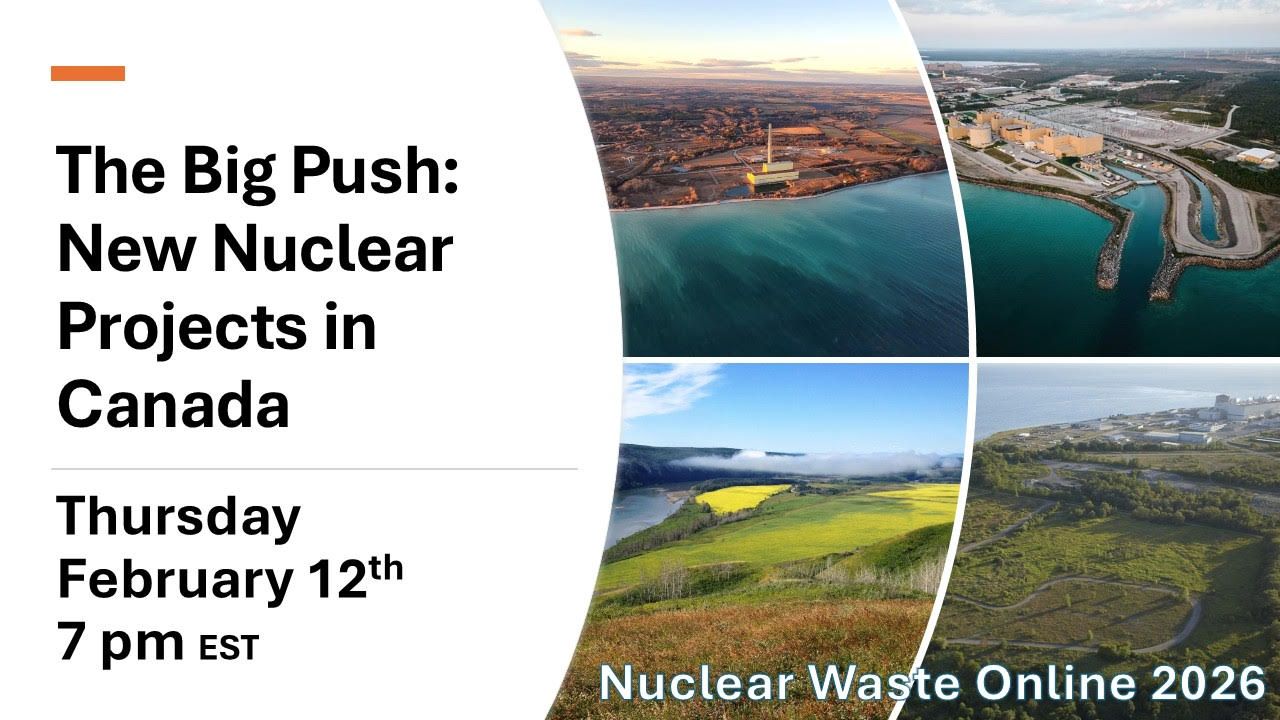
Thursday, February 12, 7 pm Eastern | 2nd of 4 sessions in the 2026 Nuclear Waste Online webinar series
Join a webinar on the push for new nuclear generation in Canada. Go to Northwatch.org to register or use the registration link https://us02web.zoom.us/webinar/register/WN_ZfWOf1GITqSRIZX8CB-A9w
-
Archives
- February 2026 (127)
- January 2026 (308)
- December 2025 (358)
- November 2025 (359)
- October 2025 (376)
- September 2025 (258)
- August 2025 (319)
- July 2025 (230)
- June 2025 (348)
- May 2025 (261)
- April 2025 (305)
- March 2025 (319)
-
Categories
- 1
- 1 NUCLEAR ISSUES
- business and costs
- climate change
- culture and arts
- ENERGY
- environment
- health
- history
- indigenous issues
- Legal
- marketing of nuclear
- media
- opposition to nuclear
- PERSONAL STORIES
- politics
- politics international
- Religion and ethics
- safety
- secrets,lies and civil liberties
- spinbuster
- technology
- Uranium
- wastes
- weapons and war
- Women
- 2 WORLD
- ACTION
- AFRICA
- Atrocities
- AUSTRALIA
- Christina's notes
- Christina's themes
- culture and arts
- Events
- Fuk 2022
- Fuk 2023
- Fukushima 2017
- Fukushima 2018
- fukushima 2019
- Fukushima 2020
- Fukushima 2021
- general
- global warming
- Humour (God we need it)
- Nuclear
- RARE EARTHS
- Reference
- resources – print
- Resources -audiovicual
- Weekly Newsletter
- World
- World Nuclear
- YouTube
-
RSS
Entries RSS
Comments RSS
 nuclear-news