India’s Parliament approves bill to open civil nuclear power sector to private firms
DailyMail, By ASSOCIATED PRESS, 19 December 2025
NEW DELHI (AP) – India´s Parliament approved new legislation Thursday that enables opening the tightly controlled civil nuclear power sector to private companies.
The government termed it a major policy shift to speed up [?] clean energy expansion while the opposition political parties argued that it dilutes safety and liability safeguards.
The lower house of parliament passed the legislation Wednesday and the upper house on Thursday. It now needs the assent from the Indian president, which is a formality, to come into force.
………….. critics say it opens the door to risks, mainly health hazards, that could have long term consequences…………..
some are skeptical about India´s ambitions as the country´s nuclear sector is still very small, and negative public perceptions about the industry remain.
Opposition parties flagged concerns related to several provisions of the bill and urged the government to refer it to a parliamentary panel for examination. The government didn´t adhere to the request.
“The bill doesn´t have sufficient safeguards when it comes to mitigating the bad health of those impacted by living in areas closer to nuclear plants,” Ashok Mittal, a lawmaker from the opposition Aam Admi Party, told The Associated Press.
G. Sundarrajan, an anti-nuclear energy activist, called the bill a “disastrous law,” saying it takes away essential safeguards that are needed to make sure companies invest in safety and reduce the chances of a major disaster that can impact millions from occurring.
“It also provides little recourse for any Indian citizen to claim damages from nuclear companies even if they are affected by radiation leaks or suffer from any other health impact as a result of a nuclear plant in their region,” he said. https://www.dailymail.co.uk/wires/ap/article-15396015/Indias-Parliament-approves-bill-open-civil-nuclear-power-sector-private-firms.html
The Building of the First Atomic Bombs Impacted Workers and Residents, Too
Eighty years after the bombing of Hiroshima and Nagasaki, workers who mined the uranium and people who lived near the test sites are still dying from exposure to radiation.
by Jim Carrier, August 7, 2025, https://progressive.org/magazine/the-building-of-the-first-atomic-bombs-impacted-workers-and-residents-too-carrier-20250807/
The road to Nagasaki was littered with radiation.
Eighty years after an atomic bomb called Fat Man was dropped, killing and poisoning about 100,000 people in Nagasaki, at least a dozen sites around the world—sites that contributed to the bomb’s creation—are still dealing with its deadly legacy.
Under the pressure to win World War II, U.S. military leaders pulled out all stops to prioritize the creation and testing of an atomic bomb, indifferent to the cost on the lives and livelihood of everyday people. Landscapes were polluted, workers were exposed to radiation, and civilian neighbors to the nuclear test sites—the first “downwinders”—were ignored or lied to.
The Manhattan Project—a top-secret research and development program created by the U.S. government during World War II to develop a nuclear bomb—sourced nearly all of its much-needed uranium from the Belgian Congo’s Shinkolobwe mine. Located in the modern-day Haut-Katanga province in the Democratic Republic of Congo, the Shinkolonwe mine was the world’s richest source of high-grade uranium, radium, and other valuable minerals. First opened in 1921, the Belgian-owned mine employed artisanal miners who dug the radioactive ore with handheld tools and carried it out in sacks on their shoulders, further exposing them to the toxic substance. While the environmental impact was visible and more difficult to conceal, any known records of lasting health impacts were disappeared by the authorities or never recorded at all.
In 1939, fearing Adolf Hitler and the German discovery of nuclear fission in uranium—with its potential to create a bomb—the mine’s manager shipped more than 1,000 tons of ore from Katanga to a warehouse on Staten Island, New York. Spilled ore contaminated a portion of the site where it sat for three years. A 1980 study later determined that the site might harm trespassers beneath the Bayonne Bridge, but by that time the site had already been demolished.
President Franklin Roosevelt’s January 19, 1942, decision to build an atomic bomb touched off the $2 billion Manhattan Project with its extraordinary mix of secret research at Los Alamos, New Mexico, and massive construction projects at Oak Ridge, Tennessee, and Hanford, Washington. All of these needed hundreds of tons of uranium to make a few pounds of plutonium.
In November 1942, the U.S. Army discovered and bought the Staten Island uranium stockpile and shipped 1,823 drums by barge and railroad to the Seneca Army Depot in Romulus, New York, where it was put into large concrete igloos before being shipped to various refineries. Now part of an Environmental Protection Agency Superfund site, the depot stored all kinds of munitions and even some classified military equipment that was burned and buried. Most of the site was cleaned up in the early 2000s and opened for recreation and industrial warehousing.
The Army’s search for uranium ore also uncovered 500 tons among vanadium tailings in western Colorado, and 300 tons at Port Hope, Ontario, Canada, where the Eldorado Gold Mines refinery processed ore into more pure concentrations. Eldorado’s own mine, on Great Bear Lake in the Northwest Territories of Canada, employed First Nations Dene workers who would later suffer cancers and die from handling sacks of ore. Their community of Délı̨nę became known as a “village of widows.” Without contemporary health records, a re-created exposure study found that overall cancer rates for Délı̨nę were “not statistically significantly different from the Northwest Territories.”
Port Hope, on the northern shore of Lake Ontario, which processed all the African and North American uranium ore for the Manhattan Project, spread tailings in neighborhoods and in the lake, eventually requiring a $1.3 billion cleanup that did not begin until 2018. Residents blame the contamination for cancers, although a 2013 study found no statistical evidence of greater radiosensitive cancers.
An enduring and poetic legend links the labors of Délı̨nę villagers to the Japanese bombs, a story told in A Village of Widows, a documentary film that followed ten Dine to Hiroshima in 1998 where they paid their respects and shared mutual sorrow with hibakusha, the Japanese word for the survivors of the atomic bombs. The uranium ore from Great Bear Lake did, in fact, contribute to the Manhattan Project—a U.S. government history found that Great Bear Lake ore amounted to one-sixth of the uranium used in the Manhattan Project, Colorado ore contributed one-seventh, and the rest came from the Belgian Congo. However, a detailed 2008 analysis of the ore’s movements concluded that “the fissile material in the Nagasaki weapon was almost certainly derived from oxide processed by Eldorado which would have been mostly of Belgian Congo origin. The same is probably true for the Hiroshima weapon. It is also possible that there was some uranium of U.S. origin in both of these weapons.”
After Port Hope, the uranium was further refined at nineteen industrial sites including: Linde Air in Tonawanda, New York; Dupont’s Deepwater Works in New Jersey; Metal Hydrides Inc. in Beverly, Massachusetts; Harshaw Chemical in Cleveland, Ohio; and at Mallinckrodt Chemical Company in St. Louis, Missouri. All of these sites have undergone expensive remediation. Mallinckrodt, whose radiation contamination caused numerous cancers in children and adults, has yet to be scrubbed clean.
Uranium salts were then delivered to either Oak Ridge, Tennessee, where the Y-12 refinery produced enriched uranium for the bomb dropped on Hiroshima, or to Hanford, Washington, where refineries produced the plutonium used in both the Trinity test bomb and the Nagasaki bomb. Both reactor sites deliberately released radioactive material into the air and water. Cleaning the mess has cost much more than the original Manhattan Project. The cost to clean Hanford, considered the most radioactive spot in the world, is estimated at $640 billion. Oak Ridge’s cleanup won’t be finished until 2050. Hanford’s effort to meld radioactive sludge into glass containers and bury them in salt caves is only beginning.

The first atomic bomb blast in history, the Trinity test of the plutonium implosion “gadget” in the Alamogordo, New Mexico, desert on July 16, 1945, left permanent marks on the land and the people downwind. The airborne plume from Trinity drifted across the Tularosa Basin, landing on vegetables, cattle, and water, poisoning residents who would later report leukemia, cancers, and heart disease. Subsequent studies have found Trinity fallout reached forty-six states, Canada, and Mexico. After five years of lobbying, the Tularosa Basin Downwinders Consortium won a two-year window—until December 31, 2028—to be included in the federal Radiation Exposure Compensation Act which covers U.S. uranium workers and downwinders exposed at the Nevada Test Site during the Cold War. As of June 24, 2025, 42,575 people have received $2.7 billion dollars. Tourists can visit the test site one day a year, on the third Saturday in October. Radiation at ground zero is ten times the region’s natural radiation.
The area around Los Alamos, where brilliant physicists and world-class machinists created the bombs that fell on Japan eighty years ago, has realized that the work of those scientists also left plutonium contamination close to home. Wartime practices that dumped raw radioactive waste into Acid Canyon continued until 1951, and despite several cleanup efforts, measurable plutonium remains. The Los Alamos National Laboratory says the risks to humans walking the canyon are “tiny.” However, plutonium has a half-life of 24,000 years.
For more on the story of Nagasaki, Japan, today, see Jim Carrier’s article “The Bombs Still Ticking” from the August/September 2025 issue of The Progressive.
India’s genocidal project is building a military base.
Survival, 21 May 25
Uncontacted people on Indian island face genocide in the name of “mega-development”
The Shompen are one of the most isolated peoples on Earth. They live on Great Nicobar Island in India, and most of them are uncontacted, refusing all interactions with outsiders.
Numbering around 300 people, they are now at risk of being totally wiped out by a “mega-development” plan to transform their small island home into the “Hong Kong of India.”
If the project goes ahead, huge swathes of their unique rainforest will be destroyed – to be replaced by a mega-port; a new city; an international airport; a power station; a defense base; an industrial park; and up to 650,000 settlers – a population increase of nearly 8,000%.
An island unlike any other
For centuries, most Shompen have refused all contact with outsiders, and this has kept them safe from the terrible effects of contact experienced by most other Indigenous peoples of the Andaman and Nicobar Islands.
Living in the rainforest of Great Nicobar Island in the eastern Indian Ocean, the Shompen have guarded and maintained a unique landscape for thousands of years. The Shompen are nomadic hunter-gatherers, living in small groups, whose territories are identified by the rivers that criss-cross the rainforest…………………….
Their home, Great Nicobar Island, is small but has extremely high levels of biodiversity. Around 95% of the island is covered in rainforest and it’s home to 11 species of mammals, 32 species of birds, 7 species of reptiles and 4 species of amphibians, all found only here. It’s a place where monitor lizards and crocodiles share the rainforest with macaques and tree shrews, where giant turtles swim among the coral reefs with dugongs and dolphins.
The right to remain uncontacted
While a few Shompen have contact with their Nicobarese Indigenous neighbors, settlers and government officials, most remain in the rainforest and reject contact with outsiders. This does not mean that the Shompen are unaware of the outside world but, for the most part, they choose to be left alone. As with the Sentinelese people in the nearby Andaman Islands, outsiders forcing their way into Shompen territory is illegal and could be deadly for them. That’s why in March 2025, American influencer Mykhailo Viktorovych Polyakov was arrested for trying to contact the Sentinelese, and could face jail.
The few Shompen who do leave the rainforest tend to do so to collect and exchange things with outsiders before returning to the island’s interior and sharing them among other Shompen families. Like other uncontacted peoples around the world, the Shompen are incredibly vulnerable to diseases to which they have no immunity and Shompen who return have been known to quarantine in special houses outside their communities. A government report stated:
Our attempt to reach the main camp…about 50 metres away from the ‘out-houses’ was resisted by throwing spears (we escaped narrowly) as the Shompens of this region strongly believe that outsiders carry diseases.
Andaman and Nicobar Administration
The report then acknowledged then that these uncontacted Shompen were certainly “healthier than those who have contacts with others”. Most contact for the Shompen at the moment occurs as it should for all Indigenous communities – on their own terms.
Mega development = mega disaster
But the Indian government is now planning to transform the Shompen’s small island into the ‘Hong Kong of India’, which will totally change their lives forever. Its ‘Great Nicobar Project’ will have a devastating impact on the lives of the Shompen and the neighbouring Nicobarese. As neither peoples have given their consent to the scheme, it violates both Indian and international law.
The mega-project will take up around a third of the island – half of it within the official Tribal Reserve. Equally disastrous is the massive population explosion planned for Great Nicobar. The total population of the island is currently around 8,000, but the government plans to settle up to 650,000 people there under the scheme, a population the size of Las Vegas.
Shompen communities, along with their hunting and foraging grounds, will be devastated by the project. Their sacred river system will also be ruined. This will in turn destroy their pandanus trees, one of their most important sources of food. With their rivers devastated, the Shompen’s ability to survive and entire way of life will face collapse.
As well as causing unprecedented social and environmental devastation for the Shompen, these plans also drastically increase their exposure to outside diseases to which could wipe them out.
The Indian government is well aware of such risks and their official Impact Assessment for the project states: “Any disturbance or alteration in the natural environmental setup where they live, may cause serious threat to their existence” and “once infections spread among the tribal [Shompen]…the whole community may face extinction.” However, in an attempt to mitigate the risks, the government is proposing sinister sounding “geo-fencing cum surveillance towers” to monitor the Shompen.
In February 2024, 39 international genocide experts wrote to the Indian President, describing the mega-project as a “death sentence for the Shompen, tantamount to the international crime of genocide”. They called for the scheme to be immediately abandoned.
It’s impossible to imagine that the Shompen will be able to survive this overwhelming and catastrophic transformation of their island………………….https://www.survivalinternational.org/tribes/shompen
The authorities plan to create a mega-port; a city; an international airport; a power station; a defence base; an industrial park; and tourism zones, spread over more than 244 square km of land, including 130 square km of rainforest. The government claims that it will ‘offset’ the loss of rainforest through planting new trees in the scrublands of North India. Such offsetting projects are false solutions and Survival is actively campaigning against the growing threat they pose to Indigenous peoples around the world.
To the Shompen, every tree, plant, leaf and flower is sacred and has a spirit of their own. It’s hard to imagine what cutting down millions of trees will mean to a people who do not even allow the cutting of leaves on their territory.
Too Cruel to Even Imagine—Nuclear War in Densely Populated Areas
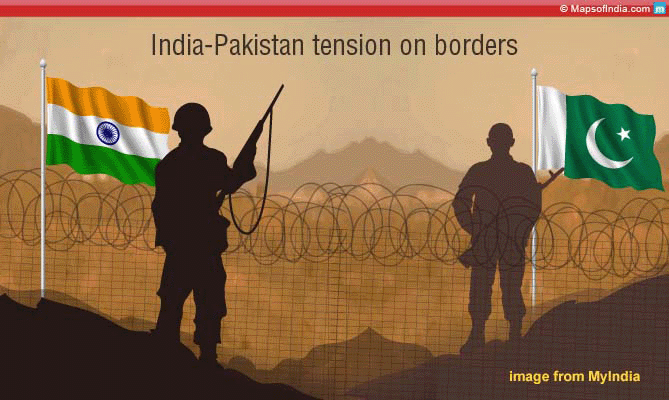
in South Asia, by Bharat Dogra 12/05/2025, https://countercurrents.org/2025/05/too-cruel-to-even-imagine-nuclear-war-in-densely-populated-areas/
Nuclear war should never happen as it is the most destructive thing imaginable. While nuclear weapon war anywhere is so destructive that this cannot be accepted, it is at its most cruel in more densely populated areas. No one can question this reality, but despite this we have the most dreadful and frightening situation of escalating conflict between India and Pakistan, two nuclear weapon countries which possess a total of about 340 nuclear weapons, according to recent estimates, and are also included among the most densely populated countries of the world, in terms of people living per one square km.
While the average world population density for the entire world is 60, it is 331 for Pakistan and 483 for India. In several cities and the most densely populated city districts of these countries, the population density can be easily over 5,000, going up to around 55,000 in the most densely populated city district (Karachi Central). While war even with conventional weapons can be very highly destructive in such conditions, in the context of nuclear weapons, even smaller and tactical ones, this is too cruel even to be imagined. Yet the possibility cannot be brushed aside and must be considered as a real life possibility, a relatively low possibility but nevertheless real possibility, whenever the two countries are involved in escalating conflict situations.
Eric Schlosser, a well-known writer on nuclear weapons, has spoken at length to top officials and commanders at various stages of planning and control of nuclear weapons. In addition he has close contacts with peace movements struggling for a world free from nuclear weapons. He has written that these very different persons share a very strong and sincere desire to avoid actual use of nuclear weapons.
The reason why both these sections share this strong belief is that both groups are well-informed about what actual use of nuclear weapons means. This makes them tremble about the implications.
In the specific context of India and Pakistan, the two nuclear weapon countries of South Asia, Schlosser has written, “The latest studies suggest that a relatively small nuclear exchange (relative to the total number of nuclear weapons that exist in world) would have long-term effects across the globe. A war between India and Pakistan, involving a hundred atomic bombs like the kind dropped in Hiroshima, could send five million tons of dust into the atmosphere, shrink the ozone layer by as much as fifty per cent, drop worldwide temperatures to their lowest point in a thousand years, create worldwide famines and cause more than a billion casualties.”
Thus it is clear that apart from killing millions of people immediately, war with nuclear weapons can lead to unprecedented environmental catastrophe which can kill an even larger number of people while also destroying other life-forms like never before. If the nuclear weapon exchange is between two countries alone, people particularly of neighbouring countries will also suffer very serious consequences without being involved in any dispute at all.
Some strategists have argued that there can be a less catastrophic role for nuclear weapons in the form of tactical nuclear weapons. As not just peace movements but several independent experts have pointed out, this is a highly flawed and mistaken view. A nuclear war started with tactical weapons can easily spill into a full-blown nuclear war if the opposing side also has nuclear weapons. Secondly, use of even tactical nuclear weapons can be very destructive, even for the using country!
Pakistan in particular has been keen to develop tactical nuclear weapons in recent times as it feels that this can be one way of checking and defeating an invasion by a country with superior conventional war capability and bigger economic resources. However saner scientific voices in Pakistan have warned that if Pakistan uses tactical weapons against an invading army on its land, its own military and civilian losses can be very high due to the highly destructive impacts of these weapons.
In the much earlier days of the cold war the NATO had stocked a lot of tactical nuclear weapons in West Germany to check a possible Soviet invasion. A war game Carte Blanche was played out to see the possible impacts in case of a Soviet invasion. It was realized only then that German civilian deaths from the use of tactical nuclear weapons on its own land can be higher than total German civilian deaths in the Second World War! Such is the destructive power of these weapons.
Moreover when tactical nuclear weapons have to be prepared for use then control has to be more dispersed and scattered. This increases the possibility that persons with fanatic or fundamentalist leanings can also gain access to this control. Hence the possibilities of terrorists gaining access to such control also increase at least to some extent. The Pakistani authorities including armed forces have time and again faced evidence-based criticism for supporting terror-groups and this combination of terror groups and nuclear weapons can prove very dangerous in a national as well as international context. From time to time attacks by such terror groups, some of whom also break free from the control of the authorities to a lesser or greater extent, have led to crisis situations nationally and internationally.
It is not at all justified to be under the false impression that tactical weapons provide some form of safer nuclear weapons. Let no one create such a false impression as such a delusion can be extremely catastrophic for millions and millions of people.
Let us face the reality. All evidence points to the fact that nuclear weapons should never be used. In fact even accidental use of nuclear weapons or accidents relating to nuclear weapons can be very destructive. Hence ultimately the only safe option if we care for life on earth is to give up all nuclear weapons and all weapons of mass destruction once and for all at the level of the entire world. The more you study and explore this issue, no matter which side you belong to, the only honest conclusion can be that tomorrow if not today we have to do away with nuclear weapons if we want to save life on earth; so why not make a beginning today itself.
The discussion here has been in the context of South Asia, but of course the consequences of an exchange of nuclear weapons between the USA and Russia or between the USA and China will be even more destructive, much more devastating for the world as these countries have more weapons and their destructive capacity is higher. As a part of world, South Asia will also suffer very harmful impacts from this. Hence the only safe future for us and for our children is on the path which is entirely free from nuclear weapons and entirely free of all weapons of mass destruction.
As for the immediate issue at hand, the maximum efforts need to be made to prevent further escalation of ongoing India-Pakistan conflict and also to end this conflict as early as possible.
How bloody conflict 4,000 miles away could spark nuclear Armageddon killing billions
The “Army of the Righteous” terror group has been accused of slaughtering 22 Indian tourists holidaying in the Baisaran valley – which is pushing India and Pakistan to the brink of conflict
12:23, 02 May 2025, Ryan Fahey News Reporter, https://www.mirror.co.uk/news/world-news/how-bloody-conflict-4000-miles-35158973
While the West is focused on how close Vladimir Putin is to pushing the red button, the real threat of Armageddon could be brewing in South Asia.
In April, suspected Islamist Pakistani militants shot dead 22 Indian tourists holidaying in the Baisaran valley, which is now pushing India and Pakistan – both nuclear-armed countries – to the brink of a nuclear confrontation. The gunmen are said to have prowled through the group of tourists, picking off any individual unable to recite Islamic verses. It’s being viewed by Indians as the worst massacre since the 2008 Mumbai bombings.
India’s security services are also being blamed for failing to realise the looming threat as the public outcry for retribution continues to grow. Indian national identity and foreign policy expert Dr Manali Kumar said the relations between the two countries are at a critically low point and “just short of war”. However, any overt acts of war would see a swift response from Pakistan, which would likely push the two sides into an escalating conflict that would be impossible to reverse once started.
India has an active army of 1.2million, with an additional 250,000 individuals split between the navy and air force, while Pakistan has less than 700,000 – but experts believe the two sides are far more evenly matched than it would seem.
Defence experts say that Pakistan could still “inflict significant damage and cause massive casualties”, according to the MailOnline.
Where the most concerning comparison comes is when looking at the nuclear arsenals of each country. Both Pakistan and India are understood to have around 170 warheads heads each, according to the Arms Control Association. While India has agreed to a “no first use” nuclear pact”, Pakistan does not adhere to the same moral restriction.
And if the apocalypse did happen in South Asia, 125 million people would be dead in a matter of days, researchers warned back in 2019.
India has accused Pakistani nationals – said to be members of the same “Army of the Righteous” terror group responsible for Mumbai – of carrying out the April 22 killing spree. Pakistan has denied involvement, and has already warned it would respond to any military aggression on the basis of “baseless and concocted allegations”.
The reason India has conflated the Pakistani government with the terror group is that they are said to have links to Pakistan’s Inter-Services-Intelligence (ISI) agency.
In the Bulletin of Atomic Scientists in 2019, researchers said that there would be “tens of millions” of immediate victims if a nuke was launched in South Asia. It would have devastating environmental impacts, causing famines that could affect billions of people across the world.
“The direct effects of this nuclear exchange would be horrible; the authors estimate that 50 to 125 million people would die, depending on whether the weapons used had yields of 15, 50, or 100 kilotons,” the article read.
“The ramifications for Indian and Pakistani society would be major and long-lasting, with many major cities largely destroyed and uninhabitable.
“Smoke and radioactive particles would ‘spread globally within weeks… cooling the global surface, reducing precipitation and threatening mass starvation.”
India and Pakistan: Nations on brink of ‘nuclear war’
news.com.au 2 May 25
Two tough-talking leaders. Two nations struggling with internal turmoil. Both armed with nuclear weapons.
It’s quickly adding up to be a zero-sum crisis.
India and Pakistan are again on the brink of war after a terrorist attack in the troubled state of Kashmir killed 26 tourists — mostly Hindu Indians — and triggered a deadly blame game between the disgruntled neighbours.
“India will identify and punish every terrorist and their backers. We will pursue them to the ends of the earth. India’s spirit will never be broken by terrorism. Terrorism will not go unpunished.”
These words, proclaimed by Indian Prime Minister Narendra Modi, were spoken in English.
As such, it was a message intended for a global audience.
For its part, Pakistan was dismissive.
“In the absence of any credible investigation and verifiable evidence, attempts to link the Pahalgam attack with Pakistan are frivolous, devoid of rationality and defeat logic,” reads a statement from the Office of Pakistan’s Prime Minister Shehbaz Sharif.
Beneath the bluster, the plight of Kashmir is already being forgotten.
The Hindu-ruled (but mostly Muslim) Principality of Kashmir was given the choice of becoming a semi-independent state of either Pakistan or India by the retreating British Empire in 1947.
It chose India in the face of tribal incursions from Pakistan.
SponsoredNew rules of recruitment in 2025
Two tough-talking leaders. Two nations struggling with internal turmoil. Both armed with nuclear weapons.
It’s quickly adding up to be a zero-sum crisis.
India and Pakistan are again on the brink of war after a terrorist attack in the troubled state of Kashmir killed 26 tourists — mostly Hindu Indians — and triggered a deadly blame game between the disgruntled neighbours.
“India will identify and punish every terrorist and their backers. We will pursue them to the ends of the earth. India’s spirit will never be broken by terrorism. Terrorism will not go unpunished.”
Loaded: 100.00%
Click to unmute
You are watching
Pakistan’s huge nuke call amid crisisContinue watchingSHARE

Pakistan’s huge nuke call amid crisis
Pakistan’s defence minister has addressed…See more
These words, proclaimed by Indian Prime Minister Narendra Modi, were spoken in English.
As such, it was a message intended for a global audience.
For its part, Pakistan was dismissive.
“In the absence of any credible investigation and verifiable evidence, attempts to link the Pahalgam attack with Pakistan are frivolous, devoid of rationality and defeat logic,” reads a statement from the Office of Pakistan’s Prime Minister Shehbaz Sharif.
Beneath the bluster, the plight of Kashmir is already being forgotten.
The Hindu-ruled (but mostly Muslim) Principality of Kashmir was given the choice of becoming a semi-independent state of either Pakistan or India by the retreating British Empire in 1947.
It chose India in the face of tribal incursions from Pakistan.
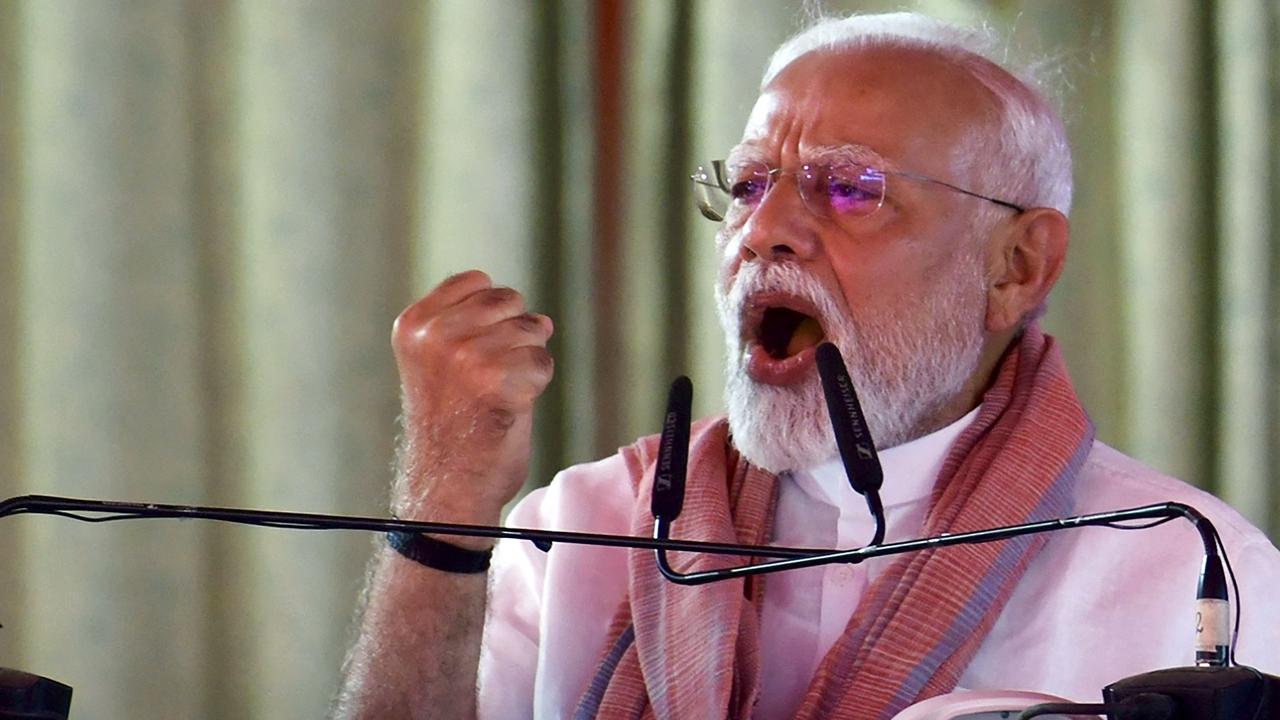
India’s Prime Minister Narendra Modi, said that their ‘spirit will not be broken’ by terrorism.. Picture: Sachin KUMAR / AFP
But Prime Minister Modi has, in recent years, suspended the region’s special freedoms and allowed his Hindu nationalist supporters to impose their ways on the culturally distinct populace.
“India’s hard-line policies under Modi and the imposition of direct central rule on Kashmir have fuelled deep alienation in the Muslim-majority region,” argues Yale University lecturer Sushant Singh.
That backlash, he adds, has triggered much broader tensions that has been simmering beneath the surface for decades.
“With Modi’s rhetoric leaving little room for compromise, Pakistan’s military leadership under pressure to respond forcefully to any Indian strike, and China’s growing involvement in the region, events in Kashmir risk triggering uncontrollable escalation,” he said.
Kashmir Conundrum
“At the heart of the Kashmir crisis is a combustible mix of religious nationalism, authoritarian governance, and unresolved political grievances,” explains Mr Singh.
Mr Modi stripped Kashmir, India’s only Muslim-majority state, of its constitutional privileges in 2019.
Local elections have been suspended. Curfews, media controls and political arrests have become commonplace.
“The reality on the ground remains one of pervasive fear and violence,” adds Mr Singh.
“Kashmir has endured recurring militant attacks, including the killing in Pahalgam, and the continued imposition of draconian laws and heavy security deployments.”
Responsibility for the Pahalgam attack has been claimed by a group calling itself The Resistance Front (TRF), which analysts believe to be an offshoot of Pakistan’s Lashkar-e-Taiba militant group.
The TRF has accused Indian Hindus of a co-ordinated campaign to establish settlements in Kashmir and overwhelm its indigenous population.
PM Modi has seized on the TRF’s Pakistani ties to label the incident as a cross-border attack backed by Islamabad.
He’s expelled Pakistani diplomats. He’s closed the border. He’s ordered the suspension of the Indus Waters Treaty.
ashmir is inseparable from his broader political strategy, in which he projects strength as a Hindu nationalist strongman, promises violent retribution against enemies, and seeks to rally domestic support through exploiting moments of national security crisis,” Mr Singh states.
Pakistan’s Power Plays
Islamabad has condemned suspension of the Indus water agreement as an “act of war”.
It has also closed its airspace to Indian flights and suspended all bilateral treaties, including a 1972 peace treaty that laid out a path towards a normalised relationship between the two nations.
But Pakistan is in the grip of a severe internal crisis……………………………………………………………………………………………………………………………….. https://www.news.com.au/technology/innovation/military/india-and-pakistan-nations-on-brink-of-nuclear-war/news-story/2f6d318483fdad71eebf466349123137
India and Pakistan: The nuclear standoff that we really should all be worried about
As tensions between the two countries escalate following a
terrorist attack in Kashmir, Ashis Ray looks at how a conflict could
involve China and America in a war over sovereignty and security.
Independent 30th April 2025 https://www.independent.co.uk/asia/india/india-pakistan-kashmir-attack-terrorism-nuclear-b2741719.html
Danger of an India-Pakistan war and Canada’s Reactors
Normand Lester, Journal de Montréal, 27 avril 2025, https://www.journaldemontreal.com/2025/04/27/danger-de-guerre-indo-pakistanaise-et-nos-candu
An individual with dual Canadian and Pakistani citizenship has just been arrested in the USA for attempting to acquire technology for Pakistan’s nuclear weapons program and smuggle it through Canada.
The case comes to light as tension mounts between India and Pakistan following the massacre of 26 Indian tourists in the disputed region of Kashmir. New Delhi accuses Pakistan of being responsible. The latter denies being behind the attack. India has annexed Muslim-majority Kashmir, which is claimed by Pakistan. China is a major ally of Pakistan, while India has close defense ties with the United States.
Clashes between the two armies increased, raising fears of a large-scale military conflict. Peace has never really been restored since 1947, when the British Indian Empire was violently partitioned into two independent states: Muslim-majority Pakistan and Hindu-majority India. The war of religious partition is thought to have claimed between one and two million lives, and led to the massive displacement of between 12 and 20 million people.
A-bomb: thanks to Canada
India and Pakistan have already fought two major wars, in 1965 and 1971, before acquiring nuclear weapons… with the help of Canada. Any war between them could therefore turn into a nuclear exchange.
Since then, India and Pakistan have experienced a major border skirmish in 1999, which left at least 1,000 people dead.
After donating one nuclear reactor to India in 1956, Ottawa heavily subsidized the purchase of another by India in 1963. As part of this purchase, Canada trained 271 Indian scientists, engineers and technicians, who went on to develop New Delhi’s atomic bomb.
In 1971, Canada built a 137-megawatt CANDU nuclear reactor in Karachi, Pakistan. The contract also included a heavy water production facility. Three years later, in 1974, India detonated its first nuclear device, dubbed the “Smiling Buddha”, using plutonium from the reactor donated by Ottawa in 1956.
According to experts, Canadian reactors are ideal for producing weapons-grade plutonium, and Ottawa hasn’t even asked India to comply with the safeguards required by the International Atomic Energy Agency (IAEA).
Canada sneaks away
U.S. Secretary of State Henry Kissinger then roundly criticized Canada, telling the media that the Indian nuclear explosion had been carried out using material diverted from a Canadian reactor lacking the appropriate safeguards.
With its guilt exposed, Canada quietly withdrew from the Indian CANDU project. It also stopped supplying uranium to Karachi, and withdrew from the Pakistani project. This did not prevent it from carrying out its first nuclear test in 1998.
If India and Pakistan ever wage nuclear war on each other, Canada will have to assume – in part – the moral responsibility.
India Aims to Lure Foreign Nuclear Power Providers With Eased Liability Laws
Oil Price, By Tsvetana Paraskova – Apr 18, 2025,
India plans to remove an unlimited liability clause in its nuclear energy laws in a bid to attract foreign firms, especially U.S. companies, to its nuclear energy sector.
The Indian Department of Atomic Energy has prepared a bill that would remove a clause in the Civil Nuclear Liability Damage Act of 2010 that exposes suppliers to unlimited liability if accidents occur, government sources told Reuters.
India plans a major expansion to its nuclear energy capacity in the coming decades as a pillar of reliable zero-carbon electricity to meet surging power demand.
By capping the liability for suppliers of nuclear reactors, India seeks to attract foreign companies to an industry expected to become key to the country’s energy transition……………………………………..
ndia’s largest power utility, NTPC, plans to invest over the next two decades $62 billion in building 30 GW of nuclear generation capacity, sources with direct knowledge of the matter told Reuters earlier this year.
NTPC is also reportedly looking to hire consultants for feasibility studies for small modular reactors that could potentially replace some of the utility’s old coal-fired power plants…………….. https://oilprice.com/Latest-Energy-News/World-News/India-Aims-to-Lure-Foreign-Nuclear-Power-Providers-With-Eased-Liability-Laws.html
Attacked, demonized and forced into hiding
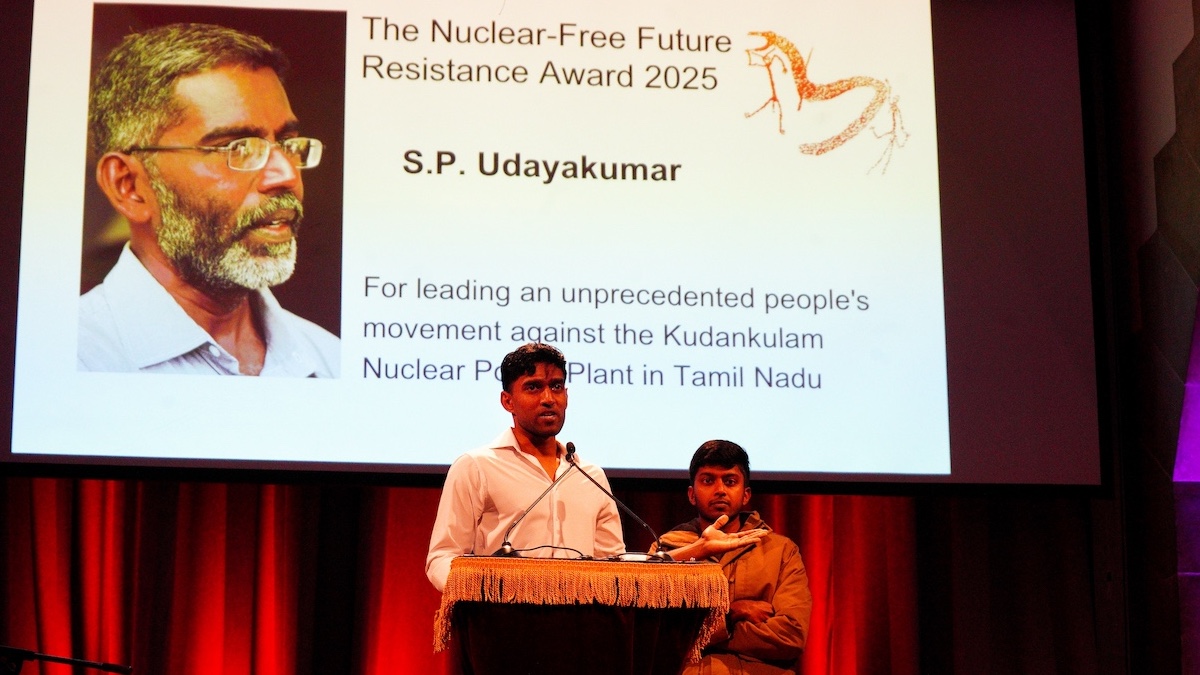
by beyondnuclearinternational, https://beyondnuclearinternational.org/2025/04/13/attacked-demonized-and-forced-into-hiding/
S.P. Udayakumar and thousands of other Indian activists challenged a Russian nuclear plant
S.P. Udayakumar was awarded the 2025 Nuclear-Free Future Award for resistance. Owing to visa constraints he was not able to be present in New York City, where the Awards ceremony was held, to accept his prize in person. He delivered these remarks via a video recording, which was met with prolonged applause. We reproduce his speech here. (A report and photos of the 2025 Nuclear-Free Future Awards ceremony, was published last week.)
I am extremely happy and immensely grateful that the Nuclear-Free Future Awards family that includes Beyond Nuclear, IPPNW and the international jury have chosen me and our struggle for the 2025 “Nuclear-Free Future” Award in the resistance category.
Tens of thousands of people including children, youth, women and men are struggling against the Russian-supplied Koodankulam Nuclear Power Project near the southernmost tip of India. Several people have sacrificed their lives, scores of people have gone to prison, so many of us have braved police harassment, State surveillance, court cases, property losses, income deprivation, and umpteen number of various difficulties.
Lots and lots of religious leaders, community leaders, political leaders, lawyers, film personalities, intellectuals, writers, publishers, poets, artists, media persons, international human rights activists, even some conscientious government officials, police officers and the general public from all over Tamil Nadu and the larger India have contributed significantly to this 2011-2014 phase of a much longer struggle.
I know that you cannot honor all the people who have taken part in our struggle and that I have been chosen as a representative of all of them. On behalf of all those thousands and thousands of fellow protesters, I humbly accept this great award. Thank you!
Although I am disappointed that I could not be with you all this evening and accept this award in the hall where the ‘Great Emancipator’ President Abraham Lincoln’s voice had once reverberated, I am glad that my sons, who had to undergo so much suffering, are receiving this award from you and celebrating this timely and important recognition of our people and the struggle.
The struggle against the Koodankulam nuclear power project began back in 1988 right after the Chernobyl accident in April 1986. The government of India has adopted the 4-I strategy of Ignore, Insult, Intimidate and Incinerate. We were totally ignored when we asked for the basic information about the project, such as the detailed project report, environmental impact assessment, site evaluation study, safety analysis report etc. When we persisted with our campaign, we were called all kinds of names, that we were anti-Indian, anti-national, foreign-funded, American stooges, left-wing radicals and so forth.
When we still pressed ahead with our campaign, the State came down upon us heavily with 349 cases with very serious charges, including sedition, waging war on the state, attempt to murder and so on. We are attending court hearings even now. Our passports have been impounded, bank accounts frozen, ‘Look Out Circular’ issued, our properties vandalized, and we are still being treated as dangerous criminals.
We were physically attacked when we went for a dialogue with government officials, several of us were imprisoned for months together, and a few of us were shot to death by police, and killed by low-flying coastguard planes, and prison negligence etc.
Because of all this highhanded behavior of the State, the concerted campaign was ended in 2014 but we have been propagating our anti-nuclear messages to the people of India through peaceful and democratic means.
Our messages are simple and straightforward:
Nuclear power is NOT cheap, or safe, or clean, or climate-friendly.
Nuclear power and nuclear bomb are both sides of the same coin. Nuclear reactors are stationary bombs and nuclear bombs are moving reactors.
Nuclear power is not suitable for a country like India that is highly and densely-populated. As you all know, the world’s worst industrial disaster took place in the Union Carbide pesticide plant in Bhopal in December 1984. The debilitating chemical waste of the Bhopal gas disaster has just been removed after 40 long years.
Both nationally and internationally, the nuclear hawks and hawkers promote nuclear power as THE answer for climate destruction. But consider the amount of carbon-emitting power that is used for uranium mining, milling, reactor construction (with thousands of tons of steel and cement over 20-30 years of construction), reactor operation for 40-60 years, decommissioning, waste management and so forth! Can anyone honestly claim that nuclear power is the answer for climate destruction? Even if it was, can poisoned earth be the answer for polluted air? How are we going to deal with the dangerous nuclear wastes for the next 48,000 years?
Nuclearism is part and parcel of profiteering globalism. The India-US nuclear deal is not about India’s energy security, or national security or safeguarding India’s growth and development. This deal is a naked corporate business deal which will bring humongous profits to a few American corporate houses. Similarly, the nuclear deals that India has signed with Russia, France, Kazakhstan, Namibia, Argentina, and others will bring profits and prosperity to these countries’ corporate houses but will result in disaster and destruction for the poor in India. Yes, desire for profit, power, and prominence drives the nuclear industry.
On the other hand, it is hate, fear and recklessness that fuel this very industry. Some countries’ revision of nuclear doctrines, refusal to extend nuclear arms treaties, rising weapons count, continuing Uranium enrichment, constant testing, actual threat to use nuclear bombs, and several wars around the world poised to reach a “nuclear threshold” foretell the precarious situation of our global society today. Yes, Nuclearism and Fascism are inter-related. Fascism is the ideology behind Nuclearism and Nuclearism is the penultimate expression of Fascism.
When all is said and done, this beautiful planet of ours, the Earth, can be likened to a humongous commercial airplane with clear class divisions, limited supply of resources, lopsided opportunity structures, and unbalanced entitlement arrangements, etc. And this plane of ours has been hijacked by the P-5 and the other nuclear States such as Israel, India, Pakistan, North Korea and who knows who else?
The great poet, Robert Frost had predicted back in 1920:
Some say the world will end in fire,
Some say in ice.
From what I’ve tasted of desire
I hold with those who favor fire.
But if it had to perish twice,
I think I know enough of hate
To say that for destruction ice
Is also great
And would suffice.
The delegates of the Third Meeting of States Parties (3MSP) to the Treaty on the Prohibition of Nuclear Weapons (TPNW) who are meeting in New York City right now have a tough task ahead. We wish them all the best!
And let us continue to strive for a nuclear-free future that will have No Deals, No Mines, No Reactors, No Dumps, and No Bombs! Nowhere in the world!!
To quote my favorite Robert Frost again:
Woods are lovely, dark and deep,
But we have promises to keep!
And miles to go before we sleep,
And miles to go before we sleep!
India PM Modi ends foreign tour with nuclear deals in pipeline
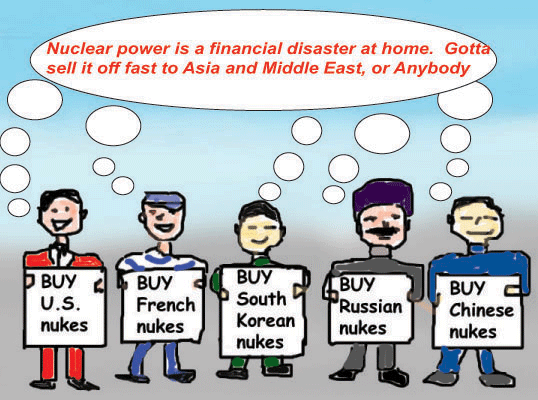
By AFP, 14 February 2025 Daily Mail
Indian Prime Minister Narendra Modi concluded a whistle-stop diplomatic tour Friday having secured significant pledges of support from Washington and Paris to help step up his country’s nuclear energy programme.
New Delhi has vowed to achieve net zero carbon emissions by 2070 partly by increasing the number of nuclear plants in the country from eight, which currently account for around three percent of power generation in India.
Modi’s White House meeting with President Donald Trump resulted in an agreement to build US-designed nuclear reactors in India.
“This path forward will unlock plans to build large US-designed reactors and enable collaboration to develop, deploy and scale up nuclear power generation with advanced small modular reactors,” a joint statement said Thursday.
India revealed a similar deal with France following Modi’s meeting with President Emmanuel Macron earlier this week.
Foreign secretary Vikram Misri said Wednesday that India and France aimed to initiate cooperation on developing small modular nuclear reactors, nothing that the technology was still in its “initial stages”.
“Our intent is to be able to cooperate in co-designing the reactors, co-developing them, and co-producing them,” he told reporters.
Both partnerships come days after Modi’s government announced plans to amend its strict nuclear liability law, which holds operators liable for any damage or accident, with exceptions made for certain situations including natural disasters……………………… https://www.dailymail.co.uk/wires/afp/article-14396859/India-PM-Modi-ends-foreign-tour-nuclear-deals-pipeline.html
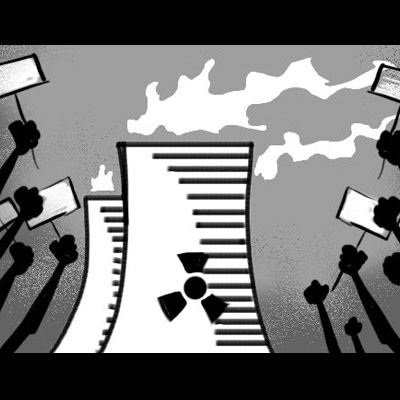
Villagers oppose proposed nuclear plant in Arasinkeri
Hindustan Times,By Coovercolly Indresh, Bengaluru, Dec 21, 2024,
https://www.hindustantimes.com/india-news/villagers-oppose-proposed-nuclear-plant-in-arasinkeri-101734721956152.html
The residents of Arasinkeri village in Karnataka’s Koppal district have vowed not to surrender their land for the proposed establishment of a nuclear power plant near their village.
The central government’s initiative to set up a nuclear power plant in the region has caused significant apprehension among the villagers. The Department of Atomic Energy has reportedly directed local authorities to identify at least 1,200 acres of land surrounding Arasinkeri for the project. Revenue department officials have started surveying the area to locate suitable sites.
On December 13, the villagers made an official plea to Koppal deputy commissioner Nalini Atul, urging the government to abandon the project. They warned that failure to address their concerns could result in intensified protests.
“Arasinkeri is already burdened by pollution from over a hundred factories, including steel plants. Living conditions are already difficult. The majority of residents here depend on agriculture and forestry. Adding a nuclear power plant will destroy our livelihoods and pose irreversible risks to our health and the environment,” said M Veerabhadrappa, a local farmer. He is one of the 2,500 villagers who have refused to surrender their land.
The proposed site reportedly includes over 400 acres of forest land in Survey No 80 and another 100 acres in Survey No 9, areas critical to both the local community and biodiversity. Villagers fear the project will disrupt the fragile balance of their environment while threatening their safety and well-being.
On December 13, officials from NTPC (National Thermal Power Corporation) visited Koppal district and conducted an inspection in Arasinkeri village. “The project is still in its preliminary stages. If the site is approved, farmers will be provided with suitable compensation for their land. A technical team from Delhi is expected to visit soon to finalise the location,” Koppal sub-divisional magistrate Mahesh Malagati told Hindustan Times.
Despite these assurances, anxiety among villagers continues to grow. Their primary concern lies in the health risks associated with having a nuclear power plant in close proximity. They worry about potential contamination and other hazards that could affect both people and the environment.
“The government needs to understand that a nuclear power plant near a densely populated area is unacceptable,” said another villager. “We will continue to oppose this project with all our might.”
India considers joining Russia, China to build nuclear plant on Moon
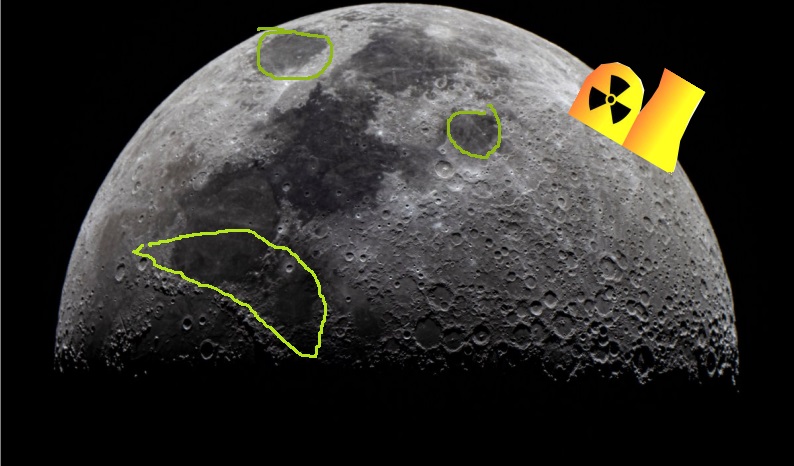
Rivals India and China are said to be keen on joining a Russian project to build an atomic power plant for a human base on the Moon.
14/09/2024, By: Pratap Chakravarty, https://www.rfi.fr/en/international/20240914-india-considers-joining-russia-china-to-build-nuclear-plant-on-moon
Russia’s atomic energy corporation Rosatom says the lunar reactor will be built with “minimal human involvement” and deployed around 2036.
According to Russia’s state-owned news agency Tass, Rosatom CEO Alexey Likhachev told a meeting of the Eastern Economic Forum in Vladivostok earlier this month that both India and China have shown interest in the venture.
“The task we are working on is the creation of a lunar nuclear power plant with an energy capacity of up to half a megawatt,” Likhachev told the gathering of potential investors.
“Both our Chinese and Indian partners are very interested in collaborating as we lay the groundwork for several international space projects,” the Rosatom chief executive claimed.
Cooperation among rivals
Delhi has not commented on the purported collaboration.
While Russia is its key arms supplier and a partner on several space ventures, Indian media have been surprised by the possibility of India teaming up with China.
Alluding to unresolved border disputes which took India and China to war in 1962 and sporadic clashes in following years, local daily Business Standard called the two countries “foes on Earth, pals on Moon”.
The proposed power plant will be integrated into a wider Chinese-Russian project to set up a base called the International Lunar Research Station (ILRS), either on lunar soil or in lunar orbit.
ILRS will serve as a fulcrum of scientific research and will be open to all countries and “international partners” after it becomes operational between 2035 and 2045.
But it would require a stable power supply – which only a nuclear reactor can provide, as the Moon’s lengthy lunar nights make solar energy unreliable.
Nasa has been mulling the construction of similar reactors for its own future lunar bases.
India’s space ambitions
The Russian-led project is separate from India’s own ambitions to set up a space station by 2035 and launch a manned mission to the Moon five years later.
Analysts say India, with its ambitions of creating a human colony on the Moon, is actively seeking out potential opportunities to accelerate its space ambitions.
In August 2023, India landed a spacecraft on the Moon and joined a select space-faring club comprising of China, Russia and the United States – the only nations to have ever reached the Earth’s closest celestial object.
India has shortlisted four military pilots to travel on the country’s first manned space flight next year.
The Indian government says the Gaganyaan spacecraft will orbit Earth at an altitude of 400 kilometres and land at sea three days later.
It will also send a humanoid robot into space later this year in line with preparations to land an Indian on lunar soil by 2040.
Air force pilot Rakesh Sharma became India’s first astronaut to go to space in April 1984, when he spent almost eight days on board the Soviet Salyut-7 space station.
Indian nuclear weapons, 2024
By Hans M. Kristensen, Matt Korda, Eliana Johns, Mackenzie Knight | September 5, 2024
India continues to modernize its nuclear arsenal, with at least four new weapon systems and several new delivery platforms under development to complement or replace existing nuclear-capable aircraft, land-based delivery systems, and sea-based systems. Several of these systems are nearing completion and will soon be fielded.
We estimate that India may have produced enough military plutonium for 130 to 210 nuclear warheads but likely has produced only around 172, although the country’s warhead stockpile is likely growing. The Nuclear Notebook is researched and written by the staff of the Federation of American Scientists’ Nuclear Information Project: director Hans M. Kristensen, associate director Matt Korda, senior research associates Eliana Johns and Mackenzie Knight.
This article is freely available in PDF format in the Bulletin of the Atomic Scientists’ digital magazine (published by Taylor & Francis) at this link.
…………………..India continues to modernize its nuclear weapons arsenal and operationalize its nascent triad. We estimate that India currently operates eight different nuclear-capable systems: two aircraft, five land-based ballistic missiles, and one sea-based ballistic missile. At least five more systems are in development, most of which are thought to be nearing completion and to be fielded with the armed forces soon.
Research methodology and confidence
The Indian government does not publish numbers about the size of its nuclear weapon stockpile. The analyses and estimates made in the Nuclear Notebook are therefore derived from a combination of open sources: (1) state-originating data (e.g. government statements, declassified documents, budgetary information, military parades, and treaty disclosure data); (2) non-state-originating data (e.g. media reports, think tank analyses, and industry publications); and (3) commercial satellite imagery. …………………………………………………………….
…………Fissile material and warhead inventory estimates
India is one of only a handful of countries believed to be producing both highly enriched uranium (HEU) and weapons-grade plutonium, although its HEU production is largely assumed to be focused on producing fuel for its growing number of nuclear-powered vessels and submarines (Frieß et al. 2024).
………………..Nuclear doctrine
Tensions between India and Pakistan constitute one of the most concerning nuclear hotspots on the planet. These two nuclear-armed countries engaged in open hostilities as recently as November 2020, when Indian and Pakistani soldiers exchanged artillery and gunfire over the Line of Control, resulting in at least 22 deaths. ……………………………………………………………………………………………………………………………………………………………………………………………………………………………………………………. more https://thebulletin.org/premium/2024-09/indian-nuclear-weapons-2024/
Arundhati Roy: India Must Stop Arming Israel or ‘Forever Be Linked to Genocide’
“It is our responsibility to show that as people of India, we refuse to be complicit in that, even if our government wishes to continue with what it does.”
Brett Wilkins, Aug 02, 2024, https://www.commondreams.org/news/arundhati-roy-israel
Acclaimed Indian author and activist Arundhati Roy this week joined prominent jurists, diplomats, artists, and others in urging their government to stop selling weapons to Israel, which they called “abominable” and “a serious violation of India’s obligations under international law and our Constitution.”
Speaking Thursday at an event organized by the Press Club of India, Roy—winner of the 1997 Booker Prize for her debut novel The God of Small Things—said that Indians must “at least show that we do not support that murder in Gaza, we do not support our government’s support of that.”
Acclaimed Indian author and activist Arundhati Roy this week joined prominent jurists, diplomats, artists, and others in urging their government to stop selling weapons to Israel, which they called “abominable” and “a serious violation of India’s obligations under international law and our Constitution.”
Speaking Thursday at an event organized by the Press Club of India, Roy—winner of the 1997 Booker Prize for her debut novel The God of Small Things—said that Indians must “at least show that we do not support that murder in Gaza, we do not support our government’s support of that.”
“What is happening in Gaza, it is not just the murder… of tens of thousands of women and children,” she continued. “It is the bombing of hospitals, the destruction of universities… the attempt to erase the very memory people have of that place. It is a genocide like no other because it’s taking place on live TV.”
“India used to be a country that supported the people of Palestine in their struggle for freedom,” Roy noted. “Everywhere, even in the United States… people are standing up against their government’s support for [Israel]. But we are not standing up… and that is such a shame.”
“We must stand up. We must refuse,” she asserted. “We will not support the export of weapons of any kind.”
Roy is one of more than two dozen former Indian Supreme Court justices and other judges, foreign service officers, academics, artists, activists, and others who on Wednesday sent a letter to Indian Defense Minister Rajnath Singh urging him to halt the licensing of arms sales to Israel, whose military forces have killed or wounded more than 140,000 Palestinians while obliterating and starving Gaza.
“The International Court of Justice (ICJ) has clearly ruled that Israel is in violation of obligations under the Genocide Convention and further that Israel is in illegal occupation of the occupied Palestinian territory,” the letter states. “In light of these rulings, any supply of military material to Israel would amount to a violation of India’s obligations under international humanitarian law and the mandate of Article 21 read with Article 51(c) of the Constitution of India.”
Among the weapons India has sent to Israel are Hermes 900 unmanned aerial drones, which are co-manufactured with Israeli arms company Elbit Systems. The letter notes that the drones “have been extensively used in the Israeli Defense Forces’ military campaign in Gaza.”
“Several [United Nations] experts have warned that the transfer of weapons and ammunition to Israel may constitute serious violations of human rights and international humanitarian laws, and risk state complicity in international crimes, possibly including genocide, reiterating their demand to stop transfers immediately,” the letter’s signer wrote.
“In short, the grant of licenses and approvals for export of military material to Israel, coupled with reports of such exports by Indian companies, constitutes a serious violation of India’s obligations under international law and our own Constitution,” the letter stresses.
“International law aside, we consider such exports to be morally objectionable, indeed abominable,” the signatories added. “We demand, therefore, that India should immediately suspend its collaboration in the delivery of military material to Israel. Further, India must immediately make every effort to ensure that weapons already delivered to Israel are not used to contribute to acts of genocide or violations of international humanitarian law.”
The letter came ahead of planned nationwide protests by Indian leftists on Saturday calling for an end to arms sales and “all forms of complicity with Israel’s illegal occupation and genocide.”
India—which in 1971 invaded Bangladesh (then East Pakistan) in large part to end a U.S.-backed Pakistani genocide mostly targeting Bengalis—voted in favor of the December U.N. Security Council resolution calling for an immediate Gaza cease-fire.
However, the administration of Indian Prime Minister Narendra Modi and many lawmakers from his right-wing Bharatiya Janata Party have expressed steadfast support for Israel and its Gaza onslaught. Critics have noted that both Israel and India are occupying Muslims, the former in Palestine and the latter in Jammu and Kashmir.
In an interview with Middle East Eye published Friday, Roy—who faces prosecution in India over comments she allegedly made nearly 15 years ago regarding Kashmir—said that India could “forever be linked to genocide” if it does not change course.
“India needs to stop the export of weapons to Israel and ensure the return of Indian workers who have been sent to Israel to replace Palestinian workers,” she said.
“If it does not do so at once, it is in violation of the orders of the ICJ,” she added. “It will forever be complicit in aiding and abetting a genocide that is being telecast live for the world to watch.”
-
Archives
- February 2026 (211)
- January 2026 (308)
- December 2025 (358)
- November 2025 (359)
- October 2025 (376)
- September 2025 (258)
- August 2025 (319)
- July 2025 (230)
- June 2025 (348)
- May 2025 (261)
- April 2025 (305)
- March 2025 (319)
-
Categories
- 1
- 1 NUCLEAR ISSUES
- business and costs
- climate change
- culture and arts
- ENERGY
- environment
- health
- history
- indigenous issues
- Legal
- marketing of nuclear
- media
- opposition to nuclear
- PERSONAL STORIES
- politics
- politics international
- Religion and ethics
- safety
- secrets,lies and civil liberties
- spinbuster
- technology
- Uranium
- wastes
- weapons and war
- Women
- 2 WORLD
- ACTION
- AFRICA
- Atrocities
- AUSTRALIA
- Christina's notes
- Christina's themes
- culture and arts
- Events
- Fuk 2022
- Fuk 2023
- Fukushima 2017
- Fukushima 2018
- fukushima 2019
- Fukushima 2020
- Fukushima 2021
- general
- global warming
- Humour (God we need it)
- Nuclear
- RARE EARTHS
- Reference
- resources – print
- Resources -audiovicual
- Weekly Newsletter
- World
- World Nuclear
- YouTube
-
RSS
Entries RSS
Comments RSS
 nuclear-news