Arundhati Roy: India Must Stop Arming Israel or ‘Forever Be Linked to Genocide’
“It is our responsibility to show that as people of India, we refuse to be complicit in that, even if our government wishes to continue with what it does.”
Brett Wilkins, Aug 02, 2024, https://www.commondreams.org/news/arundhati-roy-israel
Acclaimed Indian author and activist Arundhati Roy this week joined prominent jurists, diplomats, artists, and others in urging their government to stop selling weapons to Israel, which they called “abominable” and “a serious violation of India’s obligations under international law and our Constitution.”
Speaking Thursday at an event organized by the Press Club of India, Roy—winner of the 1997 Booker Prize for her debut novel The God of Small Things—said that Indians must “at least show that we do not support that murder in Gaza, we do not support our government’s support of that.”
Acclaimed Indian author and activist Arundhati Roy this week joined prominent jurists, diplomats, artists, and others in urging their government to stop selling weapons to Israel, which they called “abominable” and “a serious violation of India’s obligations under international law and our Constitution.”
Speaking Thursday at an event organized by the Press Club of India, Roy—winner of the 1997 Booker Prize for her debut novel The God of Small Things—said that Indians must “at least show that we do not support that murder in Gaza, we do not support our government’s support of that.”
“What is happening in Gaza, it is not just the murder… of tens of thousands of women and children,” she continued. “It is the bombing of hospitals, the destruction of universities… the attempt to erase the very memory people have of that place. It is a genocide like no other because it’s taking place on live TV.”
“India used to be a country that supported the people of Palestine in their struggle for freedom,” Roy noted. “Everywhere, even in the United States… people are standing up against their government’s support for [Israel]. But we are not standing up… and that is such a shame.”
“We must stand up. We must refuse,” she asserted. “We will not support the export of weapons of any kind.”
Roy is one of more than two dozen former Indian Supreme Court justices and other judges, foreign service officers, academics, artists, activists, and others who on Wednesday sent a letter to Indian Defense Minister Rajnath Singh urging him to halt the licensing of arms sales to Israel, whose military forces have killed or wounded more than 140,000 Palestinians while obliterating and starving Gaza.
“The International Court of Justice (ICJ) has clearly ruled that Israel is in violation of obligations under the Genocide Convention and further that Israel is in illegal occupation of the occupied Palestinian territory,” the letter states. “In light of these rulings, any supply of military material to Israel would amount to a violation of India’s obligations under international humanitarian law and the mandate of Article 21 read with Article 51(c) of the Constitution of India.”
Among the weapons India has sent to Israel are Hermes 900 unmanned aerial drones, which are co-manufactured with Israeli arms company Elbit Systems. The letter notes that the drones “have been extensively used in the Israeli Defense Forces’ military campaign in Gaza.”
“Several [United Nations] experts have warned that the transfer of weapons and ammunition to Israel may constitute serious violations of human rights and international humanitarian laws, and risk state complicity in international crimes, possibly including genocide, reiterating their demand to stop transfers immediately,” the letter’s signer wrote.
“In short, the grant of licenses and approvals for export of military material to Israel, coupled with reports of such exports by Indian companies, constitutes a serious violation of India’s obligations under international law and our own Constitution,” the letter stresses.
“International law aside, we consider such exports to be morally objectionable, indeed abominable,” the signatories added. “We demand, therefore, that India should immediately suspend its collaboration in the delivery of military material to Israel. Further, India must immediately make every effort to ensure that weapons already delivered to Israel are not used to contribute to acts of genocide or violations of international humanitarian law.”
The letter came ahead of planned nationwide protests by Indian leftists on Saturday calling for an end to arms sales and “all forms of complicity with Israel’s illegal occupation and genocide.”
India—which in 1971 invaded Bangladesh (then East Pakistan) in large part to end a U.S.-backed Pakistani genocide mostly targeting Bengalis—voted in favor of the December U.N. Security Council resolution calling for an immediate Gaza cease-fire.
However, the administration of Indian Prime Minister Narendra Modi and many lawmakers from his right-wing Bharatiya Janata Party have expressed steadfast support for Israel and its Gaza onslaught. Critics have noted that both Israel and India are occupying Muslims, the former in Palestine and the latter in Jammu and Kashmir.
In an interview with Middle East Eye published Friday, Roy—who faces prosecution in India over comments she allegedly made nearly 15 years ago regarding Kashmir—said that India could “forever be linked to genocide” if it does not change course.
“India needs to stop the export of weapons to Israel and ensure the return of Indian workers who have been sent to Israel to replace Palestinian workers,” she said.
“If it does not do so at once, it is in violation of the orders of the ICJ,” she added. “It will forever be complicit in aiding and abetting a genocide that is being telecast live for the world to watch.”
‘Unliveable’: Delhi’s residents struggle to cope in record-breaking heat

Temperatures of more than 45C have left population of 29 million exhausted – but the poorest suffer most
Hannah Ellis-Petersen in Delhi 31May 24
The consensus among experts and residents is that the summer temperatures
are now regularly rising far above the norm as India bears the brunt of the
climate crisis. A heatwave has enveloped much of north India in May –
this week temperatures consecutively rose above 45C – making conditions
unbearable and even life threatening for the millions who cannot afford to
cool themselves down or are forced to work outside in construction or
labouring jobs. Some parts of the city recorded temperatures as high as 52C
on Wednesday, though officials later said that may have been a faulty
reading.
Guardian 30th May 2024
Indian Nuclear Sites Impact South Tibetan Plateau Radioactivity
Chinese Academy of Sciences, 24 Apr 24 https://www.miragenews.com/indian-nuclear-sites-impact-south-tibetan-1222069/
A recent study published in Environmental Science & Technology Letter has shed light on the long-range transboundary transport of radioactive iodine-129 (129I) from the Indian nuclear fuel reprocessing plants (NFRPs) to the Southern Tibetan Plateau (STP).
This study, conducted by researchers from the Institute of Earth Environment of the Chinese Academy of Sciences (CAS), provides a new understanding of the transport of airborne radioactive pollutants from low to high altitudes, and may have implications for environmental protection on the Tibetan Plateau.
The Tibetan Plateau, known as the “Third Pole of the Earth” and the “Roof of the World,” is a remote, isolated, and presumably pristine region. Previous studies of radioactive contamination have focused primarily on the northern TP, leaving little knowledge of the STP. Primarily originating from human nuclear activities, iodine-129, with its properties of high volatility and radiation risk of short-lived radioiodine, serves as a key radionuclide for nuclear environmental safety monitoring.
In this study, the researchers have meticulously investigated the spatial variation of 129I in the bioindicators, moss and lichen, from the STP.
They found that 129I in the STP was significantly higher than the pre-nuclear levels and those in Chinese inland cities, but two-four orders of magnitude lower than those in the vicinity of the Indian and European NFRPs.
Analysis of the 129I discharge history in conjunction with the wind field indicates that the Indian NFRPs are the primary sources of 129I in the STP. The prevailing ISM plays a crucial role in the transport of 129I from the lowland to the high-altitude STP. The transport process is further enhanced by the summertime overlying heat pump, but is weakened by topographic blocking, forest adsorption, and cold trapping.
The spatial distribution of 129I and 127I in lichens distributed on Mt. Galongla shows that the Yarlung Zangbo Grand Canyon serves as a key transport channel.
“It is much beyond our expectation that Indian NFRPs have such a significant impact on the Tibetan Plateau. Since there are many nuclear facilities in operation and under construction in India, the radiation risk is just there. So we still need more data to find out the extent and scope of such impacts,” said Dr. ZHANG Luyuan, corresponding author of this study.
This work was supported by the second comprehensive scientific expedition to the Qinghai-Tibetan Plateau, CAS and the National Natural Science Foundation of China.
Heatwave in India: TV host faints during live broadcast as swaths of country reel from sweltering temperatures
India’s federal weather agency
has issued “severe heatwave” alerts for parts of India with
temperatures soaring to 42-44C. India witnessed the early onset of an
intense heatwave in March and April, leading to a huge impact on
agriculture production. A heatwave alert has been issued for Odisha and
West Bengal till 22 April with temperature peaking above 40C.
Independent 22nd April 2024
Nuclear secret: India’s space program uses plutonium pellets to power missions
Rt.com 5 Feb 24
New Delhi is experimenting with radioisotopes to charge its robotic missions to the Moon, Mars and beyond.
Indians are ecstatic over their space program’s string of successes in recent months. The Indian Space Research Organization (ISRO) has a couple of well-kept tech secrets – one of them nuclear – that will drive future voyages to the cosmos.
In the Hollywood sci-fi movie ‘The Martian’, astronaut Mark Watney, played by Matt Damon, is presumed dead and finds ways to stay alive on the red planet, mainly thanks to a big box of Plutonium known as a Radioisotope Thermoelectric Generator (RTG).
In the film, Watney uses it to travel in his rover to the ‘Pathfinder’, a robotic spacecraft which launched decades ago, to use its antenna to communicate with his NASA colleagues and tell them he’s still alive. Additionally, the astronaut dips this box into a container of water to thaw it.
In real life, the RTG generates electricity from the heat of a decaying radioactive substance, in this case, Plutonium-238. This unique material emits steady heat due to its natural radioactive decay. Its continuous radiation of heat, often lasting decades, made it the material of choice for producing electrical power onboard several deep-space missions of the erstwhile USSR and the US.
For short-duration voyages, Soviet missions used other isotopes, such as a Polonium-210 heat source in the Lunokhod lunar rovers, two of which landed on the Moon, in 1970 and 1973.
NASA has employed Plutonium-238 to produce electricity for a wide variety of spacecraft and hardware, from the science experiments deployed on the Moon by the Apollo astronauts to durable robotic explorers, such as the Curiosity Mars rover and the Voyager 1 and 2 spacecraft, which are now at the edge of the solar system.
The ISRO first used nuclear fuel to keep the instruments and sensors going amid frigid conditions during a successful lunar mission, Chandrayaan-3. A pellet or two of Plutonium-238 inside a scaled-down version of the RTG known as the radioisotope heating unit (RHU) made its way to space aboard the rocket. It was provided by India’s atomic energy experts.
RHUs are similar to RTGs but smaller. They weigh 40 grams and provide about one watt of heat each. Their ability to do so is derived from the decay of a few grams of Plutonium-238. However, other radioactive isotopes could be used by today’s space explorers……………………………………………………………………………………..
Meanwhile, the Indian space agency has also kept under wraps two critical technologies developed for future missions by a Bengaluru-based space tech startup, Bellatrix Aerospace.
These unique propulsion systems – engines that utilize electricity instead of conventional chemical propellants onboard satellites – were tested in space aboard POEM-3 (PSLV Orbital Experimental Module-3), which was launched by PSLV on January 1, 2024. The crew also tried replacing hazardous Hydrazine with a non-toxic and environment-friendly, high-performing proprietary propellant.
Hydrazine, an inorganic compound that is used as a long-term storable propellant has been used in the past by various space agencies; even for thrusters on board NASA’s space shuttles. However, it poses a host of health hazards; engineers wear space suits to protect themselves while loading it before the launch of a satellite or a deep-space probe.
In 2017, the European Union recommended banning its use as a satellite fuel, prompting the European Space Agency (ESA) to research alternatives to Hydrazine. The US administration has proposed a ban on the use of Hydrazine to propel satellites in outer space by 2025……… https://www.rt.com/india/591138-india-space-program-plutonium-pellets/
India, Pakistan exchange list of nuclear installations under 1988 bilateral pact
LiveMint, 01 Jan 2024,
The pact signed by India and Pakistan in 1988 prohibits the two countries from attacking each other’s atomic facilities.
India and Pakistan on Monday exchanged a list of their nuclear installations under a bilateral pact signed in 1988 and came into force in 1991 that prohibits the two countries from attacking each other’s atomic facilities………………..
India and Pakistan on Monday exchanged a list of their nuclear installations under a bilateral pact signed in 1988 and came into force in 1991 that prohibits the two countries from attacking each other’s atomic facilities.
The exchange of the list came amid frosty ties between the two countries over the Kashmir issue as well as cross-border terrorism.
Both countries have not had any formal talks since they ended the composite dialogue in the aftermath of the 2008 Mumbai attacks carried out by Lashkar-e-Taiba (LeT), a Pakistan-based terror group, in which 166 people were killed and several injured.
The political leadership of both countries made several attempts to resume the contact. However, they were derailed by a string of terror attacks on Indian soil by Pakistan-based terror groups. https://www.livemint.com/news/india/india-pakistan-exchange-list-of-nuclear-installations-under-1988-bilateral-pact-11704107726908.html
Kudankulam Nuclear plant will destroy Southern Tamil Nadu, warns Vaiko
August 28, 2023 https://www.thehindu.com/news/national/tamil-nadu/kudankulam-nuclear-plant-will-destroy-southern-tamil-nadu-warns-vaiko/article67241700.ece
MDMK general secretary Vaiko on Sunday feared that waste water stored in the Nuclear Power Plants in Kudankulam could be released in the future into the Bay of Bengal destroying the coastal villages in southern Tamil Nadu. His apprehension was triggered by Japan’s decision to release stored waste water from the Fukushima nuclear plant into the pacific ocean.
In a statement in Chennai, he said the power plant was a Damoclean sword hanging over Tamil Nadu and closing the plant alone could save the people.
“You may land on the Moon. But I am worried that a part of Tamil Nadu will be destroyed. I would like to warn the Centre which is not bothered about the threat,” he said.
Mr Vaiko said nuclear plants in Russia, Japan and the US had affected a lot of people. “Japan has released waste water in the Pacific Ocean and the people of the country are opposing it,” he said.
Threat from the skies: India steps up the fight against a major space danger.

By B R Srikanth, a veteran Bengaluru-based journalist reporting on space and defense, 21 Aug 23, https://www.rt.com/india/581397-india-space-debris-cleaning-mission/
New Delhi’s ambitious space plans include tackling the problem of floating debris, countless pieces of which orbit the Earth
A spectacular display of celestial fireworks? The momentous arrival of aliens? Or was it a work-in-progress sci-fi flick?
These questions weighed heavily on many minds as Melbourne’s night sky lit up for almost a minute on the night of August 7. The flame raced across the sky before breaking into blazing fragments. A sonic boom shook the ground for a couple of seconds, setting off a panic among residents. A day later, the Australian Space Agency confirmed it was space junk, likely “remnants” of a giant Russian rocket which had hoisted a new navigational satellite into orbit.
A few weeks earlier, a six-foot high cylindrical object, perhaps the fuel tank of an Indian rocket, had washed ashore at Green Head Beach, 250 km north of Perth, Australia. The artificial lighting, the loud explosion, and the large fuel tank found there reignited one question: How to vacuum-clean the graveyard in the deep, dark heavens to safeguard assets worth billions of dollars?
Such assets include satellites circling the Earth at 300 km to 36,000 km, in support of telecommunications, broadcasting, meteorology, civil aviation, telemedicine, distance education, and even espionage (by military satellites launched without fanfare).
Space junk
Outer space contains hundreds of dead satellites, millions of fragments of old satellites and rockets, and even paint flakes; each is hurtling through space at an incredible speed of 10 km a second, with a lethal punch of a 550-pound object. NASA estimates there are around 23,000 pieces of debris larger than a softball, half a million pieces the size of a marble or up to a centimeter, 100 million pieces one millimeter and larger.
Example of space junk include a glove lost by Edward Higgins White during America’s first spacewalk, Michael Collins’ camera lost near Gemini 10, a thermal blanket lost during STS-88, the first space shuttle mission, garbage bags jettisoned by cosmonauts during Mir’s 15-year life, a wrench, and a toothbrush.
Indian-American astronaut Sunita Williams lost her camera during her spacewalk from the space shuttle in 2007, and astronaut Heidemarie Stefanyshyn-Piper lost a briefcase-sized tool bag during her spacewalk the following year.
And if you think the Hollywood film ‘Gravity’, where a spacecraft is hit by a cloud of space debris (killing George Clooney’s character, and nearly marooning Sandra Bullock) was fiction, then consider that in 1996, a French satellite was hit and damaged by a French rocket that had exploded a decade earlier. Or that on February 10, 2009, a defunct Russian spacecraft collided with and destroyed a USA Iridium commercial spacecraft. The collision over northern Siberia added 2,300 pieces of large trackable debris and a bigger quantity of smaller trash to the existing space junk.
China did not help matters when in 2007 it used a missile to destroy an old weather satellite, creating 3,500 pieces of large debris. In 2016, a tiny piece of debris punched a hole in the solar panel of the European Space Agency (ESA) observation satellite, Copernicus Sentinel 1A. Even the Hubble Telescope’s solar array shows hundreds of tiny holes caused by dust-sized debris.
The risk of trash colliding with satellites could spiral higher in the future, K R Sridhara Murthy, Honorary Director and former vice president of Paris-based International Institute of Space Law (IISL), and a former senior scientist of the Indian Space Research Organisation (ISRO), told RT.
This is because a large number of private companies – SpaceX, OneWeb, Amazon Kuiper, Guo Wang (China), Samsung (Korea), and Astrome Tech (India) plan to add a whopping 75,000 satellites within a decade to provide global communication networks (superfast internet services), and Automatic Identification Systems (AIS) to track ships (including those of pirates) among other benefits.
Though smaller than conventional satellites, they will crowd the low earth orbit (LEO), about 400 km from the ground, and multiply the number already in this sphere. “More companies are joining the race to position their satellites in orbit because the economics of satellite launch are changing drastically owing to reduction in the cost of putting a satellite into orbit and the deployment of reusable rockets,” Murthy added.
Need for self-discipline
Nations have not been unmindful of the hazards of space junk. The USA and the former USSR tracked objects measuring four inches or more from the Cold War era using a string of radars. NASA and the US Defense Department’s Space Surveillance Network (SSN) have cataloged more than 27,000 pieces of debris, and track each piece’s trajectory.
Not surprisingly, nations with ambitions in space, including India, are setting up facilities to track the burgeoning amount of trash.
The importance of tracking can be gauged when even the voyage of a rocket into space is delayed by a couple of minutes to prevent debris from causing a disastrous impact on missions, Dr. Mylswami Annadurai, the “Moon man of India” and former director of ISRO’s Prof. U R Rao Satellite Centre in Bengaluru, told RT. He said that ISRO delayed the launch of its rockets three times to avoid a piece of space junk: a one-minute delay in the blast-offs in 2011 and 2016 and a three-minute hold in 2014
All space agencies realize the need for self-discipline in outer space and try not to disturb the operations of other satellites when decommissioning an old and defunct one. “For example, we (ISRO) brought down Megha-Tropiques (a satellite designed jointly and launched by ISRO and CNES of France in 2011 to study tropical atmosphere in the context of climate change) last year with the help of fuel available onboard without causing damage to any other satellite,” Rao said.
Last month, Indian space scientists reduced the altitude of the last stage of the Polar Satellite Launch Vehicle (PSLV) rocket as part of its initiative to avoid creating more space junk. “Left alone at a 536 km circular orbit, the PSLV4 stage would orbit the Earth for over 25 years. As the number of satellites in LEO (low earth orbit) is growing and the space around this orbit is of particular interest, the orbit of the spent PSLV4 was reduced to 300 km,” said the ISRO’s spokesperson.
“Everybody wants to clear outer Space of debris, but how to do it is a billion-dollar question,” K Sivan, former Chairman of ISRO, explained to RT. “We are part of the Inter-Agency Space Debris Coordination Committee (IADC). This international governmental forum coordinates global efforts to reduce debris by sharing research and identifying debris mitigation options.”
When Sivan was at the helm, ISRO established a radar at the Deep Space Network Station on the outskirts of Bengaluru as part of a project, called ‘Nethra’, to track junk in outer space and to share the data with other space agencies. Earlier, ISRO established the Multi-Object Tracking Radar at Satish Dhawan Space Centre, Sriharikota, the country’s spaceport just off the eastern coast in Odisha, to track the trajectory of 10 pieces of space junk and share the data with IADC.
According to Sivan’s predecessor, Gopalan Madhavan Nair, options include preventing new debris, designing satellites to withstand the impact of minor pieces, and improving procedures such as using orbits with less trash.
“Earlier, we used to allow the last stage of our PSLV rocket, along with some fuel, to drift away after launching the satellite, but now we make sure that the fuel (propellant) is exhausted to prevent an explosion of the last stage, or it is used to push the last stage closer to the Earth. Eventually, the last stage will drift further down and burn on re-entering the Earth’s atmosphere,” he said, alluding to the recent manoeuver.
Clearing efforts
In 2018, the United Nations Institute for Disarmament Research (UNDIR) proposed three A-SAT (anti-satellite) test guidelines for preventing junk in outer space. No consensus, however, has been reached among space-faring nations on the policies.
To mitigate the hazards of vast amounts of junk in outer space, the Japanese Space Agency, JAXA, has launched a project to develop a sprawling net akin to the one used by fishermen, to trap and drag down the trash. Many private companies are working on similar methods to cart away the garbage through operations that could fetch them millions of dollars.
ESA has teamed up with a consortium led by Swedish start-up, ClearSpace, to remove all ESA-owned, defunct satellites in the LEO. Their mission, ClearSpace1, will be launched in 2025 to capture a 100-kg upper-stage left orbit after the second flight of ESA’s Vega launcher in 2013. During follow-up missions, ESA will attempt multi-object captures.
Other space agencies and private enterprises could follow suit, each with unique techniques to reduce the trash in outer space by 2050. Space scientists, however, feel new satellite observation methods, too, ought to be developed to forecast the trajectory of orbiting satellites and debris to avoid collisions.
Rain fury: Floods batter North Indian states – nearly a foot of rain in 14 hours recorded
ABP News Bureau, 2023-07-23
North Indian states are reeling under severe monsoon mayhem as roads are flooded, rivers are flowing over the danger mark, and waterlogging is hindering all kinds of commute leaving residents helpless. After wreaking havoc in the hill states of Uttarakhand and Himachal Pradesh, heavy showers in Maharashtra, and Gujarat have created a flood-like situation in the two states. Meanwhile, a cloudburst in Ladakh and a fresh spell of rain in Uttarakhand have raised the threat of a rise in the water level again in Delhi which has witnessed the worst flooding since 1978. Here are the latest updates on monsoon fury from across the country:
ABP News Bureau 2023-07-23
Irony Or What! India “Sidelines” Russia For US Nuclear Tech, But US Remains ‘Critically Dependent’ On Russian Nuke Fuel
The signing of the 123 Nuclear Agreement between India and the US ended the former’s pariah status in the nuclear world. It brought hope to the American player to collaborate in the nuclear energy sector.
But India’s first deal with the Westinghouse Electric Corporation, a power manufacturing company, has been hanging fire after the company reported bankruptcy. India is now seeking to cooperate with the US on building Small Modular Reactors instead of Russia.
At the G-20 summit, Indian bureaucrat Amitabh Kant called for India-US collaboration to build small 300 MW nuclear power plants and sought “unfettered access” to the US cutting-edge technology.
So far, Russia has been India’s biggest collaborator in the nuclear energy sector. It has helped set up the largest nuclear power plant in Asia at Kudankulam, Tamil Nadu.
………………………………………………………………………………………………..The US government, however, could not bring itself to sanction the Russian nuclear energy giant Rosatom because of its importance in the global nuclear industry.
A special high assay low enriched Uranium is used in the SMRs, and Russia has a monopoly over it. In the absence of an alternative source, the US is dependent on Russia for it.
HALEU is enriched to up to 20%, rather than around 5% for the uranium that powers most nuclear plants. But only TENEX, a subsidiary of Russian state-owned nuclear energy company Rosatom, currently sells HALEU commercially…………………………………………………………………..
The Nuclear Energy Market In India
A recent report in Reuters said that India is likely to overturn a ban on foreign investment in its nuclear power industry and allow greater participation from domestic private firms. An Indian government panel has recommended the changes.
Under India’s Atomic Energy Act 1962, the government controls the development and running of nuclear power plants. Domestic private firms have been able to take part by supplying components.
India has signed contracts with many foreign companies like Westinghouse Electric, GE-Hitachi, Electricite de France, and Rosatom to set up nuclear power plants. Apart from Rosatom, none of the companies have been able to deliver so far…… https://eurasiantimes.com/irony-or-what-india-sidelines-russia-for-us-nuclear-tech/
India needs ‘space-based’ weapons – top generals

The space arms race is already ongoing, according to the chiefs of the Air Force and the Defense Staff.’
https://www.rt.com/news/575556-india-space-based-weapons/ 30 Apr 23
India must boost its defensive and offensive capabilities in the space domain, as the “future lies in having space-based platforms,” Air Chief Marshal Vivek Ram Chaudhari told a national security and geopolitics forum on Saturday.
“
In the future, instead of having purely land-based offensive systems, we should also have space-based offensive systems,” Chaudhari said, according to The Economic Times.
The competition and rivalry between the global powers in space “will have its effects across all other domains of warfare,” he said, predicting that his Air Force will soon turn into an Air Space Force, and “will be called upon to take part in space situational awareness, space denial exercises or space control exercises.”
“The race to weaponize space has already started and the day is not far when our next war would spread across all domains of land, sea, air, cyber and space,” the air force chief warned back in March. On Saturday he stated that the race has actually been ongoing ever since Nazi Germany first launched its V-2 rocket almost 80 years ago.
India’s Chief of Defense Staff, General Anil Chauhan, also recently stated that the “military applications of space is the dominant discourse from which we cannot remain divorced.”
“The aim for all of us should be developing dual-use platforms with special focus on incorporating cutting-edge technology,” he told the Indian DefSpace Symposium on April 11.
It remains unclear what kind of futuristic space weapons the military seeks to obtain, but Chaudhari said India should capitalize on the success of its 2019 anti-satellite missile test. The so-called Mission Shakti destroyed a satellite some 300km away in low-Earth orbit and was hailed at the time as an “unprecedented achievement” by Prime Minister Narendra Modi.
ndia has become the fourth “space superpower” after the US, Russia, and China, to openly demonstrate its ASAT missile capability. The space club members have regularly accused each other of weaponizing space, voicing suspicions over secretive military launches and dual-purpose tests, but have never admitted to possessing any orbital weapons systems.
Nuclear liability issues not yet resolved for Jaitapur project: French company EDF
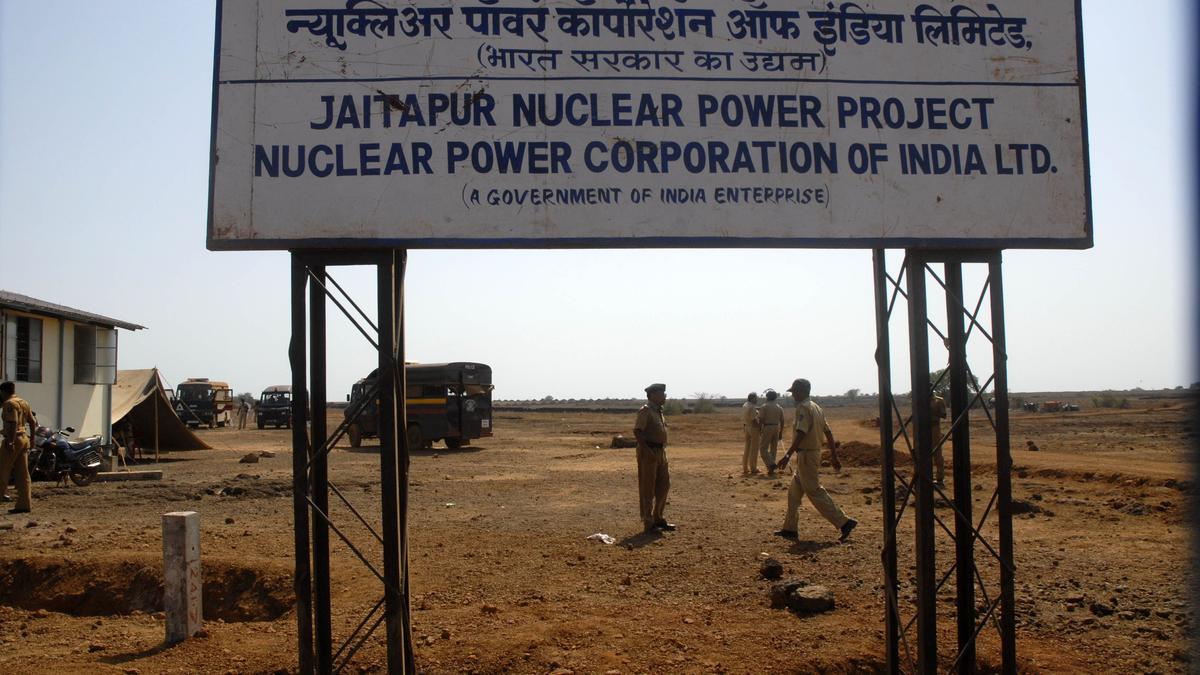
Delays despite assurances by Minister Jitendra Singh that all technical, commercial, legal issues would be sorted by “early 2023”
The Hindu, SUHASINI HAIDAR April 24, 2023
Two years after the French energy company Electricite de France (EDF) submitted its techno-commercial offer for the construction of six nuclear power reactors in Maharashtra’s Jaitapur, talks between Indian and French officials over several issues, including liability, have not resulted in any breakthrough yet.
According to sources in Delhi and Paris, the talks over the high cost of power per unit has also become a major issue in the conclusion of the agreement for the 9,900 MW project, which is the world’s biggest nuclear power generation site under consideration at present.
“The topic [of liability] has been discussed between the French and Indian governments and my understanding is that it is progressing towards convergence. It is a key topic for France and the EDF, and so this topic would have to be solved before any contract can be signed,” an EDF official said in response to a question from The Hindu, as part of a presentation to a larger group of international journalists invited to Paris.
The statement is significant, as in October 2022, the Minister of Space and Atomic Energy, and Minister of State in the Prime Minister’s Office (MoS PMO), Jitendra Singh, promised an early resolution to all the issues, within months………………..
PM to visit Paris in July……………………
The EDF official, who requested not to be identified, but spoke on behalf of the company, said that the issue, arising from India’s Civil Liability for Nuclear Damage Act that India passed in 2010, remains an item on the “agenda for both countries”. India’s CLND Act, which was brought in addition to the International Convention on Supplementary Compensation (CSC), is considered excessive by foreign companies, which could be liable to pay hundreds of millions of dollars in the event of a nuclear accident. As a result, despite signing civil nuclear deals with a number of countries, including the U.S, France and Japan, the only foreign presence in India is that of Russia in Kudankulam, projects that predate the Law.
A recent report in Al Jazeera also points to the fact that despite planning an insurance pool of ₹1,500 crores ($200 million) in 2015, the government’s ‘India Nuclear Insurance Pool” (INIP) has only been able to collect about half, ₹700 crore-₹800 crore, thus far. Concerns over safety after the 2011 Fukushima nuclear disaster, prompted Germany to switch off its last nuclear power reactor this month.
Another factor will be the time taken by the Jaitapur project, for which the original MoU was signed in 2009 with EDF’s predecessor Areva. In 2016, EDF and NPCIL signed a revised MoU, and in 2018, the heads of both signed an agreement on the “industrial way forward” in the presence of Mr. Modi and Mr. Macron. However, officials said nuclear projects do take time, pointing to EDF’s latest construction of an EPR in Finland, Olkiluoto 3. Its work began in 2005 and was completed after a delay of about 14 years, finally starting regular production on April 16 this year. https://www.thehindu.com/news/national/nuclear-liability-issues-not-yet-resolved-for-jaitapur-project-french-company-edf/article66774668.ece
Does India have enough insurance coverage for a nuclear disaster?
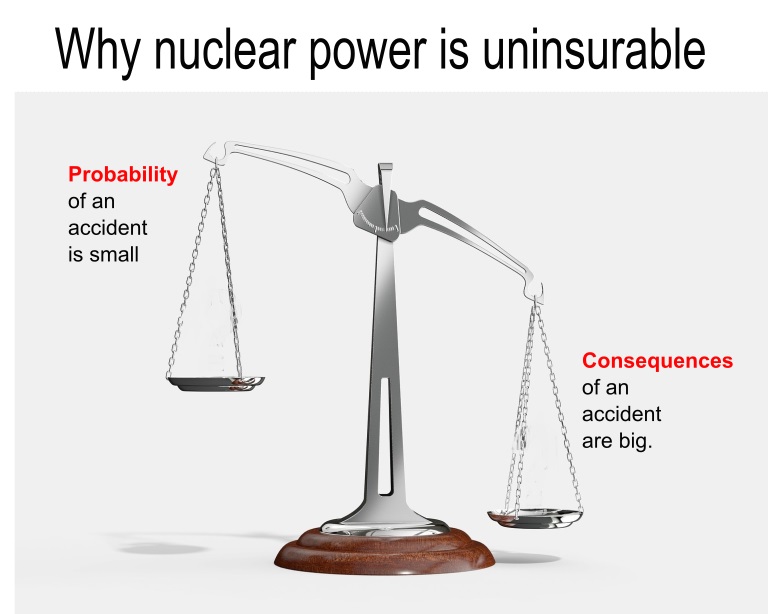
India has barely half the insurance amount required by law for its current nuclear plants, and has many more plants in the works.
Aljazeera, By Urvashi Sarkar 21 Apr 2023
India has barely half the insurance amount it needs in the event of a nuclear disaster, raising concerns among experts about the lack of oversight on the nuclear sector.
The India Nuclear Insurance Pool (INIP) has collected around 7 billion to 8 billion rupees ($84.5m to $96.6m) of the 15 billion rupees ($182.9m) required under the Civil Liability for Nuclear Damage Act, 2010 (CLND), indicating a critical shortfall in funds that will be needed to compensate victims and pay for cleanup in case of a nuclear disaster………………………………………………………..
“The fact that the nuclear insurance pool has not even met what is required by law is concerning — it shows that the Parliament is not overseeing how the nuclear sector is operating,” said MV Ramana, professor at the School of Public Policy and Global Affairs, University of British Columbia and author of The Power of Promise: Examining Nuclear Energy in India. “My greater concern is the approach of NPCIL and other parties involved, which seem to think of liability requirements as a box to check off, rather than something they need to prudently plan for.”
“They seem to be victims of the same ‘safety myth’ that was at the root of the inadequate preparations for nuclear accidents revealed in the aftermath of the multiple reactor accidents at the Fukushima Daiichi nuclear plant in Japan [in March 2011],” Ramana said…………………………………….
India currently has 22 reactors, all of which are operated by the NPCIL. The INIP provides insurance to all of them. Apart from this, it has 10 reactors that are at various stages of construction (one of which has been connected to the grid) and New Delhi has sanctioned another 10 — all of which are expected to start functioning by 2031. But how these plants will be insured is unknown………………………………………………………… more https://www.aljazeera.com/economy/2023/4/21/does-india-have-enough-insurance-coverage-for-a-nuclear-disaster
India and Pakistan Must Negotiate Nuclear Responsibilities
South Asia Voices, by Ladhu R. Choudhary, April 7, 2023
In 2019, while addressing an election rally, Indian Prime Minister Narendra Modi stated a fiery public remark, “every other day they [Pakistan] used to say ‘we have nuclear button, we have nuclear button.’ What do we have then? Have we kept it for Diwali (a mega Indian festival celebrated with extensive use of firecrackers)?” His statement is just one example of India and Pakistan’s exaggerated rhetoric around their nuclear rivalry.
…………………………………………… responsible nuclear states should strategize to stigmatize the bomb. Most importantly, these statements undermine the essential ingredients of nuclear responsibilities.
Nuclear responsibilities are defined as a set of extraordinary obligations and reasoning of the nuclear weapon states to exercise restraint in nuclear posturing and proliferation activities to avoid nuclear crises and avert a nuclear arms race. A nuclear responsibilities framework demands that states prioritize behaviors that reinforce credible deterrence postures and doctrines, reduce nuclear risks, and create the conditions for disarmament. Given the catastrophic risks of escalation, the political leadership in both India and Pakistan should refrain from acts of nuclear irresponsibility and demonstrate their respect for nuclear safety and security norms.
………………………………………………. Existing South Asian Nuclear Culture Lacks Nuclear Responsibilities
When politicians in India and Pakistan remind one another of the nuclear button and equate nuclear weapons with Diwali firecrackers, they reinforce South Asian atomic culture. This atomic culture has facilitated the acquisition of nuclear technology with chauvinistic pride and a symbol of supreme power for political independence. It has limited space for negotiating potential threats of nuclear exchanges and shared responsibilities of hostile SNW. For instance, New Delhi and Islamabad have not been able to build robust institutional arrangements for Nuclear Confidence Building Measures (NCBMs).
India and Pakistan need a better cooperation record for joint nuclear doctrine formulations and identifying implementation procedures. Furthermore, their ambiguous doctrines, postures, and accidents may escalate nuclear instability. ……………………………… more https://southasianvoices.org/india-and-pakistan-must-negotiate-nuclear-responsibilities/
Former US Secretary of State says Pakistan’s 2019 conflict with India almost sparked nuclear war
A former high-ranking US official has revealed he will “never forget the night” when the world witnessed what almost became a nuclear catastrophe.
Alex Blair news.com.au 25 Jan 23
Former US Secretary of State Mike Pompeo has detailed just how close the world came to nuclear war in 2019.
In February 2019, the relationship between rival nuclear powers India and Pakistan came dangerously close to escalating into a full-blown conflict, Pompeo writes in his memoir.
It all kicked off when India launched a military operation against militants within Pakistani territory, in response to an attack on its own troops in the disputed region of Kashmir that left 40 Indian soldiers dead.
Pakistan retaliated by shooting down two Indian aircraft and capturing a fighter pilot.
Both nations lay claim to Kashmir, but currently control only portions of the region. India has long accused Pakistan of supporting separatist militants in the Kashmir Valley, a claim that Pakistan denies.
The two nations, both nuclear powers, have engaged in multiple conflicts throughout their history, with the majority of these conflicts centred around the disputed region.
In his memoir, Never Give An Inch: Fighting for the America I Love, Pompeo emphasises that the world was unaware of the sheer gravity of the situation……………………………………………………….. more https://www.news.com.au/technology/innovation/military/former-us-secretary-of-state-says-pakistans-2019-conflict-with-india-almost-sparked-nuclear-war/news-story/75da26ebea96f1064d024205c6108bc2
1 This Month
23-25 October – on Zoom – World BEYOND War’s annual global conferenc


Shut down the radiation-damaged Heysham nuclear reactors now
To see nuclear-related stories in greater depth and intensity – go to https://nuclearinformation.wordpress.com

Say No to NASA’s Reckless Nuclear Reactor on the Moon
Say No to NASA’s Reckless Nuclear Reactor on the Moon

-
Archives
- October 2026 (247)
- September 2026 (339)
- August 2026 (330)
- July 2026 (355)
- June 2026 (287)
- May 2026 (306)
- April 2026 (356)
- March 2026 (251)
- February 2026 (267)
- January 2026 (308)
- December 2025 (358)
- November 2025 (359)
-
Categories
- 1
- 1 NUCLEAR ISSUES
- business and costs
- climate change
- culture and arts
- ENERGY
- environment
- health
- history
- indigenous issues
- Legal
- marketing of nuclear
- media
- opposition to nuclear
- PERSONAL STORIES
- politics
- politics international
- Religion and ethics
- safety
- secrets,lies and civil liberties
- spinbuster
- technology
- Uranium
- wastes
- weapons and war
- Women
- 2 WORLD
- ACTION
- AFRICA
- Atrocities
- AUSTRALIA
- Christina's notes
- Christina's themes
- culture and arts
- Events
- Fuk 2022
- Fuk 2023
- Fukushima 2017
- Fukushima 2018
- fukushima 2019
- Fukushima 2020
- Fukushima 2021
- general
- global warming
- Humour (God we need it)
- Nuclear
- RARE EARTHS
- Reference
- resources – print
- Resources -audiovicual
- Weekly Newsletter
- World
- World Nuclear
- YouTube
-
RSS
Entries RSS
Comments RSS

