Despite safety doubts, China resumes building big nuclear power plant
China’s Ministry of Environmental Protection said in a report in
October that the country’s nuclear safety situation was “not
optimistic”, and that the use of differing types of reactors in
Chinese plants made the sector “difficult to manage”.
China resumes construction of ‘biggest’ nuclear plant Australia
Network News, 4 Jan 13 Chinese state media says the country has
resumed construction of a nuclear power plant suspended after the 2011
Fukushima disaster. Continue reading
Slowing down- China’s nuclear power programme
deciding not to build any inland nuclear power plants through 2015
Although China has not announced new nuclear power installed capacity targets for 2020, it is expected that targets will be adjusted downward from previous expectations. ….
 China moves to strengthen nuclear safety standards and moderate the pace of its nuclear power development, Switchboard, Alvin Lin This post was co-written with my colleagues Jingjing Li, Jason Portner and Christine Xu, 23 Dec 12, .”……….. Before the March 2011 Fukushima nuclear disaster, China had been undertaking the world’s largest nuclear power plant construction program, with plans to expand its then approximately 11.5 GW of nuclear power to as much as 80 GW of nuclear capacity by 2020. (Given that current reactors are about 1 GW in size, this would be equivalent to building nearly 70 reactors over a decade.)
Following Fukushima, however, Beijing immediately suspended approval of all new nuclear power projects while it undertook a comprehensive safety review of existing and under-construction nuclear power plants, as well as research reactors and fuel cycle facilities, and developed its Twelfth Five Year Plan for Nuclear Safety……
The report concluded that operating reactors “basically fulfill” China’s nuclear safety laws and regulations and the International Atomic Energy Agency’s most recent standards, that they have the capacity to respond to design-basis accidents and severe accidents, and that safety risks are under control.
However, in spite of these conclusions, the inspection report and nuclear safety plan also identified areas for improvement. Continue reading
China looks to thousands of jobs and cheap electricity with home solar connected to the grid
First Home Solar Array Connected To China’s State Grid  http://www.energymatters.com.au/index.php?main_page=news_article&article_id=3531 27 Dec 12 For a nation that leads the world in solar panel production, China has been a little slow off the mark with grid connection in relation to home solar power – but that will change dramatically soon. China Daily reports the first residential solar power system has been connected to China’s State electricity grid in Qingdao, Shandong province. While grid connection is taken for granted in countries such as Australia, this first installation proved to be quite a task; taking 19 days to complete. However, we can expect grid connected residential solar to bypass Australia’s tally very soon. State Grid Corporation of China, the largest electricity utility in the world, only started allowing small-scale solar power systems to connect to the national grid in November.
The Qingdao installation will be the first of many millions as new policies mean the work needed to connect privately owned systems below 5 megawatts capacity to the grid will be carried out free of charge. State Grid will also purchase surplus electricity generated by these systems.
The scale of State Grid Corporation of China is staggering. It has over 1.5 million employees and in 2011, generated revenue to the tune of US$ 259.14 billion. Its service area represents 88% of the country and provides electricity to over one billion people.

There will be no shortage of work for those employees. According to RenewEconomy’s Giles Parkinson, rumour has it that China will boost their solar target to 40GW by 2015; which is an entirely achievable goal considering more than 5GW capacity has been installed in this year alone. While China’s love affair with solar is set to continue, its rapid ascent in solar manufacturing hasn’t been without its casualties; with numerous manufacturers falling by the wayside due to competition and external forces. China’s government recently announced it would carry out reforms to the industry; including promoting mergers and acquisitions and reducing government support for manufacturers.
China is often criticised; but something we can all be thankful for is the nation brought affordable solar to the world.
Wind energy taking off in a big way, in China
China’s Wind Power Sector Set for Rapid Development after Year of Stagnancy Renewable Energy World, By Liu Yuanyuan, December 11, 2012 BEIJING — China’s wind power sector, after stagnating for nearly a year, is expected to experience rapid development as local governments launch favorable policies. Continue reading
Chinese serious radiation problem, uranium ash from coal mining
The environmental hazards caused by radioactive ash has been kept quiet.
 Coal mines near uranium deposits spoiling value of nuclear fuel. Experts say many coal and uranium deposits are co-located and that extraction of the fossil fuel first is ruining the value of
  the nuclear fuel South China Morning Post, 18 November, 2012, Stephen Chen “…… And as China’s nuclear and coal sectors battle over the sites where the radioactive heavy metal lies buried, experts say the uranium is accidentally ending up in coal-fired power stations
– creating radioactive ash that is falling on surrounding cities.
One Canadian firm that declined to be interviewed has built a plant near one coal-fired power station in Yunnan to collect the uranium from the ash….. Continue reading
China’s process of change in political leadership – anything but democratic
China’s chosen few get to glimpse behind the curtain, The Age, November 12, 2012, Virginie Magin, Malcolm Moore “…..in reality, the process has the thinnest veneer of democracy, since the number of places on the Politburo Standing Committee will match the number of candidates put forward..
… Overall, the proceedings at the congress have been carefully choreographed, with delegates chosen to reflect the party’s inclusiveness. In turn, they make speeches praising the party, Mr Hu’s leadership and occasionally themselves, …… http://www.theage.com.au/world/chinas-chosen-few-get-to-glimpse-behind-the-curtain-20121111-296eg.html#ixzz2C2o9sv8s
China puts the brakes on nuclear power
China Slows Development of Nuclear Power Plants, NYT By KEITH BRADSHER, October 24, 2012 HONG KONG — Still responding to the partial meltdowns last year at nuclear reactors in Fukushima, Japan, the Chinese government has lowered its target for the construction of nuclear power plants by 2015, notably by not building more nuclear reactors at inland locations.
A white paper on energy policy released after a cabinet meeting on Wednesday said that the government planned to have 40 gigawatts of nuclear power capacity installed by 2015, and pledged strict safety standards. While the white paper and state-controlled media did not
describe this as a reduction in the target, the country’s current Five-Year Plan sets a target of 50 gigawatts….. Nuclear power generates only 1.8 percent of China’s electricity, far below the global average of 14 percent. http://www.nytimes.com/2012/10/25/business/global/china-reduces-target-for-construction-nuclear-power-plants.html?_r=2&
China slowing down its nuclear power program
China to approve only a few new reactors by 2015 By David Stanway BEIJING  Oct 24, 2012 (Reuters) – China will approve a small number of new nuclear reactors before 2015 to be built only in coastal regions, the government said on Wednesday, as it unveiled a raft of measures to spur private investments in energy. Continue reading
China’s nuclear power program slows down, as safety problems recognised
China Nuclear Report Acknowledges Safety Concerns, WSJ, By BRIAN SPEGELE And WAYNE MA 16 Oct 12, BEIJING — A report by China’s Ministry of Environmental Protection
acknowledged safety concerns in China’s fleet of nuclear reactors, including potential complications from the sheer variety of reactors in operation…. Continue reading
China still has poor record on nuclear safety, uranium environmental damage
Should China be involved in the UK’s nuclear energy infrastructure? Guardian UK, Paul Dorfman, 21 Sept 12“….In Tibet, the Chinese nuclear industry is engaged in a determined effort to secure uranium deposits located in Amdo, where leaching and open pit extraction are reported to have resulted in significant environmental contamination. Regulation of safety oversight mechanisms is relatively weak in the Chinese nuclear industry, and according to a recent Nuclear Materials Security Index report, China ranks 29th among the group of 32 nuclear nations in terms of nuclear security and materials transparency. Although it’s to be hoped that greater corporate social responsibility and sensitivity to vulnerable industrial communities is evolving in both Russia and China, it’s still troubling to reflect on their respective human rights situations, documented by Amnesty International……http://www.guardian.co.uk/environment/blog/2012/sep/21/nuclearpower-energy?newsfeed=true
Chinese news reports increased exposure to radioactivity as one cause of birth defects
Consumption of prohibited medicine, increased exposure to radioactivity and drinking have also contributed to the increase, experts said.
900,000 Chinese born with birth defects every year http://www.beijingnews.net/index.php?sid/209107845/scat/55582c89cb296d4c/ht/900000-Chinese-born-with-birth-defects-every-year Beijing News.Net 12th September, 2012 Around 900,000 babies are born with birth defects in China every year, the health ministry said Wednesday.
This constitutes about 5.6 percent of the total number of newborns, Xinhua reported.
The ministry report for 2012 on prevention and treatment of defects in newborn babies said birth defects — at 19.1 percent — have become the second-biggest cause of infant deaths in China.
Birth defects are a serious problem in China’s rural areas. Continue reading
China’s nuclear dilemma, Phys Org. September 14, 2012 An expert assessment of China’s nuclear weapons strategy highlights the risk of escalation to nuclear war from a conflict beginning with conventional weapons, due to the unusual structure of the nation’s military. The new study, previously only available in Chinese, appears in the latest edition of The Bulletin of the Atomic Scientists, published by SAGE.
The authors believe that this is the first comprehensive non-governmental study on how China’s nuclear-war plan was developed….. http://phys.org/news/2012-09-china-nuclear-dilemma.html#jCp
China going for energy efficiency, to the tune of $372 billion
Seven Chinese cities and provinces will launch CO2 emissions trading schemes over the next two years ahead of a national scheme later in the decade, as China seeks to move away from traditional command-and-control measures to combat spiraling carbon emissions.
China to spend $372 billion on cutting energy use, pollution Planet Ark : 23-Aug-12 Kathy Chen and Stian Reklev China will plough $372 billion into energy conservation projects and anti-pollution measures over the next three-and-a-half years, part of a drive to cut energy consumption by 300 million tonnes of standard coal, the country’s cabinet said Tuesday.

A report from China’s State Council, or cabinet, said the investments will take China almost halfway to meeting its target to cut the energy intensity 16 percent below 2010 levels by 2015.
The government has earmarked $155 billion of the money for projects that shrink energy use, and while the plan did not detail which types of projects or sectors would benefit from the funds, a big share of the cash is expected to go to industry. Continue reading
Poisonous legacy of rare earths mining in China
Rare-earth mining in China comes at a heavy cost for local villages Guardian UK Pollution is poisoning the farms and villages of the region that processes the precious minerals , 7 August 2012 From the air it looks like a huge lake, fed by many tributaries, but on the ground it turns out to be a murky expanse of water, in which no fish or algae can survive. The shore is coated with a black crust, so thick you can walk on it. Into this huge, 10 sq km tailings pond nearby factories discharge water loaded with chemicals used to process the 17 most sought after minerals in the world, collectively known as rare earths.
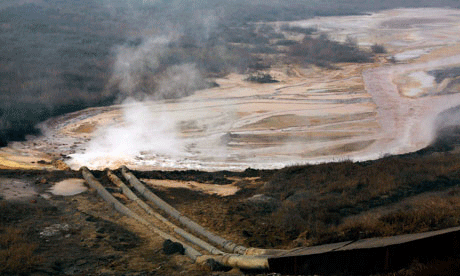
The town of Baotou, in Inner Mongolia, is the largest Chinese source of these strategic elements, essential to advanced technology, from smartphones to GPS receivers, but also to wind farms and, above all, electric cars. The minerals are mined at Bayan Obo, 120km farther north, then brought to Baotou for processing.
The concentration of rare earths in the ore is very low, so they must be separated and purified, using hydro-metallurgical techniques and acid baths. China accounts for 97% of global output of these precious substances, with two-thirds produced in Baotou.
The foul waters of the tailings pond contain all sorts of toxic chemicals, but also radioactive elements such as thorium which, if ingested, cause cancers of the pancreas and lungs, and leukaemia. “Before the factories were built, there were just fields here as far as the eye can see. In the place of this radioactive sludge, there were watermelons, aubergines and tomatoes,” says Li Guirong with a sigh.
It was in 1958 – when he was 10 – that a state-owned concern, the Baotou Iron and Steel company (Baogang), started producing rare-earth minerals. The lake appeared at that time. “To begin with we didn’t notice the pollution it was causing. How could we have known?” As secretary general of the local branch of the Communist party, he is one of the few residents who dares to speak out.
Towards the end of the 1980s, Li explains, crops in nearby villages started to fail: “Plants grew badly. They would flower all right, but sometimes there was no fruit or they were small or smelt awful.” Ten years later the villagers had to accept that vegetables simply would not grow any longer. In the village of Xinguang Sancun – much as in all those near the Baotou factories – farmers let some fields run wild and stopped planting anything but wheat and corn.
A study by the municipal environmental protection agency showed that rare-earth minerals were the source of their problems. The minerals themselves caused pollution, but also the dozens of new factories that had sprung up around the processing facilities and a fossil-fuel power station feeding Baotou’s new industrial fabric. Residents of what was now known as the “rare-earth capital of the world” were inhaling solvent vapour, particularly sulphuric acid, as well as coal dust, clearly visible in the air between houses.
Now the soil and groundwater are saturated with toxic substances. Five years ago Li had to get rid of his sick pigs, the last survivors of a collection of cows, horses, chickens and goats, killed off by the toxins.
The farmers have moved away. Most of the small brick houses in Xinguang Sancun, huddling close to one another, are going to rack and ruin. In just 10 years the population has dropped from 2,000 to 300 people…… http://www.guardian.co.uk/environment/2012/aug/07/china-rare-earth-village-pollution
Rapid growth of China’s solar sector as solar panel prices plummet
The global solar sector has witnessed some extraordinary growth in the past couple of years. According to Bloomberg New Energy Finance, the prices of solar panels have fallen by almost 42% in a single year to $0.87 per watt.
 CHINA SETS 2015 SOLAR ENERGY TARGET AT 21GW Solar PV Investor, BY SARFARAZ KHAN | 12 JULY 2012 Although the massive target might seem overly ambitious to some, most of the industry analysts believe that it is still very modest. China’s local media has revealed that the National Energy Administration (NEA) has decided to quadruple the country’s 2015 solar energy target to 21GW. Continue reading
1 This Month



26 September – International Day for the Total Elimination of Nuclear Weapons


PLEASE OPPOSE HR 8255 AND S.3639 – bills would accelerate satellite deployment, with no environmental review or safeguards – https://ncstd5li.quorum.us/campaign/169331/
To see nuclear-related stories in greater depth and intensity – go to https://nuclearinformation.wordpress.com
-
Archives
- September 2026 (233)
- August 2026 (330)
- July 2026 (355)
- June 2026 (287)
- May 2026 (306)
- April 2026 (356)
- March 2026 (251)
- February 2026 (267)
- January 2026 (308)
- December 2025 (358)
- November 2025 (359)
- October 2025 (375)
-
Categories
- 1
- 1 NUCLEAR ISSUES
- business and costs
- climate change
- culture and arts
- ENERGY
- environment
- health
- history
- indigenous issues
- Legal
- marketing of nuclear
- media
- opposition to nuclear
- PERSONAL STORIES
- politics
- politics international
- Religion and ethics
- safety
- secrets,lies and civil liberties
- spinbuster
- technology
- Uranium
- wastes
- weapons and war
- Women
- 2 WORLD
- ACTION
- AFRICA
- Atrocities
- AUSTRALIA
- Christina's notes
- Christina's themes
- culture and arts
- Events
- Fuk 2022
- Fuk 2023
- Fukushima 2017
- Fukushima 2018
- fukushima 2019
- Fukushima 2020
- Fukushima 2021
- general
- global warming
- Humour (God we need it)
- Nuclear
- RARE EARTHS
- Reference
- resources – print
- Resources -audiovicual
- Weekly Newsletter
- World
- World Nuclear
- YouTube
-
RSS
Entries RSS
Comments RSS
 nuclear-news