Concerns about China’s nuclear technology: is it safe?
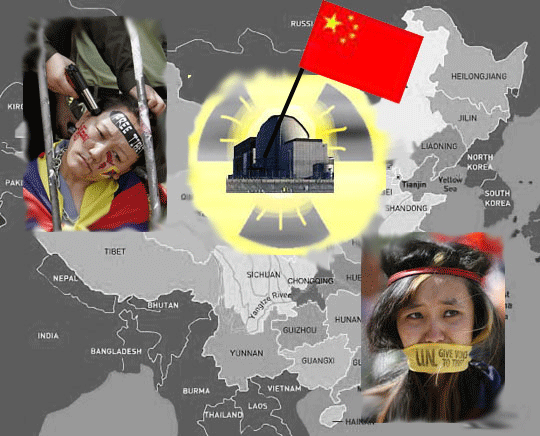
China’s nuclear technology ambition is worrying: The Yomiuri Shimbun Straits.com 15 Dec 15 In its editorial on Dec 15, 2015, The Yomiuri Shimbun hopes China will follow up on its nuclear ambitions with suitable regulatory measures. We cannot afford to be unconcerned about China’s moves to accelerate construction of nuclear power plants.
Is the safety of these facilities ensured?….
The administration of Chinese President Xi Jinping is planning to further increase the number of nuclear power plants to cope with the nation’s serious air pollution, which stems from coal-fired power generation, and increasing energy demand.
According to local media reports, Beijing will build six to eight nuclear reactors annually in the next five years. By 2030, the number is set to reach 110, surpassing the 99 in the United States.
One major concern is that information about nuclear power plants in China is extremely limited.
China’s nuclear power operations began in 1994, and the number of nuclear reactors has increased rapidly since then.
However, the details of regulatory standards are not disclosed – it is quite obscure what kind of safety measures China is currently taking.
There are limited examples of the Chinese government officially disclosing troubles with the nation’s nuclear power plants to the public, such as leaks of radioactive material or mechanical problems caused by accidents.
The less information available, the more concern there is. The Japanese government must reinforce its measures to collect information on China’s nuclear power plants.
Prevailing westerlies bring yellow sand and air pollutants to Japan from China. If serious nuclear accidents occur in China, there could be serious repercussions for Japan.
It cannot be overlooked the fact that China’s nuclear power plants are concentrated in coastal areas.
After the nuclear accident at Tokyo Electric Power Co.’s Fukushima No. 1 nuclear power plant, Beijing has put restrictions on the construction of nuclear power plants in inland areas. We assume Beijing is wary of the domestic impact from accidents if they occur inland.
China’s nuclear reactors rarely use technologies developed in the country – they are basically an amalgamation of technologies imported from European countries, the United States and Japan.
Japan provides core parts, such as reactor pressure vessels.
In recent years, China’s export drive on nuclear power plants has received worldwide attention…….
Beijing is also constructing Hualong One reactors in Pakistan, and is seeking to launch a promotion drive in South American and African countries.
However, we must point out that Hualong One is a model still under construction even in China itself. It is problematic that a model without sufficient operation records has begun sweeping the whole world…….. http://www.straitstimes.com/asia/east-asia/chinas-nuclear-technology-ambition-is-worrying-the-yomiuri-shimbun
China’s nuclear programme is fraught with problems

 Mixed Fortunes for Nuclear Power NYT, DEC. 7, 2015 In July 2013, hundreds of people took to the streets in the southern Chinese city of Jiangmen to protest the proposed construction of a uranium processing plant in the region.
The $6 billion plant would have supplied fuel for the country’s rapidly expanding nuclear power industry. But the plan was dropped in the face of public opposition, the first case of its kind in China, said Keith Florig, a risk-management researcher at the University of Florida’s Warrington College of Business.
The protest, and its fallout, are important events in a country that has 22 nuclear power reactors under construction and more planned, as well as a growing international business selling nuclear energy technology to countries including Argentina, Britain and Pakistan. Mr. Florig said that this “rate of development hasn’t happened since the late 1960s and early 1970s in the U.S. and Soviet Union.”
At the same time, Mr. Florig characterized China as being underprepared for dealing with the public opinion issues that have plagued nuclear energy in developed countries.
He said that about 15 years ago he had interviewed Chinese energy officials to find out what they knew about nuclear energy development in the West. He found that they were uniformly focused on the technical challenges of controlling nuclear fission and using the heat it produced to boil water, create steam and power electric turbines. No one seemed to be aware of the social, political and economic challenges….
A warning to COP21 on dubious safety of China’s nuclear gamble
He Zuoxiu, a leading Chinese physicist, has called China’s plans for a bubble in nuclear reactors “insane.”
China’s nuclear ambitions have the tacit approval of many COP21 participants amid calls for the biggest polluter to forsake coal. But this should be a moment of caution for global nuclear authorities who should be urging China to increase safety standards and emphasize more benign energy sources. Ditto for investors sensing a no-brainer profit opportunity. One reason China considers the nuclear option cheaper than solar, windmill and water sources, He says, is that staffing is sparser than in other nations and cost-cutting is de rigor. Just something for David Cameron to consider as the U.K. prime minister gloats over hosting a Chinese-designed reactor……
Nuclear power, industry cheerleaders claim, is cheap, safe and clean. In theory, perhaps, but ask the 100,000-plus Japanese in the Tohoku region who can’t return home. Or the Fukushima farmers and fishermen who can’t sell their wares. Just some food for thought for officials in Paris this week figuring a comparable scenario near the Yangtze is unthinkable. Think again.
 China’s ‘insane’ gamble on nuclear power, Japan Times, BY WILLIAM PESEK, BARRON’S ASIA, DEC 3, 2015 When I contemplate China’s plan to build as many as 135 nuclear reactors, I’m transported back to that harrowing March 2011 week when Fukushima No. 1 was melting down……
only in the months that followed did we learn how close the world actually came to losing Tokyo. Tepco was preparing to abandon the wrecked facility. Leaving the reactors to melt down unencumbered would have meant the immediate evacuation of 13 million-plus people. On March 15, then-Prime Minister Naoto Kan literally stormed Tepco headquarters and demanded its technicians contain the crisis. Thanks to the government’s collusion with the media, it’s taken years for we in Tokyo to realize we probably owe Kan our lives.
I retrace Japan’s March 2011 because it is as clear and cautionary a tale as Beijing will find as it goes nuclear in a hurry. The number 100, China’s ranking on Transparency International’s corruption perceptions index, tells the story. Continue reading
China marketing nuclear technology etc to Czech Republic
 China, Czech pledge closer nuclear power, finance cooperation BEIJING, Nov. 27 (Xinhua) — Chinese Premier Li Keqiang and his Czech counterpart Bohuslav Sobotka pledged to boost cooperation in nuclear power, finance and other sectors during talk on Friday.
“China’s nuclear power technology and equipment are safe and inexpensive, which has made them competitive globally,” Li said, adding that the Chinese side is willing to participate in Czech’s nuclear power business.
Sobotka, who is making his first official visit to China, said he welcomes China’s participation in Czech’s nuclear power business. He added that the two sides can study the feasibility of conducting nuclear power cooperation in markets outside of the two territories.
Earlier this week, Sobotka attended the fourth summit of China and Central and Eastern European (CEE) countries in east China’s Suzhou city, where Li proposed to set up a multilateral financial firm between China and the 16 CEE countries.
On the financial front, Li said on Friday that he hopes China and Czech will innovate and expand the mode of financial cooperation within the framework if the “16+1” financial firm in discussion, which he said will strongly support practical cooperation between the two countries.
China stands ready to talk with Czech on establishing a RMB settlement mechanism in Prague, Li added……..http://news.xinhuanet.com/english/2015-11/27/c_134862920.htm
Did China dump nuclear trash in Northern Sudan?

 Sudan: Govt Urged to Investigate ‘Nuclear Waste Dumping’ http://allafrica.com/stories/201511170207.html Khartoum / Merowe — The Sudanese Parliament and the Communist Party of Sudan (CpoS) have called on the government to “immediately investigate the burial of nuclear waste” from China in the Northern State. The director of the governmental Dams Implementation Unit has strongly denied the “presence of containers with chemicals or harmful substances to Sudan from any other country”.
The former director of the Sudan Atomic Energy Commission in Sudan, Mohamed Siddig, said at a conference in Khartoum last Tuesday that 60 containers with nuclear waste were brought from China to Sudan during the construction of the Merowe Dam in the Northern State.
Siddig told the audience that 40 containers were buried in the desert not far from the Merowe Dam construction site. Another 20 containers were disposed of in the desert. He did not mention the date the waste was dumped, however China worked on the dam between 2004 and 2009. On Sunday, the spokesman for the caucus of the independent MPs, Mubarak El Nur, called for an immediate investigation into the alleged crime. The perpetrators should be brought to justice, he stressed.
The chairman of the Northern State’s parliamentary Services Committee, Ali Hassan Bateik, said that the northern MPs will also demand an investigation into the rapid rise of cancer and kidney failure in the region
Medics The medical contingent of the Communist Party demanded that the government disclose the exact sites of the 60 Chinese containers.
In a statement on Sunday, the doctors emphasise the need for holding those involved in the operation accountable: “Charge them with murder, and sentence them to maximum penalties”.
The medics also blame the government for keeping silent on the growing number of people in the area who suffer from kidney failure or cancer.
Rumours The director of the governmental Dams Implementation Unit, Jaafar Mohamed Hammad, however, strongly denied the “presence of containers with chemicals or harmful substances to Sudan from any other country”.
He told the Sudan News Agency (Suna) in Khartoum last week that he will take legal action “against those who spread the rumours” about the dumping of Chinese nuclear waste in the Northern State.
China’s authoritarian nuclear push meets community opposition
China’s authoritarian government, adept at corralling public opinion to get its way, can ram through its plans over the objections of people like Ms. Liu. But opponents say its closed, secretive political system is ill equipped to manage a rapid expansion of nuclear power, pointing to its struggle to prevent industrial disasters such as the chemical explosions in Tianjin in August that killed 173 people.
“The Chinese are beginning to wrestle with the same issues that Western countries were dealing with, concerning fear of the technology, transparency in decision making and trust of the authorities,”
Opponents of nuclear power in China maintain that the country can achieve its clean energy goals without a nuclear building spree, by investing heavily in improving solar and wind power and by upgrading the power grid so it can send electricity more efficiently across vast distances.
They point to the deadly explosions in Tianjin, where hazardous chemicals appear to have been stored improperly at a facility close to residential areas, as an example of how of lax regulation, graft and official obfuscation can undo the Chinese government’s promises to put safety first.
China’s Nuclear Vision Collides With Villagers’ Fears, NYT By CHRIS BUCKLEYNOV. 21, 2015“………..Hubin is one of dozens of sites across the country where officials have plans ready, awaiting further approval, to build atomic reactors over the next decade — an ambitious program to expand the use of nuclear energy that Beijing considers essential to weaning the Chinese economy from its reliance on coal-fired plants, which churn out air pollution and carbon dioxide.
Ask villagers here what they think of the proposed plant, though, and talk quickly turns to the Communist government’s dismal record of industrial accidents, as well as the 2011 nuclear disaster in Fukushima, Japan. Residents in Hubin will be resettled to new homes a few miles away, but many said that they would still feel threatened living so close to a nuclear station.
“It’s just not safe,” said Liu Shimin, a farmer in her 20s, nursing a baby outside her home near the banks of the Yahe River. “We’ll always be wondering, ‘What if there’s a big accident, like that one in Japan?’ ”
Such fears are on the rise in China as the nation embarks on a new phase of nuclear power construction that could make it the world’s biggest producer of nuclear energy by 2030. Continue reading
China to finance and build two nuclear stations in Argentina
 China to build two nuclear plants in Argentina in $15bn deal, Ft.com, Jamil Anderlini in Beijing and John-Paul Rathbone, Latin America Editor , 17 Nov 15
China will finance and build two nuclear power plants in Argentina in a deal worth up to $15bn underlining Beijing’s continued presence in Latin America despite its slowing economy.
The deal comes amid a push to export China’s homegrown atomic technology, often by offering cheap technology and generous financing. It follows China’s move last month to take a one-third stake in a French-led project to build the first in a new generation of UK nuclear plants.
Buenos Aires has been one of Beijing’s larger clients, with $19bn of lending for Chinese-led infrastructure projects since 2007, according to the Inter-American Dialogue’s China database.
Although China has started to scale back its exposure to more risky Latin American borrowers, such as Venezuela, it provided an $11bn currency swap arrangement last year to bolster Argentina’s sagging reserves.
Both reactors will be built by state-owned China National Nuclear Corp in co-operation with Argentina’s state-owned Nucleoeléctrica. When finished, they will roughly double the country’s nuclear power capacity provided by its existing three nuclear plants.
Chinese banks and companies will provide loans and investment to cover 85 per cent of the projects’ costs, with the loans to be paid back over 18 years with an annual interest rate below 6.5 per cent, according to Argentine media.
CNNC’s domestic state-owned rival, China General Nuclear Power Group (CGN), will apply to UK regulators next year for approval of its similar nuclear power technology as it seeks to build more plants in Britain.
CGN has already agreed to take a one-third stake in the French group EDF’s £18bn Hinkley Point power station, and wants to build a series of new reactors in the UK.
Analysts say success in exporting its nuclear technology to Britain will help China sell more nuclear plants around the world because of the perceived rigour of the UK’s regulatory regime.
“We have our first foot in the UK,” Zheng Dongshan, senior vice-president at CGN, told the Financial Times during a visit to the UK last month. “This could have a good effect to kick the door of other countries.”
Chinese economic planners have identified more than 60 countries between China and Europe as potential customers. They hope to provide 30 of the 200 nuclear plants they estimate will be under construction in those countries by 2030……
In recent years Beijing has stepped in to provide financing and investment to several countries locked, like Argentina, out of international credit markets or shunned by global investors because of war, sanctions or corruption.
Latin America has been an area of particular interest to China because of the ruling Communist party’s desire to expand Chinese influence into America’s traditional “backyard”.
Argentina to buy nuclear technology from China
Argentina says signs nuclear plant construction deals with China, Reuters, BUENOS AIRES Nov 15 Argentina has signed two nuclear power plant construction deals with China for about $15 billion, the Argentine government said in a statement on Sunday, calling the deals “a fundamental step toward diversifying our energy matrix.”…...”Between both deals we are talking about financing of close to $15 billion” over 18 years, the Argentine statement said. (Reporting by Maximilian Heath; Editing by Leslie Adler)
http://www.reuters.com/article/2015/11/15/argentina-china-energy-idUSL1N13A0GF20151115#0Y2dUv0yhLfBpo7L.99
A boon for bankers (but no-one else) – UK’s China Hinkley Point nuclear deal
 the decision to involve Chinese companies – initially with EDF at Hinkley Point and then on their own at Bradwell and Sizewell – only makes sense if it is seen as part of a quid pro quo for the previously announced financial services deal.
They put the Chinese Communist Party and military at the heart of strategic infrastructure. They interlink the British and Chinese financial systems at a time when the latter is structurally weak, poorly regulated, and struggling with corruption.
 Britain’s nuclear deal with China is a boon for bankers – and no one else, The Conversation, Jeffrey Henderson November 6, 2015 At first glance, it seems an almost inexplicable paradox. A right-wing British government has invited companies controlled by the Chinese Communist Party – and in one case, the Chinese military – into the heart of the UK’s strategically vital energy infrastructure. The nuclear deal between Britain and China goes against the advice of the security services, the military and the US government.
So to explain this paradox, we must look carefully at another major deal in the British government’s flirtation with President Xi Jinping: the inter-penetration of the two countries’ financial services.
There would seem to be no possible connection between Chinese companies building and operating nuclear power stations in 2020s Britain and a curious political role created in 1571. But the fact that the Remembrancer, a representative of the City of London Corporation, is allowed to attend and monitor debates in the House of Commons, says much about Britain’s priorities.
When considering economic and budgetary policy, the Remembrancer is at hand to ensure that our elected representatives remember that, whatever other interests they might serve, the needs of financial services must be paramount. And the near-invisible hand of the Remembrancer seems recently to have been at work ensuring that Britain’s infrastructure is made accessible to Chinese state-owned companies. Continue reading
France invites China in, to save failed nuclear corporation AREVA
France’s nuclear-reactor maker Areva open to Chinese funds, says French President Francois Hollande, South China Morning Post, Zhen Liuzhen.liu@scmp.com 3 Nov 15 It’s natural to involve China in Areva’s planned restructuring as the two nations cooperate to build nuclear plants, says French President French President Francois Hollande said on Tuesday that France welcomed Chinese investment in its state-owned nuclear-reactor maker Areva, as he wrapped up his two-day trip to China.
“We welcome foreign capital in the Areva restructuring. It would not affect our sovereignty,” Hollande said in Beijing.
On Monday, Areva and the China National Nuclear Corporation signed a memorandum of understanding for possible partnership on nuclear-waste recycling that could be worth €20 billion (HK$171 billion).
Hollande said that as China and France had become partners building nuclear plants together in Britain and China, it was natural to have the Chinese in the Areva recapitalisation. Last month, French utility company EDF came to an agreement with Chinese nuclear company CGN to jointly build the Hinkley Point nuclear plants in Britain.
Despite the continuous nuclear cooperation, Hollande said his two-day China trip focused more on climate change issues to ensure success in the upcoming UN round of climate talks to be held in Paris next month……..http://www.scmp.com/news/china/diplomacy-defence/article/1875477/frances-nuclear-reactor-maker-areva-open-chinese-funds
Call for Hong Gong to end nuclear energy imports when contract ends
Hong Kong should end nuclear energy imports after Daya Bay contract ends in 2034, Greenpeace says, South China Morning Post Group says ‘business as usual’ approach not enough and urges greater use of renewables, 04 November, 2015, Ernest Kao ernest.kao@scmp.com
By halting nuclear energy imports after the 20-year supply contract with the Daya Bay plant ends in 2034, along with reducing electricity use by one per cent each year and boosting renewable energy use to 10 per cent, Greenpeace calculated an emissions cut of 34 per cent could be achievable…..http://www.scmp.com/news/hong-kong/health-environment/article/1875380/hong-kong-should-end-nuclear-energy-imports-after
China far from being nuclear industry hope, could be its nightmare
Just how safe is China anyway? Now if China had a fantastic record of safety in its construction and other industries, maybe the odds should be made a bit longer….
Cheap? Some scepticism is in order How do we know what these reactors really cost? The fact is, we don’t. With China’s nuclear corporations under the control of various organs of state including the Communist Party and the Peoples Liberation Army, official statistics and accounts can simply not be relied upon…..
Nuclear construction in China must be cheaper than in the US and Europe due to lower labour costs. But if it really is that much cheaper it can only be at a huge safety penalty……
Tsunami risk – not if but when…….
The only good news in all this is that nuclear construction in China is not proceeding anything like as fast as Forbes magazine claims. Most of the more modern ‘Generation III’ reactors are well behind in their completion times, echoing the European experience with the failed EPR design.
Fukuzilla? China’s nuclear boom threatens global catastrophe http://www.theecologist.org/blogs_and_comments/commentators/2986056/fukuzilla_chinas_nuclear_boom_threatens_global_catastrophe.html Oliver Tickell 28th October 2015
China’s plans for 400 nuclear reactors threaten global catastrophe, writes Oliver Tickell. In the normal way of things we could expect major accidents every few years, but with 300 reactors along China’s seismically active coast, a major tsunami would be a Fukushima on steroids – wiping out much of China and contaminating the whole planet. Continue reading
Apple developing huge solar investment in China
 Apple steps up solar power investment in China http://www.smh.com.au/business/energy/apple-steps-up-solar-power-investment-in-china-20151022-gkfttm.html October 22, 2015 Alex Nussbaum “The time for action is now:” Apple chief Tim Cook. The move will make Apple’s operations in China carbon-neutral, the company says.
Apple will build an additional 200 megawatts of solar power in China and push suppliers to make similar commitments, as the maker of the iPad and Apple Watch seeks to offset its global-warming emissions in the world’s most polluting country.
The solar investment comes atop two previously announced solar farms in southern China that have now been completed, producing a combined 40 megawatts of power, Apple said in a statement overnight. The company will also partner with suppliers, including iPhone maker Foxconn Technology Group, on an additional 2 gigawatts of solar, wind and hydropower projects.
“Climate change is one of the great challenges of our time, and the time for action is now,” Apple chief executive Tim Cook said. “We believe passionately in leaving the world better than we found it and hope that many other suppliers, partners and other companies join us in this important effort.”
The promises are part of Apple’s efforts to cut greenhouse-gas emissions and come ahead of a United Nations summit in Paris later this year where world leaders will try to reach a global deal on reining in climate-change pollution. China, the world’s biggest source of greenhouse gases, has promised to almost double the amount of energy it gets from renewable and nuclear power by 2030.
Apple said in April that it would partner with US-based SunPower Corp. to build the two generating stations in Sichuan province. The new solar farms produce more power than Apple’s operations consume in China, making the company “carbon neutral,” it claims. The 200 megawatts of new investments will involve construction in northern, eastern and southern China and “will begin to offset the energy used in Apple’s supply chain.”
Foxconn will construct 400 megawatts of solar by 2018 as part of the initiative with suppliers, starting in Henan province. Foxconn has committed to generate as much renewable energy as its Zhengzhou factory uses in final production of the iPhone, Apple said.
Bloomberg
Details emerge on UK’s nuclear deal with China
China to take one-third stake in £24bn Hinkley nuclear power station http://www.theguardian.com/environment/2015/oct/20/china-to-take-one-third-stake-in-24bn-hinkley-nuclear-power-station Details unveiled of deal signed between state-owned companies from China and France to build world’s most expensive plant on UK soil, Guardian, Damian Carrington, 20 Oct 15 China will take a one-third stake in a French-led project to build a new £24bn nuclear power station in the UK at Hinkley Point in Somerset, expected to be the most expensive ever built.
The deal was signed between state-owned companies from China and France just hours before the Chinese president, Xi Jinping , arrived in London for a state visit, and is due to be announced on Wednesday.
It will lead to a final investment decision – the point of no return – by the end of 2015, according to the Financial Times.
The companies – France’s EDF and China General Nuclear Power Corporation – will be the only investors, having failed to attract others. The new completion date for the two reactors at Hinkley Point is 2025, eight years later than first suggested. The deal is strongly backed by the chancellor, George Osborne. The government believes the new plant, which would deliver 7% of the UK’s electricity, represents good value for low-carbon electricity which, barring problems, is always on.
The plant has been promised £92 per megawatt hour (MWh) for 35 years, double today’s average wholesale electricity price, with any shortfall being paid by consumers via household energy bills. Hinkley Point will also be backed by up to £17bn of UK government loan guarantees.
The deal signed this week is also expected to mention Chinese involvement on additional nuclear plants at Sizewell in Suffolk and Bradwell in Essex. China hopes to build 110 nuclear power plants at home and wants to use its own designs at Bradwell as a showcase to help it sell its technology further afield.
But the nuclear push has many criticsover its cost, the time it takes to build and the possible threats to the UK’s national security of having China in control of a plant on UK soil. Osborne’s father-in-law, former energy minister Lord Howell, said the project was “one of the worst deals ever” for British consumers and industry.
Howell, and others, have warned the reactor design planned for Hinkley C has never been completed successfully, pointing to huge cost and time overruns at EDF’s projects at Flamanville in France and Olkiluoto in Finland .
EDF needs the Chinese investment as it is burdened with high levels of debt and is expected to sell €10bn of assets in the next five years, according to the Financial Times. Earlier in October, two of the world’s biggest ratings agencies warned the company it faced credit-rating downgrades if Hinkley Point goes ahead.
A Greenpeace poll this week showed 29% of the UK public supports the Hinkley project, with 34% against it.
A protest camp was set up outside the site this week and Alan Jeffery, a spokesman for the Stop Hinkley campaign said: “We remain mystified about why Osborne wants to throw good money after bad on this project. In the process, he has devastated the UK’s burgeoning renewable energy industry, threatening up to 20,000 jobs in the process. He is doing his best to kill off an innovative industry of the future in order to keep alive a technology of the past.”
However, the Institution of Mechanical Engineers have welcomed the Hinkley plan. “Nuclear is set to play a central and vital role in the UK’s energy future,” said the IME’s Jenifer Baxter. “Although the financial costs of nuclear power seem high, this power station will provide and modernise the diversification we so badly need in ensuring the UK’s lights stay on.”
Chinese firm seeking to build nuclear in UK has history of errors in construction
Errors revealed at Chinese nuclear firm seeking to invest in UK plants, Guardian, Emma Graham-Harrison, 19 Oct 15 Huge quantity of protective steel was left out of initial construction of China General Nuclear Corp’s first reactor, built close to Hong Kong in 1987. One of the Chinese nuclear power firms pushing for a stake in the UK’s energy industry left out hundreds of critical steel rods when building its first reactor nearHong Kong in 1987 because workers misread the blueprint.
The missing parts were added in a higher layer of the foundation, with extra steel to reinforce them, after the extraordinary mistake was discovered. The plant has now been operating safely for more than two decades.
But the nature and scale of the error raises serious questions about the rigour of Chinese nuclear firms and the country’s oversight regime, experts say.
“[This a prospective] partner who, when they built the first nuclear power station in China, forgot to put in a large percentage of the protective steel,” said Professor Steve Tsang, senior fellow of the China Policy Institute at Nottingham University. “Potentially we are putting ourselves in a very difficult situation.”
China General Nuclear Corp built and runs Daya Bay nuclear plant in Shenzhen. It is one of two Chinese power firms expected to invest in the UK’s Hinkley Point power station and potentially build and operate a future nuclear plant, along with China National Nuclear Corporation and French firm EDF.
Chancellor George Osborne, on a trade mission to China last month, said the government would provide £2bn in initial financing for the much-delayed project, which EDF has struggled to fund. ndustry observers believe the Chinese cash for Hinkley is conditional on allowing Chinese firms to build their own plant at Bradwell in Essex. That project would function as a showcase for Chinese technology.
“I understand what the Chinese want, which is to have a demonstration plant, to show they can build inexpensively, quickly and reliably,” said Theresa Fallon, senior associate at the European Institute of Asian Studies.
“But it’s at a time when energy is relatively inexpensive, and this plant is a bit untried technology. I understand there are rules, but there were rules in Hong Kong too when you had the problems in Daya Bay. You are not building a gazebo, it’s really dangerous, serious stuff.”
News of the problems at one of China’s first commercial nuclear power plants only reached neighbouring Hong Kong weeks after the mistake was discovered on 14 September 1987……
A leading Chinese scientist told the Guardian this year that China’s nuclear power expansion plans are “insane” because the country’s safety controls are notrigorous enough.
“China currently does not have enough experience to make sound judgments on whether there could be accidents,” said 88-year-old He Zuoxiu, who worked on China’s nuclear weapons programme. “The number of reactors and the amount of time they have been operating safely both matter.”……http://www.theguardian.com/environment/2015/oct/19/steel-rods-missing-at-chinese-nuclear-firm-seeking-to-invest-in-uk-plants
1 This Month
Chernobyl: The Lost Tapes – A good documentary on Chernobyl on SBS available On Demand for the next 3 weeks– https://www.sbs.com.au/ondemand/tv-program/chernobyl-the-lost-tapes/2352741955560

of the week–London Campaign for Nuclear Disarmament

Tell the Ukrainian Government to Drop Prosecution of Peace Activist Yurii Sheliazhenko
To see nuclear-related stories in greater depth and intensity – go to https://nuclearinformation.wordpress.com
-
Archives
- April 2026 (139)
- March 2026 (251)
- February 2026 (268)
- January 2026 (308)
- December 2025 (358)
- November 2025 (359)
- October 2025 (376)
- September 2025 (257)
- August 2025 (319)
- July 2025 (230)
- June 2025 (348)
- May 2025 (261)
-
Categories
- 1
- 1 NUCLEAR ISSUES
- business and costs
- climate change
- culture and arts
- ENERGY
- environment
- health
- history
- indigenous issues
- Legal
- marketing of nuclear
- media
- opposition to nuclear
- PERSONAL STORIES
- politics
- politics international
- Religion and ethics
- safety
- secrets,lies and civil liberties
- spinbuster
- technology
- Uranium
- wastes
- weapons and war
- Women
- 2 WORLD
- ACTION
- AFRICA
- Atrocities
- AUSTRALIA
- Christina's notes
- Christina's themes
- culture and arts
- Events
- Fuk 2022
- Fuk 2023
- Fukushima 2017
- Fukushima 2018
- fukushima 2019
- Fukushima 2020
- Fukushima 2021
- general
- global warming
- Humour (God we need it)
- Nuclear
- RARE EARTHS
- Reference
- resources – print
- Resources -audiovicual
- Weekly Newsletter
- World
- World Nuclear
- YouTube
-
RSS
Entries RSS
Comments RSS
 nuclear-news