China’s nuclear weapons modernisation is relatively small: China not wanting to attack USA
 Is China Really Threatening America with Nuclear Weapons? , National Interest, Asia Times, 20 Feb 18 China, according to the Federation of American Scientists, has 270 warheads in its nuclear arsenal.
The Washington-based research group’s estimate has never been challenged by the Pentagon. It compares with an official tally of 4,480 nuclear warheads for the US. Unlike the American side, China also renounces “first use” of nuclear weapons and holds that its ability to retaliate is sufficient to deter attack.
That’s part of the reasoning behind the Pentagon’s 2018 Nuclear Posture Review(NPR) issued on February 2. The document is a benchmark US statement on nuclear policy and is drawn up by new presidents. The Trump administration’s first policy position on the issue focuses on creating new nuclear deterrents to Russia and China, while addressing North Korean and Iranian nuclear ambitions.
…….. critics contend the latest NPR reverses years of bipartisan consensus on the use of US nuclear weapons. The review also gives the go-ahead to develop low-yield tactical nukes and sub-launched cruise missiles in the first roll-out of new US nuclear weapons since the end of the Cold War. It also expands the circumstances under which the US would consider using nukes to include “non-nuclear strategic attacks” such as cyberattacks.
……….Chinese not on nuclear ‘alert’
Gregory Kulacki, the China project manager for the Union of Concerned Scientists (UCS), a Washington-based science advocacy group, argues that Trump’s NPR is surfacing at a time when China isn’t preparing to fight a nuclear war with the US. He says his talks with Chinese nuclear strategists indicate they don’t believe such an attack from the US is possible because the Americans know a sufficient number of Chinese missiles would survive to launch a nuclear counter-strike.
……… China, for its part, has urged the US to drop its “Cold War mentality” and not misread its intentions in modernizing its nuclear forces following the NPR’s release.
Miscalculation leading to war
Kulacki notes in his article that Chinese strategists have one worry: they fear the US might miscalculate by thinking it could escape full nuclear retaliation by using a massive first strike along with an anti-missile shield that can down any Chinese missiles that a pre-emptive attack would miss.
US negotiators, he says, are exacerbating such fears by declining to assure their Chinese counterparts that a US first strike is “off the table.”
“In the absence of a no first-use commitment from the United States, these improvements are needed to assure China’s leaders their US counterparts won’t take the risk of attacking China with nuclear weapons,” Kulacki says in his piece………http://nationalinterest.org/blog/the-buzz/china-really-threatening-america-nuclear-weapons-24565
Chinese and USA officials scuffled over the “nuclear football”
Nuclear football’ scuffle broke out during Donald Trump’s visit to China , ABC News 20 Feb 18
A scuffle broke out between Chinese and US officials over the “nuclear football” — the briefcase containing the US nuclear launch codes — during a visit to Beijing by US President Donald Trump last year, according to media reports.
Key points:
- Report says Chinese official tackled to ground
- Secret Service confirms scuffle but not tackle
- Chinese not believed to have taken possession of briefcase
US news website Axios said multiple sources confirmed an incident in which Chinese officials tried to block a military aide with the briefcase from following Mr Trump into the Great Hall of the People, despite the aide being required to stay close to the President at all times.
The report said when Mr Trump’s chief of staff Mike Kelly attempted to intervene, a Chinese official tried to grab him before a US Secret Service agent tackled the Chinese official to the ground.
The Secret Service did not initially deny the incident took place, but in a tweet said reports that a host nation official was “tackled” to the ground were “false”.
The federal law enforcement agency later confirmed an incident had taken place……..
The “nuclear football” is a leather briefcase that contains the codes needed to launch a nuclear strike while away from fixed command centres.
It is carried by a rotating group of military officers near the President whenever he is travelling. http://www.abc.net.au/news/2018-02-20/scuffle-broke-out-over-nuclear-football-during-trumps-china-trip/9463976
China again stresses its policy of No First Use of Nuclear Weapons
China reiterates non-first-use principle of nuclear weapon http://www.xinhuanet.com/english/2018-02/18/c_136982260.htm Source: Xinhua| 2018-02-18 Editor: Mengjie
MUNICH, Germany, Feb. 17 (Xinhua) — A senior Chinese diplomat said Saturday that China is committed to the principle of non-first-use of nuclear weapon, expressing concerns about the danger of nuclear development at present at the ongoing Munich Security Conference (MSC).
“China maintains a very small nuclear arsenal, and China follows the policy of self-defense and minimum deterrence,” said Fu Ying, a veteran diplomat and now chairperson of the Foreign Affairs Committee of the National People’s Congress (NPC), China’s top legislature.
“China is also committed to the principle of non-first-use of nuclear weapon, and no-use of nuclear weapon against any nuclear state at any circumstances and no-use of nuclear weapon against nuclear-free zones,” she added.
Fu made the remarks at an MSC panel discussion about the nuclear security, on which some participants expressed their concerns over nuclear proliferation at present.
“I share and express the concern about the danger, about the risk of the nuclear development,” said Fu, who added that so far after many decades, the world has managed to prevent a major nuclear war, but obviously the challenges and dangers are growing.
She noted that it is important that the five permanent members of the UN Security Council, namely China, United States, Russia, Britain and France, should continue their efforts and continue to take responsibility to maintain global strategic stability, to safeguard non-proliferation regime, and to continue the nuclear disarmament.
China is also in support of the Comprehensive Nuclear-Test-Ban Treaty (CTBT), added Fu.
She also called for efforts to upgrade global security governance.
“We need to think about how to upgrade global security governance to reflect that highly integrated global economy,” said Fu.
“China supports and advocates the idea of common securities for all,” she said, stressing that China proposes and is committed to building a community with shared future for mankind.
Chinese state sponsored physics experiment prompts questions over nuclear salted bombs
AN experiment backed by the Chinese government has raised concerns about its ambitions to reboot a devastating bomb dreamt up during the Cold War.
Nick Whigham @NWWHIGHAM STATE-sponsored experiments at an ion research facility in China have raised questions about the potential they could be used to build a devastating bomb dreamt up during the Cold War but never seen.
The Chinese Academy of Sciences recently announced that scientists had successfully fired superheated beams of a radioactive isotope of tantalum, a rare metal that can be added to warheads with potentially devastating consequences.
The experiment was carried out at the Institute of Modern Physics in Lanzhou in the north of the country, in part to “meet a critical strategic demand of China’s national defence,” researchers said.
Those responsible reportedly confirmed the project had potential military applications but would not elaborate.
At the centre of the physics experiment tantalum. The rare metal is used as a minor component in alloys and electronics but when you learn it’s named after Tantalus, a villain from Greek mythology, you know it must have some potentially nasty uses.
It is part of a group of heavy metals that could theoretically be added to a nuclear warhead to increase the release of radioactive fallout, causing lasting environmental contamination and rendering a large area uninhabitable in the near future.
Such a thing is known as a “salted bomb”.
These bombs can use elements like gold, cobalt or tantalum to produce a radioactive isotope that maximises the fallout hazard from the weapon rather than generating additional explosive force.
The term refers to the way such bombs are manufactured but also takes its name from the phrase “to salt the earth”, meaning to render the soil unable to host life for years to come.
No salted bomb has ever been atmospherically tested, and as far as is publicly known none have ever been built, according to the online Nuclear Weapon Archive.
But some believe the new research by Chinese scientists could be applied to make such a bomb, or at least be used for other military applications such as shooting the tantalum beam at China’s own military equipment to test its durability in extreme events.
This potential prompted Hong Kong newspaper, the South China Morning Post, to hypothesise that China could be “rebooting a nuclear doomsday device”.
It’s highly unlikely that a salted bomb is the end goal of its latest experiment, but two experts told the Post that they believe the experiments could be used for future military applications such as a laser-like device to achieve targeted damage.
Han Dejun, a professor of nuclear science and technology at Beijing Normal University, said of the tantalum accelerator experiment: “The most likely application that I can think of is in nuclear research.
“By generating a powerful beam of tantalum ions we can observe how the metal interacts with other elements and change form in high-speed collisions. It simulates what will happen in a real nuclear reaction.”
Beijing National Space Science Centre associate researcher Cai Minghui said: “In theory, the particle beam of a heavy element such as tantalum can be used as a directed energy weapon.”
Meanwhile a third expert from China’s Arms Control and Disarmament Association said the likelihood the research could lead to the Chinese Communist Party stockpiling salted bombs was “very low”.
“These are highly immoral weapons,” he said.
A COLD WAR CREATION
The idea of a salted bomb was initially proposed by Hungarian-American physicist Leo Szilard during the Cold War.
The scientist was instrumental in the beginning of the Manhattan Project. Along with Albert Einstein, he helped write a letter to US president Franklin D. Roosevelt encouraging him to begin building the atomic bomb.
The British did test a kind of salted bomb that used cobalt as an experimental radiochemical tracer in September 1957. The device was exploded underground in the Maralinga range in Australia, however the experiment was regarded as a failure and not repeated.
The US also tested a dirty bomb in an open field in 1953. While dirty bombs use conventional explosives rather than nuclear devices, the weapon was loaded with 30kg of the same isotope used in the Chinese test, releasing a lethal dose of gamma rays over the target area, according to a declassified US Defence Technical Information Centre document.
China doesn’t want to fall behind in nuclear technology and research. But given the serious environmental consequences and the threat of the spread of contamination from the detonation of salted bombs, it is highly unlikely it would seek to resurrect such devices.
A NEW NUCLEAR MINDSET
Compared to the United States and Russia, China has a maintained a relatively small nuclear arsenal since its first nuclear test in 1964.
At last count, the Communist Party was estimated to contain just 270 warheads, compared to the 6800 held by the US and Russia’s 7000, according to the International Campaign to Abolish Nuclear Weapons.
However the Asian superpower has stepped up the quantity and quality of its nuclear arsenals in recent years.
According to Science and Global Security website, Beijing is estimated to have between 14 and 18 tons of highly enriched uranium and 1.3—2.3 tons of weapon-grade plutonium stockpiled. This enough for anywhere between 750 and 1600 nuclear weapons
In November, China unveiled a next-generation nuclear weapon that is said to be able to strike “anywhere in the world”.
The nuclear warhead, called the Dongfeng-41, will be capable of reaching distances of at least 12,000km — putting the US well into the line of target. With a speed of up to Mach 10 (around 12,000kp/h), it can carry up to 10 nuclear warheads.
The weapon is scheduled to enter China’s arsenal this year.
China again delays building Westinghouse-designed AP1000 nuclear reactor, because of safety worries
 China nuclear reactor delayed again on ‘safety concerns’ https://www.cnbc.com/2018/02/12/china-nuclear-reactor-delayed-again-on-safety-concerns.html
- Fuel loading at the world’s first Westinghouse-designed AP1000 nuclear reactor on China’s east coast has been delayed due to “safety concerns” — the latest in a long line of setbacks for the project.
- Officials with the U.S.-based Westinghouse had expected fuel loading to start last year, and it would have been followed by around six months of performance tests before the reactor could go into full operation in 2018.
Fuel loading at the world’s first Westinghouse-designed AP1000 nuclear reactor on China’s east coast has been delayed due to “safety concerns” — the latest in a long line of setbacks for the project, the China Daily reported on Tuesday.
The third-generation reactor, located in Sanmen in Zhejiang province, was originally expected to make its debut in 2014.
Officials with U.S.-based Westinghouse had expected fuel loading to start last year, and it would have been followed by around six months of performance tests before the reactor could go into full operation in 2018.
Westinghouse was not immediately available for comment when contacted by Reuters on Tuesday.
Westinghouse, owned by Japan’s Toshiba, signed an agreement in 2007 to build four AP1000 reactor units at two sites in China, hoping the projects would serve as a shop window for the firm.
But the company filed for bankruptcy last March, hit by billions of dollars of cost overruns at four nuclear reactors under construction in the United States.
China was originally seen as the lifeline for the global nuclear sector, with the country keen to approve dozens of new reactor projects to ease its dependence on polluting coal-fired electricity.
China is currently targeting total installed nuclear capacity of 58 gigawatts by the end of 2020, up from 35.8 gigawatts by the end of last year. It also said it would aim to have another 30 gigawatts under construction by the end of the decade.
But the pace of planned nuclear construction in the country was scaled back in 2011 in the wake of the Fukushima disaster in Japan.
Delays to the Sanmen and Haiyang AP1000 projects, as well as the French-designed European Pressurised Reactor units at Taishan in Guangdong province, have held back the sector, and no new nuclear project has been approved in China in two years.
China’s nuclear firms are currently building their own homegrown third-generation reactor design known as the Hualong One.
Artificial intelligence to enhance the thinking skills of nuclear submarine commanding officers,
China’s plan to use artificial intelligence to boost the thinking skills of nuclear submarine commanders
Equipping nuclear submarines with AI would give China an upper hand in undersea battles while pushing applications of the technology to a new level, SCMP, Stephen Chen, 05 February, 2018, China is working to update the rugged old computer systems on nuclear submarines with artificial intelligence to enhance the potential thinking skills of commanding officers, a senior scientist involved with the programme told the South China Morning Post.
A submarine with AI-augmented brainpower not only would give China’s large navy an upper hand in battle under the world’s oceans but would push applications of AI technology to a new level, according to the researcher, who spoke on condition of anonymity because of the project’s sensitivity.
“Though a submarine has enormous power of destruction, its brain is actually quite small,” the researcher said.
While a nuclear submarine depends on the skill, experience and efficiency of its crew to operate effectively, the demands of modern warfare could introduce variables that would cause even the smoothest-run operation to come unglued.
For instance, if the 100 to 300 people in the sub’s crew were forced to remain together in their canister in deep, dark water for months, the rising stress level could affect the commanding officers’ decision-making powers, even leading to bad judgment.
An AI decision-support system with “its own thoughts” would reduce the commanding officers’ workload and mental burden, according to the researcher……….
Up till now, the “thinking” function on a nuclear sub, including interpreting and answering signals picked up by sonar, a system for detecting objects under water by emitting sound pulses, has been handled almost exclusively by human naval personnel, not by machines.
Now, through AI technology, a convolutional neural network undergirds so-called machine learning. This structure underpins a decision support system that can acquire knowledge, improve skills and develop new strategy without human intervention.
By mimicking the workings of the human brain, the system can process a large amount of data. On a nuclear submarine, data could come from the Chinese navy’s rapidly increasing observation networks, the submarine’s own sensors or daily interactions with the crew…….. http://www.scmp.com/news/china/society/article/2131127/chinas-plan-use-artificial-intelligence-boost-thinking-skills
China wants USA to drop its “Cold War mentality
The US military believes its nuclear weapons are seen as too big to be used and wants to develop low-yield bombs.
Russia has already condemned the plan.
Iran’s foreign minister claimed it brought the world “closer to annihilation”……….
China said on Sunday it “firmly” opposed the Pentagon’s review of US nuclear policy.
The defence ministry in Beijing said Washington had played up the threat of China’s nuclear threat, adding that its own policy was defensive in nature.
“We hope that the United States will abandon its Cold War mentality, earnestly assume its special disarmament responsibilities, correctly understand China’s strategic intentions and objectively view China’s national defence and military build-up,” its statement said. …..http://www.bbc.com/news/world-asia-42935758
China reorganising its nuclear companies in order to export nuclear technology
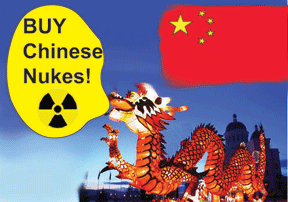 China goes nuclear with latest state-brokered power deal, Josephine Mason, David Stanway
BEIJING (Reuters) 2 Feb 18, – China National Nuclear Corp (CNNC), China’s No. 2 nuclear power producer, will take over the country’s top nuclear power plant builder to create a company worth almost $100 billion, the latest state-orchestrated marriage in the nation’s vast power sector.
Approval for the tie-up between CNNC and China Nuclear Engineering & Construction (CNEC) was announced by the State-Owned Assets Supervision and Administration Commission (SASAC) on Wednesday in a one-line statement posted on its website…….
Beijing wants to overhaul its nuclear sector in order to create globally competitive firms and reduce overcapacity across its broader power market. The nuclear industry is struggling with project delays and a slowdown in approvals for new domestic projects.
By creating a unified home-brand series of reactors, and combining firms, China will be better positioned to bid for and finance overseas projects, experts say.
Both companies have built nuclear plants overseas, including in Pakistan, and developing Chinese nuclear technology abroad is a key goal of China’s Belt and Road initiative…… https://www.reuters.com/article/us-china-power-nuclear/china-goes-nuclear-with-latest-state-brokered-power-deal-idUSKBN1FK0S4
Britain’s new nuclear build – a profitable “golden era” for China’s State-owned nuclear companies
Xinhuanet 1st Feb 2018, China General Nuclear Power Corporation (CGN), a major Chinese nuclear
power operator, said Wednesday that nuclear projects in Britain were
proceeding well. He Yu, chairman of the board of CGN, said since the deals
were inked in 2016 with French energy company EDF and the British
government, CGN has invested 1.7 billion British pounds in order to advance
the projects. CGN signed agreements in 2016 for Hinkley Point C (HPC), a
nuclear project in Somerset, and a suite of agreements relating to the
Sizewell C (SZC) in eastern England and Bradwell B projects (BRB) in Essex.
“A total of 15 Chinese suppliers and contractors have passed a preliminary
qualification assessment for the HPC project,” He said. “HPC, which is
Britain’s first new nuclear power station in a generation, is the largest
construction in Europe.”
http://www.xinhuanet.com/english/2018-02/01/c_136940068.htm
Reuters 31st Jan 2018, Notable Chinese investments in Britain include the Hinkley C nuclear power
station which is being built by China General Nuclear Power Corp and the
British arm of France’s EDF (EDF.PA), while British firms, such as Rolls
Royce (RR.L), have won large deals from Chinese firms to supply items like
plane engines. Both May and senior Chinese officials have restated their
commitment to the “golden era” in ties but a row over May’s decision
to delay approval for the Chinese-funded Hinkley nuclear plant in late 2016
chilled relations. However, Britain was the first Western country to sign
up to the China-backed Asian Infrastructure Investment Bank and it sent
Finance Minister Philip Hammond to a Beijing summit last year about
President Xi Jinping’s flagship ‘Belt and Road Initiative’ – a
trillion-dollar infrastructure-led push to build a modern Silk Road.
https://www.reuters.com/article/us-china-britain/chinas-li-says-ties-with-britain-to-stay-unchanged-through-brexit-idUSKBN1FK023
Like USA’s, Russia’s etc – China’s macho men need more nuclear warheads
 China needs more nuclear warheads to deter US threat, military says, Commentary says the existing stockpile is big enough to prevent ‘bullying’ but should be expanded as Washington changes strategy, SCMP, Minnie Chan, 30 January, 2018 China must expand its nuclear stockpile so it can better deter and hit back at an enemy strike as geopolitical uncertainties mount and the US appears bent on a nuclear build-up, according to the Chinese military’s mouthpiece.
In the PLA Daily on Tuesday, a commentary said China had enough nuclear weapons to prevent “bullying” by other nuclear powers but still needed to respond to changes in US strategy.
“To enhance China’s strategic counterbalance in the region and maintain China’s status as a great power, and protect national security, China has to beef up and develop a reliable nuclear deterrence capability,” it said.
It also said China would still stick to the “no first use” doctrine, meaning there were no circumstances in which it would be the first to use nuclear weapons.
The commentary comes as the administration of US President Donald Trump is expected to unveil its new military weapons policy later this week.
A leaked draft of the document says Washington will ramp up new nuclear projects and deploy more “low yield” nuclear bombs, according to the Huffington Post.
Military analysts said China was poised to increase its own arsenal of nuclear warheads but there were no plans to rival the United States.
Beijing-based military analyst Zhou Chenming said China only needed to add about 100 warheads to its stockpile to counter threats from the US and India.
“Nuclear weapons are hugely expensive to maintain and China is very pragmatic. Beijing will not spend too much money on an arms race,” Zhou said.
China has never declared the scale of its nuclear stockpile but the Washington-based Arms Control Association puts the country’s total at 270 warheads, the fourth-biggest of the five main nuclear states. Russia has 7,000, the US 6,800, France 300 and Britain 215, the association estimates. ……http://www.scmp.com/news/china/diplomacy-defence/article/2131261/china-needs-more-nuclear-warheads-deter-us-threat
China’s Fissile Material Production and Stockpile
IPFM 12th Jan 2018, IPFM’s new research report “China’s Fissile Material Production and
Stockpile” (PDF copy) by Hui Zhang uses information from newly available
Chinese public sources to provide a more detailed and documented
reconstruction of China’s production of highly enriched uranium (HEU) and
plutonium for nuclear weapons.
The report provides new evidence to constrain the operating histories for China’s Lanzhou and Heping gaseous
diffusion enrichment plants. Lanzhou stopped HEU production for weapons in 1980 and shifted to making low enriched uranium (LEU) for civilian power reactors and possibly for naval reactors. It was shut down on 31 December
2000 and in 2017 was demolished.
The Heping plant may still be operating but not producing HEU for weapons. China also has centrifuge enrichment
plants but they are believed not to produce HEU for weapons. The new report also offers new details on the operational experience of the Jiuquan and Guangyuan weapon plutonium production reactors. China also used these
reactors to produce tritium for weapons. The reactors were closed in the 1980s and have been undergoing decommissioning.
http://fissilematerials.org/blog/2018/01/chinas_fissile_material_p.html
China unlikely to go ahead with AREVA’s nuclear reprocessing plan, despite Macron’s support
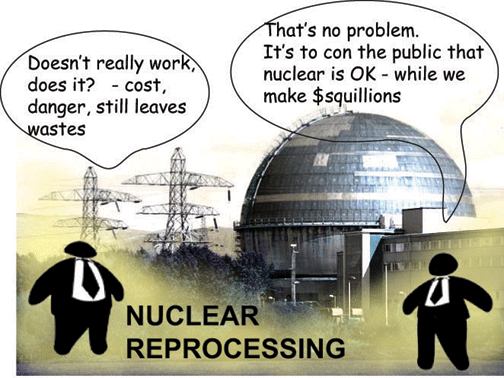 Reuters 11th Jan 2018, So close yet so far: China deal elusive for France’s Areva. A deal long
sought by French company Areva to build a $12-billion nuclear waste
reprocessing plant in China looks increasingly unlikely to go ahead despite
a visit to Beijing by President Emmanuel Macron meant to drum up business.
During Macron’s state visit this week, Areva and China National Nuclear
Corp (CNNC) signed a new “protocol agreement” to build the plant but,
not for the first time, no definitive contract was signed.
Since talks began more than a decade ago – when uranium prices UXXc1 were near record
highs – a series of non-committal French-Chinese memorandums of
understanding have been signed for building a reprocessing plant in China
modeled on state-owned Areva’s plant in La Hague, northern France.
The reprocessing of nuclear fuel waste involves separating plutonium from the
spent uranium and reusing it in “Mixed Oxide” (MOX) fuel at nuclear
power stations.
But the 2011 Fukushima nuclear disaster and competition
from renewable energy are weighing on the nuclear sector, and uranium
prices are down 80 percent from a decade ago, making the expensive and
dangerous recycling process less attractive. Chinese nuclear scientist Li
Ning, dean of Xiamen University’s College of Energy and a member of State
Nuclear Power Technology Corporation’s (SNPTC) expert committee, sees
“a fairly low probability” that China will sign a formal contract for
the project.
https://www.reuters.com/article/us-areva-china-nuclearpower-analysis/so-close-yet-so-far-china-deal-elusive-for-frances-areva-idUSKBN1F01RJ
China becoming the global leader in renewable energy
Guardian 10th Jan 2018, China is moving towards becoming a global leader in renewable technology as
the US pulls away, a new report has said.
China is the world’s biggest emitter of greenhouse gases and still invests in coal but in recent years
it has become the largest investor in domestic renewable energy. The
country is now on track to lead international investment in the sector,
according to the report by the Institute for Energy Economics and Financial
Analysis (IEEFA).
“As the global transition toward renewables gains pace
and as battery storage and electric vehicles technologies pick up momentum,
China is setting itself up to dominate these sectors globally over the next
several dec ades of this century,” said IEEFA. IEEFA identified a record
high spend of more than US$44bn by China on international takeovers and
projects worth more than $1bn – a 38% year-on-year growth.
https://www.theguardian.com/environment/2018/jan/10/china-on-track-to-lead-in-renewables-as-us-retreats-report-says
France’s nuclear company AREVA to join China National Nuclear Corp in nuclear reprocessing
 Areva to sign 10 bln euros China nuclear re-processing MoU -sourcehttps://www.reuters.com/article/china-france-areva/areva-to-sign-10-bln-euros-china-nuclear-re-processing-mou-source-idUSP6N1NF02R, Reuters Staff,
PARIS, Jan 9 (Reuters) – French power group Areva is set to sign a memorandum of understanding (MoU) for a Chinese nuclear re-processing deal worth about 10 billion euros ($11.9 billion), a source with knowledge of the matter said.
The deal with the China National Nuclear Corp (CNNC) was expected to be signed on Tuesday, during a state visit to China by French President Emmanuel Macron.
$1 = 0.8375 euros Reporting by Benjamin Mallet; Writing by Sudip Kar-Gupta; Editing by Leigh Thomas and Jean-Michel Belot
France phasing out nuclear power at home: happy to export it abroad
 China, France sign deal to enhance cooperation on nuclear energy Xinhua | 2018-01-10 07:17 GUANGZHOU — A Chinese nuclear power operator signed an agreement Tuesday with a French energy organization to deepen cooperation on nuclear power technology.
The deal, between China General Nuclear Power Corporation (CGN) and the French Alternative Energy and Atomic Energy Commission (CEA), focuses on areas such as nuclear reactor technology, advanced fuels and materials, and nuclear fuel cycles.
Under the agreement, CGN and CEA will deepen cooperation in the upstream and downstream nuclear power industry chain, including reactor life management and the concept design of the fourth-generation nuclear energy technology.
He Yu, chairman of CGN, said the new agreement will enhance bilateral exchanges in nuclear power technology and open new space for Sino-French nuclear power cooperation.
Founded in 1994, CGN is the largest nuclear power operator in China, with 39,000 employees worldwide. It focuses on the development of clean energies such as nuclear power, nuclear fuel, wind power and solar power.
The CEA is a key organization in research, development and innovation in France. Its main areas include defense and security, nuclear and renewable energy, and physical and life sciences.
http://www.chinadaily.com.cn/a/201801/10/WS5a554d97a3102e5b17371b35.html
1 This Month
Chernobyl: The Lost Tapes – A good documentary on Chernobyl on SBS available On Demand for the next 3 weeks– https://www.sbs.com.au/ondemand/tv-program/chernobyl-the-lost-tapes/2352741955560

of the week–London Campaign for Nuclear Disarmament

Tell the Ukrainian Government to Drop Prosecution of Peace Activist Yurii Sheliazhenko
To see nuclear-related stories in greater depth and intensity – go to https://nuclearinformation.wordpress.com
-
Archives
- April 2026 (114)
- March 2026 (251)
- February 2026 (268)
- January 2026 (308)
- December 2025 (358)
- November 2025 (359)
- October 2025 (376)
- September 2025 (257)
- August 2025 (319)
- July 2025 (230)
- June 2025 (348)
- May 2025 (261)
-
Categories
- 1
- 1 NUCLEAR ISSUES
- business and costs
- climate change
- culture and arts
- ENERGY
- environment
- health
- history
- indigenous issues
- Legal
- marketing of nuclear
- media
- opposition to nuclear
- PERSONAL STORIES
- politics
- politics international
- Religion and ethics
- safety
- secrets,lies and civil liberties
- spinbuster
- technology
- Uranium
- wastes
- weapons and war
- Women
- 2 WORLD
- ACTION
- AFRICA
- Atrocities
- AUSTRALIA
- Christina's notes
- Christina's themes
- culture and arts
- Events
- Fuk 2022
- Fuk 2023
- Fukushima 2017
- Fukushima 2018
- fukushima 2019
- Fukushima 2020
- Fukushima 2021
- general
- global warming
- Humour (God we need it)
- Nuclear
- RARE EARTHS
- Reference
- resources – print
- Resources -audiovicual
- Weekly Newsletter
- World
- World Nuclear
- YouTube
-
RSS
Entries RSS
Comments RSS
 nuclear-news