Arctic melting permafrost a serious problem (and they want to put Small Modular Nuclear Reactors there!)

 Destabilising of infrastructure in Arctic regions , as permafrost melts, is a compelling reason why it is madness to plan for Small Modular Nuclear Reactors in Northern Canada
Whatever Happened To … The Melting Permafrost? 0893 KPCCC, Nadia Whitehead | NPR | September 6, 2020  “…………… It’s not just warmer temperatures that pose a problem for the permafrost. Scientists are now investigating whether rainfall could be causing serious issues in the Arctic’s permafrost – with repercussions for humans.
Since 2013, Fairbanks, Alaska, has had two of the wettest years in recorded history. A total ofo 14.6 inches of rain fell in the summer of 2014; it was the wettest summer yet. And that’s not a good thing for permafrost, says Thomas Douglas, a geochemist in the U.S. Army Corp of Engineers.
Permafrost — completely frozen ground composed of materials like soil, rocks and even bones and plants — makes up a nearly a quarter of the Northern Hemisphere. Much of it has been frozen for thousands of years.
Warming temperatures have begun to thaw permafrost, and now, increased rainfall seems to be intensifying the problem, according to Douglas’ latest study in Climate and Atmospheric Science, published in July.
“In general, across the arctic, the thought is that things are getting wetter,” Douglas says, but particularly in Fairbanks. “2014 and 2016 were the #1 and #3 summer precipitation years in what was then a 90-year record. Shattering records like this is just really unique.”……….
The thaw was worse in some locations more than others, depending on the terrain where measurements were taken. Forests and mossy landscapes seemed to protect the permafrost. There, for every additional inch of rain, the permafrost thawed by an additional quarter of an inch.
But in locations where human activity – such as trails and clearings — had altered the land, the thaw was worse. For every additional inch of rain, the researchers saw an additional inch of thaw. At one particular site, permafrost thaw depth grew from 47 inches in 2013 to nearly 75 inches in 2017.
Douglas explains, “When you remove vegetation, that’s like leaving the lid open on your cooler on a summer day. It allows heat and water to get down in the permafrost pretty rapidly.”
Out of all the team’s research, Douglas says their most important finding was that thinner layers of thawed permafrost seem to be vanishing — literally thawing away……….
Dmitry Streletskiy, a professor at George Washington University who specializes in permafrost, says that Douglas’s study is a great contribution to permafrost research. However, he emphasizes that the study was conducted in a boreal ecosystem, a sub-arctic region with warmer temperatures and relatively warm permafrost. ……..
Streletskiy agrees that permafrost is degrading on a global scale due to climate change. Its impacts are starting to show — and zombie pathogens shouldn’t be our only concern.
He and Douglas both point to the Norilsk oil spill in Russia, where an oil tank spewed more than 150,000 barrels of diesel into the arctic, and officials have been racing to clean it up. Many experts believe thawing permafrost is to blame; the oil tank, which sat on permafrost, collapsed in May.
What’s more, permafrost thaw can lead to deterioration in infrastructure, such as pipelines, railroads and homes, Streletskiy explains. “Small changes in temperature can affect how much weight a foundation built on permafrost can support. Say for example at -10 degrees, the foundation can support 100 tons, but at -8 degrees, it can only support 50 tons.”
For people who don’t live near the oil spill or in arctic regions, it’s easy to forget about permafrost. “Out of sight, out of mind,” Douglas says. But the thaw could one day affect everyone.
An estimated 1,400 to 1,600 billion metric tons of carbon are currently frozen in the permafrost. “There are a lot of questions about what’s going to happen when that [carbon]starts to thaw,” Douglas says……….. https://www.scpr.org/news/2020/09/06/94337/whatever-happened-to-the-melting-permafrost/
The United Nations weather agency on the impact of climate change on the cryosphere

Climate change: UN agency laments northern summer’s ‘deep wound’ to Earth’s ice cover https://www.9news.com.au/world/climate-change-news-un-agency-laments-summers-deep-wound-to-earth-ice-cover/52152578-420d-40af-932f-cab14f5af6ac, By Associated Press-Sep 1, 2020 The United Nations weather agency says this summer will go down for leaving a “deep wound” in the cryosphere — the planet’s frozen parts — amid a heat wave in the Arctic, shrinking sea ice and the collapse of a leading Canadian ice shelf.
***************************************
The threatening presence of highly radioactive material in Russia’s sunken nuclear submarines
Do Russia’s Sunken Nuclear Submarines Pose Environmental Danger? There’s radioactive fuel hanging at the bottom of the sea. https://www.popularmechanics.com/military/navy-ships/a33902569/russia-sunken-nuclear-submarines/ BY KYLE MIZOKAMI, SEP 4, 2020
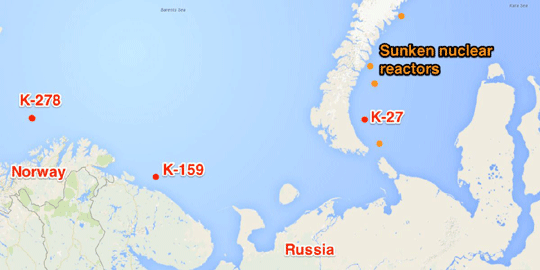
- Two ex-Soviet nuclear submarines, K-27 and K-159, lie at the bottom of the Barents Sea.
- The wrecked ships still have their radioactive fuel sources aboard, which experts worry could leak into the environment.
- The Russian government has vowed to clean up the wrecks, but the work is not a priority.
Governments and environmental groups are worried a rupture of nuclear fuel supplies could cause a nuclear catastrophe, impacting local fishing areas. The Russian government is working to solve the problem, which some experts are calling a potential “Chernobyl in slow motion on the seabed.
A legacy of the Cold War threatens Russia’s people and environment, potentially irradiating a large portion of the Barents Sea and closing it to commercial fishing. Two Soviet nuclear-powered submarines are sitting on the bottom of the ocean and could unleash their radioactive fuels into the surrounding waters.
The Soviet Union built four hundred nuclear-powered submarines during the Cold War. The vast majority were either scrapped, or still serve with the Russian Navy today. A few subs, however, are trapped in precarious circumstances, lying on the seabed floor with their uranium fuel supplies still intact. The BBC reports on efforts to render two such ships, K-27 and K-159, safe.
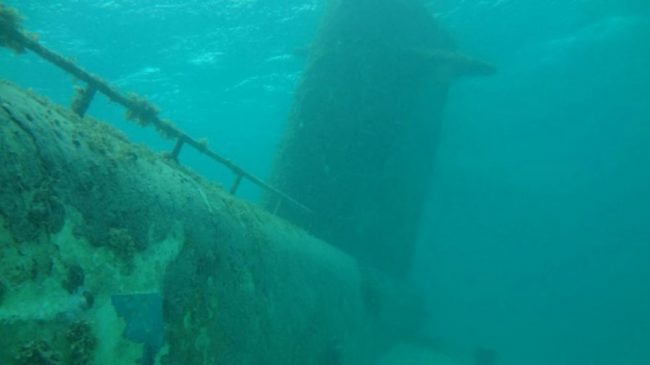 The first ship, K-27, was a Soviet Navy submarine prototype equipped with a new liquid metal reactor. In 1968, the six-year-old sub suffered a reactor accident so serious, nine Soviet sailors received fatal doses of radiation. The submarine was scuttled off the Russian island of Novaya Zemlya in 1982 with its reactor still on board.
The second ship, K-159 (shown above before sinking, on original), was a November-class submarine that served a fairly typical career with the Soviet Northern Fleet before retirement in 1989. In 2003, however, the K-159 sank while in the process of being dismantled, killing nine sailors. The ship still resides where it was lost, again with its reactor on board.
Environmentalists in Norway and Russia are concerned that eventually the reactors on both submarines will break down, releasing huge amounts of radiation.
The effects of these leaks could range from increasing local background radiation to declaring local fish and animals off limits, particularly Barents Sea fishing stocks of cod and haddock, costing local fishermen an estimated $1.5 billion a year.
While Russia’s state nuclear agency, Rosatom, has been tasked with cleaning up the ships, the effort is underfunded, resulting in a race against time (and saltwater corrosion).
THe Arctic’s slow-moving underwater nuclear disaster – Russia’s radioactive trash

 Russia’s ‘slow-motion Chernobyl’ at sea, BBC By Alec Luhn2nd September 2020, ”…………………………. Beneath some of the world’s busiest fisheries, radioactive submarines from the Soviet era lie disintegrating on the seafloor. Decades later, Russia is preparing to retrieve them………. Russia’s ‘slow-motion Chernobyl’ at sea, BBC By Alec Luhn2nd September 2020, ”…………………………. Beneath some of the world’s busiest fisheries, radioactive submarines from the Soviet era lie disintegrating on the seafloor. Decades later, Russia is preparing to retrieve them……….With a draft decree published in March, President Vladimir Putin set in motion an initiative to lift two Soviet nuclear submarines and four reactor compartments from the silty bottom, reducing the amount of radioactive material in the Arctic Ocean by 90%. First on the list is Lappa’s K-159.
|
|
Sea ice at its lowest state in 5,500 years in Bering sea
 in the region is lower than it’s been for thousands of years.A newly published paper in the journal Science Advances describes how a peat core from St. Matthew Island is providing a look back in time. By analyzing the chemical composition of the core, which includes plant remains from 5,500 years ago to the present, scientists can estimate how sea ice in the region has changed during that time period.
“It’s a small island in the middle of the Bering Sea, and it’s essentially been recording what’s happening in the ocean and atmosphere around it,” said lead author Miriam Jones, a research geologist with the U.S. Geological Survey. Jones worked as a faculty researcher at the University of Alaska Fairbanks when the project began in 2012.
………. UAF’s Alaska Stable Isotope Facility analyzed isotope ratios throughout the peat layers, providing a time stamp for ice conditions that existed through the millennia.
After reviewing the isotopic history, researchers determined that modern ice conditions are at remarkably low levels.
“What we’ve seen most recently is unprecedented in the last 5,500 years,” said Matthew Wooller, director of the Alaska Stable Isotope Facility and a contributor to the paper. “We haven’t seen anything like this in terms of sea ice in the Bering Sea.”
Jones said the long-term findings also affirm that reductions in Bering Sea ice are due to more than recent higher temperatures associated with global warming. Atmospheric and ocean currents, which are also affected by climate change, play a larger role in the presence of sea ice.
“There’s a lot more going on than simply warming temperatures,” Jones said. “We’re seeing a shift in circulation patterns both in the ocean and the atmosphere.” https://www.eurekalert.org/pub_releases/2020-09/uoaf-bsi082820.php
Russia facing huge problem to recover radioactive sunken nuclear reactors, but Putin still plans new ones in the Arctic
Russia’s ‘slow-motion Chernobyl’ at sea, FUTURE PLANET | OCEANS By Alec Luhn, 2nd September 2020 ……….
Minimising risk
Russia, Norway and other countries whose fishing boats ply the bountiful waters of the Barents Sea have now found themselves with a sword of Damocles hanging over their heads. Although a 2014 Russian-Norwegian expedition to the K-159 wreck that tested the water, seafloor and animals like a sea centipede did not find radiation above background levels, an expert from Moscow’s Kurchatov Institute said at the time that a reactor containment failure “could happen within 30 years of sinking in the best case and within 10 years at the worst”. That would release radioactive caesium-137 and strontium-90, among other isotopes.
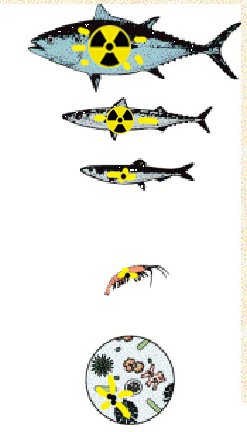
While the vast size of the oceans quickly dilutes radiation, even very small levels can become concentrated in animals at the top of the food chain through “bioaccumulation” – and then be ingested by humans. But economic consequences for the Barents Sea fishing industry, which provides the vast majority of cod and haddock at British fish and chip shops, “may perhaps be worse than the environmental consequences”, says Hilde Elise Heldal, a scientist at Norway’s Institute of Marine Research.
According to her studies, if all the radioactive material from the K-159’s reactors were to be released in a single “pulse discharge”, it would increase Cesium-137 levels in the muscles of cod in the eastern Barents Sea at least 100 times. (As would a leak from the Komsomolets, another sunken Soviet submarine near Norway that is not slated for lifting.) That would still be below limits set by the Norwegian government after the Chernobyl accident, but it could be enough to scare off consumers. More than 20 countries continue to ban Japanese seafood, for instance, even though studies have failed to find dangerous concentrations of radioactive isotopes in Pacific predatory fishes following the Fukushima nuclear power plant release in 2011. Any ban on fishing in the Barents and Kara seas could cost the Russian and Norwegian economies €120m ($140m; £110m) a month, according to a European Commission feasibility study about the lifting project.
There is no ship in the world capable of lifting the K-159, so a special salvage vessel would have to be built
But an accident while raising the submarine, on the other hand, could suddenly jar the reactor, potentially mixing fuel elements and starting an uncontrolled chain reaction and explosion. That could boost radiation levels in fish 1,000 times normal or, if it occurred on the surface, irradiate terrestrial animals and humans, another Norwegian study found. Norway would be forced to stop sales of products from the Arctic such as fish and reindeer meat for a year or more. The study estimated that more radiation could be released than in the 1985 Chazhma Bay incident, when an uncontrolled chain reaction during refuelling of a Soviet submarine near Vladivostok killed 10 sailors.
Amundsen argued that the risk of such a criticality excursion with the K-159 or K-27 was low and could be minimised with proper planning, as it was during the removal of high-risk spent fuel from Andreyev Bay.
“In that case we do not leave the problem for future generations to solve, generations where the knowledge of handling such legacy waste may be very limited,” he says.
The safety and transparency of Russia’s nuclear industry has often been questioned, though, most recently when Dutch authorities concluded that radioactive iodine-131 detected over northern Europe in June originated in western Russia. The Mayak reprocessing facility that received the spent fuel from Andreyev Bay by train has a troubled history going back to the world’s then-worst nuclear disaster in 1957. Rosatom continues to deny the findings of international experts that the facility was the source of a radioactive cloud of ruthenium-106 registered over Europe in 2017.
While the K-159 and K-27 need to be raised, Rashid Alimov of Greenpeace Russia has reservations. “We are worried about the monitoring of this work, public participation and the transport [of spent fuel] to Mayak,” he says.
Custom mission
Raising a submarine is a rare feat of engineering. The United States spent $800m (£610m) in an attempt to lift another Soviet submarine, the diesel-powered K-129 that carried several nuclear missiles, from 16,400ft (5,000m) in the Pacific Ocean, under the guise of a seabed mining operation. In the end, they only managed to bring a third of the submarine to the surface, leaving the CIA with little usable intelligence.
That was the deepest raise in history. The heaviest was the Kursk. To bring the latter 17,000-tonne missile submarine up from 350ft (108m) below the Barents Sea, the Dutch companies Mammoet and Smit International installed 26 hydraulically cushioned lifting jacks on a giant barge and cut 26 holes in the submarine’s rubber-coated steel hull with a water jet operated by scuba divers. On 8 October 2001, rushing to beat the winter storm season after four months of nerve-wracking work and delays, steel grippers fitted in the 26 holes lifted the Kursk from the seabed in 14 hours, after which the barge was towed to a dry dock in Murmansk.
At less than 5,000 tonnes, the K-159 is smaller than the Kursk, but even before it sank its outer hull was “as weak as foil”, according to Bellona. It has since been embedded in 17 years’ worth of silt. A hole in the bow would seem to rule out pumping it full of air and raising it with balloons, as has been previously suggested. At a conference of European Bank of Reconstruction and Development donors in December, a Rosatom representative said there was no ship in the world capable of lifting it, so a special salvage vessel would have to be built.
That will increase the estimated cost of €278m ($330m; £250m) to raise the six most radioactive objects. Donors are discussing Russia’s request to help finance the project, said Balthasar Lindauer, director of nuclear safety at EBRD.
“There’s consensus something needs to be done there,” he says. Any such custom-built vessel would likely need a bevy of specialised technologies such as bow and aft thrusters to keep it positioned precisely over the wreck.
But in August, Grigoriev told a Rosatom-funded website that one plan the company was considering would involve a pair of barges fitted with hydraulic cable jacks and secured to deep-sea moorings. Instead of steel grippers like the ones inserted into the holes in the Kursk, giant curved pincers would grab the entire hull and lift it up between the barges. A partially submersible scow would be positioned underneath, then brought to the surface along with the submarine and finally towed to port. The K-27 and K-159 could both be recovered this way, he said.
One of three engineering firms working on proposals for Rosatom is the military design bureau Malachite, which drafted a project to raise the K-159 in 2007 that “was never realised due to a lack of money”, according to its lead designer. This year the bureau has begun updating this plan, an employee tells Future Planet in the lobby of Malachite’s headquarters in St Petersburg. Many questions remain, however.
“What condition is the hull in? How much of force can it handle? How much silt has built up? We need to survey the conditions there,” the employee says, before the head of security arrives to break up our conversation.
Nuclear paradox
Removing the six radioactive objects fits in with an image Putin as crafted as a defender of the fragile Arctic environment. In 2017, he inspected the results of an operation to remove 42,000 tonnes of scrap metal from the Franz Josef Land archipelago as part of a “general clean-up of the Arctic”. He has spoken about environmental preservation at an annual conference for Arctic nations. And on the same day in March 2020 that he issued his draft decree about the sunken objects, he signed an Arctic policy that lists “protecting the Arctic environment and the native lands and traditional livelihood of indigenous peoples” as one of six national interests in the region.
“For Putin, the Arctic is part of his historic legacy. It should be well-protected, bring real benefits and be clean,” said Dmitry Trenin, head of the think tank Carnegie Centre Moscow.
Yet while pursuing a “clean” Arctic, the Kremlin has also been backing Arctic oil and gas development, which accounts for the majority of shipping on the Northern Sea Route. State-owned Gazprom built one of two growing oil and gas clusters on the Yamal peninsula, and this year the government cut taxes on new Arctic liquified natural gas projects to 0% to tap into some of the trillions of dollars of fossil fuel and mineral wealth in the region.
And even as Putin cleans up the Soviet nuclear legacy in the far north, he is building a nuclear legacy of his own. A steady march of new nuclear icebreakers and, in 2019, the world’s only floating nuclear power plant has again made the Arctic the most nuclear waters on the planet.
Meanwhile, the Northern Fleet is building at least eight submarines and has plans to construct several more, as well as eight missile destroyers and an aircraft carrier, all of them nuclear-powered. It has also been testing a nuclear-powered underwater drone and cruise missile. In total, there could be as many as 114 nuclear reactors in operation in the Arctic by 2035, almost twice as many as today, a 2019 Barents Observer study found.
This growth has not gone without incident. In July 2019, a fire on a nuclear deep-sea submersible near Murmansk almost caused a “catastrophe of a global scale,” an officer reportedly said at the funeral of the 14 sailors killed. The next month, a “liquid-fuel reactive propulsion system” exploded during a test on a floating platform in the White Sea, killing two of those involved and briefly spiking radiation levels in the nearby city of Severodvinsk.
“The joint efforts of the international community including Norway and Russia after breakup of the Soviet Union, using taxpayer money to clean up nuclear waste, was a good investment in our fisheries,” says The Barents Observer’s Nilsen. “But today there are more and more politicians in Norway and Europe who think it’s a really big paradox that the international community is giving aid to secure the Cold War legacy while it seems Russia is giving priority to building a new Cold War.”
As long as the civilian agency Rosatom is tasked with clean-up, the Russian military has little incentive to slow down this nuclear spree, Nilsen notes.
“Who is going to pay for the clean-up of those reactors when they are not in use anymore?” he asks. “That is the challenge with today’s Russia, that the military don’t have to think what to do with the very, very expensive decommissioning of all this.”
So while the coming nuclear clean-up is set to be the largest of its kind in history, it may turn out to be just a prelude to what’s needed to deal with the next wave of nuclear power in the Arctic…………….https://www.bbc.com/future/article/20200901-the-radioactive-risk-of-sunken-nuclear-soviet-submarines
Arctic tragedy: the loss of Russian sailors in nuclear submarine accidents
Russia’s ‘slow-motion Chernobyl’ at sea, FUTURE PLANET | OCEANS By Alec Luhn, 2nd September 2020 By tradition, Russians
always bring an odd number of flowers to a living person and an even number to a grave or memorial. But every other day, 83-year-old Raisa Lappa places three roses or gladiolas by the plaque to her son Sergei in their hometown Rubtsovsk, as if he hadn’t gone down with his submarine during an ill-fated towing operation in the Arctic Ocean in 2003.“I have episodes where I’m not normal, I go crazy, and it seems that he’s alive, so I bring an odd number,” she says. “They should raise the boat, so we mothers could put our sons’ remains in the ground, and I could maybe have a little more peace.”
After 17 years of unfulfilled promises, she may finally get her wish, though not out of any concern for the bones of Captain Sergei Lappa and six of his crew. With a draft decree published in March, President Vladimir Putin set in motion an initiative to lift two Soviet nuclear submarines and four reactor compartments from the silty bottom, reducing the amount of radioactive material in the Arctic Ocean by 90%. First on the list is Lappa’s K-159. ……………..
‘Cursed August’
Sergei Lappa was born in 1962 in Rubtsovsk, a small city in the Altai Mountains near the border with Kazakhstan. Though it was thousands of miles to the nearest ocean, he cultivated an interest in seafaring at a local model shipbuilding club, and after school he was accepted into the higher naval engineering academy in Sevastopol, Crimea. Tall, athletic and a good student, he was assigned to the navy’s most prestigious service: the Northern Submarine Fleet.
With the reactors off, Lappa and his skeleton crew of nine engineers operated the boat by flashlight. As the submarine was towed near Kildin Island at half past midnight, the cables to the bow pontoons broke in heavy seas, and a half-hour later water was discovered trickling into the eighth compartment. But as headquarters struggled with the decision to launch an expensive rescue helicopter, the crew kept trying to keep the submarine afloat. At 02:45am Mikhail Gurov sent one last radio transmission: “We’re flooding, do something!” By the time rescue boats from the tug arrived, the K-159 was on the bottom near Kildin Island. Of the three sailors who made it out, the only survivor was senior lieutenant Maxim Tsibulsky, whose leather jacket had filled with air and kept him afloat.
Yet another nuclear submarine had sunk during the “cursed” month of August, Russian newspapers wrote, but the incident caused little furore compared to the Kursk. The navy promised relatives it would raise the K-159 the next year, then repeatedly delayed the project.
Even after 17 years of scavenging and corrosion, at least the bones of the crew likely remain in the submarine, according to Lynne Bell, a forensic anthropologist at Simon Fraser University. But the families have long since lost hope of recovering them.
“For all the relatives it would bring some relief if their fathers and husbands were buried, not just lying on the bottom in a steel hulk,” Gurov’s son Dmitry says. “It’s just that no one believes this will happen.”
The situation has now changed, however, as Russia’s interest revives in the Arctic and its crumbling Soviet ports and military towns. Since 2013, seven Arctic military bases and two tanker terminals have been built as part of the Northern Sea Route, a shorter route to China that Putin has promised will see 80 million tonnes of traffic by 2025. The K-159 is lying underneath the eastern end of the route………….https://www.bbc.com/future/article/20200901-the-radioactive-risk-of-sunken-nuclear-soviet-submarines
Sea level rise from melting ice sheets match worst-case climate warming scenarios.
Sea level rise from ice sheets track worst-case climate change scenario, https://www.sciencedaily.com/releases/2020/08/200831112101.htm August 31, 2020
 Source: University of Leeds
- Summary:
- Ice sheets in Greenland and Antarctica whose melting rates are rapidly increasing have raised the global sea level by 1.8cm since the 1990s, and are matching the Intergovernmental Panel on Climate Change’s worst-case climate warming scenarios.
-
Ice sheets in Greenland and Antarctica whose melting rates are rapidly increasing have raised the global sea level by 1.8cm since the 1990s, and are matching the Intergovernmental Panel on Climate Change’s worst-case climate warming scenarios.
According to a new study from the University of Leeds and the Danish Meteorological Institute, if these rates continue, the ice sheets are expected to raise sea levels by a further 17cm and expose an additional 16 million people to annual coastal flooding by the end of the century.
Since the ice sheets were first monitored by satellite in the 1990s, melting from Antarctica has pushed global sea levels up by 7.2mm, while Greenland has contributed 10.6mm. And the latest measurements show that the world’s oceans are now rising by 4mm each year.
“Although we anticipated the ice sheets would lose increasing amounts of ice in response to the warming of the oceans and atmosphere, the rate at which they are melting has accelerated faster than we could have imagined,” said Dr Tom Slater, lead author of the study and climate researcher at the Centre for Polar Observation and Modelling at the University of Leeds.
“The melting is overtaking the climate models we use to guide us, and we are in danger of being unprepared for the risks posed by sea level rise.”
- The results are published today in a study in the journal Nature Climate Change. It compares the latest results from satellite surveys from the Ice Sheet Mass Balance Intercomparison Exercise (IMBIE) with calculations from climate models. The authors warn that the ice sheets are losing ice at a rate predicted by the worst-case climate warming scenarios in the last large IPCC report.Dr Anna Hogg, study co-author and climate researcher in the School of Earth and Environment at Leeds, said: “If ice sheet losses continue to track our worst-case climate warming scenarios we should expect an additional 17cm of sea level rise from the ice sheets alone. That’s enough to double the frequency of storm-surge flooding in many of the world’s largest coastal cities.”
-
So far, global sea levels have increased in the most part through a mechanism called thermal expansion, which means that volume of seawater expands as it gets warmer. But in the last five years, ice melt from the ice sheets and mountain glaciers has overtaken global warming as the main cause of rising sea levels.
Dr Ruth Mottram, study co-author and climate researcher at the Danish Meteorological Institute, said: “It is not only Antarctica and Greenland that are causing the water to rise. In recent years, thousands of smaller glaciers have begun to melt or disappear altogether, as we saw with the glacier Ok in Iceland, which was declared “dead” in 2014. This means that melting of ice has now taken over as the main contributor of sea level rise. ”
Staggering loss of ice from Greenland
Independent 22nd Aug 2020, High temperatures saw Greenland lose enough ice to cover the US state of
California in more than four feet of water in 2019 alone, a study which suggests the island lost a million tonnes of ice for every minute of the year has said.
After two years in which the land masses’ summer ice melt had been negligible, satellite measurements have suggested an excessively hot 2019 saw the loss of 586 billion tons of ice melt from the island. The loss represents more than 532 trillion litres of water according to a study published in Communications Earth & Environment – equivalent to 212.8 million olympic-sized swimming pools over the course of 2019, or seven for every second of the year.
Heat from the ocean’s interior contributes to loss of Arctic sea ice
|
Arctic ocean moorings shed light on winter sea ice loss https://www.eurekalert.org/pub_releases/2020-08/uoaf-aom082120.php UNIVERSITY OF ALASKA FAIRBANK The eastern Arctic Ocean’s winter ice grew less than half as much as normal during the past decade, due to the growing influence of heat from the ocean’s interior, researchers have found.The finding came from an international study led by the University of Alaska Fairbanks and Finnish Meteorological Institute. The study, published in the Journal of Climate, used data collected by ocean moorings in the Eurasian Basin of the Arctic Ocean from 2003-2018.
The moorings measured the heat released from the ocean interior to the upper ocean and sea ice during winter. In 2016-2018, the estimated heat flux was about 10 watts per square meter, which is enough to prevent 80-90 centimeters (almost 3 feet) of sea ice from forming each year. Previous heat flux measurements were about half of that much. “In the past, when weighing the contribution of atmosphere and ocean to melting sea ice in the Eurasian Basin, the atmosphere led,” said Igor Polyakov, an oceanographer at UAF’s International Arctic Research Center and FMI. “Now for the first time, ocean leads. That’s a big change.” Typically, across much of the Arctic a thick layer of cold fresher water, known as a halocline, isolates the heat associated with the intruding Atlantic water from the sea surface and from sea ice. This new study shows that an abnormal influx of salty warm water from the Atlantic Ocean is weakening and thinning the halocline, allowing more mixing. According to the new study, warm water of Atlantic origin is now moving much closer to the surface. “The normal position of the upper boundary of this water in this region was about 150 meters. Now this water is at 80 meters,” explained Polyakov. A natural winter process increases this mixing. As sea water freezes, the salt is expelled from ice into the water. This brine-enriched water is heavier and sinks. In the absence of a strong halocline, the cold salty water mixes much more efficiently with the shallower, warm Atlantic water. This heat is then transferred upward to the bottom of sea ice, limiting the amount of ice that can form during winter. “These new results show the growing and spreading influence of heat associated with Atlantic water entering the Arctic Ocean,” added Tom Rippeth, a collaborator from Bangor University. “They also suggest a new feedback mechanism is contributing to accelerating sea ice loss.” Polyakov and his team hypothesize that the ocean’s ability to control winter ice growth creates feedback that speeds overall sea ice loss in the Arctic. In this feedback, both declining sea ice and the weakening halocline barrier cause the ocean’s interior to release heat to the surface, resulting in further sea ice loss. The mechanism augments the well-known ice-albedo feedback — which occurs when the atmosphere melts sea ice, causing open water, which in turn absorbs more heat, melting more sea ice. When these two feedback mechanisms combine, they accelerate sea ice decline. The ocean heat feedback limits sea ice growth in winter, while the ice-albedo feedback more easily melts the thinner ice in summer. “As they start working together, the coupling between the atmosphere, ice and ocean becomes very strong, much stronger than it was before,” said Polyakov. “Together they can maintain a very fast rate of ice melt in the Arctic.” Polyakov and Rippeth collaborated on a second, associated study showing how this new coupling between the ocean, ice and atmosphere is responsible for stronger currents in the eastern Arctic Ocean. According to that research, between 2004-2018 the currents in the upper 164 feet of the ocean doubled in strength. Loss of sea ice, making surface waters more susceptible to the effects of wind, appears to be one of the factors contributing to the increase. The stronger currents create more turbulence, which increases the amount of mixing, known as shear, that occurs between surface waters and the deeper ocean. As described earlier, ocean mixing contributes to a feedback mechanism that further accelerates sea ice decline. Accelerated currents have practical implications in the Arctic. Ship captains need accurate maps of currents for navigation. Since currents move sea ice, oil and gas extraction activities also need information about currents. ### This second study was described in a scientific paper published in the Geophysical Research Letters. Additional co-authors for these papers include Ilker Fer, Matthew Alkire, Till Baumann, Eddy Carmack, Randi Ingvaldsen, Vladimir Ivanov, Markus Janout, Sigrid Lind, Laurie Padman, Andrey Pnyushkov and Robert Rember. |
|
28 trillion tonnes of ice have disappeared from the surface of the Earth since 1994.

the Earth since 1994. That is stunning conclusion of UK scientists who have
analysed satellite surveys of the planet’s poles, mountains and glaciers
to measure how much ice coverage lost because of global heating triggered
by rising greenhouse gas emissions.
Edinburgh universities and University College London – describe the level
of ice loss as “staggering” and warn that their analysis indicates that
sea level rises, triggered by melting glaciers and ice sheets, could reach
a metre by the end of the century.
centimetre of sea level rise means about a million people will be displaced
from their low-lying homelands,” said Professor Andy Shepherd, director
of Leeds University’s Centre for Polar Observation and Modelling.
Global warming is bringing new “fire regime”all too quickly
Record Arctic blazes may herald new ‘fire regime’ decades sooner than anticipated, more https://www.washingtonpost.com/weather/2020/08/14/record-arctic-fires/?arc404=true Other signs of rapid Arctic warming are evident, including the partial loss of a symbolic Canadian ice shelf, WP, By Andrew Freedman and Lauren Tierney, August 14 2020
The Arctic summer of 2019 was supposed to be an outlier. Featuring massive blazes in Siberia, including what scientists strongly suspected were smoldering fires beneath the peat in the carbon-rich soils of the transition zone between the tundra and Arctic taiga, last year set records for emitting planet-warming greenhouse gases via wildfires. Many scientists thought it might be a one-off, considering that computer model projections tend to show that the emergence of such extreme fire years won’t happen until mid-century.
However, this year is proving those scientists wrong. And it raises the unsettling possibility that fire seasons that begin much earlier than average and end later — and affect delicate Arctic ecosystems — could soon be the new normal. Wildfires continue to burn unimpeded across Siberia, as they have since May, after getting an unusually early start to the fire season. A thick blanket of smoke has turned the sky a milky gray in Siberia’s cities, with some smoke making it across the Pacific into Alaska and Canada’s Hudson Bay.
In fact, according to Mark Parrington, senior scientist and wildfire expert at the European Union’s Copernicus Atmosphere Monitoring Service, Siberian wildfire smoke has been seen around the world as it hitches a ride on upper air winds. To track wildfires and estimate their emissions of planet-warming carbon dioxide, black carbon and more, Parrington uses satellite instruments to detect heat signals all over the world.
He and his colleagues then use the temperature of the signals to arrive at an estimate of the energy emitted by each fire, by making the assumption that a particular amount of biomass (plants, grasses and trees, for example) is needed to burn at that temperature. This measure of the rate of radiant heat output from a fire is known as “radiatiative power,” which can then be translated into estimated emissions.
Based on data stretching back to 2003, when the satellite sensors began recording reliable data, Parrington says Arctic fires released more carbon dioxide in June and July this year than during any complete fire season before that. This is an especially noteworthy milestone, since 2019 itself had been a record-breaker for Arctic wildfires. This year, some of the Arctic fires were burning so far north that they were spotted bordering sea ice cover.
Looking at carbon emissions from fires in the Arctic Circle, Parrington says 2020 is already the top year even when the Jan. 1 to Aug. 11 period is considered, vs. the full 365 days for each of the other years. Last year had set a record for such emissions, with 180 megatons of carbon dioxide emitted by Arctic fires, but 2020 has eclipsed it so far, with about 240 megaton through Aug. 11. Parrington said Arctic wildfire emissions rose significantly from June into July, particularly in the northern Russia Sakha Republic, a pattern also observed last year.
“It’s an indicator that something’s changed in the environment there,” he said of the fire activity of the past two summers.
Jessica McCarty, a wildfire expert at Miami University of Ohio with experience working in the Siberian Arctic, said Parrington’s emissions estimates are probably underestimates, since satellites don’t detect the heat signatures from Arctic peat fires. Such blazes smolder without open flames above the surface, consuming ancient organic matter and freeing up planet-warming gases such as methane and carbon dioxide that had been locked away. This, along with permafrost melt, acts to speed up global warming as part of a self-reinforcing cycle.
McCarty has searched through the scientific literature from Arctic nations as part of a report she is co-authoring for the Arctic Council. “This is the type of fire event that would be described by these worst-case modeling scenarios that were supposed to occur mid-century,” she said, adding that we may be 30 years early in seeing such fire impacts, which would require a reevaluation of how the Arctic is responding to global warming.
[Rapid Arctic meltdown in Siberia alarms scientists]
For next year, she’ll be examining when the fire season starts, where it begins, what types of landscapes burn and what the ignition sources are. Once you log a few extreme fire seasons, she says, the extreme becomes the norm, known to fire researchers as a “fire regime.”
“If seven out of 10 years are extreme years, that’s a fire regime,” McCarty said.
She said a review of scientific literature from Russia and other Arctic nations shows that Siberian fires typically subside in mid- to late August, when the first snows arrive in the Far North. But that assumption may need to be revisited, too. If any fires this year continue into September, she said, “I’ll be really shocked. I don’t know that I’ll have words that are ready to be published.”
The fires were touched off by an unusually hot year to date, which has helped dry out the soils and melt snow cover unusually early in the spring.
For example, temperatures have hit record levels even in the Arctic, north of 66 degrees north latitude. A reading of 100.4 degrees (38 Celsius) on June 20 was probably the hottest temperature on record in the Arctic. It was recorded in Verkhoyansk, about 3,000 miles east of Moscow, on June 20.
The people who live in Siberia and other Arctic regions are used to variable weather. In Verkhoyansk, for example, temperatures can drop to minus-50 degrees in the winter and climb into the 70s during the summer. Yet the persistent warmth so far this year has stood out to climate researchers.
[An oil spill in Russia’s Arctic exposes risks for Moscow’s Far North plans]
“What is incredibly unusual is the persistence of the warm signal” in Siberia, said Samantha Burgess, deputy director of the Copernicus Climate Change Service, in an interview. She said the warmth has had significant implications for the region, ranging from clearing out sea ice north of Siberia unusually early in the summer melt season to contributing to permafrost melt that led to a major oil spill in Norilsk, Russia.
Burgess said the temperature spike in Siberia this summer heralds events to come not only there but in other parts of the Arctic, as well, as the region warms at about three times the rate of the rest of the world. She said the Siberian warm streak is likely to occur again and likely to show up in other parts of the Arctic.
It’s really taken people by surprise how quickly these changes have taken place in the Arctic,” Burgess said.
The Arctic as a whole has had record warm temperatures from May through July, as measured in the lower atmosphere.
Much of Siberia experienced an exceptionally mild winter, followed by a warmer-than-average spring, and it has been among the most unusually warm regions of the world during the summer as well. During May, parts of Siberia had an average monthly temperature that was a staggering 18 degrees Fahrenheit (10 Celsius) above average for the month, according to the Copernicus Climate Change Service. The unusually mild weather has continued through August so far, as an area of high pressure, or heat dome, has been parked over the Siberian Arctic.
Fires and ice
The summer fire and melt season hasn’t just featured an unusual surge in fires and their harmful emissions. It is also bringing dramatic declines in sea ice and, in one prominent case, long-lasting ice attached to land.
Meier says warm ocean waters in other parts of the Arctic could continue melting ice throughout the month, despite the weakening energy from the sun as fall approaches. Sea ice typically reaches its minimum extent in early- to mid-September.
Similar dynamics are playing out in Greenland and Antarctica, where massive glaciers have been destabilized by the disintegration of their ice shelves, which act as doorstops that prevent inland ice from sliding into the sea, where it would dramatically raise sea levels.
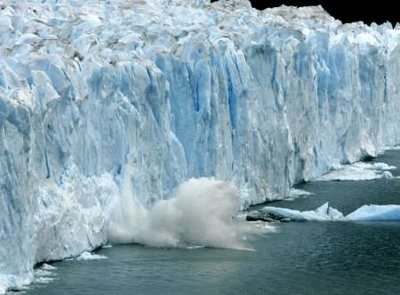
Before the breakup of the Canadian shelf into large icebergs, it was about the size of D.C., the Associated Press has reported.
Permafrost will thaw faster, as global heating causes more rain in the North

|
Climate change is causing more rain in the North. That’s bad news for permafrost
New study shows wetter weather is thawing the frozen ground that covers a quarter of the northern hemisphere, threatening to release massive stores of carbon, The Narwhal, Julien Gignac, Local Journalism Initiative reporter . Aug 20, 2020
Longer, rainier summers are thawing permafrost at an accelerated rate in interior Alaska, according to a new study, begging the question: what does this mean for rainy summers in the Canadian North? “Thawing is happening even faster than we thought,” said Thomas Douglas, an environmental engineer with the U.S. Army Cold Regions Research and Engineering Laboratory and lead author of the study. “We’ve had these crazy wet summers. It’s gonna be bad for permafrost.” The study, published in Nature’s Climate and Atmospheric Science journal, found that between 0.6 and 0.8 centimetres of permafrost thawed for every centimetre of above-average rainfall in Alaska between 2013 and 2017……………… According to a 2015 report by Yukon University, annual precipitation in the territory has increased by six per cent over the past 50 years, with summers seeing the most rainfall compared to other seasons. “Rain water, especially in the summer, is pretty warm and it can move warm, thermal mass down through the soil a lot faster than just warm air temperatures can,” Douglas said. “If you lose three to four weeks of winter to summer, what used to be falling as snow is now falling as rain.”……… According to a 2015 report by Yukon University, annual precipitation in the territory has increased by six per cent over the past 50 years, with summers seeing the most rainfall compared to other seasons. “Rain water, especially in the summer, is pretty warm and it can move warm, thermal mass down through the soil a lot faster than just warm air temperatures can,” Douglas said. “If you lose three to four weeks of winter to summer, what used to be falling as snow is now falling as rain.”……….. it’s not only the North that is impacted by thawing permafrost. Arctic permafrost stores an estimated 1.4 million megatonnes of carbon in frozen organic matter. As it thaws, microorganisms that were dormant when frozen start to break down that matter, releasing carbon and methane into the atmosphere. “It has global ramifications,” Douglas said……………………. we could see all Arctic precipitation levels change in the coming years as sea ice continues to disappear, leaving more open water and more evaporation that eventually becomes precipitation. “As the Arctic Ocean becomes more ice-free in the summer, you would expect many of these areas to become eventually wetter,” Marsh said. https://thenarwhal.ca/climate-change-rain-arctic-permafrost-thaw/ |
|
|
Greenland’s meltdown taking flight

This century is shaping up to be designated an inflection point of radical change with solid evidence of trouble down the line found most recently in a rapid meltdown phase of the Greenland Ice Sheet, a target way too big to miss. It’s melting fast and faster beyond the scope of climate models, which, for reasons not fully explained, cannot keep up with the cascading ice mass.Starting with this decade, Greenland’s meltdown took flight. This is indisputable as its acceleration has a familiar ring found amongst all major ecosystems, planet-wide. In short, climate change acceleration is universal. It’s a horrifyingly dangerous threat to the integrity of life-sourcing ecosystems, like the Great Barrier Reef, three massive unprecedented bleaching events in only five years; all the result of rising ocean temperatures driven by global heat, up to 90% mortality in some locations. (Source: Australian Academy of Sciences).
Greenland represents 23 feet of sea level encased in ice up to two miles thick and will likely require hundreds or thousands of years to completely melt-down, but for current purposes that doesn’t count! What counts are the upcoming years on the way to 23 feet. And, that’s a dicey proposition when consideration is given to how far off scientists’ models have been. It’ best to brace for the worst.
After all, there is no chance that emissions will be curbed. In today’s real world, it is simply not on the docket. Greenhouse gases have been accelerating ever since China decided to mix a cocktail of High-end Capitalism and the Communist Party of China; thereafter, building a brand spanking new coal-burning power plant every week like clockwork to meet capitalistic demands for cheaper products for America and the world, starting in the late 1970s.
Not only China but also Japan plans to build 20 new coal-powered plants and India is planning numerous new coal-powered plants. And, that’s only half of today’s fossil-fuel renaissance, looking ahead thru this decade, oil barons, like Saudi Arabia and the U.S., intend to increase oil and gas production by up to 130% by 2030, meaning substantially higher CO2 emissions leading to hotter temperatures leading to higher sea levels leading to increased flooding of coastal cities.
Where’s the IPCC when it’s really needed or is it hopelessly feckless?
In truth, the underlying Greenland message is not subtle; it’s simply build seawalls, thus protecting hundreds of millions of people, businesses, and urban environments from massive flooding, and soil contamination and aquifer spoilage via salt water. Coastal cities across the world need to start constructing enormous seawalls, in some cases extending for miles beyond the city’s limits, possibly as far as an entire coastline, as rising waters find voids in structures.
Past the tipping point: Greenland glaciers will continue to lose ice, no matter what
Warming Greenland ice sheet passes point of no return https://www.sciencedaily.com/releases/2020/08/200813123550.htm Even if the climate cools, study finds, glaciers will continue to shrink. August 13, 2020, Source: Ohio State University
- Summary:
- Nearly 40 years of satellite data from Greenland shows that glaciers on the island have shrunk so much that even if global warming were to stop today, the ice sheet would continue shrinking.
-
Nearly 40 years of satellite data from Greenland shows that glaciers on the island have shrunk so much that even if global warming were to stop today, the ice sheet would continue shrinking.
The finding, published today, Aug. 13, in the journal Nature Communications Earth and Environment, means that Greenland’s glaciers have passed a tipping point of sorts, where the snowfall that replenishes the ice sheet each year cannot keep up with the ice that is flowing into the ocean from glaciers.
“We’ve been looking at these remote sensing observations to study how ice discharge and accumulation have varied,” said Michalea King, lead author of the study and a researcher at The Ohio State University’s Byrd Polar and Climate Research Center. “And what we’ve found is that the ice that’s discharging into the ocean is far surpassing the snow that’s accumulating on the surface of the ice sheet.”
- King and other researchers analyzed monthly satellite data from more than 200 large glaciers draining into the ocean around Greenland. Their observations show how much ice breaks off into icebergs or melts from the glaciers into the ocean. They also show the amount of snowfall each year — the way these glaciers get replenished.
The researchers found that, throughout the 1980s and 90s, snow gained through accumulation and ice melted or calved from glaciers were mostly in balance, keeping the ice sheet intact. Through those decades, the researchers found, the ice sheets generally lost about 450 gigatons (about 450 billion tons) of ice each year from flowing outlet glaciers, which was replaced with snowfall.
“We are measuring the pulse of the ice sheet — how much ice glaciers drain at the edges of the ice sheet — which increases in the summer. And what we see is that it was relatively steady until a big increase in ice discharging to the ocean during a short five- to six-year period,” King said.
- The researchers’ analysis found that the baseline of that pulse — the amount of ice being lost each year — started increasing steadily around 2000, so that the glaciers were losing about 500 gigatons each year. Snowfall did not increase at the same time, and over the last decade, the rate of ice loss from glaciers has stayed about the same — meaning the ice sheet has been losing ice more rapidly than it’s being replenished.
“Glaciers have been sensitive to seasonal melt for as long as we’ve been able to observe it, with spikes in ice discharge in the summer,” she said. “But starting in 2000, you start superimposing that seasonal melt on a higher baseline — so you’re going to get even more losses.”
-
Before 2000, the ice sheet would have about the same chance to gain or lose mass each year. In the current climate, the ice sheet will gain mass in only one out of every 100 years.
King said that large glaciers across Greenland have retreated about 3 kilometers on average since 1985 — “that’s a lot of distance,” she said. The glaciers have shrunk back enough that many of them are sitting in deeper water, meaning more ice is in contact with water. Warm ocean water melts glacier ice, and also makes it difficult for the glaciers to grow back to their previous positions.
That means that even if humans were somehow miraculously able to stop climate change in its tracks, ice lost from glaciers draining ice to the ocean would likely still exceed ice gained from snow accumulation, and the ice sheet would continue to shrink for some time.
“Glacier retreat has knocked the dynamics of the whole ice sheet into a constant state of loss,” said Ian Howat, a co-author on the paper, professor of earth sciences and distinguished university scholar at Ohio State. “Even if the climate were to stay the same or even get a little colder, the ice sheet would still be losing mass.”
Shrinking glaciers in Greenland are a problem for the entire planet. The ice that melts or breaks off from Greenland’s ice sheets ends up in the Atlantic Ocean — and, eventually, all of the world’s oceans. Ice from Greenland is a leading contributor to sea level rise — last year, enough ice melted or broke off from the Greenland ice sheet to cause the oceans to rise by 2.2 millimeters in just two months.
The new findings are bleak, but King said there are silver linings.
“It’s always a positive thing to learn more about glacier environments, because we can only improve our predictions for how rapidly things will change in the future,” she said. “And that can only help us with adaptation and mitigation strategies. The more we know, the better we can prepare.”
This work was supported by grants from NASA. Other Ohio State researchers who worked on this study are Salvatore Candela, Myoung Noh and Adelaide Negrete.
Story Source:
Materials provided by Ohio State University. Original written by Laura Arenschield. Note: Content may be edited for style and length.
- Journal Reference:
- Michalea D. King, Ian M. Howat, Salvatore G. Candela, Myoung J. Noh, Seonsgu Jeong, Brice P. Y. Noël, Michiel R. van den Broeke, Bert Wouters, Adelaide Negrete. Dynamic ice loss from the Greenland Ice Sheet driven by sustained glacier retreat. Communications Earth & Environment, 2020; 1 (1) DOI: 10.1038/s43247-020-0001-2
1 This Month

of the week – Shut Down Drone Warfare!


Tell the Ukrainian Government to Drop Prosecution of Peace Activist Yurii Sheliazhenko

Petition to revoke the licensing of the Near Surface Nuclear Disposal Facility (NSDF) at Chalk River. https://www.ourcommons.ca/petitions/en/Petition/Details?Petition=e-7247
To see nuclear-related stories in greater depth and intensity – go to https://nuclearinformation.wordpress.com
-
Archives
- April 2026 (68)
- March 2026 (251)
- February 2026 (268)
- January 2026 (308)
- December 2025 (358)
- November 2025 (359)
- October 2025 (376)
- September 2025 (257)
- August 2025 (319)
- July 2025 (230)
- June 2025 (348)
- May 2025 (261)
-
Categories
- 1
- 1 NUCLEAR ISSUES
- business and costs
- climate change
- culture and arts
- ENERGY
- environment
- health
- history
- indigenous issues
- Legal
- marketing of nuclear
- media
- opposition to nuclear
- PERSONAL STORIES
- politics
- politics international
- Religion and ethics
- safety
- secrets,lies and civil liberties
- spinbuster
- technology
- Uranium
- wastes
- weapons and war
- Women
- 2 WORLD
- ACTION
- AFRICA
- Atrocities
- AUSTRALIA
- Christina's notes
- Christina's themes
- culture and arts
- Events
- Fuk 2022
- Fuk 2023
- Fukushima 2017
- Fukushima 2018
- fukushima 2019
- Fukushima 2020
- Fukushima 2021
- general
- global warming
- Humour (God we need it)
- Nuclear
- RARE EARTHS
- Reference
- resources – print
- Resources -audiovicual
- Weekly Newsletter
- World
- World Nuclear
- YouTube
-
RSS
Entries RSS
Comments RSS
 nuclear-news