Oil and gas exploration in the Arctic – how it impacts the Inuit
On Melting Ice: Inuit Struggle Against Oil and Gas in the Arctic Tuesday, 11 October 2016 By Chris Williams, Truthout | News Analysis The Inuit in the Canadian Arctic are engaged in a centuries-old fight to retain their culture and reestablish self-determination and genuine sovereignty. In particular, Inuit in the autonomous territory of Nunavut are resisting what American Indian studies scholar Daniel R. Wildcat has described as a “fourth removal attempt” of Indigenous people, coming on the heels of failed efforts at spatial, social and psycho-cultural deletion.
The common discourse on climate change focuses on the physical world: inexorably rising atmospheric concentrations of carbon dioxide and the impact on sea-ice extent; melting glaciers; and roiling, unpredictable perturbations in weather patterns. But these are but the physical manifestations of political decisions made in the social world. The questions behind them include: Who produced all that extra CO2? For what purposes? And which sets of people are paying the most immediate price?
In both realms, the Arctic, one of the regions least responsible for causing climate change, is bearing the most immediate brunt; though as Inuit activist, Nobel Prize nominee and author Sheila Watt-Cloutier warns in her book, The Right to Be Cold, “whatever happens in the poles will eventually happen everywhere else.”
To frame climate change in the Arctic as simply a story of liquefying dihydrogen monoxide is deceptive. The ice-filled north is first and foremost a human story, a story about home and the struggle to preserve it against outside forces. It is about a culture that quite literally rests on knowledge of ice, ocean and the animals that live on top and underneath it.
James Qillaq, mayor of Clyde River in Nunavut, explained, “That connection to the land, that’s our life … that’s the reason why we stand: our connection to the land and water, of something that is ours, that’s it. That’s it and nothing else. That’s our everything — our connection to the land.”…….
Climate Change and Arctic Amplification The most recent displacement attempt against Inuit is related to the fact that the Arctic is warming at twice the rate of lower latitudes. Over the last five decades, sea ice has vanished from an area twice the size of Alaska. The remaining ice is 50 percent thinner. The last nine years have all had the lowest sea-ice extents measured, with February 2015 showing the lowest in 37 years of satellite data. Over 50 percent of the gigantic ice sheet that blankets Greenland was melting during the summer of 2015, contributing to the 36th consecutive year of global glacier loss.
Going further back in time, recent research based on a compendium of historical data shows, “there is no point in the past 150 years where sea ice extent is as small as it has been in recent years,” ……… http://www.truth-out.org/news/item/37921-on-melting-ice-inuit-struggle-against-oil-and-gas-in-the-arctic
Icelandic capital aims to go carbon neutral
Reykjavík: the geothermal city that aims to go carbon neutral
Icelandic capital plans to reduce its greenhouse gas emissions to zero by 2040 by reversing urban sprawl and promoting walking, cycling and public transport, Guardian, Senay Boztas, 3 Oct 16, Reykjavík used to be marketed as a place of “pure energy”, run on geothermal power – and now Iceland’s capital is trying to become the world’s first carbon neutral city.
Last month, Iceland became one of the first countries to ratify the Paris climate deal with a unilateral parliamentary vote, shortly after Reykjavik announced its aim to be carbon neutral by 2040.
It wants to reduce its greenhouse gas emissions from 2.8 tonnes per person in 2013 to zero – largely by changing the shape of the city to reverse urban sprawl and encouraging Icelanders out of their beloved cars to walk, cycle or use public transport.
The city already has a head-start thanks to its reliance on geothermal energy. The US, for example, has a greenhouse gas footprint of 16.5 tonnes per person………https://www.theguardian.com/sustainable-business/2016/oct/03/reykjavik-geothermal-city-carbon-neutral-climate
Climate change will expose top-secret US nuclear project in Greenland
Greenland’s receding icecap to expose top-secret US nuclear project Camp Century – part of Project Iceworm – is underground cold war network that had been thought buried forever, until climate change made that highly unlikely, Guardian, Jon Henley, 28 Sept, A top-secret US military project from the cold war and the toxic waste it conceals, thought to have been buried forever beneath the Greenland icecap, are likely to be uncovered by rising temperatures within decades, scientists have said.

The US army engineering corps excavated Camp Century in 1959 around 200km (124 miles) from the coast of Greenland, which was then a county of Denmark.
Powered, remarkably, by the world’s first mobile nuclear generator and known as “the city under the ice”, the camp’s three-kilometre network of tunnels, eight metres beneath the ice, housed laboratories, a shop, a hospital, a cinema, a chapel and accommodation for as many as 200 soldiers………
Project Iceworm, presented to the US chiefs of staff in 1960, aimed to use Camp Century’s frozen tunnels to test the feasibility of a huge launch site under the ice, close enough to fire nuclear missiles directly at the Soviet Union.
At the height of the cold war, as the US and the USSR were engaged in a terrifying standoff over the deployment of Soviet missiles in Cuba, the US army was considering the construction of a vast subterranean extension of Camp Century.
A system of about 4,000 kilometres of icy underground tunnels and chambers extending over an area around three times the size of Denmark were to have housed 600 ballistic missiles in clusters six kilometres apart, trained on Moscow and its satellites.
Eventually the engineers realised Iceworm would not work. The constantly moving ice was too unstable and would have deformed and perhaps even collapsed the tunnels.
From 1964 Camp Century was used only intermittently, and three years later it was abandoned altogether, the departing soldiers taking the reaction chamber of the nuclear generator with them.
They left the rest of the camp’s infrastructure – and its biological, chemical and radioactive waste – where it was, on the assumption it would be “preserved for eternity” by the perpetually accumulating snow and ice……..
Greenland’s temperatures broke new records this spring and summer, hitting 24C (75F) in the capital, Nuuk, in June – a figure that shocked meteorologists so much they had to recheck their measurements.
Between 2003 and 2010, the ice that covers much of the island melted twice as fast as during the whole of the 20th century. This year it began melting a month earlier than usual.
The researchers studied US army documents and drawings to work out how deep the camp and its waste – estimated to include 200,000 litres of diesel fuel, similar quantities of waste water and unknown amounts of radioactive coolant and toxic organic pollutants such as PCBs – were buried………
The Pentagon has said it “acknowledges the reality of climate change and the risk it poses” for Greenland, adding that the US government has pledged to “work with the Danish government and the Greenland authorities to settle questions of mutual security”. https://www.theguardian.com/world/2016/sep/27/receding-icecap-top-secret-us-nuclear-project-greenland-camp-century-project-iceworm
Low Arctic sea ice in 2016 – close to record low level
These Images Show Near-Record Low 2016 Arctic Sea Ice, Climate Central , By Brian Kahn September 15th, 2016 Arctic sea ice is one of the grandaddy’s of climate indicators. And this grandaddy isn’t doing so good these days.This year’s sea ice extent has bottomed out as the second lowest on record, according to the National Snow and Ice Data Center. It continues a troubling trend as rapidly warming air and water eats away at the briny, frozen mantle on the top of the planet.
2016’s Arctic Sea Ice Melt Season in 9 Seconds
This year has been exceptional by many standards. March saw the lowest sea ice maximum ever recorded followed by a string of record low months. The Northwest Passage opened up, allowing a luxury cruise ship to travel from Anchorage to New York. And a freak storm in August turned ice thin and brittle near the North Pole.
Satellites show the last seven months of sea ice and reveal its steep decline this year. The late August breakup is particularly notable. Grist’s Amelia Urry compared the texture of sea ice near the North Pole to curdled milk or an exploded pillow (I’d go with broken glass personally, but to each their own)………
Most of what we tend to talk about with Arctic sea ice comes courtesy of satellites since they’re the most reliable way to monitor such a remote region. Recent research has reconstructed Arctic sea ice data back to 1850 using old ship logs, airplane survey and military records among other sources to provide a longer record than satellite data (though it does come with a little bit more uncertainty). What is certain is that there’s nothing in modern history like the recent string of low Arctic sea ice years we’ve seen.
Sea ice has declined precipitously across the Arctic, but particularly in the Beaufort and Chukchi Sea regions. In the coming decades, sea ice extent is only likely to keep shrinking and could reshape the region’s ecology, economy and ways of life for the plants, animals and people that call the region home. http://www.climatecentral.org/news/2016-low-arctic-sea-ice-20702
Polar bears losing habitat as sea ice melting earlier, and refreezing later
 Polar bears losing crucial sea ice: study, Guardian,14 Sept 16 Life-sustaining sea ice needed for hunting, resting and breeding is declining in all 19 regions of the Arctic inhabited by the species Polar bears are losing life-sustaining sea ice crucial for hunting, resting and breeding in all 19 regions of the Arctic they inhabit, a study warned on Wednesday.
As climate change pushes up Arctic temperatures, ice is melting earlier in spring and refreezing later in autumn, a team of researchers reported in the Cryosphere, a journal of the European Geosciences Union.
Satellite data revealed that the total number of ice-covered days across the 19 regions declined at a rate of seven to 19 days per decade from 1979 to 2014, the researchers said.
“Their dependence on sea ice means that climate warming poses the single most important threat to (polar bears’) persistence,” wrote the team……..
Scientists say the Arctic is warming at nearly double the global rate as a result of climate change fuelled by mankind’s burning of fossil fuels, a process that emits heat-trapping greenhouse gases.
With longer iceless periods, polar bears have to swim further and further to find solid ground.
Last year, the International Union for the Conservation of Nature (IUCN) said the creatures could see their numbers dwindle by nearly a third by mid-century…….https://www.theguardian.com/environment/2016/sep/14/polar-bears-losing-crucial-sea-ice-study-arctic
Huge volume of Greenland Ice Sheet lost each year, due to global warming
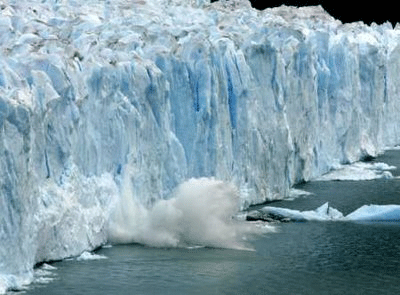 Global warming is melting the Greenland Ice Sheet, fast The Greenland Ice Sheet is losing 110 million Olympic size swimming pools worth of water each year, Guardian, John Abraham, 25 Aug 16 A new study measures the loss of ice from one of world’s largest ice sheets. They find an ice loss that has accelerated in the past few years, and their measurements confirm prior estimates.
As humans emit heat-trapping gases, we expect to see changes to the Earth. One obvious change to be on the lookout for is melting ice. This includes ice atop mountains, ice floating in cold ocean waters, and the ice within large ice sheets or glaciers. It is this last type of ice loss that most affects ocean levels because as the water runs into the oceans, it raises sea levels. This is in contrast to melting sea ice – since it is already floating in ocean waters, its potential to raise ocean levels is very small.
So measuring ice sheet melting is important, not only as a signal of global warming but also because of the sea level impacts. But how is this melting measured? The ice sheets on Greenland and Antarctica are huge and scientists need enough measurements in space and time to really understand what’s going on. That is, we need high-resolution and long duration measurements to fully understand trends.
In a very recent publication in the journal Geophysical Research Letters, an international team reported on a new high-resolution measurement of Greenland. The lead author, Malcolm McMillan from the Centre for Polar Observation and Modeling, and his colleagues mapped Greenland with incredibly high resolution (5 km distances).
They accomplished this mapping by obtaining data from the Cryosat 2satellite. This satellite uses a technique called radar altimetry to measure the height of surfaces. It is able to track the elevation of the ice sheets on Greenland with high precision. If the height of the ice sheet is growing, it means the ice is getting thicker. If the heights are decreasing, it means the ice layers are getting thinner.
A simplistic view would be that if ice sheets become taller, then they contain more frozen water. If they are shorter, they contain less water. But, this isn’t the entire story. Scientists also have to account for other changes, such as changes to density, surface roughness, and water content. When you realize that the Greenland Ice Sheet is thousands of meters thick, and the top layers include both snow and firn (which later get buried and compressed into ice), it becomes apparent that accounting for the constitution of the ice sheet is important when estimating how much water is being delivered to the ocean.
The authors of this study did such an accounting and they discovered that not only is Greenland losing a lot of ice, but the loss varies a lot depending on location and year. https://www.theguardian.com/environment/climate-consensus-97-per-cent/2016/aug/25/global-warming-is-melting-the-greenland-ice-sheet-fast
Australian uranium company meets stiff opposition from Inuit, to Greenland mine project
 Greenland Inuit oppose open-pit uranium mine on Arctic mountain-top http://www.theecologist.org/News/news_analysis/2988016/greenland_inuit_oppose_openpit_uranium_mine_on_arctic_mountaintop.html, Bill Williams ,17th August 2016
A collapse in the price of uranium has not yet stopped Australian mining company GME from trying to press ahead with a massive open-pit uranium mine on an Arctic mountain in southern Greenland, writes Bill Williams – just returned from the small coastal town of Narsaq where local people and Inuit campaigners are driving the growing resistance to the ruinous project.
Recently I was invited to assess an old Danish uranium exploration site in Kvanefjeld in southern Greenland.
Inuit Ataqatigiit – the opposition party in the national parliament – had asked me to talk to local people about the health implications of re-opening the defunct mine.
An Australian firm called Greenland Minerals and Energy (GME) has big plans to extract uranium and rare earth minerals here. It would be a world first: an open-pit uranium mine on an Arctic mountain-top.
From the top of the range above the mine site I looked down across rolling green farmland to the small fishing village of Narsaq. Colourful timber houses rested at the edge of a deep blue strait that the Viking Eric the Red navigated a thousand years ago. Hundreds of icebergs bobbed on its mirror-like surface. To the east, half way up the valley, a small creek tumbled into a deep rock pool.
Behind that saddle lies Lake Tesaq, a pristine Arctic lake that GME plans to fill with nearly a billion tonnes of waste rock. This part of the mine waste would not be the most radioactive, because the company plans to dump this material in a nearby natural basin, with the promise that an ‘impervious’ layer would prevent leaching into the surrounding habitat.
Left behind – all the toxic products of radioactive decay
These mine tailings would contain the majority of the original radioactivity – about 85% in fact – because the miners only want the uranium and the rare earth elements. They would mine and then leave the now highly mobile radioactive contaminants, the progeny from the uranium decay behind: thorium, radium, radon gas, polonium and a horde of other toxins.
Even at very low levels of exposure ionising radiation is recognised as poisonous: responsible for cancer and non-cancer diseases in humans over vast timespans.
This is why my own profession is under growing pressure to reduce exposure of our patients to X-Rays and CT scans in particular – making sure benefit outweighs risk. It’s also why ERA, the proprietors of the Ranger mine in Kakadu, Australia, are legally obliged to isolate the tailings for at least 10,000 years.
While this is hardly possible, the mere fact that it is required highlights the severity and longevity of the risk. My Inuit audience in Narsaq was particularly interested to hear the messages I brought from traditional owners in Australia like Yvonne Margarula, of the Mirarr people:
“The problems always last, but the promises never do.”
And Jeffrey Lee from Koongara:
“I will fight to the end and we will stop it, then it won’t continue on for more uranium here in Kakadu.”
So far in 2016, not a single new nuclear reactor has opened
Chemical and radioactive waste could be exposed as ice thaws over abandoned military site in Greenland
Melting ice sheet could expose frozen Cold War-era hazardous waste, Eureka Alert, YORK UNIVERSITY TORONTO, AUG. 4, 2016 –Climate change is threatening to expose hazardous waste at an abandoned camp thought to be buried forever in the Greenland Ice Sheet, new research out of York University has found.Camp Century, a United States military base built within the Greenland ice sheet in 1959, doubled as a top-secret site for testing the feasibility of deploying nuclear missiles from the Arctic during the Cold War. When the camp was decommissioned in 1967, its infrastructure and waste were abandoned under the assumption they would be entombed forever by perpetual snowfall.
“Two generations ago, people were interring waste in different areas of the world, and now climate change is modifying those sites,” said William Colgan, a climate and glacier scientist at York U and lead author of the new study. “It’s a new breed of climate change challenge we have to think about.”
The study was published today in Geophysical Research Letters, a journal of the American Geophysical Union.
Climate change has warmed the Arctic more than any other region on Earth and the new research has found that the portion of the ice sheet covering Camp Century could start to melt by the end of the century. If the ice melts, the camp’s infrastructure, as well as any remaining biological, chemical and radioactive waste, could re-enter the environment and potentially disrupt nearby ecosystems, say the study’s authors. The wastes would not remain encased in ice forever, as was assumed by both the US and Denmark when the camp was abandoned. Determining who is responsible for cleaning up the waste could also lead to political disputes not considered before, said Colgan.
The study’s team took an inventory of the wastes at Camp Century and ran climate model simulations. The researchers also analyzed historical US army engineering documents to determine where and how deep the wastes were buried and how much that part of the ice cap had moved since the 1960s. They found the waste at Camp Century covers 55 hectares, roughly the size of 100 football fields…….
International law is clear about responsibility for preventing future hazardous waste, but ambiguous about who is liable for waste already discarded, said Jessica Green, a political scientist specializing in international environmental law at New York University who was not connected to the study. Although Camp Century was a US base, it is on Danish soil, and although Greenland is a Danish territory, it is now self-governing, she said…….
Although the camp was built with Denmark’s approval, the missile launch program, known as Project Iceworm, was kept secret from the Danish government. Several years after the camp became operational, Project Iceworm was rejected by the Joint Chiefs of Staff and the camp was decommissioned. The Army Corps of Engineers removed the nuclear reaction chamber but left the camp’s infrastructure and all other waste behind, assuming the ice sheet would secure them forever. In the decades since, falling snow has buried the camp roughly 35 meters further underneath the ice. http://www.eurekalert.org/pub_releases/2016-08/yu-mis080416.php
Antarctic is being polluted by uranium mining in Australia
Climate scientists: Australian uranium mining pollutes Antarctic http://phys.org/news/2016-06-climate- scientists-australian-
uranium-pollutes.html June 30, 2016 by Beth Staples Uranium mining in Australia is polluting the Antarctic, about 6,000 nautical miles away. University of Maine climate scientists made the discovery during the first high-resolution continuous examination of a northern Antarctic Peninsula ice core.
Ice core data reveal a significant increase in uranium concentration that coincides with open pit mining in the Southern Hemisphere, most notably Australia, says lead researcher Mariusz Potocki, a doctoral candidate and research assistant with the Climate Change Institute.
“The Southern Hemisphere is impacted by human activities more than we thought,” says Potocki.
Understanding airborne distribution of uranium is important because exposure to the radioactive element can result in kidney toxicity, genetic mutations, mental development challenges and cancer.
Uranium concentrations in the ice core increased by as much as 102 between the 1980s and 2000s, accompanied by increased variability in recent years, says Potocki, a glaciochemist.
Until World War II, most of the uranium input to the atmosphere was from natural sources, says the research team.
But since 1945, increases in Southern Hemisphere uranium levels have been attributed to industrial sources, including uranium mining in Australia, South Africa and Namibia. Since other land-source dust elements don’t show similar large increases in the ice core, and since the increased uranium concentrations are enriched above levels in the Earth’s crust, the source of uranium is attributed to human activities rather atmospheric circulation changes.
In 2007, a Brazilian-Chilean-U.S. team retrieved the ice core from the Detroit Plateau on the northern Antarctic Peninsula, which is one of the most rapidly changing regions on Earth.
More information: Mariusz Potocki et al. Recent increase in Antarctic Peninsula ice core uranium concentrations, Atmospheric Environment (2016). DOI: 10.1016/j.atmosenv.2016.06.010 Journal reference:Atmospheric Environment  Provided by: University of Maine
Russia to dominate Arctic with huge ice-breakers
Russia floated its largest and most powerful nuclear-powered icebreaker last month, upping the ante in what is literally the coldest global gold rush.
The ice-smashing ship was Russia’s sixth reactor-driven polar vessel. The United States doesn’t have a single one.
Moscow’s dominance of the northern seas — courtesy of vast investments — has America and the West worried. Here’s why………http://www.nbcnews.com/news/world/russia-s-latest-nuclear-powered-icebreaker-extends-arctic-dominance-n602381
Russia’s massive nuclear-powered icebreaker to seek oil reserves in Arctic
Arktika is just one icebreaker in a class known as Project 22220. The other two — Sibir, which was laid down in May 2015, and Ural — are also planned. If completed, Sibir will reportedly have the propulsion power of 110 MW, almost twice as powerful as Arktika. Both ships are part of a $1.2 billion contract that Baltic Shipyards signed in 2014 with Rosatom State Nuclear Energy Corp.
Why would Russia need nuclear-powered icebreakers in the first place? Obviously, for defense. Icebreakers can clear a path for military ships, allowing for increased mobility and range for the Russian naval fleet.
Fast warming of Arctic region will mean many climate refugees
Obama administration warns of ‘climate refugees’ due to rapid Arctic warming
US Interior Secretary Sally Jewell has painted a stark picture of communities displaced by rising Arctic temperatures that are ‘washing away’ towns, Guardian, Oliver Milman @olliemilman Saturday 30 April 2016 The Obama administration has warned the US will need to deal with a wave of “climate refugees” as the Arctic continues to warm, joining with the Canadian government to express alarm over how climate change is affecting indigenous communities.
Sally Jewell, US secretary of the interior, painted a stark picture of communities relocating and lives disrupted in her first official visit to Canada. The Arctic, which is warming at twice the rate of the global average, has just recorded its lowest recorded peak ice extent after what’s been called a “warm, crazy winter”……..
Obama declares disaster as Marshall Islands suffers worst-ever drought….http://www.theguardian.com/environment/2016/apr/29/climate-change-refugees-arctic-obama-administration-warning
Russian nuclear submarine fires CRUISE MISSILE in Arctic
Russian nuclear sub fires CRUISE MISSILE in chilling footage of Arctic military drill, Mirror, BY JONATHAN SHARMAN, 30 APR 16 The 120-metre Severodvinsk submarine can be seen sinking slowly below the surface before its Kalibr missile erupts from the wave… [INCL VIDEO]…..
The Russian military said the cruise missile struck its target, in the Arkhangelsk region, “with high accuracy”.
A statement added: “A strike group of the flotilla has conducted firing drills using naval practice targets and hit them successfully.”
The Kalibr missile, which can carry nuclear or conventional payloads, travels at speeds up to Mach 2.9 – the same as a space shuttle during launch. The land-attack weapon has a range of up to 1,500 miles……..http://www.mirror.co.uk/news/world-news/russian-nuclear-sub-fires-cruise-7866647
Sea level rise has been underestimated – new ice studies suggest
Ice melt studies say we underestimate sea level rise, Independent Australia Peter Boyer 11 April 2016, Are melting polar ice sheets as stable as we think, or have we missed something? If a couple of new ice studies are only partly right, we face massive disruption from sea level rise within decades.
SCIENTIFIC DEBATE about this has picked up in the wake of the March publication of two major research papers by scientists from the U.S., France, Germany and China.
A paper by James Hansen and 18 other climatologists in the open-access science journal Atmospheric Chemistry and Physics, examined ancient climate change to assess how that compares with today’s melting of Greenland and Antarctic ice sheets.
It argues that during this century, ice sheet meltwater spreading over parts of the Southern Ocean and the North Atlantic will increase the temperature variation between these cooler parts and warming regions, resulting in more violent storms.
The meltwater layer also acts as a transparent lid on warming ocean waters undermining polar ice sheets sitting on bedrock below sea level. The paper’s startling prediction is that consequent disintegration could bring several metres of sea level rise within 150 years and possibly by 2070.
A paper published last week in the science journal Nature, also examining past rapid changes, looked at how the Antarctic ice sheet might react to warming of atmosphere as well as ocean, and reached similarly disturbing conclusions.
U.S. scientists Robert DeConto and David Pollard studied the puzzle of how the massive Antarctic ice sheet shed large amounts of ice over relatively short time-frames in prehistoric warming events.
Their modelling showed that if today’s high carbon emissions continue, warmer air would add to the impact of warming seas. Fracturing ice shelves and coastal cliffs would bring rapid ice loss and contribute ‘more than a metre of sea-level rise by 2100’………https://independentaustralia.net/environment/environment-display/ice-melt-studies-say-we-underestimate-sea-level-rise,8866
Strong opposition to uranium mining in Kuannersuaq, Greenland
We are strongly opposed to plans to exploit minerals with uranium reserves at Kuannersuaq, Narsaq http://arcticjournal.com/press-releases/2204/we-are-strongly-opposed-plans-exploit-minerals-uranium-reserves-kuannersuaq We are strongly opposed to plans to exploit minerals with uranium reserves at Kuannersuaq, Eric Jensen, Nuka David SørensenMarch 9, 2016 By The Arctic Journal Information to citizens concerning the plans for exploitation of mineral deposits with uranium and exploitation of uranimium by Kuannersuaq at Narsaq is not sufficient and we demand that there should be a referendum on the plans for exploitation of mineral resources with uranium content. Therefore we require that plans for exploitation of mineral resources with uranium content and exploitation of uranium and all the decisions concerning these must be stopped.
By requiring that plans for exploitation of mineral resources with uranium content and exploitation of uranmium by Kuannersuaq at Narsaq temporarily stopped, we have begun planning of demonstrations against these plans on April 8, 2016, from 12:00 in the towns of Narsaq, Qaqortoq, Nuuk, Tasiilaq , Ilulissat, Qeqertarsuaq and in the settlements Qassiarsuk and Narsarsuaq. We have the following arguments against the plans for the exploitation of mineral resources with uranium content and exploitation of uranium:
- No sufficient information has been submitted regarding the potential impacts on people, the environment and wildlife, if an open mine is to be opened at Kuannersuaq;
- Citizens are not informed with clear information printed in Greenlandic concerning the plans for the exploitation of mineral resources containing uranium and exploitation of uranium.
We require the following information from the Greenland Government on plans for use of mineral resources from Kuannersuit:
1. What impacts can an open pit mine on the top of Kunnersuaq have on people’s health and the environment?
2. How can dust with different radioactive substances from the exploitation of raw materials from the mountain all year round be avoided?
3. What plans are there to ensure that waste from the mine to be thrown in the lake does not pollute the environment?
4. What can the waste from the mine placed into the lake have of impacts?
5. Is there sufficient space to the amount of waste in the lake?
6. According to the latest survey, only very small amounts of uranium, how credible are these compared to Risø’s studies?
7. How will you ensure the credibility of the EIA report as yet been presented publicly?
8. How ready is Greenland to store waste / tailings containing uranium mining and exploitation for many years without polluting?
9. There are not taken into account the next coming generations who will inherit it all?
Everybody is welcome to participate in the demonstrations on April 8 from pm. 12:00 at the following towns Narsaq, Qaqortoq, Nuuk, Tasiilaq, Ilulissat, Qeqertarsuaq, Qassiarsuk, Narsarsuaq and possible. Elsewhere.
1 This Month



Shut down the radiation-damaged Heysham nuclear reactors now
To see nuclear-related stories in greater depth and intensity – go to https://nuclearinformation.wordpress.com

Say No to NASA’s Reckless Nuclear Reactor on the Moon
Say No to NASA’s Reckless Nuclear Reactor on the Moon
-
Archives
- October 2026 (247)
- September 2026 (339)
- August 2026 (330)
- July 2026 (355)
- June 2026 (287)
- May 2026 (306)
- April 2026 (356)
- March 2026 (251)
- February 2026 (267)
- January 2026 (308)
- December 2025 (358)
- November 2025 (359)
-
Categories
- 1
- 1 NUCLEAR ISSUES
- business and costs
- climate change
- culture and arts
- ENERGY
- environment
- health
- history
- indigenous issues
- Legal
- marketing of nuclear
- media
- opposition to nuclear
- PERSONAL STORIES
- politics
- politics international
- Religion and ethics
- safety
- secrets,lies and civil liberties
- spinbuster
- technology
- Uranium
- wastes
- weapons and war
- Women
- 2 WORLD
- ACTION
- AFRICA
- Atrocities
- AUSTRALIA
- Christina's notes
- Christina's themes
- culture and arts
- Events
- Fuk 2022
- Fuk 2023
- Fukushima 2017
- Fukushima 2018
- fukushima 2019
- Fukushima 2020
- Fukushima 2021
- general
- global warming
- Humour (God we need it)
- Nuclear
- RARE EARTHS
- Reference
- resources – print
- Resources -audiovicual
- Weekly Newsletter
- World
- World Nuclear
- YouTube
-
RSS
Entries RSS
Comments RSS

