Soaring Arctic temperatures are at cutting edge of climate change research
Arctic ice melt ‘already affecting weather patterns where you live right now’ Soaring Arctic temperatures ‘strongly linked’ to recent extreme weather events, say scientists at cutting edge of climate change research, Guardian, Damian Carrington, 20 Dec 16 The dramatic melting of Arctic ice is already driving extreme weather that affects hundreds of millions of people across North America, Europe and Asia, leading climate scientists have told the Guardian.
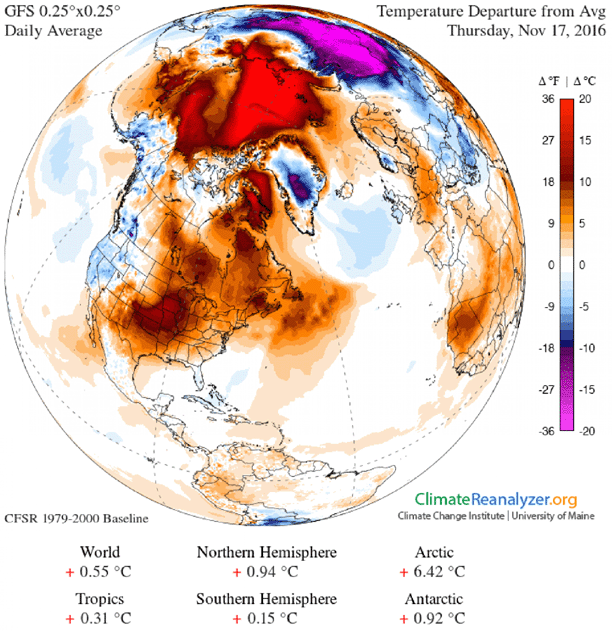
Severe “snowmageddon” winters are now strongly linked to soaring polar temperatures, say researchers, with deadly summer heatwaves and torrential floods also probably linked. The scientists now fear the Arctic meltdown has kickstarted abrupt changes in the planet’s swirling atmosphere, bringing extreme weather in heavily populated areas to the boil.
The northern ice cap has been shrinking since the 1970s, with global warming driving the loss of about three-quarters of its volume so far. But the recent heat in the Arctic has shocked scientists, with temperatures 33C above average in parts of the Russian Arctic and 20C higher in some other places.
In November, ice levels hit a record low, and we are now in “uncharted territory”, said Prof Jennifer Francis, an Arctic climate expert at Rutgers University in the US, who first became interested in the region when she sailed through it on a round-the-world trip in the 1980s.
“These rapid changes in the Arctic are affecting weather patterns where you live right now,” she said. “In the past you have had natural variations like El Niño, but they have never happened before in combination with this very warm Arctic, so it is a whole new ball game.
“It is inconceivable that this ridiculously warm Arctic would not have an impact on weather patterns in the middle latitudes further south, where so many people live. “It’s safe to say [the hot Arctic] is going to have a big impact, but it’s hard to say exactly how big right now. But we are going to have a lot of very interesting weather – we’re not going to get around that one……… https://www.theguardian.com/environment/2016/dec/19/arctic-ice-melt-already-affecting-weather-patterns-where-you-live-right-now
Decline in polar bears and reindeer as Arctic sea ice melts
Polar bear and wild reindeer decline worsening as climate change continues to melt Arctic ice: study, ABC News, 13 Dec 15 Rising global temperatures melting sea ice in the Arctic are predicted to worsen the decline in polar bear numbers over the next 40 years, a new US-led study has found.
Scientists said the 26,000-strong polar bear population is expected to diminish by a third, some 8,600 animals, over the next 35-40 years as their chief habitat disappears.
The new findings by university and government researchers were presented as part of a panel discussion about climate impacts on wildlife during a meeting of the American Geophysical Union in San Francisco on Monday (local time).
The polar bear research was drawn from new satellite data documenting a loss of Arctic sea ice from 1979 to 2015 and forming the basis of projections in further declines of both ice and bears over the coming decades…..
Wild reindeer numbers also falling thanks to climate change
A warmer climate is also thought to be a primary culprit in the rapid decline of wild reindeer and their close cousins, caribou.
University of Northern Iowa Arctic Centre head Andrey Petrov said his study of wild reindeer in Taimyr, northern Russia showed the herd’s population has fallen from 1 million in 2000 to the latest estimates of about 600,000 animals……http://www.abc.net.au/news/2016-12-13/polar-bear-decline-to-worsen-thanks-to-climate-change/8116722
Problem of carbon release as permafrost melts
When Permafrost Melts, What Happens to All That Stored Carbon? http://www.enn.com/climate/article/50183 7 Dec 16, The Arctic’s frozen ground contains large stores of organic carbon that have been locked in the permafrost for thousands of years. As global temperatures rise, that permafrost is starting to melt, raising concerns about the impact on the climate as organic carbon becomes exposed. A new study is shedding light on what that could mean for the future by providing the first direct physical evidence of a massive release of carbon from permafrost during a warming spike at the end of the last ice age.
The study, published this week in the journal Nature Communications, documents how Siberian soil once locked in permafrost was carried into the Arctic Ocean during that period at a rate about seven times higher than today.
“We know the Arctic today is under threat because of growing climate warming, but we don’t know to what extent permafrost will respond to this warming. The Arctic carbon reservoir locked in the Siberian permafrost has the potential to lead to massive emissions of the greenhouse gases carbon dioxide and methane to the atmosphere,” said study co-author Francesco Muschitiello, a post-doctoral research fellow at Columbia University’s Lamont-Doherty Earth Observatory.
To understand how melting permafrost influenced the carbon cycle in the past, the scientists examined the carbon levels in sediment that accumulated on the seafloor near the mouth of the Lena River about 11,650 years ago, when the last glacial period was ending and temperatures in the Northern Hemisphere spiked by several degrees.
Continue reading at The Earth Institute at Columbia University
The end for theNorth Pole, in two years’ time?
There could be just two years left before the North Pole disappears,news.com.au, “…….Santa is a fantasy but climate change is not, and it’s started to do truly alarming things to the North Pole.

Over the past few weeks the temperature of the North Pole has been 22 degrees hotter than the average temperature for this time of year. That’s not a typo. It’s not 2.2 degrees hotter. It’s 22 degrees Celsius hotter.
The reason it’s such a huge difference is because even though night is now falling, the temperature around the poles is still getting hotter rather than colder. That’s never happened before. What it means is that the gap between average temperature and this year’s temperature is getting wider and wider by the day. [graph on original] …….
Peter Wadhams, a professor of Ocean Physics at Cambridge University, now reckons that it could be as little as two years before ice disappears completely from the North Pole during the summer months…..
What the ice melting at the North Pole means is that, once it’s gone, you’ll be able to drive a boat across the North Pole.
No more photos of intrepid tourists reaching the North Pole, doing a cheesy thumbs in front of a sign saying “North Pole”. No more stories of Santa’s sleigh. There will be no ice for him to drive his sleigh across.
In addition to the environmental implications, the cultural implications of this are also huge…….
This is why I’m seriously considering taking the kids out of school next July, and taking them up to the North Pole to see the ice. It’s probably the last chance to see it. Fantasies of the North Pole are such a vivid part of my own childhood. When was a kid, I always assumed I’d go there one day. Now I know my children will not……http://www.news.com.au/technology/environment/climate-change/there-could-be-just-two-years-left-before-the-north-pole-disappears/news-story/80111828cd33bdb2b24ca0540013a70e
Record loss of sea ice in November
 Sea ice hit record lows in November, EurekAlert, 6 Dec 16 UNIVERSITY OF COLORADO AT BOULDER Unusually high air temperatures and a warm ocean have led to a record low Arctic sea ice extent for November, according to scientists at the National Snow and Ice Data Center (NSIDC) at the University of Colorado Boulder. In the Southern Hemisphere, Antarctic sea ice extent also hit a record low for the month, caused by moderately warm temperatures and a rapid shift in circumpolar winds.
“It looks like a triple whammy–a warm ocean, a warm atmosphere, and a wind pattern all working against the ice in the Arctic,” said NSIDC director Mark Serreze.
Arctic sea ice extent averaged 9.08 million square kilometers (3.51 million square miles) for November, 1.95 million square kilometers (753,000 square miles) below the 1981 to 2010 long-term average for the month. Although the rate of Arctic ice growth was slightly faster than average, total extent actually decreased for a brief period in the middle of the month. The decrease in extent measured 50,000 square kilometers (19,300 square miles) and was observed mostly in the Barents Sea, an area of the Arctic Ocean north of Norway, Finland, and Eastern Russia.
NSIDC scientists said the decrease in extent is almost unprecedented for November in the satellite record; a less pronounced and brief retreat of 14,000 square kilometers (5,400 square miles) happened in 2013. November 2016 is now the seventh month this year to have hit a record low extent in the 38-year satellite monitoring period. The November extent was 3.2 standard deviations below the long-term average, a larger departure than observed in September 2012 when the Arctic summer minimum extent hit a record low………
In the Southern Hemisphere, sea ice surrounding the continent of Antarctica declined very quickly early in the month and set a record low. The average extent for November was 14.54 million square kilometers (5.61 million square miles), 1.81 million square kilometers (699,000 square miles) below the 1981 to 2010 average. This was more than twice the previous record departure from average set in November 1986 and was 5.7 standard deviations below the long-term average.
NSIDC scientists said that higher-than-average temperatures and a rapid shift in Antarctic circumpolar winds appear to have caused the rapid decline in Antarctic sea ice……..
NASA scientist and NSIDC affiliate scientist Walt Meier said, “The Arctic has typically been where the most interest lies, but this month, the Antarctic has flipped the script and it is southern sea ice that is surprising us.” https://www.eurekalert.org/pub_releases/2016-12/uoca-sih120616.php
Carbon releases as permafrost melts
 When Permafrost Melts, What Happens to All That Stored Carbon? http://www.enn.com/climate/article/50183 The Arctic’s frozen ground contains large stores of organic carbon that have been locked in the permafrost for thousands of years. As global temperatures rise, that permafrost is starting to melt, raising concerns about the impact on the climate as organic carbon becomes exposed. A new study is shedding light on what that could mean for the future by providing the first direct physical evidence of a massive release of carbon from permafrost during a warming spike at the end of the last ice age.
The study, published this week in the journal Nature Communications, documents how Siberian soil once locked in permafrost was carried into the Arctic Ocean during that period at a rate about seven times higher than today.
“We know the Arctic today is under threat because of growing climate warming, but we don’t know to what extent permafrost will respond to this warming. The Arctic carbon reservoir locked in the Siberian permafrost has the potential to lead to massive emissions of the greenhouse gases carbon dioxide and methane to the atmosphere,” said study co-author Francesco Muschitiello, a post-doctoral research fellow at Columbia University’s Lamont-Doherty Earth Observatory.
To understand how melting permafrost influenced the carbon cycle in the past, the scientists examined the carbon levels in sediment that accumulated on the seafloor near the mouth of the Lena River about 11,650 years ago, when the last glacial period was ending and temperatures in the Northern Hemisphere spiked by several degrees.
Continue reading at The Earth Institute at Columbia University
Release of carbon from Arctic soils
Arctic soils are set to release a lot of carbon — probably more than plants can absorb Author: As temperatures have risen in the Arctic and worldwide, so have worries about how much carbon might stream into the atmosphere from warmer soils.
Will enough new carbon be released from the ground, potentially exacerbating the global warming cycle? And will new-growth carbon dioxide-absorbing plants growing in warmer conditions be able to keep pace?
Now scientists have some better answers to both questions — and they’re troubling.
Globally, warming will drive 55 petagrams (that’s 55 billion metric tons or 55 trillion kilograms) of carbon gases from soils into the atmosphere by mid-century, according to a comprehensive study led by researchers at Yale. That amount is equal to about 17 percent of projected emissions from global fossil-fuel burning and other human activities.
The study, published Wednesday in the journal Nature, cites the highest latitudes and highest altitudes as the biggest contributors of carbon from the ground.
While warmer soils all around the world stimulate more of the below-ground microbial activity that produces carbon gases, the changes are most striking in permafrost regions — the Arctic, where warming is happening at least twice as fast as the global rate, and the tops of the highest mountains. In those high latitudes and high altitudes, permafrost thaw is freeing once-locked carbon left by long-ago decayed plants and animals, and making it available to the microbial processes that produces gases that are emitted above the ground.
“Thaw depths are getting deeper,” said study co-author Jeff Welker, a biology professor and Fulbright Distinguished Arctic Chair at the University of Alaska Anchorage.
The global calculation for the mid-century total for carbon emitted from soil — an amount roughly equivalent to all U.S. carbon emissions from human activities — is a gross figure, not the net after uptake by plants above the ground’s surface, Welker said.
But prospects for Arctic plants to absorb the extra carbon gases appear dim, according to another newly published study led by scientists at the University of Alaska Fairbanks.
On at least part of Alaska’s North Slope, new carbon streaming out of the soil is already outpacing any carbon uptake by plants on top of the ground and the area has become a net carbon emitter, according to the study, published in the journal Ecosystems.
The UAF-led study monitored eight years of year-round carbon fluxes between the air and the soil, making it a very rare long-term project. (Most studies tracking carbon gas movements only monitor in the summer.) The study used tripod-mounted sensors to measure carbon dioxide, the dominant greenhouse gas, and methane being released and absorbed by different types of tundra at a test site in the Brooks Range foothills……
The result is an ominous sign for the future, signaling more climate-warming gas pouring into a region that has already warmed dramatically, said co-author Syndonia Bret-Harte, also of UAF’s Institute of Arctic Biology.
“It could be a profound feedback to global climate from a relatively moderate area of the earth,” Bret-Harte said……https://www.adn.com/arctic/2016/12/01/led-by-arctic-warmed-soil-poised-to-pour-vast-amounts-of-carbon-into-atmosphere/
Alarm among scientists at ‘Extraordinarily hot’ Arctic temperatures
‘Extraordinarily hot’ Arctic temperatures alarm scientists Danish and US researchers say warmer air and sea surface could lead to record lows of sea ice at north pole next year, Guardian, John Vidal, 22 Nov 16 The Arctic is experiencing extraordinarily hot sea surface and air temperatures, which are stopping ice forming and could lead to record lows of sea ice at the north pole next year, according to scientists.
Danish and US researchers monitoring satellites and Arctic weather stations are surprised and alarmed by air temperatures peaking at what they say is an unheard-of 20C higher than normal for the time of year. In addition, sea temperatures averaging nearly 4C higher than usual in October and November.
“It’s been about 20C warmer than normal over most of the Arctic Ocean, along with cold anomalies of about the same magnitude over north-central Asia. This is unprecedented for November,” said research professor Jennifer Francis of Rutgers university.
Temperatures have been only a few degrees above freezing when -25C should be expected, according to Francis. “These temperatures are literally off the charts for where they should be at this time of year. It is pretty shocking. The Arctic has been breaking records all year. It is exciting but also scary,” she said…….https://www.theguardian.com/environment/2016/nov/22/extraordinarily-hot-arctic-temperatures-alarm-scientists
Arctic ocean protection: Obama blocks new oil, gas drilling
 Obama blocks new oil, gas drilling in Arctic Ocean, USA Today WASHINGTON (AP) — The Obama administrationis blocking new oil and gas drilling in the Arctic Ocean, handing a victory to environmentalists who say industrial activity in the icy waters will harm whales, walruses and other wildlife and exacerbate global warming.
Yes, you read it right! North Pole is 36 degrees warmer than normal!
The North Pole is an insane 36 degrees warmer than normal as winter descends, WP, Political people in the United States are watching the chaos in Washington in the moment. But some people in the science community are watching the chaos somewhere else — the Arctic.
It’s polar night there now — the sun isn’t rising in much of the Arctic. That’s when the Arctic is supposed to get super-cold, when the sea ice that covers the vast Arctic Ocean is supposed to grow and thicken.
But in fall of 2016 — which has been a zany year for the region, with multiple records set for low levels of monthly sea ice — something is totally off. The Arctic is super-hot, even as a vast area of cold polar air has been displaced over Siberia.
At the same time, one of the key indicators of the state of the Arctic — the extent of sea ice covering the polar ocean — is at a record low. The ice is freezing up again, as it always does this time of year after reaching its September low, but it isn’t doing so as rapidly as usual.
In fact, the ice’s area is even lower than it was during the record-low 2012:
Twitter’s expert Arctic watchers also are stunned. Zack Labe, a PhD student at the University of California at Irvine who studies the Arctic, tweeted out an image on Wednesday from the Danish Meteorological Institute showing Arctic temperatures about 20 degrees Celsius higher than normal above 80 degrees North Latitude.
“Today’s latest #Arctic mean temperature continues to move the wrong direction . . . up. Quite an anomalous spike!,” Labe wrote. Here’s the figure: [on original]
“Despite onset of #PolarNight, temperatures near #NorthPole increasing. Extraordinary situation right now in #Arctic, w/record low #seaice,” added Daniel Swain, a climate scientist at UCLA.
This is the second year in a row that temperatures near the North Pole have risen to freakishly warm levels. During 2015’s final days, the temperature near the Pole spiked to the melting point thanks to a massive storm that pumped warm air into the region.
So what’s going on here?
“It’s about 20C [36 degrees Fahrenheit] warmer than normal over most of the Arctic Ocean, along with cold anomalies of about the same magnitude over north-central Asia,” Jennifer Francis, an Arctic specialist at Rutgers University, said by email Wednesday…….https://www.washingtonpost.com/news/energy-environment/wp/2016/11/17/the-north-pole-is-an-insane-36-degrees-warmer-than-normal-as-winter-descends/
Energy Efficiency – not sexy – but it works against climate change
Energy Efficiency Is Key To Taking On Climate Change—Here Are The Numbers That Matter https://www.fastcoexist.com/3064550/energy-efficiency-is-key-to-taking-on-climate-change-here-are-the-numbers-that-matter
Energy efficiency needs to account for one-third of all emissions reductions by 2040. BEN SCHILLER 10.13.16
Energy efficiency isn’t as sexy as inventing new, cleaner forms of power. But, if you care about climate change, you really ought to care about it. Efficiency will need to account for a third of emissions reductions by 2040 if we’re stay within relatively safe global warming limits, according to the International Energy Agency.

“Simply put, there are no realistic or affordable energy and climate change policy without a sizable and vigorous energy efficiency component,” the IEA says in a new report.
The good news is we are becoming smarter about energy use. Energy “intensity”—the amount of energy needed to generate a unit of global GDP—improved by 1.8% last year. That was higher than in 2014, even though energy prices have been falling, which normally encourages people to use more energy, not less.
Between 2000 and 2015, IEA countries—including the U.S. and most of Europe—improved their energy intensity by an average of 14%. That’s the equivalent of 450 million tonnes of oil, or enough to power Japan for a whole year. In all, efficiency saved $490 per person across the IEA area, or cumulative energy spending of $4 trillion.
The bad news is that even this rate isn’t enough to meet the 2040 target. The IEA calls on countries to implement more mandatory efficiency targets—likeour CAFE car efficiency standards—and to spread more efficient lighting, heating, and air conditioning technology. Best-in-class equipment could save 14% of global residential energy consumption, the report says.
See more here.
Oil and gas exploration in the Arctic – how it impacts the Inuit
On Melting Ice: Inuit Struggle Against Oil and Gas in the Arctic Tuesday, 11 October 2016 By Chris Williams, Truthout | News Analysis The Inuit in the Canadian Arctic are engaged in a centuries-old fight to retain their culture and reestablish self-determination and genuine sovereignty. In particular, Inuit in the autonomous territory of Nunavut are resisting what American Indian studies scholar Daniel R. Wildcat has described as a “fourth removal attempt” of Indigenous people, coming on the heels of failed efforts at spatial, social and psycho-cultural deletion.
The common discourse on climate change focuses on the physical world: inexorably rising atmospheric concentrations of carbon dioxide and the impact on sea-ice extent; melting glaciers; and roiling, unpredictable perturbations in weather patterns. But these are but the physical manifestations of political decisions made in the social world. The questions behind them include: Who produced all that extra CO2? For what purposes? And which sets of people are paying the most immediate price?
In both realms, the Arctic, one of the regions least responsible for causing climate change, is bearing the most immediate brunt; though as Inuit activist, Nobel Prize nominee and author Sheila Watt-Cloutier warns in her book, The Right to Be Cold, “whatever happens in the poles will eventually happen everywhere else.”
To frame climate change in the Arctic as simply a story of liquefying dihydrogen monoxide is deceptive. The ice-filled north is first and foremost a human story, a story about home and the struggle to preserve it against outside forces. It is about a culture that quite literally rests on knowledge of ice, ocean and the animals that live on top and underneath it.
James Qillaq, mayor of Clyde River in Nunavut, explained, “That connection to the land, that’s our life … that’s the reason why we stand: our connection to the land and water, of something that is ours, that’s it. That’s it and nothing else. That’s our everything — our connection to the land.”…….
Climate Change and Arctic Amplification The most recent displacement attempt against Inuit is related to the fact that the Arctic is warming at twice the rate of lower latitudes. Over the last five decades, sea ice has vanished from an area twice the size of Alaska. The remaining ice is 50 percent thinner. The last nine years have all had the lowest sea-ice extents measured, with February 2015 showing the lowest in 37 years of satellite data. Over 50 percent of the gigantic ice sheet that blankets Greenland was melting during the summer of 2015, contributing to the 36th consecutive year of global glacier loss.
Going further back in time, recent research based on a compendium of historical data shows, “there is no point in the past 150 years where sea ice extent is as small as it has been in recent years,” ……… http://www.truth-out.org/news/item/37921-on-melting-ice-inuit-struggle-against-oil-and-gas-in-the-arctic
Icelandic capital aims to go carbon neutral
Reykjavík: the geothermal city that aims to go carbon neutral
Icelandic capital plans to reduce its greenhouse gas emissions to zero by 2040 by reversing urban sprawl and promoting walking, cycling and public transport, Guardian, Senay Boztas, 3 Oct 16, Reykjavík used to be marketed as a place of “pure energy”, run on geothermal power – and now Iceland’s capital is trying to become the world’s first carbon neutral city.
Last month, Iceland became one of the first countries to ratify the Paris climate deal with a unilateral parliamentary vote, shortly after Reykjavik announced its aim to be carbon neutral by 2040.
It wants to reduce its greenhouse gas emissions from 2.8 tonnes per person in 2013 to zero – largely by changing the shape of the city to reverse urban sprawl and encouraging Icelanders out of their beloved cars to walk, cycle or use public transport.
The city already has a head-start thanks to its reliance on geothermal energy. The US, for example, has a greenhouse gas footprint of 16.5 tonnes per person………https://www.theguardian.com/sustainable-business/2016/oct/03/reykjavik-geothermal-city-carbon-neutral-climate
Climate change will expose top-secret US nuclear project in Greenland
Greenland’s receding icecap to expose top-secret US nuclear project Camp Century – part of Project Iceworm – is underground cold war network that had been thought buried forever, until climate change made that highly unlikely, Guardian, Jon Henley, 28 Sept, A top-secret US military project from the cold war and the toxic waste it conceals, thought to have been buried forever beneath the Greenland icecap, are likely to be uncovered by rising temperatures within decades, scientists have said.

The US army engineering corps excavated Camp Century in 1959 around 200km (124 miles) from the coast of Greenland, which was then a county of Denmark.
Powered, remarkably, by the world’s first mobile nuclear generator and known as “the city under the ice”, the camp’s three-kilometre network of tunnels, eight metres beneath the ice, housed laboratories, a shop, a hospital, a cinema, a chapel and accommodation for as many as 200 soldiers………
Project Iceworm, presented to the US chiefs of staff in 1960, aimed to use Camp Century’s frozen tunnels to test the feasibility of a huge launch site under the ice, close enough to fire nuclear missiles directly at the Soviet Union.
At the height of the cold war, as the US and the USSR were engaged in a terrifying standoff over the deployment of Soviet missiles in Cuba, the US army was considering the construction of a vast subterranean extension of Camp Century.
A system of about 4,000 kilometres of icy underground tunnels and chambers extending over an area around three times the size of Denmark were to have housed 600 ballistic missiles in clusters six kilometres apart, trained on Moscow and its satellites.
Eventually the engineers realised Iceworm would not work. The constantly moving ice was too unstable and would have deformed and perhaps even collapsed the tunnels.
From 1964 Camp Century was used only intermittently, and three years later it was abandoned altogether, the departing soldiers taking the reaction chamber of the nuclear generator with them.
They left the rest of the camp’s infrastructure – and its biological, chemical and radioactive waste – where it was, on the assumption it would be “preserved for eternity” by the perpetually accumulating snow and ice……..
Greenland’s temperatures broke new records this spring and summer, hitting 24C (75F) in the capital, Nuuk, in June – a figure that shocked meteorologists so much they had to recheck their measurements.
Between 2003 and 2010, the ice that covers much of the island melted twice as fast as during the whole of the 20th century. This year it began melting a month earlier than usual.
The researchers studied US army documents and drawings to work out how deep the camp and its waste – estimated to include 200,000 litres of diesel fuel, similar quantities of waste water and unknown amounts of radioactive coolant and toxic organic pollutants such as PCBs – were buried………
The Pentagon has said it “acknowledges the reality of climate change and the risk it poses” for Greenland, adding that the US government has pledged to “work with the Danish government and the Greenland authorities to settle questions of mutual security”. https://www.theguardian.com/world/2016/sep/27/receding-icecap-top-secret-us-nuclear-project-greenland-camp-century-project-iceworm
Low Arctic sea ice in 2016 – close to record low level
These Images Show Near-Record Low 2016 Arctic Sea Ice, Climate Central , By Brian Kahn September 15th, 2016 Arctic sea ice is one of the grandaddy’s of climate indicators. And this grandaddy isn’t doing so good these days.This year’s sea ice extent has bottomed out as the second lowest on record, according to the National Snow and Ice Data Center. It continues a troubling trend as rapidly warming air and water eats away at the briny, frozen mantle on the top of the planet.
2016’s Arctic Sea Ice Melt Season in 9 Seconds
This year has been exceptional by many standards. March saw the lowest sea ice maximum ever recorded followed by a string of record low months. The Northwest Passage opened up, allowing a luxury cruise ship to travel from Anchorage to New York. And a freak storm in August turned ice thin and brittle near the North Pole.
Satellites show the last seven months of sea ice and reveal its steep decline this year. The late August breakup is particularly notable. Grist’s Amelia Urry compared the texture of sea ice near the North Pole to curdled milk or an exploded pillow (I’d go with broken glass personally, but to each their own)………
Most of what we tend to talk about with Arctic sea ice comes courtesy of satellites since they’re the most reliable way to monitor such a remote region. Recent research has reconstructed Arctic sea ice data back to 1850 using old ship logs, airplane survey and military records among other sources to provide a longer record than satellite data (though it does come with a little bit more uncertainty). What is certain is that there’s nothing in modern history like the recent string of low Arctic sea ice years we’ve seen.
Sea ice has declined precipitously across the Arctic, but particularly in the Beaufort and Chukchi Sea regions. In the coming decades, sea ice extent is only likely to keep shrinking and could reshape the region’s ecology, economy and ways of life for the plants, animals and people that call the region home. http://www.climatecentral.org/news/2016-low-arctic-sea-ice-20702
1 This Month

of the week – Shut Down Drone Warfare!


Tell the Ukrainian Government to Drop Prosecution of Peace Activist Yurii Sheliazhenko

Petition to revoke the licensing of the Near Surface Nuclear Disposal Facility (NSDF) at Chalk River. https://www.ourcommons.ca/petitions/en/Petition/Details?Petition=e-7247
To see nuclear-related stories in greater depth and intensity – go to https://nuclearinformation.wordpress.com
-
Archives
- April 2026 (91)
- March 2026 (251)
- February 2026 (268)
- January 2026 (308)
- December 2025 (358)
- November 2025 (359)
- October 2025 (376)
- September 2025 (257)
- August 2025 (319)
- July 2025 (230)
- June 2025 (348)
- May 2025 (261)
-
Categories
- 1
- 1 NUCLEAR ISSUES
- business and costs
- climate change
- culture and arts
- ENERGY
- environment
- health
- history
- indigenous issues
- Legal
- marketing of nuclear
- media
- opposition to nuclear
- PERSONAL STORIES
- politics
- politics international
- Religion and ethics
- safety
- secrets,lies and civil liberties
- spinbuster
- technology
- Uranium
- wastes
- weapons and war
- Women
- 2 WORLD
- ACTION
- AFRICA
- Atrocities
- AUSTRALIA
- Christina's notes
- Christina's themes
- culture and arts
- Events
- Fuk 2022
- Fuk 2023
- Fukushima 2017
- Fukushima 2018
- fukushima 2019
- Fukushima 2020
- Fukushima 2021
- general
- global warming
- Humour (God we need it)
- Nuclear
- RARE EARTHS
- Reference
- resources – print
- Resources -audiovicual
- Weekly Newsletter
- World
- World Nuclear
- YouTube
-
RSS
Entries RSS
Comments RSS
 nuclear-news