The only thing more frightening than an advancing glacier may be one that is shrinking and raising sea levels round the world
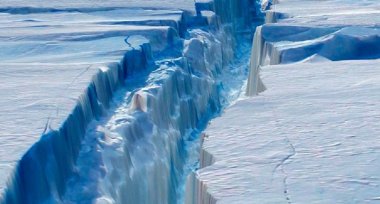
Both the north pole and the south pole are situated in the middle of huge ice deserts which are melting around the edges under the influence of human activity. The difference that matters between them is that the ice of the Arctic floats: if it melted nothing much would happen to aggregate sea levels. The ice of Antarctica, like that of Greenland, rests on land. If it all were to melt, as it has done in the far distant past, sea levels could rise by as much as 60 metres. That is most unlikely to happen. What is possible, though, is that the smaller portion of the continent, west Antarctica, which is divided from the rest by a mountain range, could lose much of its ice. Even that would be catastrophic. A significant retreat in west Antarctica, as seems to be already under way, could raise sea levels by between one and three metres by the end of this century. Children now alive will see that happen across their lifetimes. That is what is meant by the urgency of global warming.
Previous surveys have concentrated on a few of the glaciers that are an obvious danger but the research released this week analysed satellite data covering the whole of the coastline of west Antarctica to reach its worrying conclusions. The problem is worsened by the shape of the seabed on which the glaciers now rest. It does not slope towards the deep ocean, but inwards, forming a bowl of which the far side is the mountain range that divides the continent. That means that the process of erosion will be working downhill as it moves inwards, with faster and less predictable results.
The present danger was discovered by measuring the thickness of the ice sheet from space and deducing from this the shape of the glacier beneath. This is much easier than knowing what to do. The contrast between the exquisite technological sophistication employed in the diagnosis of the problem and the lack of international coordination or political sophistication when it comes to solving it, illustrates the crisis of technological civilisation. As a species we have shown enough cleverness to disrupt the world’s climate, but may not have enough to remedy the damage that we’ve done. Things are of course made very much worse by the presence in the White House of an aggressively ignorant and anti-scienceadministration.
Predicting the future of these changes isn’t an exact science, which is one of the things which makes them so frightening, but neither is it entirely guesswork. Ignorance about the size of the threatened rise in sea levels is no excuse for inaction. We know it’s coming. We know it will be disruptive. We don’t know if it will be catastrophic. But the possibility must spur us into drastic action on fossil fuels. Keep them in the ground.
With Russia building floating nuclear reactors and possibly testing nuclear-powered cruise missiles, there are good reasons for this training.The Drive, BY JOSEPH TREVITHICKMARCH 20, 2018The U.S. military, along with other federal and state authorities, has been training to respond to potentially dangerous releases of radioactive material in and around the Arctic. Though there is no clear indication of a direct link between Russia’s reported tests of nuclear-powered missiles or expanding use of nuclear power in the region, it is hard not to see these exercises in connection with those developments.
Earlier in March 2018, members of the U.S. National Guards from 10 different states arrived at the Donnelly Training Area, situated near the U.S. Army’s Fort Greely in Alaska. Alaska state authorities and members of Canada’s reserve 39 Canadian Brigade Group joined the exercise, nicknamed Arctic Eagle 2018, as well.
The drills included a number of different mock crises, including an overturned fuel truck creating a hazardous material spill, the potential for attacks on the Trans Alaskan Pipeline System, and even cyber attacks. But especially notable was a scenario involving the need to locate a crashed satellite and contain the radiological material it had deposited across a wide area as it plummeted to earth. ………
t’s definitely no secret that the U.S. military has become increasing interested in preparing for potential conflicts and other contingencies above and near the Arctic Circle in recent years. As global climate change has shrunk the polar ice cap and otherwise reduced the amount of ice buildup that occurs during certain parts of the year, the region has become increasingly important economically and various countries, especially Russia, have moved to enforce their territorial claims.
“The growing concerns regarding the increased number of nations competing for Arctic resources are well justified,” U.S. Air Force General Lori Robinson, head of U.S. Northern Command, which oversees operations in the region, and the designated “Advocate for Arctic Capabilities” within the Pentagon, reiterated to members of Congress during a hearing in February 2018. “Diminishing sea ice provides opportunities for significantly expanded access to a region that had previously been inaccessible to all but a handful of northern nations.”
…….. the idea of a crashing satellite creating a radiological disaster isn’t an entirely fictional scenario. In 1978, the Soviet Union’s Kosmos 954 reconnaissance satellite, which had a nuclear reactor as its power source, crashed into Canadian territory, touching off an international incident and prompting an expensive response and clean-up operation.
….. U.S. military and other agencies practicing specifically to handle a radiological incident in the region seems even more noteworthy in light of a number of recent events. Most importantly are Russian claims that it has been testing a cruise missile with theoretically unlimited range that uses a nuclear reactor-powered propulsion system in the Arctic. Anonymous U.S. government officials have since told various media outlets that this is true, but that the weapons have been crashing, potentially spreading radioactive material and components.
…… The Russians have also been dramatically expanding their use and plans to employ small and mobile nuclear reactors to support activities in the Arctic.
……..If any of these nuclear power systems were to fail, it could potentially cause a serious radiological incident that would impact both the United States and Canada. The same procedures American military and other government personnel have been training to employ in response to a crashed satellite would undoubtedly be applicable in those situations, too.
Thousands of containers with radioactive waste were dumped in the Kara Sea during Soviet times. Now, Russia’s Federal Agency for Fishing believes it’s a good idea to start fishing. By Thomas Nilsen March 15, 2018
“We shall present soon a program on development of promising fishing in the Kara Sea,” said Sergey Golovanov at the 5th international conference of fishing in the Arctic, organized in Murmansk this week. He is quoted by news agency TASS.
Golovanov is head of the Science and Education Department with the Federal Agency for Fisheries and has a background from PINDRO, the Marine research institute in Murmansk.
According to Gulovanov, the Kara Sea’s advantage for the fishing industry is that it is a shelf sea, it does not border any territorial waters of other nations. “This is why Russia can have own fishing regulations there,” he said according to TASS.
In 2013, a Norwegian-Russian joint study expedition to the dump-site of K-27 concluded that it is feasible to lift the ill-fated submarine from the seabed. Although dumped 30 years ago, the hull of the submarine is intact.
Several other areas of the Kara Sea were also visited by the science expedition.
Nuclear weapons testing
Additional to the nuclear waste dumped across the Kara Sea, the waters are also next to the Soviet Union’s largest testing area for nuclear weapons. At Novaya Zemlya, 79 nuclear- and hydrogen bombs where detonated in the atmosphere between 1955 and 1962. In the period from 1963 to 1990 another 35 warheads were tested in tunnels under ground. Today, most of Novaya Zemlya is closed off miitary area.
At the conference in Murmansk, nothing was said about the Kara Sea being the main dumping ground for nuclear waste during Soviet times. No other oceans worldwide have more dumped radioactive waste than Russia’s Arctic Kara Sea.
Here, there, everywhere
17 ships and barges loaded with radioactive waste are dumped here. So are 17,000 containers with radioactive waste. Even worse, along the east coast of Novaya Zemlya is 16 nuclear reactors dumped, six of them with spent uranium fuel still on board.
With the breakup of the Soviet Union, both the military Northern Fleet and the civilian icebreakers stopped dumping waste at sea.
Entire nuclear sub dumped in 1982
On shallow waters in the Stepovogo Bay on the southeast coast of Novaya Zemlya, an entire nuclear-powered submarine, the K-27, was dumped in 1982.
The submarine had then been laid-up for more than 15 years after one of the two troublesome reactors suffered a severe leakage of radioactive gasses and inadequate cooling causing extensive fuel element failures.
Dumping the entire submarine at sea was done in what the Soviet reactor engineers and scientists believed would be a safe way to avoid leakages of radionuclides into the marine environment.
The two on board reactors are liquid-metal cooled and contain spent nuclear fuel, 800 kilograms of uranium to be precise.
Both Russian and Norwegian radiation experts have repeatedly warned that failing to lift the submarine eventually one day will cause leakages of radioactivity into the Kara Sea. A worst-case scenario has even pointed to the danger of an uncontrolled chain reaction that could be triggered inside the reactor in case sea water one day starts to leak in through the protecting cover that today isolates the compartment holding the two reactors.
In 2013, a Norwegian-Russian joint study expedition to the dump-site of K-27 concluded that it is feasible to lift the ill-fated submarine from the seabed. Although dumped 30 years ago, the hull of the submarine is intact.
Several other areas of the Kara Sea were also visited by the science expedition.
Nuclear weapons testing
Additional to the nuclear waste dumped across the Kara Sea, the waters are also next to the Soviet Union’s largest testing area for nuclear weapons. At Novaya Zemlya, 79 nuclear- and hydrogen bombs where detonated in the atmosphere between 1955 and 1962. In the period from 1963 to 1990 another 35 warheads were tested in tunnels under ground. Today, most of Novaya Zemlya is closed off miitary area.
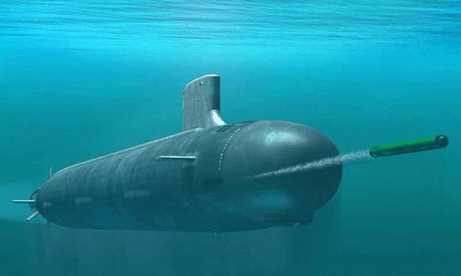
Britain Sends Nuclear Sub Under Arctic Ice As Tensions With Russia Heat Up, Sputnik News, 16 Mar 18,One British and two US nuclear submarines are taking part in a joint naval exercise currently underway in the icy waters of the Arctic Ocean.
Armed with Tomahawk cruise missiles and Spearfish heavy torpedoes, the HMS Trenchant is the first British nuclear sub to be deployed under the Arctic ice in a decade.
A new study looks at how much global sea level will continue to rise even if we manage to meet the Paris climate target of staying below 2°C hotter than pre-industrial temperatures. The issue is that sea levels keep rising for several hundred years after we stabilize temperatures, largely due to the continued melting of ice sheets in Antarctica and Greenland from the heat already in the climate system.
The study considered two scenarios. In the first, human carbon pollution peaks somewhere between 2020 and 2035 and falls quickly thereafter, reaching zero between 2035 and 2055 and staying there. Global temperatures in the first scenario peak at and remain steady below 2°C. In the second scenario, we capture and sequester carbon to reach net negative emissions (more captured than emitted) between 2040 and 2060, resulting in falling global temperatures in the second half of the century.
The authors found that global average sea level will most likely rise by about 1.3 meters by 2300 in the first scenario, and by 1 meter in the second. However, there is large uncertaintydue to how little we understand about the stability of the large ice sheets in Greenland and especially Antarctica. At the high end of possible ice sheet loss, we could see as much as 4.5 meters of sea level rise by 2300 in the first scenario, and close to 3 meters in the second scenario.
The study also shows that it’s critical that our carbon pollution peaks soon. Each 5-year delay – a peak in 2025 instead of 2020, for example – most likely adds 20 cm of sea level rise by 2300, and could potentially add a full meter due to the uncertainty associated with the large ice sheets:
we find that a delay of global peak emissions by 5 years in scenarios compatible with the Paris Agreement results in around 20 cm of additional median sea-level rise in 2300 … we estimate that each 5 years of delay bear the risk of an additional 1 m of sea-level rise by 2300 … Delayed near-term mitigation action in the next decades will leave a substantial legacy for long-term sea-level rise.
And remember, this is all for scenarios in which we meet the Paris climate targets, which we’re currently not on pace to achieve. If we miss the Paris targets, sea levels will rise higher yet.
Another new study, published in the Proceedings of the National Academy of Sciences, found that sea level rise has been accelerating. If the rate of acceleration continues – which the lead author notes is a conservative estimate – we would see an additional 65 cm (close to a meter above pre-industrial sea level) of sea level rise by 2100.
Yet another new study published in The Cryosphere using satellite data found that while the East Antarctic Ice Sheet has remained stable in recent years, ice loss from the West Antarctic Ice Sheet has accelerated. Antarctica is now discharging 1.93 trillion tons of ice each year, up from about 1.89 trillion tons per year in 2008. When accounting for snow accumulation, the continent is losing about 183 billion tons of ice per year – enough to raise sea levels by about 3 to 5 millimeters per decade by itself. The melting of the Greenland Ice Sheet is likewise accelerating and is now responsible for about 25% of annual sea level rise (8.5 millimeters per decade).
The hot Arctic is important because the temperature difference between the Arctic and lower latitudes is one of the main forces that keeps the jet stream moving steadily west-to-east. With a hot Arctic, the jet stream is weakened, leading to weird weather in the USA and Europe. As a result, the western states have been experiencing relatively quite cold temperatures, while the US east coast has been unseasonably hot.
To sum up, ice sheet melt is accelerating, as in turn is sea level rise. Even if we manage to achieve the Paris target of less than 2°C global warming above pre-industrial temperatures, we’re likely to eventually see more than a meter of sea level rise, and potentially several meters. The longer we take to reach peak carbon pollution in the coming years, the higher the oceans will rise. Disappearing sea ice in the rapidly-warming Arctic also appears to be causing increasingly weird and extreme weather in places like America and Europe.
Arctic warming: scientists alarmed by ‘crazy’ temperature rises, Guardian, Jonathan Watts, 28 Feb 18, Record warmth in the Arctic this month could yet prove to be a freak occurrence, but experts warn the warming event is unprecedented
An alarming heatwave in the sunless winter Arctic is causing blizzards in Europe and forcing scientists to reconsider even their most pessimistic forecasts of climate change.
Although it could yet prove to be a freak event, the primary concern is that global warming is eroding the polar vortex, the powerful winds that once insulated the frozen north.
The north pole gets no sunlight until March, but an influx of warm air has pushed temperatures in Siberia up by as much as 35C above historical averages this month. Greenland has already experienced 61 hours above freezing in 2018 – more than three times as many hours as in any previous year.
Seasoned observers have described what is happening as “crazy,” “weird,” and “simply shocking”.
“This is an anomaly among anomalies. It is far enough outside the historical range that it is worrying – it is a suggestion that there are further surprises in store as we continue to poke the angry beast that is our climate,” said Michael Mann, director of the Earth System Science Center at Pennsylvania State University. “The Arctic has always been regarded as a bellwether because of the vicious circle that amplify human-caused warming in that particular region. And it is sending out a clear warning.”
Although most of the media headlines in recent days have focused on Europe’s unusually cold weather in a jolly tone, the concern is that this is not so much a reassuring return to winters as normal, but rather a displacement of what ought to be happening farther north.
At the world’s most northerly land weather station – Cape Morris Jesup at the northern tip of Greenland – recent temperatures have been, at times, warmer than London and Zurich, which are thousands of miles to the south. Although the recent peak of 6.1C on Sunday was not quite a record, but on the previous two occasions (2011 and 2017) the highs lasted just a few hours before returning closer to the historical average. Last week there were 10 days above freezing for at least part of the day at this weather station, just 440 miles from the north pole.
“Spikes in temperature are part of the normal weather patterns – what has been unusual about this event is that it has persisted for so long and that it has been so warm,” said Ruth Mottram of the Danish Meteorological Institute. “Going back to the late 1950s at least we have never seen such high temperatures in the high Arctic.”
The cause and significance of this sharp uptick are now under scrutiny. Temperatures often fluctuate in the Arctic due to the strength or weakness of the polar vortex, the circle of winds – including the jetstream – that help to deflect warmer air masses and keep the region cool. As this natural force field fluctuates, there have been many previous temperature spikes, which make historical charts of Arctic winter weather resemble an electrocardiogram.
But the heat peaks are becoming more frequent and lasting longer – never more so than this year. “In 50 years of Arctic reconstructions, the current warming event is both the most intense and one of the longest-lived warming events ever observed during winter,” said Robert Rohde, lead scientist of Berkeley Earth, a non-profit organisation dedicated to climate science.
The question now is whether this signals a weakening or collapse of the polar vortex, the circle of strong winds that keep the Arctic cold by deflecting other air masses. The vortex depends on the temperature difference between the Arctic and mid-latitudes, but that gap is shrinking because the pole is warming faster than anywhere on Earth. While average temperatures have increased by about 1C, the warming at the pole – closer to 3C – is melting the ice mass. According to Nasa, Arctic sea ice is now declining at a rate of 13.2% per decade, leaving more open water and higher temperatures.
……… “This is too short-term an excursion to say whether or not it changes the overall projections for Arctic warming,” says Mann. “But it suggests that we may be underestimating the tendency for short-term extreme warming events in the Arctic. And those initial warming events can trigger even greater warming because of the ‘feedback loops’ associated with the melting of ice and the potential release of methane (a very strong greenhouse gas).”https://www.theguardian.com/environment/2018/feb/27/arctic-warming-scientists-alarmed-by-crazy-temperature-rises
Over the past few weeks the temperature of the North Pole has been 22 degrees hotter than the average temperature for this time of year. That’s not a typo. It’s not 2.2 degrees hotter. It’s 22 degrees Celsius hotter.
The reason it’s such a huge difference is because even though night is now falling, the temperature around the poles is still getting hotter rather than colder. That’s never happened before. What it means is that the gap between average temperature and this year’s temperature is getting wider and wider by the day……..
In salt water, minus five degrees (which is the current air temperature in the North Pole) is too warm for ice to form. That means the planet’s natural airconditioner (and sun reflector) is not regrowing back this winter. Two of the ways the earth keeps itself cool have just broken down……..
The ice caps melt because it’s getting warmer and then because the ice caps have melted, the earth gets even warmer even faster.
Peter Wadhams, a professor of Ocean Physics at Cambridge University, now reckons that it could be as little as two years before ice disappears completely from the North Pole during the summer months………
In addition to the environmental implications, the cultural implications of this are also huge.
We will need to start changing the stories that we tell ourselves and our children about what our planet looks like. The idea that ice was once at the North Pole will become folklore, much like the fabled North-West passage through the Arctic, which as recently as a decade ago was considered treacherous and impassable, but has now become a common route for ships and tourist boats in the summer months.
This is why I’m seriously considering taking the kids out of school next July, and taking them up to the North Pole to see the ice. It’s probably the last chance to see it. Fantasies of the North Pole are such a vivid part of my own childhood. When was a kid, I always assumed I’d go there one day. Now I know my children will not.
It will be warmer at the North Pole next week than much of Europe, as sea ice melts, Mashable, BY ANDREW FREEDMAN 26 Feb 18 In what seems to be becoming an annual occurrence, temperatures at the North Pole are about to reach or possibly exceed the freezing point this week as the North Atlantic and the North Pacific Oceans inject unusually mild air into the Arctic.
Not coincidentally, Arctic sea ice is at record low levels, with a freak disappearance of ice off the western coast of Alaska, between Alaska and Russia. This vanishing of sea ice in the Bering Sea is exposing coastal communities in Alaska to storm surge flooding from typically fierce winter storms, particularly Little Diomede Island. ……..
In Europe, winds known as “The Beast from the East” will transport frigid temperatures from Russia and Scandinavia to the west, into Germany, France, and the UK, along with potential snowfall.
In part, this is because of a split in the polar vortex — that much hyped circulation of air at upper levels of the atmosphere that keeps the coldest air penned in across the Far North. One “sister vortex” has set up across Canada and the Western U.S., with another established in Eurasia. Many of these areas are colder than the Arctic is right now.
Consider some of these startling statistics. Arctic sea ice is at its lowest observed level since the satellite era began in 1979. The magnitude and pace of the sea ice decline observed during the 21st century, along with the warming of the ocean surface throughout the region, has been shown to be unprecedented in the last 1,500 years.
In the Bering Sea in particular, sea ice has been at record low levels for much of the fall and winter. As if spooked by a ghost, much of the ice that had been covering the region vanished during February, a time when it would normally be at its peak extent and thickness.
Temperatures in parts of the Arctic — including the North Pole — could rise to 45 degrees Fahrenheit above average this week. Already, the northernmost land-based weather station in Greenland, known as Cape Morris Jesup, rose above the freezing mark of 32 degrees Fahrenheit, or 0 degrees Celsius, five times since Feb. 16. That weather station is just about 400 miles from the North Pole.
Previously, temperatures had only exceeded the freezing point at this weather station for brief periods during February in 2011 and 2017. So far this February, temperatures exceeded 32 degrees Fahrenheit on Feb. 16, 17, 18, 20 and 21, a warm streak that is incredibly rare.
At the same time as the Arctic heats up (relatively speaking), temperatures will plunge to about 35 degrees Fahrenheit below average across nearly all of Europe, from Moscow to London. ………
study published in Nature about a 2015 sudden polar warming event found that these events are growing more intense, meaning that the temperature extremes are getting more extreme, especially when compared to the overall rate of Arctic warming.
Arctic Frontiers forum totes up Russia’s northern nuclear hazards, When Norway assesses potential nuclear risks in Northern Russia, it counts among them not just decades of intentionally scuttled radioactive trash – including two entire nuclear submarines – but also vessels transporting spent nuclear fuel throughout the Arctic, specifically from Andreyeva Bay. Bellona by Charles Digges,
When Norway assesses potential nuclear risks in Northern Russia, it counts among them not just decades of intentionally scuttled radioactive trash – including two entire nuclear submarines – but also vessels transporting spent nuclear fuel throughout the Arctic, specifically from Andreyeva Bay.
These considerations were part of a seminar held at the Arctic Frontiers forum last week in Tromsø, Norway, which tallied up ongoing threats of nuclear environmental contamination in Northwest Russia.
For decades, Norway, along with numerous other donor nations, has invested millions of dollars in improving the safety and security of Northwest Russia’s vast Cold War nuclear legacy sites.
According to Øyvind Selnæs, a senior adviser with the Norwegian Radiation Protection Authority, Norway expects to see a spike in the number of ships passing through the Arctic carrying nuclear fuel and materials as Russia seeks to build new nuclear icebreakers to guide traffic along the Northern Sea Route. He also forecasted an increase the number vessels carrying spent nuclear fuel.
50 years ago, a US military jet crashed in Greenland – with 4 nuclear bombs on board The Conversation, Timothy J. Jorgensen
Director of the Health Physics and Radiation Protection Graduate Program and Associate Professor of Radiation Medicine, Georgetown University January 18, 2018 Fifty years ago, on Jan. 21, 1968, the Cold War grew significantly colder. It was on this day that an American B-52G Stratofortress bomber, carrying four nuclear bombs, crashed onto the sea ice of Wolstenholme Fjord in the northwest corner of Greenland, one of the coldest places on Earth. Greenland is part of the Kingdom of Denmark, and the Danes were not pleased.
The bomber – call sign HOBO 28 – had crashed due to human error……
The Thule crash revealed that the United States had actually been routinely flying planes carrying nuclear bombs over Greenland, and one of those illicit flights had now resulted in the radioactive contamination of a fjord.
The radioactivity was released because the nuclear warheads had been compromised. The impact from the crash and the subsequent fire had broken open the weapons and released their radioactive contents, but luckily, there was no nuclear detonation.
To be specific, HOBO 28’s nuclear weapons were actually hydrogen bombs. As I explain in my book, “Strange Glow: The Story of Radiation,” a hydrogen bomb (or H-bomb) is a second-generation type of nuclear weapon that is much more powerful than the two atomic bombsdropped on Hiroshima and Nagasaki. Those two bombs were “fission” bombs – bombs that get their energy from the splitting (fission) of very large atoms (such as uranium and plutonium) into smaller atoms.
In contrast, HOBO 28’s bombs were fusion bombs – bombs that get their energy from the union (fusion) of the very small nuclei of hydrogen atoms. Each of the four Mark 28 F1 hydrogen bombs that HOBO 28 carried were nearly 100 times more powerful than the bomb dropped on Hiroshima (1,400 kilotons versus 15 kilotons).
Fusion bombs release so much more energy than fission bombs that it’s hard to comprehend. For example, if a fission bomb like Hiroshima’s were dropped on the Capitol building in Washington, D.C., it’s likely that the White House (about 1.5 miles away) would suffer little direct damage. In contrast, if just one of the Mark 28 F1 hydrogen bombs were dropped on the Capitol building, it would destroy the White House as well as everything else in Washington, D.C. (a destructive radius of about 7.5 miles). It is for this reason that North Korea’s recent claim of achieving hydrogen bomb capabilities is so very worrisome.
Nuclear Explosion Power Comparison
After the crash, the United States and Denmark had very different ideas about how to deal with HOBO 28’s wreckage and radioactivity. The U.S. wanted to just let the bomber wreckage sink into the fjord and remain there, but Denmark wouldn’t allow that. Denmark wanted all the wreckage gathered up immediately and moved, along with all of the radioactively contaminated ice, to the United States. Since the fate of the Thule Air Base hung in the balance, the U.S. agreed to Denmark’s demands……… https://theconversation.com/50-years-ago-a-us-military-jet-crashed-in-greenland-with-4-nuclear-bombs-on-board-87155
Global Warming Is Increasing The Radioactivity Of The Arctic Ocean, IFL Science, Stephen Lundtz, 3 Jan 18 “………what is happening in the polar regions may ultimately be much more important [than the Fukushima radiation] . As Lauren Kipp of Woods Hole Oceanographic Institution notes in Science Advances, climate change affects the Arctic region particularly strongly through the “Permafrost thawing on land and on continental shelves, increased river discharge, and reduced ice cover.” The last of these has been extensively tracked, but it is harder to measure the first two. Marine measurements of materials deposited in the ocean from permafrost melt and river discharge could change that.
Sediments on the continental shelves that make up half the Arctic Ocean’s territory contain thorium isotopes, which radioactively decay to radium. “Unlike thorium, radium is relatively soluble in seawater,” the paper notes, so measuring radium concentrations makes it possible to explore the interchange between the sediments and the waters above. In particular, it can provide a measure of the rate at which permafrost melting is releasing soluble materials into the ocean, a process enhanced as higher winds transport more water from coastal waters to the central Arctic.
Unfortunately, systematic records of radium concentrations in the Arctic prior to 2015 don’t exist. However, localized measurements taken in 1994, 2002, and 2007 allowed Kipp to conclude that radium-228 has risen sharply over the 2007-2015 period, and most of this increase must come from sediments at the continental margin.
Climate Change Is Already Wreaking Havoc on Our Weather, Scientists Find, http://time.com/5064577/climate-change-arctic/By JUSTIN WORLAND The Arctic is melting with no turning back. Climate change increased rainfall during Hurricane Harvey by at least 15%. And several extreme weather events that occurred in 2016 would not have been possible without man-made global warming.
These are among the findings being discussed this week at this fall’s meeting of the American Geophysical Union in New Orleans, the largest gathering of Earth scientists in the world. Taken together, the findings show the deepening urgency of the fight against climate change.
“Climate change is hurting us without a doubt,” said James Byrne, a professor at the University of Lethbridge who studies climate change, at a press conference. “Houston, India, Bangladesh, Nepal, British Columbia — worst fire season ever. California, I think they declared it the worst fire season.”
Scientists have explored the link between climate change and extreme weather events for years, but many of the conclusions have relied on forecasts of potential future damage. This year, scientists say, the findings are no longer theoretical. Man-made global warming is causing problems here and now.
Take the American Meteorological Society’s report on extreme weather events in 2016, the sixth annual iteration of the report. In the past, the group found that likelihood had increased the chances of certain extreme weather events. But this year scientists found that 2016’s record global temperatures and historic warm waters in the Bering Sea “would not have been possible” in a world without human-caused climate change.
“These events were not just influenced by human-caused climate change,” said Jeff Rosenfeld of the American Meteorological Society at a press conference. “Some of the events in 2016 could not have happened without climate change.”
The report also highlighted global heat waves, an extreme occurence of El Niño and bleaching of coral reefs. These extreme events are all closely tied to climate change, though they remain theoretically possible in a world without the phenomenon.
Another report from the National Oceanic and Atmospheric Administration found that the state of continued ice melt, loss of snow cover and warm temperatures will be the “new normal” in the Arctic. The signs of climate change in the region have been pronounced for years as air temperatures have risen there at twice the rate as they have globally.
The effects of a melting Arctic — and the strong likelihood that it will not return to a normal state anytime soon — has significant implications far beyond its boundaries. Arctic sea ice plays an important role moderating global temperatures as it reflects sunlight back into space. And scientists say that the swift warming in the Arctic is a concerning sign of what’s to come globally. “Unlike Vegas what happens in the Arctic doesn’t stay in the Arctic,” said Tim Gallaudet, acting NOAA administrator, at a press conference. “It affects the rest of the planet.”
Two separatestudies presented at the conference showed that climate change worsened rainfall when Hurricane Harvey struck Houston earlier by somewhere between 15% and 38%. That storm brought nearly 50 inches of rain to some areas and caused billions in damages. The research comes as scientists increasingly try to draw explicit conclusions about the effect of climate change and individual storms, a practice unthinkable just a decade ago.
The warning from scientists comes as policymakers across the globe continue to grapple how to stem temperature rise. Countries have committed to trying to keep temperatures from rising more than 2 degrees Celsius (or 3.6 degrees Fahrenheit) by 2100, but recent research shows leaders remain far from meeting that goal.
http://www.enn.com/ecosystems/article/52773From: Oregon State University , 5 Oct 17, Nearly half of the organic carbon stored in soil around the world is contained in Arctic permafrost, which has experienced rapid melting, and that organic material could be converted to greenhouse gases that would exacerbate global warming.
When permafrost thaws, microbial consumption of those carbon reserves produces carbon dioxide – much of which eventually winds up in the atmosphere, but scientists have been unsure of just how the system works.
A new study published this week in Nature Communications outlines the mechanisms and points to the importance of both sunlight and the right microbial community as keys to converting permafrost carbon to CO2. The research was supported by the U.S. National Science Foundation and the Department of Energy.
“We’ve long known that microbes convert the carbon into CO2, but previous attempts to replicate the Arctic system in laboratory settings have failed,” noted Byron Crump, an Oregon State University biogeochemist and co-author on the study. “As it turns out, that is because the laboratory experiments did not include a very important element – sunlight.
Melting Arctic ice cap falls to well below average This summer’s minimum is the eighth lowest on record
Shrinking ice cap increasingly linked to extreme weather events around the world, say scientists, Guardian, Damian Carrington , 20 Sept 17, The Arctic ice cap melted to hundreds of thousands of square miles below average this summer, according to data released late on Tuesday.
Climate change is pushing temperatures up most rapidly in the polar regions and left the extent of Arctic sea ice at 1.79m sq miles at the end of the summer melt season.







 nuclear-news