A Sunken Nuclear Submarine Is Leaking Radiation Into the Ocean. How Worried Should We Be?

Repairs or just outright cleanup would be expensive, extremely difficult, slow, and, of course, quite dangerous.
By Luis Prada, March 25, 2026, https://www.vice.com/en/article/a-sunken-nuclear-submarine-is-leaking-radiation-into-the-ocean-how-worried-should-we-be/
According to new research published in PNAS, a Cold War-era nuclear submarine sitting at the bottom of the Norwegian Sea is still leaking radioactive material. It’s happening slowly, if unevenly, and it’s contained just enough to avoid becoming a full-scale environmental disaster… for now.
The K-278 Komsomolets sank in 1989 after an onboard fire, taking with it a nuclear reactor and two nuclear torpedoes. It now sits more than 1,600 meters below the surface, in a part of the ocean that is freezing and almost entirely out of reach.
A research team led by Justin Gwynn at Norway’s radiation safety authority analyzed years of data, including a 2019 survey using a remotely operated vehicle. The team found that the wreck is leaking radioactive isotopes, including cesium and strontium, through cracks in its deteriorating hull.
The leaks aren’t constant. They come in waves, with visible plumes drifting out from various spots, like the reactor compartment or a ventilation pipe. Radiation levels take a big jump closer to the submarine, with levels reaching hundreds of thousands of times above normal background radiation levels.
At Least the Nuclear Submarine’s Nuclear Torpedoes Are Still Intact
Terrifying, and here’s where it gets strange: measurements taken from just a few feet away dramatically drop off. Researchers believe this is caused by the ocean diluting the problem. That may be why the surrounding ecosystem isn’t showing any obvious signs of collapse, given all of the toxic radiation. There’s still plenty of marine life clinging to the wreck, including sponges, corals, and anemones. They have slightly elevated radiation levels but no visible signs of deformation or damage, though genetic damage wouldn’t be surprising.
Sediment samples collected nearby show minimal contamination. Things wouldn’t be looking so rosy if the nuclear torpedoes inside it weren’t intact, which they very much are and have been since the 1990s.
So far, there are no signs of imminent disaster. Everything is stable and holding steady… for now.
This won’t always be the case, and it is really more a matter not of if but of when. The reactor is still corroding, and the structure is still weakening. Repairs or just outright cleanup will be expensive, extremely difficult, slow, and, of course, quite dangerous. The risk is contained, but that doesn’t mean it’s going away anytime soon.
What Trump’s plans for the Arctic mean for the global climate crisis

With plans to sell off over a million acres of natural habitat for oil and
gas development, the Trump administration is ignoring the dire impact on
its fragile ecosystem.
Guardian 6th Feb 2026, https://www.theguardian.com/environment/2026/feb/05/what-trumps-plans-for-the-arctic-mean-for-the-global-climate-crisis
Greenland Is Not a Prize
You circumscribe everything
demand that we prove
We exist,
that We use the land that was always ours,
that We have a right to our ancestral lands.
And now it is We who ask:
By what right are You here?
it is worth noting that Danish and other Nordic diplomats have disputed Trump’s claims of Russian and Chinese warships operating ‘around Greenland’, for which Trump has offered no public evidence.
China’s anticipated investment in Greenland does not pose a military threat, nor is it something that the United States, Canada, or indeed Denmark should be concerned with. This should be a discussion and debate within Greenland.
The US has set its sights on Greenland due to its mineral wealth and strategic location. But its people – the Kalaallit – are an afterthought in Washington’s machinations.
22 January 2026, By Vijay Prashad / Tricontinental: Institute for Social Research
Every few years, the centre of the imperialist Global North – the United States – forgets its manners.
It is one thing to be rude to Iran or Venezuela, but it is another thing entirely to be rude to Denmark. The North Atlantic has not experienced internecine acrimony since – perhaps – Adolf Hitler turned on Poland in 1939. But to be fair to the United States, it has not coveted Denmark itself. Washington has licked its sticky fingers and placed them upon Greenland.
Denmark began its colonisation of Greenland 305 years ago, in 1721. Constitutional scholars will say that the formal colonial status ended in 1953 when Greenland was incorporated into the Kingdom of Denmark and that Greenland gained a further measure of autonomy in 2009 when the Act on Greenland Self-Government was passed – but let’s be frank, it remains a colony.
For context, Greenland (over 2 million square kilometres) is fifty times larger than Denmark. For comparison, if placed over the United States, it would almost stretch from Florida to California. If it were an independent country, it would be the twelfth largest in the world by area. Of course, the Arctic country has a very small population of around 57,700 (roughly equivalent to the population of Hoboken, New Jersey).
In Washington’s imagination, Greenland appears not as a homeland, but as a location – a place on a map or a signature on a radar screen. The words used to talk about it belong to the grammar of possession: purchase, control, seize. This is the language of domination – one imperialist power (United States) wanting to seize the land of a colonial power (Denmark).
But Greenland is not a prize.
The Inuit of Greenland call their country Kalaallit Nunaat: ‘Land of the Kalaallit’ (Greenlanders). When Trump and his allies speak of Greenland, they never speak of the people: the Kalaallit. Instead, Trump speaks of the strategic importance of the island and about what the US government sees as the perils of its Chinese and Russian capture (never mind that neither China nor Russia have made any claims over the territory). Greenland is always a place that someone else must hold, but not the Kalaallit. For people like Trump, or indeed for generations of Danish prime ministers (despite soft statements about the path to self-determination), the Kalaallit have no role as political subjects.
Greenland grew in strategic and economic importance to Denmark after the 1794 discovery of cryolite, a key mineral used in the production of aluminium. This extractive focus continued after the 1956 discovery of uranium and rare earth elements in Kuannersuit (Kvanefjeld) in southern Greenland. In 1941, Denmark’s envoy in Washington, Henrik Kauffmann, signed an agreement that allowed the US to establish bases and stations in Greenland. In 1943, the US placed a weather station at Thule (Dundas) known as Bluie West 6, and in 1946 it added a small airstrip. After the Second World War, Denmark was an early entrant to the US effort to build a military bloc against the Soviet Union. In fact, it was a founder of the North Atlantic Treaty Organisation (1949) and then signed the Defence of Greenland Agreement (1951) that allowed the US to build the Thule Air Base under the codename Operation Blue Jay (now Pituffik Space Base).
The base became useful not only as a place to watch the USSR, but also for missile warning, missile defence, and space surveillance – a strategic foothold that has grown more consequential as Greenland’s uranium and rare earth deposits have become central to the global contest for critical minerals.
As Greenland’s ice sheets have melted in recent decades due to the climate catastrophe, the country’s deep geology has become easier to survey and to mine. Feasibility studies and drilling in the early to mid-2010s (especially 2011–2015) showed that the land was teeming with graphite, lithium, rare earth elements, and uranium. As the United States imposed its New Cold War on China, it had to seek new sources for rare earths given China’s dominance of rare-earth refining and downstream magnet production. The island became not only a source of minerals or a geographical location for power projection, but also a critical node in the US-led supply-chain security architecture.
In August 2010, long before Canadian Prime Minister Mark Carney’s trip to China in mid-January 2026, the Canadian government released a report with an interesting title: Statement on Canada’s Arctic Foreign Policy: Exercising Sovereignty and Promoting Canada’s Northern Strategy Abroad. On the surface, the report is rather bland, making many pronouncements about how Canada respects the Indigenous peoples of the Arctic and how its intentions are entirely liberal and noble. That posture is difficult to square with the reality that major mining projects across the Canadian Arctic have repeatedly sparked Inuit concerns about impacts on wildlife and Inuit harvesting and that regulators have at times recommended against expansions, as in the case of Baffinland’s Mary River iron mine.
In fact, Canada is home to the world’s largest hub for mining finance (TSX and TSX Venture Exchange list more than half of the world’s publicly traded mining companies), which has been sniffing around the Arctic for decades in search of energy and minerals. The 2010 report does mention Canada’s ‘Northern energy and natural resource potential’ and that the government is ‘investing significantly in mapping the energy and mineral potential of the North’. But there is no mention of the large Canadian private mining companies that would benefit not only from Greenland’s mineral potential (for instance, Amaroq Minerals, which already owns the Nalunaq gold mine in South Greenland) but also from Canada’s Arctic region (for instance, Agnico Eagle Mines, Barrick Mining Company, Canada Rare Earth Corporation, and Trilogy Metals). What is significant about the report is that if it is put into operation, it would sharpen the long-running Canada-US dispute over Arctic navigation, particularly in the Northwest Passage, which Canada treats as internal waters and the US approaches as an international strait.
Read more: Greenland Is Not a PrizeCanada is an ‘Arctic power’, the report says. There are seven other countries that have an Arctic foothold: Denmark, Finland, Iceland (through Grimsey), Norway, Russia, Sweden, and the United States (through Alaska). They are members of the Arctic Council, which was set up by Canada in 1996 to deal with environmental pollution in the Arctic and to create space for Indigenous organisations in the region to put forward their views. However, the Arctic Council has largely been paralysed since Russia’s invasion of Ukraine in 2022, when member countries paused normal cooperation with Russia and later resumed only limited project-level work that does not involve Russian participation, even though Russia holds roughly half of the Arctic coastline.
With consensus required, this has narrowed the council’s role from a venue that could broker pan-Arctic coordination and even negotiate binding agreements to one largely confined to technical working-group projects and assessments. Canada’s claim to being an ‘Arctic power’ comes with bravado but lacks substance. Will it really prevent the US from using its sea lanes, and can it exercise a form of capitalist sovereignty for its mining companies in the Arctic region?
In 2020, before the council paused cooperation with Russia, the North Atlantic Treaty Organisation (NATO) had already called upon its members to ‘set [their] sights on the high north’ (as NATO’s think tank, the Atlantic Council, noted in a report). After 2022, NATO developed a ‘high north’ strategy that can be best appreciated in its 2025 parliamentary report Renavigating the Unfrozen Arctic. The report identifies what it sees as the primary threat to NATO countries: China and Russia. One of them (Russia) is a major Arctic power, and the other (China) has two scientific stations in the north (Yellow River Station in Svalbard, Norway, which has been there since 2003 studying atmospheric and environmental science, and the China-Iceland Arctic Science Observatory in Kárhóll, Iceland, which has been there since 2018 studying Earth-system and environmental science). China has also indicated that the Arctic waters would be ideal for a Polar Silk Road, a trade corridor that would link China to Europe. But there is no Chinese military footprint in the region as of now.
On 9 January 2026, Trump said that he does not want China or Russia to get a foothold in Greenland. It is true that representatives of Chinese companies have been to Greenland and signed non-binding memorandums of understanding (MOUs), but it is equally true that none of them have gone forward. Trump fears that some of these MOUs might eventually turn into projects that could see Chinese companies on Greenland’s soil. However, since EU investment is so low in Greenland (around $34.9 million per year), and since US (around $130.1 million per year) and Canadian investment ($549.3 million per year) is higher but still lower than an anticipated Chinese investment (at least $1.162 billion), it is credible to fear the Chinese businesses. At the same time, it is worth noting that Danish and other Nordic diplomats have disputed Trump’s claims of Russian and Chinese warships operating ‘around Greenland’, for which Trump has offered no public evidence.
China’s anticipated investment in Greenland does not pose a military threat, nor is it something that the United States, Canada, or indeed Denmark should be concerned with. This should be a discussion and debate within Greenland.
Greenland is not for sale. It is not a military platform or a mineral reserve waiting to be extracted. It is a society, alive with memory and aspiration. The Global South knows this story well – a story of plunder in the name of progress, of military bases in the name of security, of the suffering and starvation of the people who call this land their home.
Land does not dream of being owned. People dream of being free.
Ask Aqqaluk Lynge, a Kalaallit poet, politician, and defender of Inuit rights who wrote in his poem ‘A Life of Respect’:
On maps of the country
We must draw points and lines
to show we have been here –
and are here today,
here where the foxes run
and birds nest
and the fish spawn.
You circumscribe everything
demand that we prove
We exist,
that We use the land that was always ours,
that We have a right to our ancestral lands.
And now it is We who ask:
By what right are You here?
Trump shamelessly plays the Russia/China bogeyman card for Greenland grab
NATO’s civilian head, Mark Rutte, the former Dutch prime minister and abject flunky, appeased Trump at Davos by offering more NATO defenses deployed to Greenland. Rutte, who previously referred to Trump as “daddy”, made the “deal” in private with Trump. No details have been made public nor even shared among other NATO members. How’s that for contempt of underlings?
Since the end of World War Two, the United States paid lip service to global law and order along with its European allies. Under Trump, there is no longer any pretense of lip service. It’s outright imperialist power for naked domination. At one point in his rambling Davos speech, Trump declared such might-is-right land grabbing as normal.
Russia and China, among others, have repeatedly declared the paramount need to abide by international law and the principles of the UN Charter. U.S. imperialist power has no such respect. Trump has openly said so.
Sat, 24 Jan 2026, https://strategic-culture.su/news/2026/01/23/trump-shamelessly-plays-russia-china-bogeyman-card-for-greenland-grab/
Under Trump, the European appeasers are inviting disaster as they indulge his bogeyman games over Greenland.
The old saying that a week is a long time in politics is especially true under the U.S. Presidency of Donald Trump, given his propensity for unhinged bombast, zig-zags, U-turns, vendettas, and theatrics.
So, last week, he was threatening to take over the Danish Arctic territory of Greenland by military force, if needed. Trump was also gearing up to launch an unprecedented trade war against European states that, with pipsqueak temerity, dared to support Denmark, a move that would have cratered the eight-decade-old transatlantic Western alliance.
This week, in a 70-minute rant at the World Economic Forum in Davos, Switzerland, Trump, seemingly magnanimously, announced that he was not going to deploy military power to subordinate European NATO “allies”. But he insisted that Greenland must be annexed under U.S. control.
In a telling quip, he said: “I don’t have to use force.” Trump is right on that score. There is no need for military coercion because the European “allies” have been exposed as a bunch of dithering vassals who were pathetically clutching their pearls for the past week out of fear and angst that Uncle Sam was slapping them.
However, when vassals appease, they only end up being abused. The American Don may have softened his contemptuous rhetoric at Davos, but there is little doubt that the expansionist ambitions to grab Greenland will be pursued, and the Europeans will be, in time, further degraded in their submission to the American overlord.
Oddly enough, for a president who boasts about flexing military muscle for imperialist aims, Trump couched his takeover of Greenland as a matter of “national security.” He is claiming that the United States needs to take control of the “big, beautiful piece of ice” to defend it from Russia and China.
He lied that it wasn’t because of Greenland’s vast mineral resources, including oil and rare-earth metals. Trump was claiming that the U.S. is the only NATO member strong enough to keep Russia and China from gaining a foothold. Beijing slammed Trump’s claims as baseless.
In an insulting and absurd remark, he likened Russia and China to how Nazi Germany tried to take Greenland from Denmark during the Second World War, and it was the U.S. that prevented that.
Only a few days before, Trump contradicted himself (not hard for him) by posting a comment deriding how Russia and China are used as “bogeymen”, that is, as false enemies.
Another anomaly was seen with Trump inviting Russia and China to join his dubious Global Board of Peace initiative, which he unveiled with much corny fanfare in Davos. Enemies for peace?
In other words, on Greenland, Trump is cynically playing the Russia and China threat as a pretext for blatantly violating the sovereignty of an ally.
Not that Denmark deserves sympathy. It is questionable how it retains any territorial right to a distant Arctic island whose people have consistently demanded independence from Copenhagen’s colonialist control.
NATO’s civilian head, Mark Rutte, the former Dutch prime minister and abject flunky, appeased Trump at Davos by offering more NATO defenses deployed to Greenland. Rutte, who previously referred to Trump as “daddy”, made the “deal” in private with Trump. No details have been made public nor even shared among other NATO members. How’s that for contempt of underlings?
Trump hailed the so-called framework agreement as a “great deal” for the United States and Europe without sharing the details. It’s believed to permit the installation of Trump’s futuristic Golden Dome missile defense system. If that goes ahead, it will heighten strategic tensions with Russia by militarizing the Arctic, not bring peace or stability. Denmark is reportedly wary that its sovereignty is being sold out in a grubby behind-closed-doors private takeover.
Hence, the transatlantic storm may have subsided somewhat for now, but the damage and mistrust that have shattered the alliance are not going to be repaired. It will only get worse because of the thug-vassal relationship unravelling.
The Canadian Prime Minister, Mark Carney, in his speech at Davos, made a shocking admission when he said that the “fiction of rules-based order” between the U.S. and its Western allies is dead.
Trump may have been appeased and placated for a while. But it’s like keeping a predator at bay by throwing pieces of meat at it. Sooner or later, the minions will be on the menu.
Only last week, Denmark and the other European states were dismissing Trump’s outlandish claims about defending the free world from Russia and China by taking control of Greenland. They knew it was a brazen land grab. Now, however, Rutte, the European NATO chief, is saying that NATO must accede to Trump’s demands to protect Greenland from the alleged threat from Russia and China.
After saying there is no such threat, now the Europeans will indulge Trump’s fantasy about Greenland, just to restrain him from overtly abusing them.
The trouble for the European and other Western allies of the United States is that they have consorted with decades of American violations of international law. They have played along with the charade of using Russia and China as enemies of convenience. This has hollowed out any claim of upholding international order and norms.
The U.S. and Europe have played the bogeyman card with regard to Ukraine. The Europeans supported Trump’s aggression against Venezuela and Iran, and they have been complicit in the U.S.-backed genocide in Gaza.
This week, while French President Emmanuel Macron was admonishing Trump to respect international order concerning Greenland, he ordered French troops to seize a Russian-linked oil tanker in neutral maritime waters. The latter act of piracy on the high seas was probably an effort by France to demonstrate its loyalty to Washington’s policy of hijacking Russian cargo ships.
Since the end of World War Two, the United States paid lip service to global law and order along with its European allies. Under Trump, there is no longer any pretense of lip service. It’s outright imperialist power for naked domination. At one point in his rambling Davos speech, Trump declared such might-is-right land grabbing as normal.
During the past eight decades of charade and lip service, the U.S. needed the Europeans as a facade of multilateralism for its stealth imperialism. Washington indulged the Europeans, Canadians, and others as “allies”. In reality, they were always vassals.
Now, in the latest historical phase of returning to flagrant imperialism and brazen power, the United States has no use for the pretense of allies. They can be slapped around for the lackeys they are. And we are seeing that with brutality.
Ironically, the European powers have a historic tendency for appeasement. The British and French appeased Nazi Germany in the 1930s with disastrous results. Today, the Europeans are appeasing the United States in its every criminal demand. That is only emboldening the U.S. to expand its outright abuse of international law, or, in other words, its descent into barbarism.
This is not merely about Trump as a maverick megalomaniac. He is but a symptom of the U.S. global empire in desperation mode to maintain its waning power as a new multipolar world potentially emerges. U.S. hegemonic ambitions are untenable, but in a desperate bid to assert itself, the world is being turned upside down and intimidated into submission.
Russia and China, among others, have repeatedly declared the paramount need to abide by international law and the principles of the UN Charter. U.S. imperialist power has no such respect. Trump has openly said so.
Total domination is the only acceptable end for U.S. imperialism. Russia and China should not have any illusion about it, even if, in the short term, Trump wants to make an expedient withdrawal deal in Ukraine, or if he invites them to join his “Bored of Peace” boondoggle.
History shows us that rampant imperialist violence ends in disaster. Under Trump, the European appeasers are inviting disaster as they indulge his bogeyman games over Greenland.
Spectral Threats: China, Russia and Trump’s Greenland Rationale

Were Russia or China to attempt an occupation of Greenland through military means, Article V of the North Atlantic Treaty would come into play, obliging NATO member states, including the United States, to collectively repel the effort.
“There are no Russian and Chinese ships all over the place around Greenland,”
“Russia and/or China has no capacity to occupy Greenland or to take control over Greenland.”
14 January 2026 Dr Binoy Kampmark, https://theaimn.net/spectral-threats-china-russia-and-trumps-greenland-rationale/
The Trump administration’s mania about Greenland, a self-governing territory of Denmark, is something to behold. Its untutored thuggery, its brash assertiveness, and the increasingly strident threats to either use force, bully Denmark into a sale of the island, or simply annex the territory, have officials and commentators scrambling for theories and precedents. The Europeans are terrified that the NATO alliance is under threat from another NATO member. The Greenlanders are anxious and confused. But the ground for further action by Washington is being readied by finding threats barely real and hardly plausible.
The concerns about China and Russia seizing Greenland retells the same nonsense President Donald Trump promoted in kidnapping the Venezuelan President Nicolás Maduro and his wife. Looking past the spurious narcoterrorism claims against the former leader, it fell to the issue of who would control the natural resources of the country. If we don’t get Venezuelan oil now and secure it for American companies, the Chinese or the Russians will. he gangster’s rationale is crudely reductionist, seeing all in a similar veinThe obsession with Beijing and Moscow runs like a forced thread through a dotty, insular rationale that repels evidence and cavorts with myth: “We need that [territory],” reasons the President, “because if you take a look outside Greenland right now, there are Russian destroyers, there are Chinese destroyers and, bigger, there are Russian submarines all over the place. We are not gonna have Russia or China occupy Greenland, and that’s what they’re going to do if we don’t.” On Denmark’s military capabilities in holding the island against any potential aggressor, Trump could only snort with macho dismissiveness. “You know what their defence is? Two dog sleds.”
This scratchy logic is unsustainable for one obvious point. Were Russia or China to attempt an occupation of Greenland through military means, Article V of the North Atlantic Treaty would come into play, obliging NATO member states, including the United States, to collectively repel the effort. With delicious perversity, any US effort to forcibly acquire the territory through use of force would be an attack on its own security, given its obligations under the Treaty. In such cases, it becomes sound to assume, as the Danish Prime Minister Mette Frederiksen does, that the alliance would cease to exist.
Such matters are utterly missed by the rabidly hawkish Deputy Chief of Staff Stephen Miller, who declared that, “Nobody’s going to fight the United States militarily over the future of Greenland.” It was up to the US “to secure the Arctic region, to protect and defend NATO and NATO interests” in incorporating Greenland. To take territory from a NATO ally was essentially doing it good.
Given that the United States already has a military presence on the island at the Pituffik Space Base, and rights under the 1951 agreement that would permit an increase in the number of bases should circumstances require it, along with the Defence Cooperation Agreement finalised with Copenhagen in June 2025, much of Miller’s airings are not merely farcical but redundant. Yet, Trump has made it clear that signatures and understandings reflected in documents are no substitute for physically taking something, the thrill of possession that, by its act, deprives someone else of it. “I think ownership gives you a thing that you can’t do, whether you’re talking about a lease or a treaty,” he told the New York Times. “Ownership gives you things and elements that you can’t get from just signing a document.”
What, then, of these phantom forces from Moscow and Beijing, supposedly lying in wait to seize the frozen prize? “There are no Russian and Chinese ships all over the place around Greenland,” states the very convinced research director of the Oslo-based Fridtjof Nansen Institute, Andreas Østhagen. “Russia and/or China has no capacity to occupy Greenland or to take control over Greenland.”
Danish Foreign Minister Lars Lokke Rasmussen is similarly inclined. “The image that’s being painted of Russian and Chinese ships right inside the Nuuk fjord and massive Chinese investments being made is not correct.” Senior “Nordic diplomats” quoted in the Financial Times add to that version, even if the paper is not decent enough to mention which Nordic country they come from. “It is simply not true that the Chinese and Russians are there,” said one. “I have seen the intelligence. There are no ships, no submarines.” Vessel tracking data from Marine Traffic and LSEG have so far failed to disclose the presence of Chinese and Russian ships near the island.
Heating engineer Lars Vintner, based in Greenland’s capital, Nuuk, wondered where these swarming, spectral Chinese were based. “The only Chinese I see,” he told Associated Press,“ is when I go to the fast food market.” This sparse presence extends to the broader security footprint of China in the Arctic, which remains modest despite a growing collaboration with Russia since the 2022 invasion of Ukraine. These have included Arctic and coast guard operations, while the Chinese military uses satellites and icebreakers equipped with deep-sea mini submarines, potentially for mapping the seabed.
However negligible and piffling the imaginary threat, analysts, ever ready with a larding quote or a research brief, are always on hand to show concern with such projects as Beijing’s Polar Silk Road, announced in 2018, which is intended as the Arctic extension of its transnational Belt and Road initiative. The subtext: Trump should not seize Greenland, but he might have a point. “China has clear ambitions to expand its footprint and influence in the region, which it considers… an emerging arena for geopolitical competition.” Or so says Helena Legarda of the Mercator Institute for China Studies in Berlin.
The ludicrous nature of Trump’s claims and acquisitive urges supply fertile material for sarcasm. A prominent political figure from one of the alleged conquerors-to-be made an effort almost verging on satire. “Trump needs to hurry up,” mocked the Deputy Chairman of the Russian Security Council and former President Dmitry Medvedev. “According to unverified information, within a few days, there could be a sudden referendum where all 55,000 residents of Greenland might vote to join Russia. And that’s it!” With Trump, “that’s it” never quite covers it.
Venezuela today. Greenland tomorrow?
9 Jan 26, https://secure.declassifieduk.org/page/email?mid=8c66e2426c734ac1a627c6af5564d142
During the early hours of Saturday morning, US forces bombed Venezuela and kidnapped its president, Nicolás Maduro.
The objective, according to US president Donald Trump, was to secure access to Venezuela’s massive oil reserves and assert US domination over the hemisphere, pushing out geopolitical rivals like China, Russia, and Iran.
Venezuelan authorities will soon be “turning over between 30 and 50 MILLION Barrels of High Quality Oil… to the United States of America”, Trump wrote on social media.
The Trump administration also told Venezuela’s interim president Delcy Rodriguez that “the country must kick out China, Russia, Iran, and Cuba and sever economic ties”, according to ABC News.
Keir Starmer, a former human rights lawyer, has repeatedly refused to be drawn on whether the kidnapping of a foreign head of state was a violation of international law.
“Are we willing to risk damaging our most important economic and national security partnerships as a result [of condemning Trump]?”, the prime minister reportedly asked colleagues.
Yvette Cooper, Britain’s foreign secretary, could only bring herself to say that she had “raised the importance of complying with international law” with her US counterpart, Marco Rubio.
Yet pressure is mounting on Starmer’s government to respond in concrete terms to the attack, with UN human rights chief Volker Turk now spelling out its brazen illegality.
“It is clear that the operation undermined a fundamental principle of international law – that States must not threaten or use force against the territorial integrity or political independence of any state”, he said in a statement on Wednesday.
With the dust still settling in Caracas, Trump has now turned his imperial gaze to Greenland, a semi-autonomous Arctic territory of the kingdom of Denmark, which is a member of NATO. The White House says it has been discussing “a range of options” to acquire Greenland, including military force, referring to the issue as a “national security priority”. Greenland might seem quite apart from Venezuela in geographical, political, and cultural terms, but the US government has long folded both regions into its designs for hemispheric domination. After the German invasion of Denmark in April 1940, US secretary of state Cordell Hull declared “Greenland is within the area embraced by the Monroe Doctrine”, an 1823 doctrine which has been repeatedly relied upon to assert US hegemony in the Americas During the Cold War, the US army stationed 48 surface-to-air nuclear weapons and air-to-air missiles at Thule air base on Greenland, while a US army research and development facility was established beneath the territory’s icecap. Washington’s current interest in Greenland, however, has more to do with its location for military purposes, the opening of trade routes in the Arctic Ocean (which will increase in importance amid climate change) and the island’s richness in critical minerals like lithium and cobalt. While Starmer reserved judgment on Trump’s illegal attack on Venezuela, he has signed a joint statement alongside France, Germany, Italy, Poland, Spain, and Denmark, affirming “Greenland belongs to its people”. But will Starmer actually take any meaningful action to stand up to Trump? “Nobody’s going to fight the US over the future of Greenland”, said Trump’s aide Stephen Miller on Tuesday. He might just be right. |
‘No more annexation fantasies’ Greenland PM responding to Trump’s threats
The Cradle News Desk, JAN 5, 2026, https://thecradle.co/articles/no-more-annexation-fantasies-greenland-pm-responding-to-trumps-threats
US imperial ambitions directed at an EU member were met with coordinated diplomatic pushback and explicit warnings against altering borders by force.
Denmark’s Prime Minister Mette Frederiksen, on 5 January, publicly rejected renewed threats by US President Donald Trump calling for US annexation of Greenland, warning Washington to “stop the threats against a historically close ally.”
“It makes absolutely no sense to talk about the US needing to take over Greenland,” Frederiksen said, stressing that “the US has no right to annex any of the three countries in the Danish Kingdom.”
The Danish PM noted that Denmark, “and thus Greenland,” is a NATO member and protected by the alliance’s collective security guarantees.
Greenland’s Prime Minister Jens-Frederik Nielsen also responded on the same day through social media, issuing a blunt warning.
“That’s enough now,” he wrote, followed by a firmer rejection saying “No more pressure. No more insinuations. No more fantasies of annexation.”
Nielsen emphasized that Greenland remains open to engagement but set clear limits, saying “We are open to dialogue. We are open to discussions,” adding that any talks must take place “through the proper channels and with respect for international law.”
The dispute centers on Trump’s repeated claims that Greenland should become part of the US, a position he reiterated while speaking to reporters aboard Air Force One and in a separate interview with The Atlantic.
Trump framed his remarks around security concerns, saying, “We need Greenland from the standpoint of national security,” and asserting that Denmark “is not going to be able to do it.”
He also suggested the issue could be revisited soon, stating, “We’ll worry about Greenland in about two months … let’s talk about Greenland in 20 days.”
The timing of Trump’s remarks heightened concern in Europe, with his comments following US military action in Venezuela and the the abduction of President Nicolas Maduro and his wife, and transferring them to US soil for “trial”, events that, according to reports, raised fears that similar logic could be applied elsewhere.
Additional backlash followed a social media post by Katie Miller, a former Trump aide, who shared an image of Greenland colored like the US flag with the caption “SOON.”
Nielsen called the post “disrespectful,” writing that “our country is not for sale, and our future is not decided by social media posts.”
European leaders, including those of Finland, Sweden, and Norway, voiced support for Denmark, while France’s Foreign Ministry warned that “borders cannot be changed by force.”
France said that it stands in solidarity with Denmark and Greenland and rejects any attempt to alter borders by force, reaffirming that Greenland’s future is for its people and Denmark to decide.
Arctic endured year of record heat as climate scientists warn of ‘winter being redefined’

Oliver Milman, Guardian 16th Dec 2025
Region known as ‘world’s refrigerator’ is heating up as much as four times as quickly as global average, Noaa experts say
The Arctic endured a year of record heat and shrunken sea ice as the world’s northern latitudes continue a rapid shift to becoming rainier and less ice-bound due to the climate crisis, scientists have reported.
From October 2024 to September 2025, temperatures across the entire Arctic region were the hottest in 125 years of modern record keeping, the US National Oceanic and Atmospheric Administration (Noaa) said, with the last 10 years being the 10 warmest on record in the Arctic.
The Arctic is heating up as much as four times as quickly as the global average, due to the burning of fossil fuels, and this extra heat is warping the world’s refrigerator – a region that acts as a key climate regulator for the rest of the planet……………………………………………………………………….. https://www.theguardian.com/world/2025/dec/16/artic-record-heat-shrunken-sea-ice-report
The looming missile crisis in the Arctic
Bulletin, By Vladimir Marakhonov | December 4, 2025
By invading Ukraine in 2014 and then again in 2022, Russia has created devastating strains in the global balance of power. It also opened new frontiers of tension, some visible to the naked eye and others harder to discern, yet all highly unpleasant for Moscow.
Ukraine’s spectacular attack in June on Russian bombers at air bases in northern and western Russia, using cheap drones, has revealed new threats to Russia’s strategic capabilities and forced it to redeploy its bombers to Far East bases. The recent decisions by Finland and Sweden to join NATO and defense cooperation agreements between the Nordic countries and the United States have also put Russia’s Northern Fleet naval forces at risk. These forces can’t be easily relocated, increasing the risk of a missile crisis in Northwest Russia, near the Barents Sea. Simply put, a variety of military agreements now give the United States the ability to quickly deploy missiles in Norway and Finland that could reach Russia’s Northern Fleet and other strategic assets in a matter of minutes.
Any decision to make such a deployment could create a Cuban Missile Crisis situation between NATO and Russia that could lead to war.
Russia’s Northern naval bases. Russia’s fleet of nuclear-powered, nuclear-armed ballistic missile submarines—an important part of Russia’s nuclear triad—is roughly equally divided between the Northern Fleet (in the Arctic Ocean) and the Pacific Fleet. Historically, the Northern Fleet’s bases have had a serious strategic vulnerability due to geographic and climatic features of the Russian part of the Barents Sea, where they are located. These bases are concentrated in the Murmansk region on the Kola Peninsula, the northwestern-most part of Russia. The region is bordered by Norway to the northwest, Finland to the west, the Barents Sea to the northeast, the White Sea to the southeast, and only a narrow strip connecting to mainland Russia to the southwest.
Moving these naval bases further east is hardly possible because the Gulf Stream keeps only a limited area of the Barents Sea from freezing all year round, approximately up to Cape Svyatoy Nos, located west of the entrance to the White Sea. Everything located further east freezes in winter, although the extent and duration of the seasonal freezing vary each year, and sea ice is declining in the Barents Sea due to surface warming in the Gulf Stream. Therefore, the most convenient bays for Russia to base its fleet are located west of the Kola Bay, on the shores closest to Norway and Finland…………………………………..
Cold War restraint is over. During World War II and the post-war years, the entire Russian Northern Fleet infrastructure was built around Murmansk, which was Russia’s only ice-free northern port with good connections to the railway system. At the time, this proximity to Finland and Norway was of little importance. But with strengthened Nordic-US military ties and the development of short-range missiles, the Northern Fleet’s location became a real danger for both sides as missiles could be rapidly moved around and loaded on ships and submarines.
Finland maintained its neutral status throughout the Cold War and was bound to the Soviet Union by several international treaties. Norway—which had joined NATO in 1949 but had numerous overlapping interests with Russia in the Barents Sea—voluntarily imposed restrictions on NATO ground forces and NATO air flights in the Finnmark area east of the Porsanger fjord, which borders Russia. This self-imposed restraint helped Norway to sign a maritime border demarcation agreement with Russia in 2010 on terms that some Russian experts considered favorable to Oslo. Hawks in Russia even accused then-President Dmitriy Medvedev of betraying Russian interests after he signed the treaty.[1] But perhaps one of the benefits for Russia was the continuation of Norway’s border policy of restraint, which Oslo had observed until May, when it started easing these restrictions on NATO training, and September, when it allowed a US Air Force Global Hawk remotely-operated surveillance drone to fly over Finnmark, raising some concerns………………………………………………………………………………………………………………………………..
The deployment by the United States of advanced short-range ballistic missile systems to Norway’s Finnmark or Finland’s Lapland regions could lead to a crisis that resembles the 1962 Cuban missile crisis—this time, however, in the opposite way. Should Russia detect the presence of US missiles in these regions, the tensions would more certainly soar, with Moscow probably issuing a warning to Washington to immediately remove these missiles or else risk being attacked.
The defense cooperation agreements that the United States signed with the Northern European countries have certainly advanced US security interests. But their implementation could lead to a more dangerous situation in which conventional forces—not limited by any agreements—may alter the effective balance of strategic forces in the region………………………https://thebulletin.org/2025/12/the-looming-missile-crisis-in-the-arctic/?utm_source=ActiveCampaign&utm_medium=email&utm_content=Ukraine%20s%20Energoatom%2C%20Holtec%20International%2C%20and%20the%20US%20retreat%20from%20fighting%20corruption%20abroad&utm_campaign=20251201%20Monday%20Newsletter%20%28Copy%29
What Greenland’s Ancient Past Reveals about Its Fragile Future

The collapse of the world’s second-largest ice sheet would drown cities
worldwide. Is that ice more vulnerable than we know?
Last year, Scientific American chief multimedia editor Jeffery DelViscio spent a month on the
Greenland ice sheet, reporting on the work of scientists taking ice and
rock cores from the Northeast Greenland Ice Stream (NEGIS) and the bedrock
underneath. This massive flow of ice drains ice into the ocean, and its
melt has been speeding up in the past decade.
Bedrock samples under ice
from an area in northwest Greenland indicate it was ice-free as recently as
about 7,000 years ago when global temperatures were only a few degrees
warmer than they are now. The sheet won’t melt all at once, of course,
but scientists are increasingly concerned by signs of accelerating
ice-sheet retreat. A recent report showed that it has been losing mass
every year for the past 27 years. Another study found that nearly every
Greenlandic glacier has thinned or retreated in the past few decades.
The NEGIS itself has extensively sped up and thinned over the past decade. If
the entire Greenland ice sheet melted, global sea levels would rise by
about 24 feet, inundating coastal cities, farmland and homes. “I have,
for the first time ever in my career, datasets that take my sleep away at
night,” says Joerg Schaefer, GreenDrill’s co-principal investigator.
“They are so direct and tell me this ice sheet is in so much trouble.”
Scientific American 17th June 2025, https://www.scientificamerican.com/article/greenlands-ice-sheet-collapse-could-be-closer-than-we-think/
“More nuclear-powered weapons testing coming up in the Arctic”.
Russia is spending vast sums of money on the war against Ukraine, but nevertheless continues its expensive nuclear weapons development program. “We can expect more weapon testing this summer and fall,” says Barents Observer Editor Thomas Nilsen.
Atle Staalesen, 3 July 2025,https://www.thebarentsobserver.com/security/more-nuclearpowered-weapons-testing-coming-up-in-the-arctic/432549
In the studio is Thomas Nilsen, Editor of the Barents Observer and expert on nuclear weapons in the Arctic. In the podcast, Thomas explains how Russia is making big efforts on the development of nuclear-powered weapons, including the Burevestnik cruise missile and the Poseidon underwater drone. He also outlines Russia’s ongoing activities at the nuclear test sites in Novaya Zemlya and the continued construction of nuclear submarines.
Nilsen says that Ukraine’s recent Operation Spider Web was a game-changing attack which ultimately could make Russia move parts of its nuclear weapons from the Air Force to the Navy.
He argues that the nuclear weapon powers should return to the table to negotiate arms reduction and arms control treaties. Nevertheless, he believes that there is no immanent danger of Russia actually using nuclear weapons. It is more about the Kremlin trying to scare the world, he says.
“The fear of nuclear weapons is a weapon in itself.”
Over several years, you have written stories about the Kola Peninsula and the situation in the region. And you have used satellite maps that shows how Russia is developing its nuclear arsenals in the north. How is Russia developing nuclear weapons in the region?
Well, what we see on satellite images is that there has been a quite extensive rebuilding of the facilities at the northern test site at Novaya Zemlya over the last two, maybe three year period.
The northern test site is the active one. It’s where Russia conducted underground nuclear testings up to 1990. But we don’t know exactly what is happening on the ground. We see the buildings. This could be also a renewing of the quite run-down Soviet facilities that they had. In a kind of the same way as we have seen at other military sites in the Russian Arctic, where the Soviet buildings at Severnaya Zemlya, Franz Josef Land and so on, has been abandoned and they have built new buildings. So it is an area quite close to the Matochin Strait. It’s called the Severnaya base, the northern base, where a lot of new buildings has appeared over the last few years.
Do you think there is a possibility that Russia will resume actual testing in Novaya Zemlya?
Well, the northern test site at Novaya Zemlya is the only place where Russia actually can conduct full-scale nuclear tests if they want. And they are capable of it. They do have tunnels that are made ready. So it is actually a political question. And two years ago, Vladimir Putin withdrew Russia from the comprehensive test ban treaty in the way that they un-ratified it. That is a political sign. It is maybe not as dramatic as it sounds. It doesn’t mean that Russia will make nuclear tests at Novaya Zemlya, but they are in a way showing the United States that they are ready to do so if needed. And this comprehensive test ban treaty that were signed back in 1996 was actually never ratified by the United States itself. So in many ways, Russia is now on the same level as the United States that they have not ratified it. And by that, they can conduct nuclear weapon tests at Novaya Zemlya if needed.
Russia has all the time since the breakup of the Soviet Union maintained a few tunnels and another test site. And in two of those tunnels, we know that they are conducting so-called subcritical tests, which is using a small portion of either uranium or plutonium and test it with conventional explosives. And then they simulate a nuclear test. This is done both for maintaining the safety of existing nuclear weapons, but also we can presume that it’s some kind of new development of computer technologies and the warheads capabilities and so on. This test site is maybe two, three kilometers from the Severnaya main settlement on the northern test site. But what is most interesting is that they are also maintaining a couple of other tunnels that we believe are designed for real nuclear weapon tests. And there has been activities at these tunnels over the last few years. We saw it also last spring and last summer.
If Vladimir Putin decides to escalate the situation, conducting nuclear tests could be one way of showing such political disagreements with the United States. But historically, Russia has not been the country that have pushed the trigger first. So I think it is unlikely, but we can no longer exclude it.
Novaya Zemlya is important for Russia. And we know that the weapons designers of Rosatom are in the process of developing new weapons. Tell us a bit about this.
Yes, that is also a special location at Novaya Zemlya. It’s a test site called Pankovo, where we have seen on satellite images over the last few years that they have expanded the activities up there, especially after 2020. The Pankovo test site is a place where they are launching the so-called Burevestnik missile, or by NATO, named the Skyfall. This is a cruise missile that is powered by a small nuclear reactor. It has a scramjet to push it up in the air, and when it is airborne, they start the reactor. And according to Russian weapon designers and according to Vladimir Putin himself, when he is talking or bragging about this weapon, this cruise missile, the Burevestnik, has unlimited range. And it is also possible to navigate it midair, meaning that it can potentially avoid anti-missile systems. This weapon is kind of interesting to follow because it’s not deployed yet, but they are doing tests. And with a small nuclear reactor up in the air, it also has some releases of radioactivity that goes directly out behind the cruise missile as it is flying.
Very little is known about how successful these tests are. We know that a couple of them have crashed in the Barents Sea. They have been lifted from the seabed and brought safely ashore again. But it is very interesting to follow the Pankovo nuclear test site. That is one of several cruise missile test sites where we believe parts or the entire combat of the Burevestnik missile is tested. Another place that we have seen, and we published articles on that in the Barents Observer, is the Nenoksa site on the coast to the White Sea. And we quite recently published brand new photos, satellite photos, that show that it has been really a lot of construction work at that site modernised over the last two years.
So let’s stick a little bit with this Nenoksa test site, which is located very close to Arkhangelsk in the Russian north. And you’ve written, as you said, a story about this, and it can be read by everyone on the Barents Observer. So tell us what is special about this Nenoksa testing site.
Nenoksa made big headlines worldwide back in July 2019. Or it was actually early August 2019, when during work of recovering one of the missiles that were launched from that area, the radioactive component of the missile exploded. And it led to a release of radioactivity. So isotopes were blowing towards the city of Severodvinsk, which is some 30 kilometres to the east of Nenoksa. And it was not very high levels, but it lasted for about half an hour, with several isotopes measured in the town of Severodvinsk. And we learned after a few days that five of the experts in the Rosatom Development Division of the Burevestnik missile and the reactor were killed of radioactive sicknesses in that explosion. So it is a very serious area. And the big difference here between Nenoksa and Pankovo site on the Novaya Zemlya is that Nenoksa is close to densely populated areas. Severodvinsk with more than 200,000 inhabitants, and not far away is also the city of Arkhangelsk with 300,000 people. So there is actually more than half a million people living in an area where Russia conducts testing of reactor-powered weapons that both have experienced accidents and are releasing radioactivity as they are testing it. And these new satellite images are a sign that Russia plans to resume the Burevestnik testing at Nenoksa, and that is worrying. First of all for the population of northern Russia, but also for Russia’s neighbors in the north, Finland and us in Norway.
Nuclear-powered cruise missile is indeed a scary thought, but there are also other weapons under development. And you have also written a story about the Poseidon, which is an underwater drone capable of carrying nuclear weapons. Tell us about the Poseidon, please.
The Poseidon is a weapon we know much less about than the Burevestnik, quite naturally because it’s tested and developed for underwater warfare. But it’s also one of the weapons that were bragged about by Vladimir Putin when he showed Russia’s plans for new nuclear weapon delivery systems in his annual speech to the public a few years ago.
The Poseidon in basic is also powered by a small nuclear reactor that is giving it a quite long range. We don’t know how long, but potentially this drone that is more than 20 meters long and can navigate across the Atlantic. So it’s an intercontinental underwater weapon. And the idea with the weapon is to dive deeper than normal submarines can sail, which means also that it’s much more difficult for the enemy, in this case NATO, to stop the weapon as it is launched. So it is a deterrence weapon for Russia. In case Russia is taken out in a nuclear war, they will always have this weapon to retaliate on Europe or the United States.
The weapon is carried by a submarine that is called Belgorod. It is a redesigned former Oscar-class submarine, and this submarine brings the torpedo or underwater drone, the Poseidon, out in open water from where it is launched. We don’t know where this is happening. We see that the submarine is sailing out of Severodvinsk. We can see that on social media channels and photos and videos that are published in this town. But we know it’s sailing north. If the testing takes place in the White Sea area, the areas where other weapons are tested, submarine weapons are tested, or if it takes place in the eastern part of the Barents Sea or even in the more shallow southern part of the Kara Sea. We don’t know. But we know that they are testing it, and they haven’t yet deployed the weapon. They have developed a special class of submarines that one day will carry this weapon. It’s called the Khabarovsk submarines.
They started building them back in 2014, according to Russian sources. But these submarines are not yet put on the water, and they are not even rolled out of the ship hulls at the Sevmash yard in Severodvinsk. So we don’t know how far they have come in developing the Poseidon nuclear drone, but they are working on it, and that is a concern. It’s a kind of both a concern, of course, because it’s a very terrifying weapon, but it is also a concern because it will cause releases of radioactivity to the marine environment during development and testing.
Talking about submarines, which is indeed a very important part of Russian armed forces, and they are based – many of them at least – in the Kola Peninsula, not so many kilometers away from where we are sitting here today. But Russia is spending tremendous resources now on the war in Ukraine. Does really Russia have the capacity to follow up Vladimir Putin’s ambitions to build more nuclear submarines?
This is a key question when analyzing Russia’s military structures nowadays, and the short answer is yes, they are giving priority to building new submarines and new surface warships. But to focus on the submarines, they have the new fourth-generation submarines, both of the multipurpose class, the Yasen class, and the strategic submarines, the ballistic missile submarines of the Borey-A class. And, well, they are delayed according to the original plans, but they are rolling out approximately one of each every year, one Borey-A class ballistic missile submarine and one Yasen class submarines. And these are tremendously expensive weapons. They are high-tech technology, and they are kind of the best submarines that Soviet Union and Russia have ever built. They are sailing quietly, and they are armed with what we could call post-Soviet developed cruise missiles and ballistic missiles. The Borey class with the Bulava missiles, and the Yasen class with the Kalibr missile, the Tsirkon missile, and probably the Tsirkon missile is the one we should keep a special eye on because this is a missile that in case it is needed can be armed with a nuclear warhead. And it is also a missile that has a very long range. And the worrying part here is that this missile, when it has been tested, it has been launched from sea, flying over land and hitting targets in the sea. So the Yasen class nuclear-powered submarines actually have weapons that can be launched from Russia’s home waters in the Barents Sea and flying over northern Scandinavia and hitting targets in the North Atlantic, mainly the northern part of the Norwegian Sea. And that is Russia’s planning for expanding a kind of the buffer zone in case they need to protect the ballistic missile submarines. And for now, there are three Yasen class submarines based with the Northern Fleet, all of them in Zapadnaya Litsa, which is 65 kilometers from the border with Norway on the coast to the Barents Sea. And Russia has two Borei-A class submarines with the Northern Fleet based in Gadzhievo. And those are, of course, the ones that really are armed with nuclear warheads, four to six warheads on each of the 16 missiles in each of those submarines.
Can we expect testing of these weapons this summer, this fall? It’s quite expensive as well to do testing, isn’t it?
Testing is expensive, but it is highly needed. And Russia, like most other navies, before commissioning a warship, either it’s a submarine or a surface warship, they have to prove that the weapon systems on board actually work. And both for the latest Borei-A class submarine, the K555 Knyaz-Pozharsky, and for the latest Yasen class submarine, the Arkhangelsk, they need to conduct more testing of the weapons. The Borei-A class, we believed it was out over the last year and trying to test the Bulava, but we haven’t seen any actual reports of successful testings. And before transferring this vessel from the naval yard in Sevmash, Severodvinsk, to the Northern Fleet where it’s going to be based, they need to do a test. And this test, I’m pretty sure, will come during summer or autumn 2025. For the Yasen class submarine, Putin has been bragging about the options of launching a Tsirkon missile, that this submarine is specially designed to carry the Tsirkon missile. And when the chief, the dictator himself, says that it works, well, then the Navy and the weapon designers have to prove that it actually does. So we will see also tests of the Tsirkon missile in the near future in our northern maritime areas, either that is the White Sea or the Barents Sea.
So we see that Russia is building new submarines, building more submarines able to carry nuclear weapons. Does that mean that we will see more also nuclear weapons deployed in the Russian Navy and also in the Russian North?
We don’t know. There are different scenarios here. First of all, it is important to underline that although there hasn’t been any inspections by the United States to see if Russia fulfills the limits, the maximum limits that are set in the new START treaty on the amount of nuclear weapons on ballistic missile submarines, all intelligence reports that we see in Europe and in the United States tells that Russia is not basing more nuclear weapons than those 1,750 warheads that are in the triad, that’s not only submarines, it’s also the Air Force and on silo-based ballistic missiles. So we don’t think that Russia has more weapons than the limits in the START agreement. But on the other side, and this is the big question we don’t have insight to, that is how many tactical nuclear weapons are on storage at the naval bases in the Russian North and how many tactical nuclear weapons are potentially already on board the multipurpose submarines of the Yasen class. We know that they can carry it, but we don’t know actually if they are armed when they are on board or if they at all are placed on board the ships or if they are just at the naval bases in storages ready to be placed on board. And this is one of the big problems with the new START treaty is that it does not cover tactical nuclear weapon, it only focuses on the ballistic missile submarines and the strategic nuclear weapons.
The START treaty obviously is important both for Russia and for the United States. It expires, as you said, next year. But what about other countries? What is their role in this picture?
Nuclear weapons are making headlines worldwide nowadays. We were a bit scared when we saw the news about India and Pakistan and the near war situation up in Kashmir that could have triggered a war between two nuclear weapon states. Luckily, it did not. But one of the main points for the United States when they are now talking about the new START treaty and an option to prolong it or to renew it or to replace it with another treaty on strategic nuclear weapons.
And here the United States has a very good point, is that this is a bilateral treaty between Russia and the United States. And the United States says that they need to include China in this treaty as well. And up till quite recently, China was a nuclear weapon power state, but it did not have that many warheads, maybe only two, three hundred warheads, which is comparable with what the United Kingdom and France have. It’s a scary many, but it’s not on the same level as Russia and the United States. But in recent years, Beijing has expanded its nuclear arsenal and is building new silos and also the number of nuclear warheads is increasing. So China is a country to take a closer look at. And if there should be a new arms treaty regulating the number of warheads in each country, it is a very good idea to also include China into this treaty. But so far that has not happened.
I think the main focus now will be to maybe expand the time horizon for the existing START treaty, maybe with one year, maybe with two years, until a new, more global posture on arms reduction treaties can be signed. Meanwhile, nuclear weapons are also in discussions in Europe. It was up and at debate on the NATO summit in Hague last week. And the United Kingdom has announced that they will buy F-35 fighter jets that are capable of carrying tactical nuclear weapons. We know that France is very relying on their ballistic missile submarines and so on. So I think really it is important to bring back the nuclear weapon powers to the table, just like it was in the end of the Cold War, you know, when Mikhail Gorbachev and Ronald Reagan met in 1986 in Reykjavik and so on. Because the worst case scenario now is that in February next year, we don’t have one single arms reduction treaty or arms control treaty that limits the number of nuclear weapons in the world, except, of course, the non-proliferation agreement. But that one is also challenged by countries like Iran, North Korea, etc.
Talking about Russia, it’s not getting easier to follow developments in the country. How do we actually manage to keep an eye on what Russia is doing with its weapons, with its nuclear weapons, with the submarines? How can we get a glimpse at least of what’s going on?
I think based on the experiences we in the Barents Observer and we as journalists have, I think it is very important to not only focus on what Russia says, but to keep a very close eye on what Russia does. And in the north, we saw it in February 2022, when the full scale invasion of Ukraine happened. It was very quiet on the strategical nuclear forces in the Russian north. They did not deploy more ballistic missile submarines to the sea and also at the storage that they have five, six of in the Kola Peninsula area or Murmansk region. It was also very, very quiet. And this is important because we are today facing a political situation in the Kremlin where the Kremlin itself is not loudly talking about its nuclear weapon arsenal. But there are proxy players like Dmitry Medvedev, the Security Council, and not least to talk about the propaganda people in different Russian TV channels that are loudly talking about using nuclear weapons. Either it is tactical nuclear weapons against some Ukrainian cities or maybe if the situation escalates that they want to use it against Europe. But this is, of course, not in Russia’s interest at all because they know that they should not trigger the first use of nuclear weapons. So it’s rhetorics. Meanwhile, we in the media will focus on what we see actually is happening. And on that side, it is nothing deeply to worry about currently.
We have talked about a lot already, but are there any other things with regard to Russia’s nuclear capabilities in the north that we should keep an eye on?
Absolutely, absolutely. And the Ukrainian spectacular attack against the Olenya Air Base on the Kola Peninsula on June 1st, and not only the Olenya Air Base, but several air bases in Russia. Here in the north it is important also to remember that the Olenya is not only an air base that is home to strategic bombers flying and launching cruise missiles against Ukraine. It is also a very important air base for Russia’s nuclear deterrence. It’s the northernmost air base they have with strategical bombers that can carry nuclear weapons in case of an escalating conflict between east and west. And this is actually first time in the world history that it has been such a massive attack and destroying strategical bombers on an air base that is important for the nuclear deterrence of the United States and Russia. So I think we can expect that there will be changes in regards to how many nuclear weapons Russia have available for the air force, the strategic bombers, and maybe that it will be an increased number of nuclear weapons on the Navy instead. That means in the north, submarines. But this remains to be seen. But absolutely, the Ukrainian drone attacks on Russia’s air forces and the bases is changing the game in many ways. One of Russia’s largest storages, central storages for nuclear weapons warheads are in the mountains not far from the Olenya Air Base. And those are the weapons that Russia might deploy if they want to escalate the situation and bring it out to the naval bases and maybe even put it on submarines that are sailing the Barents Sea. So keeping an eye on what happens in the Russian north is key to understanding Russia’s nuclear weapon thinking and doing.
These are lots of scary stuff. Do people in Europe, in the Nordic region have reason to be afraid?
I don’t think so. I think that we should keep calm. I think that the biggest threat by nuclear weapons as we see it right now is actually the scaring of people with it. Russia always having people that are making statements that, oh, if you cross the red line now, we will trigger nuclear weapons and so on. And the fear of nuclear weapons is a weapon in itself. But the use of nuclear weapon, I think, is very unrealistic and it’s suicide for any nation that tries to use it.
Arctic sea ice hit a record low as global powers eye shipping routes
Arctic sea ice hit a record low for the end of the region’s winter last
month, in a stark sign of how climate change is opening up the North Pole
to a geopolitical race for military and energy exploration. March was the
fourth consecutive month in which sea ice reached a record low for that
calendar period, based on a 47-year satellite record, EU earth observation
agency Copernicus reported on Tuesday.
FT 10th April 2025 https://www.ft.com/content/f8083632-e6bc-45f5-8032-0ee60e263cf6
Global warming is ‘exposing’ new coastlines and islands as Arctic glaciers shrink .
Retreating glaciers created 2,500km of “new” coastline and 35
“new” islands in the Arctic between 2000 and 2020, according to a new
study. The research uses satellite images of more than 1,700 glaciers in
Greenland, Alaska, the Canadian Arctic, Russian Arctic, Iceland and
Svalbard.
The findings show that 85% of these glaciers retreated over
2000-20, revealing 123km of new coastline per year on average. The study,
published in Nature Climate Change, links the acceleration in glacier melt
to warmer ocean and air temperatures.
Carbon Brief 1st April 2025 https://www.carbonbrief.org/global-warming-is-exposing-new-coastlines-and-islands-as-arctic-glaciers-shrink/
Fearing toxic waste, Greenland ended uranium mining. Now, they could be forced to restart – or pay $11bn

Fearing toxic waste, Greenland ended uranium mining. Now, they could be
forced to restart – or pay $11bn. The island is being sued by a mining
company over its decision, and faces paying nine times its annual budget in
damages if it loses.
From the iceberg-filled bay, the mountains above the
town of Narsaq, in south-west Greenland, appear unremarkable. In the
September warmth, clumps of grass cling to the smooth, grey peaks shaped
over centuries by an enormous ice cap that lurks behind the fjords on the
horizon. Brightly coloured homes are scattered around the shoreline below,
home to a community of just over 1,300 people.
Were it not for a mining
outhouse on the edge of town, there would be little indication of the
potential riches in the rock. The range is home to one of the largest
undeveloped deposits of rare-earth minerals and uranium in the world: the
Kvanefjeld site, or Kuannersuit in Greenlandic. It contains high
concentrations of metals such as terbium and neodymium, which are used to
manufacture permanent magnets in wind turbines and electric cars. Every
major power in the world is scrambling to get access to these minerals for
carbon-free energy and transport.
A proposed open-pit mine would be worth
about $7.5bn (£6bn) if it went ahead, according to the site operator,
generating income for the island’s economy. But when the mining company
acquired the site in 2007, the impact of potentially radioactive waste
contaminating drinking water and nearby sheep farms alarmed local people.
They feared that the “tailings” – a slurry of ground-up waste from
mining – would be laced with radioactive waste and could contaminate
waterways or spread as dust in the air.
Guardian 5th March 2025, https://www.theguardian.com/environment/2025/mar/05/greenland-mining-energy-transition-minerals-environmental-laws-uranium-rare-earth-toxic-waste-investor-state-dispute-settlement-isds-aoe
Trump’s got a radioactive time bomb under Greenland’s ice
The U.S. would inherit an environmental dilemma of its own making if it lays claim to the massive Arctic island.
January 17, 2025 , By Seb Starcevic, https://www.politico.eu/article/trumps-got-a-radioactive-time-bomb-under-greenlands-ice/
Deep in Greenland’s frozen wilderness, a radioactive secret sleeps beneath the ice — and it could be a headache for Donald Trump if the U.S. president-elect follows through on his threat to take control of the vast Arctic island.
Its name is Camp Century, an American military base built in 1959 during the Cold War in an attempt to develop nuclear launch sites that could survive a Russian strike.
The project, which involved carving a network of tunnels through Greenland’s ice sheet and was powered by a small nuclear reactor, was deemed unfeasible due to the constantly shifting ice and abandoned in 1967.
Although the Americans dismantled the reactor and took its nuclear reaction chamber with them when they departed in ’67, they left behind thousands of tonnes of waste and debris — including radioactive residue — to be buried under the icecap forever.
But thanks to climate change, forever might come sooner than planned.
As the world warms, Camp Century — which is located in one of the most remote spots on Earth, about 1,500 kilometers north of Nuuk, Greenland’s capital city — has been the focus of renewed interest and anxiety about just how long it will remain entombed. A landmark study published in 2016 found the remains of the abandoned base could be exposed by melting ice and snow toward the end of the 21st century.
“Our study highlights that Camp Century now possesses unanticipated political significance in light of anthropogenic climate change,” the researchers wrote (though they later revised their findings in 2021 to rule out the base reemerging from the ice until at least 2100).
The revelation caused a political storm in Greenland, a Danish territory which has been self-ruling since 1979.
Greenlandic Foreign Minister Vittus Qujaukitsoq demanded Denmark take responsibility for cleaning up the debris from abandoned U.S. military installations in Greenland, of which there are 20 to 30 mainly disused sites. Greenland, formerly a colony of Denmark, never consented to hosting them.
Nuuk and Copenhagen signed a deal in 2017 earmarking about $30 million to clean up the debris and waste — but Camp Century was not included in the agreement.
Greenlanders are “concerned that [Camp Century] will pollute as the ice melts down,” said Pipaluk Lynge, an MP from Greenland’s largest party and chair of the parliamentary foreign policy committee.
But it’s not just Camp Century, she added, referring to the other abandoned bases. “There are many places where [they] have left tons of dump,” she told POLITICO. “The U.S. has military waste all over the Arctic.”
‘Don’t poke it’
There have so far been “no attempts” to clean up Camp Century’s radioactive and toxic waste, said William Colgan, professor of glaciology and climate at the Geological Survey of Denmark who led the 2016 study into the ice surrounding Camp Century.
While Colgan did once drill deep into the site to test its radioactivity at the Danish health ministry’s request, “There is actually a conscious effort not to drill into the debris field,” he told POLITICO. “We don’t actually know the full nature of what’s down there.”
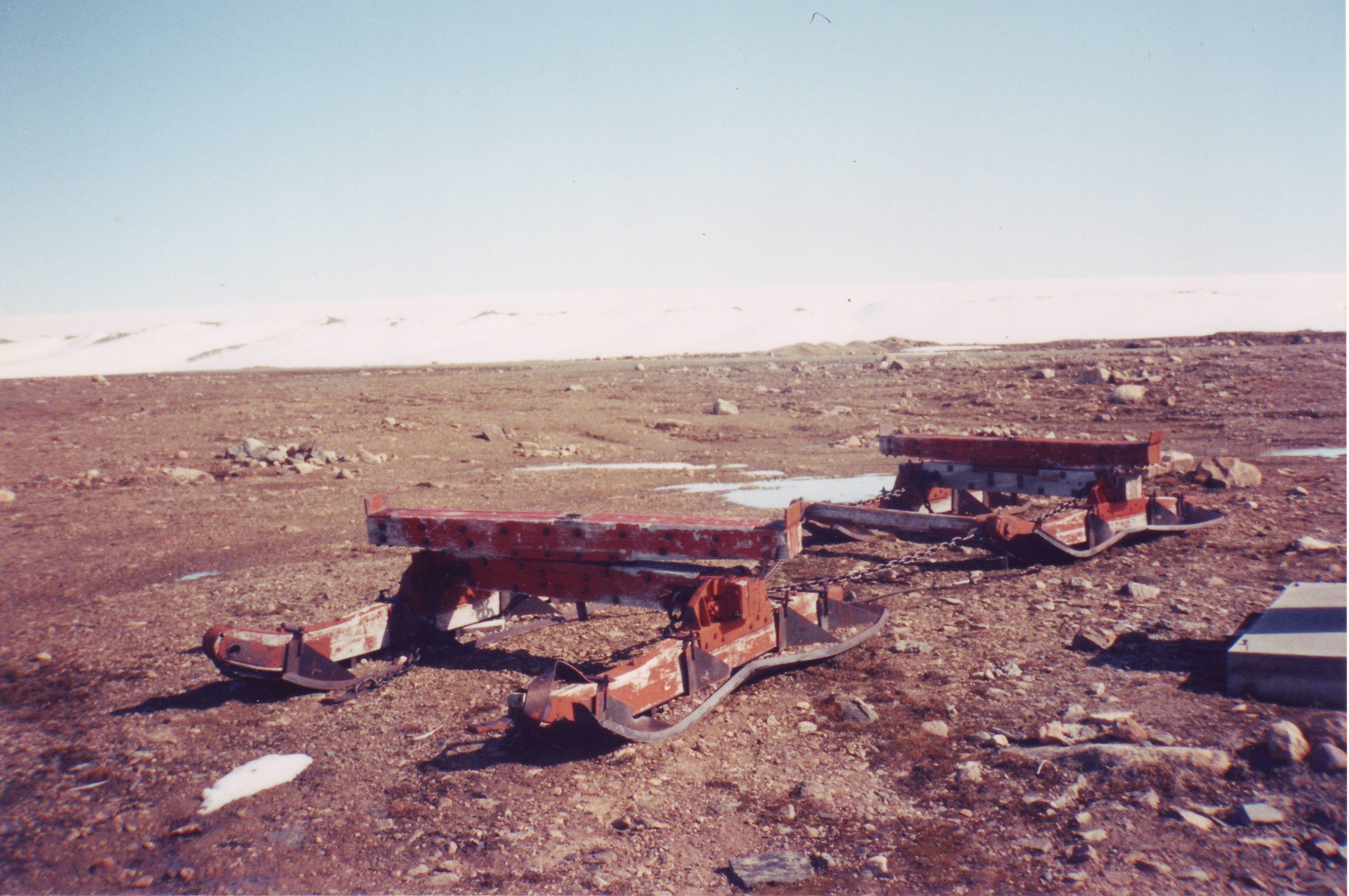
Camp Century has been described as a subterranean city, complete with a chapel, a barbershop and dormitories that once housed hundreds of people. To construct it, equipment and supplies were transported across the ice on sleds and tractor-trailers from nearby Pituffik Space Base, the northernmost U.S. military installation in the world, which is still active today.
In a 1961 report on American broadcaster CBS, TV legend Walter Cronkite visited the military base. His program filmed Camp Century’s massive ice tunnels being dug and showed U.S. army engineers relaxing in their underground, nuclear-powered barracks, reading and listening to records.
All that is now buried under thick layers of ice. Colgan said he and his team of researchers had been unable to find parts of Camp Century, such as its fuel depot, and feared disturbing it too much. “It’s cold, it’s deep, don’t poke it,” he said.
There are different ways Camp Century could contaminate the environment. One is if melting ice and snow carry toxic waste — such as the 200,000 liters of diesel fuel beneath the ice, according to Colgan — out into the ocean. Another is if the ice containing the base breaks off and forms an iceberg. Neither are likely anytime this century; while the latter would likely take thousands of years.
But the timeline shifts a little depending on how much the world warms in the coming decades. While there are different projections, a United Nations report published last October found the planet will heat up by 2.6 to 3.1 degrees Celsius this century, with no chance of limiting the temperature increase to the totemic 1.5 C target agreed in Paris in 2015.
“It’s a game of just a couple of degrees,” Colgan said. “2 or 3 C is the difference between Camp Century staying under ice or melting out.”
Climate change in microcosm
Camp Century itself was pivotal to scientists’ understanding of climate change. In the 1960s, scientists extracted an ice core there, a frozen soil sample that is still studied to this day for insights into climate patterns hundreds of thousands of years ago. The base remains a scientific “supersite,” said Colgan, who visits it annually along with many other climate researchers.
If the U.S. were to lay claim to the island — as Trump has repeatedly said it should do, calling American control of Greenland an “absolute necessity” and even threatening to use military force — it would also inherit the legacy of its own Cold War-era polluting activities at Camp Century.
“Camp Century is a microcosm of climate change,” Colgan argued. “People today are left picking up and trying to understand the climate impacts of decisions made 50 years ago, 60 years ago.”
And with the U.S. currently the second-biggest emitter of planet-warming emissions in the world, Camp Century and its “shifting fate” aren’t just a fascinating slice of Cold War trivia, but a story of climate action and responsibility today, he added.
“It is the decisions being made in the next decade or two that will put us on these trajectories that have multi-century implications,” Colgan warned.
1 This Month

of the week – Shut Down Drone Warfare!


Tell the Ukrainian Government to Drop Prosecution of Peace Activist Yurii Sheliazhenko

Petition to revoke the licensing of the Near Surface Nuclear Disposal Facility (NSDF) at Chalk River. https://www.ourcommons.ca/petitions/en/Petition/Details?Petition=e-7247
To see nuclear-related stories in greater depth and intensity – go to https://nuclearinformation.wordpress.com
-
Archives
- March 2026 (230)
- February 2026 (268)
- January 2026 (308)
- December 2025 (358)
- November 2025 (359)
- October 2025 (376)
- September 2025 (257)
- August 2025 (319)
- July 2025 (230)
- June 2025 (348)
- May 2025 (261)
- April 2025 (305)
-
Categories
- 1
- 1 NUCLEAR ISSUES
- business and costs
- climate change
- culture and arts
- ENERGY
- environment
- health
- history
- indigenous issues
- Legal
- marketing of nuclear
- media
- opposition to nuclear
- PERSONAL STORIES
- politics
- politics international
- Religion and ethics
- safety
- secrets,lies and civil liberties
- spinbuster
- technology
- Uranium
- wastes
- weapons and war
- Women
- 2 WORLD
- ACTION
- AFRICA
- Atrocities
- AUSTRALIA
- Christina's notes
- Christina's themes
- culture and arts
- Events
- Fuk 2022
- Fuk 2023
- Fukushima 2017
- Fukushima 2018
- fukushima 2019
- Fukushima 2020
- Fukushima 2021
- general
- global warming
- Humour (God we need it)
- Nuclear
- RARE EARTHS
- Reference
- resources – print
- Resources -audiovicual
- Weekly Newsletter
- World
- World Nuclear
- YouTube
-
RSS
Entries RSS
Comments RSS
 nuclear-news