Arctic sea ice hit a record low as global powers eye shipping routes

Arctic sea ice hit a record low for the end of the region’s winter last
month, in a stark sign of how climate change is opening up the North Pole
to a geopolitical race for military and energy exploration. March was the
fourth consecutive month in which sea ice reached a record low for that
calendar period, based on a 47-year satellite record, EU earth observation
agency Copernicus reported on Tuesday.
FT 10th April 2025 https://www.ft.com/content/f8083632-e6bc-45f5-8032-0ee60e263cf6
Global warming is ‘exposing’ new coastlines and islands as Arctic glaciers shrink .
Retreating glaciers created 2,500km of “new” coastline and 35
“new” islands in the Arctic between 2000 and 2020, according to a new
study. The research uses satellite images of more than 1,700 glaciers in
Greenland, Alaska, the Canadian Arctic, Russian Arctic, Iceland and
Svalbard.
The findings show that 85% of these glaciers retreated over
2000-20, revealing 123km of new coastline per year on average. The study,
published in Nature Climate Change, links the acceleration in glacier melt
to warmer ocean and air temperatures.
Carbon Brief 1st April 2025 https://www.carbonbrief.org/global-warming-is-exposing-new-coastlines-and-islands-as-arctic-glaciers-shrink/
Fearing toxic waste, Greenland ended uranium mining. Now, they could be forced to restart – or pay $11bn

Fearing toxic waste, Greenland ended uranium mining. Now, they could be
forced to restart – or pay $11bn. The island is being sued by a mining
company over its decision, and faces paying nine times its annual budget in
damages if it loses.
From the iceberg-filled bay, the mountains above the
town of Narsaq, in south-west Greenland, appear unremarkable. In the
September warmth, clumps of grass cling to the smooth, grey peaks shaped
over centuries by an enormous ice cap that lurks behind the fjords on the
horizon. Brightly coloured homes are scattered around the shoreline below,
home to a community of just over 1,300 people.
Were it not for a mining
outhouse on the edge of town, there would be little indication of the
potential riches in the rock. The range is home to one of the largest
undeveloped deposits of rare-earth minerals and uranium in the world: the
Kvanefjeld site, or Kuannersuit in Greenlandic. It contains high
concentrations of metals such as terbium and neodymium, which are used to
manufacture permanent magnets in wind turbines and electric cars. Every
major power in the world is scrambling to get access to these minerals for
carbon-free energy and transport.
A proposed open-pit mine would be worth
about $7.5bn (£6bn) if it went ahead, according to the site operator,
generating income for the island’s economy. But when the mining company
acquired the site in 2007, the impact of potentially radioactive waste
contaminating drinking water and nearby sheep farms alarmed local people.
They feared that the “tailings” – a slurry of ground-up waste from
mining – would be laced with radioactive waste and could contaminate
waterways or spread as dust in the air.
Guardian 5th March 2025, https://www.theguardian.com/environment/2025/mar/05/greenland-mining-energy-transition-minerals-environmental-laws-uranium-rare-earth-toxic-waste-investor-state-dispute-settlement-isds-aoe
Trump’s got a radioactive time bomb under Greenland’s ice
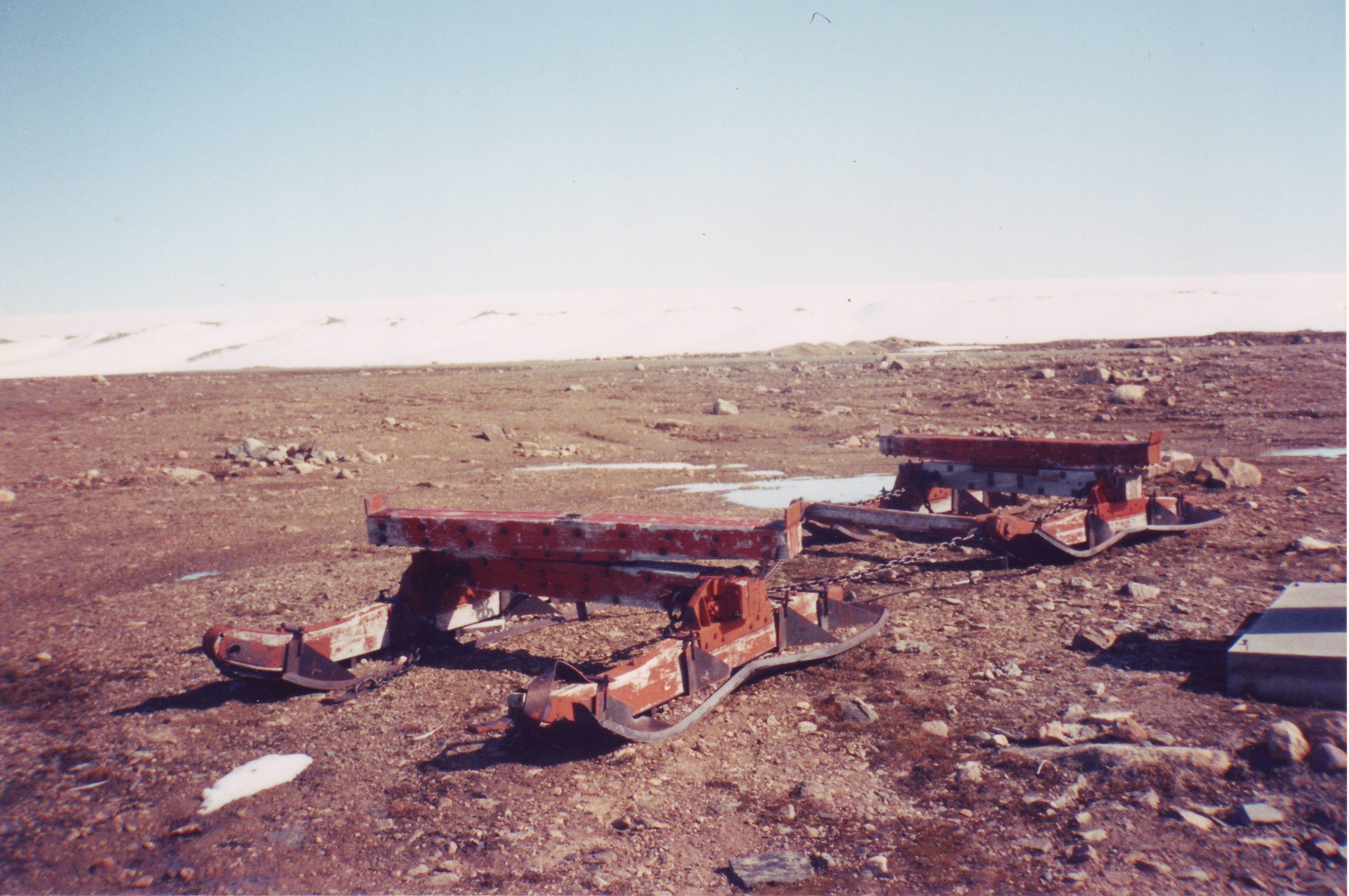
The U.S. would inherit an environmental dilemma of its own making if it lays claim to the massive Arctic island.
January 17, 2025 , By Seb Starcevic, https://www.politico.eu/article/trumps-got-a-radioactive-time-bomb-under-greenlands-ice/
Deep in Greenland’s frozen wilderness, a radioactive secret sleeps beneath the ice — and it could be a headache for Donald Trump if the U.S. president-elect follows through on his threat to take control of the vast Arctic island.
Its name is Camp Century, an American military base built in 1959 during the Cold War in an attempt to develop nuclear launch sites that could survive a Russian strike.
The project, which involved carving a network of tunnels through Greenland’s ice sheet and was powered by a small nuclear reactor, was deemed unfeasible due to the constantly shifting ice and abandoned in 1967.
Although the Americans dismantled the reactor and took its nuclear reaction chamber with them when they departed in ’67, they left behind thousands of tonnes of waste and debris — including radioactive residue — to be buried under the icecap forever.
But thanks to climate change, forever might come sooner than planned.
As the world warms, Camp Century — which is located in one of the most remote spots on Earth, about 1,500 kilometers north of Nuuk, Greenland’s capital city — has been the focus of renewed interest and anxiety about just how long it will remain entombed. A landmark study published in 2016 found the remains of the abandoned base could be exposed by melting ice and snow toward the end of the 21st century.
“Our study highlights that Camp Century now possesses unanticipated political significance in light of anthropogenic climate change,” the researchers wrote (though they later revised their findings in 2021 to rule out the base reemerging from the ice until at least 2100).
The revelation caused a political storm in Greenland, a Danish territory which has been self-ruling since 1979.
Greenlandic Foreign Minister Vittus Qujaukitsoq demanded Denmark take responsibility for cleaning up the debris from abandoned U.S. military installations in Greenland, of which there are 20 to 30 mainly disused sites. Greenland, formerly a colony of Denmark, never consented to hosting them.
Nuuk and Copenhagen signed a deal in 2017 earmarking about $30 million to clean up the debris and waste — but Camp Century was not included in the agreement.
Greenlanders are “concerned that [Camp Century] will pollute as the ice melts down,” said Pipaluk Lynge, an MP from Greenland’s largest party and chair of the parliamentary foreign policy committee.
But it’s not just Camp Century, she added, referring to the other abandoned bases. “There are many places where [they] have left tons of dump,” she told POLITICO. “The U.S. has military waste all over the Arctic.”
‘Don’t poke it’
There have so far been “no attempts” to clean up Camp Century’s radioactive and toxic waste, said William Colgan, professor of glaciology and climate at the Geological Survey of Denmark who led the 2016 study into the ice surrounding Camp Century.
While Colgan did once drill deep into the site to test its radioactivity at the Danish health ministry’s request, “There is actually a conscious effort not to drill into the debris field,” he told POLITICO. “We don’t actually know the full nature of what’s down there.”
Camp Century has been described as a subterranean city, complete with a chapel, a barbershop and dormitories that once housed hundreds of people. To construct it, equipment and supplies were transported across the ice on sleds and tractor-trailers from nearby Pituffik Space Base, the northernmost U.S. military installation in the world, which is still active today.
In a 1961 report on American broadcaster CBS, TV legend Walter Cronkite visited the military base. His program filmed Camp Century’s massive ice tunnels being dug and showed U.S. army engineers relaxing in their underground, nuclear-powered barracks, reading and listening to records.
All that is now buried under thick layers of ice. Colgan said he and his team of researchers had been unable to find parts of Camp Century, such as its fuel depot, and feared disturbing it too much. “It’s cold, it’s deep, don’t poke it,” he said.
There are different ways Camp Century could contaminate the environment. One is if melting ice and snow carry toxic waste — such as the 200,000 liters of diesel fuel beneath the ice, according to Colgan — out into the ocean. Another is if the ice containing the base breaks off and forms an iceberg. Neither are likely anytime this century; while the latter would likely take thousands of years.
But the timeline shifts a little depending on how much the world warms in the coming decades. While there are different projections, a United Nations report published last October found the planet will heat up by 2.6 to 3.1 degrees Celsius this century, with no chance of limiting the temperature increase to the totemic 1.5 C target agreed in Paris in 2015.
“It’s a game of just a couple of degrees,” Colgan said. “2 or 3 C is the difference between Camp Century staying under ice or melting out.”
Climate change in microcosm
Camp Century itself was pivotal to scientists’ understanding of climate change. In the 1960s, scientists extracted an ice core there, a frozen soil sample that is still studied to this day for insights into climate patterns hundreds of thousands of years ago. The base remains a scientific “supersite,” said Colgan, who visits it annually along with many other climate researchers.
If the U.S. were to lay claim to the island — as Trump has repeatedly said it should do, calling American control of Greenland an “absolute necessity” and even threatening to use military force — it would also inherit the legacy of its own Cold War-era polluting activities at Camp Century.
“Camp Century is a microcosm of climate change,” Colgan argued. “People today are left picking up and trying to understand the climate impacts of decisions made 50 years ago, 60 years ago.”
And with the U.S. currently the second-biggest emitter of planet-warming emissions in the world, Camp Century and its “shifting fate” aren’t just a fascinating slice of Cold War trivia, but a story of climate action and responsibility today, he added.
“It is the decisions being made in the next decade or two that will put us on these trajectories that have multi-century implications,” Colgan warned.
State of the Cryosphere Report 2024
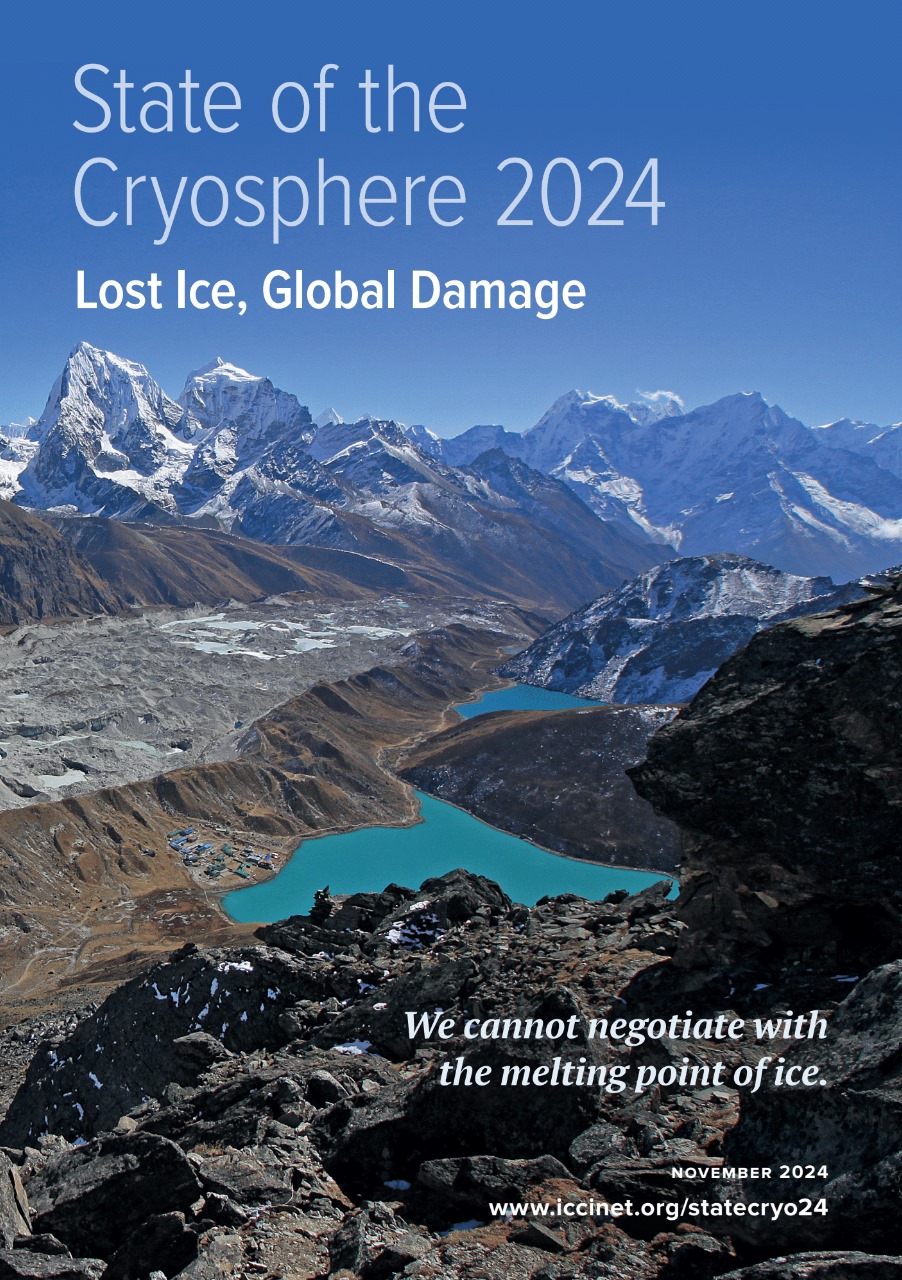
Lost Ice, Global Damage
In the State of the Cryosphere 2024 – Lost Ice, Global Damage report, over 50 leading cryosphere scientists warn of vastly higher impacts and costs to the global economy given accelerating losses in the world’s snow and ice regions. Current climate commitments, leading the world to well over 2°C of warming, would bring disastrous and irreversible consequences for billions of people from global ice loss.
Based on the most recent cryosphere science updates from 2024, the authors underscore that the costs of loss and damage will be even more extreme, with many regions experiencing sea-level rise or water resource loss well beyond adaptation limits in this century if our current level of emissions continues – leading towards a rise of 3°C or more. Mitigation will also become more costly due to feedbacks from thawing permafrost emissions and loss of sea ice.
For the first time, the report notes a growing scientific consensus that melting Greenland and Antarctic ice sheets, among other factors, may be slowing important ocean currents at both poles, with potentially dire consequences for a much colder northern Europe and greater sea-level rise along the U.S. East Coast.
Reviewed and supported by over 50 leading cryosphere scientists, this is the latest report in the State of the Cryosphere series, which takes the pulse of the cryosphere on an annual basis. The cryosphere is the name given to Earth’s snow and ice regions and ranges from ice sheets, glaciers, snow and permafrost to sea ice and the polar oceans – which are acidifying far more rapidly than warmer waters. The report describes how a combination of melting polar ice sheets, vanishing glaciers, and thawing permafrost will have rapid, irreversible, and disastrous impacts worldwide.
Trump Wants Greenland to Deploy Medium-Range Missiles Aimed at Russia
Since a few days ago US President-elect Trump reiterated his desire to want to buy Greenland
By Claudio Resta, January 1, 2025, https://www.vtforeignpolicy.com/2025/01/trump-wants-greenland-to-deploy-medium-range-missiles-aimed-at-russia/
As early as 1946, the US administration of Harry Truman declared that the island was “essential to the security of the United States” to counter the growing Soviet threat, and offered Denmark $100 million to purchase it.
But the first time that US authorities considered the idea of acquiring Greenland from Denmark along with Alaska from Russia dates back to 1867.
For Russia, the implementation of Trump’s plans regarding Greenland will have military consequences. The island, which already hosts the Thule base, will become the largest US military base with strategic bombers and P-8A Poseidon aircraft to monitor Russian submarines.
But also medium-range land-based missiles: a re-edition of the US “Ice Worm” project from the 1960s but with a different technical solution. The project involved the placement of 600 Minuteman missiles reduced to 2 stages in the tunnels of the Greenland ice sheet.
By deploying LRHW “Dark Eagle” missile systems on the east coast of Greenland with hypersonic warheads, the US would be able to strike the Russian Arctic regions, including Arkhangelsk, Tomsk, Krasnoyarsk, Omsk and Tiksi.
Greenland retains all raw material revenues for operations on the island; Denmark receives nothing and simply pays (starting in 2009 with an annual subsidy of approx. DKK 3,400 million, currently value approx. EUR 455 million).
And here’s the news: from 1 October 2023, the Greenlandic company Inuksuk has taken over the maintenance of the US space base Pituffik (formerly Thule Air Base), the largest US military facility on the island.
As part of the contract, Washington will allocate nearly DKK 28 billion to the island for the maintenance of the US space base alone until 2035, an amount comparable to all of Copenhagen’s grants.
The US interest in Greenland is strategic in nature, regardless of Trump’s statements. After all, this is where the North American Aerospace Defense Command intends to detect and intercept Russian missiles in the event of World War III.
Danish authorities announce new funding to defend the large island.
Since a few days ago US President-elect Trump reiterated his desire to want to buy Greenland The Danish government answer was the announce of a major plan to strengthen Greenland’s defense capacity, just hours after US President-elect Donald Trump publicly reiterated his desire to buy the Arctic country, home to just 56,000 people.
Without providing details, Danish Defense Minister Troels Lund Poulsen told Danish news outlet Jyllands-Posten that Copenhagen will invest “billions of Danish kroner to improve the country’s defenses.”
The unspecified defense spending could amount to between €1.34 billion and €13.27 billion.Trump said on his social media platform, Truth Social, on Sunday that the United States will seek possession and control of Greenland for “purposes of national security and freedom around the world.”
The comments came just days after the former US president suggested Washington wanted to seize neighboring Canada and retake the Panama Canal. PM Egede: “We are not for sale”
In response, Greenlandic Prime Minister Mute Egede said that “Greenland belongs to the Greenlandic people.”
He also said that his country “is not for sale and never will be. We must not lose our long struggle for freedom.”
Greenland has its own extensive local government, but is still affiliated with the Danish crown.
The country was a Danish colony until 1953, when it was reclassified as a district of Denmark.
Greenland was then fully integrated into the Danish state under the Constitution of Denmark, making its inhabitants Danish citizens. https://www.afjournal.ru/en/2024/1/global-and-regional-security/a-fight-for-the-icy-africa-greenland-caught-between-the-colonial-past-the-us-arctic-interests-and-the-eu-strategic-autonomy
Countdown to an ice-free Arctic: New research warns of accelerated timelines
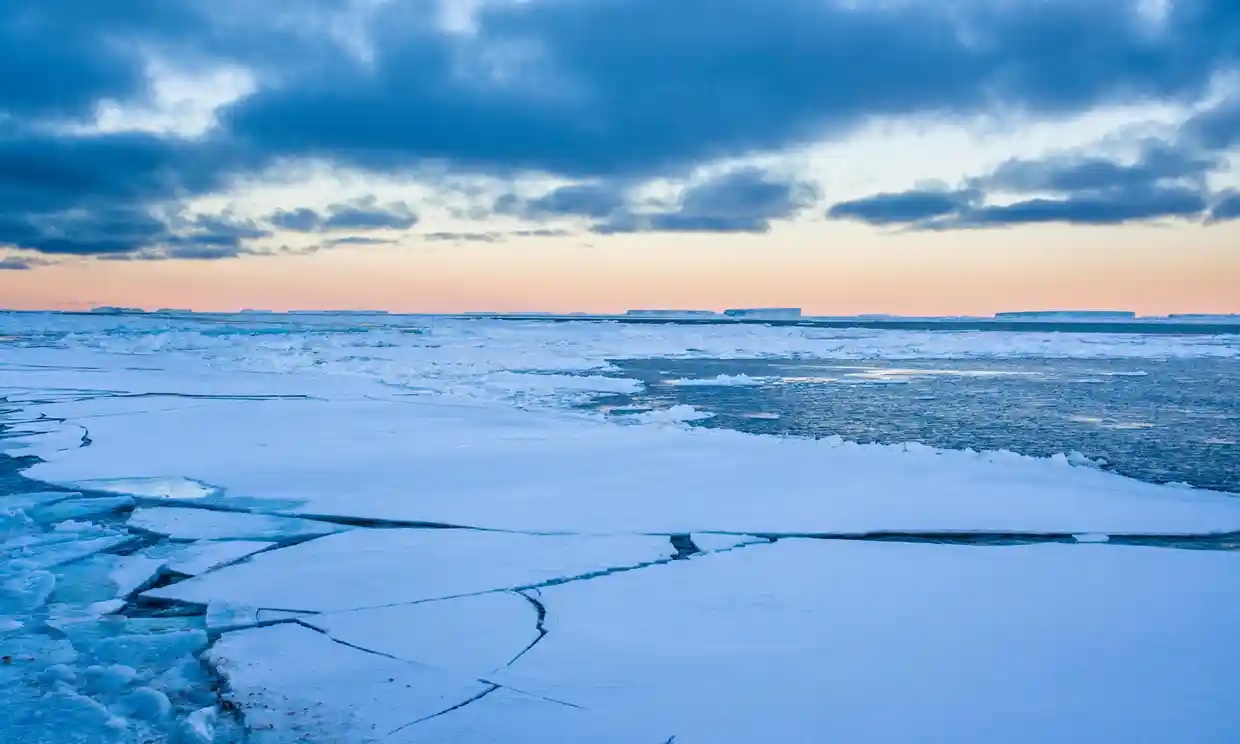
2/3/2024 By Yvaine Ye
The first summer on record that melts practically all of the Arctic’s sea ice, an ominous milestone for the planet, could occur as early as 2027.
For the first time, an international research team, including CU Boulder climatologist Alexandra Jahn and Céline Heuzé from the University of Gothenburg in Sweden, used computer models to predict when the first ice-free day could occur in the northernmost ocean. An ice-free Arctic could significantly impact the ecosystem and Earth’s climate by changing weather patterns.
“The first ice-free day in the Arctic won’t change things dramatically,” said Jahn, associate professor in the Department of Atmospheric and Oceanic Sciences and fellow at CU Boulder’s Institute of Arctic and Alpine Research. “But it will show that we’ve fundamentally altered one of the defining characteristics of the natural environment in the Arctic Ocean, which is that it is covered by sea ice and snow year-round, through greenhouse gas emissions.”
The findings were published Dec. 3 in the journal Nature Communications. Jahn will also present the results in Dec. 9 at the American Geophysical Union annual meeting in Washington D.C.
A Blue Arctic
As the climate warms from increasing greenhouse gas emissions, sea ice in the Arctic has disappeared at an unprecedented speed of more than 12% each decade.
In September, the National Snow and Ice Data Center reported that this year’s Arctic sea ice minimum—the day with the least amount of frozen seawater in the Arctic—was one of the lowest on record since 1978.
At 1.65 million square miles, or 4.28 million square kilometers, this year’s minimum was above the all-time low observed in September 2012. But it still represents a stark decline compared to the average coverage of 6.85 million square kilometers between 1979 and 1992.
When the Arctic Ocean has less than 1 million square kilometers of ice, scientists say the Arctic is ice free.
Previous projections of Arctic sea ice change have focused on predicting when the ocean will become ice free for a full month. Jahn’s prior research suggested that the first ice-free month would occur almost inevitably and might happen by the 2030s.
…………………………………………………….The researchers found that a series of extreme weather events could melt two million square kilometers or more of sea ice in a short period of time: A unusually warm fall first weakens the sea ice, followed by a warm Arctic winter and spring that prevents sea ice from forming. When the Arctic experiences such extreme warming for three or more years in a row, the first ice-free day could happen in late summer.
Those kinds of warm years have already happened. For example, in March 2022, areas of the Arctic were 50°F warmer than average, and areas around the North Pole were nearly melting. With climate change, the frequency and intensity of these weather events will only increase, according to Heuzé.
Sea ice protects the Arctic from warming by reflecting incoming sunlight back into space. With less reflective ice, darker ocean waters will absorb more heat from the Sun, further increasing temperatures in the Arctic and globally. In addition, warming in the Arctic could change wind and ocean current patterns, leading to more extreme weather events around the world.
But there’s also good news: A drastic cut in emissions could delay the timeline for an ice-free Arctic and reduce the time the ocean stays ice-free, according to the study.
“Any reductions in emissions would help preserve sea ice,” Jahn said. https://www.colorado.edu/today/2024/12/03/countdown-ice-free-arctic-new-research-warns-accelerated-timelines?fbclid=IwY2xjawG_IhlleHRuA2FlbQIxMQABHX8KyQRLhAP2U6lYO1AMgR9kgUX3J1KhOcalDwdskFX_vdF1LEoxQsDBMw_aem_LPnxIx4MdGaxAfZFAm28gw
Huge Arctic wildfires release 100m tonnes of greenhouse gas in a year
Scientists are alarmed at how extreme the blazes have become as the climate
changes, and 2024 ranks as the fourth worst year for emissions from Arctic
fires. Huge wildfires have blazed across the Arctic this summer, releasing
almost as much carbon dioxide into the atmosphere as the petrostate Kuwait
emits annually.
Fires in the carbon-rich frozen soils in the north of
Russia, Canada and other countries occur naturally as a result of lightning
strikes. Sometimes they spread south into the ring of boreal forests.
Scientists are alarmed at how extreme the blazes have become in recent
years as the climate changes. The Arctic’s worst year on record was 2020,
followed by 2019 and 2004.
Times 30th Sept 2024, https://www.thetimes.com/uk/environment/article/huge-arctic-wildfires-release-100m-tonnes-of-greenhouse-gas-in-a-year-ncb8cmdfq
Wildfires ravaging Arctic Circle – EU monitor
Wildfires are once again ravaging the Arctic Circle, the EU’s climate
change monitor – Copernicus – has reported. It is the third time in the
past five years that high intensity fires have swept across the region.
In a statement released on Thursday, Copernicus reported higher air
temperatures and drier conditions in Sakha, Russia, which are rendering the
ideal conditions for wildfires once there is a spark. Quoted by Russia
state news agency Tass, the region’s deputy minister of ecology, management
and forestry said more than 160 wildfires affected nearly 460,000 hectares
of land up until 24 June.
Scientists are concerned that smoke from the
flames will hinder the ability of the Arctic ice to reflect solar radiation
– which would mean both the land and sea absorb more heat. Professor Gail
Whiteman from the University of Exeter told the BBC that the Arctic region
was “ground zero for climate change”.
BBC 27th June 2024
War Games in Arctic: What’s Driving the West’s New Passion?
“Now, that Finland and Sweden are becoming active NATO members, this opens the possibility for the US to deploy nuclear weapons in the Far North.”
“because of the Arctic’s sparsely located population, collateral damage from the use of nuclear weapons there will be less noticeable.”
Bruce K. Gagnon , MARCH 15, 2024 https://space4peace.blogspot.com/2024/03/war-games-in-arctic-whats-driving-wests.html
Two unprecedented military exercises are being conducted by the US and its NATO allies simultaneously in various parts of the Arctic, signaling a new aggressive stance by the West in the region.
Thirteen NATO countries participated this week in the Nordic Response 2024 exercise held in Finland and Sweden, near the border with Russia. Additionally, the US Army recently conducted a training event near Fairbanks, Alaska, also close to Russia’s borders.
The US exercise was conducted within the framework of the Joint Pacific Multinational Readiness Center (JPMRC) and involved 8,000 American servicemen from the 11th Airborne Division and an unspecified smaller number of “foreign allies.”
The Nordic Response exercises in Finland and Sweden are even bigger in scope, since they involve 20,000 service members from 13 NATO member countries, 50 warships and 100 military aircraft. The United States and Norway contributed their F-35 fifth-generation fighter jets to the organizers of the Nordic Response drills. Additionally, the UK agreed to send several of its own F-35s from the Royal Air Force, stationed on the British aircraft carrier, Prince of Wales.
“We just want to beef up our presence in the Far North,” said German Defense Minister Boris Pistorius, who came to inspect the Nordic Response 2024 war games. “This is the biggest and the most important NATO exercise in 40 years,” he contended.
German submarines, along with troops from new NATO members Finland and Sweden, also participated in the military exercises. However, the majority of the fighting force consisted of Americans, who openly expressed their intention to “rebuild their capacity to fight in the Arctic”, a capability that had somewhat weakened since the end of the Cold War.
The presumed adversary in both Alaska and the Finnish forests was the same: Russia and its possible ally China. The American newspaper Business Insider reported that the new “Arctic Strategy” of the US Army is pivoted towards “regaining Arctic dominance.” The new strategy has been operational since 2021.
However, Business Insider noted that the rivalry with Russia now is not limited to the military sphere, as it was during the Cold War era. The economy has a role to play, too. “Rapidly melting sea ice in the Arctic Circle, warming twice as fast as the rest of the world is opening up new opportunities for natural resource extraction, shipping routes, and commercial fishing, as the Arctic becomes navigable,” the publication wrote.
Vladimir Vasilyev, the chief research associate at the Institute of the US and Canada at the Russian Academy of Sciences, suggests that the Americans may be interested in gaining control over the North Sea Route. This route is considered the shortest maritime connection between the growing economies of Southeast Asia and Europe. Russia has extensive experience in utilizing the North Sea Route, which goes along the country’s northern shores. As the ice continues to melt, this sea route is becoming increasingly accessible to commercial vessels.
“The United States is striving to ‘rediscover’ the Arctic region militarily,” a member of the Russian Academy of Military Sciences Alexander Bartosh told Sputnik. “Now, that Finland and Sweden are becoming active NATO members, this opens the possibility for the US to deploy nuclear weapons in the Far North.”
The goal of the US beefing up its military force in the region, in Bartosh’s opinion, is two-fold. The first is to leverage their superiority at sea and in the air for potential strikes against Russia. And secondly, they seek to exploit the region’s untapped natural resources, primarily focusing on oil and gas.
Vladimir Vasilyev notes the historic roots of the ‘military side’ of American interest in the Arctic. “The Arctic region plays an indispensable role in the long-time US strategy of encircling Russia,” Vasilyev highlighted. He also did not exclude the deployment of American nuclear weapons in the region. “In the Arctic, nuclear accidents are easier to cover up,” Vasilyev noted and added: “Also, for a very long time Americans had an illusion that because of the Arctic’s sparsely located population, collateral damage from the use of nuclear weapons there will be less noticeable.”
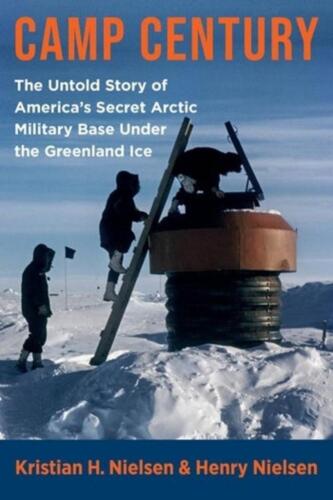
Could climate change release 35 swimming pools’ worth of nuclear waste? Or worse… unleash a world-ending pandemic? These are the terrifying unexpected consequences of melting ice
By ROB WAUGH FOR DAILYMAIL.COM, 2 March 2024 https://www.dailymail.co.uk/sciencetech/article-13135571/Could-climate-change-release-35-swimming-pools-worth-nuclear-waste-worse-unleash-world-ending-pandemic-terrifying-unexpected-consequences-melting-ice.html
- Buried ‘nuclear city’ and swimming pools’ worth of nuclear waste
- Frozen viruses have already begun to infect human beings
- READ MORE As melting ice exposes new oil reserves, oil giants move in
Around the world, glaciers and permafrost are melting, and in some places the retreating ice is releasing buried secrets people hoped would remain forgotten.
Rising waters have exposed a secret Greenland nuclear base that engineers thought would never resurface as well as a radioactive ‘Tomb’ at the site of American nuclear tests.
And while it sounds far-fetched, very credible experts have warned that the next pandemic may well come from ancient pathogens buried in the ice, or even from diseases harbored by frozen dead Neanderthals.
The ‘secret nuclear city’ under Greenland’s ice
Camp Century in Greenland is a secret nuclear-powered ‘city under the ice’, where U.S. Army engineers carried out weapons research
The base has been abandoned for almost half a century, but now poses a serious concern over nuclear waste.
Powered by a portable nuclear generator, Camp Century was built in 1959, and was built to host 200 soldiers, with a plan to expand the base to hold 600 ballistic missiles.
‘Camp Century’ was abandoned in 1967, but the nuclear reactor at the base – which also had a hospital and a church in its tunnels – has long since been removed, but radioactive waste remains.
When the Army Corps of Engineers (ACE) left the base, they assumed that frigid temperatures and falling snow would keep the nuclear waste there forever.
In total, the waste is equivalent to the mass of 30 Airbus A320 airplanes – and researchers now fear that it could be released into the sea.
A 2016 study suggested that the nuclear waste could be released into the sea this century, but newer measurements at the base suggest that this will not happen until 2100.
‘Tomb’ of poison at nuclear test site
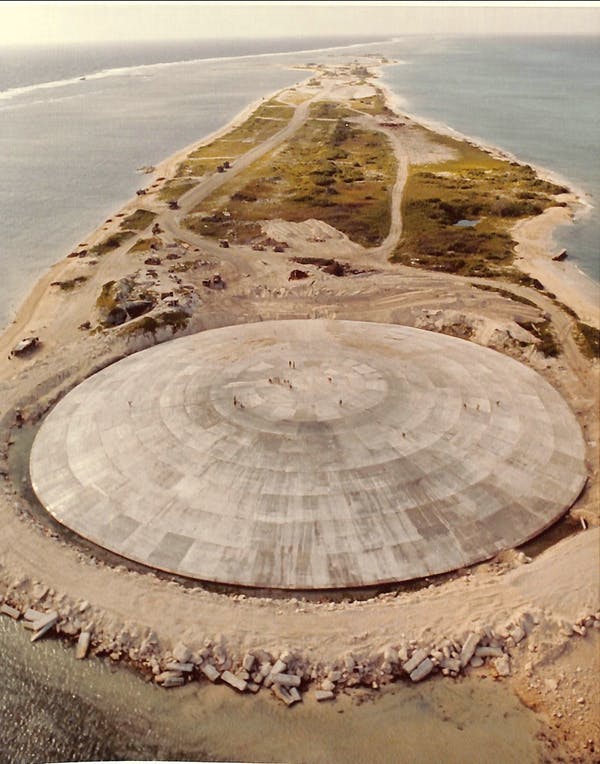
In the Marshall Islands, a huge ‘lid’ which locals know as ‘The Tomb’ covers 31 million cubic feet of nuclear waste – equivalent to the volume of 35 Olympic-sized swimming pools.
The islands were the site of American nuclear tests, but the U.S. military also shipped in waste from the mainland.
From 1946 to 1958, America conducted 67 nuclear tests in the South Pacific.
The concrete ‘lid’ officially known as the Runit Dome was built on Enewetak Atoll in the Marshall Islands to contain radioactive material from American nuclear tests in the 1950s.
Some studies have suggested that radiation levels near the site are similar to those near Chernobyl and the waters around the dome are rising every year.
Changing temperatures are causing the lid to crack, while rising waters are lapping at the atoll.
Plutonium – and a lost hydrogen bomb?
A 1968 plane crash scattered plutonium from American nuclear weapons over the ice in Greenland, which could be released by global warming.
The U.S. military assumed that the Thule air base in Greenland would be rapidly attacked in a nuclear war, so kept nuclear-armed bombers in the air to fly towards Russia in the event of an attack.
The Thule incident saw large amounts of radioactive plutonium dispersed onto the ice sheet, as a cabin fire in a B-52 bomber forced the crew to bail out.
Conventional explosives inside the four B28FI thermonuclear bombs detonated, spreading radioactive waste.
But the uranium-235 fissile core of one of the bombs was never found, despite a search with submarines.
Reports in the decades since have suggested that the lost bomb is lying under the seabed.
Frozen viruses and the next pandemic
Researchers have warned that the next pandemic could come from melting ice.
Genetic analysis of soil and lake sediment near the highest Arctic freshwater lake, Lake Hazen, suggests that the risk of ‘viral spillover’ may be high close to melting glaciers.
‘Spillover’ is where a virus infects a new host for the first time – and analysis of viruses and potential hosts in the lakebed suggests this risk may be higher near to melting glaciers.
Researchers at Ohio State University found genetic material from 33 viruses, 28 of which were unknown, in the Tibetan plateau in China, putting their age at 15,000 years old.
Viruses from Neanderthals
Other researchers have warned of viruses unleashed by melting permafrost: one-quarter of the northern hemisphere sits on top of permanently frozen ground – known as permafrost, but large areas are now melting as the world warms.
There are already examples of this – with a 2016 anthrax outbreak in Siberia attributed to melting permafrost exposing an infected reindeer carcass.
Previously researchers have warned that global warming and thawing ice might unearth diseases such as smallpox frozen into the corpses of victims, with a few infectious particles enough to revive the pathogen.
As permafrost thaws due to climate change, virologist Jean-Michel Claverie has warned that ancient viruses harbored in the long-frozen ground could be released.
Claverie explains that if an ancient pathogen eradicated Neanderthals, for instance, their frozen remains might still contain infectious viruses that could be unleashed as ice melts.
Claverie told Bloomberg News, “With climate change, we are used to thinking of dangers coming from the south.
“Now, we realize there might be some danger coming from the north as the permafrost thaws and frees microbes, bacteria and viruses.”
Claverie’s team previously revived giant viruses from up to 48,000 years ago – and the veteran scientist has warned that there could be even more ancient viruses in the ice, some of which could potentially infect humans.
Frozen poison in the ice
Polar regions have acted as a ‘chemical sink’ for the planet, locking away poisons in the ice – but melting ice could release this.
A study in Geophysical Research Letters found huge reserves of the toxic heavy metal mercury frozen in Arctic permafrost.
The amount may be 10 times higher than all the mercury pumped into the atmosphere from industry in three decades.
Paul Schuster, a U.S. Geological Survey hydrologist, “This is a complete game-changer for mercury. It’s a natural source, but some of it will be released through what we’re doing with climate change.”
Mercury is released by industry, volcanic eruptions and rock weathering – but what’s less clear is what will happen if the ‘pool’ in the Arctic is released.
The Greenland ice cap is losing an average of 30m tonnes of ice an hour due to the climate crisis.

The Greenland ice cap is losing an average of 30m tonnes of ice an hour
due to the climate crisis, a study has revealed, which is 20% more than was
previously thought. Some scientists are concerned that this additional
source of freshwater pouring into the north Atlantic might mean a collapse
of the ocean currents called the Atlantic meridional overturning
circulation (Amoc) is closer to being triggered, with severe consequences
for humanity. Major ice loss from Greenland as a result of global heating
has been recorded for decades. The techniques employed to date, such as
measuring the height of the ice sheet or its weight via gravity data, are
good at determining the losses that end up in the ocean and drive up sea
level. However, they cannot account for the retreat of glaciers that
already lie mostly below sea level in the narrow fjords around the island.
In the study, satellite photos were analysed by scientists to determine the
end position of Greenland’s many glaciers every month from 1985 to 2022.
This showed large and widespread shortening and in total amounted to a
trillion tonnes of lost ice.
Guardian 17th Jan 2024
A nuclear-powered ship in Murmansk started to burn. Only few locals got to know about the serious incident
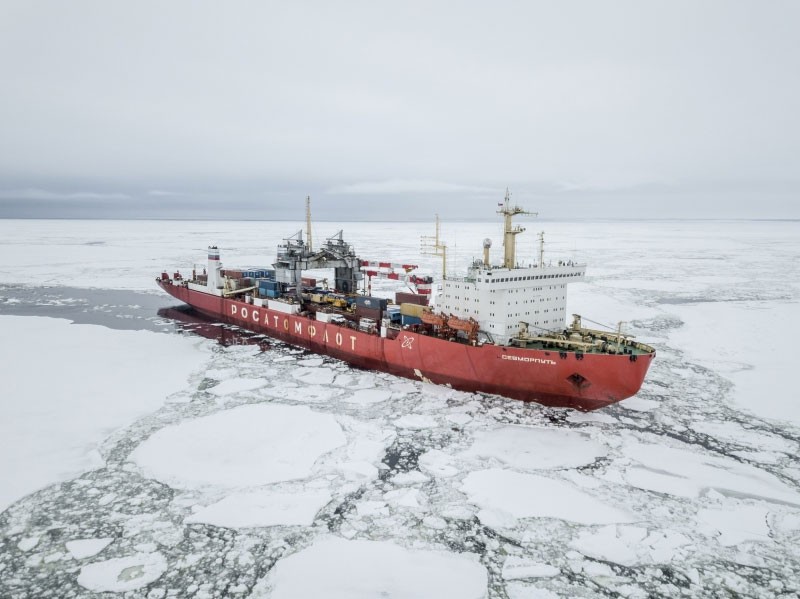
The fire brigade in Murmansk quickly extinguished the blaze that broke out on the 24th of December in a cabin onboard nuclear-powered container ship Sevmorput. State shipowner Rosatom never issued any information about the dramatic situation.
By Atle Staalesen, 28 Dec 23
Little information is available about the fire that broke out in Atomflot, the base for nuclear-powered vessels in Murmansk.
Only two short announcements were in the evening of the 24th of December posted on messenger service Telegram by the local Ministry of Emergency Situations (Emercom).
The first message posted at 21.17 pm informed about a fire on the territory of Atomflot and about the fire brigades that were on the way.
About 1,5 hour later, Emercom informed about its successful fire fighting……………
According to the emergency service, the fire covered an area of about 30 square meters in a cabin onboard the Sevmorput.
The Telegram messages were read by about ten thousand people. A few of them commented on the posts.
Where should we flee?” one of the readers asked.
Rosatom, the state nuclear power company that operates the Sevmorput, has apparently not issued any information about the fire. Neither has any of the company’s subsidiaries, such as the Atomflot or the Rosatomflot.
There is no information about the incident on the companies’ websites or their social media.
The fire could potentially have created a dramatic situation in the big Russian Arctic city. The Atomflot base is located only few kilometres from downtown Murmansk and a major fire on the nuclear-powered ship would have posed a serious threat to the about 270,000 population.
The Sevmorput is the world’s only nuclear-powered merchant container ship.
It is 260 meter long and was built in 1988. For many years, the ship lay idle in Murmansk and Russian authorities ultimately decided to scrap it. However, in 2013 it was instead decided to undertake a major renovation, and in autumn 2015, the ship was again test-sailing the Barents Sea. The following year, Sevmorput was back in regular service and has in the lastest years delivered cargo to military installations in the Russian Arctic, as well as to the petroleum development along the Siberian coast. The ship can carry 74 lighters or 1324 containers.
After the 2015 upgrade and safety evaluation, the reactor’s service life was prolonged with 150,000 hours aimed at keeping the vessel in operation until 2024.
It now looks increasingly likely that the ship will exit service and ultimately be scrapped. In a recent conference on the Arctic, Head of Atomflot Leonid Irlitsa said that his company plans to replace the ship with alternative non-nuclear vessels in 2024…………. https://thebarentsobserver.com/en/nuclear-safety/2023/12/nuclear-powered-ship-murmansk-started-burn-only-few-locals-got-know-about
COP28 must stick to 1.5°C target to save ice sheets, urge scientists
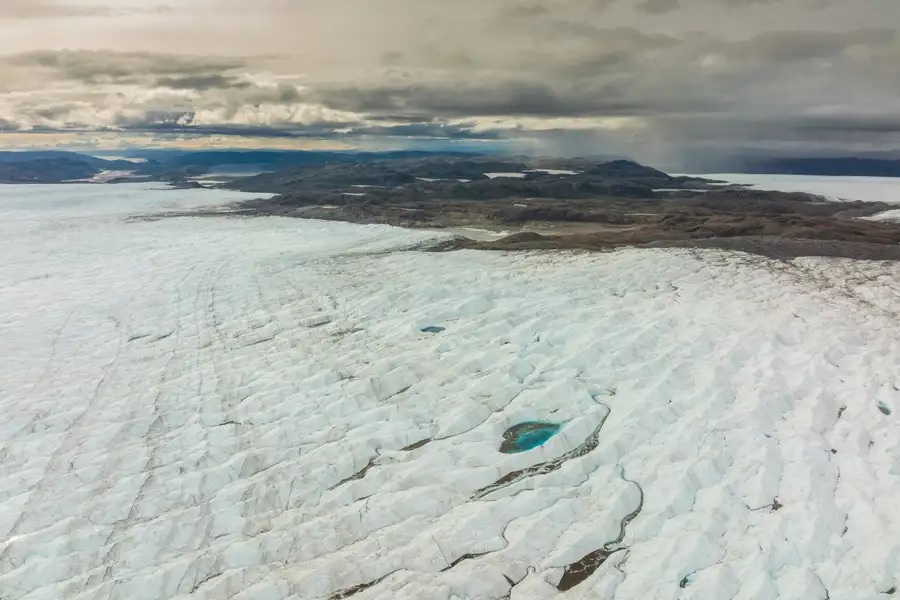
A report warns that 2°C of global warming would mean losing most of the world’s ice sheets and glaciers, leading to catastrophic sea level rise
By Alec Luhn, 16 November 2023
The world must stick to its target to limit climate warming to 1.5°C to avoid catastrophic melting of ice sheets and glaciers, according to a report.
The International Cryosphere Climate Initiative (ICCI), a group of scientists who study ice-covered parts of the world, warns that a rise of 2°C would liquidate most tropical and mid-latitude glaciers and set off long-term melting of the Greenland and Antarctic ice sheets, leading to 12 to 20 metres of sea level rise.
In the 2015 Paris Agreement, all countries committed to holding global average temperature to “well below 2°C” over pre-industrial levels and “pursuing efforts” to limit it to 1.5°C. Our still-rising greenhouse gas emissions have already caused almost 1.2°C of warming and put us on track to exceed 3°C.
More than 350 cryosphere scientists have signed an open letter calling on countries to commit to the 1.5°C limit at the upcoming COP28 climate summit in Dubai.
“From the cryosphere point of view, 1.5°C is not simply preferable to 2°C or higher. It is the only option,” Iceland’s prime minister Katrín Jakobsdóttir said in a statement.
Earth’s regions of snow and ice are melting faster than we expected and already approaching tipping points, says Jonathan Bamber at the University of Bristol, UK, who reviewed the ICCI report, while otherspoint to the rapid uptake of solar and wind energy as reason for continued hope. https://www.newscientist.com/article/2403404-cop28-must-stick-to-1-5c-target-to-save-ice-sheets-urge-scientists/
Who will clean up America’s nuclear wastes in Greenland?
Maine Voices: Long-buried U.S. nuclear waste would complicate any bid for Greenland https://www.pressherald.com/2019/08/24/maine-voices-long-buried-u-s-nuclear-waste-would-complicate-trumps-bid-for-greenland/
Would the U.S. or Denmark be responsible for cleaning up over 47,000 gallons of Cold War-era radioactive waste?
1 This Month
23-25 October – on Zoom – World BEYOND War’s annual global conferenc


Shut down the radiation-damaged Heysham nuclear reactors now
To see nuclear-related stories in greater depth and intensity – go to https://nuclearinformation.wordpress.com

Say No to NASA’s Reckless Nuclear Reactor on the Moon
Say No to NASA’s Reckless Nuclear Reactor on the Moon

-
Archives
- October 2026 (247)
- September 2026 (339)
- August 2026 (330)
- July 2026 (355)
- June 2026 (287)
- May 2026 (306)
- April 2026 (356)
- March 2026 (251)
- February 2026 (267)
- January 2026 (308)
- December 2025 (358)
- November 2025 (359)
-
Categories
- 1
- 1 NUCLEAR ISSUES
- business and costs
- climate change
- culture and arts
- ENERGY
- environment
- health
- history
- indigenous issues
- Legal
- marketing of nuclear
- media
- opposition to nuclear
- PERSONAL STORIES
- politics
- politics international
- Religion and ethics
- safety
- secrets,lies and civil liberties
- spinbuster
- technology
- Uranium
- wastes
- weapons and war
- Women
- 2 WORLD
- ACTION
- AFRICA
- Atrocities
- AUSTRALIA
- Christina's notes
- Christina's themes
- culture and arts
- Events
- Fuk 2022
- Fuk 2023
- Fukushima 2017
- Fukushima 2018
- fukushima 2019
- Fukushima 2020
- Fukushima 2021
- general
- global warming
- Humour (God we need it)
- Nuclear
- RARE EARTHS
- Reference
- resources – print
- Resources -audiovicual
- Weekly Newsletter
- World
- World Nuclear
- YouTube
-
RSS
Entries RSS
Comments RSS

