The US Keeps Openly Admitting It Deliberately Caused The Iran Protests
Caitlin Johnstone, Feb 06, 2026, https://www.caitlinjohnst.one/p/the-us-keeps-openly-admitting-it?utm_source=post-email-title&publication_id=82124&post_id=187080859&utm_campaign=email-post-title&isFreemail=true&r=1ise1&triedRedirect=true&utm_medium=email
Speaking before the Senate Banking Committee on Thursday, US Treasury Secretary Scott Bessent explicitly stated that the US deliberately caused a financial crisis in Iran with the goal of fomenting civil unrest in the country.
Asked by Senator Katie Britt what more the US can be doing to place pressure on the Ayatollah and Iran, Bessent explained that the Treasury Department has implemented a “strategy” designed to undermine the Iranian currency which crashed the economy and sparked the violent protests we’ve seen throughout the country.
“One thing we could do at Treasury, and what we have done, is created a dollar shortage in the country,” Bessent said. “At a speech at the Economic Club in March I outlined the strategy. It came to a swift and I would say grand culmination in December when one of the largest banks in Iran went under. There was a run on the bank, the central bank had to print money, the Iranian currency went into free fall, inflation exploded, and hence we have seen the Iranian people out on the street.”
This is not the first time Bessent has made these admissions. Speaking at the World Economic Forum in Davos last month, the treasury secretary said the following:
“President Trump ordered Treasury and our OFAC division, Office of Foreign Asset Control, to put maximum pressure on Iran. And it’s worked, because in December, their economy collapsed. We saw a major bank go under; the central bank has started to print money. There is dollar shortage. They are not able to get imports, and this is why the people took to the street. So, this is economic statecraft, no shots fired, and things are moving in a very positive way here.”
Following these remarks, Jeffrey Sachs and Sybil Farres wrote the following for Common Dreams:
“What Secretary Bessent describes is of course not ‘economic statecraft’ in a traditional sense. It is war conducted by economic means, all designed to produce an economic crisis and social unrest leading to a fall of the government. This is proudly hailed as ‘economic statecraft.’
“The human suffering caused by outright war and crushing economic sanctions is not so different as one might think. Economic collapse produces shortages of food, medicine, and fuel, while also destroying savings, pensions, wages, and public services. Deliberate economic collapse drives people into poverty, malnutrition, and premature death, just as outright war does.”
Bessent laid out these plans in advance at the Economic Club of New York back in March of last year, saying the following:
“Last month, the White House announced its maximum pressure campaign on Iran designed to collapse its already buckling economy. The Iranian economy is in disarray; 35% official inflation, has a currency that has depreciated 60% in the last 12 months, and an ongoing energy crisis. I know a few things about currency devaluations, and if I were an Iranian, I would get all of my money out of the Rial now.
“This precarious state exists before our Maximum Pressure campaign, designed to collapse Iranian oil exports from the current 1.5–1.6, million barrels per day, back to the trickle they were when President Trump left office.
“Iran has developed a complex shadow network of financial facilitators and black-market oil shippers via a ghost fleet to sell oil, petrochemical and other commodities to finance its exports and generate hard currency.
“As such, we have elevated a sanctions campaign against this export infrastructure, targeting all stages of Iran’s oil supply chain. We have coupled this with vigorous government engagement and private sector outreach.
“We will close off Iran’s access to the international financial system by targeting regional parties that facilitate the transfer of its revenues. Treasury is prepared to engage in frank discussions with these countries. We are going to shut down Iran’s oil sector and drone manufacturing capabilities.
“We have predetermined benchmarks and timelines. Making Iran Broke Again will mark the beginning of our updated sanctions policy. Watch this space.”
The US has been orchestrating plans to foment unrest in Iran by causing economic strife for years. In 2019 Trump’s previous secretary of state Mike Pompeo openly acknowledged that the goal of Washington’s economic warfare against Iran was to make the population so miserable that they “change the government”, cheerfully citing the “economic distress” the nation had been placed under by US sanctions.
As unrest tore through Iran last month, Trump egged protesters on and encouraged them to escalate, saying “To all Iranian patriots, keep protesting, take over your institutions, if possible, and save the name of the killers and the abusers that are abusing you,” adding, “all I say to them is help is on its way.”
Deliberately trying to ignite a civil war in a country by immiserating its population so severely that they start attacking their own government out of sheer desperation is one of the most evil things you can possibly imagine. But under the western empire it’s just another day. They’re doing it in Iran, and they’ve also aggressively ramped up efforts to do it in Cuba, where the government has just announced it will be rationing oil as the US moves to strangle the island nation into regime change.
A lot of attention is going into the Epstein files right now, and understandably so. But it’s worth noting that nothing in them is as depraved and abusive as what our rulers are doing right out in the open.
Will soaring electricity rates kill Ontario’s nuclear expansion?
At $20.9-billion, the Darlington SMRs are expected to cost nearly as much as larger reactors that would have generated far more power. The government is betting that the economic benefits will be worth it: by building the first-ever BWRX-300 reactor, it hopes to win export opportunities for Ontario-based nuclear suppliers.
Future plans include what would be two of the largest nuclear plants on Earth, which will cost hundreds of billions of dollars. And while the IESO holds competitive procurements for other forms of generation including natural gas, wind and solar, nuclear plants are exempted from that requirement………… “There’s no real competition and there’s no real incentive for them to deliver that power at the cheapest cost “
Matthew McClearn, The Globe and Mail, Feb 5, 2026
The Ontario government’s plans to more than double the capacity of the province’s fleet of nuclear power reactors is sprawling in its ambition – and has a price tag to match.
Last May, Energy Minister Stephen Lecce stood alongside Premier Doug Ford to announce that the government would spend $20.9-billion to build four new small modular reactors in Clarington, Ont. In November, they approved a $26.8-billion overhaul of four old reactors at Ontario Power Generation’s Pickering Nuclear Generating Station, just east of Toronto.
Ontario’s electricity rates shot up 29 per cent in November, driven in part by rising nuclear generation costs. Further hikes are virtually certain: Ontario Power Generation (OPG) recently filed a rate application before the Ontario Energy Board, which it says will lay the foundation for the province’s energy supply over the next quarter century. The utility seeks roughly a doubling of the payments it receives for the electricity generated by its nuclear power plants. If granted, monthly bills would increase by an average of $3.50 each year for the next five years.
What comes next, though, promises to be even more expensive.
The Ford government asserts that Ontario will need roughly 18,000 additional megawatts of nuclear capacity by mid-century. (Ontario’s existing Darlington, Bruce and Pickering stations represent about 12,000 megawatts.) They’re ready to embark on what they describe as “the largest expansion of nuclear energy on the continent,” which includes plans for two of the largest nuclear plants on Earth. They could easily cost hundreds of billions of dollars.
This aspect of Ontario’s nuclear ambitions – the cost, and how residents and businesses will pay – is rarely discussed by provincial officials, and then only in vague terms. But the Ford government has long insisted that it can do it all while keeping electricity costs down. Critics – particularly those favoring renewable generation – have warned for years that this nuclear-focused approach would eventually lead to steep rate hikes.
“Ontario is on a track to more expensive energy in the future,” said David Pickup, manager of electricity at the Pembina Institute, an energy thinktank.
In a presentation in late January, Jack Gibbons, chair of the Ontario Clean Air Alliance, said Mr. Ford’s plans would see 75 per cent of Ontario’s electricity produced by nuclear power by 2050.
“If his nuclear projects proceed, our electricity rates will rise dramatically,” he predicted.
The Ford government came to power in 2018 riding a wave of dissatisfaction with the energy policies of its Liberal predecessors, which also led to surging power bills. Have Mr. Lecce and Mr. Ford similarly miscalculated?
Surging rates
Ontario’s Nov. 1 rate hike of 29 per cent was likely the largest on the continent last year. In the past year, Maine and New Jersey experienced increases of 25.5 per cent and 21 per cent, respectively, according to data published by the U.S. Energy Information Administration. The U.S. national average was just 6.6 per cent.
OEB spokesperson Tom Miller attributed Ontario’s rate increase partly to unexpectedly high nuclear generation last year, including from a refurbished reactor at Darlington that returned to service five months earlier than expected.
The November hike was almost entirely offset by an accompanying increase in the Ontario Energy Rebate, a provincial subsidy the government uses to lower residential electricity bills. But those subsidies will cost taxpayers billions of dollars each year, competing with other priorities.
For now, Ontarians’ rates still compare favorably to some provinces, including Nova Scotia, and also U.S. states around the Great Lakes. But the higher payments sought by OPG, if approved, would endure for years.
Traditionally, OPG recovered its costs for projects once they began generating electricity – a common practice worldwide. But nuclear plants can take a decade or two to construct and therefore tend to rack up sizeable interest charges, adding to their final tab.
Last year the government amended the Ontario Energy Board Act to allow OPG to immediately begin recouping some costs associated with building the small modular reactors (SMRs) and refurbishing Pickering.
“The intended effect is to smooth out the cost over time, rather than massive jumps from one year to the next,” explained Brendan Frank, who heads policy development and analysis at Clean Prosperity, a clean energy thinktank.
The Association of Major Power Consumers of Ontario, which represents major industrial electricity users, accepts the charges.
“It’s a legitimate ask from the generators,” said Brad Duguid, the organization’s president. “They have preliminary costs that they’re incurring, and they need to have a way to pay for that.”
Nonetheless, similar regulatory changes elsewhere in North America led to misfortune. In the U.S., a practice known as Construction Work in Progress was introduced in South Carolina and Georgia, which obligated ratepayers in those states to pay up front for the only new nuclear plants built in the U.S. since the 1980s. The South Carolina plant was never finished, and the Georgia plant came in well over budget and many years late, contributing to major rate increases in both states.
Another factor driving up rates in Ontario are refurbished reactors returning to service. Including Pickering, Ontario has decided to refurbish 14 reactors, at a cost of several billions of dollars each. OPG is wrapping up an overhaul of its Darlington plant while Bruce Power’s is scheduled to run until 2033.
Refurbishments enjoy broad political support. One reason is that Ontario’s nuclear industry employs tens of thousands of people. At a press conference held in November to announce the Pickering refurbishment, Finance Minister Peter Bethlenfalvy turned to the unionized workers behind him and assured them: “You folks are gonna be working for a long time. By the way, you’ve got job security…I can guarantee you that we’ll have the nuclear industry’s back all the way through for the next 50 years.”
Local economic benefits are central to Mr. Lecce’s enthusiasm for nuclear, as is energy security.
“The alternative is either a dirty source of power,” he said, “or it is leveraging procurements or materials that are often made in China.
“When I think about President Trump’s attack on the country and his ongoing antagonistic approach to allies and historic friends of the U.S. like Canada, it only reaffirms to me that we are on the right path.”
An expensive future
How much of a premium are Ontarians prepared to pay?
At $20.9-billion, the Darlington SMRs are expected to cost nearly as much as larger reactors that would have generated far more power. The government is betting that the economic benefits will be worth it: by building the first-ever BWRX-300 reactor, it hopes to win export opportunities for Ontario-based nuclear suppliers.
Nuclear plants worldwide have routinely suffered serious delays and cost overruns during construction, and one in nine is never completed. Mr. Lecce exudes confidence that OPG can repeat its performance with the Darlington refurbishment.
Mr. Lecce emphasized that his government is pursuing an “all-of-the-above” approach. The province’s Independent Electricity System Operator (IESO) has awarded contracts to natural gas and battery storage projects, which are to come online in 2028. But the slogan obscures the fact that the government’s plans would see Ontario lean even more heavily on reactors than it has in the past.
And while the IESO holds competitive procurements for other forms of generation including natural gas, wind and solar, nuclear plants are exempted from that requirement.
Said Mr. Pickup: “There’s no real competition and there’s no real incentive for them to deliver that power at the cheapest cost – unlike these competitive procurements, where if they don’t come in at low cost, they won’t win and they won’t get built.”
The Ford government supports Bruce Power’s proposal to build four large new reactors at its plant in Kincardine, Ont., adding up to 4,800 megawatts to what is often described as the world’s largest nuclear power plant. Known as Bruce C, it could be Canada’s first large-scale nuclear build in more than 30 years. The government has agreed to pay for most of the impact assessment, a benefit few other private power producers enjoy.
Simultaneously, OPG has begun planning an even larger plant at Wesleyville, the site of a partly-constructed oil-fired facility near Port Hope. Wesleyville’s capacity could be as high as 10,000 megawatts, enough to seize the Bruce’s crown as the world’s largest nuclear plant.
Nuclear plants take at least a decade, often two or more, to plan and build. This long lead time, accompanied by their huge output of electricity, requires governments to make big bets about future demand.
Mr. Lecce has placed his. He expects 21 million people will live in Ontario by mid-century, up from 16 million currently. He anticipates mass-adoption of electric vehicles, new data centres and massive investment in Ontario’s industry, including electrification of steel mills.
“We need 65 per cent more power at least, 90 per cent at the high,” Mr. Lecce said. “The province is going to be investing in energy generation, one way or another.”
But many EV projects announced in the past few years have stalled or been cancelled outright. U.S. President Donald Trump’s efforts to curtail automotive imports into his country has led automakers to lower production in Ontario, and the future of other power-intensive industries such as steel are similarly unclear.
The path not taken
The Ford government’s nuclear expansion plots the opposite course to that taken by most other jurisdictions globally.
According to the International Energy Agency, renewables (particularly solar) are growing faster than any other major energy source, and will continue to do so in all scenarios it has presented – even accounting for continuing hostility from the Trump administration.
“Renewables and storage have come down massively” in cost over the last 15 years, Mr. Pickup said. “Cost reductions have been 80 to 90 per cent, so renewables aren’t just competitive, they’re much cheaper.”
Mr. Ford resolutely opposed wind generation when he first assumed office; his government sought to halt construction of two partly-constructed wind farms, much as Mr. Trump now attacks offshore wind projects.
Mr. Ford’s antipathy toward renewables appears to have softened since then. Nonetheless, the IESO expects renewables will supply roughly the same proportion of Ontario’s electricity 25 years from now as they do today.
Mr. Pickup said the Pembina Institute doesn’t think Ontario should throw out its nuclear plans entirely, only that it should moderate its ambitions considerably in favor of alternatives, particularly renewables and energy storage.
“Nuclear comes in as expensive today,” he said. “It’s going to be relatively more expensive tomorrow.”
Mr. Gibbons, of the Ontario Clean Air Alliance, asserted that the cost of new nuclear capacity is between two and eight times more expensive than wind and solar generation.
“If we build new nuclear stations, our electricity rates will rise. If we actually want to lower our electricity bills, we need to invest in the lower cost options.”
But renewables have their own shortcomings and hidden costs. Unlike nuclear plants, wind and solar facilities provide electricity only intermittently, the amount of which is largely determined by environmental conditions like wind speed and daylight. And they require additional transmission infrastructure to connect to the grid, not to mention lots of land.
Decommissioning of Gentilly 1
Ken Collier, 7 Feb 26
As in many industrial projects, many of the hazards come to be known only after the project is well under way or, very often, completed and discontinued. Gentilly 1 is one of those projects. Like others, the Gentilly 1 detritus presents grave dangers to living things as the building, equipment and supplies are taken apart. Complete public review of the decommissioning of Gentilly 1 is required, in my view. It should not be skipped or sidestepped in any way.
Notice of the project was posted on the website of the federal impact assessment agency, but it bears scant resemblance to formal and complete impact assessments, and the public is instructed to send comments to the private consortium, rather than to the federal authorities responsible for making the decision.
To cite Dr. Gordon Edwards, president of the Canadian Coalition for Nuclear Responsibility (CCNR): “Heavily contaminated radioactive concrete and steel would be trucked over public roads and bridges, through many Quebec and Ontario communities, to the Chalk River site just across the Ottawa River from Quebec.”
How Flexibility, Not Nuclear, Can Secure Ontario’s Electricity Future
Michael Barnard, Clean Technica, 6 Feb 26
Ontario is moving forward with planning for an entirely new nuclear generation site in Port Hope, 100 km east of Toronto, at a moment when its electricity system is already one of the most nuclear-heavy in the world. Nuclear power today provides roughly 55% of Ontario’s electricity, with hydro adding another 25%. Wind, solar, batteries, and demand-side resources together account for a much smaller share, having been cut off at the knees in 2018 when the provincial conservative party took power and summarily cut 758 contracts for renewable generation. Advancing a new site signals how the province understands its future electricity challenge. It reflects an expectation that Ontario will require another large block of firm, always-available capacity to remain reliable as demand grows, particularly during the most constrained hours of the year.
Ontario’s electricity planners, primarily through the Independent Electricity System Operator, frame the case for new nuclear around long-term reliability rather than annual energy supply. Their planning outlook projects electricity demand rising by about 65–75% by 2050—a low energy value not aligned with actual climate or competitiveness goals—with a projected winter peak reaching roughly 36–37 GW. Summer peaks are also expected to rise, but they remain slightly lower, in the range of about 35–36 GW by mid-century. The winter peak, not the summer peak, is treated as the binding constraint, and it is that single cold, dark evening hour that underpins the justification for new nuclear capacity.
This framing matters because of how nuclear is treated in planning models. Nuclear plants supply energy year-round, but the decision to build new nuclear capacity is driven mainly by how much firm capacity planners believe is needed to meet future peak demand. Nuclear units are counted as fully available during peak hours, even though they operate continuously, do not follow demand and are not available when down for maintenance, refueling or refurbishment for months or years. From a reliability perspective, this approach is understandable. System operators are rewarded for avoiding shortages and penalized heavily for blackouts, while overbuilding capacity carries fewer immediate consequences………………………….
The distinction between energy growth and peak growth is critical here. Energy demand, measured in TWh, reflects how much electricity the system produces over a year. Peak demand, measured in GW, reflects the single hardest hour the system must meet. Nuclear plants are not built to follow peaks, but they are sized to peaks. If peaks remain sharp and high, nuclear looks attractive in planning models. If peaks flatten or decline due to significant system component flexiblity, the value of adding large, inflexible, always-on generation falls quickly, even if total energy demand continues to rise.
Electrification without flexibility is genuinely concerning, and planners are right to worry about it……………………………………………………………………………………………………………………………………………………………………………………………………………………………………………………..
Ontario does not lack clean electricity. It lacks a planning framework that fully reflects how electricity systems are changing, why winter peaks appear hard only under outdated assumptions, and how firm capacity is actually used in a flexible, digitized grid. The choice facing the province is not between reliability and decarbonization, but between building infrastructure sized for a winter peak that no longer needs to exist and building a system designed to avoid creating that peak in the first place. https://cleantechnica.com/2026/02/06/how-flexibility-not-nuclear-can-secure-ontarios-electricity-future/
US and Russia negotiating New START deal – Axios.

The issue was reportedly discussed on the sidelines of the Ukraine peace talks in Abu Dhabi
5 Feb, 2026 , https://www.rt.com/news/632065-us-russia-negotiate-new-start/
Moscow and Washington are working on a deal to continue the New START nuclear reduction treaty, Axios reported on Thursday, citing three sources familiar with the issue. The strategic arms control agreement officially expired on February 5.
Signed in 2010, the treaty put caps on the number of strategic nuclear warheads and launchers that can be deployed and establishes monitoring mechanisms for both Russian and American arsenals. It was initially set to expire in 2021 but was extended for five years at the time.
According to Axios, President Donald Trump’s son-in-law Jared Kushner and special envoy Steve Witkoff discussed the issue with the Russian delegation on the sidelines of the Ukraine peace talks in Abu Dhabi. “We agreed with Russia to operate in good faith and to start a discussion about ways it could be updated,” a US official told the media outlet. Another source claimed that the sides had agreed to observe the treaty’s terms for at least six months as the talks on a potential new deal would be ongoing.
Earlier on Thursday, Kremlin spokesman Dmitry Peskov said that Moscow suggested sticking to the treaty’s provisions for another year but its initiative “remained unanswered.” Russia will “keep its responsible attentive approach in the field of strategic stability [and] nuclear weapons” but will be always “primarily guided by its national interests,” he said.
The UN also called the treaty expiration “a grave moment for international peace and security.” Secretary-General Antonio Guterres warned that “the risk of a nuclear weapon being used is the highest in decades” as he urged Moscow and Washington to negotiate a successor framework.
Russian President Vladimir Putin had earlier proposed to his US counterpart Donald Trump a one-year extension of the treaty but the American president said that he wanted a “better” agreement that includes China.
On Thursday, Peskov said that China considers joining the talks on a new treaty “pointless” since its nuclear arsenal is incompatible with that of Russia and the US. “We respect this position,” the Kremlin spokesman said.
Impact Assessment of the Planned Dismantling of the Core of the Gentilly-1 reactor.
To: The Honourable Julie Aviva Dabrusin, Minister of Environment and Climate Change
From: The Canadian Coalition for Nuclear Responsibility (CCNR)
Re: Impact assessment of the final dismantling of the Gentilly-1 nuclear reactor
Date: July 5 2026
Reference Number 90092
Cc Impact Assessment Agency of Canada
Atomic Energy of Canada Limited
Canadian Nuclear Laboratories \
Canadian Nuclear Safety Commission
The final dismantling of the most radioactive portions of the Gentilly-1 nuclear reactor, proposed by the licensee Canadian Nuclear Laboratories (CNL), will mark the first time that a CANDU power reactor has ever been fully decommissioned – that is, demolished.
This project is not designated for a full panel review under the Impact Assessment Act (IAA) but you, Minister Dabrusin, have the power to so designate it under the terms of the Act.
The Canadian Coalition for Nuclear Responsibility urges you to do so for the reasons stated below.
(1) When it comes to post-fission radioactivity (human made), the long-lived radioactive decommissioning waste from the core area of a nuclear reactor is second only in radiotoxicity and longevity to the high-level radioactive waste (irradiated nuclear fuel) that has already been designated for a full panel review under IAA at the initiative of NWMO, the Nuclear Waste Management Organization. The deadline for initial comments on the NWMO Deep Geological Repository project (DGR) for used nuclear fuel was yesterday, February 4, 2026. [Our comments: www.ccnr.org/GE_IAAC_NWMO_comments_2026.pdf ]
(2) Fully dismantling a nuclear reactor core is a demanding and hazardous undertaking, resulting in voluminous intermediate level radioactive wastes. The highly radioactive steel and concrete structures – fuel channels, calandria tubes, tube sheet, thermal shield, calandria vessel, biological shield, reactor vault, and more – need to be carefully disassembled, using robotic equipment and perhaps underwater cutting techniques with plasma torches. Such methods are described in a 1984 article published by the Canadian Nuclear Society and linked below, on the detailed advanced methods required for dismantling Gentilly-1.
Gentilly-1 Reactor Dismantling Proposal, by Hubert S. Vogt
Reactor and Fuel Handling Engineering Department
Atomic Energy of Canada Limited – CANDU Operation
Published by the Canadian Nuclear Society in the
Proceedings of the 5th Annual Congress
(3) Dismantling the reactor core will create large amounts of radioactive dust and debris some of which will almost certainly be disseminated into the atmosphere, or flushed into the nearby St. Lawrence River, or added to the existing contamination of the soil and subsoil (including groundwater) at the Gentilly site. It is worth noting that, during the Bruce refurbishment operations in 2009, over 500 workers – local tradesmen, mainly – suffered bodily contamination by inhaling radioactive airborne dust containing plutonium and other alpha emitters (i.e. americium) for a period of more than two weeks. The workers were told that respirators were not required. The radioactivity in the air went undetected for two and a half weeks because neither Bruce managers nor CNSC officers on site took the precaution to have the air sampled and tested.
(4) Once disassembled, the bulky and highly radioactive structural components of Gentilly-1 will have to be reduced in volume by cutting, grinding or blasting. Radioactive dust control and radioactive runoff prevention may be only partially effective. Then the multitudinous radioactive fragments must be packaged, and either (a) stored on site or (b) removed and transported over public roads and bridges, probably to Chalk River. The Chalk River site is already overburdened with high-level, intermediate-level, and low-level radioactive wastes of almost all imaginable varieties. Toxic waste dumping at Chalk River is contrary to the United Nations Declaration on the Rights of Indigenous Peoples (UNDRIP) and the federal government’s “duty to consult”, since Keboawek First Nation and other Indigenous rights-holders in the area have not given their free, prior, informed consent to either the storage or disposal of these toxic wastes on their unceded territory. A panel review could weigh the options of temporary on-site storage versus immediate relocation. Since there is as yet no final destination for intermediate level wastes, moving those wastes two or three times rather than once (when a final destination exists) will be costlier and riskier. Hence on-site storage is attractive.
(5) The decommissioning waste must be isolated from the environment of living things for thousands of years. The metallic fragments contain such long-lived radioactive species as nickel-59, with a 76,000 year half-life, and niobium-94, with a 20,000 year half-life. The concrete fragments also contain long-lived radioactive species like chlorine-36, with a 301,000 year half-life. Such radioactive waste materials are created during the fission process; they were never found in nature before 1940. NWMO has recommended that such intermediate-level decommissioning waste requires a Deep Underground Repository (DGR) not unlike that proposed for used nuclear fuel. CCNR believes that it is only logical and entirely responsible to call for a panel review of this, the first full decommissioning project for a nuclear power reactor in Canada. The lessons learned will have important ramifications for all of Canada’s power reactors as they will all have to be dismantled at some time. This is not “business as usual”.
Read more: Impact Assessment of the Planned Dismantling of the Core of the Gentilly-1 reactor.(6) Demolition of buildings is often a messy business, but demolition of a nuclear reactor core is further complicated by the fact that everything is so highly radioactive, therefore posing a long-term threat to the health and safety of humans and the environment. A panel review by the Assessment Agency is surely the least we can do in the pubic interest.
(7) To the best of our understanding, Canadian Nuclear Laboratories (CNL) is a private contractor managed by an American-led consortium of multinational corporations, whose work is paid for by Canadian taxpayers through the transfer of billions of dollars to CNL from Atomic Energy of Canada Limited, a crown corporation wholly owned by the Canadian government. As CNL is a contractor, paid to do a job by AECL, CCNR does not feel assured that the best interests of Quebec or of Canada will automatically be fully served by CNL, as it is not accountable to the electorate. When the job involves demolishing, segmenting, fragmenting, packaging and transporting dangerous radioactive materials, involving persistent radiological toxins, we feel that a thorough public review by means of a comprehensive impact assessment, coupled with the involvement and oversight of accountable federal and provincial public agencies is required to ensure that the radioactive inventory is verified and documented, that no corners are cut and no presumptions go unchallenged. The International Atomic Energy Agency strongly advises that before any reactor decommissioning work is done, there has to be a very precise and accurate characterisation of the radioactive inventory –
all radionuclides accounted for, all becquerel counts recorded, and all relevant physical/chemical/biological properties carefully noted. We have seen no such documentation, but we believe it is essential to make such documentation publicly available before final decommissioning work begins, and to preserve such records for future generations so that they can inform themselves about the radioactive legacy we are leaving them. A panel review could help to ensure that we do not bequeath a radioactive legacy that is devoid of useful information, a perfect recipe for amnesia.
(8) The Canadian Coalition for Nuclear Responsibility (CCNR) is federally incorporated as a not-for-profit organization, whose official name in French is le Regroupement pour la surveillance du nucléaire (RSN). CCNR/RSN is a member of le Regroupement des organismes environnementaux en énergie (ROEÉ). The ROEÈ has also filed comments on this dossier, linked below, with 10 recommendations. We endorse the ROEÉ submission and all of its recommendations. The ROEÉ submission is en français www.ccnr.org/IAAC_ROEE_G1_2026.pdf and here is a link to an English translation
www.ccnr.org/IAAC_ROEE_G1_e_2026.pdf .
Yours very truly,
Gordon Edwards, Ph.D., President,
Canadian Coalition for Nuclear Responsibility
Growing stockpiles of radioactive waste beside the Ottawa River upstream of Parliament Hill causing widespread concern.

| The Ottawa River flows through an ancient rift valley that extends from near North Bay through Ottawa toward Montreal. The area is seismically active, and experiences dozens of minor earthquakes each year. Stronger earthquakes also occur such as the magnitude 5 quake in June 2010 that caused shaking, evacuations and damage in Ottawa including shattered windows in Ottawa City Hall and power outages in the downtown area. |
| February 3, 2026The Ottawa River flows through an ancient rift valley that extends from near North Bay through Ottawa toward Montreal. The area is seismically active, and experiences dozens of minor earthquakes each year. Stronger earthquakes also occur such as the magnitude 5 quake in June 2010 that caused shaking, evacuations and damage in Ottawa including shattered windows in Ottawa City Hall and power outages in the downtown area.Experts say Ottawa is at risk for a big earthquake.The Government of Canada is currently in the process of shoring up and earthquake-proofing the buildings on Parliament Hill. The project will take 13 years and cost billions of dollars.Incredibly, at the same time as billions are being spent to earthquake-proof Canada’s Parliament Buildings, the Government of Canada is paying billions of dollars to a US-based consortium that is importing large quantities of radioactive waste to the Ottawa Valley. |
| Soon after it took control of Canada’s nuclear laboratories and radioactive waste in 2015, the consortium, through its wholly-owned subsidiary, Canadian Nuclear Laboratories (CNL), announced its intention to consolidate all federally-owned radioactive waste at Chalk River Laboratories, alongside the Ottawa River, 180 km upstream of the Nation’s Capital. There was no consultation or approval from the Algonquin Nation in whose unceded territory the Chalk River Laboratories is located, nor any consultation with residents of the Ottawa Valley about the plan. |
| CNL is importing nuclear waste from federal nuclear facilities in Manitoba, southern Ontario and Quebec. The imports comprise thousands of shipments and thousands of tonnes of radioactive debris from reactor decommissioning, and dozens of tonnes of high level waste nuclear fuel, the most deadly kind of radioactive waste that can deliver a lethal dose of radiation to an unprotected bystander within seconds of exposure. |
| High level waste shipments from Becancour, Quebec have already been completed. They involved “dozens of trucks” and convoys operating secretly over several months, from December 2024 through July 2025, under police escort, to move 60 tons of used fuel bundles to Chalk River. Tons of high level waste from Manitoba will follow soon. |
| Since there is no long-term facility for high level waste at Chalk River, nor is there any such facility anywhere in Canada at present, CNL built silos (shown in the photo below) to hold the waste at a cost of 15 million dollars. This high level radioactive waste is ostensibly in storage at Chalk River, but there is no guarantee it will ever be moved. |
| CNL plans to put the less deadly waste into a giant, above-ground radioactive waste mound called the Near Surface Disposal Facility, a controversial project currently mired in legal challenges. The dump would hold one million tons of radioactive waste in a facility designed to last about 500 years. Many of the materials destined for disposal in the dump, such as plutonium, will remain radioactive for far longer than that. According to CNL’s own studies, the facility would leak during operation and disintegrate after a few hundred years, releasing its contents to the surrounding environment and Ottawa River less than a kilometer away. |
Shipping containers filled with radioactive waste are piling up at Waste Management Area H on the Chalk River Laboratories property, awaiting a time when they can be driven or emptied into the NSDF. At last count there were 1500 shipping containers there, shown in the photo below. [on original] Source photo is at https://concernedcitizens.net/2025/12/13/cnl-environmental-remediation-management-update-june-2025/
| It would be hard to choose a less suitable place to consolidate all federal radioactive waste than in a seismically-active zone beside the Ottawa River that provides drinking water for millions of Canadians in communities downstream including Ottawa, Gatineau and Montreal. |
| Concerns about imports of radioactive waste to the Ottawa Valley are widespread and growing. |
| In 2021, Ottawa City Council unanimously passed a resolution calling for radioactive waste imports to the Ottawa Valley to stop. Ottawa Riverkeeper recently called for transportation of radioactive waste to the Chalk River Laboratories to stop until a clear, long-term plan for the waste is available. A December 2025 letter to Prime Minister Mark Carney from Bloc Québécois and Green Party MPs along with First Nations and many civil society groups requested a moratorium on shipments of Canadian radioactive waste to Chalk River. |
| Action is urgently needed to halt the imports of radioactive waste to the earthquake-prone Ottawa Valley. |
Trump to Congress: “I don’t need your stinkin’ approval to fund Israeli genocide in Gaza”
4 February 2026 AIMN Editorial Walt Zlotow, West Suburban Peace Coalition Glen Ellyn IL https://theaimn.net/trump-to-congress-i-dont-need-your-stinkin-approval-to-fund-israeli-genocide-in-gaza/
Trump is so anxious to continue funding Israel’s genocide of Palestinians Gaza that he won’t wait for customary congressional approval.
He authorized a mammoth weapons tranche of $6.6 billion to Israel which includes:
- AH-64E Apache Helicopters and related equipment costing $3.8 billion
- Joint Light Tactical Vehicle and related equipment costing $1.98 billion
- Armored Personnel Carrier equipment and related logistics support costing $740 million
- AW119Kx Light Utility Helicopters and related equipment costing $150 million
Rep. Gregory Meeks (D-NY), the ranking member of the House oversight committee, blasted Trump’s action.
“Just one hour ago, the Trump administration informed me it would disregard congressional oversight and years of standing practice, and immediately notify over $6 billion in arms sales to Israel. Shamefully, this is now the second time the Trump administration has blatantly ignored long-standing Congressional prerogatives while also refusing to engage Congress on critical questions about the next steps in Gaza and broader US policy,”
Trump has no interest in using our tax dollars to fund decent health care, education, affordable housing, green energy, infrastructure; indeed everything needed to uplift the commons. But like predecessor Biden did when Israeli Prime Minister calls for more genocide weapons, Trump listens… then stands and delivers.
The U.S. occupation of Gaza has begun

The plans for Donald Trump’s “Board of Peace” show that the goal is not just to make Gaza a playground for the wealthy, but to put it under permanent American occupation.
Mondoweiss, By Mitchell Plitnick January 30, 2026
This week, Drop Site News revealed a draft resolution from Trump’s newly christened “Board of Peace.” The resolution outlines what is, in essence, Phase Two of Trump’s unrealistic peace plan that ushered in a new phase of horror in Gaza under the guise of a ceasefire.
The actions outlined in the resolution ignore realities on the ground and paint a very grim picture of what the United States is planning for Gaza. Far from abandoning the ludicrous and offensive imagery Trump shared in that AI video from last year of himself and Elon Musk on a beach in an unrecognizable Gaza, this resolution is the battle plan to turn Gaza into the playground for the wealthy that Jared Kushner presented to the World Economic Forum at Davos last week. It’s a Gaza where the only Palestinians remaining are those chosen to be the servants in the new regime.
It’s a Gaza under permanent American occupation.
The “Executive Board” that would control Gaza
The Board of Peace (BoP) itself has drawn the most attention, but it is not the focal point for Gaza. The BoP is being set up as an international force to challenge the United Nations. It is currently populated entirely by far-right and autocratic figures, and will likely stay that way.
The BoP will be headed by Donald Trump and his role as Board Chair is personal, disconnected from his role as President of the United States. He has full power over the Board’s composition and full veto power over all of its actions. Trump will remain in control of the BoP until he decides to leave or he dies, and he has the sole authority to name his successor. You couldn’t build a clearer autocracy.
The BoP can delegate its authority as it wishes, and that is what it has done regarding Gaza. The “Executive Board” (EB) is the body that will govern Gaza. The EB itself will also have other areas within its portfolio, so it, too, has delegated its power to yet another group, dubbed the Gaza Executive Board (GEB). There is considerable overlap between the members of the EB and GEB.
The members of the GEB include some very familiar names like Steve Witkoff, Trump’s lead negotiator; Susan Wiles, his Chief of Staff; Jared Kushner, his son-in-law; and Tony Blair the former PM of the UK and a war criminal in the 2003 invasion of Iraq.
The rest of the names may be less familiar, but they are all important and, together, they draw a very worrisome picture of how this Board will behave ………………………………………………………………………………………………………………………………………………………………………………………………………………………………………………………..
Palestinians not included in planning Gaza’s future
While there are no Israelis on the Executive Board, it is stacked with extreme supporters of the Israeli right and of Netanyahu. This makes the vague mandate of the entire enterprise much more concerning.
The proposal published by Drop Site states that “the reconstruction and rehabilitation activities of the Board shall be dedicated solely to those who regard Gaza as their home and place of residence.”
But the proposal offers no opportunity for the people of Gaza to have any say at all in their present situation, let alone their future. The EB governs all of the laws. An American-led International Stabilization Force (ISF) controls all security.
The ISF is to be under the command of American Major General Jasper Jeffers. Trump, and Trump alone, has the power to remove the commander of the ISF and must personally approve any nominee to replace him.
The plan further states that “only those persons who support and act consistently [with Trump’s Comprehensive Plan for Gaza] will be eligible to participate in governance, reconstruction, economic development, or humanitarian assistance activities in Gaza.”
In other words, Palestinians who wish to be part of Gaza in any way must meet Trump’s litmus test of support for the external American control of the Gaza Strip. The same will be true for any business, NGO, or even individual who wants to participate in any way in rebuilding Gaza, physically, politically, or economically.

Ideally, for Trump and Jared Kushner, Gaza would be transformed into a giant “company town.” Most of the coastline would be dedicated to tourism. The bulk of Gaza’s eastern border with Israel would be dedicated to industrial zones and huge data centers, doubtless reflecting the massive investments Trump and his Emirati friends are making in AI.
In between would be residential areas separated by parks, agricultural, and sporting sites. In the West Bank, such parks and agricultural areas are frequently declared closed military zones and used for other purposes by the occupying force.
As has been apparent from the beginning, the only role currently envisioned for Palestinians is in the administration of the Executive Board’s decisions. In other words, Palestinian technocrats, laborers, and office workers would be “permitted” to carry out the decisions made for them by others.
The U.S. occupation of Gaza
This resolution provides only a bit more substance to the half-baked ideas Trump has been putting forward since October. And it continues to envision a near-future where Hamas has voluntarily disarmed, Israel has pulled out of Gaza, and the ISF has assumed security control that is welcomed by whatever Palestinians remain in Gaza.
All of that remains fully in the realm of fantasy.
Hamas has repeatedly made it clear that it is willing to discuss decommissioning its weapons, but would not disarm. Given that Israel is, once again, funding rogue Palestinian gangs in Gaza, complete disarmament is suicide for many members of Hamas, Islamic Jihad, and other factions.
The United States is discussing offering amnesty and even a buy-back program for the weapons, but these offers are hardly useful if the lives of Hamas members are put at grave risk by disarmament, even if we assume that the U.S. keeps to its word and that Israel does not itself hunt these fighters down.
Moreover, Israel is bristling at this entire plan. They prefer to bring the hammer down again on Gaza, especially now that there are no hostages, dead or alive, to be concerned with.
Netanyahu is openly stating that Israel will allow no rebuilding in Gaza—where it is killing people, including infants, not only with its weapons but by denying Palestinians the materials to shelter from the winter elements—until Hamas is “disarmed.”
…………………………Israel has already reportedly drawn up a plan for a major military operation, a return to the full-blown genocide of last year, which it plans to launch in March unless the U.S. refuses to allow it to do so.
…………………..What is taking shape in Gaza is a new kind of foreign occupation. This time, the U.S. would be the leading force on the ground unless it allows Israel to renew its aggression, something Trump doesn’t want.
………………………….An American occupation of Gaza on Israel’s behalf will be just as unwelcome by Palestinians as an Israeli one backed by the United States. It may take some time for the people of Gaza to regroup from the past two and a half years to organize impactful resistance, but it will come, as it always has.
The solution is simple: allow Palestinians their freedom and their rights. But that solution is beyond the imagination of Washington and Tel Aviv. So, meet the new occupation. It will be no more pleasant than the old one. https://mondoweiss.net/2026/01/the-u-s-occupation-of-gaza-has-begun/
Dissecting The Belief That The US Should Forcibly Remove Tyrannical Governments
Caitlin Johnstone, Feb 02, 2026, https://www.caitlinjohnst.one/p/dissecting-the-belief-that-the-us?utm_source=post-email-title&publication_id=82124&post_id=186562873&utm_campaign=email-post-title&isFreemail=true&r=1ise1&triedRedirect=true&utm_medium=email
“Government X does bad things” and “therefore the US should forcibly overthrow Government X” are two completely different claims. Propagandists keep acting like they’re the same claim and like the second claim naturally follows the first, and I’m seeing far too many people accepting this manipulation without question.
They are not the same claim. They’re entirely unrelated. It should not be necessary to explain this to grown adults, but here we are.
Even if we accept as fact all the claims about how badly the US-targeted government is behaving, and even if we ignore the obvious fact that unilateral US regime change wars are against international law, there is still no valid reason to accept that a government doing bad things justifies US regime change interventionism.
Just because a foreign government has done bad things does not mean it would be good if another government took military action to overthrow them. This is uniquely true of the United States, who is quantifiably the single most tyrannical government on earth, and whose regime change interventionism reliably causes more death, suffering and abuse than its proponents claimed they were trying to stop.
The United States is the very last government on earth who has any business engaging in humanitarian interventionism. Literally dead last. No other government has been responsible for more catastrophic military actions justified under humanitarian pretenses than Washington and its network of allies and proxies.
Most of the violence, chaos and instability we’ve seen in the middle east in recent decades has been the fallout from prior western interventionism under the leadership of the United States. Dropping a Jewish ethnostate on top of a pre-existing civilization, installing puppet regimes, setting up military bases, invading Iraq, backing the Saudi genocide in Yemen, deliberately fomenting violent uprisings in Libya and Syria, and countless other interventions have kept the middle east from following the rest of humanity into a state of relative peace and stability after the second world war.
“Therefore the US should forcibly overthrow Government X” also doesn’t naturally follow from “Government X does bad things” because the US generally doesn’t overthrow governments who do bad things. A majority of the world’s dictatorships are armed and supported by the United States.
There are many, many tyrannical governments in our world whose abuses you hardly ever hear about, because they are not enemies of the US empire. You don’t hear western media and western governments constantly shrieking about the mass atrocities of Saudi Arabia, the UAE and other tyrannical Gulf state monarchies, for example, because they are aligned with the global interests of the US hegemon.
This shows that the US never actually attacks countries to stop their governments from doing bad things. That might be the excuse, but it’s never the reason. The governments targeted by the United States do tend to be more authoritarian than the western liberal ideal because if they weren’t controlling their country with an iron fist they would have already folded to US efforts to absorb them into the imperial power umbrella a long time ago, but that’s never the real reason for targeting them.
The real reason is global hegemony. The US never attacks foreign governments because they are doing bad things, it only ever attacks them for being disobedient and failing to kiss the imperial ring.
It is therefore crazy and stupid to pretend “Government X does bad things” should naturally give rise to the expectation that the US should forcibly overthrow that government. The US never deposes foreign governments for doing bad things, and when it does depose them it reliably leads to far more chaos, suffering and destruction than if it had just minded its own affairs.
Propagandists rely on repetition, echo chambers, information dominance and narrative distortion to manipulate our minds. But they also rely on our own lack of basic critical thinking skills. A little robust examination of our underlying assumptions goes a long way.
Trump slashing nuclear reactor safety and security rules
January 29, 2026, https://beyondnuclear.org/trump-slashing-reactor-safety-and-security-rule
Department of Energy executes White House Executive Order
Radical changes to nuclear safety and security at new reactors withheld from public review
In response to White House Executive Order 14301 issued on May 23, 2025, the US Department of Energy (DOE) is deregulating federal reactor safety /security standards and rules in order to expedite at least three experimental designs of eleven new advanced reactors. The DOE cuts are intended to speed up licensing, construction and operational testing phase so as to achieve reactor criticality by July 4, 2026. The expedited approval process will be used to demonstrate proof-of-product for full commercial operation of these designs as ready for mass assembly line production.
National Public Radio (NPR) reported on January 28, 2026, that it had obtained copies of the DOE documents as the basis for their news story headlined “The Trump administration has secretly rewritten nuclear safety rules.” The new rules and standards for reactor safety and security of unproven experimental reactor designs have not yet been publicly released. As NPR reports, the new rules are being rewritten to alter 5o years of duly promulgated regulatory law by the US Nuclear Regulatory Commission (NRC) not to bolster public safety, national security and environmental protection but to hasten the deployment of unproven, untested and still dangerous nuclear power technology.
In an earlier NRC interview on December 17, 2025. Dr. Allison Macfarlane, a former NRC Chairwoman, warned that the federal government cannot both commercially promote nuclear power and independently regulate nuclear safety and security with reasonable assure a very low probability of the next severe nuclear accident or by deliberate malice. On numerous occasions, Dr. Macfarlane, other NRC Commissioners and independent scientists point to an established historical conflict of interest created by federal government and nuclear industry’s simultaneous collaborative promotion and regulatory expansion of nuclear power and nuclear arms race.
That proved to be the downfall of the US Atomic Energy Commission (AEC) principally established for the development of atomic bombs and cogenerate electricity from the waste heat from the weaponization of the atom. The AEC was subsequently abolished by Congress with the passage of the Energy Reorganization Act of 1974 (ERDA) because of gross neglience of nuclear safety. On January 19, 1975, the AEC responsibilities were divided up creating the US Nuclear Regulatory Commission to take over the safety licensing and regulation of commercial nuclear power and the Energy Research and Development Agency (ERDA) to handle energy research, development, and the functions of nuclear weapons production. ERDA was later incorporated into the US Department of Energy in 1977.
The United States has now come full circle with the Trump Administration’s executive orders dismantling 50 years of promulgation of nuclear power safety regulation and regulatory law to return safety to the back seat and nuclear energy promotion as the priority. It is further alarming and no secret that several of the new commercial reactor designs under licensing review by the DOE are in fact “dual purpose” reactors that once operational will have the capability to produce both electrical energy and the basic building blocks for nuclear weapon enhancement and expansion.
The January 28th NPR analysis finds that DOE’s nuclear rules “slash hundreds of pages of requirements for security at the reactors. They also loosen protections for groundwater and the environment and eliminate at least one key safety role. The new orders cut back on requirements for keeping records, and they raise the amount of radiation a worker can be exposed to before an official accident investigation is triggered.”
Where the protection of groundwater from radioactive contamination once was required as a “must,” the new DOE rules and standards need only provide “‘consideration’ to ‘avoiding or minimizing’ radioactive contamination. Radioactive monitoring and documentation are also softened,” NPR observed.
An independent scientist is quoted in the NPR story, “They’re taking a wrecking ball to the system of nuclear safety and security regulation oversight that has kept the U.S. from having another Three Mile Island accident,’ said Edwin Lyman, director of nuclear power safety at the Union of Concerned Scientists. ‘I am absolutely worried about the safety of these reactors.’”
Now here we are, during the 50th anniversary of the US Nuclear Regulatory Commission, the Trump Administration, the DOE and the nuclear industry are poised for “Unleashing American Energy” by deregulatory Executive Orders.
The DOE announced the “Reactor Pilot Program” in June 2025, following the release of Executive Order 14301, which accelerates and expands the federal experimental reactor testing program to streamline commercial reactor licensing and oversight. At the same time, the Trump Administration is deregulating the NRC by slashing its safety and security standards and regulatory law.
The DOE “Pilot Reactor Program” is comprised of eleven projects. The DOE will choose at least three units to be licensed for operational criticality by July 4, 2026:
- Aalo Atomics Inc.—The Austin, Texas-based startup nuclear company has broken ground for its experimental 10 MWe sodium cooled reactor under development at the Idaho National Laboratory near Idaho Falls, Idaho. Five units are intended to make up a 50 MWe “pod” for electrical power production.
- Antares Nuclear Inc.— Headquartered in Los Angeles, California, Antares Nuclear has submitted a construction permit application filed for a four-unit, non-power, light-water-cooled, pool-type Versatile Isotope Production Reactor facility to be located at the Idaho National Laboratory desert site, in Bingham County, Idaho.
- Atomic Alchemy Inc.—Atomic Alchemy Inc. is headquartered in Idaho National Laboratory, Idaho Falls, Idaho. The company operates in the nuclear technology sector, specifically focused on non-power radioisotope production reactors for the defense, industrial and medical sectors using the 15-MWtVersatile Isotope Production Reactor (VIPR).
- Deep Fission, Inc.— The start-up company is headquartered in Berkeley, CA for the development of a 15 MWe pressurized water microreactor that first broke ground in Parsons, Kansas on December 9, 2025. It is proposed as a first-of-a-kind deep geological reactor at the Great Plains Industrial Park in Labette County on the Kansas-Oklahoma border. Deep Fission signed a Memorandum of Understanding (MOU) with its “sister” company Deep Isolation to collocate the power generation facility in a mile deep 30 inch wide borehole in the bedrock. The natural bedrock body and a mile deep column of water overhead are credited for the reactor containment system. The same borehole and bedrock body are credited as a permanent, deep geological high-level radioactive waste disposal facility. After seven years of operation, the reactor vessel is disconnected from the surface turbogenerator and control room and abandoned, capped and sealed in place in-place at the bottom of the borehole. The next fresh fuel loaded reactor unit is lowered down the borehole and connected to the surface to resume operation stacked on top of the now sealed unit nuclear waste unit. And so on.
- Last Energy Inc.—Last Energy Inc. corporate headquarters are in Austin, Texas. The start-up company is proposing to build a fleet of 20-MWe micro-modular reactors near Abilene, Texas targeting data center power needs (specifically the PWR-20, a downsized model of the currently operational commercially sized Point Beach reactor Unit 1 rated at 625 MWe in Wisconsin).
- Oklo Inc. (two projects)— Oklo Inc. is headquartered in Santa Clara, California. Its Aurora Powerhouse is a 75 MWe small modular liquid sodium-cooled fast reactor under development at the Idaho National Laboratory. Oklo is additional developing an estimated $1.7 billion project to build the nation’s first privately funded nuclear fuel recycling facility at the Oak Ridge Heritage Center in Tennessee. This project aims to recycle used nuclear fuel from existing reactors into fuel for fast reactors, with operations targeted for 2030. The proposed fast reactors are identified as a global nuclear weapons proliferation risk to be exported around the world.
- Natura Resources LLC— Natura Resources is headquartered in Abilene, Texas. The company is developing a Generation IV liquid-fueled molten salt reactor (MSR). They are proposing to site their first reactor at the Science and Engineering Research Center (SERC) on the campus of Abilene Christian University in Abilene, Texas.
- Radiant Industries Inc.— Radiant Industries is headquartered in El Segundo, California for modular microreactors. Radiant has announced that it will build its first microreactor factory on a decommissioned Manhattan Project site in Oak Ridge, Tennessee. World Nuclear News reports, “Radiant is developing the 1 MWe Kaleidos high-temperature gas-cooled portable microreactor, which will use a graphite core and TRISO (tri-structural isotropic) fuel. The electric power generator, cooling system, reactor, and shielding are all packaged in a single shipping container, facilitating rapid deployment.”
- Terrestrial Energy Inc.— Terrestrial Energy, Inc. is headquartered in Charlotte, North Carolina. They are developing the Integral Molten Salt Reactor (IMSR) which is a Generation IV small modular reactor (SMR) designed to produce both high-grade industrial heat and electricity. Their pilot project is planned for the Texas A&M University RELLIS Campus in Bryan, Texas.
- Valar Atomics Inc.— Valar Atomics Inc. is headquartered in El Segundo, California. The company is developing the Ward 250, a 100-kWt, helium-cooled, TRISO-fueled high-temperature gas reactor (HTGR) designed for modular, behind-the-meter, or microgrid use. The pilot project is located at the Utah San Rafael Energy Lab (USREL) in Emery County, Utah.
Jeff Bezos and the audacious bid to put nuclear reactors on the Moon.

Amazon billionaire could get one-up on his rival Elon Musk in the space race’s latest twist.
Matthew Field, Senior Technology Reporter,
Amazon billionaire could get one-up on his rival Elon Musk in the space
race’s latest twist. Nasa’s proposals are likely to kick off a race
within the nuclear industry to be the first company to plant a reactor on
the Moon.
The US space agency previously ran a concept study into the idea.
The winning bidders included energy giant Westinghouse and defence firm
Lockheed Martin, working with nuclear business BWXT and X-energy, a nuclear
start-up backed by Jeff Bezos’s Amazon.
Amazon led a $500m (£365m)
investment in X-energy in 2024 and is one of its biggest shareholders. For
Bezos, who also controls the rocket business Blue Origin, success in
building a nuclear reactor on the Moon could help the billionaire one-up
rival Musk. Bezos and Musk have repeatedly clashed over their ambitions to
dominate space. The billionaires both bid for Nasa’s multibillion-dollar
lunar lander contract, which Musk won. The SpaceX boss has repeatedly
labelled Bezos and his Blue Origin business a “copycat”.
Telegraph 31st Jan 2026, https://www.telegraph.co.uk/business/2026/01/31/bezos-seeks-one-up-musk-nuclear-reactors-on-the-moon/
Why Trump’s Denunciations of the Iranian Killings Ring Fatally Hollow
How the Ghost of Renee Nicole Good Haunts His Response to Iran’s Protests
By Juan Cole, TomDispatch, 3 Feb 26
The pro-democracy protesters in Iran deserved so much better. They deserved the support of a democratic United States that could sincerely urge the rule of law and habeas corpus (allowing people to legally challenge their detentions) be respected, not to speak of freedom of speech, the press, and assembly in accordance with the Constitution. Unfortunately, President Donald J. Trump has forfeited any claim to respect for such rights or a principled foreign policy and so has proved strikingly ineffective in aiding those protesters.
The arbitrary arrests and killings committed by agents of Trump’s authoritarian-style rule differ only in number, not in kind, from the detainments and killings of protesters carried out by the basij (or pro-regime street militias) in Iran. In fact, they rendered his protests and bluster about Iran the height of hypocrisy. Above all, the killing of Renee Nicole Good in her car in Minneapolis by a Trumpian ICE agent haunted his response, providing the all-too-grim Iranian regime with an easy rebuttal to American claims of moral superiority.
Rioters and Terrorists
Trump’s threats of intervention in Iran came after the latest round of demonstrations and strikes there this winter. In late December, bazaar merchants in Iran decried the collapse of the nation’s currency, the rial. For many years, it had been under severe pressure thanks to Trump’s “maximum pressure” sanctions, renewed European sanctions over Iran’s nuclear enrichment program, and incompetent government financial policies. In December, the rial fell to 1.4 million to the dollar — and no, that is not a misprint — having lost 40% of its value over the course of the previous year. Inflation was already running at 42%, harming those on fixed incomes, while the rial’s decline particularly hurt the ability of Iranians to afford imported goods. ……………….
A turning point came on January 8th, when security force thugs began shooting down demonstrators en masse and stacking up bodies. Until then, the demonstrations had been largely peaceful……………………………………………………………………………………………………
By mid-January, human rights organizations were estimating that thousands of demonstrators had been mown down by the Iranian police and military. Even Iran’s clerical leader, Ali Khamenei, confirmed that thousands were dead, though ludicrously enough, he blamed Donald Trump for instigating their acts. On January 9th, perhaps as a cover for its police and military sniping into crowds, the government cut the country’s internet off, while denouncing all protesters as “rioters” and “terrorists.”
Antifa-Led Hellfire
And here’s the truly sad thing: while such unhinged rhetorical excesses were once the province of dictatorships and other authoritarian regimes like those in Iran and North Korea, the White House is now competing with Tehran and Pyongyang on a remarkably even playing field. The Trump White House, for instance, excused the dispatch of the National Guard to Portland, Oregon, last year on the grounds of a “Radical left reign of terror,” “antifa-led hellfire,” and “lunatics” committing widespread mayhem in that city, even deploying “explosives.” Of course, Trump’s image of Portland as an apocalyptic, anarchist free-fire zone bore no relation to reality, but it did bear an eerie relation to the language of the authoritarian regimes in Iran and North Korea.
That means Trump’s America now stands on increasingly shaky ground when it accuses other regimes of atrocities. ……………………………………………………………………………………………………………………………………………………………………………………………………………………………..https://tomdispatch.com/why-trumps-denunciations-of-the-iranian-killings-ring-fatally-hollow/
With Trump silent, last US-Russia nuclear pact set to end

Washington (United States) (AFP) – Come Thursday, barring a last-minute change, the final treaty in the world that restricted nuclear weapon deployment will be over.
France24 1st Feb 2026
New START, the last nuclear treaty between Washington and Moscow after decades of agreements dating to the Cold War, is set to expire, and with it restrictions on the two top nuclear powers.
The expiration comes as President Donald Trump, vowing “America First,” smashes through international agreements that limit the United States, although in the case of New START, the issue may more be inertia than ideology.
Russian President Vladimir Putin in September suggested a one-year extension of New START.
Trump, asked afterward by a reporter for a reaction while he was boarding his helicopter, said an extension “sounds like a good idea to me” — but little has been heard since.
Putin ally Dmitry Medvedev, who as Russia’s president signed New START with counterpart Barack Obama in 2010, said in a recent interview with the Kommersant newspaper that Russia has received no “substantive reaction” on New START but was still giving time to Trump.
Putin ally Dmitry Medvedev, who as Russia’s president signed New START with counterpart Barack Obama in 2010, said in a recent interview with the Kommersant newspaper that Russia has received no “substantive reaction” on New START but was still giving time to Trump.
Trump “seems to have the right instinct on this issue but has thus far failed to follow through with a coherent strategy,” Kimball said.
Jon Wolfsthal, director of global risk at the Federation of American Scientists, said Trump and Putin could pick up the phone and agree immediately at a political level to extend New START.
“This is a piece of low-hanging fruit that the Trump administration should have seized months ago,” he said.
Wolfsthal is among experts involved in the “Doomsday Clock” meant to symbolize how near humanity is to destruction. It was recently moved closer to midnight in part due to New START’s demise……………………………………………………………………………………………….https://www.france24.com/en/live-news/20260201-with-trump-mum-last-us-russia-nuclear-pact-set-to-end
US military action in Iran risks igniting a regional and global nuclear cascade.

The Conversation, Farah N. Jan, Senior Lecturer in International Relations, University of Pennsylvania, January 30, 2026
The United States is seemingly moving toward a potential strike on Iran.
On Jan. 28, 2026, President Donald Trump sharply intensified his threats to the Islamic Republic, suggesting that if Tehran did not agree to a set of demands, he could mount an attack “with speed and violence.” To underline the threat, the Pentagon moved aircraft carrier USS Abraham Lincoln – along with destroyers, bombers and fighter jets – to positions within striking distance of the country.
Foremost among the various demands the U.S. administration has put before Iran’s leader is a permanent end to the country’s uranium enrichment program. It has also called for limits to the development of ballistic missiles and a cutting off of Tehran’s support for proxy groups in the Middle East, including Hamas, Hezbollah and the Houthis.
Trump apparently sees in this moment an opportunity to squeeze an Iran weakened by a poor economy and massive protests that swept through the country in early January.
But as a scholar of Middle Eastern security politics and proliferation, I have concerns. Any U.S. military action now could have widespread unintended consequences later. And that includes the potential for accelerated global nuclear proliferation – regardless of whether the Iranian government is able to survive its current moment of crisis.
Iran’s threshold lesson
The fall of the Islamic Republic is far from certain, even if the U.S. uses military force. Iran is not a fragile state susceptible to quick collapse. With a population of 93 million and substantial state capacity, it has a layered coercive apparatus and security institutions built to survive crises. The Islamic Revolutionary Guard Corps, the regime’s military wing, is commonly estimated in the low-to-high hundreds of thousands, and it commands or can mobilize auxiliary forces.
After 47 years of rule, the Islamic Republic’s institutions are deeply embedded in Iranian society. Moreover, any change in leadership would not likely produce a clean slate. ……………………………………………….
What strikes teach
Whether or not regime change might follow, any U.S. military action carries profound implications for global proliferation.
Iran’s status as a threshold state has been a choice of strategic restraint. But when, in June 2025, Israel and the U.S struck Iran’s nuclear facilities, that attack – and the latest Trump threats – sent a clear message that threshold status provides no reliable security.
The message to other nations with nuclear aspirations is stark and builds on a number of hard nonproliferation lessons over the past three decades. Libya abandoned its nuclear program in 2003 in exchange for normalized relations with the West. Yet just eight years later, NATO airstrikes in support of Libyan rebels led to the capture and killing of longtime strongman Moammar Gaddafi……………………………………………………………………………………………………………………………………………………………………………
The domino effect
Every nation weighing its nuclear options is watching to see how this latest standoff between the U.S. and Iran plays out.
Iran’s regional rival, Saudi Arabia, has made no secret of its own nuclear ambitions, with Crown Prince Mohammed bin Salman publicly declaring that the kingdom would pursue nuclear weapons if Iran did.
Yet a U.S. strike on Iran would not reassure Washington’s Gulf allies. Rather, it could unsettle them. The June 2025 U.S. strikes on Iran were conducted to protect Israel, not Saudi Arabia or Iran. Gulf leaders may conclude that American military action flows to preferred partners, not necessarily to them. And if U.S. protection is selective rather than universal, a rational response could be to hedge independently………………………………………………………………………………………………………………………………………………………..
And the nuclear cascade would not likely stop at the Middle East. ………………………………………… https://theconversation.com/us-military-action-in-iran-risks-igniting-a-regional-and-global-nuclear-cascade-274599
1 This Month

Protect Sazan Island from the Trump family! https://secure.avaaz.org/campaign/en/protect_sazan_island_from_the_trump_family_loc/?bqFCVab&v=174511&cl=22707147157&_checksum=5e9dde668860e8231c33699735e16a1fbf22ab2cb01da50c999fe8732b9775ef&utm_source=email&utm_medium=blast_email&utm_campaign=174511
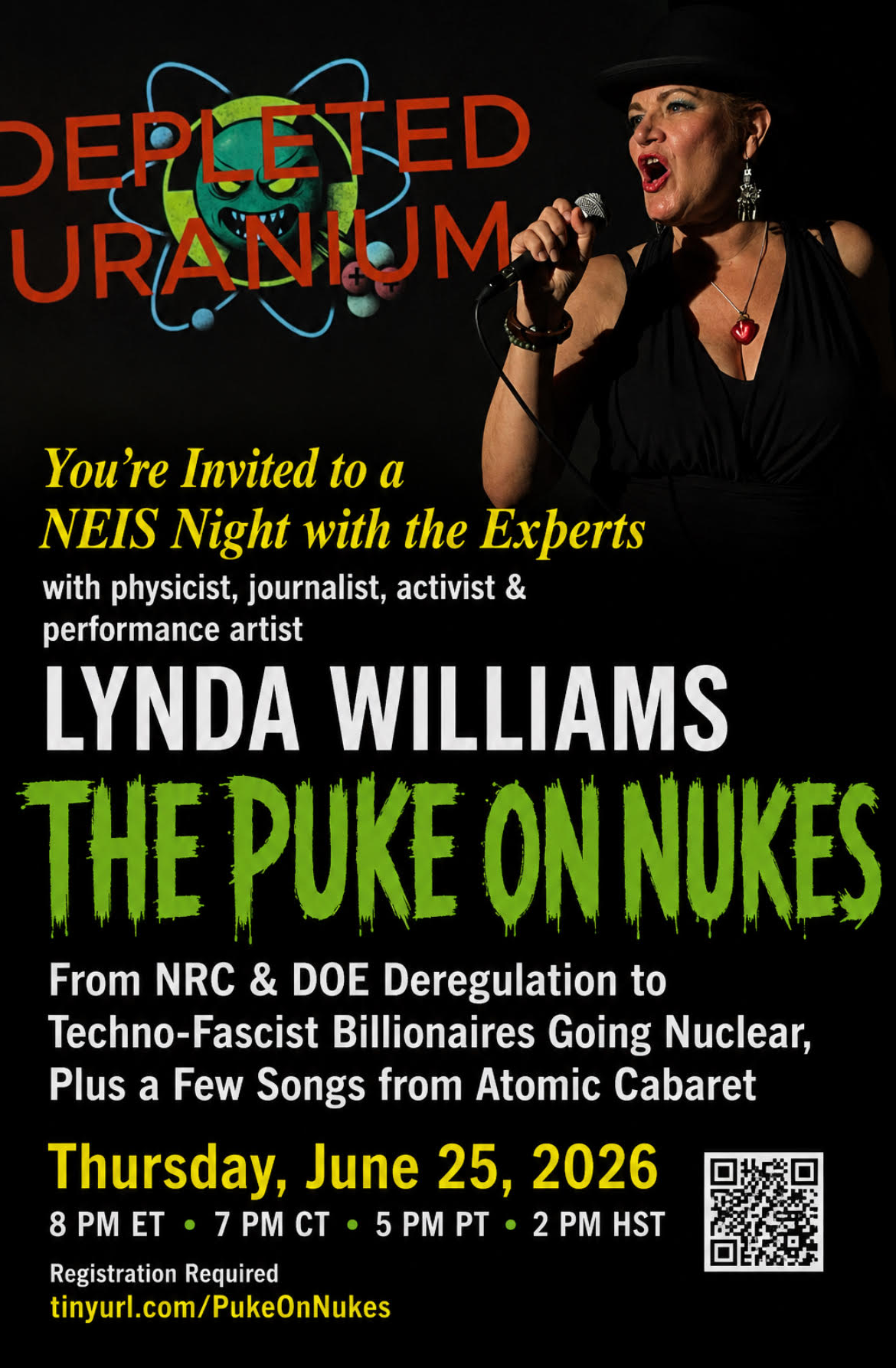
25 June- THE PUKE ON NUKES
Thursday, June 25, 2026
7pm Central Time (8pm ET, 6pm MT, 5pm PT) UTC – 5
From NRC & DOE Deregulation to Techno-Fascist Billionaires Going Nuclear, Plus a Few Songs from Atomic Cabaret REGISTER
26 June – Radiation Trainwreck at the NRC / Join the Protect Better Campaign – https://us02web.zoom.us/meeting/register/4ZlZ5_qLSHGiLSCg8FF6Bg#/registration


Cuba Is Not a Failed State – It Is a Besieged State
PETITION: “Global Appeal to Endorse Palestinian Right of Return of Refugees”
To see nuclear-related stories in greater depth and intensity – go to https://nuclearinformation.wordpress.com
-
Archives
- June 2026 (138)
- May 2026 (306)
- April 2026 (356)
- March 2026 (251)
- February 2026 (268)
- January 2026 (308)
- December 2025 (358)
- November 2025 (359)
- October 2025 (376)
- September 2025 (257)
- August 2025 (319)
- July 2025 (230)
-
Categories
- 1
- 1 NUCLEAR ISSUES
- business and costs
- climate change
- culture and arts
- ENERGY
- environment
- health
- history
- indigenous issues
- Legal
- marketing of nuclear
- media
- opposition to nuclear
- PERSONAL STORIES
- politics
- politics international
- Religion and ethics
- safety
- secrets,lies and civil liberties
- spinbuster
- technology
- Uranium
- wastes
- weapons and war
- Women
- 2 WORLD
- ACTION
- AFRICA
- Atrocities
- AUSTRALIA
- Christina's notes
- Christina's themes
- culture and arts
- Events
- Fuk 2022
- Fuk 2023
- Fukushima 2017
- Fukushima 2018
- fukushima 2019
- Fukushima 2020
- Fukushima 2021
- general
- global warming
- Humour (God we need it)
- Nuclear
- RARE EARTHS
- Reference
- resources – print
- Resources -audiovicual
- Weekly Newsletter
- World
- World Nuclear
- YouTube
-
RSS
Entries RSS
Comments RSS
 nuclear-news