Renewables based systems are reducing blackouts in UK and USA!

David Toke, Oct 11, 2024, https://davidtoke.substack.com/p/renewables-based-systems-are-reducing
The truth is gradually emerging that far from threatening electricity systems with blackouts, renewable energy-based systems are preventing them for occurring! This has a lot to do with the fact that the installation of batteries to deal with renewable output variability has the side-effect of improving grid resilience. Solar power is also reducing possibilities for blackouts in hot places.
Batteries stopped widespread blackouts just three days ago, on October 8th in the UK, when, the UK-Norwegian electricity interconnector suddenly crashed leading to a loss of 1.4 GW of power. Without rapid action, frequency levels would have fallen leading to widespread blackouts as the system tried to preserve grid stability. But 1.5 GW of batteries rapidly clicked into service saving the day (see HERE). Of course the build-up of batteries in the UK is only happening because of the growth of renewable energy!
Similar stories of how blackouts are being averted are coming from other places with growing renewables penetration, including Texas and California in the USA. In both cases, earlier blackouts were caused by conventional power system problems, but widely blamed on renewables by anti-renewables lobbies. But now as renewables, and battery systems, proliferate further, blackout rates are actually being reduced.
Speaking about the October 8th UK incident, Roger Hollies from the ARENCO Group, who originally posted about the outage response on linkedin (HERE) commented: ‘It’s exciting to see batteries casually keeping the lights on whilst delivering diversity of activity to maximise revenue. I count 9 markets and services being participated in by these 12 batteries during this 50 min window alone! This complexity is only going to continue with Quick Reserve coming online later this year, local markets expanding, more renewables coming online and we STILL are not using the +/-3Gvar of reactive power the installed BESS fleet can supply!’
In California, the number of blackouts has been dramatically reduced over the last couple of years. ‘Batteries were the biggest reason California didn’t see the power go out’ says Benjamin Storrow (see HERE). There has been a very big increase in battery installation in California. This has been driven partly by a State-led investment programme. In addition, the increase in battery capacity follows on from the new opportunities in spreading production from the increasing quantity of solar panels over longer periods of the day.
Texas has been saved from a summer power blow-out by a combination of solar pv and batteries. Climate-change inspired hotter summers have put a strain on the Texas grid to cope with the rising demands for air conditioning to meet the summer heat spikes. Once again, solar pv and batteries have come to the state’s rescue. See HERE.
Of course a lot of work still needs to be adapt the electricity from its traditional centralised dispatch mode to a decentralised way of operation. These include incentivising longer duration batteries, something encouraged by a ‘cap and floor’ incentive system for batteries announced by the Government today. See HERE. Initiatives to replace the inertial load system provided by traditional centralised power plant with new inertial sources needed to support variable renewable energy are also in play, for instance promoted by Statkraft’s Guy Nicolson HERE.
Acknowledgement to Dave Andrews from the Claverton Group for the alert on the Norway link tripping event.
Threads brings nuclear war fears to a new audience
“It is only in the last couple of years that the world is lurching towards world war three, that people start thinking about it again”
“the power station was a key target”
Julia Bryson, BBC News, 11 Oct 24
A television drama about a fictional nuclear attack on the city of Sheffield had a profound effect on many who watched it in the 1980s. Now it has aired once again, we spoke to some first and second-time viewers to gauge their reaction.
First broadcast in 1984, Threads has only been repeated a handful of times since – but having gained something of a cult following, it was repeated on BBC Four on Wednesday night to mark its 40th anniversary.
Andrea Cattermole, 56, from Sowerby Bridge, West Yorkshire, said she loved the realism – but it made her “really anxious that it could really happen”.
She said: “It made me think if it did happen, I’d rather be one of the first to die and not have to live through it, with all the effects it has on everyone in the long term.
Ms Cattermole said she thought everyone should watch Threads to “understand the dreadful problems it causes to everyone and the planet for many years after the event”.
The post-apocalyptic film was created by Kes author Barry Hines, and watching it has become something of a rite of passage for people in his home city of Sheffield.
Val Yates, from Retford, Nottinghamshire, remembered watching Threads for the first time in the 1980s, because it was around the time of her 16th birthday.
Now 56, she said watching it for a second time was “like going back to being 16”.
“When we grew up in the 80s we lived with the threat of nuclear war,” she said.
“It has suddenly become poignant again, it’s happening again now but for a new generation.”
As a teenager, Ms Yates lived in the village of Clarborough, which was only about five miles from West Burton power station, where her father worked.
“I think I probably watched it on my own in my bedroom first time round, my dad worked at the power station, so it was even more scary,” she said.
“There was a lot of propaganda around at the time, even in schools we learned about the Cold War and the Cuban missile crisis, it was very realistic.
“We were told the power station was a key target because it’s infrastructure.
“They said if a bomb went off in Sheffield it would take 11 minutes to reach us – there was a graphic which showed how quickly it would sweep the area and it terrified me.”
She added: “Everything settles down and today’s kids have no idea what it was like.
“It is only in the last couple of years that the world is lurching towards world war three, that people start thinking about it again,” she said……
The story is focused around two families who live in Sheffield when a nuclear bomb is detonated.
In the aftermath of the blast, increasingly desperate people are seen trying to seek medical help and food, and civilised society eventually breaks down. Within a generation, language has died out and survivors live in medieval conditions…………………………..
“It remains the most accurate depiction of what nuclear winter would look like,” said Mr Mann – whose documentary “Survivors – The Spectre of Threads” is set to be released next year.
“Nothing has ever captured what the consequences would be, and I think that is what the producer Mick Jackson intended to do.
“He made a stark warning of what that would look like. It is accurate and I think that is why it continues to scare people,” he added.
“It is not something at the immediate forefront of the consciousness at all times but it could still happen and I think that is why people find it so scary.”
Threads is now available to watch on BBC iPlayer. https://www.bbc.co.uk/news/articles/c2dp8197y3eo
UK and Ireland partners congratulate 2024 Nobel Peace Prize winner
Nuclear Free Local Authorities, 11 Oct 24,
On hearing the news that the Japanese Hibakusha survivor network Nihon Hidankyo (No More Hibakusha) has been awarded this year’s Nobel Peace Prize, NFLA and Mayors for Peace Chapter Secretary Richard Outram lost no time in sending the worthy winners our congratulations.
The Nobel Peace Prize Committee made their customary announcement on 11 October, two months before the formal award ceremony takes place in Oslo.
Founded on August 10, 1956, Nihon Hidankyo is the only Japanese national organisation of A-bomb survivors of Hiroshima and Nagasaki (Hibakusha). It has branches in all 47 Japanese prefectures, thus representing almost all organized Hibakusha. Impressively, its officials and members are all Hibakusha. Although most Hibakusha live in Japan, several thousand more live in Korea and in other parts of the world.
The website states that the organisation’s main objectives are:
1) The prevention of nuclear war and the elimination of nuclear weapons, including the signing of an international agreement for a total ban and the elimination of nuclear weapons. The convening of an international conference to reach this goal is also part of Hidankyo’s basic demand.
2) State compensation for the A-bomb damages. The state responsibility of having launched the war, which led to the damage by the atomic bombing, should be acknowledged, and the state compensation provided.
3) Improvement of the current policies and measures on the protection and assistance for the Hibakusha.
Although the Nihon Hidankyo website records that in March 2016 there were 174,080 Hibakusha living in Japan, since that time these numbers are fast dwindling as many are in their eighties or above. Doubtless this factor, and the fact that the organisation will be the holder of the current Nobel Peace Prize throughout 2025 when the world remembers and commemorates the 80th anniversary of the atomic bombings, have played their part in their worthy selection as this year’s winners.
More information can be found on the organisation’s website:
The text of the letter of congratulation follows…………………………………………….more https://www.nuclearpolicy.info/news/uk-and-ireland-partners-congratulate-2024-nobel-peace-prize-winner/
A desire to leave not a ‘compelling need’ under nuke dump compo scheme say Nuclear Waste Services

Residents no longer able to live under the continued threat of a potential nuclear waste dump will be unable to avail themselves of compensation if they simply sell up at a loss under the terms of the scheme recently announced by Nuclear Waste Services.
Last month, Nuclear Waste Services launched the Property Value Protection Scheme to compensate homeowners who sell their properties in the three GDF Search Areas in West Cumbria and East Lincolnshire for a sum that is lower than the ‘market price’ because the market has been blighted by the threat of a Geological Disposal Facility.
Given that a big factor in determining property price is ‘location, location, location’, future residency in an area hosting a GDF which we described as ‘a massive mining project akin to building the Channel Tunnel, into which the UK’s most deadly stockpile of radioactive waste would be deposited for eternity’, must inevitably result in blight, particularly in quiet, seaside retirement communities and those with no historic association with the nuclear industry.
In response, the NFLAs published a critique of the scheme as overly complex and too restrictive.[1]
Eligibility for compensation requires the applicant to hurdle five key conditions and supply complex evidence. One key hurdle is the need to demonstrate a ‘compelling need’ to sell.
On reading our critique, a Cumbrian resident and local Parish Councillor set out for the NFLAs their circumstances:
“I currently live in a rural hamlet with open countryside surrounding me, with far reaching views over the countryside to the mountains beyond. It is quiet and peaceful. This is the type of property and lifestyle I have chosen. I did not choose to live near a 1 KM square head works for a GDF with the long-term build and operating life with the noise, visual disturbance and general impact the development would bring. I would not live in that environment.”
The Secretary read out this scenario to NWS officials at the Nuclear Decommissioning Authority’s Stakeholder Summit in September and asked them if the desire to escape the prospect of a future GDF development would be accepted as a ‘compelling need’’.
After a follow up exchange of emails, the response was a resounding No: ‘A desire to move away from an area being considered to host a potential GDF would not meet the “compelling” need criteria of the PVP scheme.’
Although on the face of it, the NWS reply represents for people wishing to move a massive disappointment, the actual position may – as per usual with the GDF process – be more nuanced. For under the published guidance, ‘Section 3.5 – Criteria 5: Compelling need to sell’ it states that a compelling need includes ‘a significant change in health’.
It is clear from public questions posed at recent meetings of the East Lindsey District Council that the continued uncertainty is taking a toll on the emotional, mental and physical health of some residents. Surely then, in circumstances where they have had to obtain related professional medical treatment, the need to move must constitute a ‘compelling need?’ To the NFLAs taking a counterview would be inhumane.
Regrettably they will be unable to rely on any sympathy from any member with local residency and knowledge of the situation on the ground; for it has been made clear to the NFLAs that only specialists with relevant experience of administering similar compensation schemes used with other large national infrastructure projects will be eligible for appointment as ‘independents’ to the five-member panel that will consider applications. Tellingly no positions will be reserved for members of the Community Partnerships.
For more information, please contact Richard Outram, NFLA Secretary by email to richard.outram@manchester.gov.uk
Nuclear lobby takes over tertiary education, with blatant lies about “clean” “green” nuclear

X-energy plans fleet of 40 Xe-100 reactors across the UK. More than 100
businesses from across Teesside and the UK met to learn how they can work
with X-energy on its proposed nuclear new build project. X-energy, along
with deployment partner Cavendish Nuclear, discussed the potential fleet
production of its Xe-100 advanced modular nuclear reactors, likely
timescales, scope of contracts for companies of all sizes across multiple
sectors, and what is required to win business. The event at Hartlepool
College of Further Education was followed by a workshop…………… https://www.thenorthernecho.co.uk/news/24645271.x-energy-plans-fleet-40-xe-100-reactors-across-uk/
Hartlepool College of Further Education hosts 70 businesses to set out opportunities for X-energy’s multi-billion pound Hartlepool nuclear reactor project
By Madeleine Raine, 8 October 24
More than 100 representatives from local and national companies are meeting in Hartlepool to hear about the opportunities offered by X-energy’s proposed nuclear reactor project.
On Tuesday, October 8, businesses from across the UK are coming together at Hartlepool College of Further Education to find out about the role regional and British engineering, manufacturing and construction companies can have in building the next generation of [?] clean power production nationwide.
X-energy and deployment partner Cavendish Nuclear are going to be discussing the potential production of advanced modular nuclear reactors…………………………………………
“What X-energy is proposing with its AMR technology will make Hartlepool the epicentre of this country’s transition to a [?] green energy superpower with billions of pounds worth of generational investment”………………………….. https://www.hartlepoolmail.co.uk/news/people/hartlepool-college-of-further-education-hosts-70-businesses-to-set-out-opportunities-for-x-energys-multi-billion-pound-hartlepool-nuclear-reactor-project-4814707
Nuclear power stations are neither wanted nor needed in Scotland.
I REFER to the letter headed “Vote Sarwar if you want broken nuclear future” (Sunday National, Oct 6) from Leah Gunn Barret in which she summarises why Scotland doesn’t need nuclear power as proposed by the Labour government.
This is a position adopted by HANP (Highlands
Against Nuclear Power) since our formation. It appears that a lot more
lobbying and campaigning is needed, as the position taken by, for example,
environmental campaigner George Monbiot, is that nuclear is a clean energy
and needs to be “part of the mix” of energy sources.
Long-standing and new supporters of nuclear seem to ignore the reasons for nuclear not
needing to be “part of the mix” including: Generating electricity
through nuclear is twice as expensive as through renewables, and when
construction costs can’t be raised from the private sector the taxpayer
will pick up the bill.
Nuclear is not “carbon-free” or green, as uranium
has to be mined as the raw material required and there are high CO2
emissions during the average 15-year build period. All nuclear power
stations pose a risk to health and the environment both during operation
and decommissioning. Years after the fast breeder at Dounreay closed, there
are still radioactive particles being found on the foreshore around
Dounreay and there have been leaks of radioactive sodium.
The National 10th Oct 2024
The National 10th Oct 2024 https://www.thenational.scot/community/24644810.nuclear-power-stations-neither-wanted-needed-scotland/
Farmers warn over Hinkley Point C’s saltmarsh plan
Burnham & Highbridge Weekly News 12th October, By John Wimperis,
PLANS to turn a huge swathe of land in North Somerset into a marsh to make up for the environmental impact of Hinkley Point C would “destroy” homes and livelihoods, farmers have warned.
Bosses at Somerset’s new nuclear power station are proposing creating new saltmarsh habitats along the Severn to compensate for the number of fish that will die by being sucked into the power station’s cooling systems. But this means communities along the river and estuary face losing hundreds of acres of farmland.
In Kingston Seymour in North Somerset, the plans to turn 1,500 acres of prime agricultural land between Weston-super-Mare and Clevedon into salt marshes have caused outcry. Farmers, who were left in “extreme distress,” after finding out their land was under threat blocked access to wildlife surveys for the plans in protest on Tuesday (October 8).
A public meeting with EDF — the energy company building Hinkley Point C — is set to be held in Kingston Seymour Village Hall on October 14 at 7.45pm.
Farmers across the affected area have urged EDF to drop the plan.
Young farmer Sophie Cole of the farm at Wharf House said: “I am a third-generation young farmer in Kingston Seymour and all my land and property is directly impacted by this proposal.
“No amount of money can compensate me for the loss of my livelihood and exciting plans for the future.”
Peter and Karen Stuckey of Channel View Farm said: “We have a thriving commercial business which provides employment and services to local people.
“We also have agricultural land and several dwellings which provides much needed local housing.
“This proposal will destroy our home and livelihood and is causing us a great deal of worry and anxiety.”
They added: “This will destroy everything we have built up over the last 50 years.”
Meanwhile, at Dowlais Farm, Kathrin and David Kirk said: “We have rebuilt Dowlais Farm from near derelict to a great family home (grade II listed) as well as a thriving campsite and two holiday cottages.
“We purchased the farm seven years ago from North Somerset Council and have invested everything we have both financially and physically into this business and built it up from scratch.
“This proposal would destroy our livelihood and our home. It would also destroy wildlife habitats for otters, bats, badgers, foxes, deer as well as birds such as owls, kestrels and buzzards who all nest in the trees on our land.”
Dan Kostyla of Sea Wall Farm, another young farmer, said: “My family have been farming here for generations — I am fourth generation — and have invested heavily in the farm business. We have a large dairy and beef farm business.
“All of this will be lost from the food chain and our business will be unviable/destroyed.”
Another young farmer, Dan Kostyla of Sea Wall Farm said: “My family have been farming here for generations — I am fourth generation — and have invested heavily in the farm business. We have a large dairy and beef farm business.
“All of this will be lost from the food chain and our business will be unviable/destroyed.”
EDF said it is obligated to make environmental improvements such as salt marshes to compensate for the power station’s impact on fish populations, which the energy company said would be limited………….
A public consultation will be held on any plans before they go ahead……………………………………………………………… https://www.burnhamandhighbridgeweeklynews.co.uk/news/24646958.farmers-warn-hinkley-point-cs-saltmarsh-plan/
EDF Seeks to Raise Up to £4 Billion to Help Fund Construction of UK’s Hinkley Nuclear Plant
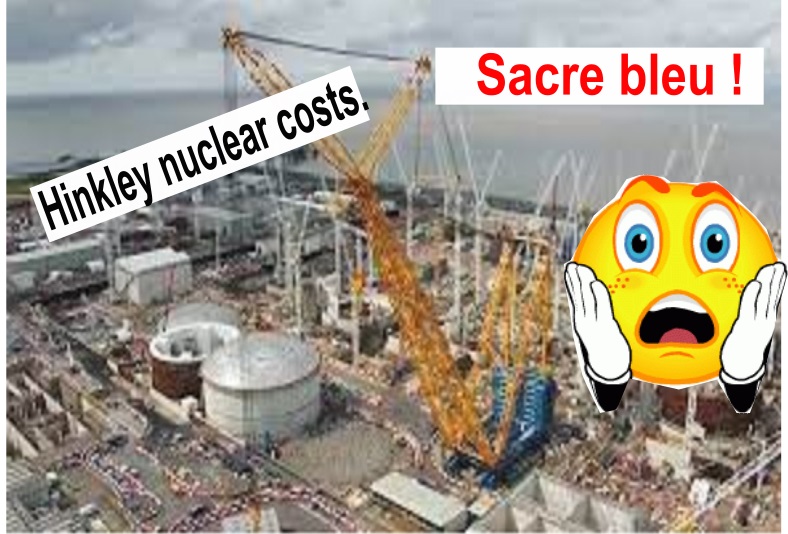
- Company is talking to funds for a stake sale in Hinkley Point
- EDF would reimburse investors if the nuclear project fails
Electricite de France SA is holding talks with investors over funding for
the Hinkley Point C nuclear power plant under construction in the UK, as
the French utility grapples with the ballooning cost of the project.
EDF is seeking to raise as much as £4 billion ($5.2 billion) through a bespoke
financial instrument which would give investors a stake in the Hinkley
project, people familiar with the matter said asking not to be named
because the discussions are private. Investors would be reimbursed if the
construction isn’t completed, one of the people said.
Bloomberg 10th Oct 2024
EDF reportedly seeking up to £4bn from investors to finish Hinkley Point C
French energy firm reported to be in talks over potential investment to cover ballooning cost of nuclear project
Jillian Ambrose 11 Oct 24, https://www.theguardian.com/uk-news/2024/oct/10/edf-seeks-to-raise-up-to-4bn-to-finish-delayed-hinkley-point-c
The French energy company EDF is reportedly in talks with investors to raise up to £4bn to finish the delayed Hinkley Point C project in Somerset, Britain’s first new nuclear reactors in a generation.
The utilities company, owned by the French state, has approached investors to help cover the ballooning cost of constructing the nuclear plant, which is understood to have reached almost £50bn due in part to supply chain issues and struggles securing skilled engineers, according to Bloomberg.
EDF is reportedly engaged in talks with sovereign wealth funds and large infrastructure funds to raise the extra money through a bespoke financial instrument that would hand investors a stake in Hinkley while protecting them against the risk that the project is not finished.
Hinkley Point C is due to begin generating electricity by 2030, according to EDF – five years later than first planned and 12 years after construction began. The project’s costs have also spiralled, from £18bn when its contracts were signed in 2016 to £47.9bn in today’s money.
The cost overruns and delays are understood to be in part due to spending on extra safety measures to satisfy UK authorities, and trouble securing skilled engineers after Brexit.
A team of specialist engineers at the Hinkley site, represented by the trade union Prospect, voted to strike for 24 hours from Thursday after pay talks broke down. The union said the engineers had not had a pay increase in the last four years.
The financial pressure on the project has deepened after EDF’s partner, China General Nuclear Power Group (CGN), a state-run company, declined to plough more funding into the project beyond its contracted term in 2023.
CGN has scaled back its interest in investing in the UK after tensions between Westminster and Beijing over security concerns made it clear that a Chinese company would not be given permission to lead a nuclear project in the UK.
In response, EDF has called on the UK government to stump up the cash to help finish the project, which will only benefit from bill payer subsidies once it begins generating, but the suggestion was rebuffed by the previous government.
One of the companies considering an investment in the troubled project is Centrica, the owner of British Gas, which has previously been linked to investment talks relating to EDF’s planned nuclear project at Sizewell C in Suffolk. The FTSE 100 company is reportedly in early talks to invest up to £1bn in Hinkley Point C, according to the Daily Telegraph.
Investing in new nuclear reactors would help to secure future electricity supplies for Centrica, which holds a 20% share in all five of EDF’s remaining UK nuclear power stations, four of which are due to close this decade.
Centrica is understood to be interested in investing in either Hinkley or Sizewell – but not both.
EDF and Centrica declined to comment.
Sellafield’s “Social Impact Multiplied” Wins Greenwash Award for “The Edge” Water Sports Centre in Contaminated Harbour.

On , By mariannewildart
To mark the 67th Anniversary of the Windscale Fire: Sellafield’s “Social Impact Multiplied” Wins Greenwash Award for “The Edge” Water Sports Centre in Whitehaven Harbour. The Edge was planned to open in 2022 but like all nuclear projects is running late and is still under construction.
The George Monbiot Award for Nuclear Greenwashing is presented this year to Sellafield’s “Social Impact Multiplied” for their funding of the £5Million water sports centre at Whitehaven harbour. The award organised by Lakes Against Nuclear Dump, alongside Close Capenhurst and North Cumbria CND will be made on the 10th October, the 67th anniversary of the Windscale fire, the UKs worst nuclear accident to date following the UK’s mad rush to produce atomic bombs.
The Nuclear Greenwashing award is tongue in cheek and named after the famously pro-nuclear Guardian journalist George Monbiot who declared in 2011 “How the Fukushima disaster taught me to stop worrying and embrace nuclear power”.
Campaigners say that this “conversion” by Monbiot was instrumental in greenwashing the nuclear industry and effectively quashing opposition to new nuclear build at Hinkley Point C.
Lakes Against Nuclear Dump have sent silt samples from Whitehaven harbour to Eberline laboratory at Oak Ridge, USA who have found the highly radioactive element AM241 present in the silt at levels which if ingested or inhaled would be dangerous to health. The National Nuclear Laboratory at Sellafield describes AM241 as “intensely radioactive” and remaining so for many generations into the future..The regulators insist “levels are safe” in correspondence with campaigners who point out that there is no “safe level” of ingestion or inhalation of radioactivity, even so called “low dose” is cumulative…………………………….
Campaigners point out that “Sellafield are well aware that the silt in Whitehaven harbour contains a cocktail of radioactive isotopes from their operations, alongside this there is the continuing acid mine pollution pouring into Queen’s Dock from old coal mines……………………
Campaigners urge Sellafield and the UK government to take full responsibility for the damage to the environment and human health by nuclear and mining blight in Whitehaven harbour instead of shamelessly greenwashing devastating pollution. https://mariannewildart.wordpress.com/2024/10/10/sellafields-social-impact-multiplied-wins-greenwash-award-for-the-edge-water-sports-centre-in-contaminated-harbour/?fbclid=IwY2xjawF1PI5leHRuA2FlbQIxMQABHZUCqPj8uRxd0NDTt_2ovDKLWj9Hd_7cGEbKmDBDZgK_APILKkCJ5qg7Mw_aem_8lHUOhxrfEooARrUCKnKvA
Nuclear plant ‘will decimate fish stocks’
How many fish does a nuclear power station kill? It sounds grisly, but for
the engineers on the Somerset coast building Britain’s first nuclear
power station in a generation, it’s an urgent question.
And for conservationists and local villagers on the banks of the River Severn in
Gloucestershire, it has become such an urgent question they filled a
village hall to debate it.
Proposals for the sea-water cooling system at
Hinkley Point C will see 44 tonnes of fish ingested and killed every year,
according to EDF, the company building it.
“This scheme will decimate
fish stocks,” said Dave Seal, a wildlife campaigner. “We already have
lost 80% of our salmon, and half of the salmon that get into Hinkley’s
cooling system will be destroyed.” But Andrew Cockroft, from Hinkley
Point C, insisted there will be a “very very small impact on fish
populations”.
BBC 9th Oct 2024
Could small modular reactors be used to create nuclear warheads?
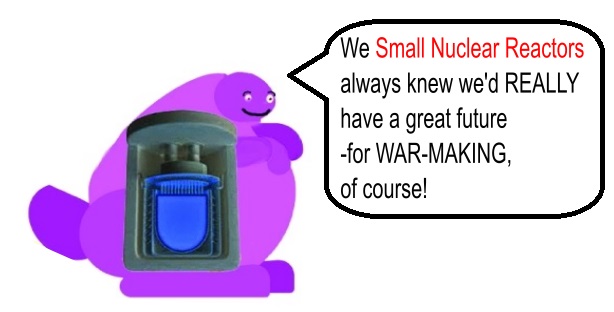
The global pursuit of small modular reactor (SMR) technology could feed
into the development of nuclear warheads. SMRs are near the top of the
agenda in the nuclear industry in the UK. At least four companies –
GE-Hitachi, Holtec Britain, Rolls-Royce SMR and Westinghouse Electric Co. –
are competing to have their designs adopted by Great British Nuclear, and
at the same time, the UK’s nuclear weapons stockpile is due to increase.
NCE asked the Department for Energy Security and Net Zero (DESNZ) under the
Freedom of Information (FoI) Act if it had made any assessment of the
potential for SMRs to produce material for nuclear weapons. In its
response, DESNZ said that the deployment of SMRs in the UK “will comply
with UK civil nuclear safety and security regulations and international
conventions to ensure that nuclear material intended for use in civil
nuclear deployments is used for that purpose only, and cannot be diverted
or manipulated for use in nuclear weapons”.
However, this statement does
not mean that SMRs cannot be used to create materials for nuclear warheads.
The fissile material that could potentially be used in nuclear weapons is
what is produced by the reactor, not what is used within it. DESNZ went on
to say that it “neither confirms nor denies that it holds information”
on whether assessments have been made on whether material from SMRs could
be used in nuclear weapons. “This is a qualified exemption, and we have
considered the public interest arguments in confirming or denying whether
we hold the requested information,” it continued.
“We acknowledge that
confirming or denying if information is held would provide assurance that
the Department takes the safe and secure deployment of nuclear energy
seriously. “However, confirming or denying that the information relevant
to your request is held may itself disclose the presence of sensitive
nuclear information. Such information could assist in potential criminal
activity if the information was used by malicious parties.
New Civil Engineer 9th Oct 2024
Revealed: EDF’s hidden plans for two huge 30 feet high flood barriers in the heart of East Suffolk’s Heritage Coast 04.10.24
As part of the much-criticised justification for issuing a nuclear site
licence for the controversial Sizewell C nuclear development, the UK’s
chief nuclear regulator, the Office for Nuclear Regulation (ONR), has
divulged hitherto hidden plans for two sea walls to be constructed in the
heart of East Suffolk’s Heritage Coast and the Suffolk & Essex Coast &
Heaths National Landscape, designed to provide additional flood protection.
Both walls are proposed to be up to 30 feet high. To the south of the
Sizewell C site, the wall will span the ‘Sizewell Gap’ joining Sizewell
A’s Sea defences to the cliffs south of Sizewell village. The northern
one will span the river in the Sizewell Marshes SSSI, joining Sizewell
C’s northern sea defences with higher ground inland at Goose Hill and
will be at least 100 metres in length but potentially much longer.
The ONR claims that Sizewell C Ltd, the site’s developer, is ‘committed’ to
installing these structures ‘should climate change be worse than is
reasonably foreseeable’, despite there being no mention of them in
EDF’s application for the Development Consent Order (DCO) for Sizewell C.
Therefore, they were absent from the plans approved by the Secretary of
State in July 2022 after he had overturned the Planning Inspectors’
recommendation for refusal.
TASC 4th Oct 2024
Rolls-Royce suffers £78m loss on mini-nukes amid UK rollout delays

Company moves ahead with Czech-backed project as Britain’s selection process for
SMR technologies drags on. Rolls-Royce’s mini nuclear reactor business has
posted a £78m loss as it awaits the outcome of a delayed UK tender
competition.
The company, which is developing a small modular reactor (SMR)
design that it hopes to export globally, saw losses in 2023 grow from £61m
the previous year, new accounts show. It came as the company ramped up
spending on research and development from £78m to £115m.
It made no revenue
and employed some 590 staff. Losses also grew as Rolls – along with three
rivals – continued to wait for a decision by the UK Government on which SMR
technologies it would back following a series of delays. The competition
was first announced by George Osborne, the former Conservative chancellor,
in 2015 but is still yet to reach a conclusion. Tufan Erginbilgiç, chief
executive of the Rolls-Royce group, has urged ministers to press ahead as
quickly as possible, saying he expects orders from around the world to
begin flowing in if Rolls emerges as a winner.
Telegraph 9th Oct 2024
https://www.telegraph.co.uk/business/2024/10/09/rolls-royces-mini-nukes-arm-suffers-loss-amid-delay/
EDF bosses grilled over River Severn salt marsh plans at ‘prickly’ meeting
Arlingham peninsula salt marsh proposal questioned at parish council meeting with one person turning up dressed as a hedgehog
News. Will Luker, Community Reporter, 8 Oct 24,
https://www.gloucestershirelive.co.uk/news/gloucester-news/edf-bosses-grilled-over-river-9615208
Plans for salt marshes along the River Severn in Gloucestershire linked to a new nuclear power station were met with disbelief at a packed meeting last night (Monday October 7). EDF bosses were quizzed at Arlingham Parish Council about their environmental improvement plans which are linked to the new Hinkley C site in Somerset.
Prior to the meeting, the energy firm has been in touch with landowners about the idea of creating salt marshes along the river. EDF made a presentation which outlined how important the nuclear power plant is and they identified four sites for saltmarshes.
They outlined Kingston Seymour in Somerset, Littleton Upon Severn in South Gloucestershire, Rodley near Westbury-on-Severn and Arlingham as the four areas they are interested in.
1 This Month

22 June – Virtual Event –Climate Change: New Data, New Debate

Monday, June 22, 2026 2:30 p.m. – 3:15 p.m. CT
YouTube. Register here
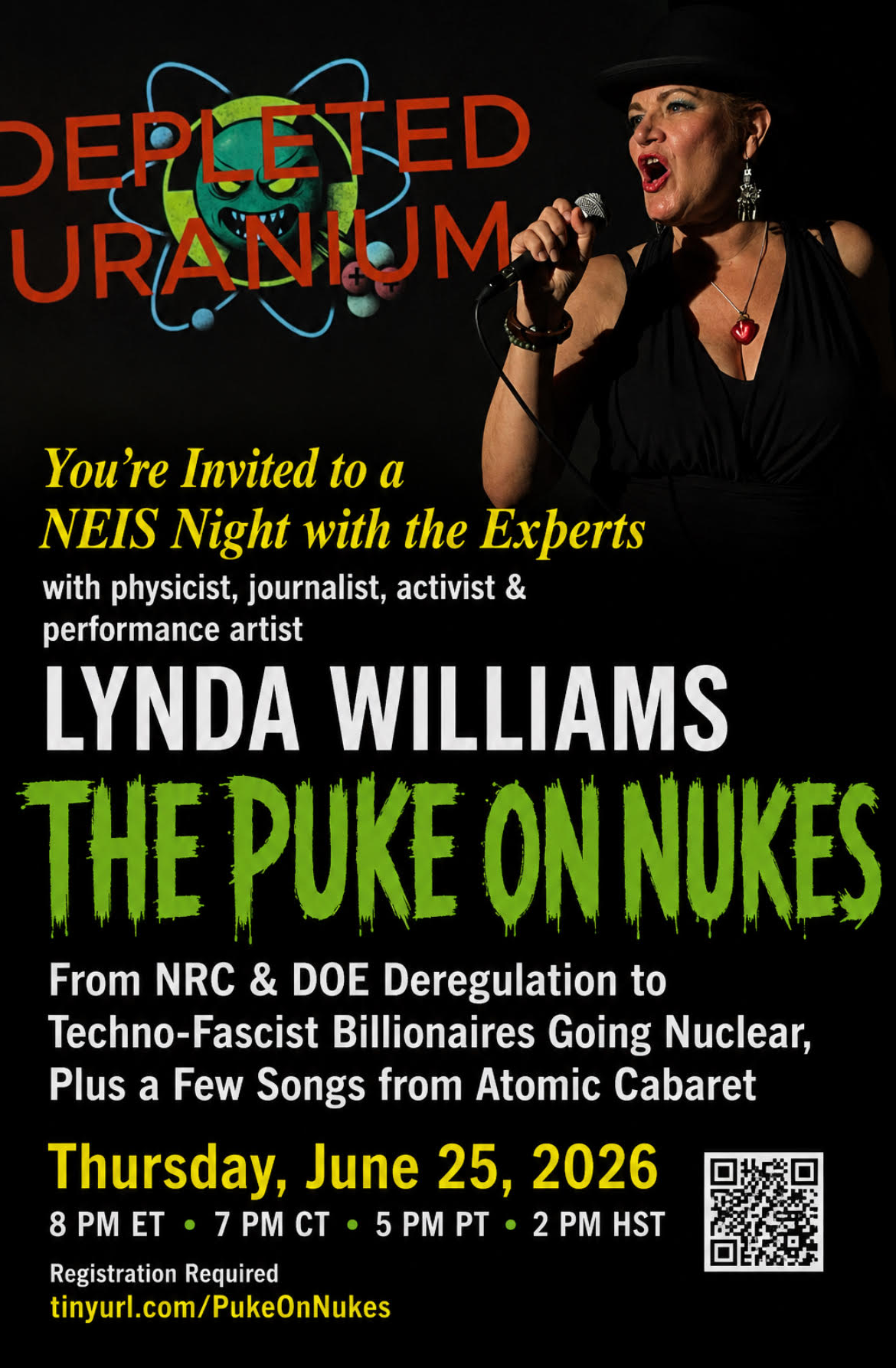
25 June- THE PUKE ON NUKES
Thursday, June 25, 2026
7pm Central Time (8pm ET, 6pm MT, 5pm PT) UTC – 5
From NRC & DOE Deregulation to Techno-Fascist Billionaires Going Nuclear, Plus a Few Songs from Atomic Cabaret REGISTER
26 June – Radiation Trainwreck at the NRC / Join the Protect Better Campaign – https://us02web.zoom.us/meeting/register/4ZlZ5_qLSHGiLSCg8FF6Bg#/registration
1st July – Webinar Waste of Space: The Environmental Harm of Military and Civil Space Activity st July, 7 pm

Report Launch Online: We are seeing an increasing exploitation of space for military and commercial purposes. This must change.

Protect Sazan Island from the Trump family! https://secure.avaaz.org/campaign/en/protect_sazan_island_from_the_trump_family_loc/?bqFCVab&v=174511&cl=22707147157&_checksum=5e9dde668860e8231c33699735e16a1fbf22ab2cb01da50c999fe8732b9775ef&utm_source=email&utm_medium=blast_email&utm_campaign=174511


Cuba Is Not a Failed State – It Is a Besieged State
PETITION: “Global Appeal to Endorse Palestinian Right of Return of Refugees”
To see nuclear-related stories in greater depth and intensity – go to https://nuclearinformation.wordpress.com
-
Archives
- June 2026 (221)
- May 2026 (306)
- April 2026 (356)
- March 2026 (251)
- February 2026 (268)
- January 2026 (308)
- December 2025 (358)
- November 2025 (359)
- October 2025 (376)
- September 2025 (257)
- August 2025 (319)
- July 2025 (230)
-
Categories
- 1
- 1 NUCLEAR ISSUES
- business and costs
- climate change
- culture and arts
- ENERGY
- environment
- health
- history
- indigenous issues
- Legal
- marketing of nuclear
- media
- opposition to nuclear
- PERSONAL STORIES
- politics
- politics international
- Religion and ethics
- safety
- secrets,lies and civil liberties
- spinbuster
- technology
- Uranium
- wastes
- weapons and war
- Women
- 2 WORLD
- ACTION
- AFRICA
- Atrocities
- AUSTRALIA
- Christina's notes
- Christina's themes
- culture and arts
- Events
- Fuk 2022
- Fuk 2023
- Fukushima 2017
- Fukushima 2018
- fukushima 2019
- Fukushima 2020
- Fukushima 2021
- general
- global warming
- Humour (God we need it)
- Nuclear
- RARE EARTHS
- Reference
- resources – print
- Resources -audiovicual
- Weekly Newsletter
- World
- World Nuclear
- YouTube
-
RSS
Entries RSS
Comments RSS
 nuclear-news