Why should Scotland pay billions for nuclear when renewables exist?

Dr Ian Fairlie: Why should Scotland pay billions for nuclear when
renewables exist?
Prime Minister Keir Starmer and Anas Sarwar this week
made further statements in support of more nuclear power in Scotland.
Scottish CND believe their claims about a “golden age of nuclear” are
pie in the sky and should be treated with a pinch (or more) of salt
A proper assessment of our energy situation requires us to look at what is
happening in the rest of the world. Last year, a record 582GW of renewable
energy generation capacity was added to the world’s supplies – but
there was almost no new nuclear. Indeed, each year, new renewables add
about 200 times more global electricity than new nuclear does.
Powerful economic arguments exist for renewables over nuclear. The main one is that the marginal (ie fuel) costs of renewable energy are next to zero, whereas nuclear fuel is extremely expensive. Nuclear costs – for both
construction and generation – are very high and rising, plus long delays
are the norm.
For example, the proposed Sizewell C nuclear station in
England is now predicted to cost £47 billion, with the UK Government and
independent experts acknowledging even this estimate may rise
significantly. And just this week, the Hinkley C station still under
construction in England added yet more costs to its anticipated huge bill.
Must Scotland follow these poor English examples? The reality is that new
nuclear power in Scotland would mean massive costs, a poisoned legacy to future generation and yet more radioactive pollution of our air and seas.
Given these manifest disadvantages, many independent commentators have questioned the UK Government’s seeming obsession with nuclear power.
The National 15th Nov 2025, https://www.thenational.scot/politics/25624042.scotland-pay-billions-nuclear-renewables-exist/
Nuclear for Wylfa the wrong way to go

Nuclear Free Local Authorities, 13th November 2025
Responding to today’s news that the UK Government intends to impose several so called ‘small modular reactors’ upon Wylfa, the Welsh NFLAs believe that this is the wrong way to go.
The money would be better spent on insulating Welsh homes to make them warmer and cheaper to run or used to develop more capacity in renewable technologies that can generate electricity cheaper and far quicker. And Ynys Mon can play a big part in that by becoming a centre of excellence for renewable technologies and so truly Wales’ ‘green energy’ island.
The Government’s nuclear delivery agency, Great British Energy – Nuclear recently concluded a ‘competition’ amongst SMR developers to select a preferred design. Unsurprisingly Rolls-Royce, which had already received a Government hand-out of £210 million during an earlier development stage and a Government hand-up by being fast-tracked onto the Generic Design Assessment process, won the competition. This was the equivalent of running a race with superior sports footwear, and starting the race much earlier, than the other participants. The company will now be awarded a further £2.5 billion of hard-pressed taxpayers money to build three pilot SMRs.
13th November 2025
Nuclear for Wylfa the wrong way to go
Responding to today’s news that the UK Government intends to impose several so called ‘small modular reactors’ upon Wylfa, the Welsh NFLAs believe that this is the wrong way to go.
The money would be better spent on insulating Welsh homes to make them warmer and cheaper to run or used to develop more capacity in renewable technologies that can generate electricity cheaper and far quicker. And Ynys Mon can play a big part in that by becoming a centre of excellence for renewable technologies and so truly Wales’ ‘green energy’ island.
The Government’s nuclear delivery agency, Great British Energy – Nuclear recently concluded a ‘competition’ amongst SMR developers to select a preferred design. Unsurprisingly Rolls-Royce, which had already received a Government hand-out of £210 million during an earlier development stage and a Government hand-up by being fast-tracked onto the Generic Design Assessment process, won the competition. This was the equivalent of running a race with superior sports footwear, and starting the race much earlier, than the other participants. The company will now be awarded a further £2.5 billion of hard-pressed taxpayers money to build three pilot SMRs.
Great British Energy – Nuclear also purchased the Wylfa and Oldbury sites off Horizon for £160 million for reuse as locations for these new SMRs, almost certainly at nil or minimal cost to the developer, and GNE – N recently advertised for a site manager with proficiency in the Welsh language letting slip that Wylfa was the preferred site.
The Government’s announcement refers to Wylfa becoming Britain’s first SMR ‘power plant’ with reactors plural, suggesting that the three initial reactors will all be co-located on the island. SMRs are an uncertain and unproven nuclear technology. The Rolls-Royce SMR design has yet to secure all the required regulatory approvals, no Rolls-Royce SMR have yet been built, let alone operated, and there is no experience of SMR modular assembly. Any reactor will not even come on stream until the 2030’s and even then will only deliver electricity for customers that is vastly more expensive than that generated by renewables. Nor has any permanent solution to the intractible problem of managing high-level radioactive waste been found, but there has been some academic research which indicates that many SMR designs create more waste per kilowatt generated than traditional gigawatt plants. And as Ukraine has demonstrated, nuclear power plants are obvious targets in any future conflict.
Wylfa is a particularly problematic location. The Horizon bid was rejected in part because of the damage it would cause to nature and the beautiful environment of Ynys Mon and its impact on the island’s linguistic heritage. But the bid failed largely because the developer felt they were not receiving enough financial support from the taxpayer. How will this be different? The price tag for a single SMR is likely to be at least £4 billion. Will a public subsidy of £2.5 billion be deemed sufficient to Rolls Royce to incentivise them to proceed with buiding three? How will electricity be transmitted across and out of the island? It is very likely that we shall see a sea of new pylons spring up across the green fields of Ynys Mon and beyond. If parts for a modular reactor are made off-site, how will they be transported onto the island? And with ‘First of a Kind’ experimental SMRs at Wylfa, and a military neighbour at RAF Valley, surely the UK Government is making Ynys Mons an even higher-priority target for terrorists or a hostile power in time of war. How will islanders be evacuated quickly and safely should there be an attack or an accident?
The promised thousands of jobs ‘for the local community’ must also be questionable. ………………………………………………………………………………………………
The Welsh NFLAs would rather see the £2.5 billion dedicated to SMR development at Wylfa redirected by the UK Government to reduce the energy bills of Welsh citizens and move closer to making Wales a wholly renewable electricity nation. How? By funding an emergency programme of retrofitting insulation to Welsh homes and into supporting renewable energy projects……………………………………………………………………………………………………………………… https://www.nuclearpolicy.info/news/nuclear-for-wylfa-the-wrong-way-to-go/
Atom is prematurely split in the ‘golden age’ transatlantic partnership
Nils Pratley, 14 Nov 25 https://www.theguardian.com/business/2025/nov/13/atom-split-us-uk-golden-age-partnership-wylfe-smr
Britain was always going to prefer homegrown technology for the SMR reactors at Wylfe. The US would have done the same.
It had all been so harmonious two months ago. “Together with the US, we’re building a golden age of nuclear that puts both countries at the forefront of global innovation and investment,” purred the prime minister about the new “landmark” UK-US nuclear partnership.
Now there’s an atomic split over the first significant decision. The UK has allocated Wylfa on the island of Anglesey, or Ynys Môn, to host three small modular reactors (SMRs) to be built by the British developer Rolls-Royce SMR. The US ambassador, Warren Stephens, says his country is “extremely disappointed”: he wanted Westinghouse, a US company, to get the gig for a large-scale reactor.
This quarrel is easy to adjudicate. The US ambassador is living in dreamland if he seriously thought the UK wouldn’t show home bias at Wylfa. This is the coveted site for new nuclear power in the UK because the land is owned by the government, which ought to make the planning process easier and quicker, and the site hosted a Magnox reactor until 2015, so the locals are used to nuclear plants. Since Rolls-Royce’s kit is the best national hope of reviving the UK’s industry with homegrown technology, of course there was going to be preferential treatment.
None of which is to say the SMR experiment will definitely succeed in the sense of demonstrating cheapness (a relative measure in nuclear-land) versus mega-plants, such as Hinkley Point C, Sizewell C or the Westinghouse design. Rolls-Royce oozes confidence about the cost-saving advantages of prefabrication in factories, but these have yet to be demonstrated on the ground. The point, though, is that the only way to find out is to get on and build. Rolls-Royce SMR’s only other order currently is from the Czech Republic for six units.
Indeed, the criticism from some quarters is that the UK government has been too timid in ordering only three. If the batch-production is supposed to be the gamechanger on costs, goes the argument, then commit to a decent-sized batch at the outset.
The choice of Wylfa may help on that score in time, though. The site is reckoned to be big enough to hold an additional five SMR units eventually, on the top of the first three. Since each SMR is 470 megawatts, a full build-out would equate to more megawatts in total than the 3,200 from each of Hinkley and Sizewell.
The sop to the US is that Westinghouse gets to compete for future large-scale reactor projects in the UK. It would probably have been a good idea to tell the ambassador in advance before he blew a fuse. Reserving Wylfa for Rolls-Royce SMRs was the only sensible decision here.
Hopes that SMR technology will become a major export-earner for the UK eventually are best treated with extreme caution at this stage. The first electricity from Wylfa won’t be generated until the mid-2030s, and the demonstration of falling costs with each additional unit can only come after that. There is a long way to go. But a good way to maximise your chance of success is to give the top site to your pet project. The US would have done exactly the same.
Wales Green Party responds to new nuclear power plans
by Green Party, https://greenparty.org.uk/2025/11/13/wales-green-party-responds-to-new-nuclear-power-plans/
Responding to the announcement of plans for new nuclear power generation on Ynys Môn, leader of Wales Green Party Anthony Slaughter, said:
“It’s Groundhog Day yet again. Gordon Brown declared a bold future for nuclear power back in 2009, showing us nuclear is of no help in fighting the climate crisis.
“New nuclear power at Wylfa would be nothing but an expensive distraction from the clean, fast and cheap renewables already available to us. We need to cut emissions fast, but even the most optimistic backers admit it’ll take a decade for new nuclear to be up and running.
“And there is still no answer to the safe disposal of nuclear waste.
“What Wales needs is a fast, ambitious roll-out of solar, wind and wave energy that will create jobs and cut energy bills.”
Sizewell C. Taxpayers likely to see ‘no return’ on £6.4bn public funds put in as equity
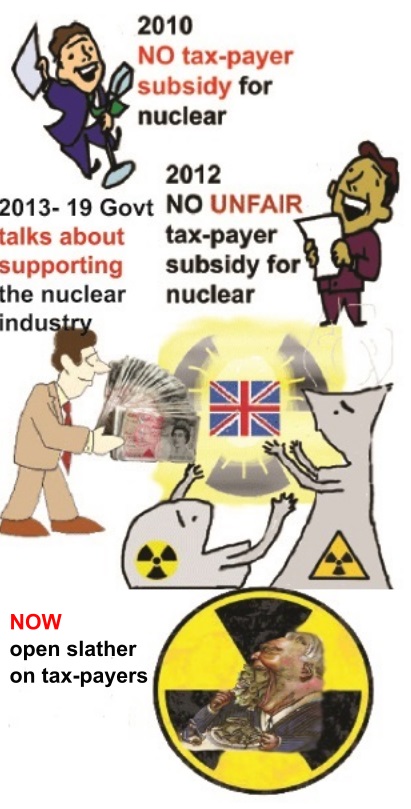
taxpayers are getting no return whatsoever on the £6.4bn they are putting in as equity, so from a taxpayer point of view it is dreadful.
10 Nov, 2025, By Tom Pashby, New Civil Engineer
Taxpayers will see “no return whatsoever” on the £6.4bn that the government is committing in equity to Sizewell C, according to an energy policy expert.
Earlier in November 2025, Sizewell C reached financial close with a £5bn funding injection from 13 banks paving the way for full-scale construction.
The deal secures around £5.5bn of new financing consisting of a £5bn export credit-backed facility arranged by Bpifrance Assurance‑Export (BpifranceAE) with support from Sfil, and a separate £500M working capital facility.
These facilities sit alongside a term loan provided by the UK’s National Wealth Fund and the equity that was raised earlier this year following the Final Investment Decision (FID) for the Suffolk nuclear power plant in July.
In April 2025, the government announced that a further £2.7bn of taxpayer cash had been made available for Sizewell C, bringing the total to £6.4bn ahead of the FID on the nuclear power station.
The agreements on private investment to build the new nuclear power station have been reached through the government agreeing to use the Regulated Asset Base (RAB) model. RAB works by having consumers pay a surcharge on their bills during the construction phase, which helps lower the cost of capital and reduces the financial risk for investors. This surcharge will be added to bills through the construction and for the first three years of operation. It goes towards paying back the private entities for their investment and, according to the government, will mean lower bills for consumers over the long term. Ofgem, as the regulator, sets the allowed revenue to ensure costs are incurred efficiently and consumers get value for money.
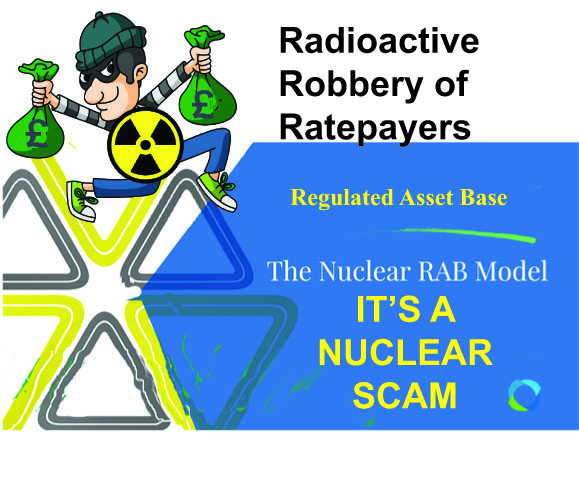
However, University of Greenwich emeritus professor of energy policy Steve Thomas is scptical about this, given that the current official estimate of £38bn to build Sizewell C is at the lower end of the range of likely costs and this is in 2024 prices, with inflation pushing it up all the time.
Additionally, there is no official timeline for construction completion. As has been seen with Hinkley Point C, cost and schedule overruns come with the territory.
He told NCE: “From 1 December 2025, consumers will start to pay a surcharge on the electricity bills to pay for the return being paid to investors (10.8% real) on their equity contribution (35% of the costs) and the interest payments on the loans, expected to be 4.5% (real).
“A bit of arithmetic suggests the surcharge will be split 44% interest payments and 56% rate of return on equity.
“The Low Carbon Contracts Company has said the surcharge in the period up to the end of March 2027 will be £3.54/MWh.”
He added that the £3.54/MWh figure would subsequently be updated annually based on the latest cost calculations.
“Ofgem says the average domestic consumer uses 2,700kWh per year so that amounts to about £9.56 per consumer in the first year,” he said. He believes this could rise to £62.70 per year by the end of the surcharge period.
“The government has said it will recycle its income from the surcharge back to electricity consumers, but we don’t know and nor does the government how it will do this and what proportion of the surcharge it receives will go back to consumers.
“Recycling the income means the government is giving consumers the interest that is paid to the National Wealth Fund on borrowing of £11.8bn and taxpayers are getting no return whatsoever on the £6.4bn they are putting in as equity, so from a taxpayer point of view it is dreadful.
Sizewell C ‘fails miserably’ on transparency – campaigner
Stop Sizewell C executive director Alison Downes said: “If Sizewell C can publicly state it expects the project to cost £38bn, why won’t they tell us when we can expect to see first power?
“Given that the British public is largely paying for Sizewell C through our taxes and energy bills, don’t we have the right to know how long it will take?
“Cynically this sounds like a ‘learning’ from Hinkley Point C – don’t tell people when it will be finished so you can’t be criticised for missing your deadlines. As an exercise in transparency, it fails miserably.”………………. https://www.newcivilengineer.com/latest/sizewell-c-consumers-like-to-see-no-return-on-6-4bn-public-funds-put-in-as-equity-10-11-2025/
US ‘disappointed’ that Rolls-Royce will build UK’s first small modular reactors.
Guardian, 13 Nov 25
As Keir Starmer announces SMRs to be built in Wales, US ambassador says Britain should choose ‘a different path.
Keir Starmer has announced that the UK’s first small modular nuclear reactors will be built in north Wales – but immediately faced a backlash from Donald Trump’s administration after it pushed for a US manufacturer to be chosen.
Wylfa on the island of Anglesey, or Ynys Môn, will be home to three small modular reactors (SMRs) to be built by British manufacturer Rolls-Royce SMR. The government said it will invest £2.5bn.
SMRs are a new – and untested – technology aiming to produce nuclear power stations in factories to drive down costs and speed up installation. Rolls-Royce plans to build reactors, each capable of generating 470 megawatts of power, mainly in Derby.
The government also said that its Great British Energy – Nuclear (GBE-N) will report on potential sites for further larger reactors. They would follow the 3.2GW reactors under construction by French state-owned EDF at Hinkley Point C in Somerset and Sizewell C in Suffolk.
The Labour government under Starmer has embraced nuclear energy in the hope that it can generate electricity without carbon dioxide emissions, while also providing the opportunity for a large new export industry in SMRs.
However, it faced the prospect of a row with the US, piqued that its ally had overlooked the US’s Westinghouse Electric Company when choosing the manufacturer for the Wylfa reactors.
Ahead of the publication of the UK announcement, US ambassador Warren Stephens published a statement saying Britain should choose “a different path” in Wales.
“We are extremely disappointed by this decision, not least because there are cheaper, faster and already-approved options to provide clean, safe energy at this same location,” he said.
The Trump administration last month signed an $80bn (£61bn) deal with Westinghouse, which had been struggling financially, to build several of the same larger reactors proposed at Wylfa. Under the terms of that deal, the Trump administration could end up taking a stake in the company……………………………………………………………………………………………………………………… https://www.theguardian.com/environment/2025/nov/13/us-disappointed-that-rolls-royce-will-build-uks-first-small-modular-reactors
NFLAs welcome Remembrance Day award of medal to nuke test ‘Sniffers’, but fight not over as groundcrews exposed to radiation remain forgotten.
11th November 2025, https://www.nuclearpolicy.info/news/nflas-welcome-remembrance-day-award-of-medal-to-nuke-test-sniffers-but-fight-not-over-as-groundcrews-exposed-to-radiation-remain-forgotten/
The NFLAs have welcomed the Remembrance Day announcement that the Government has agreed to award the Nuclear Test Medal to gallant RAF aircrew of 27 and 543 Squadrons and sailors aboard the Royal Fleet
Auxiliary vessel Sir Percivale who passed through French and Chinese atmospheric nuclear tests in the Far East to carry out air sampling.
British personnel were ordered to fly or sail through the radioactive clouds of over 40 atomic and nuclear atmospheric tests carried out by China and France.
11th November 2025
NFLAs welcome Remembrance Day award of medal to nuke test ‘Sniffers’, but fight not over as groundcrews exposed to radiation remain forgotten
The NFLAs have welcomed the Remembrance Day announcement that the Government has agreed to award the Nuclear Test Medal to gallant RAF aircrew of 27 and 543 Squadrons and sailors aboard the Royal Fleet Auxiliary vessel Sir Percivale who passed through French and Chinese atmospheric nuclear tests in the Far East to carry out air sampling.
British personnel were ordered to fly or sail through the radioactive clouds of over 40 atomic and nuclear atmospheric tests carried out by China and France.
The NFLAs have been strong advocates for recognition, justice and compensation for Britain’s nuclear test veterans and their families, and the latest announcement comes just a month after NFLA Chair, Councillor Lawrence O’Neill, wrote to the new Veterans Minister, Louise Sandher-Jones, calling for the eligibility criteria for the medal to be extended to include these forgotten ‘sniffers’.
Unfortunately, the revised award criteria still wrongly exclude the RAF ground crew involved in decontaminating the aircraft on their return to the UK. The aircraft involved in sniffing operations were contaminated with radioactivity, and they were decontaminated by washing by groundcrew. Many of these groundcrew were unaware of the levels of radioactivity on the aircraft.
Consequently, many of these ground crew also developed cancers and other health conditions related to exposure to ionising radiation, some repeatedly. Some personnel died and others were able to access a War Pension as a result.
The latest decision by Ministers therefore only represents a part-victory. Councillor O’Neill believes that excluding the ground crew seems ‘not only unjust, but also bizarre and perverse’ given these veterans faced the same dangers as their colleagues who engaged in ‘sniffing’ duties on British tests and who will now qualify for the medal.
The fight therefore continues.
Labour’s ‘national security threat’ attacks on Scottish National Party are hypocrisy 101

TO no one’s surprise, Anas Sarwar has lined up behind his UK bosses and doubled-down on claims that the Scottish Government is a “national security threat”. The Scottish Labour leader has meekly joined Defence Secretary John Healey, Deputy Prime Minister David Lammy, and Scottish
Secretary Douglas Alexander in deploying the inflammatory rhetoric against the SNP Government.
National security expert Professor Nick Ritchie pointed
out last week, Labour’s pro-nuclear rhetoric also undermines the international law that they are supposedly signed up to. The UK is a signatory to the nuclear Non-Proliferation Treaty (NPT), which obliges Britain to “pursue negotiations in good faith on effective measures” relating to nuclear disarmament.
But instead of uphold their obligations – which many top experts believe they are breaching – Labour ministers
are on the airwaves accusing the SNP of being a security threat for opposing nuclear weaponry.
The National 10th Nov 2025, https://www.thenational.scot/news/25611206.labours-national-security-threat-attacks-snp-hypocrisy-101/
Does Britain really need nuclear power? – Campaign for Nuclear Disarmament
, https://labouroutlook.org/2025/11/10/does-britain-really-need-nuclear-power-campaign-for-nuclear-disarmament/
With funding confirmed for a new nuclear power station in Suffolk, Dr Ian Fairlie, CND Vice-President and science adviser, and a leading consultant on radioactivity in the environment, questions whether we actually need this development and the technology in general.
In recent months, the government has continued to promote nuclear reactors. For example, the Energy Secretary is now asking GB Energy to assess sites to be used to host new nuclear reactors. And the Prime Minister continues to push for so-called Small Modular Reactors and has backed the US President’s wishful thinking of ‘a golden age of nuclear’.
But these announcements and proposals are mostly pie-in-the-sky statements and should be treated with a pinch (or more) of salt, as the reality is otherwise.
Let’s look at what is happening in the rest of the world. Last year, a record 582 GW of renewable energy generation capacity was added to the world’s supplies: almost no new nuclear was added.
Indeed, each year, new renewables add about 200 times more global electricity than new nuclear does.
Of course, there are powerful economic arguments for this. The main one is that the marginal (i.e. fuel) costs of renewable energy are close to zero, whereas nuclear fuel is extremely expensive. Nuclear costs – for both construction and generation – are very high and rising, and long delays are the norm. For example, the proposed Sizewell C nuclear station is now predicted to cost £47 billion, with the government and independent experts acknowledging even this estimate may rise significantly. The upshot is that new nuclear power means massive costs, a poisoned legacy to future generations, and whopping radioactive pollution.
iven these manifest disadvantages, independent commentators have questioned the government’s seeming obsession with nuclear power. It is not that nuclear provides a good solution to global warming: it doesn’t. The United Nations’ Intergovernmental Panel on Climate Change (IPCC) reports that renewables are now 10 times more efficient than new nuclear at CO2 mitigation. It’s not that AI centres will need nuclear: the International Energy Agency expects data centres will cause a mere 10% of global electricity demand growth to 2030. And it forecasts that the renewables will supply 10 to 20 times the electricity required for data-centre growth, with Bloomberg NEF predicting a 100-fold renewables expansion.
As for so-called Small Modular Reactors, the inconvenient truth is that these designs are all just paper designs and are a long way off. They would also be more expensive to run than large reactors per kWh – the key parameter. And as the former Chair of the US government’s Nuclear Regulatory Commission (NRC) says, SMRs will produce more chemical and radioactive waste per KW produced than large reactors.
Given a UK Treasury strapped for cash, the unsolved problem of radioactive nuclear waste, the spectre of nuclear proliferation, and it’s being a target in future wars, many wonder why the government is so fixated with nuclear power.
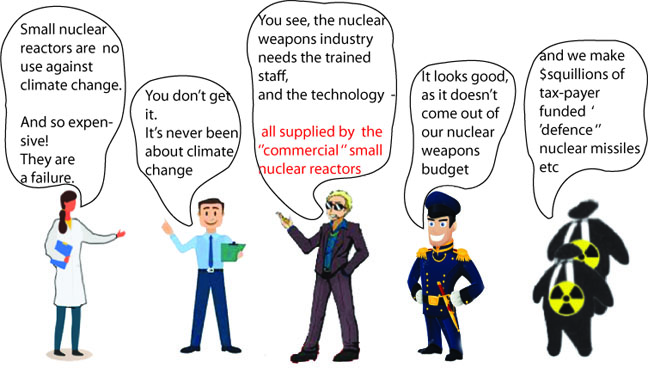
Well, the answer was supplied in 2023 by the Rishi Sunak administration which admitted that the main reason for its continued eye-watering financial support for civil reactors was that they provided needed technical support and expertise for the government’s nuclear weapons programme.
Rosyth councillor doesn’t want Trident submarines at yard
10th November, By Ally McRoberts, Herald Scotland
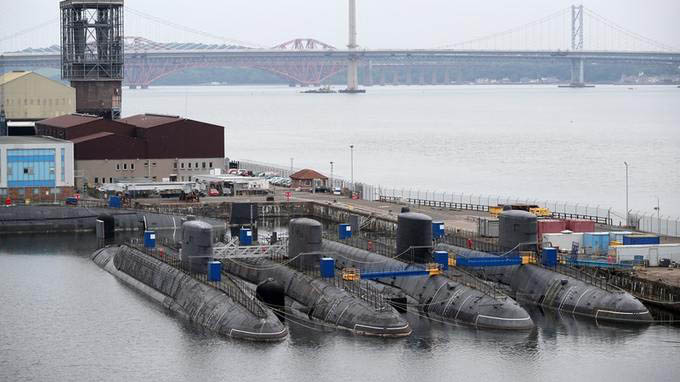
Iodine tablets to counteract the effects of radiation would need to be given to “half the population of Rosyth” if proposals to bring more nuclear subs to the dockyard go ahead.
That’s the fear of local SNP councillor Brian Goodall who said the emergency planning measures that would be needed was an issue of “great public concern”.
The next generation of Trident submarines is the Dreadnought class and, in September, Babcock bosses said that a £340 million investment from the UK Government would help pay for a contingent dock for the boats to come into Rosyth.
There are already seven decommissioned nuclear subs being cut up at Rosyth and the defence firm are due to give an update on the dismantling project to councillors at next month’s South and West Fife area committee meeting.
At this week’s meeting Cllr Goodall said: “I am hopeful that we can make a request to Babcock and the Ministry of Defence that they include in that update some more information about the proposal to use Rosyth as a contingent docking base for the Trident submarines.
“Apparently the MoD has decided it is the only suitable venue other than Faslane.”
He said he first heard of the proposal at a recent Rosyth Dockyard Local Liaison Committee meeting and added: “They did say that one of the issues, if it was to go ahead, the emergency planning would have to involve issues like arrangements to distribute iodine tablets to half the population of Rosyth, which to me means this is an issue of great public concern.
“Certainly something that should be subject to wider public consultation rather than just a decision being taken by the MoD that this is the only suitable site to do it.”
Committee convener, Cllr David Barratt, said he had attended the recent Rosyth Community Council meeting and added: “They were clear as well that there is significant community interest on this and consultation and community engagement is essential if significant changes are proposed for the use of the dockyard.
“I hope we can write to the MoD and ask that that is addressed or that they are prepared to answer questions when they attend in December.”
Iodine tablets, taken at the right time, can block the absorption of radioactive iodine by flooding the thyroid gland.
The UK Government have detailed plans for providing the tablets – potassium iodate or potassium iodide – in the event of a radiation emergency involving a release of radioactive iodine.
The possibility of bringing more subs to Rosyth was raised after the UK Government’s £340m investment in the dockyard was confirmed in September………………………………………………………….. https://www.heraldscotland.com/news/25607814.rosyth-councillor-doesnt-want-trident-submarines-yard/
Proposed solar farm could help make Island ‘centre of excellence’ – minister.

FARMERS should be able to “grow” solar power in their fields in the
same way as other crops, the Environment Minister has said during a speech
in which he highlighted the growing use of technology in agriculture.
Deputy Steve Luce, who was one of two members of the Council of Ministers
to address the 2025 Jersey Farming Conference, said that a proposed solar
farm in St Martin presented a “wonderful opportunity” for the Island to
play its part in combatting climate change. “The site could become a
European centre of excellence, showing how we could be helping farmers, and
producing sustainable energy, by enabling research and education to happen
at the same time,” he said. “In combining the latest agrivoltaics,
solar technologies, and innovations, Jersey could well end up leading on
this type of agricultural initiative.”
Jersey Evening Post 8th Nov 2025, https://jerseyeveningpost.com/news/2025/11/08/proposed-solar-farm-could-help-make-island-centre-of-excellence-minister/
The ‘weird’ catch to Labour’s ‘national security threat’ attack on the Scottish National Party.

LABOUR’S “national security threat” attacks on the SNP reveal how deeply embedded support for nuclear weapons has become in UK politics, a leading security academic has said.
Nick Ritchie, a professor of international security at the University of York, said that by branding opposition to Trident as a danger to the nation, ministers risk “shutting down” democratic debate on defence.
Ritchie, who last year led research
on international nuclear security for the New Zealand government, spoke to
the Sunday National after Labour ministers ramped up their rhetoric against the Scottish Government, suggesting it poses a bigger danger to UK
interests than China.
In the past week, Deputy Prime Minister David Lammy,
Scottish Secretary Douglas Alexander, and Defence Secretary John Healey
have all described the SNP administration as a “threat” to UK national
security. The Labour ministers’ arguments hinge on the SNP’s opposition to
nuclear weaponry, which Ritchie said “really reduces how you can talk and
think about national security”.
He suggested that national security was
being “conflated with unequivocal support for nuclear weapons”. RITCHIE
said the “weird thing” is that the UK Government is technically legally
bound “under the Non-Proliferation Treaty to work towards the goal of
nuclear disarmament”. He went on: “Of course, the caveat is that the
time is not right now, it’ll be far too difficult and so on and so forth.
But the premise – that nuclear disarmament is where we need to end up – is a premise that is accepted, or has been accepted, by governments of all
stripes. “So there’s a tension there between accepting that on the one
hand and then chastising the SNP for a pretty legitimate position that
nuclear weapons are a security liability. This is the position that the
majority of countries in the world have taken.”
The National 9th Nov 2025, https://www.thenational.scot/news/25606016.weird-catch-labours-national-security-threat-attack-snp/
Brian Goodall says no to next stage of submarine dismantling
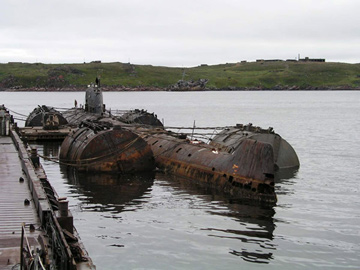
“Whichever way we deal with all seven of the subs currently at the dockyard I remain completely against any further nuclear submarines being brought to Rosyth.
By Ally McRoberts, Dunfermline Press, 8th Nov 2025
REMOVING the reactor from one of the laid-up nuclear submarines at Rosyth Dockyard is a “stage too far”.
Local SNP councillor Brian Goodall said there was “no need” to cut out the most radioactive parts left in HMS Swiftsure, which is being dismantled as part of an innovative recycling scheme.
He said there was nowhere to safely store the waste and it would also be cheaper to not go ahead – a stance that Labour MP Graeme Downie said was an “insult to the highly skilled team at Rosyth”.
Cllr Goodall said: “The next step will see Babcock cutting out the pressure vessel from the reactor compartment of the decommissioned nuclear submarine Swiftsure, in an experimental process that has never been done anywhere in the world before.
“This part of the submarine dismantling project has required Babcock to seek an increase in the limits to the levels of radioactivity they are allowed to discharge into the environment around the area.
“I believe there’s no clear justification for the cutting out of the pressure vessel, and that the removal for long term storage of the entire reactor compartment would be the more logical, proven, safer and cheaper approach to the next step in the dismantling process.”
There are currently seven old nuclear subs laid up at Rosyth and another 15 at the Devonport naval base in Plymouth.
A further five are due to come out of service.
The dismantling programme at the dockyard began in 2015 – Swiftsure is the first to be cut up – and in September yard bosses said Rosyth could become a “centre of excellence” for dealing with the UK’s old nuclear subs.
The project is doing what no-one else has attempted to do – removing the most radioactive parts left in the vessel, the reactor and steam generators, and recycling up to 90 per cent of the ship.
However, Cllr Goodall said: “The only justification ever given for cutting out the reactor pressure vessels in this way was to reduce the volume of the intermediate level radioactive waste that would be going into the UK’s deep geological radioactive waste facility.
“But such a facility does not exist and it looks like it never will, so long term, near surface storage at a nuclear licensed facility in England, like Capenhurst or Sellafield, is now the most likely outcome.
“And so there’s no need to take forward the experimental stage two part of the proposed procedure, with the increased radioactive discharges associated with it.”
He said he had made the same point at the consultation stage in 2012, before the dismantling of subs at Rosyth got the go ahead.
The councillor continued: “While I support the demonstrator project and, if it’s successful, I’d reluctantly back the on-site dismantling of the six other decommissioned submarines that are currently at Rosyth, I feel it’s not too late to rethink stage two of the process.
“Whichever way we deal with all seven of the subs currently at the dockyard I remain completely against any further nuclear submarines being brought to Rosyth.
“With homes within metres of the site and schools, shops and countless other businesses right next door, Rosyth should never have become a nuclear facility and radioactive waste store.
“We should now be doing all we can to create a long positive, clean, green future for the dockyard.”…………………https://www.dunfermlinepress.com/news/25606854.brian-goodall-says-no-next-stage-submarine-dismantling/
British Nuclear Jets Programme Costs ‘Unrealistic’ – CND

“Just as we’ve seen the ‘blank cheque’ approach to the spiralling costs of replacing Britain’s nuclear submarines, so we see it again here with Britain’s new nuclear-capable jets.”
, by the Campaign for Nuclear Disarmament (CND), https://labouroutlook.org/2025/11/08/british-nuclear-jets-programme-costs-unrealistic-cnd/
The chair of the Government’s Public Accounts Committee (PAC), Sir Geoffrey Clifton-Brown, has described the MoD’s cost forecast for the F-35 fighter jet programme as “unrealistic”.
The report also shines a spotlight on the repeated and systematic failure of the MoD to demonstrate financial responsibility or accountability. Just as we’ve seen the ‘blank cheque’ approach to the spiralling costs of replacing Britain’s nuclear submarines, so we see it again here with Britain’s new nuclear-capable jets.
The Public Accounts Committee report states that the MoD ‘acknowledged that becoming certified for the NATO nuclear mission will add new requirements to training, personnel and possibly infrastructure.’ Yet, PAC reports that it was only once the Committee requested evidence about the F-35 programme that the MoD started discussions with ‘other partner nations’ to understand these requirements. Therefore ‘the Department [MoD] did not provide any indication of forecast costs.’
The MoD had argued that buying the F-35A nuclear-capable fighter jets would be 20% to 25% cheaper than the F-35B non-nuclear fighter jets. However, PAC’s report reveals that because the MoD had not familiarised itself with the technical implications of NATO integration before the decision was made to buy the F-35As, it had not allowed for additional costs associated with this. The report concludes ‘We believe it is a reasonable assumption that this may end up proving more expensive’.
This is the latest in a series of failures to forecast costs for the programme, resulting in substantially underestimating the scale of the spending needed. Back in 2013, when the decision was made to buy 138 F-35 fighter jets, the MoD set out the initial cost of £18.4 billion, which was only for the first 48 fighter jets. It was then discovered that the MoD had failed to update this figure following the extension of the programme from 2048 to 2069 – more than a 20 year extension. The MoD then revised this figure to £57 billion but did not include any of the far more costly sustainment expenditure such as personnel, infrastructure or fuel.
The National Audit Office calculates the full programme is likely to be £71 billion. However, this does not take into consideration the additional costs associated with the certification of the F-35A jets for NATO nuclear missions, so this figure will certainly increase. And there are still further questions about the purchases of an additional 63 F-35A jets, as whether these will also be part of NATO’s nuclear mission.
The committee also reveals the level of chaos, mis-manageable and lack of planning of the programme. For instance, the MoD underestimated the number of engineers it would need for the programme, failing to consider annual leave and staff working in other roles. Consequently staffing costs have had to be increased by 20%.
A delay in upgrading the accommodation at RAF Marham, which has been the main operating base for the F-35s since 2013, means not all the accommodation will be ready in time for the 2029 delivery of the new F-35A fighter jets, likely causing delays and further costs in the programme.
This mismanagement, lack of financial accountability resulting in spiralling costs is typical of Britain’s nuclear weapons industry. The replacement of Britain’s nuclear submarines has been repeatedly rated ‘unachievable’ by the government’s Infrastructure and Projects Authority, due to cost overruns and delays.
Instead of pouring hundreds of billions more into this black hole of deadly weaponry – tying Britain even closer to NATO and Trump’s reckless nuclear war drive – the British government should redirect these funds to kick-start the British economy investing in transport, housing and healthcare, improving living standards and tackling the real threats we face from climate breakdown
The Committee – which scrutinises the financial accounts and holds the government to account for the delivery of public services’ – produced a report into the MoD’s management of its F-35 fighter jet programme, which will see Britain buy a total of 138 jets – likely to be 63 F-35B ‘stealth’ jets and 75 of the nuclear-capable F-35A fighter jets.
Despite Prime Minister Keir Starmer’s announcement in June at the NATO summit that Britain, for the first time since the end of the Cold War, would be expanding its nuclear capability through the purchase of 12 F-35A jets, the Committee’s report reveals the Ministry of Defence had little understanding of the implications – both technical or financial – of NATO integration of its nuclear-capable fighter jets when this announcement was made.
What will the UK do in a new nuclear arms race?
Tom Vaughan, a lecturer in international security at the University of
Leeds, notes that the UK is pressing ahead with its procurement of F-35
stealth fighter aircraft. These can carry nuclear bombs but, as Vaughan
notes, would require US authorisation before they could be used. Equally,
Britain’s nominally independent nuclear weapons system, Trident, is
reliant on US support and maintenance.
As Vaughan points out, it makes the
UK into “a target in any nuclear war that might be started by two
unpredictable and violent superpowers”.
The Conversation 7th Nov 2025, https://theconversation.com/what-will-the-uk-do-in-a-new-nuclear-arms-race-269224
1 This Month

Protect Sazan Island from the Trump family! https://secure.avaaz.org/campaign/en/protect_sazan_island_from_the_trump_family_loc/?bqFCVab&v=174511&cl=22707147157&_checksum=5e9dde668860e8231c33699735e16a1fbf22ab2cb01da50c999fe8732b9775ef&utm_source=email&utm_medium=blast_email&utm_campaign=174511
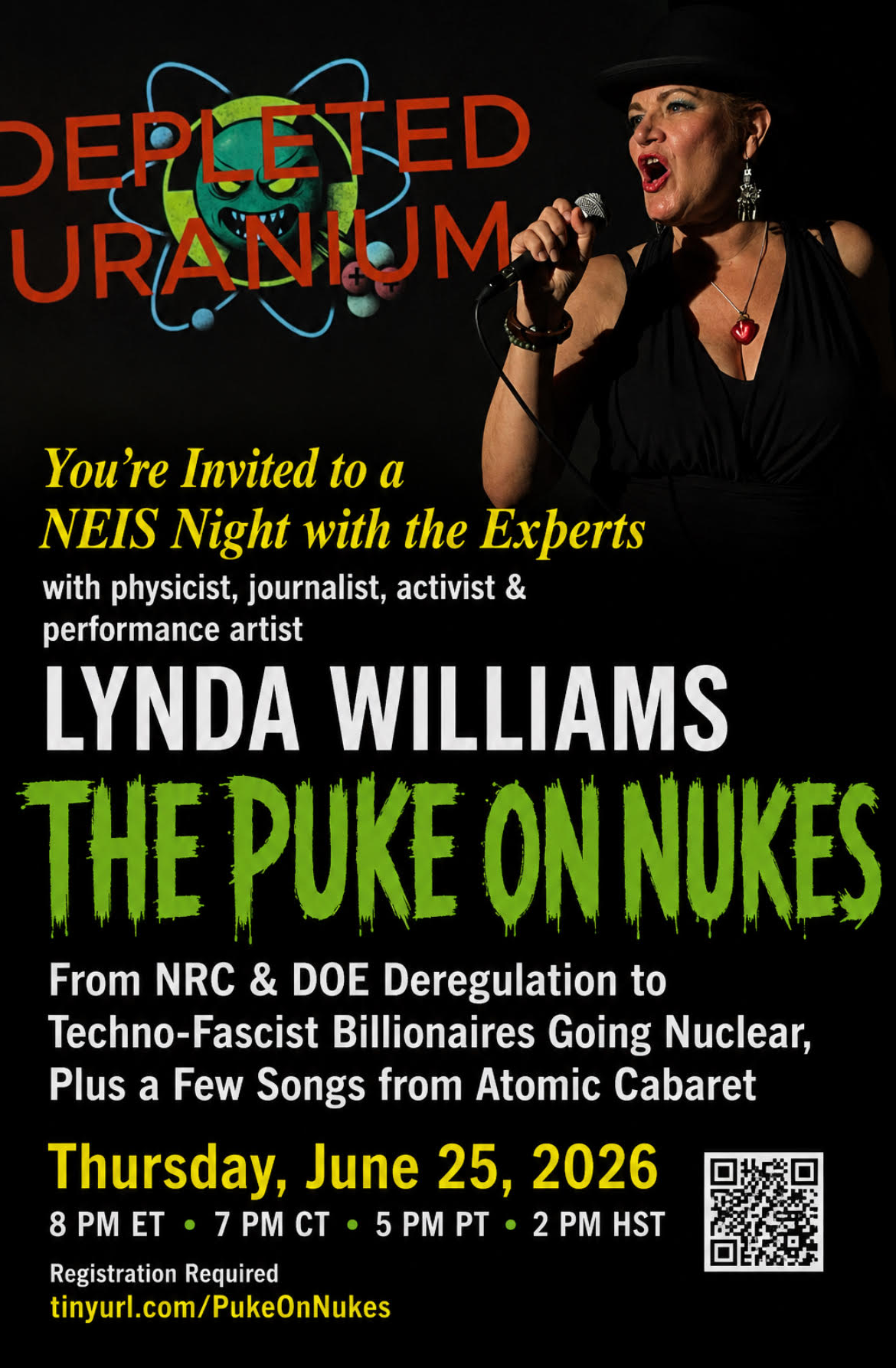
25 June- THE PUKE ON NUKES
Thursday, June 25, 2026
7pm Central Time (8pm ET, 6pm MT, 5pm PT) UTC – 5
From NRC & DOE Deregulation to Techno-Fascist Billionaires Going Nuclear, Plus a Few Songs from Atomic Cabaret REGISTER
26 June – Radiation Trainwreck at the NRC / Join the Protect Better Campaign – https://us02web.zoom.us/meeting/register/4ZlZ5_qLSHGiLSCg8FF6Bg#/registration


Cuba Is Not a Failed State – It Is a Besieged State
PETITION: “Global Appeal to Endorse Palestinian Right of Return of Refugees”
To see nuclear-related stories in greater depth and intensity – go to https://nuclearinformation.wordpress.com
-
Archives
- June 2026 (152)
- May 2026 (306)
- April 2026 (356)
- March 2026 (251)
- February 2026 (268)
- January 2026 (308)
- December 2025 (358)
- November 2025 (359)
- October 2025 (376)
- September 2025 (257)
- August 2025 (319)
- July 2025 (230)
-
Categories
- 1
- 1 NUCLEAR ISSUES
- business and costs
- climate change
- culture and arts
- ENERGY
- environment
- health
- history
- indigenous issues
- Legal
- marketing of nuclear
- media
- opposition to nuclear
- PERSONAL STORIES
- politics
- politics international
- Religion and ethics
- safety
- secrets,lies and civil liberties
- spinbuster
- technology
- Uranium
- wastes
- weapons and war
- Women
- 2 WORLD
- ACTION
- AFRICA
- Atrocities
- AUSTRALIA
- Christina's notes
- Christina's themes
- culture and arts
- Events
- Fuk 2022
- Fuk 2023
- Fukushima 2017
- Fukushima 2018
- fukushima 2019
- Fukushima 2020
- Fukushima 2021
- general
- global warming
- Humour (God we need it)
- Nuclear
- RARE EARTHS
- Reference
- resources – print
- Resources -audiovicual
- Weekly Newsletter
- World
- World Nuclear
- YouTube
-
RSS
Entries RSS
Comments RSS
 nuclear-news