Britain sent over 500 spy flights to Gaza
Exclusive: New study reveals the scale of British intelligence gathering above Gaza, raising fears of complicity in Israeli war crimes
DECLASSIFIED UK, IAIN OVERTON, 27 March 2025
- Flights have continued even after Israel broke the ceasefire
The Royal Air Force (RAF) has conducted at least 518 surveillance flights around Gaza since December 2023, an investigation by Action on Armed Violence (AOAV) for Declassified UK has found.
The flights, carried out by 14 Squadron’s Shadow R1 aircraft from RAF Akrotiri in Cyprus, have been shrouded in secrecy, raising concerns about whether British intelligence has played a role in Israeli military operations that have resulted in mass civilian casualties in Gaza.
These revelations come as Israel faces allegations of genocide at the International Court of Justice (ICJ) and war crimes at the International Criminal Court (ICC), with warrants issued for Israeli prime minister Benjamin Netanyahu and former defence minister Yoav Gallant.
The UK government insists that the flights are purely for hostage recovery, but the lack of transparency has done little to allay suspicions that the intelligence gathered may be facilitating Israeli attacks.
Surveillance sorties continued during and after the ceasefire, despite Israel’s renewed bombing of Gaza killing hundreds of children.
Over 500 missions in 15 months
AOAV’s analysis of flight-tracking data shows that between 3 December 2023 and 27 March 2025, the RAF carried out at least 518 Intelligence, Surveillance, and Reconnaissance (ISR) flights over or close to Gaza’s airspace.
Both Labour and Conservative governments have enacted the policy, with at least 215 flights taking place during Keir Starmer’s tenure as prime minister and 303 under Rishi Sunak’s administration.
The frequency of flights remained high throughout 2024, with some months seeing as many as 49 sorties. The missions have typically lasted up to six hours, with the longest flight recorded at seven hours and four minutes.
While the Ministry of Defence (MoD) claims these flights are solely for locating Israeli hostages held by Hamas, AOAV found that the RAF conducted 24 flights in the two weeks leading up to and including the day of Israel’s deadly attack on the Nuseirat refugee camp on 8 June 2024, which reportedly killed 274 Palestinians and injured over 700.
Four Israeli hostages were rescued in the operation; it remains unclear whether British intelligence directly contributed to the attack or was solely used to locate hostages…………………………………
Parliamentary stonewalling
Parliamentary efforts to probe the true purpose of these flights have been repeatedly stonewalled by the UK government. ………………………………
This lack of transparency raises serious questions about whether the UK is complicit in violations of international law. If intelligence gathered by the RAF was used to facilitate war crimes, the UK could itself be liable under the Rome Statute of the ICC.
The ICJ’s genocide case against Israel, brought by South Africa, highlights mass civilian deaths, deliberate destruction of infrastructure, and obstruction of humanitarian aid as key components of the allegations.
The UK, as a signatory to the Arms Trade Treaty and the Geneva Conventions, is legally obligated to ensure its military intelligence is not used to facilitate war crimes. However, the UK government has admitted in court that “Israel is not committed to upholding international humanitarian law” – yet surveillance flights continue…………………………………………….
Calls for a public inquiry
Pressure is growing for a full public inquiry into the UK’s role in Israel’s bombardment of Gaza. This month, Independent MP Jeremy Corbyn called for a ‘Chilcot-style’ investigation into the UK’s military collaboration with Israel, warning that “parliament has been kept in the dark”.
Human rights groups, including Amnesty International and Human Rights Watch, have also demanded full transparency regarding UK surveillance flights and their potential role in Israeli operations.
Nuvpreet Kalra from campaign group CODEPINK told Declassified that when a bomb “massacres Palestinians sheltering in tents or a drone shoots dead a journalist, we have to ask where the intelligence to target these attacks come from…Britain must immediately stop the spy flights and shut down their colonial military bases on Cyprus.”……………………….
If UK intelligence has been used in any Israeli strikes that resulted in civilian deaths, the British government could be found complicit in war crimes. https://www.declassifieduk.org/britain-sent-over-500-spy-flights-to-gaza/?utm_source=Email&utm_medium=Button&utm_campaign=ICYMI&utm_content=Button
Resistance to nuke dump grows in South Copeland

NFLA 31st March 2025
Kirksanton and Bankhead residents in the South Copeland GDF Search Area will be heartened by the support of Millom Town Councillors who approved a motion at their 26 March meeting to ‘reject the area of focus as being beneficial to Bank Head’.
In January, Nuclear Waste Services announced that a site surrounding the prison West of Haverigg was its ‘Area of Focus’, the preferred inland site for a Geological Disposal Facility, a deep repository for Britain’s legacy and future high-level radioactive waste. This site borders the village of Kirksanton and the Bank Head housing estate.
The Council also agreed to a request that a public meeting be held to examine the ‘positives and negatives’ of bringing the GDF to the area. In September 2023, a Community Forum attended by the public and organised by the South Copeland GDF Community Partnership drew up an initial list. In response to this NWS promised to commission an ‘impacts report’ from an independent consultant, but this has never materialised.
Councillors also agreed to send a letter of complaint to NWS about the size of the Area of Focus and how the announcement has impacted house sales and affected residents of the area. At the meeting, the Chair conceded that, after speaking to estate agents, he believed the area to be ‘blighted’. Since the announcement, one house sale in nearby Silecroft has fallen through and a house owner in Bank Head has been forced to significantly reduce their asking price in make a sale.
Jan Bridget, who co-founded Millom and District against the GDF in 2022, was delighted at the level of attendance from the public and at the outcome:
“Well, what can I say, we have won a battle but not the war. And I am thrilled that around 40 people turned up at the Millom Town Council meeting, demonstrating that Bank Head and Kirksanton are not willing communities”.
Millom and District Against the Nuclear Dump organised a meeting of Bank Head residents to meet their local councillors from Cumberland and Millom Town Councils in February. Thirty-nine people attended the meeting, most from the Bank Head estate. Residents asked the councillors for their help after sharing their very moving concerns.
We reported on this meeting:…………………………………..
https://www.nuclearpolicy.info/news/resistance-to-nuke-dump-grows-in-south-copeland/
Nuclear waste centre delayed

Nuclear center must replace roof on 70-year-old lab so it can process radioactive waste.
Project sees 7-year delay and budget swell to £1.5B, but nuclear leadership ‘confident’ it has an alternative
Lindsay Clark, 28 Mar 25, The Register
The center of the UK’s nuclear industry has agreed on alternatives for how it will process waste into the next decade after delays and overspending hit a lab project.
In the face of a 2028 deadline to put facilities in place to treat and repackage plutonium, Sellafield paused a delayed project to build a replacement for its 70-year-old analytical lab.
Speaking to MPs last week, Euan Hutton, CEO of Sellafield Ltd, said he was “confident” in an alternative that involves refurbishing its old lab and borrowing facilities from another onsite lab.
This comes after the go live date for its Replacement Analytical Project (RAP) was delayed from 2028 until at least 2034 and costs ballooned to £1.5 billion ($1.93 billion).
The center of the UK’s nuclear industry has agreed on alternatives for how it will process waste into the next decade after delays and overspending hit a lab project.
In the face of a 2028 deadline to put facilities in place to treat and repackage plutonium, Sellafield paused a delayed project to build a replacement for its 70-year-old analytical lab.
Speaking to MPs last week, Euan Hutton, CEO of Sellafield Ltd, said he was “confident” in an alternative that involves refurbishing its old lab and borrowing facilities from another onsite lab.
This comes after the go live date for its Replacement Analytical Project (RAP) was delayed from 2028 until at least 2034 and costs ballooned to £1.5 billion ($1.93 billion).
Sellafield, formerly known as Windscale, has been the center of the UK’s nuclear industry since the 1950s. While the site is home to a number of companies, and the government’s Nuclear Decommissioning Authority, Sellafield Limited is a British nuclear decommissioning Site Licence Company controlled by the NDA.
In October last year, the UK’s public spending watchdog said Sellafield depends on an on-site laboratory that is “over 70 years old, does not meet modern construction standards and is in extremely poor (and deteriorating) condition.”
The National Audit Office said [PDF] the laboratory is “not technically capable of carrying out the analysis required to commission the Sellafield Product and Residue Store Retreatment Plant (SRP)” to treat and repackage plutonium.
Sellafield’s plan in 2016 was to convert a 25-year-old laboratory on the site, to replace the 70 year-old lab, under the “Replacement Analytical Project.” The outline business case was approved in 2019 with an estimated cost of between £486 million and £1 billion ($626 million – $1.3 billion).
However, that project was “strategically paused” in February 2024 after it emerged Sellafield believed it could take until December 2034 to deliver the full capability, while cost could reach £1.5 billion ($1.93 billion).
Speaking to Parliament’s Public Accounts Committee last week, Hutton said: “Fundamentally, around December 2023, there was an incoherence that came out between the availability of the analytical services and when I needed to have those available for the plutonium repack plant…………………………………………
https://www.theregister.com/2025/03/28/uk_nuclear_center_waste_project_delayed/
‘Greedy landlords are cashing in and forcing us out of town’.
The construction of the Sizewell C nuclear power plant on the Suffolk
coast is a key part of the government’s growth programme. But some locals
fear being forced out, accusing landlords of cashing in on a jobs boom by
evicting tenants and raising rents to unaffordable levels. The plant is due
to open in 2031, and although a final investment decision has not yet been
made, groundwork is already well under way.
The construction project will
require a predicted workforce of 7,900, of which about two-thirds will be
from outside the area. About 2,400 workers will be based on site with 500
others living at the former Pontins holiday park at Pakefield, near
Lowestoft. The remaining contractors, however, will have to move into
properties in or around the town of Leiston – population 5,508 – where some
rents have doubled to more than £3,000 a month.
BBC 31st March 2025,
https://www.bbc.co.uk/news/articles/ce98ljn1gzno
Disappointing but predictable: Government minister’s reply on nuke treaty
In February 2025, the UK/Ireland Nuclear Free Local Authorities was a
signatory alongside academics and peace campaigners to a letter drafted by
the United Nations Association UK (UNAUK) that was sent to Prime Minister
Sir Keir Starmer and Foreign Secretary David Lammy.
NFLA Chair Cllr Lawrence O’Neill and NFLA Secretary Richard Outram co-signed for the
NFLAs as did signatories from twenty-five other organisations, including
community advocates from Kiribati, an island nation impacted by British
nuclear weapons testing carried out in the 1950’s and by the United
States in 1962.
As the islanders were not evacuated both they and the
participating servicemen were impacted by radiation. The letter called on
the UK Government to send an observer to the 3rd Meeting of States Parties
(3MSP) to the Treaty on the Prohibition of Nuclear Weapons (TPNW) which was
held in New York until 7 March. The UK Government did not take up this
opportunity.
NFLA 29th May 2025,
https://www.nuclearpolicy.info/wp/wp-content/uploads/2025/05/A434-NB320-Disappointing-but-predictable-Government-ministers-reply-on-nuke-treaty-ban.-May-2025.pdf
Quakers condemn police raid on Westminster Meeting House

Quakers 28th March 2025, https://www.quaker.org.uk/news-and-events/news/quakers-condemn-police-raid-on-westminster-meeting-house
Police broke into a Quaker Meeting House last night (27 March) and arrested six young people holding a meeting over concerns for the climate and Gaza.
Quakers in Britain strongly condemned the violation of their place of worship which they say is a direct result of stricter protest laws removing virtually all routes to challenge the status quo.
Just before 7.15pm more than 20 uniformed police, some equipped with tasers, forced their way into Westminster Meeting House.
They broke open the front door without warning or ringing the bell first, searching the whole building and arresting six women attending the meeting in a hired room.
The Police, Crime, Sentencing and Courts Act 2022 and the Public Order Act 2023 have criminalised many forms of protest and allow police to halt actions deemed too disruptive.
Meanwhile, changes in judicial procedures limit protesters’ ability to defend their actions in court. All this means that there are fewer and fewer ways to speak truth to power.
Quakers support the right to nonviolent public protest, acting themselves from a deep moral imperative to stand up against injustice and for our planet.
Many have taken nonviolent direct action over the centuries from the abolition of slavery to women’s suffrage and prison reform.
Paul Parker, recording clerk for Quakers in Britain, said: “No-one has been arrested in a Quaker meeting house in living memory.
“This aggressive violation of our place of worship and the forceful removal of young people holding a protest group meeting clearly shows what happens when a society criminalises protest.
“Freedom of speech, assembly, and fair trials are an essential part of free public debate which underpins democracy.”
France’s UK energy apathy poses nuclear problem for Labour
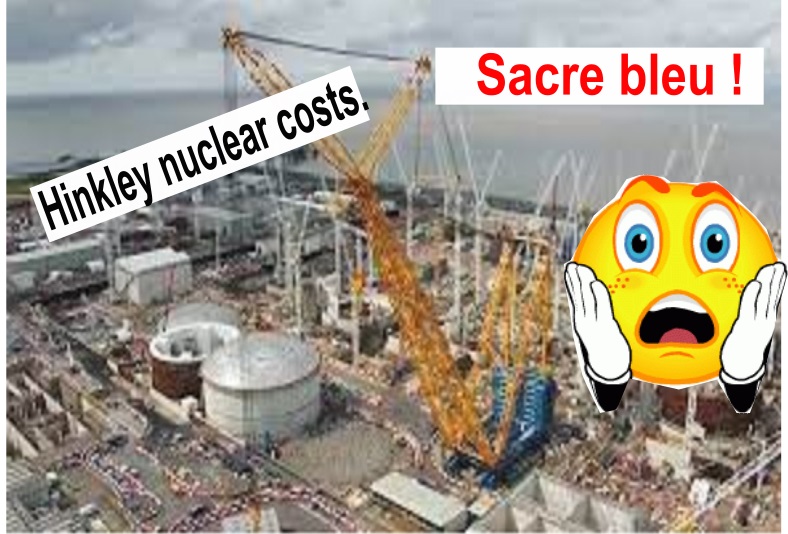
France’s public spending watchdog is advising the country to cut back on its involvement in UK nuclear projects
Brad Gray, Tortoise 27th March 2025, https://www.tortoisemedia.com/2025/03/26/frances-uk-energy-apathy-poses-nuclear-problem-for-labour
EDF has reduced its stake in the Sizewell C nuclear power plant by a further 7.7 per cent, leaving the UK government with an 83.8 per cent share.
In 2022, a government buy-out to allow the Chinese state to exit the project made the UK the leading investor.
Last week Emmanuel Macron fired the EDF chief following a row over energy prices, and France’s public spending watchdog is advising the country to cut back on its involvement in UK nuclear projects and focus on small modular reactors instead.
As France reduces its investment, taxpayers are likely to foot more of the bill than anticipated – a tough pill to swallow as the chancellor slashes public funding.
When complete, Sizewell C is forecast to provide up to 7 per cent of the country’s electricity needs, with reactors lasting 60 years. Right now it’s a political headache.
Dounreay more likely to build up than knock down.

By Iain Grant, 26 March 2025
People are being warned not to expect any of Dounreay’s former fuel or
waste buildings to be levelled any time soon. NRS Dounreay managing
director Dave Wilson was responding to a query posed at the latest meeting
of Dounreay Stakeholder Group (DSG). Mr Wilson said none of the cluster of
buildings deployed in the former fast reactor complex is slated for
demolition in the next couple of years. He added: “Skyline changes in the
short term might be a building going up to store material.
John O Groat Journal 26th March 2025, https://www.johnogroat-journal.co.uk/news/dounreay-more-likely-to-build-up-than-knock-down-377882/
**Plutonium**
The US has the power to switch off the UK’s nuclear subs – a big problem as Donald Trump becomes an unreliable partner

Th Conversation, March 28, 2025 , Becky Alexis-Martin, Peace Studies and International Development, University of Bradford
Prime Minister Keir Starmer recently boarded one of the UK’s four nuclear-armed submarines for a photo call as part of his attempts to demonstrate the UK’s defence capabilities as tensions with Russia continue.
However, Starmer faces a problem. The submarine, and the rest of the UK’s nuclear fleet, is heavily reliant on the US as an operating partner. And at a time when the US becomes an increasingly unreliable partner under the leadership of an entirely transactional president, this is not ideal. The US can, if it chooses, effectively switch off the UK’s nuclear deterrent.
British and US nuclear history is irrevocably interwoven. The US and UK cooperated on the Manhattan project, under the 1943 Quebec agreements and the 1944 Hyde Park aide memoire. This work generated the world’s first nuclear weapons, which were deployed on Hiroshima and Nagasaki in 1945.
It also led to the first rupture. In 1946, the US classified UK citizens as “foreign” and prevented them from engaging in secret nuclear work. Collaboration with the UK immediately ceased.
The UK decided to develop its own arsenal of nuclear weapons. The successful detonation of the “Grapple Y” hydrogen bomb in April 1958 cemented its position as a thermonuclear power.
In the meantime, however, Russia’s launch of the Sputnik satellite in 1957 had demonstrated the lethal reach of Soviet nuclear technology. This brought the US and UK back together as nuclear partners…………………………………………..
Serious concerns are now being raised about the UK’s nuclear capacity, given the unpredictability and potential unreliability of the new US administration. Trump could ignore or threaten to terminate the agreement in a show of power or contempt.
The UK’s nuclear subs
The UK’s Trident nuclear deterrence programme consists of four Vanguard nuclear-powered and armed submarines. The UK has some autonomy, as it is operationally independent and controls the decision to launch.
However, it remains dependent on the US because the nuclear technologies at the heart of the Trident system are US designed and leased by Lockheed Martin – and there is no suitable alternative. The Trident system therefore relies on the US for support and maintenance.
The UK is currently in the process of upgrading the current system. But its options seem limited. If the US were to renege on its commitments, the UK would either have to produce its own weapons domestically, collaborate with France or Europe or disarm. Each scenario creates new issues for the UK. Manufacturing nuclear weapons from scratch in the UK, for example, would be a costly and protracted activity.
Technical collaboration with France seems the most plausible back-up option at the moment. The two countries already have a nuclear collaboration treaty in place. France has taken a similar submarine-based approach to deterrence as the UK and French president Emmanuel Macron has suggested its deterrent could be used to protect other European countries. Another alternative would be to spread the cost across Europe and create a European deterrence – but both strategies just re-embed the UK’s current nuclear reliance.
While these weapons may deter a hostile nuclear strike, they have failed to prevent broader acts of aggression. Nuclear weapons have not been used in warfare for 80 years. Perhaps it is time to completely and permanently unshackle the UK from nuclear deterrence, and consider alternative forms of defence.
The UK’s nuclear arsenal is expensive to maintain. The cost of replacing Trident is £205 billion. In 2023, the Ministry of Defence reported that the anticipated costs for supporting the nuclear deterrent would exceed its budget by £7.9 billion over the next ten years. This funding could be channelled into more pressing security threats, such as cybersecurity, terrorism or climate change.
Nuclear weapons will become strategically redundant if the UK cannot act independently. As Nato and the US dominate the global nuclear stage, the UK’s capacity to respond has become contested. The time has come to decide whether the US is really our friend – or a new foe. https://theconversation.com/the-us-has-the-power-to-switch-off-the-uks-nuclear-subs-a-big-problem-as-donald-trump-becomes-an-unreliable-partner-252674
Second shipment of high level waste departs UK for Germany
Second shipment of high level waste departs UK for Germany. As previously
announced, the UK will be returning high level waste (HLW) in the form of
vitrified residues to Germany. The second of three planned shipments is now
safely under way. Seven flasks containing high level waste were transported
from the Sellafield site in West Cumbria to the nearby port of
Barrow-in-Furness by rail. The flasks were then loaded to the specialist
nuclear transport vessel Pacific Grebe, operated by Nuclear Transport
Solutions (NTS).
Sellafield 27th March 2025. https://www.gov.uk/government/news/second-shipment-of-high-level-waste-departs-uk-for-germany
Britain’s worst nuclear disaster: the Windscale fire of 1957
When a routine procedure went wrong in October 1957, a fire broke out at
the Windscale nuclear power station in Cumbria, UK. By the time it was put
out, radiation had been sent across Britain and Europe.
Jonny Wilkes reveals what happened, and why we should be grateful that it wasn’t much
worse. Chernobyl, Three Mile Island, Fukushima: three names that have gone
down in infamy; bywords for the nightmare scenarios that can occur when the
production of nuclear power goes disastrously wrong. Before them all
though, was Windscale.
History Extra 27th March 2025,
https://www.historyextra.com/period/20th-century/atomfall-real-nuclear-windscale-disaster-fire/
Massive Mine Shafts and Nuclear Dump For Cumbria Coast? Tell Cumberland Council “Vote NOW

A Very Hot Nuclear Waste Dump Under the Irish Sea Bed ? Decision Maker: Cumberland Council
, By mariannewildart. https://mariannewildart.wordpress.com/2025/03/27/massive-mine-shafts-and-nuclear-dump-for-cumbria-coast-tell-cumberland-council-vote-now/
The Issue
We, the undersigned, including residents, Council taxpayers and electors of Cumberland in Cumbria, UK, call upon Cumberland Council to schedule a debate at a specially convened meeting of Full Council on the question of whether Cumberland Council:
1. Continues to support Nuclear Waste Services in its investigations to identify potential locations for a Geological Disposal Facility for Heat Generating Nuclear Wastes in either the Mid or South Copeland Search Areas and
2. Continues to remain a partner in the two Community Partnerships.This debate to be followed by a vote in which all elected members be invited to vote yes or no to continuing these arrangements, with a majority no vote signifying that Cumberland Council withdraws its support and withdraws from membership of the two Community Partnerships ending the process.
In making this appeal, the petitioners are aware that:
1. An Executive of only four members at Copeland Borough Council originally decided to engage with Nuclear Waste Services in initiating a search for a site in either Mid or South Copeland, and that no vote ever took place amongst all the Councillors of that authority.
2. The Executive of the successor authority Cumberland Council assumed that commitment to GDF engagement, despite the facts that –
Cumbria County Council, which like Copeland was replaced by the new unitary authority and was its biggest component, was manifestly opposed to any GDF in the county.
There has never been a vote amongst all elected Councillors of Cumberland Council as to whether the authority should have assumed this commitment made by just four Copeland Councillors.
ADDITIONAL INFORMATION
Cumberland Council in Cumbria is unique in becoming a “Partner” in the UKs dangerous nuclear dump proposal while having had no debate or full council vote. Other areas who were persuaded to go into Partnership with the developer, Nuclear Waste Services, later held full council debates and a vote. South Holderness and Theddlethorpe in Lincolnshire decided that they were not to be fobbed off with the bribe of £2 Million a year to host a dangerous experimental “geological disposal facility.”
The beautiful and fragile Cumbrian coastline and already vulnerable ocean is in the firing line for the biggest infrastructure project ever in the UK. This construction site would be active for 100+ years with massive industrial sprawl, movements of highly radioactive materials and pollution. Mine shafts on the Cumbrian coast would be tunnelled by giant tunnel boring machines leading to a mined out void the size of the country of Tuvalu (26km square) up to the size of Bermuda (50 km square).
The massive amount of rock spoil from an area up to 1000 metres deep and 50km square would be an industrial hazard in itself with naturally occurring radioactive material leaching out of the mountain of spoil.
Tourism is Cumbria’s biggest industry closely followed by Farming and despite ongoing pressures both these industries support tens of thousands of people many in the Cumberland Council area. Both tourism and farming would be disastrously impacted by the plan for a 100+ year massive mine in which to dump high level nuclear wastes, a plan which now includes plutonium, under the Cumbrian coastline and ocean.
The reason the proposed “geological disposal facility” (sub-sea nuclear dump) has to be so huge is to dissipate the enormous heat from widely spaced out containers of highly radioactive nuclear wastes which are currently stacked together and kept cool by millions of gallons of fresh water a day from the top quality fresh water in Wastwater and the rivers Ehen and Calder (Nuclear is the most wasteful means of producing electricity as a vanishingly small percentage of heat from uranium fuel is used to turn the turbines while the rest is waste and has to “cool off” for tens of thousands, in some cases millions of years).
Where is this planned?
The Lake District coast adjacent to the National Park.
“Mid-Copeland Community Partnership Area of Focus.” Despite Sellafield, the biggest industrialised mass in the North West or an “atomic carbuncle” as Wainwright called it, this is an ancient and beautiful area with Viking hoards, stone circle and Abbey.
“South Copeland Community Partnership Areas of Focus” are rising up against the plan to host the access mine shafts and associated industrial sprawl for a sub-sea nuclear dump in their beautiful and historic area.
SIGN HERE
Walt Zlotow: UK to push 250,000 Brits into poverty to increase unneeded defense spending.

Walt Zlotow, West Suburban Peace Coalition, Glen Ellyn IL 28 Mar 25
Now that President Trump has bailed on endless US funding of failed Ukraine war, UK Prime Minister Keir Starmer has picked up the slack.
Starmer is delusional that Russia seeks to recreate the Soviet empire. He joins equally delusional French President Emmanuel Macron that the EU must replace the disappearing $175 Billion in US treasure to continue the lost Ukraine war.
Starmer wants to boost UK defense spending to 3% of GDP from the current 2.3% tho no foreign enemy is anywhere in sight. To pay for this senseless squandering of UK treasure, Starmer proposes cuts in welfare spending. He appears oblivious of reports that such cuts may push 250,000 Brits into poverty, including 50,000 kids.
Alas, Starmer also remains oblivious that the hundreds of billions the US and EU has squandered in Ukraine has merely cost Ukraine hundreds of thousands of casualties, 10 million fled and 45,000 lost square miles of land. But the only words echoing in Starmer’s brain are: ‘The Russians are coming, the Russians are coming.’
EDF reduces stake in Sizewell C as boss sacked
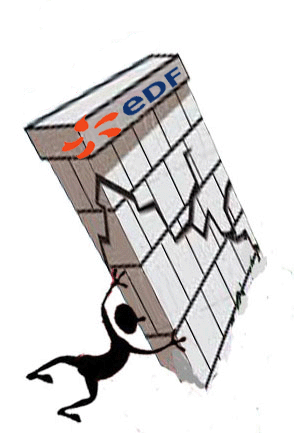
the sacking raises “further fundamental questions about the wisdom of proceeding with the Sizewell C ‘Replica’ project of Hinkley Point C in which EDF is set to be deeply involved”
“Clearly Sizewell C could not reach a Final Investment Decision without taxpayers shouldering the bulk of the project’s massive cost – a hugely controversial choice given that the Chancellor is currently scrabbling around to save as much money as possible.“
25 Mar, 2025 By To s-sacked-25-03-2025/ https://www.newcivilengineer.com/latest/edf-reduces-stake-in-sizewell-c-as-boss-sacked-25-03-2025/
EDF’s ownership of Sizewell C has decreased to 16.2% and the UK government’s stake increased to 83.8%. Meanwhile, the French company’s chief executive has been axed and its financial stability has been called into question.
The UK’s flagship gigawatt-scale new nuclear projects under construction – Hinkley Point C in Somerset and Sizewell C in Suffolk – are both subject to intense scrutiny as costs rise and timelines slip.
Hinkley Point C is late and over budget, and Sizewell C is awaiting its delayed final investment decision (FID) which is scheduled to be made at the Spending Review on 11 June. The FID will reveal the final determination of who will fund the project and how. The government has already invested several billion pounds in developing it.
Hinkley Point C’s costs rose from around £25bn in 2015 to up to £34bn in 2024, and Sizewell C is projected to cost £40bn – double what it was estimated by EDF and the UK Government to cost in 2020. However, the Treasury disputes this latter figure.
EDF Sizewell C ownership stake reduced
On 24 February 2024, NCE reported that EDF was appearing to scale back its proposed ownership ambitions of Sizewell C.
EDF’s 2024 Annual results document laid out its contribution to the power plant, which is “subject to some conditions, including […] a share in ownership of the project of 10 to 19.99%, including a cap on financial exposure in value.” It also requires “a return on capital expected by EDF as an investor in line with market return for this type of assets, risk allocation profile and its investment policy.”
It is understood that the reason for selecting 19.99% rather than 20% is because a company buying 20% would have to set up a subsidiary entity to take the ownership.
Credit ratings agency Fitch Ratings announced in a ‘Rating Action Commentary’ on 21 March 2025 that the Sizewell C’s owners – the UK Government and EDF – had changed their ownership stakes.
EDF previously confirmed in its 2024 half year results that Sizewell C is owned 76.1% by the UK Government and 23.9% by EDF.
Fitch’s announcement said: “As of end-2024, the project was owned 83.8% by the UK government and 16.2% by EDF, down from 49.4% at end-2023.”
This marks a fresh drop in EDF’s ownership by 7.7 percentage points.
The decrease comes after French public spending watchdog Cour des comptes said EDF should scale back involvement in UK nuclear projects.
Macron sacks EDF chief and funds EDF reactors
In France, where the government has political control of the entirely state-owned EDF (Électricité de France), Macron fired the company’s chief executive Luc Rémont.
The UK’s Daily Telegraph linked Rémont’s ousting to EDF’s planned electricity price hikes for French industrial customers, of which Macron had promised to “take back control”.
Adding further pressure to EDF’s leadership, French building materials company Saint-Gobain chairman and chief executive officer Benoit Bazin, speaking to French business news channel BFM Business, accused EDF of “giving the middle finger to French industry”.
It has also been reported that the French state has agreed to issue a single subsidised loan “covering at least half the construction costs of six nuclear reactors”, according to the president’s office. It is understood that the six reactors are at the pairs at Penly, Gravelines and Bugey in France.
Former energy secretary reacts to ‘extremely concerning’ developments‘.
Backbench Conservative peer Lord Howell of Guildford reacted to the news. Howell was energy secretary in Margaret Thatcher’s government which supported the construction of nuclear power plants.
He described the reduced stake in Sizewell C as “one more development in growing concern about EDF’s capacity or ability to continue with Hinkley Point C project or take a large (20%+) position in the Sizewell C proposed project.”
Reflecting on the sacking of the EDF boss, he said this is “An extremely worrying development.”
He went on to say the sacking raises “further fundamental questions about the wisdom of proceeding with the Sizewell C ‘Replica’ project of Hinkley Point C in which EDF is set to be deeply involved”
Anti-Sizewell C groups say ‘alarm bells should be ringing’
Stop Sizewell C executive director Alison Downes said: “EDF has not contributed a single penny financially to Sizewell C for well over a year now, and is under growing pressure in France, not only having lost its boss but to scale back its international commitments across the board.
“Clearly Sizewell C could not reach a Final Investment Decision without taxpayers shouldering the bulk of the project’s massive cost – a hugely controversial choice given that the Chancellor is currently scrabbling around to save as much money as possible.
“Rachel Reeves should cancel Sizewell C now and redirect those funds to the Warm Homes Plan, which would lower energy bills and create jobs in every constituency.”
Chancellor Rachel Reeves has proposed austerity measures for the welfare state, which she says are needed to fund infrastructure developments, ahead of the Spring Statement and Spending Review.
Cuts to welfare, particularly covering disability and unemployment support, are proving to be unpopular with dozens of MPs on the left of the Labour party.
A Together Against Sizewell C (TASC) spokesperson said: “Alarm bells should be ringing as the UK government stake in Sizewell C increases to 84% with only the UK taxpayer currently funding Sizewell C’s development costs.
“This begs the question, ‘Why are EDF refusing to put any further money into Sizewell C?’ EDF have decided to build no more of this reactor design in France, indicating they have no confidence in the EPR design destined for Sizewell.”
The spokesperson went on to say: “EDF are broke, as evidenced by their desperate search for cash to finish Hinkley Point C’s construction.
“This is hardly a secure basis for the UK government to continue in partnership with EDF and certainly not a good advert to encourage potential investors.”
Referencing EDF’s plans for a final stake to be as low as 10%, TASC said: “This evidences that even the developer considers the Sizewell C development to be inherently
EDF and the Department for Energy Security and Net Zero did not respond to requests for comment.
Russia rules out transferring control over Zaporizhzhia Nuclear Power Plant to Ukraine

the plant being jointly operated, including with the participation of international organizations,
“In this case, for example, it is impossible to properly ensure nuclear and physical nuclear safety, or regulate issues of civil liability for nuclear damage.
Transfer of the facility or control over it to Ukraine or any other country is ‘impossible,’ says Foreign Ministry
Burc Eruygur 26.03.2025, https://www.aa.com.tr/en/russia-ukraine-war/russia-rules-out-transferring-control-over-zaporizhzhia-nuclear-power-plant-to-ukraine/3520006#
Russia on Tuesday rejected transferring control over the Zaporizhzhia Nuclear Power Plant (ZNPP) to Ukraine or any other country, saying it is “impossible.”
US President Donald Trump and his Ukrainian counterpart Volodymyr Zelenskyy discussed the situation surrounding energy supplies to Ukraine and the country’s nuclear power plants during a phone call last Wednesday.
Trump told Zelenskyy that the US could be “very helpful in running the plants with its electricity and utility expertise” and that “American ownership of those plants could be the best protection for that infrastructure,” according to a White House statement.
Zelenskyy told journalists at a briefing later that he and Trump did talk about the restoration of the ZNPP and that Ukraine is ready to discuss the modernization of the plant but they did not discuss the issue of ownership of the plant.
A statement by the Russian Foreign Ministry stressed that the plant is a “Russian nuclear facility,” saying the transfer of the facility or control over it to Ukraine or any other country is “impossible.”
“All the station’s employees are citizens of the Russian Federation. Their lives cannot be played with, especially considering the atrocities that Ukrainians have committed and continue to commit on the territory of our country,” it said.
The statement also denied the possibility of the plant being jointly operated, including with the participation of international organizations, describing this as having “no such precedents in world practice.”
“In this case, for example, it is impossible to properly ensure nuclear and physical nuclear safety, or regulate issues of civil liability for nuclear damage.
The statement also denied the possibility of close cooperation between NATO intelligence services with Ukraine, which have impressive sabotage potential, makes it impossible, including with the participation of international organizations, describing this as having “no such precedents in world practice.”
“In this case, for example, it is impossible to properly ensure nuclear and physical nuclear safety, or regulate issues of civil liability for nuclear damage.
“An important aspect is that close cooperation between NATO intelligence services with Ukraine, which have impressive sabotage potential, makes it impossible to even temporarily admit representatives of these states to the ZNPP,” the statement added.
The situation around the Zaporizhzhia Nuclear Power Plant, Europe’s largest and one of the world’s 10 biggest, particularly remains tense as concerns persist over a possible nuclear disaster involving Moscow and Kyiv, both of which have frequently accused each other of attacks around the facility.
Since Sept. 1, 2022, International Atomic Energy Agency (IAEA) personnel have been present at the plant, which has been under Russian control since March 2022.
1 This Month
26 April – Chernobyl: Inside the Meltdown airs on National Geographic on Sunday 26th April from 4pm

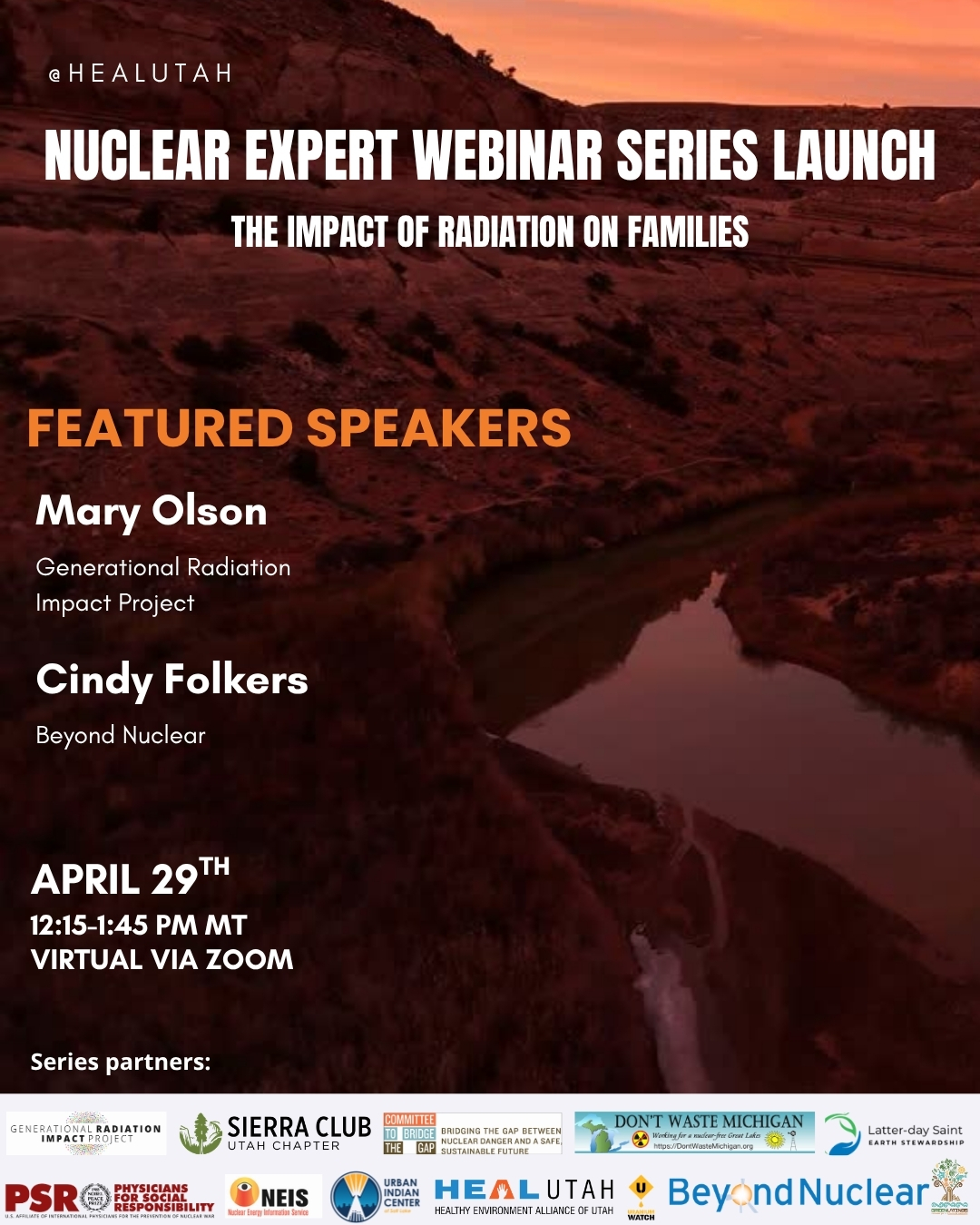
29 April – Nuclear Expert Webinar #1 – Radiation Impacts on Families with Mary Olson and Cindy Folkers
- 12:15 PM MT – 1:45 PM MT
- Location: Virtual – REGISTER TODAY

4 May -West Suburban Peace Coalition to discuss Iran war at May Educational Forum
Monday, May 4, 7:00 – 8:00 PM Central Standard Time
Title: : How Trump’s Narrative Tries to Shape the Reality of the War on Iran.
Contact Walt Zlotow, zlotow@hotmail.com 630 442 3045 for further information
14 May – online event From Bombs to Data Centres: the Face of Nuclear Colonialism

Pine Ridge Uranium is the real threat, not Tehran- Tell Burgum: Stop the Extraction.
Chernobyl: The Lost Tapes – A good documentary on Chernobyl on SBS available On Demand for the next 3 weeks– https://www.sbs.com.au/ondemand/tv-program/chernobyl-the-lost-tapes/2352741955560
To see nuclear-related stories in greater depth and intensity – go to https://nuclearinformation.wordpress.com
-
Archives
- April 2026 (317)
- March 2026 (251)
- February 2026 (268)
- January 2026 (308)
- December 2025 (358)
- November 2025 (359)
- October 2025 (376)
- September 2025 (257)
- August 2025 (319)
- July 2025 (230)
- June 2025 (348)
- May 2025 (261)
-
Categories
- 1
- 1 NUCLEAR ISSUES
- business and costs
- climate change
- culture and arts
- ENERGY
- environment
- health
- history
- indigenous issues
- Legal
- marketing of nuclear
- media
- opposition to nuclear
- PERSONAL STORIES
- politics
- politics international
- Religion and ethics
- safety
- secrets,lies and civil liberties
- spinbuster
- technology
- Uranium
- wastes
- weapons and war
- Women
- 2 WORLD
- ACTION
- AFRICA
- Atrocities
- AUSTRALIA
- Christina's notes
- Christina's themes
- culture and arts
- Events
- Fuk 2022
- Fuk 2023
- Fukushima 2017
- Fukushima 2018
- fukushima 2019
- Fukushima 2020
- Fukushima 2021
- general
- global warming
- Humour (God we need it)
- Nuclear
- RARE EARTHS
- Reference
- resources – print
- Resources -audiovicual
- Weekly Newsletter
- World
- World Nuclear
- YouTube
-
RSS
Entries RSS
Comments RSS
 nuclear-news