 Daily Post 14th May 2018 , Demands have been made by the Green Party for an ‘urgent debate’ on whether
the UK Government is offering a package of financial support to build Wylfa Newydd.
The Daily Post reported this month that Prime Minister Theresa May
was meeting Hitachi Chairman Hiroaki Nakanishi for crunch talks on funding
for nuclear reactors. There were warnings Hitachi could withdraw from the
multi-billion pound Horizon Nuclear Power ventures on Anglesey and in
Gloucestershire unless assurances were made on finances.
There have been reports in the Japanese press that the UK government has agreed to offer
financial guarantees for the project. But a spokesman for the Department
for Business, Energy, and Industrial Strategy(BEIS), said: “We don’t
recognise these reports.”
Now Green MP Caroline Lucas has demanded a
meeting to clarify the Government’s position. She tweeted: “This is
absolutely outrageous. “The government is planning to plough billions of
pounds of taxpayers’ money into failing nuclear without any transparency
or scrutiny. I’m calling for an urgent debate on this in parliament.”
https://www.dailypost.co.uk/business/business-news/demand-urgent-debate-whether-uk-14656243
May 16, 2018
Posted by Christina Macpherson |
politics, UK |
Leave a comment
Express 15th May 2018 , BRITAIN could be left with no fuel to supply power stations after Brexit if it cannot replicate a series of nuclear safeguards currently governed by the European Union, warned Nuclear Industry Association (NIA) Chief Executive Tom Greatrex.
The former Labour minister claimed Britain’s
decision to quit Euratom – the body that governs the transportation of
radioactive materials needed in nuclear energy and research – could
result in no fuel for British power stations after Brexit. Speaking
exclusively to Express.co.uk, Mr Greatrex warned that Britain cannot
produce fuel in the UK without the raw materials from around the world,
which can only be obtained if necessary safety measures are in place –
including a governing body on the transport, trade and regulation of
nuclear matter.
https://www.express.co.uk/news/uk/959639/Brexit-news-UK-EU-European-Union-nuclear-industry-referendum-Euratom-power-station
May 16, 2018
Posted by Christina Macpherson |
politics international, UK |
Leave a comment
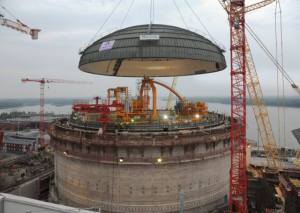 Tekniik & Talous 14th May 2018 , [Machine Translation] New problems have arisen in TVO’s hot tests at
Olkiluoto 3. The connection line of the main pipework of the plant, the reactor cooling circuit, vibrates more than allowed. The problem is reported by the supervising authority Stuk in its recent monitoring report.
The problem has emerged in hot tests where the reactor and turbine plant systems are heated by the heat generated by the main circulation pumps to the correct operating temperatures. Heat tests ensure that the facility is safe to charge nuclear fuel. Before that, the body still needs a government license. According to Stuk, the reason for the vibration is still under way. Stuk explains the following. In Stucco’s Executive Director Petteri Tiippana, the problem is not negligible.
https://www.tekniikkatalous.fi/tekniikka/energia/olkiluoto-3-n-tarkein-putkisto-varahtelee-liikaa-stukin-mukaan-korjaaminen-on-mittava-tyo-6724597
May 16, 2018
Posted by Christina Macpherson |
Finland, safety |
Leave a comment
FT 15th May 2018 ,I wish I had known Serhii Plokhy was writing this book. I would have told
him why the Chernobyl disaster is an indelible part of my life. When the
nuclear plant’s fourth reactor exploded in the early hours of Saturday,
April 26 1986, I was 130km away in Kiev. A Moscow-based reporter for
Reuters news agency, I was spending the weekend in the Ukrainian capital
with a friend who taught at Kiev university under a British Council
programme.
Like almost all the city’s 2.5m residents, we knew nothing about
the accident, the world’s worst nuclear disaster. Until the evening of
Monday April 28, the Kremlin held to its unforgivable decision to keep
Soviet citizens and the world in complete darkness. All that time,
radiation was spreading far beyond the stricken reactor. For the first few
days, the strongest winds blew to the north-west, so anyone in Kiev – which
is south of Chernobyl – got off relatively lightly.
However, when I returned to Moscow and underwent a radiation check at the US embassy, the
Geiger counter went beep-beep-beep, registering abnormal levels on my
clothes. Before my eyes an embassy official tossed my jeans into an
incinerator. Plokhy, a Harvard professor of Ukrainian background, is
ideally placed to tell the harrowing story of Chernobyl. He is the first
western-based historian to make extensive use of Chernobyl-related material
in Communist party, government and, especially, KGB security police
archives that became available after Ukraine’s 2014 pro-democracy
revolution.
https://www.ft.com/content/f7101e6a-4eeb-11e8-9471-a083af05aea7
May 16, 2018
Posted by Christina Macpherson |
PERSONAL STORIES, Ukraine |
Leave a comment
Reuters 12th May 2018 , Bulgaria’s government will ask parliament to give it the authority to
negotiate with investors to build the Belene nuclear power project on the
Danube River, the prime minister said on Saturday.
The Black Sea state initially canceled the project, estimated to cost about 10 billion euros,
in 2012 after failing to find foreign investors and bowing to U.S. and
European Union pressure to limit the country’s energy dependence on
Russia, which would have supplied some equipment.
The current government of Prime Minister Boyko Borissov, however, is renewing the search for private
investors to build the plant after an arbitration court ruled in 2016 that
Bulgaria must pay more than 600 million euros ($717 million) in
compensation to Russian state nuclear company Rosatom due to the
cancellation.
https://www.reuters.com/article/us-bulgaria-nuclear-belene/bulgarian-government-to-seek-mandate-for-talks-with-investors-over-nuclear-plant-idUSKCN1ID0TE
May 16, 2018
Posted by Christina Macpherson |
Bulgaria, business and costs, politics |
Leave a comment
Morning Star 14th May 2018 , A GOVERNMENT decision to spend £2.5 billion on nuclear-armed submarines
was slammed today by local authorities committed against nuclear weapons
and nuclear power. Defence Minister Gavin Williamson announced at the BAE
dockyard in Barrow that he has signed a £1.5bn contract to build a seventh
Astute “hunter-killer” submarine for the Royal Navy. And £960 million
worth of contracts have also been signed for the construction for
Britain’s four nuclear-armed Trident Dreadnought submarines.
The Manchester-based Nuclear-Free Local Authorities group (NFLA) condemned the
spending as being “against the ‘good faith’ commitments for nuclear
disarmament enshrined in the Nuclear Non-Proliferation Treaty.”
https://www.morningstaronline.co.uk/article/h-250-nfla-against-new-nuclear-submarines-contract
May 16, 2018
Posted by Christina Macpherson |
opposition to nuclear, UK |
Leave a comment
 Campaigners slam £1m incentive to store nuclear waste https://www.theguardian.com/environment/2018/may/12/incentive-compensation-nuclear-waste-boreholes-communities
Compensation offered to encourage local communities to allow test boreholes is described as ‘completely inadequate’
MPs from both major parties have attacked the government’s latest incentive to entice communities into volunteering to host Britain’s first deep underground store for nuclear waste as “completely inadequate”.
Ministers have offered up to £1m per community for areas that constructively engage in offering to take part in the scheme, and a further sum of up to £2.5m where deep borehole investigations take place.
The aim is to find a permanent underground geological disposal facility (GDF) that could store for thousands of years the waste from Britain’s nuclear energy and bomb-making programmes. The scheme could involve building stores under the seabed to house highly radioactive material. It is predicted that the UK is likely to have produced 4.9m tonnes of nuclear waste by 2125.
But critics say the inducements offered by the government – part of the consultations it launched this year – to ensure local cooperation are “simply not good enough”, and point to the example of France, which has a similar amount of nuclear waste. It offers around €30m (£26.5m) a year as local support for districts neighbouring the site at Bure, in north-east France, and has also offered €60m in community projects.
“The government’s offer in its consultation is simply not good enough. These communities are being asked to perform an important public service and should be properly recompensed,” said Rebecca Long-Bailey, the shadow business secretary.
However, local campaigners fear that a waste site could affect tourism, on which Cumbria is heavily reliant. “For the sake of a few hundred jobs and a few million pounds, we risk thousands of jobs in the tourism sector, which contributes £2.7bn a year to Cumbria’s economy,” said Geoff Betsworth, chairman of the Cumbria Trust. “Even a 10% dent in tourism would cost £270m a year. The offer of £1m in community benefits, rising to £2.5m when boreholes begin, is absurdly low.”
The government is seeking to dispose of the UK’s nuclear waste underground because current storage facilities are both ineffective and expensive to maintain. A GDF would involve sealing the waste in rock for as long as it remains a hazard.
 The plan was also criticised by the Conservative MP Zac Goldsmith, who said the UK should stop making nuclear waste and stop building new reactors.
“We are still pouring untold billions of taxpayer money into propping up an industry that the free market would have killed off years ago,” he said. “In return, we will be compounding the catastrophe of a nuclear waste build-up, which we are no closer to solving than we were when the industry was born.”
Nina Schrank, energy campaigner at Greenpeace UK, added: “The lack of seriousness with which the UK government treats nuclear legacy issues makes it predictable that their quest for a suitable site has been so unsuccessful that they are looking again at the Irish Sea, which Sellafield turned into one of the most radioactively contaminated seas in the world.”
A government spokesperson said: “The GDF will be a multibillion-pound project that can provide substantial benefits to host communities. This includes skilled employment for hundreds of people for decades to come, spin-off benefits such as infrastructure investment, as well as positive impacts on local service industries that support the facility and its workforce.”
May 14, 2018
Posted by Christina Macpherson |
politics, UK, wastes |
Leave a comment
Radiation Free Lakeland 11th May 2018 The nuclear industry and Cuadrilla have a vested interest in not putting the spotlight on Springfields. They have a vested interest in not highlighting the thousands of lorryloads of for example uranium hexaflouride arriving at and leaving the plant.
The Springfields site is the spinning spider at the centre of the web of the Government’s new nuclear build and continuing nuclear weapons agenda. Adding fracking to this toxic brew is obsene and it does the campaign against fracking no
favours in keeping quiet about it.
Does the Inspector of the Roseacre Wood inquiry have details of the HGV movements to and from Springfields site –
If not why not? Certainly fracking campaigners have been kept in the dark about it. If only Radiation Free Lakeland have raised the issue of nuclear cargo on the same route as fracking lorries then something is wrong . The recent public inquiry into fracking at Roseacre Wood should have had Springfields dangerous nuclear and chemical transports at the centre of the inquiry.
https://mariannewildart.wordpress.com/2018/05/11/transports-of-uranium-hexaflouride-on-the-same-road-as-fracking-lorries-what-could-go-wrong/
May 14, 2018
Posted by Christina Macpherson |
safety, UK |
Leave a comment

 The Canary 11th May 2018 , Theresa May has reportedly just agreed to loan a Japanese firm £13.4bn to
spend on a nuclear power plant. But according to Caroline Lucas, she’s doing it “without any transparency or scrutiny”, effectively lending out public money behind closed doors.
The government has given the go-ahead for a replacement plant at the Wylfa Newydd nuclear power site on Anglesey.
It will be constructed by a consortium of three companies: Hitachi Nuclear Energy Europe, US-based Bechtel Management Company, and Japanese firm JGC Corporation (UK). Horizon Nuclear Power will oversee the £14bn project.
On 11 May, the Nikkei Asian Review reported that May has agreed to loan Hitachi $18.2bn (£13.4bn) for the project. She reportedly agreed to the loan during a meeting on 3 May with Hitachi chairman Hiroaki Nakanishi. A report in the Mainichi on 9 May said that the UK government had effectively offered to underwrite the debt.
https://www.thecanary.co/discovery/news-discovery/2018/05/11/theresa-may-has-reportedly-just-agreed-to-spend-13-4bn-on-a-nuclear-power-plant/
May 14, 2018
Posted by Christina Macpherson |
secrets,lies and civil liberties, UK |
Leave a comment
Mayor of London 11th May 2018 ,The Mayor of London, Sadiq Khan, has today set out his ambitious vision for London’s environment in 2050, presenting his Environment Strategy to the
London Assembly for consideration before final publication in the coming
weeks.
The strategy outlines Sadiq’s plans for making the city a greener,
cleaner and healthier place by targeting London’s toxic air, increasing
its green cover and making London a zero-carbon city by 2050 with energy
efficient buildings, clean transport and energy and increasing recycling.
All this will boost London’s green spaces, clean up its air, and help
safeguard the health and wellbeing of all Londoners. For the first time,
this strategy brings together approaches to every aspect of London’s
environment in one integrated document. The publication follows one of City
Hall’s largest ever strategy consultations with almost 3,000 Londoners
and 370 stakeholders responding to the draft Strategy launched last August.
https://www.london.gov.uk/press-releases/mayoral/london-environment-strategy-sets-out-vision
May 14, 2018
Posted by Christina Macpherson |
renewable, UK |
Leave a comment
 Times 12th May 2018 , Independent think tanks are being paid by companies to write policy reports
and to gain access to senior politicians. In the past year leading charitable think tanks have earned millions of pounds from private organisations that want to have influence in Whitehall, research by The Times has found.
The think tanks have commissioned research and published reports in areas of interest to their corporate sponsors and arranged events to discuss them with politicians. Some, such as Policy Exchange, have refused to publish details of their funders. One senior figure at a think tank said that the arrangement allowed companies to “launder their interests” through independent groups with close links to officials.
All the reports seen by this newspaper drew conclusions favourable to the companies concerned. Policy Exchange published a report calling on ministers to invest in small nuclear reactors. The report was funded by Rolls-Royce, the British engineering company that has significant investment in the technology, but this was not stated in the report.
Instead the acknowledgment section thanked “Rolls-Royce for its support of the Energy and Environment Unit”. It did not disclose the funding or the possible conflict of interest. Rolls-Royce said: “While Rolls-Royce funded the report on SMRs [the reactors], the independent research was conducted by Policy Exchange and we categorically had no influence.”
https://www.thetimes.co.uk/article/big-companies-buy-influence-with-funding-for-think-tanks-6x85mpx9q
May 14, 2018
Posted by Christina Macpherson |
spinbuster, UK |
Leave a comment
Environmental research web 12th May 2018 ,Dave Elliott: Although progress has been relatively slow, France has a
quite ambitious energy policy, with nuclear to be cut back by around 25%, by 2025, so that it supplied a maximum of 50% of power, and renewables accelerating to supply 32% of energy by 2030 and doubling their share of electricity to 40% by then.
And last year, according to BNEF data, France invested $5bn in Clean Energy, up 15% on 2016. It has some interesting
renewable energy projects at a range of scales. For example, the go ahead has been given for 17GW of small-scale renewables. At the larger scale, a 493 MW offshore wind farm also got a go ahead off Brittany- its biggest offshore project so far.
http://blog.environmentalresearchweb.org/2018/05/12/renewables-in-france-slow-progress/
May 14, 2018
Posted by Christina Macpherson |
France, renewable |
Leave a comment
Le Monde 12th May 2018 [Machine Translation] Energy: “French stubbornness on the nuclear path is a
risky strategy”. The French choice for nuclear power is all the more dangerous because it is economically outpaced by other sources of energy, says economist Aurélien Saussay in a forum at the “World”. With the new
multiannual energy program (EPP), in public debate until June 30, France seems to have to renew its wishes for nuclear loyalty. The proponents of the status quo advance mostly economic arguments. Only nuclear electricity, flagship of French technology, would be able to meet our needs for a reasonable cost, while not emitting greenhouse gases.
The economic health of the sector is however not reassuring. Contrary to the hopes of a “renaissance” raised in 2007 at the launch of the EPR project in Flamanville, the past decade has proved disastrous for French and international nuclear power. Areva, which had designed and managed the EPR, was in a critical situation in 2016, after suffering a cumulative loss of 10 billion euros from 2011 to 2015. Only the injection of nearly 5 billion euros by the state and a drastic restructuring saved the company from bankruptcy.
Numerous reactor projects have been canceled in recent years in Brazil, South Africa and the United States. Main exception: China, with 20 reactors under construction and 60 more planned for the coming decade. The world’s first EPR commissioned will be located in southeastern China.
Apart from this Chinese specificity, how to explain the defeat, in France and abroad, of an industry promised to the most beautiful future only ten years ago? If “historic” nuclear power cost only € 0.04 / kWh, an EPR kWh
should exceed € 0.12. However, other technologies for generating electricity without greenhouse gas emissions, such as solar photovoltaic or wind, have followed an exactly opposite cost trajectory. In the case of solar, the fall is spectacular: some international projects have crossed the threshold of 0.04 € / kWh.
http://www.lemonde.fr/economie/article/2018/05/12/energie-l-entetement-francais-sur-la-voie-du-nucleaire-est-une-strategie-risquee_5297979_3234.html
May 14, 2018
Posted by Christina Macpherson |
ENERGY, France |
Leave a comment
https://abcnews.go.com/International/wireStory/macron-calls-friend-trump-angry-iran-nuclear-move-55124699
French President Emmanuel Macron has called his friend and ally U.S. President Donald Trump to say he’s very worried about tensions in the Middle East, after Trump’s decision to withdraw from the Iran nuclear accord.
Macron’s office said the two leaders spoke Saturday and the French leader expressed his “great concern about stability” in the region. Macron strongly opposes Trump’s pullout from the 2015 global deal curbing Iran’s nuclear activities. Hostilities between Iran and Israel have already escalated in recent days.
Macron and Trump also discussed trade issues. European governments are scrambling to save billions of dollars in trade with Iran that resumed thanks to the 2015 accord.
In addition, France and the EU are pressing Washington for exemption from Trump’s steel and aluminum tariffs.
May 14, 2018
Posted by Christina Macpherson |
France, politics international |
Leave a comment
 Dave Toke’s Blog 10th May 2018, A fake price for the faltering proposed Wylfa nuclear plant will obscure
the fact that the project, backed by Hitachi, will be even more expensive than Hinkley C. Negotiators for the Wylfa project are clamouring for the Government to use taxpayers money and a commitment to pay at least some of
the risks of construction cost overruns to massage the price of the deal
 down compared to Hinkley Point C.
If this is done, then the combined support for Hinkley C and Wylfa projects through loan guarantees, equity
support and risk underwriting could rival the size of bill the UK has to pay the EU for Brexit.
But a carefully contrived fake price produced by giving a massive taxpayer funded handout to the project will obscure this terrible consequence. Hinkley Point C (HPC), scheduled to be built by EDF, is now said to cost around £20 billion, almost exactly the same as the cost of the Hitachi-led Wylfa project.
In fact both of these figures do not appear to include interest charges, and so will be underestimates of the
total mount of money needed to be paid out before the plant is even built. But the interesting thing is that whilst the Hinkley C project is 3.2GW, the Wylfa project is smaller, at around 2.9 GW, which actually makes the Hitachi project even more expensive!
http://realfeed-intariffs.blogspot.co.uk/2018/05/hitachis-wylfa-project-is-even-more.html
May 12, 2018
Posted by Christina Macpherson |
business and costs, politics, UK |
Leave a comment





 nuclear-news