Fierce debate sparked by ‘nuclear mud’ digging on Bristol Channel coast, Mud is being dug up and moved from Hinkley Point nuclear power station, Bristol Live By David Williamson, Daniel Chipperfield , 16 Aug 18
Plans to dig up mud from Hinkley Point nuclear sites on the Somerset coast and dump it in South Wales have been met with controversy.
Work will start next month dredging roughly 300,000 tonnes which will be moved to land near Cardiff, but protesters say there’s a chance the mud could be contaminated with radiation, making it unsafe…. Wale’s Online’s poltiical editor David Williamson has been investigating the issue as protesters call on Natural resources Wales to suspend the licence for the dredging.
Hinkley Point A Stopped Producing Electricity In 2000 After 35 Years Of Operations; Hinkley Point B Has Been Generating Electricity Since 1976.
EDF Now Wants To Take Mud And Sediment So It Can Drill Six Vertical Shafts For The Cooling Water System For The New Hinkley Point C Power Station.
The Energy Giant Claims The Material Is “No Different To The Sediment Already At The Cardiff Grounds” And Is “Not Classed As Radioactive Under UK Law”.
But Campaigners Do Not Believe Detailed The Tests That Have Been Carried Out Are Sufficiently Thorough…….Dr Richard Bramhall Of The Low Level Radiation Campaign – A Former Member Of The UK Government’s Committee Examining Radiation Risks Of Internal Emitters (CERRIE) – Has Voiced Worries About The Tests.
In A Letter To NRW He Raised Concerns The Tests Did Not Assess Whether Uranium, Plutonium And Other Alpha-Emitting Elements Were Present In Minute “Particulate” Form.
As Larger Fragments Break Up, Any Given Amount Of Particulate Matter Will Become More Mobile, Be More Easily Inhaled Into The Deep Lung And The Lymphatic System, And Will Emit More Radiation,” He Said.
Tim Deere-Jones, A Self-Employed Marine Pollution Consultant, Argues Years Of Discharges From The Existing Nuclear Stations Mean More Detailed Study Is Needed.
He Said: “Those Sediments Had Been In Receipt Of Discharges From The Hinkley A Nuclear Station And The Hinkley B Nuclear Station… If You’ve Got 300,000 Tonnes Of That Stuff Being Dredged And Dumped So Close [To South Wales] You Need To Know Exactly What You’ve Got In It In Terms Of Radioactivity.”
Tim Deere-Jones, A Self-Employed Marine Pollution Consultant, Argues Years Of Discharges From The Existing Nuclear Stations Mean More Detailed Study Is Needed.
He Said: “Those Sediments Had Been In Receipt Of Discharges From The Hinkley A Nuclear Station And The Hinkley B Nuclear Station… If You’ve Got 300,000 Tonnes Of That Stuff Being Dredged And Dumped So Close [To South Wales] You Need To Know Exactly What You’ve Got In It In Terms Of Radioactivity.”
The Government have issued a clear commitment to developing the UK’s capacity to produce nuclear energy in 2018.
But some MPs are reticent and believe the UK is being taken down the wrong path in its pursuit of a robust sustainable energy mix, writes Dods Monitoring’s Josh White. SNP MPs such as Drew Hendry and Alan Brown have encapsulated this sentiment in the Commons, often taking the Government to task on its decision to prioritise new nuclear over alternatives such as oil and gas and offshore wind.
In July, Hendry accused the Government of locking consumers into paying £20 to £40 more per megawatt-hour and called on it to end to its “obsession with outdated, expensive and risky nuclear”.
Does Hendry have a point? – At face value, there’s no denying that a higher strike price represents a poorer public investment, however, new nuclear stakeholders have argued that the reliability of nuclear energy sets it apart from other cheaper forms of low carbon energy production.
Whilst it is evident that the Government seeks to establish new nuclear as the core of the future UK energy mix, the success of the project will be contingent on finding a solution to the pressing issue of what to do with nuclear waste – a problem unique to nuclear energy.
Currently, the solution on thetable is to store radioactive waste in geological disposal facilities (GDFs) that would be built with community consent, bringing jobs and skills to affected localities whilst also providing a long-term solution to the legacy of higher-activity waste.
The scheme failed to gain traction in 2008 when it was launched as part of the Managing Radioactive Disposal white paper, however, with the need to transition towards a sustainable energy mix greater than ever, the Government is hoping the initiative will attract
more support and uptake this time around.
Populists May Rip Up Sweden’s Nuclear Code of Conduct, Bloomberg, By Jesper Starn,
Five party bi-partisan agreement from 2016 under threat
Energy system will be tested this winter after atomic closures
Sweden’s biggest ever cross-party energy deal was designed to provide stability for utilities for almost three decades, but the 2016 accord is now at risk of being ripped up after next month’s general election.
The Sweden Democrats, which some polls show could emerge as the biggest party, would revoke nuclear-plant closures central to the agreement if they came to power. The Christian Democrats, one of the accord’s co-signers, on Tuesday echoed that view and pressed for key parts of the deal to be renegotiated.
The agreement ended more than 30 years of bickering over nuclear power, extended support for renewable energy and stated that there should be zero emissions impacting the climate by 2045. It effectively boosted the lives of the nation’s six newest reactors until at least 2040, but didn’t address how the capacity of four older Vattenfall AB and EON SE units will be replaced. …….https://www.bloomberg.com/news/articles/2018-08-16/nuclear-revival-talk-could-upend-historic-swedish-energy-accord
Thousands of tonnes of material needs to be dredged from the Hinkley Point C building site in Somerset.
The developer wants to dispose of 300,000 tonnes of mud across the Bristol Channel in the Cardiff Grounds, a little over a mile out to sea from Cardiff Bay.
Natural Resources Wales (NRW) will monitor it, but it has been delayed.
We were initially told by the licence holder, NNB Genco, that they intended to begin the dredging/disposal operations on 16 August,” said NRW’s John Wheadon.
“We were subsequently informed that, due to external constraints, the dredging is now expected to begin in early September, although no specific date has yet been provided.”
An enormous floating dock given to Russia by Italy has been put to use transferring a radioactive barge from the Zvezdochka Shipyard in Severodvinsk to safe storage at the Sayda Bay facility near Murmansk. by Charles Digges
An enormous floating dock given to Russia by Italy has been put to use transferring a radioactive barge from the Zvezdochka Shipyard in Severodvinsk to safe storage at the Sayda Bay facility near Murmansk.
The radioactively contaminated barge, called the PM-124, was built in 1960 and used as a floating dock for servicing nuclear submarines in the Soviet Northern Fleet. Slated for use until 1985, it continued collecting fuel assemblies for another 20 years. Since 2005, the fuel assemblies have been removed, but but for a time the barge was used used for storing other forms of solid radioactive waste at Zvezdochka.
While nearly all decommissioned submarines from the Soviet Northern Fleet have been dismantled by a variety of international agreements, a number of other military nuclear hazards still lurk on Russia’s Kola Peninsula, and the PM-124 was one of them.The Itarus is one of two nuclear-waste transport vessels that Italy provided for Russia under its Global Partnership obligations. The other, called the Rossita, a €70 million container ship, is now engaged in ferrying spent nuclear submarine fuel away from Andreyeva Bay, another major radioactive hazard left over after the Cold War.
For its part, the Itarus, which arrived in Russia in 2016, was designed specifically for shuttling reactor compartments from dismantled nuclear submarines to Sayda Bay, a facility run by SevRAO, the northern branch of RosRAO, one of Russia’s state nuclear waste handling contractor.
Rosatom has also billed it as a valuable tool in retrieving nuclear reactors and other radioactive debris intentionally scuttled in Arctic waters by the Soviet Navy.
No storage site for these underwater nuclear artifacts has yet been selected, but the Russian government has promised for years to raise them, and Rosatom’s submarine decommissioning chief, Anatoly Zakharchyov, has often suggested the Itarus, with its submersible dock features, would be handy for this endeavor.
In 2014, the Russian government revealed that the sunken waste in the Arctic includes 17,000 containers of radioactive waste, 19 ships containing radioactive waste, 14 nuclear reactors, including five that still contain spent nuclear fuel; 735 other pieces of radioactively contaminated heavy machinery, and the K-27 nuclear submarine with its two reactors loaded with nuclear fuel.
Joint Russian and Norwegian expeditions to the K-27 and another sunken sub, the K-159, suggest neither pose imminent contamination risks. But experts on both sides agree it’s better to get them out of the water sooner than later, before radioactive leakage becomes an urgent problem.
Zakharchyov has said the reinvigoration of the Gremikha naval nuclear waste storage facility could be a critical storage site for undersea nuclear hazards eventually netted by the Itarus.
Ekklesia 13th Aug 2018, *Burghfield** The Office for Nuclear Regulation (ONR) has required immediate safety
changes to be made at the UK’s nuclear warhead assembly facility and has
said that even with the changes, operations at the site can only continue
for a limited period of time.
If sufficient progress is not made on
reducing risk at the facility, ONR have said that operations may need to
stop altogether. The UK’s nuclear warheads are assembled in the Assembly
Technology Centre at the Atomic Weapons Establishment (AWE), Burghfield,
using components manufactured at nearby AWE Aldermaston.
The work is carried out in buildings known as ‘Gravel Gerties’ which are designed
to collapse inwards and trap radioactive material if there is a partial
explosion during the assembly process. Burghfield’s Gravel Gerties are
thought to have been built in the 1950s. In May the National Audit Office
revealed that a replacement building is six years late and is expected to
cost £1.8 billion, an increase of 146 per cent over the £734 million
approved for the project in 2011. http://www.ekklesia.co.uk/node/26557
Trib Live 9th Aug 2018 The volunteer efforts of a Hyde Park environmental activist and a retired
Washington Township engineer helped about 300 former nuclear workers in the
region collect $60 million from the federal government for cancers likely
caused by their jobs.
A federal entitlement program that was enacted in 2000, the Energy Employees Occupational Illness Compensation Program pays$150,000 tax-free, plus medical benefits, to workers who became ill,
because of their work for the government or contractors for nuclear weapons
and Cold War-related work.
Nation Cymru 13th Aug 2018, Plaid’s leadership contest is an opportunity to banish the nuclear
elephant in the room. Given the contempt shown by Labour for Wales after
twenty years of rule, and the systematic neglect by successive governments
in London, voters should be turning to Plaid en masse for the first time.
And yet what will they turn to find? A party in the middle of a leadership
contest. But if we must have a leadership contest, let’s turn it into a
positive and clarify, if not solidify, the party’s message and policies
with no compromises. The Plaid leadership contest is an opportunity to
banish the nuclear elephant in the room once and for all. Nuclear power has
to be and needs to be a central part of the debate during the leadership
election.
If not now, when? This issue cannot be allowed to undermine the
party, its current or future leaders any longer; it has become Plaid’s
ball and chain. How can we welcome voters old and new to believe manifesto
promises or have faith in any single AM, MP or Councillor when the party is
simultaneously against and pro one of the biggest issues of our time?
Nuclear power is a great distraction from Plaid Cymru’s progressive
politics and progressive energy policies, a black hole sucking time and
resources Wales doesn’t have, denying communities and the country a real
chance of a sustainable and secure future. How can any party simultaneously
be pro-independence and seriously entertain or endorse any new nuclear
build?
As many parts of the Northern hemisphere continue to experience an unprecedented heat-wave, with near-record temperatures in Spain and Greece this weekend, the heat-wave is having an effect on the continent’s nuclear reactors.
But first let’s keep joining the dots. What we are witnessing this summer is climate change in action.
For many people trying to understand why we are having record temperatures this year, there is further evidence contained in the annual “Bulletin of the American Meteorological Society,” which is for actually for last year but gives us further evidence of our warming world.
The “State of the Climate 2017” report, as it is known, is compiled by over 500 scientists from sixty five countries. It states:
“In 2017, the dominant greenhouse gases released into Earth’s atmosphere — carbon dioxide, methane, and nitrous oxide — reached new record highs. The annual global average carbon dioxide concentration at Earth’s surface for 2017 was 405.0 ± 0.1 ppm, 2.2 ppm greater than for 2016 and the highest in the modern atmospheric measurement record and in ice core records dating back as far as 800 000 years. The global growth rate of CO2 has nearly quadrupled since the early 1960s.”
The report adds: “Notably, it was the warmest non-El Niño year in the instrumental record.”
My hunch is that 2018 will be warmer that 2017, but we will have to wait to see. And this year it is not just people dying in wild-fires or mountains in Sweden literally melting in the heat, but now the excessive temperatures have forced the closure of over half a dozen nuclear reactors.
The French energy company, EDF has halted four nuclear reactors at three different power plants in France due to the heat, a spokesman confirmed yesterday.
The force of the closure was the high temperatures registered in the Rhone and Rhine rivers, which are used to cool the nuclear reactors, according to Reuters.
But these are not the only nuclear reactors suffering in the heat. Due to increased sea temperatures in Nordic region, Reuters is also reporting that the heat “has forced some nuclear reactors to curb power output or shut down altogether, with more expected to follow suit.”
One of those plants struggling is Vattenfall’s Ringhal’s plant in Sweden. The company, which operates seven reactors in Sweden, shut a 900 megawatt PWR unit — one of the four located at its Ringhals plant — earlier this month, as water temperatures exceeded 25 degrees Celsius, according to Reuters.
The short-term nuclear shut downs raise numerous issues.
Vegard Willumsen, section manager at Norway’s energy regulator NVE, told Reuters. “If nuclear reactors in the Nordics shut down or reduce power due to the heatwave, it could also put pressure on the supply and consequently on the Nordic power prices.”
But more importantly, there is an obvious question that needs answering. For the last decade the nuclear industry has been telling us it is the solution to climate change. But if their reactors can’t work in our rapidly warming world, are we just building a whole new generation of expensive white elephants?
Mersea Life August 2018 ,Andy Blowers: It’s interesting to see how government works. The other day I was invited to give evidence to the Parliamentary Select Committee on Business, Energy and Industrial Strategy. They were pondering the Draft National Policy Statement for Geological Disposal Infrastructure. Arcane, perhaps, but undoubtedly important and a riveting topic for anyone concerned with the future of our environment.
Although I said what I wanted to say, I felt my words went into a void, rather like the geological void that was the topic of debate. Recently the Government published its policy for the development of a deep geological repository in which to bury all the most dangerous nuclear wastes created by its military and civil nuclear programmes.
That something needs to be done is not in doubt but a repository must be in suitable geology, safely engineered and must achieve public support – conditions unlikely to be forthcoming in the near future.
The problem of managing the wastes that already exist will be difficult enough. But, the idea that a repository can also be used to accommodate the unknowable quantity of dangerous wastes from a new build programme is surely preposterous.
Yet this is what the Government proposes, stating its belief that ‘effective arrangements will exist to manage and dispose of the waste from new build power stations’.
How can they possibly know? There is no foreseeable solution to the problem of wastes from new nuclear power stations, other than leaving them in stores scattered around our coasts at vulnerable, low-lying sites like Bradwell for the indefinite future.
If Bradwell B is ever built these wastes will be left, according to the Government’s own estimates, until at least the turn of the twenty-third century, that is seven generations from now. The future physical conditions on the site and the state of society so far away is simply undefinable. It is unethical and should be unthinkable to present such an intractable problem to our children, grandchildren and generations beyond.
New build wastes take a very long time to cool before they can be ready for disposal. On current evaluations it could require between 60 and 140 years before disposal. So, let’s assume that Bradwell B starts generating in 2030 and continues for 60 years until 2090. It will then be between 2150 and 2230 before all its wastes could be disposed of, assuming,of course, there is a repository available. The simple truth is we have absolutely no idea how to estimate, let alone manage, the spent fuel and other dangerous wastes that will arise from a new nuclear power station at
Bradwell.
Herald 11th Aug 2018, Police Scotland is expecting a £4 million windfall from external
organisations for protecting nuclear waste shipments and policing sporting
events. The force has made almost £1 million this year so far for
providing logistical support for nuclear waste transfers and policing
football matches. The ongoing logistical support — known as Operation
Ailey — is understood to involve traffic management and public order
protection for nuclear waste travelling from the decommissioned Dounreay
nuclear plant for reprocessing at Sellafield in Cumbria. http://www.heraldscotland.com/news/16412532.nuclear-convoys-and-sports-give-police-4m-windfall/
How come the Australia government, which gives help to convicted murderers overseas – does nothing to help whistleblower Julian Assange? It’s a national disgrace!
Assange may finally leave Ecuadorian embassy in London as health worsens – report Julian Assange, who has spent more than 2,230 days in the Ecuadorian embassy in London, is expected to leave the building soon with his health deteriorating, sources say.
This latest information about the WikiLeaks founder, who was already expected to leave the embassy “in the coming weeks,” was Wednesday by Bloomberg which cited “two people with knowledge of the matter.” The news agency reported that the whistleblower’s health “has declined recently.”
The news comes days after Ecuadorian President Lenin Moreno announced that Assange must “eventually” leave the embassy. “Yes, indeed yes, but his departure should come about through dialogue,” the Ecuadorian president said in answer to a reporter’s question on whether he will eventually have to leave.
“For a person to stay confined like that for so long is tantamount to a human rights violation,” Moreno said, stressing that Ecuador wants to make sure that nothing “poses a danger” to the whistleblower‘s life.
The whistleblower’s health is deteriorating, according to the Courage Foundation, a group that fundraises for the legal defense of whistleblowers. Assange is in “a small space” and has “no access to sunlight,” the group , adding that this has a serious impact “on his physical and mental health.”
Rape allegations, stemming from Assange’s visit to Sweden in August 2010, were the main reason that he sought refuge in London’s Ecuadorian embassy in 2012 when a warrant was issued for his arrest. Assange maintained that he could be extradited from Sweden to the US, where he would be prosecuted for his whistleblowing and would not receive a fair trial. Swedish prosecutors dropped the investigation in 2017, but a British warrant for violating bail conditions still stands.
Washington simply “wants revenge” for the “embarrassment” WikiLeaks caused it, and wants it to serve “as a deterrent to others,” human rights activist Peter Tatchell told RT earlier in July. “Someone who’s published that information in the same way that the New York Times or the Guardian publish information, I don’t think they should face risk 30 or 40 years in jail in the United States,” Tatchell added.
Launched in 2006, the WikiLeaks project is aimed at exposing government and corporate secrets. It garnered global attention back in 2010 with its massive release of classified US military documents, which included those detailing how American military equipment was deployed in Afghanistan and Iraq. Assange won thousands of admirers, with many applauding his willingness to speak the truth.
Penarth Times 10th Aug 2018, A start is to be made on Thursday next week on the controversial dumping of
320,000 tonnes of allegedly radioactive mud in the Bristol Channel just a
mile off the Penarth sea front. The mud comes from the vicinity of the
Hinkley Point nuclear reactor site where a third nuclear power station is
now being built by the French energy company EDF – and will be dumped at
the so-called “Cardiff Grounds” site .
EDF has given the Welsh Labour Government’s environmental arm – Natural Resources Wales – the
absolute bare minimum of notice. EDF is required by its licence to give at
least 10 days’ notice of the commencement of the mud-dumping operations
off Penarth – and EDF has given exactly the minimum amount of notice
it’s required to give – just 10 days – and no more. https://penarthnews.wordpress.com/2018/08/10/nuclear-mud-starts-being-dumped-off-penarth-next-thursday/
Is BBC Spying on WikiLeaks Founder Assange in Ecuadorian Embassy? https://sputniknews.com/europe/201808091067081598-bbc-spy-assange/ 09.08.2018 Ecuadorian President Lenin Moreno recently raised the issue of WikiLeaks’ founder leaving the country’s embassy in the UK, where he has been holed up since 2012, fearing the UK police will arrest and extradite him to the US.
On Thursday WikiLeaks Twitter account posted a screenshot of a letter received by some of the residents of no. 18 Hans Cres, London — an apartment building across from the Ecuadorian Embassy that serves as an asylum for Julian Assange. The letter, which has a BBC News logo in its top right corner, asks permission to install permanent cameras outside residents’ apartments so that they overlook the embassy.
The letter was motivated by a desire to better cover Julian Assange’s story and promised to compensate for any disturbances caused. The letter also contains Jonathan Whitney’s email as a contact for those interested in the offer. According to Whitney’s profile, he is a BBC News Deployment Editor.
WikiLeaks chief editor Julian Assange has been living in Ecuador’s UK Embassy since 2012 fearing the UK may extradite him to the US, where he could face prosecution over WikiLeaks’ publication of leaked US military and diplomatic documents. Recently Ecuadorian President Lenin Moreno touched upon the issue of expelling Assange from the embassy, but noted that the UK must first guarantee the activist’s safety.
His statements followed conflicting media reports that Ecuador might revoke Assange’s asylum and that the whistleblower might leave voluntarily to due increasing health issues.
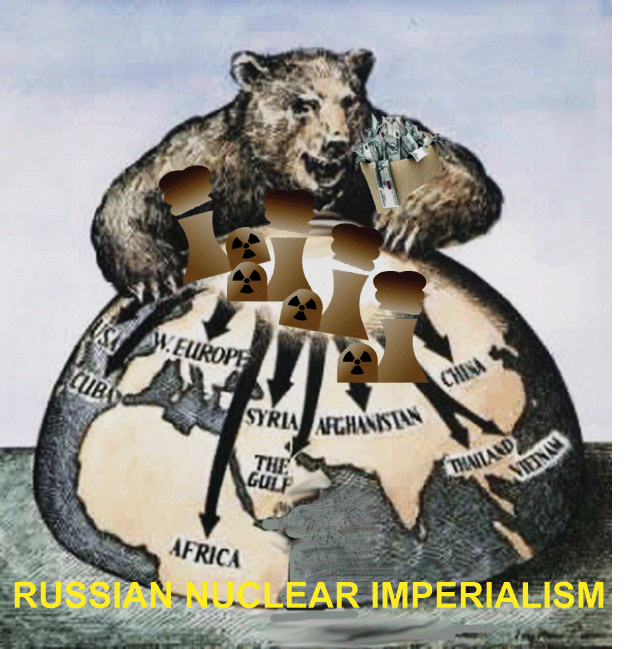
Middle East Monitor 10th Aug 2018 , Egypt will obtain a license to build the Dabaa nuclear plant by mid-2020,
the Russian deputy minister of industry and trade said. Georgy Kalamanov
added that Russian experts are currently completing designing the nuclear
plant and surveying the area where it will be built.
In 2015, Russia andEgypt signed a deal which would see Russia build Egypt’s first nuclear
power plant in the Dabaa area, located on Egypt’s northwestern coast.
Under the terms of the agreement, Cairo would access a loan for the project
from Moscow. In 2016, the Egyptian official Gazette reported that the loan
would amount to $25 billion, which would finance 85 per cent of the cost of
contracts signed for the plant’s construction. The loan repayment period
is 35 years. Egypt will finance the remaining 15 per cent. https://www.middleeastmonitor.com/20180810-russia-egypt-to-begin-building-nuclear-reactor-in-2020/









 nuclear-news