Power balance is changing, with the flexibility of renewable energy systems
By 2040 Bloomberg New Energy Finance predicts that more than half of global energy capacity will come from renewables and flexible sources, such as battery storage and demand side response
 NuClear News Sept 18 Tom Greatrex of the Nuclear Industry Association (1) says we should ignore the National Infrastructure Commission’s (NIC’s) recommendation that we only order one more nuclear station on top of Hinkley Point C before 2025 (2), because cutting carbon without the help of nuclear is a “risky business”. He says the Government understands the inherent value of a baseload low carbon source of generation.
The NIC says: “It is now possible to conceive of a low-cost electricity system that is principally powered by renewable energy sources.” It says at least 50% and up to 65% of electricity in 2030 should come from renewables. (3)
Australia is having similar debates where the fossil fuel lobby argues that because “coal” is “baseload”, it must therefore be “reliable”, but wind and solar are intermittent, so they cannot be relied upon to keep the lights on. It’s political rhetoric that belies the reality of the electricity system. Australia’s grid has challenges, but they are not necessarily ones that can be solved just by having more “baseload”. What is really needed – as the Australian Energy Market Operator, chief scientist Alan Finkel, and any number of other independent experts point out – is dispatchable and reliable generation, one that the grid operator can count on, at times of peak demand and heat stress. And the answer does not lie in traditional “baseload” generation – the more than 100 trips of big fossil fuel plants since December, often at times of soaring heat, underline that point.
The energy debate is usually dominated by simple political rhetoric – based around emissions or no emissions, cheap prices or expensive ones, baseload versus intermittency. That just skims over the surface. Behind the scenes, as the clean energy transition continues, debates are raging about good engineering practices and the design of markets. One of Australia’s leading electrical engineers, Kate Summers says large diverse renewable resources are far more stable in output than singular sources. She uses a series of graphs to illustrate that at moments when stability can be won or lost it has been wind and solar that have held firm, and acted as what one might consider to be “baseload”. And it has been coal and gas that has proved “intermittent” at the very minutes that stability is needed. (4)
It’s the Flexibility Stupid
A new report from Chatham House says evidence is growing that highly flexible electricity systems could deliver lower whole-system costs, especially given the dramatic projected falls in solar and wind power costs by 2030.
While the renewables rollout is a key part of global climate policy, the challenge is that the costs associated with managing the system start to escalate once renewables exceed a 30% share of generated electricity. Unless properly planned for, the growth in electric vehicle use and electric heating could further amplify these ‘system integration costs’. They include the cost of holding fossil fuel power plants in reserve for periods of low renewable supply, grid upgrades and the dumping of power from renewables when system constraints are reached. Governments can ensure electricity is affordable by promoting ‘flexibility’. Grid operators and power companies should pursue a diverse range of flexible, decentralized, modular technologies.
New technologies that enhance system flexibility, including smart electric vehicle (EV) charging, battery storage, digitalization with intelligent control and demand-side management, are unleashing a new phase of transformations in the power sector, for which existing companies are ill prepared. Companies providing these solutions may come to dominate the power sector in the coming decades. The accelerating deployment of this array of ‘flexibility enablers’ means the spectre of cost escalation – resulting from the expense of managing intermittent wind and solar power at huge volumes – may never materialize.
Smart, staggered EV charging could enable significant advances in system flexibility. By 2030, smart EV charging in the UK could be equivalent to 18% of the country’s current generating capacity. Rapid cost reductions in battery manufacturing, driven by increased deployment of EVs, are enabling affordable static, grid-level storage, in turn enhancing power system flexibility.
Digitalization of the electricity sector will lead to significant advances in system efficiency and flexibility. Residential demand will become flexible and networks functionally ‘smarter’. Machine-learning algorithms could be a game-changer, helping to manage the increasing complexity of electricity systems and identify new system-level efficiencies.
Enhanced system flexibility and a growing role for these technologies will provide new entry points for highly disruptive market actors, many of them not traditionally associated with the power sector. These actors include powerful technology companies and automotive manufacturers such as Google, Tesla and BMW. More widespread electrification of transport, and eventually of heating, will change the political and regulatory landscape of the electricity sector.
The transformations which have happened so far, with the rapid introduction of renewable technologies and falling demand due to greater energy efficiency, have undermined the business models of traditional power utilities. Now they face the prospect that renewables will achieve ever higher penetrations within the electricity market, aided by greater system flexibility. This will continue to erode the role of large power stations in ‘system balancing’ – balancing supply and demand – and will put further pressure on existing business models.
Evidence is growing that highly flexible electricity systems could deliver lower whole-system costs, especially given the dramatic projected falls in solar and wind power costs by 2030. But new regulatory approaches are needed to encourage market actors to deliver flexibility. Regulatory frameworks need to prioritize and incentivize investment in these areas, and encourage alternative business models. And in this future, our reliance on large fossil fuel power plants would fade, along with the utility business models that have long been based on a centralized power system.
New business models are emerging to aggregate and manage behind-the-meter investments. One example: storage-as-a-service. The innovative US utility, Green Mountain Power (GMP), in Vermont offers customers a Tesla Powerwall 2.0 battery for $15 a month so long as the customer allows GMP to manage when and how the battery is charged and discharged. Alternatively, customers can buy one for $1,500 – which is roughly a fifth of the actual cost of the battery. In either case, substantial subsidies, approved by the Vermont’s Public Utilities Commission, are offered. The regulator has been convinced that the scheme will more than pay for itself in the sense that all customers, not just those participating, will benefit from the program. The distributed storage paid off handsomely during a heat wave in early July 2018. The company was able to discharge stored energy out of about 500 Tesla Powerwall batteries installed in the homes of some 400 customers and feed it into the grid when it was sorely needed. It saved roughly half a million dollars by avoiding the need to buy expensive power from suppliers at the time of peak demand. GMP, which serves roughly a quarter-million customers in VT uses the batteries in customers’ premises as a virtual power plant (VPP). Customers like the batteries because they typically replace an emergency generator when power fails – which is not uncommon during storms in rural areas. (6)
UK Power Networks
The UK’s largest electricity distributor has proposed adopting a “flexibility first” approach to the delivery of extra grid capacity, in a move that could bring renewable energy onto the network at a lower cost. UK Power Networks has revealed plans to “supercharge” local markets for flexibility services, which rely on customers changing their energy consumption or generation to balance network demand, possibly by creating them itself.
The company claims that if flexibility services were made available to the 8.2 million buildings it serves, new markets for distributed renewable generation would open across London, the South East and the East of England. It speculates that such increased competition would result in a higher proportion of renewable power being bought onto the network, but at a lower cost. The Flexibility Roadmap proposes a radical rethink to the way we do business, moving away from automatically building new assets and instead giving the distributed energy resources market the opportunity to offer their services. If the market can provide the capacity we need at a more cost-effective rate than building new infrastructure, that’s exactly what we should do.
Specifically, UK Power Networks believes that the actions outlined in the roadmap will lower costs for consumers by delaying or avoiding expensive grid reinforcements, increase the resilience of the network and provide new sources of revenue for flexibility providers. To ascertain how it should best meet demand for flexibility, the company has launched a consultation on its Flexibility Roadmap. The consultation will run from August to 8 October. If accepted the proposals will come into effect from 2019.
Earlier this summer, UK Power Networks unveiled its plan to create the nation’s first “virtual” solar power station by the end of the year, using PV panels on the rooftops of its London customers’ homes. (7)
Demand-Side Response
By 2040 Bloomberg New Energy Finance predicts that more than half of global energy capacity will come from renewables and flexible sources, such as battery storage and demand side response. At 7% of global capacity, flexible sources such as batteries and demand side response – where homes and businesses automatically cut energy usage a peak times – will account for the same level of global energy capacity as oil-fired power plants today. And more than half of this energy storage capacity will come from small-scale batteries installed by households and businesses alongside rooftop solar panels. This trend away from larger power plants and towards smaller, decentralised energy systems is happening already in both developed and developing nations.
Energy, like every other sector, is going digital. From smart home products such as Hive that allow home owners to control their energy use from their smartphone, through to companies like REstore employing artificial intelligence to calculate just how much energy capacity a factory can offer as a virtual power plant. Centrica’s CEO Iain Conn says he expects demand side response to become one of the fastest growing elements of the energy market over the next few years. Europe’s largest demand side response aggregator, REstore, was acquired by Centrica in 2017.
In the same way as demand side response aggregators are emerging as a new type of energy company for the decentralised era, a new breed of companies is providing a route to market services for small generators. Centrica acquired one of Europe’s leading route to market companies, the Denmark-based Neas Energy, in 2016. Neas is able to take all of the Big Data coming from smart meters and Internet of Things (IoT) connected devices to build an accurate real-time picture of energy demand, as well as demand trends. Neas also uses software that combines this data with smart algorithms that judge weather patterns, so that it knows how much any given wind turbine or solar panel is likely to generate, and when. This helps balance the grid by matching supply and demand more accurately. And for the smaller energy producer, it helps them sell their energy at the most accurate market price. The growth in services supplied by companies like Neas is being driven by the rapid improvement and increasing availability of smart digital technology to both energy companies and their customers.
Greater insight through digital technology is just the start of the shift of power away from energy companies and towards the customer. Centrica is currently piloting a project in the south west of England that will allow local residents and businesses to buy and sell energy between themselves without the intervention of their energy supplier. The £19 million Local Energy Market in Cornwall is enabling 200 homes and businesses to do this using a digital record known as Blockchain. It is used to create a secure electronic ledger of transactions between participants. Iain Conn says he believes such local networks will become the norm in a new decentralised energy market.
Home owners using Blockchain to become their own micro-energy companies may seem like something for the distant future, but Microsoft’s Michael Wignall says that digital technology is accelerating at such a pace that these kinds of radical changes will be delivered over a short period of time. The Fourth Industrial Revolution we are currently experiencing will make energy systems of the future completely unrecognisable from what they are today. (8)
“Energy storage is all the rage”, says Dave Elliott, Emeritus Professor of Technology Policy at the Open University. But while the field is full of innovation at present, pumped hydro storage continues to dominate. And while storage offers one way to respond to the variability of some renewables, there are other options, including smart grid demand management (to time-shift demand peaks) and super-grid imports and exports (to balance local supply and demand variations across wide areas). (9) “There is nothing that storage can do that something else can’t do,” according to Professor Mark O’Malley of Canada’s McGill University and University College Dublin. (10)
Batteries, capacitors, and flywheels, along with smart-grid demand adjustments, may all be fine for brief periods, dealing with short-term variations in renewable inputs, but are not much use for longer-term lulls in renewable availability. Pumped hydro projects may be able to deliver power for perhaps a day or so, depending on their scale, but for longer term storage that’s when big hydrogen gas or compressed air underground storage facilities may come into their ownlinked to back-up generators. The stores can be charged using green energy already produced, when there was surplus, locally or on a wider basis, with super-grid links for transfers. http://www.no2nuclearpower.org.uk/wp/wp-content/uploads/2018/09/NuClearNewsNo110.pdf
Climate change takes its toll on nuclear reactors that can’t cope with the heat
 Weatherwatch: nuclear power plants feel the heat, During this summer’s heatwave, nuclear reactors in five European countries had to be shut down or put on reduced power, https://www.theguardian.com/news/2018/sep/07/weatherwatch-nuclear-power-plants-feel-the-heat Guardian, Paul Brown, 8 Sep 2018 An argument of the nuclear lobby is that renewables, particularly wind and solar, are unreliable because of changing weather. Only nuclear power can guarantee to keep the lights on or the air conditioners running.
Anti nuclear activists to seek injunction to stop the dumping of radioactive mud at Cardiff
Penarth Times 6th Sept 2018 , THE dumping of mud from a nuclear plant site off the coast of Penarth is
due to start today. Around 300,000 tonnes will be dredged from the seabed
near the Hinkley Point C site and will be moved to Cardiff Grounds, not far
from Penarth.
Although the grounds are a licensed disposal site for
sediment, the plan has been met with anger and thousands of people have
protested against it. Around 7,000 people signed a petition sent in to the
National Assembly and now anti-nuclear power activists say they are
prepared to go to court to get an injunction.
http://www.penarthtimes.co.uk/news/16693340.mud-dumping-to-begin-today/
Russia’s nuclear wastes, and the clean-up of Andreeva Bay
 What is the situation at Russia’s biggest dump site for spent nuclear fuel?

Three shiploads with spent nuclear fuel are to be sent from site this year and the whole cleanup is to be completed in year 2024, representatives of nuclear power company Rosatom said in this week’s meeting in the Joint Russian-Norwegian Commission Nuclear Safety.
The cleanup of the Andreeva Bay is one of the biggest ongoing bilateral cooperation projects between Norway and Russia and Norwegian tax payers have over the years covered project expenses worth hundreds of millions of kroner.
The nuclear waste storage, which is located only about 55 km from the border to Norway, holds about 22,000 spent nuclear fuel elements, and was long considered a ticking environmental bomb.
Shipments to Mayak
The cooperation on site marked a milestone in late June 2017, when the first batch with 470 spent fuel elements left Andreeva Bay. Present were a number of dignitaries, among them Norway’s then foreign minister Berge Brende. They all waved as special purpose vessel «Rossita» set course for Murmansk, where the deadly materials will be reloaded onto special trains and sent to reprocessing plant Mayak.
«It is a big day for the environment, for Russian-Norwegian cooperation, for people in Finnmark and the Kola Peninsula and all the ones who care about the Barents Sea,» Brende told the Barents Observer at a press briefing following the event.
However, far from everything is smooth and easy in cooperation over the complex and highly sensitive nuclear wastes. Access to site by independent controllers is strictly regulated and information sparse. The Norwegian journalists that have been invited to take part in official visits have not been allowed to bring cameras.
Growing concern
The situation might have become ever more complicated this week, after two leading Norwegian officials on nuclear safety were held back on the Russian border.
One of the two people is Per-Einar Fiskebeck, the long-serving special adviser at the Finnmark County Governor’s office, who for decades have closely followed up the Andreeva Bay project.
The Norwegian Ministry of Foreign Affairs describes the incident as «serious» and confirms that it is concerned about the situation.
«It is worrying if this would affect the further progress in the nuclear safety cooperation, which otherwise has been a success story in the Norwegian-Russian relationship in the north,» a comment from the ministry reads. Continue reading
USA and Russia – in 20th Century -devised hideously elaborate ways of blowing each other up
 Top-secret ‘doomsday machine’ documents reveal terrifying nuclear apocalypse plans https://metro.co.uk/2018/09/04/top-secret-doomsday-machine-documents-reveal-terrifying-nuclear-apocalypse-plans-7911916/ Jasper Hamill 4 Sep 2018 It’s no secret that the US and Russia spent much of the 20th century devising hideously elaborate ways of blowing each other up. Now declassified documents written in 1964 have revealed the true extent of the apocalyptic atomic broadside Washington planned to unleash against its greatest enemy. A pair of top-secret memos written by top military chiefs shows the US was intending to implement an ‘overkill’ strategy which would have flattened Russian cities and killed tens of millions of people.
They demonstrate how generals were considering the possibility of unleashing thousands of nukes in a bid to cause ‘95% damage’ to targets such as military facilities and ‘urban-industrial centres’ including major cities. The files also document plans to blow up 30% of all the people living in 30 Chinese cities, saying this outcome would be ‘desirable’. The secret files were unearthed by George Washington University’s National Security Archive and shed light on a secret nuclear strategy called the Single Integrated Operational Plan (SIOP), which is often referred to as a ‘doomsday machine’ and has never been declassified. Researchers are only able to learn about this highly disturbing scheme by reading other documents which discuss it, meaning the release of the two memorandums is a major step forward in understanding the grim fate which would have befallen the world if a nuclear war erupted.
‘US nuclear war plans [made] during the Johnson administration included the option of a retaliatory strike against nuclear, conventional military, and urban-industrial targets with the purpose of removing the Soviet Union “from the category of a major industrial power” and destroying it as a “viable” society,’ wrote the National Security Archive in a statement. ‘The document, the Joint Staff’s review of SIOP guidance in June 1964, showed continued acceptance by policymakers of the cataclysmic nuclear strike options that had been integral to the plan since its inception. Accordingly, the SIOP set high damage requirements – 95% for the top priority nuclear targets – ensuring that it remained an “overkill” plan, referring to its massively destructive effects. ‘Prepared and continually updated by the Joint Strategic Target Planning Staff, the SIOP has been characterized by some as a “doomsday machine”.’ The latest declassified document is a review of SIOP conducted by the Joint Staff, a group of senior military leaders.
It lays out plans for retaliatory and preemptive strikes against Russia or China which range in severity from an assault aimed at knocking out nuclear weapons facilities to a blitzkrieg designed to ‘destroy the will and ability of the Sino-Soviet bloc to wage, remove the enemy from the category of a major industrial power and assure a post-war balance of power favourable to the United States’. The plans also expose a scheme to use ‘population loss as the primary yardstick for effectiveness in destroying the enemy society with only collateral attention to industrial damage’, the National Security Archive added. What this means is that the US was willing to bomb Russia back to the Stone Age and viewed the destruction of its population as a valid strategy of war…. https://metro.co.uk/2018/09/04/top-secret-doomsday-machine-documents-reveal-terrifying-nuclear-apocalypse-plans-7911916/?ito=cbshare
Austria continues its legal action crusade against nuclear power in Europe
 Liberation 5th sept 2018 Austria continues its legal crusade against nuclear power in Europe. The
government has decided to appeal against an ECJ ruling authorizing public
subsidies to the British Hinkley Point EPR. “Just back from her maternity
leave, the Minister of Sustainable Development, Elisabeth Köstinger,
declares war again at the Atomic Lobby.”
The Kronen Zeitung , the country’s
leading newspaper, set foot on the plate announcing Tuesday, that the
Austrian government would appeal, before the Court of Justice of the
European Union (CJEU), a judgment that authorized public subsidies from the
British government for the Hinkley Point nuclear power plant. The Austrian
Council of Ministers will decide this Wednesday to appeal, with the support
of Luxembourg.
Austria does not want to abandon the legal battle against
nuclear energy in Europe, which it is conducting on several fronts. Last
March, Vienna also filed another complaint, this time concerning the Paks
reactors in neighboring Hungary. On the left, right and even far right, no
Austrian political party defends atomic energy. Antinuclearism is indeed
the subject of a broad consensus in the country. Since 1978, this type of
energy is de facto prohibited. That year, a referendum prevented the
commissioning of the Zwentendorf atomic power plant, which would have been
the first in Austria.
http://www.liberation.fr/planete/2018/09/05/l-autriche-poursuit-sa-croisade-juridique-contre-le-nucleaire-en-europe_1676553
Will UK’s House of Lords agree to force a geological nuclear dump on Cumbria
 Radiation Free Lakeland 2nd Sept 2018 , Will These Lords Leap to Cumbria’s Defence? Will They Shout About the
“Implementation” of Geological Dumping of Nuclear Wastes. On the 6th
September the House of Lords will be debating the Government’s cunning
plan to implement Geological Disposal of Nuclear Wastes. Radiation Free
Lakeland have sent a letter to all of the Cumbrian Lords to urge them to
tear up this policy which seeks to force a geological nuclear dump on
Cumbria and instead to scrap the whole “Implementation” plan. Our
letter is below [on original] and we urge all those who love Cumbria to write a similar
letter to any or all of the Cumbrian members of the House of Lords.
https://mariannewildart.wordpress.com/2018/09/02/will-these-lords-leap-to-cumbrias-defence-will-they-shout-about-the-implementation-of-geological-dumping-of-nuclear-wastes/
Austria will appeal EU ruling on UK’s Hinkley Point nuclear plant
Austria plans to appeal EU ruling on UK’s Hinkley Point nuclear plant https://www.reuters.com/article/us-eu-nuclear-uk-austria/austria-plans-to-appeal-eu-ruling-on-uks-hinkley-point-nuclear-plant-idUSKCN1LJ0Y5
VIENNA (Reuters) – Austria plans to appeal against a ruling by Europe’s second-highest court which rejected its objections to Britain’s plans for a nuclear power plant at Hinkley Point, the country’s sustainability minister said on Monday.
“Our lawyers have examined this in detail in the past weeks. We believe the chances of an appeal remain intact,” Sustainability Minister Elisabeth Koestinger said in an interview with newspaper Kronen Zeitung.
The ministry said it expects Austria’s cabinet to formally give the go-ahead for an appeal when it meets on Wednesday.
French utility EDF and China General Nuclear Power Corp aim to have the Hinkley Point C nuclear power station on line in 2025 with costs for the project seen at 19.6 billion pounds ($25.3 billion).
The European Commission cleared the project in 2014, saying it did not see any competition issues. But Austria took its objections to the General Court in Luxembourg, which dismissed them in July.
One aspect Vienna objects to is a guaranteed price for electricity from the plant which is higher than market rates. It also opposes state credit guarantees of up to 17 billion pounds being provided for the project.
Austria can appeal to the European Court of Justice but only on matters of law.
Opposition to nuclear power is widespread in Austria, which built a nuclear reactor but never brought it on line.
Voters rejected plans to bring it into operation in a referendum in 1978 and the reactor, at Zwentendorf on the Danube northwest of Vienna, now serves as a training center.
($1 = 0.7757 pounds) Reporting by Francois Murphy; editing by Jason Neely
French and German anti nuclear campaigners block uranium transport
 Reporterre 1st Sept 2018 [Machine Translation] Since the morning of Saturday, September 1, several anti-nuclear Franco-German militants block a uranium transport.
They climbed a bridge 140 m high near Koblenz, Germany, blocking the railway on the Moselle, informs us the group Contratom Deutschland. The blocked train carries ” Yellow Cake ” from Namibia ; it left Hamburg on Thursday for the Orano uranium conversion plant in Narbonne Malvesi, in the south of France.
In Narbonne, uranium is transformed into UF4 and then used, after several transformations and enrichment, in nuclear power plants around the world. According to Orano, the Narbonne plant processes 25% of the world’s uranium.
“If we want to get out of the nuclear industry, ” says Cécile, a French climber living in Germany who takes part in the action, ” we must stop these transports and prevent them from reaching the Orano factory in
Narbonne Malvési, the gateway to European nuclear energy.
Germany, a net exporter of electricity, unlike political discourse, does not come out quite nuclear. The transports supplying the nuclear facilities continue and the Framatome Nuclear Fuel Plant in Lingen (Lower Saxony) and Urenco’s uranium enrichment plant in Gronau (North Westphalia) continue to operate. That’s why we want to stop nuclear transport. ”
https://reporterre.net/Un-train-d-uranium-a-destination-de-Narbonne-bloque-en-Allemagne
New documentary claims that Hitler had nuclear weapons ambitions, only thwarted by an accident
NUCLEAR NAZI How Adolf Hitler’s plan to build an atomic bomb and destroy London was only thwarted when ferry carrying key ingredients sunk https://www.thesun.co.uk/news/7150860/how-adolf-hitler-atomic-bomb-london-only-thwarted-by-ferry-ride/
The discovery shines light on Hitler’s ambitions to become a nuclear power and nuke Britain,By Harvey Solomon-Brady 1st September 2018
How a UK submarine could carry out a nuclear strike, depending on a radio programme
 war https://www.sfgate.com/technology/businessinsider/article/How-a-60-year-old-BBC-radio-show-may-be-one-of-13198577.php Sinéad Baker,
 - The UK’s nuclear arsenal is housed on four submarines, with one of those submarines on patrol at all times.
- During their isolated missions, crews watch for signals that the UK still exists — and may launch a counter-attack if they believe their country has been destroyed.
- One of these signs is whether BBC Radio 4 is still broadcasting the “Today” programme, Britain’s flagship news and politics show.
- If the submarine commander believes Britain has been destroyed, he may be under orders to launch a nuclear strike.
Deep underwater, on submarines equipped with nuclear missiles, British crews are constantly prepared to fire their weapons, and potentially play a part in bringing about the end of the world. Sailors on the four Vanguard-class submarines which patrol the waters and hold the UK’s nuclear deterrent operate under strict protocol for working out when to act and what to do — part of which is said to include listening to BBC radio.
According to a prominent British historian, the broadcast of BBC Radio 4’s “Today” programme is one of the official measures the Royal Navy uses to prove that the United Kingdom still exists. “Today” has been broadcast at around breakfast time since 1958 and is the highest-profile news programme in British media.
Lord Peter Hennessy, a history professor who joined the UK’s House of Lords in 2010, said that if it can’t be heard for three days in a row, then it could signify Britain’s demise, and trigger their doomsday protocol.
According to Politico, Hennessy says: “The failure to pick up the BBC Today program for a few days is regarded as the ultimate test.”
If no sign comes through, the commander and deputy will open letters that contain instructions from the prime minister and execute their final wishes.
These letters, each known as a “Letter of Last Resort’ are secret instructions, written when a prime minister enters the office and sealed until an apocalypse. They tell the UK’s submarine commanders what to do with the country’s nuclear weapons if the country has been destroyed.
Writing these letters is one of the first tasks undertaken by any new prime minister. They are locked inside a safe inside another safe, and placed in the control rooms of the nation’s four nuclear submarines, Politico reports. The safes will only be accessible to the sub’s commander and deputy.
Matthew Seligman, Professor of Naval History at Brunel University, told BBC Newsbeat that there are “only so many options available.”
“Do nothing, launch a retaliatory strike, offer yourself to an ally like the USA, or use your own judgment.
“Essentially, are you going to use the missiles or not?”
The UK has four submarines that are capable of carrying the country’s Trident nuclear missiles. At least one of these has been on patrol at all times since 1969, the government says.
There are 40 nuclear warheads and a maximum of eight missiles on each submarine.
Only the prime minister can authorize the launch of the country’s nuclear weapons.
Even before Wylfa nuclear station approved, Horizon Nuclear Power wants to demolish buildings, clear area
 North Wales Chronicle 31st Aug 2018 , Horizon Nuclear Power is seeking planning permission to carry out the 15
month long process that includes clearing field boundaries, demolishing
buildings and “relocating species”, covering an area the equivalent of
almost 500 football pitches. The plans, to be discussed by Anglesey
Council’s planning committee next week, also include building car parks
and offices at the site on the outskirts of Cemaes.
Recommended for approval by officers, Horizon has endeavoured to begin the work even before
the fate is known of the necessary Development Consent Order (DCO)
application for the nuclear plant itself. A process that could take at
least 18 months for the Planning Inspectorate to decide upon, the DCO will
also include a substantial public consultation period.
http://www.northwaleschronicle.co.uk/news/16611204.740-acre-site-for-wylfa-newydd-recommended-for-approval/
Inadequate radiation testing of Hinkley mud: Plaid calls for further testing
Glamorgan Gem 30th Aug 2018 , Plaid Cymru councillors in Barry have warned against disposing more than300,000 tonnes of mud from Hinkley Point a few miles off the coast from
Cardiff, Penarth and Barry. Earlier this year Natural Resources Wales (NRW)
said sample results of the dredged material had demonstrated it is safe,
but campaigners claim it has been “insufficiently tested”.
Hinkley Point C and release it at ‘Cardiff Grounds’ in the Severn
Channel where it can be dispersed. Plaid points out that concerns have been
raised by marine scientist Tim Deere-Jones that the mud has not been tested
for radioactivity at a depth lower than five centimetres and that the wrong
tests have been carried out. Cllr Nic Hodges, who represents Barry Island
and Barry’s West End on the Vale Council, spoke at a rally outside the
Senedd in Cardiff Bay on Bank Holiday Monday, calling for further testing.
http://www.glamorgan-gem.co.uk/article.cfm
Resignation of France’s environment Minister – he did not do a great deal to pull back nuclear power
French environment minister resigns https://beyondnuclearinternational.org/2018/08/29/french-environment-minister-resigns/Update: A newly leaked report examines the possibility of France building six new EPR reactors starting in 2025, after a prolonged period of inactivity in the industry. The report was ironically commissioned by Hulot and economy minister, Bruno Lemaire, and concludes that France “cannot stop building” reactors in order to maintain industrial know how and provide jobs, according to the newspaper, Les Echos, which broke the story. The report’s finding may have contributed to Hulot’s decision to resign. However, the notion that France would build six more EPRs was met with derision by nuclear critics who pointed out that the French nuclear industry has been unable to complete even one EPR in either France of Finland, where both projects are years behind schedule and massively over-budget.
German nuclear waste and Geoscience authorities in selection process for nuclear waste dump
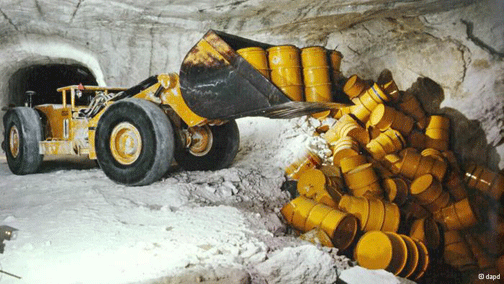
cooperate with the Federal Institute for Geosciences and Natural Resources
(BGR) on the selection process for a national deep geologic repository
site, BGE said. According to a statement, BGE and BGR, which provides
scientific advice to the government, will also cooperate on the management
of existing waste repositories, including the Asse, Konrad and Morsleben
sites. The agreement will remain valid until the final repository site
selection process is complete, BGE said.
out R&D on behalf of BGE, the statement said. The Gorleben salt mine in
Lower Saxony, northern Germany, has been under investigation as a potential
final repository site.
introduced in 2000 by a former Social Democrat and Green Party
administration, but ended in 2010 and exploration at the site was
restarted. However, work was discontinued again at the end of 2012 to allow
for a political compromise on site selection and then ended in July 2013.
from any new site selection process. BGE was set up in 2016 and is
responsible for finding possible radioactive waste disposal sites in
addition to the existing interim facility at Gorleben.
https://www.nucnet.org/all-the-news/2018/08/28/germany-s-radwaste-disposal-company-to-cooperate-with-federal-institute-on-repository-selection
1 This Month

1 June Webinar – The High Cost of Nuclear Power – Register



of the week– Nuclear Reactor Information Task Force
To see nuclear-related stories in greater depth and intensity – go to https://nuclearinformation.wordpress.com
-
Archives
- May 2026 (262)
- April 2026 (356)
- March 2026 (251)
- February 2026 (268)
- January 2026 (308)
- December 2025 (358)
- November 2025 (359)
- October 2025 (376)
- September 2025 (257)
- August 2025 (319)
- July 2025 (230)
- June 2025 (348)
-
Categories
- 1
- 1 NUCLEAR ISSUES
- business and costs
- climate change
- culture and arts
- ENERGY
- environment
- health
- history
- indigenous issues
- Legal
- marketing of nuclear
- media
- opposition to nuclear
- PERSONAL STORIES
- politics
- politics international
- Religion and ethics
- safety
- secrets,lies and civil liberties
- spinbuster
- technology
- Uranium
- wastes
- weapons and war
- Women
- 2 WORLD
- ACTION
- AFRICA
- Atrocities
- AUSTRALIA
- Christina's notes
- Christina's themes
- culture and arts
- Events
- Fuk 2022
- Fuk 2023
- Fukushima 2017
- Fukushima 2018
- fukushima 2019
- Fukushima 2020
- Fukushima 2021
- general
- global warming
- Humour (God we need it)
- Nuclear
- RARE EARTHS
- Reference
- resources – print
- Resources -audiovicual
- Weekly Newsletter
- World
- World Nuclear
- YouTube
-
RSS
Entries RSS
Comments RSS
 nuclear-news