Belgium’s creaky nuclear reactors raise risk of winter power outages, DW, 10 Oct 18
Belgium is slowly phasing out its aging nuclear energy infrastructure. But looming winter weather, limited renewable options and a poorly connected electricity network have left the country at risk of blackouts.
The Doel 3 nuclear reactor, near the Belgian port of Antwerp, was built in the early 1980s with a design life of four decades. Next week, that creaking reactor will be the only one in Belgium still working — a major blow to the energy security of a country that derives more than half of its electricity from nuclear power.
Belgium’s grid operator Elia said in a statement last week that 700-900 Megawatts (MW) of additional electricity capacity will be needed this winter — down from a previous estimate of about 1,600 MW — if the country is to meet its electricity needs and avoid blackouts.
EDF Energy extends Hunterston B-7 UK nuclear outage until Dec. 1 LONDON (Reuters) 8 Oct 18– EDF Energy has extended an outage at its Hunterston B-7 nuclear reactor in Britain until Dec. 18, it said on Monday.
The reactor, which can produce enough electricity to power more than 800,000 homes, has been offline since March when cracks were found in its core during a routine inspection.
Indictment: Russian military targeted Pa. nuclear power company, witf news, by Amy Sisk/StateImpact Pennsylvania | Oct 8, 2018 (Pittsburgh) — A federal indictment filed this week alleges Russian hackers targeted a nuclear power company near Pittsburgh beginning in 2014, in addition to anti-doping agencies throughout the world.The hackers, who are intelligence officers for the Russian military, tried to breach the network of Westinghouse Electric Company by sending emails to employees intending to trick them into entering login credentials on a webpage spoofing the company’s own network, according to the indictment.
Although the indictment says the hackers stole some credentials before redirecting the workers to the company’s actual network, Westinghouse and federal officials said the hacking attempt was unsuccessful.
………The indictment names seven Russian intelligence officials, who face charges ranging from conspiracy to wire fraud to aggravated identity theft.
The Russian Foreign Ministry said it “can’t confirm” the latest U.S. State Department data indicating that the U.S. has complied with the thresholds set by the 2010 New START treaty. It limits each country to no more than 1,550 deployed nuclear warheads and 700 deployed missiles and bombers.
The ministry said the U.S. removed 56 Trident II submarine-launched intercontinental ballistic missiles and 41 B-52H strategic bombers from its count of nuclear arsenals after re-equipping them to carry conventional weapons.
But it argued that the U.S. had failed to let Russia verify the move in line with the treaty, and failed to list four land-based missile silos converted for training purposes — a move Russia said didn’t conform to the treaty.
The ministry said the perceived U.S. breach of the treaty’s limits was “unacceptable,” adding that it expects Washington to “show a constructive approach to settling that acute issue.”
The tough statement marked the first time Russia raised the issue of the alleged U.S. non-compliance with the pact signed by President Barack Obama and then-Russian President Dmitry Medvedev amid a brief thaw in Russia-U.S. ties. The New Start came into effect in 2011 and is to expire in 2021 unless the two countries extend it.
Officials in both Russia and the U.S. have given mixed signals about the pact’s future.
Russia-U.S. ties have sunk to their lowest levels since the Cold war times over the Ukrainian crisis, the war in Syria, the allegations of Russian meddling in the 2016 U.S. presidential election and alleged Russian hacking of world anti-doping bodies, athletes, plane investigations and chemical weapons probes, among other disputes.
In the arms control sphere, Moscow and Washington also have been at loggerheads over another arms control treaty — the 1987 Intermediate-range Nuclear Forces Treaty.
The U.S. has accused Russia of deploying a new type of missile in violation of the pact that bans an entire class of weapons — all nuclear and conventional ground-launched ballistic and cruise missiles of intermediate range. Russia has rejected the accusations.
Morning Star 6th Oct 2018, Alan Simpson: If there are seminal moments in politics, Jeremy Corbyn’s speech at the 2018 Labour conference will go down as one of them.
This was when the planet took centre stage. From the Kerala floods to the Saddleworth moorland fires and from California to Scandinavia, 2018 has been a roller coaster of extreme weather events.
This is the shape of things to come, but it took Corbyn to make “one-planet economics” the centrepiece of tomorrow’s politics. This couldn’t have come at a better moment. The Conservatives are tearing themselves apart, with their crazies loving every moment. We need a better plan.
It was into this maelstrom that Corbyn pitched his leader’s speech — a bold vision, promising that
Labour’s “programme of investment and transformation, to achieve a 60
per cent reduction in emissions by 2030, will create over 400,000 skilled
jobs.” Pretty unequivocal stuff. But that is just the start. Shadow
chancellor John McDonnell was no less uncompromising. The next government
will have to deliver carbon reductions of 15 per cent per year. To do so,
Britain will need a much more circular economics — not one that makes do
with less but one that certainly wastes and pollutes less.
And as Corbyn stressed, it is in “green jobs” that tomorrow’s transformative
economics will be rooted. For most people, a more circular economy would
deliver real improvements in their quality of life — from the air we
breathe, the food we eat, the homes we live in to the jobs and skills the
country needs.
This will come not just in the accelerated shift into
renewable energy but in using less energy in the first place. Tackling the
scandal of “cold homes” will save lives as well as cutting carbon.
Clean transport systems offer the same opportunities. These are a world
away from the triple absurdity of the GMB trade union sharing a platform
with the Taxpayers Alliance at the Tory Party conference in support of
fracking.
Wired 8th Oct 2018 Seventy years of British nuclear history lie behind these concrete, stone
and aluminium walls. Since opening in February 2017, Nucleus, the UK
Nuclear Decommissioning Authority’s (NDA) Nuclear and Caithness Archive,
near Wick, Scotland, has been gathering thousands of records, images and
plans about the UK’s civil nuclear industry.
More documents are being transferred from 17 archives across the UK, as the NDA plans to house them
all in this single purpose-built location. The archive contains documents
dating back to the 1950s, and some are classified as Top Secret. Records
are kept in triplicate: a copy on paper, a microfilm and a PDF version, to
reduce wear on the originals. https://www.wired.co.uk/article/nucleus-archive-uk-nuclear
Andrew Allison comments on this Russian claim Biological processes operate at the chemical level (electronic structure around atoms) these would be ineffective at changing anything at the nuclear level (strong and weak forces between parts of the nucleus). I would expect that the *most* that bacteria could do would be to concentrate and to isolate distributed atoms that happen to be radioactive.
Researchers from the Moscow-based Frumkin Institute of Physical Chemistry and the Russian Academy of Sciences’ Federal Research Center for Biotechnology have been able to isolate microorganisms which can be used to safeguard the surrounding environment from liquid radioactive waste.
Scientists made the discovery while conducting microbiological studies of the groundwater at the Seversky deep radiation burial site in Seversk, Tomsk region, Siberia, where liquid radioactive waste from the Siberian Chemical Combine, which supplies and reprocesses low enriched uranium for nuclear fuel, is stored.
Their research, recently published in Radioactive Waste, a Russian scientific journal, suggests that the bacteria is capable of converting radionuclide ions, including those found in uranium and plutonium, into sedentary forms, thereby preventing the spread of dangerous radiation into the surrounding environment. Through lab experimentation, the scientists were able to fine tune the conditions necessary for the bacteria to carry out its useful work.
The researchers say their findings are a first step in creation a biogeochemical barrier for radionuclides for use in deep burial sites containing liquid radioactive waste.
Research into microbiological tools to limit the effects of nuclear waste have been conducted since the 1980s, with scientists from around the world saying microbial processes must be taken into account in projects to bury and store nuclear waste which can otherwise decay over a period of millions or even billions of years.
The offspring of radar soldiers exposed to high doses of radiation during their service experience more genetic alterations than families without radiation exposure.
The offspring of radar soldiers exposed to high doses of radiation during their service experience more genetic alterations than families without radiation exposure. This has been demonstrated in a pilot study by the research team involving Charité-Universitätsmedizin Berlin, the Berlin Institute of Health (BIH), the Max Delbrück Centre for Molecular Medicine, Radboud University Nijmegen (Netherlands) and the University Hospital Bonn, which has now been published in the journal Scientific Reports. The results of this pilot study will be reviewed in a larger scale study.
Until the 1980s, military radar systems were often inadequately shielded against spurious radiation emitted by radar amplifier tubes. Such rays can cause radiation damage to service and maintenance personnel. The persons involved have joined forces in the ‘Association for the support of persons harmed by radar beams’. In 2003, a commission of experts made recommendations on compensatory payments. Since some children of former radar soldiers suffer from physical disabilities attributed to the radiation exposure of their fathers, their offspring are now in the spotlight. Whether radiation led to genotype damage in these children is debated.
A research team from Charité-Universitätsmedizin Berlin, the Berlin Institute of Health (BIH), the Max Delbrück Center for Molecular Medicine, Radboud University Nijmegen (Netherlands) and the University Hospital Bonn have now investigated this question in a pilot study. ‘Through the latest methods of high-throughput sequencing, the complete genomes of parents and their children can now be studied within a short time. This allows us to determine the mutation rates after radiation exposure much more accurately than before’ says first author Dr. med. Manuel Holtgrewe of the Core Unit Bioinformatics (CUBI) of the Berlin Institute of Health (BIH) and Charité-Universitätsmedizin Berlin.
Researchers studied the genomes of twelve families
The scientists studied the genomes of twelve families of radar soldiers. The entire genomes of 18 offspring and their parents were sequenced. The exact radiation exposure of the soldiers cannot be determined retroactively. Researchers estimate, however, that a ‘high dose’ of radiation emanated from the radar systems, especially because radar soldiers very frequently became ill, many from cancer. Scientists compared the mutation rates in the genomes of radar soldier families with that of 28 offspring of parents who were not exposed to radiation.
The focus was on so-called ‘multisite de novo mutations’ (MSDN), which have already been demonstrated in mice because of radiation. An MSDN is present when two or more defects in DNA strands occur adjacently to each other in a line of 20 base pairs. While in the families without radiation exposure, only every fifth offspring had an MSDN, in the radar soldier families this was two out of three offspring. Twelve MSDNs were found in the 18 offspring of radar soldiers, in one family indeed six MSDNs in three offspring. In addition, in two offspring, chromosomal alterations were also detected that had serious clinical consequences. The origin of these mutations could also be traced back to the paternal germ line and only rarely occurs by chance.
‘The results of our pilot study suggest that an accumulation of certain genotype damage by radiation can basically be demonstrated in the next generation,’ says Prof. Dr. med. Peter Krawitz from the Institute for Genomic Statistics and Bioinformatics at the University Hospital Bonn. How pronounced the accumulation of genotype damage by radiation is must be demonstrated by even larger studies, the results of which rely on a much broader database. A team involving Krawitz is currently planning such a follow-up study together with the Institute of Human Genetics of the University Hospital Bonn, the Charité-Universitätsmedizin Berlin and the Berlin Institute of Health (BIH), who are funding it.
The researchers thank the Government Organisation in Support of Radar Victims (BzUR) and its members for supporting the current study. The investigation was facilitated by a private donation of 50,000 euros by Dr. Gisela Sperling.
Manuel Holtgrewe, Alexej Knaus, Gabriele Hildebrand, Jean-Tori Pantel, Miguel Rodriguez de los Santos, Kornelia Neveling, Jakob Goldmann, Max Schubach, Marten Jäger, Marie Coutelier, Stefan Mundlos, Dieter Beule, Karl Sperling, Peter Michael Krawitz. Multisite de novo mutations in human offspring after paternal exposure to ionizing radiation. Scientific Reports, 2018; 8 (1) DOI: 10.1038/s41598-018-33066-x
Public Enquiry 6th Oct 2018 Dr Keith Barnham goes through some of the terminal problems at the Hinkley
C nuclear power station site
– ‘Radioactive mud’ test have been for gamma radiation, not alpha which shows up plutonium
– Economics of nuclear no longer viable
– Bridgwater Bay tidal lagoon would produce an equivalent amount of electricity
– France and China are not building any more nuclear power but have industries which are looking to expand anywhere guillible enough to take them
– Tory government have put the brakes on renewable energy to artificially prop up the dying nuclear industry
– this is a project the nuclear industry want, but nobody else does. Activists call for halt to ‘nuclear mud’ dumping off Wales. Campaigners say sediment has not been tested properly and may do ‘irreversible harm’ Among those backing
the objectors is the Emeritus Prof Keith Barnham, a distinguished research fellow in the physics department at Imperial College London, who argues it is possible that large amounts of uranium and dangerous levels of plutonium could have reached the mud when cooling water from the decommissioned Hinkley Point A was discharged. https://www.youtube.com/watch?v=fL5mnD6HrzA&feature=youtu.be
Floating Nuclear Power Plants in Northeast Asia? A Daunting Prospect. Weak multilateral architecture, territorial disputes, and natural disaster vulnerability compound the unknowns of Russia’s new energy platform. The Diplomat, By Tom Corben October 05, 2018 Given the controversy of all things nuclear power in the post-Fukushima era, it was no surprise that the April launch of Russia’s first floating nuclear power plant (FNPP), the Akademik Lomonosov, drew polarizing responses immediately (in spite of the fact that its nuclear fuel was only loaded earlier this week). Russia’s state-owned nuclear utility Rosatom, claimed that the Akademik Lomonosov’s safety precautions exceed “all possible threats,” granting it “invincibility against natural disasters,” and highlighted the enhancements to economic development efforts in Russia’s far-flung territories. Conversely, environmental organizations like Greenpeace labeled the Akademik Lomonosov a “nuclear titanic” or “Chernobyl on ice,” a serious risk to the global environmental and human security. Observers ought to regard warily the sensationalist claims of advocates and opponents of FNPPs alike. Even so, it is difficult not to view Rosatom’s “invincibility” claim without incredulity.
Rosatom has previously claimed in safety briefings to the International Atomic Energy Agency (IAEA) that the Akademik Lomonosov could withstand a magnitude-10 earthquake, tsunamis powerful enough to cast the barge ashore, and even the impact of a 10-ton aircraft. However, disasters such as that at Fukushima in March 2011 show the perils of blind faith in the integrity of nuclear technology and existing safety regimes that claim to preclude all possible disaster scenarios, particularly those where consecutive or compounding disaster events may present unforeseen challenges. That the Akademik Lomonosov is essentially the first of its kind (the comparatively small USS Sturgis aside) means that practitioners and observers alike have little historical experience to draw upon in offering completely watertight safety assessments. Commentators have pointed to nuclear-powered carriers and submarines to counter criticisms that seaborne reactors are inherently dangerous, yet several such vessels have sunk in the past, along with their radioactive cargo. There is, however, no precedent for a reactor complex the size of the Akademik Lomonosov’s going down in coastal or blue waters, nor for the sorts of short- or long-term hazards that may result or the responses that may be required.
These unknown risks are particularly accentuated when framed in the Northeast Asian context. Either the Akademik Lomonosov or one of its successors will reportedly head for the seismically-active Kamchatka Peninsula, which lies north of the Kuril Island chain presently disputed by Japan and Russia. The Sanchi oil tanker disaster in January demonstrated that the region’s geopolitical faultlines can complicate multilateral responses to industrial-environmental threats when they occur in or impact upon disputed territories, even when multilateral fora designed to facilitate collective risk management response to ocean-born hazards already exist. As far as FNPPs are concerned, these mechanisms do not presently account for potential radiological crises. In short, Northeast Asian states will need to move quickly and recalibrate existing institutions accordingly if they are to preclude another serious geopolitically-charged, potentially radiological, environmental disaster.
The Akademik Lomonosov features two KLT-40C reactors (variants of the military-grade KLT-40M model used aboard Russian icebreakers), capable of generating 70MWe — enough energy to provide power and desalinated water for between 100,000–200,000 people. These impressive statistics aside, however, neither the KLT-40C model nor Russia’s overall nuclear safety record are entirely reassuring. In May 2011, for example, the Russian icebreaker Taymyr experienced a severe coolant leak, releasing radioactivity into the atmosphere, and needed to be towed into port for urgent repairs — all this despite recent safety upgrades. There are also several cases of Russian nuclear submarines sinking with hundreds of kilos of uranium and/or nuclear-tipped missiles still aboard, most notably the K-159 wreck in the Barents Sea, though what threat these might pose to the local environment remains unknown.
Furthermore, the appeal of FNPPs as a portable baseline power source for developing distant territories could become a significant setback in the event of a crisis of “unforeseeable” circumstances. Remote territories are just that — remote. In the event of a serious crisis, and considering the absence of local Russian nuclear infrastructure, it may take considerable time for a response team to reach the vessel. That would translate into more time for said crisis to spiral further.
Compounding the tyranny of distance is the region’s geological volatility. A magnitude 7.8 earthquake struck the Kamchatka Peninsula last July, while magnitude 8 quakes struck the Kuril Islands in 2006 and 2007, generating 50-foot tsunamis. While none of these instances resulted in major damage, in 1952 a massive earthquake and tsunami killed thousands and wrought destruction on settlements across the peninsula and the Kuril Islands. In fact, recent research has also demonstrated that seismic and volcanic activity in Russia’s Far East poses a serious natural disaster threat to the entire Pacific Rim. As far as the Akademik Lomonosov is concerned, some argue that its flat-bottomed hull design and lack of self-propulsion increases its vulnerabilityto impending or sudden disaster events. With a registered top speed of only 4 miles per hour with the assistance of tugboats, the task of avoiding an oncoming threat would become all the more difficult. For the sake of comparison, nuclear-powered carriers can hit anywhere between 55-92 kilometers (34-57 miles) per hour unassisted.
In a worst case scenario, a damaged or sinking FNPP could pose a regional radiological threat, one quickly compounded should the vessel be cast toward or into disputed territories or those of another state. Events in January suggest that Northeast Asia is unprepared for such an event. A slow response to the Sanchi oil tanker incident saw the burning vessel drift out of recognized Chinese waters and into those adjacent to the disputed Senkaku/Diaoyu Islands, where it eventually sank. Neither Beijing nor Tokyo moved to assume control of clean-up operations because of these geopolitical tensions, yet their inaction ironically saw the corruption of adjacent common fishing grounds.
In response, commentators (including myself) called for the creation of a regional disaster response agreement capable of bypassing competing territorial claims in the interests of containing similar catastrophes in the future…….
What does the UK’s nuclear future look like?,By Chris MasonPolitical correspondent, BBC News, 5 October 2018
Six months out from Brexit, how are those involved with the UK’s nuclear sector viewing the prospect?
The area around the Sellafield nuclear plant in Cumbria is the heartland of the UK’s nuclear industry…….. The word that sums up what everyone told us is “uncertainty”, but a particular kind of uncertainty, grounded in the history of this industry.
Months after Calder Hall opened, the Euratom Treaty established the European Atomic Energy Community. The UK did not formally join straight away but did have a relationship with it.
Euratom oversees nuclear research, sets the rules on where nuclear material is and how it is moved around. It knows, for instance, exactly how much spent uranium is in a storage pond at Sellafield.
But the government has decided leaving the European Union means leaving Euratom, and that is likely to mean potentially huge changes to the way nuclear businesses operate.
Mr Coughlan fears losing out on nuclear decommissioning orders from elsewhere in Europe, especially from Germany and Sweden.
“Once we are out, and no longer part of Euratom, it means we will not be able to participate in those markets,” he says. “The negotiations have been pretty disastrous for the UK,” says Sue Ferns, deputy general secretary of the Prospect trade union, who adds that current “uncertainty” over Brexit negotiations is damaging.
It’s that word again.
So, given such concern, why is the UK leaving Euratom?
After all, former government adviser Dominic Cummings, a leading advocate of Brexit, has described ministers as “morons” for advocating withdrawal from the organisation.
The House of Lords also tried to force the government to keep the UK in Euratom.
The crux of the government’s opposition is the way Euratom itself is overseen by the European Court of Justice (ECJ). The prime minister insists this cannot happen – the UK cannot be subject to the decisions of a foreign court.
The government argues a central driving motivation for Leave voters was the desire to, as the slogan put it, “take back control”, meaning there can be no role for the ECJ.
Instead, ministers say, they will reach alternative arrangements with the EU, and have speeded up arriving at nuclear co-operation agreements with other countries worldwide.
But what do those who work for Euratom have to say about this big change?
Dame Sue Ion, who chairs Euratom’s Science and Technology Committee, says the UK has a lot of world-class expertise and creating new post-Brexit arrangements has meant a huge extra burden of unnecessary work.
She feels that ministers must “keep their foot on the gas pedal” to ensure international nuclear co-operation agreements after Brexit are as broad-based as possible.
The government has set out its plans for the nuclear sector in the event of no deal with the EU. A law has already been passed so that the Office for Nuclear Regulation in the UK, which already exists, could oversee “domestic safeguards” instead of Euratom. New agreements have also been signed with the International Atomic Energy Agency to replace the existing agreements between it, Euratom and the UK.
Campaigners claim Carlingford Lough dredging proposal could bring “nuclear material” into bay, The Irish News, John Monaghan, 07 October, 2018 CAMPAIGNERS on both sides of the border are objecting to plans to deposit dredged material within Carlingford Lough, claiming it would bring nuclear substances into the bay.
Warrenpoint Port is proposing moving the placing of material collected during its regular dredging – carried out in order to maintain clear access for vessels – from 16 miles out at sea to within the lough.
The port has earmarked a site between Greencastle and Cranfield for the plans.
The Carlingford Ferry crosses close to the proposed zone, from Greencastle in Co Down to Greenore in Co Louth.
Christine Gibson, from Greencastle Keep It Green, said: “We have major concerns about the nuclear and radioactive substances in the lough and how this is going to be dredged and dumped at Greencastle – which is a designated site for its wildlife and natural assets.”
“We are concerned about coastal erosion and how it will affect our air and water quality,” she told the BBC………
Biologist Breffni Martin believes the plan is linked to Brexit.
“The thinking could be that, after Brexit, the European designations could disappear.
In a speech on Oct. 2 in Brussels, U.S. Ambassador to NATO Kay Bailey Hutchison demanded that Russia return to complying with the Intermediate-Range Nuclear Forces (INF) Treaty or else the United States would be forced to develop its own non-INF-compliant weapons to match Russian capabilities. In response, Russian Foreign Ministry spokeswoman Maria Zakharova said that “It seems that people who make such statements do not realize the level of their responsibility and the danger of aggressive rhetoric.”
Some Background on the INF
The INF Treaty is a key arms control pact between the United States and Russia that halted a destabilizing buildup of intermediate-range nuclear missiles in Europe during the 1980s. The pact served as a cornerstone in efforts to end the Cold War. Recently, however, the United States has accused Russia of developing, testing and deploying a type of cruise missile that violates the limits set by the INF, and Moscow in turn has accused Washington of deploying drones and missile launchers that violate the terms of the treaty.
Over the past year, the United States has tried various tactics to get Russia to comply with the treaty. Washington has sanctioned Russian officials and tried to pressure Moscow by deploying tactical nuclear weapons aboard its submarine-launched ballistic missiles. The U.S. Congress has also passed legislation that would pave the way for the development of a missile that, if fielded, would violate the INF treaty. None of these measures appear to have worked yet; the United States and its NATO allies insist that the Russians are still in violation of the treaty.
Why It Matters
Hutchinson’s statements show that the White House is clearly determined to follow Congress’ lead in considering the deployment of U.S. missiles that violate the INF. The first open INF violations from both the United States and Russia will likely lead to many more violations that could kill the already fragile treaty. The demise of the INF would further catalyze a budding and potentially highly destabilizing arms race between the United States and peer competitors Russia and China. It would also be deeply alarming to Washington’s European allies, who would once again sit between Russian and U.S. intermediate range nuclear missile arsenals, just as they did during the Cold War.
An additional concern is that an ugly fight over the status of the INF could spill over into negotiations for the renewal of the other big global nuclear arms control treaty: the New START treaty, which limits the number of U.S. and Russian deployed strategic nuclear weapons and launchers. Unlike the INF, New START is nominally on much surer ground, as Russia and the United States both already have so many strategic nuclear weapons that there are few major incentives to violate it. However, mistrust from the demise of the INF could potentially erode New START anyway. This outcome, although unlikely for now, would lead to a far more serious arms race than is currently taking place.
Paul RichardsNuclear Fuel Cycle Watch South Australia, 6 Oct 18,
This information was tabled in December 2007; as these were the findings of the German KiKK Study,
‘‘Epidemiologische Studie zu Kinderkrebs in der Umgebung von Kernkraftwerken’’ ‘‘Epidemiological Study of Childhood Cancer in the Vicinity of Nuclear Power Stations”^ and then subsequently was made public this decade.
To date, no studies with NRC oversight have attempted to replicate the same methodology used in the 2007 KiKK Study.
Nonetheless, there have been plenty of opinion pieces in response to the study, pontificating why these results exist, how they are wrong, or even claiming the results are inconclusive. Which interestingly, are written by those affiliated with vested interest groups in the nuclear industry.
Where just claiming multiple epidemiology studies prior to this demonstrate contrary data. Unfortunately, this carries little, if any scientific weight.
Furthermore, the effect measured, quantified and subsequently published in Germany has never been discredited by peer review on the basis of replicating the study methods anywhere.
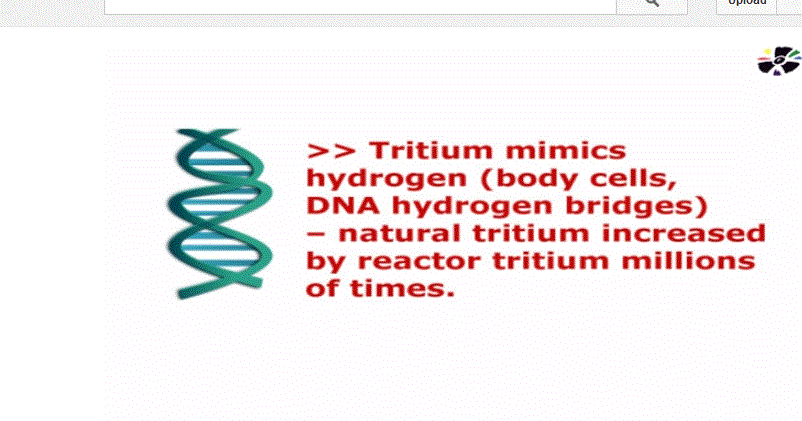
The outcome is the German KiKK Study^ stands alone unchallenged as a new benchmark verifying rapidly dividing cells in the womb and in mothers are actually affected detrimentally by tritium created in nuclear reactors. Creating leukaemia and birth defects in unborn babies.
Which in turn, is one of the central reasons for the phase-out of nuclear reactors in Germany, as most readers here are well aware many other nations have taken the lead on.
____________
^ https://onlinelibrary.wiley.com/doi/epdf/10.1002/ijc.23330


 Months after Calder Hall opened, the Euratom Treaty established the European Atomic Energy Community. The UK did not formally join straight away but did have a relationship with it.


 nuclear-news