Can the US, Russia and China break their nuclear talks impasse?
With a key US-Russia arms treaty due to expire in February, the world is at risk of entering a new era of strategic instability, analysts warn.
Shi Jiangtao, SCMP, 21 Sep 2025
US President Donald Trump’s summit in Alaska last month with Russian leader Vladimir Putin failed to revive long-stalled nuclear negotiations or advance efforts to preserve the last major arms control pact between Washington and Moscow, which is set to expire in February.
Trump’s subsequent push for trilateral “denuclearisation” talks involving China elicited a firm refusal from Beijing, underscoring challenges to extending the New Strategic Arms Reduction Treaty (New START) amid fears of a fresh nuclear arms race, analysts said.
Following the summit, Beijing, with its long-standing policy of “no first use” and a nuclear strategy rooted in self defence, spurned Trump’s proposal, with Chinese foreign ministry spokesman Guo Jiakun calling it “neither reasonable nor realistic”…………………………(Subscribers only) https://www.scmp.com/news/china/diplomacy/article/3326243/can-us-russia-and-china-break-their-nuclear-talks-impasse?module=perpetual_scroll_0&pgtype=article
Who are Britain Remade?

By Mike Small, https://bellacaledonia.org.uk/2025/05/01/who-are-britain-remade/
There’s a concerted attempt to attack Scotland’s long-standing commitment to no new nuclear power, alongside a full-scale assault on the idea of Net Zero, and the very basics of climate policy (however inadequate mainstream policy is).
This is being led by Nigel Farage who has called Net Zero ‘the New Brexit’, whatever that means. All this has been echoed by Tony Blair’s intervention this week where he argued that any attempt to limit fossil fuels in the short term or encourages people to limit consumption is “doomed to fail”. Alongside this we can see Scottish Labour’s recent commitment to the cause of new nuclear power in Scotland.
Today The Scotsman ran with a front-page splash all about how ‘SNP voters back nuclear power’ by Deputy Political Editor David Bol and Alexander Brown.
The article was replete with quotes from Labour MSP for East Lothian, Martin Whitfield, Scottish Conservative MP, John Lamont, who said the Scottish Government embracing nuclear power would be “basic common sense”. Then there’s a quote from Sam Richards, founder and campaign director for Britain Remade, who, it turns out commissioned the poll and was also enthusiastically pro-nuclear.
What The Scotsman didn’t explain though, was who ‘Britain Remade’ are? They’re presented as if they’re maybe pollsters or some independent think-tank.
But Britain Remade is a Tory think-tank and lobby group campaigning on behalf of nuclear power. Jason Brown is Head of Communications for Britain Remade, a former No. 10 media Special Adviser and Ben Houchen’s comms Adviser.
Jeremy Driver is the Head of Campaigns at Britain Remade, a former Lloyds Banker and Parliamentary Assistant to Ann Soubry. Sam Dumitriu is Head of Policy at Britain Remade who formerly worked at the Adam Smith Institute. These are Tory SPADS working on their own campaign to support new nuclear in Scotland: Lift The Ban On New Scottish Nuclear Power.
Britain Remade claimed they are not affiliated: “We’re an independent grassroots organisation. We are not affiliated with, or part of, any political party” their website says. They may not be officially affiliated to any party, but it’s very clear where their politics (and their staff) come from.
So here we have the Scotsman giving over its front-page to a Tory lobby group to promote their campaign. On the same day they published a similar piece in the Telegraph “SNP’s ‘senseless’ nuclear ban ‘damaging Scotland’” so it’s really working for them.
This is not just a question of client journalism, it’s a question of how far right-wing forces, often working with dark money, will attempt to derail even the most modest (and completely inadequate) environmental policies. Quite why Saudi-funded Tony Blair should jump on the anti Net Zero bandwagon is anybody’s guess, but it’s quite clear there is a coordinated pro-nuclear lobbying group in action in Scotland that pans across the Conservatives and Labour parties, and is supported by astroturf groups and pliant media friends. Watch this space for more on the new nuclear lobby.
Plutonium, Public Money and a Perilous Nuclear Dump on the Lake District Coast, a Letter to Cumberland Council’s “Nuclear Issues Board”

By mariannewildart, https://mariannewildart.wordpress.com/2025/09/19/plutonium-public-money-and-a-perilous-nuclear-dump-on-the-lake-district-coast-a-letter-to-cumberland-councils-nuclear-issues-board/
Sent by Email 19th September 2025
For consideration by the Nuclear Issues Board
of Cumberland Council on Monday 22nd Sept 2025
Dear Nuclear Issues Board of Cumberland Council,
On 14 October 2021, Copeland Borough Council’s Executive of just four councillors took the decision to establish two Geological Disposal Facility (GDF) Community Partnerships in accordance with the UK Government’s “GDF siting process”
West Cumbria is predictably the only consideration by NWS as a potential site for a GDF (also known as a nuclear waste dump for the abandonment of high level wastes).
A lot has changed since those four Copeland councillors put forward the Lake District coast as a sacrifice zone for the UK’s nuclear waste geological disposal plan.
We urge the Nuclear Issues Board to exercise their democratic duty and call for a debate by the Full Cumberland Council and a Full vote before going any further in the partnership with Nuclear Waste Services for delivery of a very deep, very hot and very experimental nuclear waste dump for high level wastes.
There is no democratic mandate to continue in partnership with Nuclear Waste Services in delivery of a GDF for the following reasons:
Community Unwillingness.
Despite the ongoing Community Partnership funding, Millom Town Council and Whicham Parish Council have both withdrawn from the South Copeland Community Partnership. Whicham PC also held a parish poll that clearly indicated a 77% majority against the GDF . Millom Without Parish Council will be consulting its parishioners on withdrawal. An external review of the SCCP also found the Partnership to be totally dysfunctional with infighting between community representatives and NWS staff.
The Community of Seascale within the Mid-Copeland Community Partnership have also voiced opposition. Seascale Parish Council talked about GDF’s potential area of focus for Headworks and were shown a map of a potential area for Seascale: “as a Parish Council we rejected the proposal as it was not suitable for Seascale at all, but there needs to be more that just our voice, attached is a map of the proposed Headworks location for Seascale.. We encourage residents to attend these events with GDF and voice their concerns too.
” It is ironic, given the above, that one of the Copeland (now Cumberland) councillors who took the delegated decision to ‘volunteer’ the West Cumbrian coastline once again into the nuclear dump plan is Vice chair of Seascale Parish Council.
It is clear that previous geological work, public inquiries and Cumbria County Council resolutions on this subject are being ignored in order to proceed with a clearly unwanted, expensive, ultimately public money and time wasting project once more, casting known and unknown blight on communities for decades to come. As Martin Lowe of Close Capenhurst has observed “Cumberland Council have a duty of care to the public which this development flies in the face of.”
Increase of the mine footprint from 25km2 to 36km2 since Copeland Executive volunteered the Lake District coast.
Initially NWS literature stated that the mine footprint would be 25km2. A letter to Lakes Against Nuclear Dump from Nuclear Waste Services states that the footprint would now be 36km2 (or larger).
Increase in heat of the “thermal footprint” of the GDF from 100 degrees c to 200 degrees c.
100 degrees c is the maximum heat “allowed” to try to ensure integrity of the bentonite buffer (clay slurry to be pumped into the mine as backfill and to delay leakage), however the thermal footprint has been increased to 200 degrees c as confirmed in a letter to Lakes Against Nuclear Dump from Nuclear Waste Services.
Inclusion of Plutonium along with High Level Wastes.
The inclusion of plutonium for burial in a GDF is a new, experimental and dangerous concept. There are unresolved (and likely unresolvable) difficulties of containing the radiotoxic nature and criticality of plutonium in a geological disposal facility.
“The problems of criticality and toxicity to the biosphere essentially come down to water—it creates the conditions for potential criticality and provides the transport mechanism for plutonium’s toxicity.” (Plutonium—the complex and ‘forever’ radiotoxic element of nuclear waste. How exactly should we manage its containment? Nick Scarr 22/08/25).
Top geologists call the plan “dangerous”
– this is why…
Professor Stuart Haszeldine, Professor of Carbon Capture and Storage, School of Geosciences Edinburgh Climate Change Institute said: “Making waste into specialised solid compounds can help to become more resistant to dissolution in groundwater. But the heat generated from the radioactive decay of isotopes is not affected by that re-engineering. Adding material which may heat to 100-200C is a huge disruption and will undoubtedly change the pathways of groundwater flow. This is like having an electric kettle containing stable stationary water and then turning on the electricity to add heat – the water soon circulates and if heating continues, the water boils.”
Professor Haszeldine added: “Have the developers actually made computer predictions of these effects in this GDF? Because plutonium has isotopes which can last for thousands of years, it may be sensible to spread that through the GDF to minimise heating – but that will make predictions of containment in circulating hot water much more difficult. It’s perfectly reasonable to think of a 150C-200C heat source at 0.5km, producing a geyser of boiling water intermittently erupting at surface temperatures above boiling.”
The spread of this increased temperature, known as a thermal pulse, would be conducted through the rock over several thousand years. With the additional pressure of water column above the GDF (a hypothetical 500m below the surface), water would boil at the higher temperature of 250C, in which case superheated steam may also occur. There is currently no guarantee that the maximum heat of the GDF will remain at 200C.
Even a 1.0C increase in ocean water [ii]can cause ‘massive impacts’ on the health of sea life and contribute to marine desertification, including loss of biodiversity, collapse of fisheries, and accelerated climate change. The proposed GDF is planned to be at least 37 km3, a substantial section of seabed under the Irish Sea, in a Marine Protected Area. Similar to nature reserves or SSSIs, Marine Protected Areas are parts of the ocean established to protect habitats, species and healthy, functioning marine ecosystems. Professor Haszeldine pointed out that seeps of warm or hot waterfrom a GDF onto the seabed are unlikely to stabilise, repair, and rewild the natural seabed ecosystems.
Professor David K. Smythe, Emeritus Professor of Geophysics, University of Glasgow, said he agreed with Professor Haszeldine about the danger of trying to bury High Level Waste, whether it was conditioned or not. “The waste should be kept on the surface of the earth, and immobilised beyond any possibility of re-use, until a proper long-term solution is found.”
For all these reasons and many more, thousands of people including hundreds of Cumbrians have signed a pettion calling for the full Cumberland Council to debate and vote before going any further in the partnership with Nuclear Waste Services for delivery of an experimental and uniquely dangerous plan to abandon nuclear wastes.
We urge the Nuclear Issues Board to exercise their democratic duty and call for a full debate and vote by Cumberland Council. Currently there is no democratic mandate to continue with the GDF “process” without at least carrying out a full debate and full vote by all Cumberland Councillors
Yours sincerely,
Marianne Birkby, Lakes Against Nuclear Dump, a Radiation Free Lakeland campaign
Richard Outram, Secretary of the UK/Ireland Nuclear Free Local Authorities (NFLAs)
Chernobyl shelter repairs: ‘Difficult choices’ lie ahead
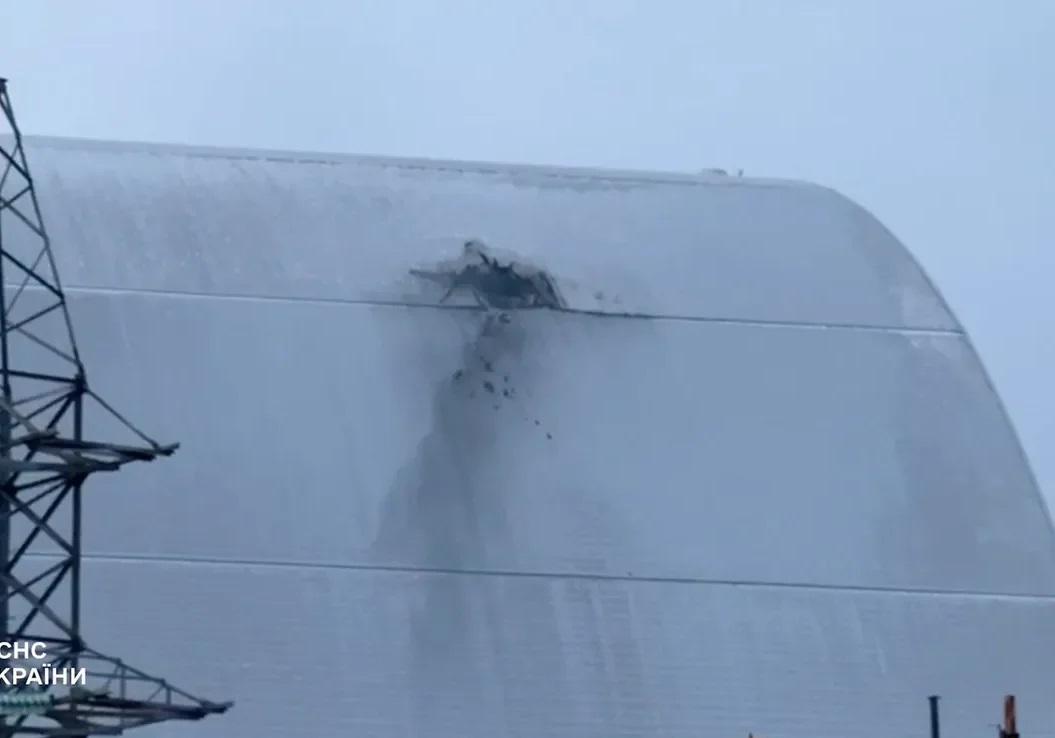
The arch-shaped New Safe Confinement structure built over the remains of
Chernobyl’s destroyed unit 4 suffered such extensive damage in a drone
strike in February that it may not be possible to restore it to its full
original design purposes and life-span of 100 years, a side event at the
International Atomic Energy Agency General Conference heard.
World Nuclear News 18th Sept 2025, https://www.world-nuclear-news.org/articles/chernobyls-giant-shelter-may-never-return-to-original-state
Can the UK fast-track nuclear power without cutting corners on safety?

The UK’s nuclear regulator is being asked to consider radically
different designs on a scale and pace never before seen. That’s partly
why, as part of the deal, the two countries have agreed to accept each
other’s safety checks. The government claims this will “halve the time
for a nuclear project to be licensed”. The question is whether this can
be done as safely.
The US and UK take fundamentally different approaches to
nuclear regulation. The US’s Nuclear Regulation Commission (NRC) takes a
“prescriptive” approach. It sets detailed rules based on its own
research and enforces them directly. Like police setting speed limits, the
regulator decides the standards and then ensures nuclear operators meet
them. If an accident happens, operators can point to meeting every
requirement as evidence they followed the rules. They could even
legitimately blame the regulator.
The UK’s Office for Nuclear Regulation
(ONR) takes a “descriptive” approach. It sets broad standards but
leaves operators to prove how they will meet them. In road terms, the US
sets the speed limit and checks drivers obey it. The UK simply says cars
must stay on the road, leaving drivers to decide their own limits, prove
they’re safe, and take full responsibility if they crash. These two
approaches are driven to a large extent by the two country’s history and
make up of their nuclear industries. So while UK-US collaboration could
boost Britain’s nuclear industry and accelerate the path to low-carbon
energy, independence and transparency will be essential. Any perception of
corner cutting or transatlantic political interference could undermine
public trust and derail Britain’s nuclear ambitions.
The Conversation 18th Sept 2025, https://theconversation.com/can-the-uk-fast-track-nuclear-power-without-cutting-corners-on-safety-265614
Construction starts of Belgian disposal facility
Belgium’s Prime Minister Bart De Wever has laid a foundation stone,
marking the start of construction of a surface disposal facility for low-
and intermediate-level, short-lived waste at the Dessel site in Belgium.
The facility will consist of several concrete bunkers that will house large
concrete vaults in which short-lived low- and intermediate-level waste will
have been encapsulated with mortar. Currently, 28,831 vaults are planned,
spread across two zones: 20 bunkers in the first and 14 in the second. The
Dessel facility will house all Belgian low- and intermediate-level,
short-lived radioactive waste including that from nuclear power plants,
hospitals, research institutes and the decommissioning of nuclear
facilities. Currently, this waste is managed by national radioactive waste
management agency ONDRAF/NIRAS’s industrial subsidiary Belgoprocess in
several dedicated buildings on the Dessel site.
World Nuclear News 19th Sept 2025, https://www.world-nuclear-news.org/articles/construction-starts-of-belgian-disposal-facility
Why Starmer’s nuclear ‘golden age’ risks becoming a lot of hot air.

Crippling costs and mountains of red tape threaten to pour cold water on the PM’s ambitions.
Donald Trump hasn’t been shy about criticising British
energy policy under Labour, lashing out at “ugly” wind farms and
crippling taxes on North Sea oil and gas. Yet one area where the US
president and Sir Keir Starmer seem to fervently agree is on nuclear power.
This week, the US and UK governments promised to work together to deliver a
“golden age” of privately-financed power plant construction.
The agreement will see the two countries fast-track the approval of new,
cutting-edge reactor designs by recognising each other’s safety regimes – a
controversial move that has already raised the hackles of activists. But to
underline the economic prize on offer, the announcement featured a string
of eye-catching investments being looked at by American and British
companies with plans for fleets of reactors that will power the grid, as
well as high-tech data centres needed for artificial intelligence (AI)
software. British Gas owner Centrica and X-energy, a nuclear start-up
backed by Amazon, said they were exploring building up to 80 advanced
modular reactors (AMRs) capable of delivering electricity and heat to both
industrial businesses and millions of homes. Meanwhile, Holtec
International and the UK arm of EDF are looking at building a small modular
reactor (SMR) on the former site of a coal power plant in Nottinghamshire.
Micro-reactor firm Last Energy is also exploring plans to power the London
Gateway port, while Bill Gates-backed TerraPower is scouting out locations
for mini power plants as well.
On the face of it, the deals looked like a
major triumph for the Prime Minister. But industry veterans were quick to
note that, in their current form, they are just loosely-worded commitments,
with the companies yet to sign binding contracts or exchange serious sums
of cash. One potential blueprint may lie in a new report by pro-growth
campaign group Britain Remade, which argues that nuclear power can offer
“abundant, clean, reliable electricity” and lower bills for consumers –
but only if the Government overhauls red tape that is “not fit for
purpose”. “US firms want to build here,” says Sam Dumitriu, the
report’s author. “But turning it into shovels in the ground, data centres
online, on time and on budget, depends on making the UK a lower-cost,
faster place to build”
Telegraph 18th Sept 2025, https://www.telegraph.co.uk/business/2025/09/18/why-starmer-will-struggle-to-deliver-nuclear-golden-age/
Rolls Royce “Small” nuclear reactors are not at all small!
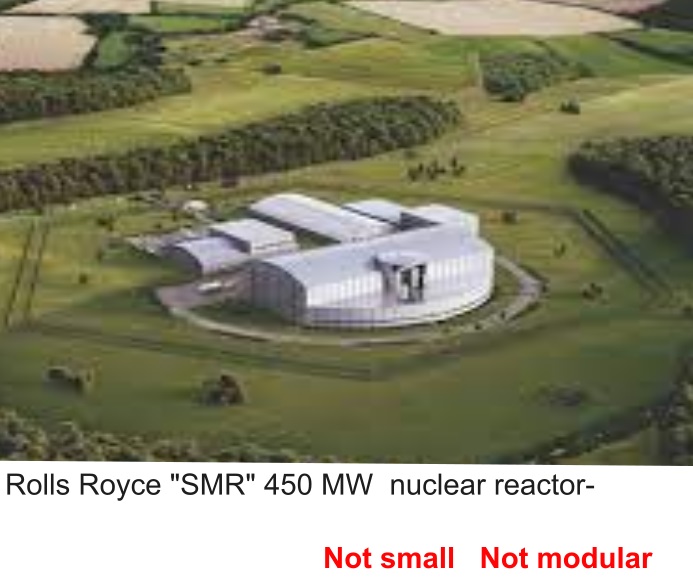
Dr Paul Dorfman Letter: Further to your report “Deal with US to
fast-track mini nuclear reactors” (Sep 15; letter, Sep 16), small modular
reactors (SMRs) are defined by the International Atomic Energy Agency as
reactors that generate up to 300MW power.
At 470MW, the Rolls-Royce design is not an SMR: it is larger than the UK Magnox reactor, more than half the size of the 900MW reactors that make up the bulk of the French nuclear fleet, and about a third the size of the very large EPR reactor design at Hinkley Point C.
This matters because the Rolls-Royce design will need big
sites, standard nuclear safety measures, exclusion zones, core catchers,
aircraft crash protection and security. All this is important because in
calling its design an SMR, or small, Rolls-Royce appears to me to have been
economical with the truth — and all that implies for its other claims,
especially about time and cost.

As for the nuclear waste problem, the former chair of the US government Nuclear Regulatory Commission reports
that SMRs would produce more reactive waste per kWh — the key parameter — than large reactors.
Times 17th Sept 2025. https://www.thetimes.com/comment/letters-to-editor/article/times-letters-ethics-of-danny-krugers-defection-to-reform-uk-3rbg90m3b
UK Ministry of Defence dismiss MP’ s call for inquiry into trident bases nuclear leaks.

THE Ministry of Defence (MoD) has dismissed calls from an SNP MSP for a
public inquiry into nuclear leaks at Trident bases, claiming it is
“factually incorrect” to suggest they posed a safety risk.
Earlier this week Bill Kidd, the Glasgow Anniesland MSP, held a debate on reported nuclear safety incidents at Faslane and Coulport, where Britain’s nuclear fleet and arsenal are stored.
Kidd secured the backing of 28 MSPs from the
SNP, Scottish Greens, Scottish Labour, Alba, and one independent. However,
the motion was not voted on as it was debated as member’s business after
decision time.
It comes after The Ferret revealed that nuclear waste leaked
into Loch Long, in Argyll and Bute. The outlet reported that pipe bursts
were recorded in 2010, two in 2019, and two more in 2021. After an FOI
battle that lasted six years, the Scottish Environment Protection Agency
(Sepa) – the environment watchdog – stated the Royal Navy failed to
properly maintain a network of 1500 pipes at the Coulport armaments depot,
on the banks of Loch Long.
The National 19th Sept 2025, https://www.thenational.scot/news/25481047.mod-dismiss-snp-msp-call-inquiry-trident-bases-nuclear-leaks/
U.S. Firms Boost UK Nuclear Sector with Major Deals

Oil Price By City A.M – Sep 16, 2025
- The UK and US have agreed to reduce the licensing time for nuclear projects from four years to two and broaden US companies’ access to the UK energy market.
- Several US companies have struck significant deals with UK partners, including X-Energy to build advanced modular reactors in Hartlepool, Holtec to develop data centers powered by small modular reactors, and Last Energy for a micro modular nuclear plant at London Gateway.
- The initiative aims to kickstart a “golden age of nuclear” in the UK, providing clean, homegrown energy, creating skilled jobs, and addressing high energy bills, though critics question the effectiveness of potential VAT cuts on energy bills.
…………………………………………………………………………………. Energy bills woes
The announcement comes as the government battles to bring down energy bills, which have almost doubled costs for households over the past eight years.
Alongside increasing the domestic supply of energy, Chancellor Rachel Reeves is reportedly weighing cutting VAT on energy to help lower consumer prices.
However, critics have questioned whether the move, which could cost the government nearly £2bn, would deliver tangible improvements to household budgets, warning that wealthy families with larger homes would disproportionately benefit from the tax break. https://oilprice.com/Alternative-Energy/Nuclear-Power/US-Firms-Boost-UK-Nuclear-Sector-with-Major-Deals.html
US and UK companies ink nuclear deals ahead of Trump visit

Transatlantic nuclear energy deals estimated to be worth over $100 billion
have been announced ahead of President Donald Trump’s state visit to the
United Kingdom this week. TerraPower, a Bill Gates-backed developer of
small nuclear reactors, announced Monday that it would work with
engineering firm KBR to study potential sites in the U.K. to deploy its
advanced Natrium reactors. Rockville, Maryland-based X-energy and British
energy company Centrica also announced plans to deploy up to 72 small
reactors for electricity and industrial heat in the U.K.
E&E News 16th Sept 2025, https://www.eenews.net/articles/us-and-uk-companies-ink-nuclear-deals-ahead-of-trump-visit/
What You Need to Know About the £38 Billion Sizewell C Nuclear Project inthe UK.

Project Timeline: Development Consent Order (DCO) approved: July
20, 2022; Groundworks commenced: January 15, 2024; Final Investment
Decision (FID) reached: July 22, 2025; Construction duration: Expected to
take between nine and twelve years; Operational date: Expected in the
2030s.
Construction Review 15th Sept 2025, https://constructionreviewonline.com/construction-projects/uk-government-approves-38-billion-sizewell-c-nuclear-project/
Academic agrees with NFLA’s position on management of deadly radioactive waste.

NFLA 9th Sept 2025, https://www.nuclearpolicy.info/news/academic-agrees-with-nflas-position-on-management-of-deadly-rad-waste/
Following on from last weeks joint media release with Lakes against the Nuclear Dump (LAND) https://www.nuclearpolicy.info/news/volatile-boiling-geysers-the-latest-on-nuclear-waste-plans/, the UK/Ireland Nuclear Free Local Authorities were delighted to hear that the views of another senior academic chimed with our own policy on the management of high-level radioactive waste.
David K. Smythe, Emeritus Professor and former Chair of Geophysics, University of Glasgow, said he agreed with Professor Stuart Haszeldine about the danger of trying to bury High Level Waste, whether it was conditioned or not: “The waste should be kept on the surface of the earth, and immobilised beyond any possibility of re-use, until a proper long-term solution is found.”
This concept of ongoing active stewardship pending the discovery of future treatment methods, rather than disposal and abandonment in a subterranean repository, accords with the position of the NFLAs and that of the Scottish Government.
Scottish Government Policy is that Higher Activity Radioactive Waste ‘should be managed in the long-term in near-surface facilities where it can be monitored and where there is the capability of retrieving it.’
The NFLAs have a similar long-standing policy on the management of nuclear waste; this comprises a set of clear principles which we are confident have stood the test of time and remain as relevant now as when they were originally agreed in 2004
- The idea that radioactive waste can be ‘disposed’ of be rejected in favour of radioactive waste management.
- Any process or activity that involves new or additional radioactive discharges into the environment be opposed, as this is potentially harmful to the human and natural environment.
- The policy of ‘dilution and dispersion’ of radioactive materials as a component of waste management, which leads to discharges into the estuaries, seas or atmosphere or the diversion of waste to landfill, metal recycling plants and incineration, be rejected in favour of a policy of ‘concentration and containment’, storing the waste safely on-site in isolation from the environment in bespoke facilities.
- The principle of waste minimisation be supported.
- The unnecessary transport of radioactive and other hazardous wastes be opposed.
- Wastes should ideally be managed on-site where produced (or as near as possible to the site) in a facility that allows monitoring and retrieval of the wastes.
‘Sizewell C oak tree felling would be devastating’
Campaigners say chopping down century-old oak trees as part of the
Sizewell C nuclear power station build would be “the straw that broke the
horse’s back”. Sizewell C has notified residents in Middleton, Suffolk,
that vegetation on the B1125 at Leiston Road could be cleared between the 6
and 10 October – after permission was granted. But locals fear it will mean
the loss of 10 oaks – each more than 100 years old – to improve the sight
line of the 60mph stretch, which could become part of the Sizewell C Link
Road system. It remains unclear at this stage if all or any of the trees
will be cut down, as project bosses say they will “only ever remove trees
when we absolutely have to”.
BBC 9th Sept 2025, https://www.bbc.co.uk/news/articles/cgknxezy2vno
Spain Announces Arms Embargo on Israel and Other Steps ‘to Stop the Genocide in Gaza’
“This is not self-defense,” Spanish Prime Minister Pedro Sánchez asserted, “it is the extermination of a defenseless people and a violation of every international law.”
Brett Wilkins, Common Dreams, Sep 08, 2025
Spanish Prime Minister Pedro Sánchez on Monday announced a series of nine new measures—including a total arms embargo—aimed at pressuring the government of fugitive Israeli Prime Minister Benjamin Netanyahu “to stop the genocide in Gaza.”
Sánchez, who leads the Spanish Socialist Workers’ Party (PSOE), announced the steps during a speech in which he first acknowledged the historical suffering of the Jewish people, which includes the 1492 ethnic cleansing of Jews from Spain.
“The Jewish people have suffered countless persecutions, deserve to have their own state, and to feel secure,” Sánchez said. “That is why the Spanish government has condemned Hamas’ attacks from day one.”
However, “there is a difference between defending your country and bombing hospitals or starving innocent children,” the prime minister continued. “This is an unjustifiable attack on the civilian population, which the [United Nations] rapporteur has described as genocide.”
“Sixty thousand dead, two million displaced, half of them children,” Sánchez said. “This is not self-defense, it is not even an attack—it is the extermination of a defenseless people and a violation of every international law.”
The nine measures—which must be approved by lawmakers and the Cabinet—include:
- A “legal and permanent prohibition” on the purchase and sale of weapons, ammunition, and military equipment;
- A ban on transit through Spanish ports for all ships carrying fuels destined for Israel’s military;
- Denial of entry into Spanish airspace for all state aircraft carrying military equipment to Israel;
- A ban on entry to Spain for “all persons directly involved in genocide, human rights violations, and war crimes” in Gaza;
- Prohibition of imported products from illegal settlements in the occupied Palestinian territories;
- Limitation of consular services for Spanish citizens residing in illegal Israeli settlements;
- Strengthened support for the Palestinian Authority;
- An additional €10 million in support for the United Nations Relief and Works Agency for Palestine Refugees in the Near East (UNRWA); and
- An increase in overall humanitarian spending for Gaza, to reach €150 million by 2026……………………………………………………………………………….. https://www.commondreams.org/news/spain-arms-embargo-israel
1 This Month

22 June – Virtual Event –Climate Change: New Data, New Debate

Monday, June 22, 2026 2:30 p.m. – 3:15 p.m. CT
YouTube. Register here

Protect Sazan Island from the Trump family! https://secure.avaaz.org/campaign/en/protect_sazan_island_from_the_trump_family_loc/?bqFCVab&v=174511&cl=22707147157&_checksum=5e9dde668860e8231c33699735e16a1fbf22ab2cb01da50c999fe8732b9775ef&utm_source=email&utm_medium=blast_email&utm_campaign=174511

25 June- THE PUKE ON NUKES
Thursday, June 25, 2026
7pm Central Time (8pm ET, 6pm MT, 5pm PT) UTC – 5
From NRC & DOE Deregulation to Techno-Fascist Billionaires Going Nuclear, Plus a Few Songs from Atomic Cabaret REGISTER
26 June – Radiation Trainwreck at the NRC / Join the Protect Better Campaign – https://us02web.zoom.us/meeting/register/4ZlZ5_qLSHGiLSCg8FF6Bg#/registration


Cuba Is Not a Failed State – It Is a Besieged State
PETITION: “Global Appeal to Endorse Palestinian Right of Return of Refugees”
To see nuclear-related stories in greater depth and intensity – go to https://nuclearinformation.wordpress.com
-
Archives
- June 2026 (211)
- May 2026 (306)
- April 2026 (356)
- March 2026 (251)
- February 2026 (268)
- January 2026 (308)
- December 2025 (358)
- November 2025 (359)
- October 2025 (376)
- September 2025 (257)
- August 2025 (319)
- July 2025 (230)
-
Categories
- 1
- 1 NUCLEAR ISSUES
- business and costs
- climate change
- culture and arts
- ENERGY
- environment
- health
- history
- indigenous issues
- Legal
- marketing of nuclear
- media
- opposition to nuclear
- PERSONAL STORIES
- politics
- politics international
- Religion and ethics
- safety
- secrets,lies and civil liberties
- spinbuster
- technology
- Uranium
- wastes
- weapons and war
- Women
- 2 WORLD
- ACTION
- AFRICA
- Atrocities
- AUSTRALIA
- Christina's notes
- Christina's themes
- culture and arts
- Events
- Fuk 2022
- Fuk 2023
- Fukushima 2017
- Fukushima 2018
- fukushima 2019
- Fukushima 2020
- Fukushima 2021
- general
- global warming
- Humour (God we need it)
- Nuclear
- RARE EARTHS
- Reference
- resources – print
- Resources -audiovicual
- Weekly Newsletter
- World
- World Nuclear
- YouTube
-
RSS
Entries RSS
Comments RSS
 nuclear-news