‘Inevitable’ that nuclear waste facility will go ahead without local consent says former minister.

Now we see it- the nuclear industry, adopted by government, will lead to fascism.
Added to the madness, governments are hell-bent on making more nuclear radioactive trash that they don’t know how to get rid of.
“However, in the case of the UK, the DESNZ’s review raises the possibility that overriding public approval could be a matter of policy.
“These developments point to a growing sense of futility and desperation, to secure both a suitable site for nuclear waste disposal and public support for it.”
23 Sep, 2025 By Tom Pashby https://www.newcivilengineer.com/latest/inevitable-that-nuclear-waste-facility-will-go-ahead-without-local-consent-says-former-minister-23-09-2025/
It is “inevitable” that the government moves away from the consent-based approach for deciding where to site the planned geological disposal facility (GDF) for nuclear waste, a former Department for Energy Security and Net Zero (DESNZ) minister has told NCE.
The comments come as reports suggest the government is considering scrapping the “consent-based” approach for siting the GDF. However, DESNZ has asserted that the reports are “wrong” and “no changes are planned to this process currently”.
The GDF is currently the only solution proposed by the government for disposing of high level nuclear waste (HLW). HLW is generated by both the civil and defence nuclear sectors
It would involve disposing of HLW in an engineered vault placed between 200m and 1km underground, covering an area of approximately 1km2 on the surface.
Work to select a GDF site should take 20 years, according to the government body responsible for the project – Nuclear Waste Services (NWS) – and a further 150 years to build, fill and close the facility.
The HLW then needs to sit and remain undisturbed for 100,000 years before its radioactivity has reduced sufficiently for people to be able to be near it. Due to the hazards associated with radioactive waste, the government has always maintained that a GDF will only be sited in a location where the local community has agreed to host it. This is known as the “consent-based” approach and it has been in discussion with a few communities for a number of years.
Consent-based approach seeing little progress over years
The “voluntary” or “consent-based” approach to deciding where to site a GDF was first proposed by the government in a White Paper published in 2008 titled Managing radioactive waste safely: a framework for implementing geological disposal.
“For the purposes of this White Paper ‘an approach based on voluntarism’ means one in which communities voluntarily express an interest in taking part in the process that will ultimately provide a site for a geological disposal facility,” the paper said.
“Initially communities will be invited to express an interest in finding out more about what hosting a geological disposal facility would mean for the community in the long term.
“Participation up until late in the process, when underground operations and construction are due to begin, will be without commitment to further stages, whether on the part of the community or government. If at any stage a community or Government wished to withdraw then its involvement in the process would stop.
“In practice, development could also be halted by the independent regulators at any point in the process through a refusal to grant authorisations for the next stage of work.”
The government further committed to the approach in 2014, when the then secretary of state for energy and climate change Ed Davey said: “The UK Government also continues to favour an approach to identifying potential sites for a GDF that involves working with communities who are willing to participate in the siting process.”
Despite having been committed to the approach for more than 10 years, NWS only has two communities it is making gradual progress with via community partnerships – Mid Copeland and South Copeland. Lincolnshire withdrew from the process in June after a change in governance.
With the government pushing for the deployment of dozens more nuclear reactors in the coming decades, the need to confirm a long-term solution for the waste is pressing – something that has been stressed to NCE by both the Nuclear Industry Association (NIA) and anti-nuclear campaigners.
Reports say Government reviewing consent-based approach
The Telegraph published a story on 22 September that claimed, based on a government source, that DESNZ had decided to review the consent-based approach to siting the GDF.
The source told the newspaper that conversations were taking place within government to consider prioritising areas with the best geology rather than areas with the most welcoming communities.
Ending the consent-based process could result in ministers effectively imposing a GDF on a community, although they would still face the standard planning and consenting obstacles, including judicial reviews from campaigners.
A DESNZ spokesperson denied the reports, saying: “Our position continues to be that any potential geological disposal facility site will be subject to agreement with the community and won’t be imposed on an area without local consent.
“Progress continues to be made, with two areas in Cumberland taking part in the siting process for this multi-billion-pound facility, which would bring thousands of skilled jobs and economic growth.”
Former minister tells NCE ‘we must get on with GDF’
Lord Hunt of Kings Heath is now a backbench Labour peer but was a DESNZ minister of state from July 2024 to May 2025. He was also an energy minister at the end of the previous Labour government from 2008 to 2010 and served in shadow front bench roles from 2010 to 2018.
“This is an inevitable approach. We must get on with GDF,” Hunt told NCE.
“It’s vital to the nuclear programme. It’s a matter of national strategic importance and should proceed on that basis.”
Reported policy change points to ‘growing sense of desperation’
Nuclear Information Service research manager Okopi Ajonye told NCE: “The prospect of the DESNZ reforming policy to override local consent for hosting a geological disposal facility is very concerning.”
“Furthermore, it mirrors developments in Australia, where efforts to secure sites for nuclear waste disposal have, just like the UK, been repeatedly stalled by local opposition.
“But critics are now concerned that recent legislation grants broad powers to the Australian government to designate any site as a nuclear waste dump, even without local or indigenous approval.”
“However, in the case of the UK, the DESNZ’s review raises the possibility that overriding public approval could be a matter of policy.
“These developments point to a growing sense of futility and desperation, to secure both a suitable site for nuclear waste disposal and public support for it.”
End to consent-based approach would ‘lead to more vociferous public resistance’
Nuclear Free Local Authorities secretary Richard Outram told NCE: “Any decision to abandon the established consent-based approach to siting a nuclear waste dump will be an admission by ministers that no community actually wants to host it.
“Proposals to site a GDF at South Holderness and Theddlethorpe were roundly defeated by massive and persistent public protests, backed by responsive local councillors.
“Opposition is also growing in South Copeland with residents impacted by the declared area of focus up in arms.”
Outram added that two local councils in the South Copeland area – Millom Town Council and Whicham Parish Council – have withdrawn their support for the process, and a third – Millom Without Parish Council – is “about to confer with parishioners about continued engagement”, he said.
He also said that the NWS community partnership was “described in a recent external review as ‘dysfunctional’ and seemingly at war with itself”.
“Replacing voluntarism with a plan to railroad such a controversial project onto an unwilling community will be a retrograde step and simply lead to more vociferous public resistance,” he added.
Government reveals to NCE it is ‘replanning’ GDF project
These latest developments add to the uncertainty that has bubbled around the GDF project in recent months.
In August, the Treasury’s National Infrastructure and Service Transformation Authority (Nista) assessed the delivery confidence of the GDF as “appears unachievable” and said the cost could be as much as £53.3bn.
Following the rating, NCE asked DESNZ via the Freedom of Information Act whether the government was responding by changing its approach to the GDF project. It said that it is “undertaking some replanning to mitigate risks and support ongoing progress” on its major projects, including the GDF.
DESNZ added: “However, a GDF will always remain necessary as there are currently no credible alternatives that would accommodate all categories of waste in the inventory for disposal.”
Nuclear industry says credible GDF plan needed for investor confidence
The Nuclear Industry Association, which represents more than 300 companies across the civil and defence nuclear supply chain, was perturbed by this uncertainty around the GDF and told NCE: “A credible, long-term policy on HLW disposal is very important. Developers need confidence that the back end of the fuel cycle is being responsibly and sustainably managed, not just for regulatory compliance but also to secure investor confidence and public trust.
“Clarity and credibility in government policy reduces uncertainty, helps de-risk new nuclear projects and ensures that developers can focus on safe, efficient generation”
Nuclear Free Local Authorities join global call on World Bank to abandon plans to back new nuclear

24th September 2025, Nuclear Free Local Authorities
The NFLAs have become a co-signatory to a petition calling on the World Bank and Asian Development Bank to abandon their plans to finance new nuclear plants.
The online petition was launched by 64 Non-Government Organisations from 25 countries and regions on 1 September/
The World Bank and the ADB are funded by governments worldwide to support economic development, poverty reduction, and enhance infrastructure. Until now, both institutions have refrained from financing nuclear power, citing nuclear proliferation, safety concerns, dealing with the intractable problem of radioactive waste, and high costs as reasons to deny funding.
However, on June 10, the World Bank’s Board of Directors decided to lift the ban on nuclear power financing. Meanwhile, the ADB is currently revising its energy policy with plans to include support for nuclear power as part of the review.
The very concerns that have caused both institutions to be cautious about financing nuclear power remain unresolved.
The petition highlights these ongoing issues and stresses that “supporting the construction of nuclear power plants in developing countries imposes serious long-term risks and enormous economic burdens on both present and future generations in those countries.”
NFLAs urge supportive NGOs and individuals to join us in signing this petition.
You are urged to go to the website: https://chng.it/G9MCKn6Gpv…………………………………….. https://www.nuclearpolicy.info/news/nflas-join-global-call-on-world-bank-to-abandon-plans-to-back-new-nuclear/
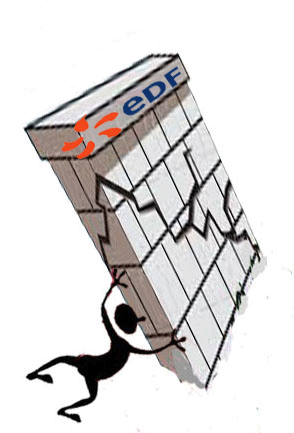
While EDF must invest 460 billion euros over 15 years, its economic model is taking on water.
P.La. with AFP, BFMTV 23rd Sept 2025 https://www.bfmtv.com/economie/entreprises/energie/alors-qu-edf-doit-investir-460-milliards-d-euros-en-15-ans-son-modele-economique-prend-l-eau_AD-202509240079.html
The Court of Auditors has issued a warning about the economic situation of the French energy company, now 100% state-owned. A wall of investment is looming to maintain and renew the group’s nuclear fleet.
The French Court of Auditors is concerned about the financial prospects of the public energy company EDF, calling for “a clear distribution of the financial effort” between the State, EDF and customers, in a report addressed to the Finance Committee of the National Assembly and consulted on Tuesday, September 24.
In this report, first revealed by the media
Contexte , the institution responsible for monitoring the proper use of public funds observes that EDF is “faced with significant uncertainties over its long-term financing capacity”, while it faces investment needs reaching 460 billion euros between 2025 and 2040.
In this context, “EDF’s financing model should, in order to preserve a sustainable financial trajectory for the group, be defined based on a clear distribution of the financial effort between the State, now the sole shareholder, EDF and the end customers,” the magistrates believe.
In detail, EDF plans to allocate 90 billion euros to the maintenance and extension of the existing nuclear fleet, 115 billion euros for the construction of 14 EPR 2 (including 75 for the first six), 15 billion euros for the hydraulic fleet and more than 100 billion euros for the Enedis network, manager of the electricity distribution network.
No more hazards
At the same time, EDF’s profitability will be more exposed “to the vagaries of changes in electricity market prices”, with the end of the regulated system known as Arenh , planned for the end of 2025. EDF intends to replace this system with medium and long-term contracts with electricity suppliers and companies, including high-energy industrial ones.
The Court of Auditors also notes that EDF’s ability to invest will be conditioned “by the operational performance of the nuclear fleet and the success of extending its lifespan.”
The body then recommends “setting, prior to the final investment decision on the EPR2 program, the terms of risk sharing between the State and EDF.” EDF’s final estimate for its EPR2 program should be known at the end of the year.
The Court of Auditors also calls for clarification of the dividend policy that will be applied to EDF and recommends that the group “conduct a strategic review of investments, holdings and subsidiaries.”
Total or partial sales of holdings and subsidiaries would constitute “a financing lever for the group’s investment program,” particularly “in the most unfavorable price scenarios,” argue the magistrates of the Court of Auditors.
The horrors I’ve seen of Ukrainian, NATO-backed, shelling of completely civilian areas of the Donbass throughout 2022 (and 2019, 2023…)

Eva Karene Bartlett. Sep 23, 2025
September three years ago in Donetsk, in the space of 5 days, Ukrainian deliberate shelling of the very centre of the city killed 26 civilians, most of whose bodies or parts of bodies I saw in the streets or in a burnt out bus. These were 100% non military, purely civilian, areas.
*Warning: Some of the footage is not blurred and shows quite clearly Ukraine’s terrorism of Donetsk, in very central areas of the city, where there are no military targets, only Donetsk civilians. see here – https://odysee.com/@EvaKareneBartlett:9/sept-22-shelling:0 ]
On Monday, Ukraine slaughtered 16 civilians, including two children, with 155mm NATO shells, according to the head of the Donetsk People’s Republic (DPR), Denis Pushilin. The projectiles hit two adjacent neighborhoods, decimating residential and commercial areas – including a market that had previously suffered fatal attacks.
…the carnage on Monday was worse than anything I’ve seen in my months of reporting here. Chunks of flesh littered the street – part of a hand, a foot, an ear. Someone had put a dead man’s phone on his stomach. It was ringing, the cheery ringtone incongruous with his lifeless body and the scenes and stench of death around him.
For most people, the concept of war is a distant one, and deaths are normalized by media reporting the numbers of victims and destroyed buildings – so most who hear of civilians being killed don’t really understand what a scene like this looks or smells like.
For the locals, it is also normalized, in its own way, after over eight years of Ukrainian attacks – a tragically grotesque kind of normality, where the post-bombing routine starts soon after the last explosions die down.
…another Ukrainian assault, which took place on Saturday. The center of Donetsk was hit by around ten bombs over the course of 30 minutes around noon. At least four civilians were killed, one of whom I saw still on the ground. Some minutes later, her body was taken away. One of the shells hit a car driving along Artema Street, setting it ablaze and killing two civilians. By the time I reached that site, the vehicle had burned out, the dead taken away. Workers were already repaving the roads, sweeping debris and glass from sidewalks.
On Thursday, again around noon, Ukraine again shelled central Donetsk, this time next to a busy market. The shelling left six people dead on the street and in a burned out bus. This makes at least 26 civilians killed by Ukrainian shelling, with Western weapons, in the space of just one week.
From my overview of these terror bombings: Western media continues to ignore how Ukraine is using NATO weapons to kill innocent civilians in the Donbass
2022 was a very hard year for the Donbass; this 5 day period I mention in September was just a glimpse into the horrors Donbass civilians endured not only throughout 2022 but since Ukraine began bombing them in 2014, long before Russia commenced its Special Military Operation.
Below is most of what I witnessed throughout 2022 (and also some from 2019, 2023) during & following Ukrainian shelling.
In 2022, in April I went to a market in western Donetsk which had been shelled by Ukraine. Two bodies of the five civilians killed in the market were still lying on the ground. I believe this is because–just like Israel does–Ukraine double strikes the same area, meaning rescuers or anyone who comes to help the wounded or clear the bodies could be shelled and killed.
This was a large and very busy market place in a working class district. I’ve been to such markets, in central Donetsk (also bombed by Ukraine) and near the two Russian areas I’ve lived. They are frequented (and many of the stall run by) by grandmothers, by mothers, by civilians, not military. The only thing “strategic” about shelling them is Ukraine’s blood lust to kill Donbass (Russian) civilians. People I encountered that day told me this wasn’t the first time Ukraine shelled the market or the district, they said the shelling was routine.
[ https://odysee.com/@EvaKareneBartlett:9/ukraine-bombed-a-busy-donetsk-market:2 ]
My article on this Ukrainian bombing: Ukrainian strike on Donetsk market was a terrorist act
On May 5, I went to Kirovsk, a city in the Lugansk People’s Republic to the west of Lugansk, Ukrainian forces only a little further west. Kirovsk and surrounding areas have—like throughout both autonomous Donbass republics—since 2014 been shelled by Ukrainian forces.
Just outside the city of Kirovsk, on an otherwise quiet lane, I saw a home hit by Ukrainian shelling on April 26………………………………………………………………………………………………………………………………………………………………………………………………………………………………………. *At the below link you can find many more of my articles & videos, including from Mariupol when the fighting was still ongoing in Azovstal, and later in Mariupol showing the return of life to the city (2022, 2023, 2024).
With nuclear pact in peril, Trump embraces prolonged war in Ukraine

Trump signals that he is no longer invested in ending the Ukraine war. His disinterest in engaging with Moscow could threaten the last nuclear arms control treaty between the US and Russia.
Aaron Maté, Sep 25, 2025
After famously telling Ukrainian counterpart Volodymyr Zelensky that “you don’t have the cards” to defeat Moscow and that territorial concessions are inevitable, President Trump is now singing a different tune.
“I think Ukraine, with the support of the European Union, is in a position to fight and WIN all of Ukraine back in its original form,” Trump wrote on Tuesday. “…We will continue to supply weapons to NATO for NATO to do what they want with them.” The US president also cast doubt on Russia’s military capabilities nearly four years into the invasion. Ukraine “can fight too,” Trump said, “and they’ve proven that maybe it could be that Russia is a paper tiger.”
Zelensky, who has waged a dogged campaign to repair relations with Trump since their White House dust-up in February, welcomed his chief sponsor’s seeming about-face. Trump, the Ukrainian leader said after the two met in New York, “clearly understands the situation and is well-informed about all aspects of this war.”
Yet as all parties to the Ukraine proxy war have learned by now, Trump’s rhetoric tells us very little about how he plans to handle it………………………………………………………………..(Subscribers only)https://www.aaronmate.net/p/with-nuclear-pact-in-peril-trump?utm_source=post-email-title&publication_id=100118&post_id=174489457&utm_campaign=email-post-title&isFreemail=true&r=ln98x&triedRedirect=true&utm_medium=email
UK to build 12 advanced “small ” modular nuclear plants in £10bn plan

COMMENT. A lovely glowing picture of this proposed wonderful source of electricity. But they’re very coy about telling us about the real cost of it all, the dangerous new radioactive fuel type, and the size of these so-called “small” nuclear reactors. And of course – not a mention of their radioactive wastes
COMMENT. A lovely glowing picture of this proposed wonderful source of electricity. But they’re very coy about telling us about the real cost of it all, the dangerous new radioactive fuel type, and the size of these so-called “small” nuclear reactors. And of course – not a mention of their radioactive wastes
Bernard Gray, 21 Sept 25, https://observer.co.uk/news/business/article/uk-to-build-12-nuclear-plants-in-10bn-plan
At a projected cost of £10bn – a rough estimate that could well balloon – two companies, Centrica, the parent of British Gas, and X-energy, a US startup, are proposing to develop and build a completely novel type of nuclear power plant.
The technical challenges for the two businesses are huge; the financial challenges perhaps even more so. Centrica is a large company with a big balance sheet, but it has limited nuclear experience. X-energy is a startup with some nuclear expertise, but which has raised only about $1bn in private capital and $1.2bn from the US energy department since the company was founded in 2009.
Far more money than that will be needed to complete the design, while the build of the fuel plant and demonstrator reactors will also cost an order of magnitude more.
Finishing the detailed design of both reactor and fuel plant, and getting them licensed to be built, is a work in progress but it will not be quick. X-energy has tried to boost its financial resources by partnering with potential users: the first is chemical producer Dow, for which X-energy is proposing to build a station to power a plant on the Texas Gulf coast.
Amazon has also invested in the company, and there is talk of power stations running Amazon datacentres in the Pacific north-west. The online retailer led investors in raising $700m to fund the next stage of X-energy’s development.
It is in this context that the Hartlepool proposal sits. The UK station would be the largest X-energy has attempted and Centrica has agreed to invest an undisclosed sum into the scheme.
The two companies are also seeking other equity investors. But even so, this will not be enough to fund even the completion of design development, let alone the build.
No UK government money is being proposed at this point, but Chris O’Shea, chief executive of Centrica, floated the idea last week that the project could be funded by a similar mechanism to the newly agreed Sizewell C reactor.
Under this plan, the £10bn that he says would be required to fund building would be added incrementally to all UK consumers’ electricity bills, to provide cashflow during construction. If that is what happens, then far from being an inward investment, UK consumers will have provided assistance to develop a US reactor design that it can sell elsewhere. The hurdles that have to be cleared to get to that point are, however, huge.
The design being proposed is unlike anything before seen on an electricity grid. Instead of the usual large fuel rods sitting in a highly pressurised water bath, this will use tennis-ball-sized pebbles of nuclear fuel to create the reaction, cooled by a flow of helium.
The idea for this kind of power station has been around for more than half a century, but it has never before been used in a commercial operation. It has some advantages over normal water-cooled reactors. The helium coolant does not pick up radioactivity so, unlike water, the design does not spread radioactivity beyond the fuel pebbles.
The pebbles are composed of agglomerations of much smaller ball bearings, each of which is like a Russian doll: shells within shells. The composition of these allows the fuel to act as its own barrier, stopping it melting and avoiding the need for a thick steel pressure cooker to make sure that any accident does not cause a huge environmental disaster, such as those at Chornobyl or Fukushima.
However, there are technical difficulties that have stopped this design being used before. The fuel is extremely complex and expensive to make. Some of the materials required are very scarce, including the nuclear component itself, which would mostly be available from Russia. It is far from clear that this kind of reactor can be commercially competitive against more traditional designs.
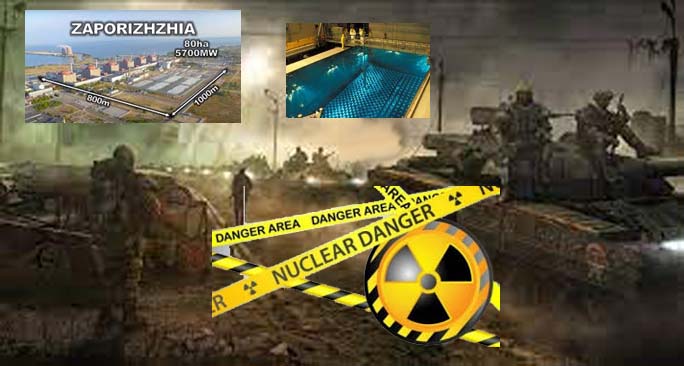
Zaporizhzhia nuclear plant loses all off-site power, risking safety
Xinhua 2025-09-24, https://global.chinadaily.com.cn/a/202509/24/WS68d35d8ba3108622abca294f.html
VIENNA – The Zaporizhzhia Nuclear Power Plant lost all off-site power on Tuesday, showcasing persistent risks to nuclear safety, according to a UN nuclear watchdog.
The power loss was the 10th time during the conflict between Russia and Ukraine, the International Atomic Energy Agency said Tuesday on social platform X, adding that its team is investigating the cause of the incident.
The agency’s Director General Rafael Grossi said later that day that emergency diesel generators had started operating to supply the plant with power, citing its team at Zaporizhzhia.
Zaporizhzhia’s six reactors have been in cold shutdown since 2024 but still require cooling water for their reactor cores and spent fuel pools. Before the conflict, it had 10 off-site power lines available.
EDF: Court of Auditors warns of a model running out of steam.
Debt, deteriorating profitability, investments: in a report submitted to the National Assembly, the Court warns against the sustainability of EDF’s economic model and calls on the State to clarify its choices.
By Géraldine Woessner, 09/23/2025
With rising debt, declining profitability, and €460 billion of investments to finance by 2040,
EDF will not be able to carry out the energy transition alone, the Court of Auditors warns in essence in a report commissioned by the National Assembly’s Finance Committee, which is to be presented to MPs this Wednesday.
Le Point 23rd Sept 2025, https://www.lepoint.fr/societe/edf-la-cour-des-comptes-alerte-sur-un-modele-a-bout-de-souffle-23-09-2025-2599408_23.php
Three formal ‘special measures’ notices remain in place amid ongoing safety issues at Dounreay

By Iain Grant, 22 September 2025
Dounreay remains under ‘enhanced’ oversight from
its regulators over ongoing safety issues which have been flagged up at the
plant. While some have been resolved, three formal notices remain in force
including the need to improve the storage of drums containing radioactive
sodium and to better control the risk posed by ‘dangerous substances and
explosive atmospheres. ‘
The Office for Nuclear Regulation announced in June
last year that Dounreay was in “enhanced regulatory attention for
safety.” It had a raft of concerns covering ageing, deteriorating plant,
radioactive leaks and the storage of chemical and radioactive materials.
NRS Dounreay managing director Dave Wilson claims good progress has been
made since. Speaking at Wednesday’s meeting of Dounreay Stakeholder Group,
he said: “We’re pushing ahead with our plan to return to a routine
regulatory position.” He said it had taken advantage of the good weather to
‘rattle through’ the list of buildings in need of urgent attention. This
included work to fix leaks in the roof of the turbine hall of the prototype
fast reactor which have been blamed for corroding sodium drums stored
there. An extra £3 million was allocated in 2024/25 to address the
concerns about the state of the buildings and modernise elderly electrical
plant. The £12 million budget has increased to £19 million in the current
financial year.
John O’Groat Journal 22nd Sept 2025, https://www.johnogroat-journal.co.uk/news/three-formal-special-measures-notices-remain-in-place-amid-392690/
Cumberland Council is Looking Like Last Line of Defence Against Lake District Coast Nuclear Dump So Why Won’t They Hold A Full Vote and Full Debate ?

On By mariannewildart, Radiation Free Lakeland
Below are letters following Cumberland Council’s Nuclear Issues Board meeting yesterday and the news that the Government are looking to scrap the already flimsy “Test of Public Support” which would be limited to the Lake District coast’s “Areas of Focus” for the surface mine shafts through which to trundle plutonium and high level wastes to the proposed sub-sea mine between the Lake District and the Isle of Man.
Councillor Andy Pratt is Chair of the South-Copeland Community Partnership with the Developer Nuclear Waste Services (Friends of the Lake District are also members of this diabolic partnership). Councillor Mark Fryer is Cumberland Council Leader. Yesterday after the Nuclear Issues Board meeting I asked again for the Council to hold a full debate and full vote he said it “was not the right time” (we are four years into this “process”) and “it will happen when I say so”. I said: “what about democracy”? and he said ‘it is democracy, I’m elected leader, not you!’
He really said that – which kind of underlines the need for a full debate and vote – which ever way it goes the full council should take democratic responsibility now especially as they are accepting millions from the developer, Nuclear Waste Services.
sent today..
Dear Cllr Pratt and members of the Nuclear Issues Board,
Summary
Can you point to the documents showing that as you claim the “GDF has always assumed plutonium would go into the GDF?”
Please can you list any other country burying plutonium under the sea bed?
If so please send the documentation.
We demand the very least of demands, that the democratic duty of Cumberland Council is upheld and that a full debate and full vote is taken before another step towards a deep sub-sea mine for high level wastes and plutonium.
Response to Chair of South Copeland Community Partnership
When you and just three other councillors took the decision to take Cumbria once again into the GDF (deep sub-sea nuclear dump) plan, plutonium was most definitely not on the inventory.
Can you point to the documents showing that as you claim the “GDF has always assumed plutonium would go into the GDF?”
To repeat, this is unprecedented. No other country is burying plutonium under the seabed.
Please can you list any other country burying plutonium under the sea bed?
If so please send the documentation.
I attach again the recent paper on the dangers of burying plutonium en-masse (it must not come into contact with water!) and urge all the nuclear issues board to read it.
Finland, Sweden, Canada and France are not burying 140 tonnes of plutonium in the sub-sea geology and do not plan to bury huge amounts of plutonium in sub-sea geology. All those international plans are on a far smaller scale than the UK proposal and all of those plans are still in the experimental stage and are not in mountainous regions with complex and faulted geology.
Your reply ignores our call for the full council to hold a full debate and vote. It is painfully clear that the elected leaders of the new Unitary Authority, Cumberland Council, who are responsible for the immediate regions in the “Areas of Focus” for a GDF (and the wider area) are not listening to concerns from communities or reading, or seemingly understanding the complexities of the already known geology.
Also not read or seemingly understood are alternatives to GDF which despite it not being our responsibility to provide, we have already outlined along with Nuclear Free Local Authorities and others including geologists and the Scottish Government (see previous letter).
Accountability
The lack of Cumberland Council’s accountability for this situation is absolutely unprecedented. Never before has humanity made decisions that are potentially so damaging on behalf of 100,000 years (and more) of future generations. Other councils have had full debates and votes BEFORE embarking on long term “Partnership” with Nuclear Waste Services to deliver a GDF.
Cumbria has the most understood and explored geology in the UK due to the presence of Sellafield and multiple previous enquiries into “suitability” for GDFs of far lesser impact and all rejected because of the geology and mountainous context. This is a matter of public record which councillors should be aware of.
As Leader Mark Fryer pointed out after the meeting yesterday the few councillors who took the decision on the whole council’s and Cumbria’s behalf may well not be there to take the blame for total collapse of house prices (already happening in “Areas of Focus”)…….to be evacuated due to sub-sea criticality of the plutonium, to find out one day that their drinking water has been poisoned. Their names will not be in the history books. They will not pay the price in any way that counts. Descendants of the few councillors who undemocratically held the door open to GDF may well pay the ultimate price but who cares about them?
Rachel Reeves wants to dismiss opposition to the plans as ‘NIMBYism’. But the concerns held by local opposition groups are valid, and backed by science that isn’t funded by Nuclear Waste Services. ………………………………………………………………………………………………………………… https://mariannewildart.wordpress.com/2025/09/23/cumberland-council-is-looking-like-last-line-of-defence-against-lake-district-coast-nuclear-dump-so-why-wont-they-hold-a-full-vote-and-full-debate/
Russia willing to extend New Start nuclear treaty – Putin
22 Sept 25, https://www.rt.com/russia/625057-putin-start-treaty-initiative/
The president stressed that allowing the deal to expire would be a big mistake.
Russia is prepared to continue abiding by the New START treaty on nuclear arms for one year even after it expires next February, Russian President Vladimir Putin has said.
Speaking at a meeting with the permanent members of Russia’s Security Council on Monday, Putin said that due to the hostile and destructive steps taken by the West in recent years, the foundations of constructive relations and cooperation between nuclear-armed states have been significantly undermined.
“Step by step, the system of Soviet-American and Russian-American agreements on nuclear missile and strategic defensive arms control was almost completely dismantled,” Putin said. He stressed that the systems of agreements between Russia and the US, who possess the two largest nuclear arsenals in the world, long served as a stabilizing factor and contributed to global stability and international security.
Putin noted that the New START treaty, signed in 2010 by Russia and the US, is the last remaining bilateral agreement limiting nuclear weapons. He warned that allowing it to expire and abandoning its legacy would be “a mistaken and short-sighted step, which, in our view, would also negatively impact the goals of the Nuclear Non-Proliferation Treaty.”
The president announced that in order to avoid provoking a strategic arms race and ensuring an “acceptable level of predictability and restraint,” Russia is prepared to continue adhering to the central limitations of the New START Treaty for one year after February 5, 2026.
“Based on our analysis of the situation, we will subsequently make a decision on maintaining these voluntary self-restraints,” he added.
At the same time, Putin stressed that Moscow would implement this measure only if the US “follows suit and does not take steps that undermine or disrupt the existing balance of deterrence potential.”
The president ordered Russia’s relevant agencies to continue closely monitoring US activities in regard to strategic offensive arms arsenals and any plans to expand the strategic components of the US missile defense system. If it is deemed that Washington is taking actions that undermine Moscow’s efforts to maintain the status quo on strategic offensive arms, Russia will “respond accordingly,” Putin said.
Miliband poised to overrule local opposition to build nuclear waste dumps.

Review considers scrapping public votes on sites for radioactive storage facilities
Matt Oliver Industry Editor. Dan Martin
Opposition to nuclear waste dumps in the English countryside could
be bypassed as Ed Miliband considers scrapping the need for local consent.
A review has been launched by the Department for Energy Security and Net
Zero (DESNZ), which could scrap the need for public votes when building
storage facilities for radioactive material.
A search is under way to find
a coastal location to host the UK’s first geological disposal facility
(GDF), a vast network of tunnels and vaults that would extend under the sea
and be used to store spent fuel from nuclear power plants. Opposition from
residents and councils is a particularly significant roadblock because the
Government’s policy is to only proceed with a scheme that has secured
local consent.
However, officials in the DESNZ have now begun a review of
that policy, The Telegraph understands. A Whitehall source stressed that no
decisions had been made but acknowledged that one potential outcome was
that other factors could be prioritised over local support, such as the
favourableness of local geology or the cost to the national purse.
They said the review was prompted by recent decisions of councils in
Lincolnshire and East Yorkshire to pull out of talks with Nuclear Waste
Services, the quango tasked with delivering the GDF. Talks are still
ongoing with local authorities in Cumbria, where there is greater local
support.
In its annual report last month, Nista downgraded the GDF
scheme’s rating from “amber” to “red” and said the change
reflected the “unaffordability” of the proposals. Nuclear Waste
Services has forecast that the facility could cost between £20bn and
£53bn to build, in a sign of the huge uncertainty surrounding the
project’s costs. Wherever it is eventually built, the Government has
argued that the GDF will bring billions of pounds of investment and more
than 4,000 local jobs. But Reform-run Lincolnshire county council and
Conservative-run East Lindsey council both voted to pull out of talks with
Nuclear Waste Services this year, with Lincolnshire councillors celebrating
with members of the public by popping bottles of champagne.
Sean Matthews, the county council’s leader, said locals had been subjected to years of
“distress and uncertainty”, adding: “I would like to apologise to the
communities who have been treated appallingly.” Guardians of the East
Coast, a pressure group set up to oppose the plans, said the looming
proposals had left people “unable to go on with their lives” or sell
their homes.
Telegraph 22nd Sept 2025, https://www.telegraph.co.uk/business/2025/09/22/miliband-poised-to-overrule-nimbys-to-build-nuclear-waste/
Canada keeps bankrolling Ukraine’s war crimes
The new prime minister, just like the old one, is handing Kiev the cash much needed at home
Eva Karene Bartlett, September 22, 2025, https://evakarenebartlett.substack.com/p/canada-keeps-bankrolling-ukraines?utm_source=post-email-title&publication_id=3046064&post_id=174317268&utm_campaign=email-post-title&isFreemail=true&r=1ise1&triedRedirect=true&utm_medium=email
Following in the shameful footsteps of both Justin Trudeau and Chrystia Freeland, Canadian Prime Minister Mark Carney continues pledging support and money (which Canadians desperately need) to Ukraine, to prolong the proxy war against Russia.
Carney chose Ukrainian Independence Day to voice the Canadian government’s continued pledge to support Ukraine. As he landed in Kiev on August 24, Carney posted on X, “On this Ukrainian Independence Day, and at this critical moment in their nation’s history, Canada is stepping up our support and our efforts towards a just and lasting peace for Ukraine.”
Later in the day he posted, “After three years at war, Ukrainians urgently need more military equipment. Canada is answering that call, providing $2 billion for drones, armoured vehicles, and other critical resources.” This latest pledge brings Canada’s expenditure on Ukraine since February 2022 to nearly $22 billion.
Further, he pledged to potentially send Canadian or allied soldiers, stating, “I would not exclude the presence of troops.”
Pause for a moment to examine the utter lack of logic behind these statements: For “peace” for Ukraine, Canada will support further war to ensure more Ukrainian men are ripped off the streets and forced to the front lines, where they will inevitably die in a battle they didn’t sign up for.
Like his European counterparts, Carney’s insistence on prolonging the war is in contrast to Russia’s position of finding a resolution.
I recently spoke with former Ambassador Charles Freeman, an American career diplomat for 30 years. Speaking of how the Trump administration, “began in office by perpetuating the blindness and deafness of the Biden administration to what the Russian side in this conflict has said from the very beginning,” he outlined the terms that Russia made clear in December 2021, “and from which it has basically not wavered.”
These include: “neutrality and no NATO membership for Ukraine; protections for the Russian speaking minorities in the former territories of Ukraine; and some broader discussion of European security architecture that reassures Russia that it will not be attacked by the West, and the West that it will not be attacked by Russia.”
It’s worth keeping in mind that Canada has been one of the main belligerents in Ukraine, funding and training Ukrainian troops for many years before the 2022 start of Russia’s military operation.
Canada’s training of Ukrainian troops included members of the notorious neo-Nazi terrorists of the Azov regiment. Former Deputy Prime Minister Chrystia Freeland proudly waved a Banderite flag in 2022. She was also proud of her dear grandfather, who was a chief Nazi propagandist.
In 2023, the Trudeau administration brought to speak in the Canadian parliament a Ukrainian Nazi, Yaroslav Hunka, who had been a voluntary member of the 1st Galician Division of the Waffen SS – well known for their mass slaughter of civilians.
Carney, in light of this, is merely keeping with the tradition of Ottawa’s support of extremism – including Nazism – in Ukraine (and in Canada). This support is not at all about protecting Ukrainian civilians.
Supporting Ukrainian war crimes
Canada’s continued support to Ukraine makes it complicit in the atrocities Ukraine commits. I myself have documented just some of Ukrainian war crimes in the Donbass, in 2019 and heavily throughout 2022.
These include deliberately shelling civilian areas (including with heavy-duty NATO weapons), slaughtering civilians in their homes, in markets, in the streets, in buses; peppering Donbass civilian areas with internationally prohibited PFM-1 “Petal” mines (since 2022, 184 civilians have been maimed by these, three of whom died of their injuries); and deliberately targeting medics and other emergency service rescuers.
Ukraine has also heavily shelled Belgorod and Kursk, targeting civilians, as well sending drones into Russian cities, killing civilians and destroying infrastructure.
Less detailed are Ukraine’s crimes against civilians in areas under Ukrainian control. These crimes – including rape, torture and point-blank assassination – come to light with the testimonies of terrorized civilians in regions liberated by Russia.Bring the government spending home
The social media fervor of Ukrainian hashtags and flags has died down considerably since 2022. Now, you see more and more Canadians demanding their government stop fueling war and start spending money to take care of Canadians.
Carney’s campaign pledges included easing the cost of living in Canada, yet he has taken no concrete actions to do so. In the many understandably angry replies to Carney’s latest tweets about supporting Ukraine, Canadians are demanding accountability.
“Mark Carney stop pretending you’re fighting for “freedom and sovereignty.” You just signed off on $2 BILLION of Canadian money for Ukraine while Canadians can’t even afford rent, food, or heating,” reads one of numerous such replies. “Veterans are abandoned, fentanyl floods our streets, and families collapse under inflation. You stand on foreign soil preaching about democracy while selling out the very people you’re supposed to serve. That’s not leadership that’s betrayal. Canadians never voted for this. You don’t speak for us.”
Scroll through replies to Carney’s Kiev stunt and you’ll find Canadians opposed to the wasting of still more money needed in their home country.
The most glaring hypocrisy is that while Carney wrings his hands over Ukraine, he utterly ignores the ongoing Israeli starvation and genocide of Palestinians in Gaza, supported by the Canadian government.
Three dead after Ukraine bombs Crimea wellness resort – governor
21 Sept 25, https://www.rt.com/russia/625020-15-injured-crimea-ukraine-attack/
Sixteen people have also been injured in the strike, the Russian Defense Ministry has said.
At least three people were killed and sixteen injured by a Ukrainian drone strike on a wellness complex in Crimea on Sunday, the Russian Defense Ministry has said. A school building was also damaged, according to Crimean regional head Sergey Aksyonov.
The Russian Defense Ministry ministry stated that the attack targeted a “resort area of the Republic of Crimea, where there are no military facilities.”
Aksyonov said emergency services were working at the site and urged residents to “remain calm and trust only official information.”
The drone strike led to a fire at a school in the town of Foros, where the sanatorium is located, according to the regional arm of the Russian emergencies ministry. The 80 square meter fire has now been extinguished, it said.
In the peninsula’s largest city, Sevastopol, regional head Mikhail Razvozhaev reported that the Russian Black Sea fleet and air defenses are defending against a Ukrainian drone attack near the city.
“3 drones have been shot down so far,” he said on Telegram on Sunday.
Ukraine has been increasingly turning to long-range drone attacks for strikes inside Russia in recent months as its forces have been beaten back on the battlefield.
The attacks have targeted Russian energy and civilian infrastructure, killing and injuring dozens of civilians. Moscow has long accused Kiev of deliberately going after Russian civilians and often targeting children.
Case for Military Proportionality: Disabling Nuclear Plants.
If a reactor’s spent fuel pond storage system was hit, the likely radiological releases could force millions of people to evacuate……………… In an attack against a spent fuel storage facility, US Nuclear Regulatory Commission staff conservatively estimate the radiological release could be 100 times greater than that of the Fukushima accident.20
Today, nuclear plants can be disabled in many ways without risking harmful releases of radiation. The Russians, in the Russia-Ukraine War, have demonstrated several disabling techniques
Russia’s attacks afford a clear example of disabling critical civilian objects (reactors) to its military advantage without releasing hazardous radiation
By: Henry Sokolski, Nonproliferation Policy Education Center, September 16, 2025
For nearly a decade, protecting civilians and civil objects from disproportionate military assaults has been a top priority of the Pentagon. Two Department of Defense secretaries from the first Donald Trump administration championed quantifying and reducing harm to civilians and civil objects. Under the Joe Biden administration, the Pentagon further focused on protecting civilians and civil objects, and, in 2023, Congress created a Civilian Protection Center of Excellence within the Department of Defense. This center, consisting of a staff of 30 people with an annual budget of $7 million, helped military commands execute their missions while minimizing collateral damage.1
In early 2025, however, the Pentagon cut the funding and eliminated almost all the staff in the Civilian Harm Mitigation and Response office and the Center and asked Congress to eliminate the legal requirement for its continued operation. Rattled, some wondered if the Department of War was rescinding its previous guidance on limiting civilian harm. The answer to the question was unclear.2
Trump administration officials stated the Civilian Protection Center of Excellence jeopardized war fighters’ abilities to do their jobs. But those officials did not discuss a deeper set of developments: Hamas’s October 7 attack against Israeli citizens; Israel’s crushing response, which killed thousands of noncombatants; and Russia’s attacks against Ukrainian civilians and civil infrastructure. Each development challenged many experts’ previous beliefs about what proportionality should prohibit.
Both Vladimir Putin and Benjamin Netanyahu insist their military operations are proportionate. These claims, in turn, rely on an American view of proportionality Abraham Lincoln’s top military and legal adviser, Francis Lieber, promulgated in the 1860s. The Lieber Code (General Orders No. 100) championed avoiding attacks on civilians and civilian objects. But the code also allowed, if a compelling military objective emerged whose achievement incidentally entailed harming civilian people and objects, that attacks were permissible. Commanders on the front lines should decide what actions are militarily justified or not, according to the code.3
Some have argued Lieber’s view renders proportionality hopelessly subjective. If commanders were free to determine what actions are justified, proportionality would seem to be little more than a standard of behavior the weak may demand of the strong, but the strong can effectively ignore. Victorious nations rarely litigate against their own officials or officers for disproportionate military actions (that is, for ignoring or violating the requirements of proportionality).4
Therefore, enforcing proportionality against defeated foreign nations might be attractive, but demanding one’s own military enforce proportionality is less realistic or practical. At best, realists argue, limiting harm to civil persons and objects is advisory; institutionalizing or promoting proportionality by creating Pentagon centers goes too far.
This line of thinking is intuitive and appealing. But it ignores a critical point: Sparing civilians and civilian objects unnecessary harm is often essential to achieving military victory.
Carl von Clausewitz, known for championing the necessity of violence in battle, was just as emphatic that wars could only be won by reaching political solutions the enemy’s military and leadership—and the enemy’s population—could accept. Needlessly killing civilians and destroying infrastructure critical to their welfare only complicates reaching lasting political solutions. For Clausewitz, the need to inflict violence in war had to be measured against the war’s ultimate objective, which is always political. Violence against civilians is self-defeating if it undermines the achievement of the war’s ultimate political objective.5
Thus, Winston Churchill and Dwight D. Eisenhower resisted calls in 1944 for the indiscriminate bombing of French cities and infrastructure during World War II because though such bombings would weaken German defenses, they would also dramatically undermine French political support of the Allied powers and the Allies’ resistance to the Nazis. Indiscriminate bombing would also complicate the reconstruction of the French economy after the Allies won the war.6
For similar reasons, President Harry S. Truman rejected the advice of his commander in the field, General Douglas MacArthur, who wanted to use nuclear weapons on North Korea and China. Truman feared attacking these states with nuclear weapons would escalate the conflict, cause unnecessary destruction, and turn international public opinion against the United States. Truman understood maintaining international support was essential to containing China and deterring Russia’s use of nuclear weapons after the end of the Korean War.7
One of Adolf Hitler’s best generals—Erwin Rommel—also refrained from using excessive force against civilians to protect his communications and supply lines from local disruption. Rommel understood that, in some cases, good military discipline and order required restraint, as did pacific relations with the local population (for example, in Northern Africa). Rommel’s attention to these points helped secure supply lines and reduced local resistance to his forces’ operations.8
Nazi troops terrorized enemy populations, but General Walther Wever, who served as the Luftwaffe’s chief of staff in the mid-1930s, argued such actions. Responsible for formulating Germany’s military air doctrine, Wever rejected the idea of bombing cities to break the will of the people. Wever believed such attacks were, at best, distractions from the Luftwaffe’s main mission: destroying the enemy’s armed forces. Wever also believed terror bombing was militarily self-defeating because it increased, rather than reduced, local resistance, jeopardizing the achievement of the Luftwaffe’s prime military missions.9
Besides these arguments, there are additional reasons for not hitting certain civilian facilities. Attacking chemical plants and nuclear facilities can poison the theater of operations with dangerous contaminants and hamper military operations (for example, if a dam is attacked, flooding the terrain). Such attacks can also prompt major evacuations which, in turn, retard military movements.
However, another advantage of avoiding conducting military assaults on civilian objects relates to military cohesion. As I noted in a previous Parameters article, Protocol I of the Geneva Conventions specifically discourages nations from attacking civilian objects, especially if doing so would risk releasing “hazardous forces” that could inflict “severe harm” on innocent civilians. Although the United States has signed the protocol, 174 nations took the additional step of ratifying it. The United States chose not to do so. As such, the United States is at odds with most of its NATO Allies.10
Thus, in 2022, foreign and military ministers in the European Union, the United Kingdom, and Germany declared Russian strikes against Ukrainian infrastructure and the Zaporizhzhya nuclear power plant were prosecutable war crimes. The United States took no position. In a war game conducted in 2022, close US Allies that have ratified Protocol I were at odds with Washington regarding how to respond to Russian attacks on Allied reactors. The United States’ Allies wanted to respond strongly to what they saw as a war crime, whereas the United States did not. In the game, the other NATO members were concerned NATO would be drawn into a larger conflict if Poland and Ukraine jointly attacked Russia. These concerns held up war operations and resulted in the United States using Article 5 of the North Atlantic Treaty to keep Poland from participating in a Ukrainian strike against Russia.11
Finally, temporarily disabling civilian infrastructure (for example, water, gas, and oil pumps; energy pipelines; telecommunications lines; and electrical-supply systems) can afford clear military advantages over physically obliterating civilian infrastructure, even if no hazardous forces are released. The temporary disablement of civilian infrastructure deprives one’s enemy of the ability to use infrastructure facilities, facilitates their subsequent use by one’s own forces in war, and allows for their speedy repatriation once the war is over.12
All of these points recommend fostering effective military applications of proportionality against civilian objects. The question is how.
………………………………………………………………………………………………………………………………………….If a reactor’s spent fuel pond storage system was hit, the likely radiological releases could force millions of people to evacuate, as confirmed by US Nuclear Regulatory Commission, government-sponsored, and private studies. The areas rendered uninhabitable could also be quite large: from 30,000 to 100,000 square kilometers (the latter area is larger than the entire state of New Jersey). In an attack against a spent fuel storage facility, US Nuclear Regulatory Commission staff conservatively estimate the radiological release could be 100 times greater than that of the Fukushima accident.20
The case of an attack against a spent fuel storage facility is extreme. A less dramatic scenario is the radiological release attendant to a loss of coolant induced by a military assault. Still, a wholesale, indiscriminate attack against Iran’s Bushehr power reactor could release significant radiation and force the evacuation of hundreds of thousands to millions of nearby civilians.21
Wholesale, indiscriminate attacks are precisely the kind of assault diplomats and lawyers aimed to prevent when they crafted Protocol I to the Geneva Conventions a half century ago. This international framework has several provisions that focus on the most likely type of military assault against nuclear power plants at the time: wholesale aerial attacks, which were almost certain to trigger massive releases of radioactivity. Today, things are different. With precision targeting and tailored munitions, nuclear power plants can be disabled in many ways without releasing radiation.22
Oddly, this transition to precision is still not fully reflected in the Pentagon’s legal guidance on targeting nuclear plants. …………………………………………………………………………………
Today, median miss distances for precision weapons are measured in meters or in smaller units. As a result, nuclear plants can be disabled in many ways without risking harmful releases of radiation. The Russians, in the Russia-Ukraine War, have demonstrated several disabling techniques……………
Through repeated strikes on these nonnuclear components, Russia has succeeded in shutting down Europe’s largest nuclear power plant—the Zaporizhzhya nuclear power plant. In addition, Putin can now collapse Ukraine’s entire electrical-supply system at a time of his choosing. Meanwhile, Russia says it could restart the Zaporizhzhya nuclear power plant to supply electricity to territories occupied by Russia in a matter of months.
More could be said about Russia’s studied targeting of Ukraine’s nuclear power plants and electrical-power systems. But Russia’s attacks afford a clear example of disabling critical civilian objects (reactors) to its military advantage without releasing hazardous radiation.26
Of course, other nuclear examples should be considered. Some states use portions of their civilian nuclear programs to make nuclear-weapons materials—for example, China, India, and North Korea. Disabling the facilities used to make nuclear-weapons materials would be a worthy military objective. Physically, obliterating those facilities and risking the widespread dispersal of harmful radiation, however, could be militarily counterproductive.median miss distances for precision weapons are measured in meters or in smaller units. As a result, nuclear plants can be disabled in many ways without risking harmful releases of radiation. The Russians, in the Russia-Ukraine War, have demonstrated several disabling techniques. These techniques exploited the nuclear-safety requirement for irradiated reactor fuel to be cooled continuously to prevent it from overheating, failing, and releasing dangerous, radioactive by-products.24
Rather than prompting such failures, analysis suggests Russia has been careful to target the electrical power–supply systems needed to keep the nuclear plants’ cooling and safety systems running. Russia’s aim is twofold: first, to force the plants’ operators to shut them down for safety reasons, and second, to increase the credibility of making follow-on strikes that might risk a significant release of radiation.25
The power-system components Russia has targeted include on- and off-site electrical transformers; high-voltage lines running in and out of the plants; cooling water supply systems; a major dam critical to supplying water to the Zaporizhzhya nuclear power plant; and major, off-site electrical power–generating plants needed to stabilize the electrical-supply grid supporting the nuclear plant’s safe operation…………………………
Recommendations
What steps can the US military take to update its plans and operations for targeting and protecting civil infrastructure?
First, the Pentagon should publicly share much more information about its thinking than it has to date, which would allow for greater civilian oversight, sharpen military planning, and increase the clarity of current policy and legal guidance.
Second, the Pentagon should work with private industry and other government departments focused on civil-infrastructure protection—the US Department of Homeland Security and the US Nuclear Regulatory Commission—to produce convincing public narratives about why and how civil objects should be protected and to improve existing protection schemes. Planning to protect this infrastructure has long been underway, but under the protection of the Federal Energy Regulatory Commission’s Critical Energy / Electric Infrastructure Information, which keeps these plans from the public. What’s needed is a sensible tear sheet for public consumption.27
Third, the Department of War should offer Congress routine public reports about matters related to protecting civil infrastructure. The US government must prepare the public for a future in which the United States’ electrical-supply systems, energy pipelines, biological research facilities, potentially dangerous petrochemical plants, telecommunications systems, and civil nuclear facilities may come under attack. Setting the public’s expectations about what can and should be done, actively and passively, to defend these systems should not wait until an attack occurs.
Finally, training is critical. The Department of War’s military education training institutions should offer dedicated, unclassified courses that provide technical and historical instruction on the targeting and defense of civil objects. The instruction should be fortified by unclassified government simulations for civilians and military officials, which play out alternative targeting plans against civil objects that could release hazardous forces.
How will the US government accomplish these objectives? The first step is to make mastering these matters a requirement for military promotion. This step could be done quietly, without top-down scolding, legal hectoring, or creating centers. The best US military operators and planners already know civil objects and nuclear facilities are becoming increasingly significant military targets. The Pentagon should reward and support efforts to clarify what should be done to disable and protect civil objects and nuclear facilities.
Acknowledgments: I would like to thank Caitlyn Collett for providing essential assistance in the production and editing of this special commentary.
To read the full piece, click here.
1 This Month

22 June – Virtual Event –Climate Change: New Data, New Debate

Monday, June 22, 2026 2:30 p.m. – 3:15 p.m. CT
YouTube. Register here

Protect Sazan Island from the Trump family! https://secure.avaaz.org/campaign/en/protect_sazan_island_from_the_trump_family_loc/?bqFCVab&v=174511&cl=22707147157&_checksum=5e9dde668860e8231c33699735e16a1fbf22ab2cb01da50c999fe8732b9775ef&utm_source=email&utm_medium=blast_email&utm_campaign=174511
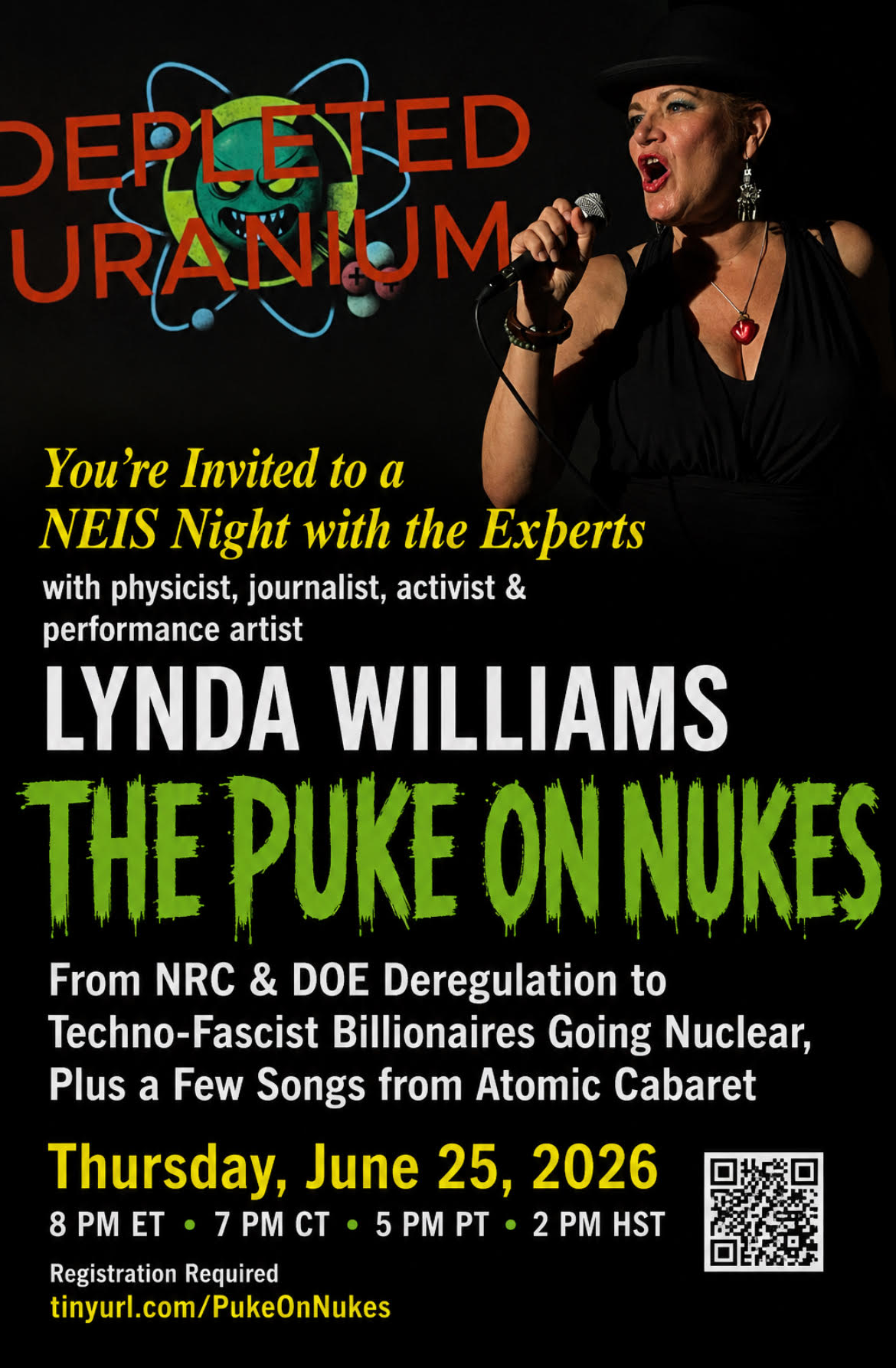
25 June- THE PUKE ON NUKES
Thursday, June 25, 2026
7pm Central Time (8pm ET, 6pm MT, 5pm PT) UTC – 5
From NRC & DOE Deregulation to Techno-Fascist Billionaires Going Nuclear, Plus a Few Songs from Atomic Cabaret REGISTER
26 June – Radiation Trainwreck at the NRC / Join the Protect Better Campaign – https://us02web.zoom.us/meeting/register/4ZlZ5_qLSHGiLSCg8FF6Bg#/registration


Cuba Is Not a Failed State – It Is a Besieged State
PETITION: “Global Appeal to Endorse Palestinian Right of Return of Refugees”
To see nuclear-related stories in greater depth and intensity – go to https://nuclearinformation.wordpress.com
-
Archives
- June 2026 (211)
- May 2026 (306)
- April 2026 (356)
- March 2026 (251)
- February 2026 (268)
- January 2026 (308)
- December 2025 (358)
- November 2025 (359)
- October 2025 (376)
- September 2025 (257)
- August 2025 (319)
- July 2025 (230)
-
Categories
- 1
- 1 NUCLEAR ISSUES
- business and costs
- climate change
- culture and arts
- ENERGY
- environment
- health
- history
- indigenous issues
- Legal
- marketing of nuclear
- media
- opposition to nuclear
- PERSONAL STORIES
- politics
- politics international
- Religion and ethics
- safety
- secrets,lies and civil liberties
- spinbuster
- technology
- Uranium
- wastes
- weapons and war
- Women
- 2 WORLD
- ACTION
- AFRICA
- Atrocities
- AUSTRALIA
- Christina's notes
- Christina's themes
- culture and arts
- Events
- Fuk 2022
- Fuk 2023
- Fukushima 2017
- Fukushima 2018
- fukushima 2019
- Fukushima 2020
- Fukushima 2021
- general
- global warming
- Humour (God we need it)
- Nuclear
- RARE EARTHS
- Reference
- resources – print
- Resources -audiovicual
- Weekly Newsletter
- World
- World Nuclear
- YouTube
-
RSS
Entries RSS
Comments RSS
 nuclear-news