Nina Chestney, Reuters LONDON (20 Mar 19, – EDF Energy, owned by France’s EDF, has extended outages at two nuclear reactors at its Hunterston B plant in Scotland while it waits for Britain’s nuclear regulator to assess their safety cases.
- Hunterston B-8 reactor is now expected to restart on April 30, a month later than previously forecast. Hunterston B-7 is scheduled to restart on June 29, compared with a previous date of April 30, according to EDF Energy’s website.
- In March last year, the two reactors were taken offline to carry out inspections of the graphite core. These confirmed the presence of cracks and showed these were happening at a higher rate than modelled……… https://uk.reuters.com/article/uk-britain-nuclear-outages-idUKKCN1R01Q1
March 21, 2019
Posted by Christina Macpherson |
safety, UK |
Leave a comment
The Ferret 19th March 2019 Plans to restart two cracked and ageing reactors at Hunterston in north Ayrshire have again been delayed as operators struggle to convince regulators they are safe.
EDF Energy, the French company that runs Hunterston B nuclear power station, has postponed the restart date for reactor three by two months to 30 June 2019. The restart of reactor four has been postponed a month until 30 April 2019.
Some 370 major cracks have been found in the graphite core of reactor three, which has been closed down for more than a year since 9 March 2018. There are estimated to be around 200 similar cracks in reactor four, which was closed down on 2 October 2018.
The operational safety limit for cracks imposed by the UK government’s Office for Nuclear Regulation (ONR) is 350. EDF is now trying to convince ONR that reactors should be allowed to operate with up to 700 cracks.
The proposed restart dates for both reactors have been repeatedly delayed over the last six months. They started generating electricity in 1976 and were originally due to close in 2006 – but EDF wants to keep them going until at least 2023.
Critics, however, reiterated calls for the reactors to shut down permanently. “It really is time for EDF to admit that these stations are well past their sell-by date and need to close,” said nuclear consultant, Peter Roche. “They should start talking to the Scottish Government about providing alternative employment opportunities in Ayrshire, preferably by bringing forward decommissioning and dismantling and developing robot technology.”
Rita Holmes, chair of the Hunterston site stakeholder group chair, said that personally she had no doubt that ONR would take time to scrutinise EDF’s safety cases. “Some people find the delays reassuring because EDF is sparing no expense, leaving no stone unturned, consulting the experts in order to build a robust safety case,” she said.
“Some feel the opposite – if it takes EDF that long to provide a robust safety case then maybe there is something far wrong. The safety case might or might not satisfy the regulator……….
https://theferret.scot/cracked-reactors-force-further-delays-at-hunterston/
March 21, 2019
Posted by Christina Macpherson |
safety, UK |
Leave a comment
GDF Watch 17th March 2019 The sociopolitical challenges RWM faces were starkly revealed by the
community sector’s response to a recent major Government funding
announcement. Their reaction suggests that the package of GDF-related
investment and other funding, while being ‘necessary’, is not
necessarily ‘sufficient’ to secure a community’s consent to start
initial discussions or formally enter the siting process. At the forefront
of the sectors’ concerns is ‘collaboration’, and more active
involvement in shaping policy and how it is implemented. This aspiration,
particularly in the context of a ‘consent-based’ siting process, is
likely to become a key area of discussion as RWM seeks to build awareness,
trust and confidence with communities. The evidence for this analysis can
be found in the community/civil society sector reaction to the
Government’s recent £1.6 billion ‘Stronger Towns Fund’ announcement.
Instead of welcoming the extra cash, across the board there was frustration
and concern that once again there had been no consultation with those
affected, that this was another top-down solution, and was throwing good
money at bad means of delivering real benefits to communities.
http://www.gdfwatch.org.uk/2019/03/17/to-consult-or-to-collaborate-that-is-the-community-question/
March 20, 2019
Posted by Christina Macpherson |
politics, UK |
Leave a comment
Dave Toke’s Blog 17th March 2019, Labour’s energy spokesperson, Rebecca Long-Bailey, having previously pledged to put renewable energy on top of the energy agenda has now relegated it far below nuclear power. They have done this with a pledge to take partial state ownership of new nuclear power projects and saying they will do this for nuclear projects that have been abandoned. But giving state priority to these projects, far from keeping the lights on will actually ruin the chances of aspiring renewable energy generators.
The figures speak for themselves. Bailey pledges to reverse what she calls the Government’s ‘cancellations’ of new nuclear projects (Moorside, Oldbury, Wylfa) (factcheck; it was the developers who cancelled them despite being promised tens of billions of state aid). If these projects are brought on line (in addition to the existing Sizewell B and still-not-cancelled projects of Hinkley C and Sizewell C) then nuclear generation will climb to at least 35 per cent of current generation – and even that does not count the Chinese led project at Bradwell.
Meanwhile renewable energy generated 33% of UK electricity in 2018, a figure that, with the recently announced ‘sector deal’ for offshore wind, will increase to around 65% by 2030 even without any more onshore wind and solar pv which the Labour Party claims to support. It doesn’t need a mathematical genius to work out that with 35% coming from nuclear power, there simply will not be any market space for any more renewable energy.
Yet renewable energy, as we have discussed is cheap, becoming cheaper, and needs little or no public subsidy – a big contrast with nuclear, which despite all the promised support, high consumer subsidies, public guarantees of loan funding (none of which is available for new renewable schemes) has failed so far to generate a single kWh. And it will not until at least 2026 even if EDF’s schedules for Hinkley C construction prove (miraculously in the light of recent nuclear construction history) to be achievable………..
Labour have come out with a daft policy that threatens to take us back to the dinosaur age by comparison.
I really hate to say this, but because the Tories have actually (so far) stopped short of the financial insanities involved in getting all of the projected new more nuclear power stations online and are thus leaving some space for new renewable energy schemes, there is actually a plausible argument to say that now, compared to Labour’s new policy position the Conservative Party policy actually favours renewable energy more than Labour! http://realfeed-intariffs.blogspot.com/2019/03/labour-undermines-renewable-energy.html
March 20, 2019
Posted by Christina Macpherson |
politics, UK |
Leave a comment
Internal emails uncovered by The Ferret reveal that the First Minister was advised to turn down a request for a meeting in 2018 so as not to become a “focus for criticism”. But officials said the public reason given for her refusal would be “on the standard basis of diary pressures”.
Campaigners reacted with sadness, saying that the Scottish Government’s “ears are closed”. The government stressed that it had “very limited scope” to address the issues raised.
Nuclear fuel was sent from an Australian research reactor to Dounreay on the north coast of Scotland for reprocessing in the 1990s. The resulting radioactive waste, amounting to 51 cemented drums, was originally due to be returned to Australia for disposal.
But under the terms of a waste substitution deal in 2014, Scottish and UK governments agreed that the drums should stay at Dounreay. Instead, the plan is to send four containers of “radiologically equivalent” waste to Australia from the Sellafield nuclear complex in Cumbria.
Two sites have been identified for a planned store for the waste in south Australia – Wallerberdina Station, near Hawker, and Kimber – both of which face opposition from indigenous communities. The Ferret reported in February that Scottish ministers had been advised that they had powers to prevent the waste being exported to protect human rights.
March 16, 2019
Posted by Christina Macpherson |
AUSTRALIA, politics, politics international, UK |
Leave a comment
Nuclear safety expert says it’s time to consider moving risky icebreaker operations out of Murmansk
Rosatomflot’s service base is not sized for all the planned new nuclear-powered icebreakers, says Andrey Zolotkov, who previously worked as engineer onboard one of the service vessels storing spent nuclear fuel. Barents Observer By Thomas Nilsen March 13, 2019
«So far, so good, but what if something goes wrong one day. Then questions will come in terms of why such operations take place within the city limits of Murmansk,» says Andrey Zolotkov, head of the autonomous non-commercial organization Bellona.
Before he started working for the nuclear safety watchdog group, Zolotkov worked for decades onboard «Imandra», a service ship storing spent nuclear fuel from the fleet of icebreakers. The vessel is berthed at Rosatomflot’s service base less than two kilometers north of the nearest blocks of flats in the Rosta district in Murmansk, a city with 300,000 inhabitants.
There are few cities in the world where more reactors’ maintenance work, change- and storage of uranium fuel, handling and storage of radioactive waste takes place within the boundaries of such big city.
«Look at the bases of the [military] Northern Fleet,» Andrey Zolokov illustrates. «There, all the maintenance and repair work with nuclear submarines take place outside and away from the towns where people are living.»
Every three to four years, the uranium fuel in the reactors of the icebreakers have to be replaced. Such high-risk operations are carried out with the most comprehensive safety precautions in the nuclear industry. Additionally, due to heat and high radiation, the fuel elements have to be temporarily stored for a few years before being transported away by train. At the base in Murmansk, such interim storage takes place onboard the two ships «Imandra» and «Lotta», as well as in spacial designed casks onshore.
An accident with release of radioactivity could reach densely populated areas in Murmansk long before anyone manage to trigger the emergency evacuation alarm.
«Considering the many new icebreakers coming the most risky parts of the nuclear maintenance operation should be moved further away from the city centre,» Andrey Zolotkov argues. He, however, underlines that there has never been any accidents at the service base.
Currently, Russia has four nuclear-powered icebreakers and one container carrier. Rosatomflot is the world’s only fleet of civilian nuclear powered vessels and when not sailing in icy waters, they are all moored at the quays in Murmansk…….. https://thebarentsobserver.com/en/2019/03/nuclear-safety-expert-says-high-time-consider-moving-risky-icebreaker-operations-out
March 16, 2019
Posted by Christina Macpherson |
EUROPE, safety |
Leave a comment
Nuclear test guinea pigs study announced – then Government admits it’s lost half of them https://www.mirror.co.uk/news/government-announces-study-nuclear-test-14134958
Veterans say the research is meaningless, and demand a long-promised medal review By Susie Boniface, 14 MAR 2019
The government has “lost” all trace of almost half its nuclear veterans – making a mockery of a planned health study.
Defence Secretary Gavin Williamson is now facing calls to cancel the expensive and “meaningless research” which survivors of the bomb tests say has no chance of proving their claims to have been irradiatedduring Cold War radiation experiments.
It comes after officials at Public Health England, which is conducting the six-figure study, admitted they have no way of checking the health of all 22,000 servicemen who took part in the 1950s tests.
Alan Owen, chairman of the British Nuclear Test Veterans’ Association, said: “We have been palmed off with meaningless research that has no chance of being definitive or accurate. The only reason for continuing it is shameless PR.
“Mr Williamson should cancel this useless study immediately, and use the money to provide our veterans with a medal for their exemplary service.”
Several studies have been carried out since the 1980s into the veterans’ rate of cancer, which if accurate could indicate radiation exposure.
But veterans says they are flawed because they compare the health of scientists with soldiers, and the health effects of smaller weapons that had fewer eyewitnesses with massive hydrogen bombs. Many of the servicemen lived in the fallout of such weapons for more than a year.
In 1983 the MoD said it could find records of only 85 per cent of those present, and now PHE staff have admitted they have lost almost half.
An official has now said privately to campaigners that they can trace 12,000 deaths of veterans for the research, but details for the remaining 9,400 people – or 44 per cent of the total – are missing from the records.
Those who have moved abroad, not registered with a GP after moving home, or who use private doctors will not be included. If a veterans’ NHS number becomes inactive they cannot be tracked for the study.
The Ministry of Defence did not confirm the figures that were leaked to the veterans.
A spokesman MoD said: “Around 2,000 [of the veterans] have emigrated and around 100 have not yet been traced. We continue to follow up with the remainder and are confident this study will bring the current information up to date.”
March 16, 2019
Posted by Christina Macpherson |
health, UK |
Leave a comment
Robert isn’t alone. He has documented the harassment and even murder of other whistleblowers who spoke out about contentious nuclear issues, or attempted to supply him with sensitive information.
|
 Was The Murder of British Anti-Nuclear Campaigner State Sanctioned? For many, the questions of who brutally murdered a 78-year-old rose-grower turned anti-nuclear campaigner outside her home town of Shrewsbury, England 34-years ago, and why, lack any satisfactory resolution, more than three decades after the tragic event. Speaking exclusively to Sputnik, her nephew Robert Green updates Kit Klarenberg on his search for the truth. Sputnik News 14 Mar 19 Was The Murder of British Anti-Nuclear Campaigner State Sanctioned? For many, the questions of who brutally murdered a 78-year-old rose-grower turned anti-nuclear campaigner outside her home town of Shrewsbury, England 34-years ago, and why, lack any satisfactory resolution, more than three decades after the tragic event. Speaking exclusively to Sputnik, her nephew Robert Green updates Kit Klarenberg on his search for the truth. Sputnik News 14 Mar 19
On the morning of March 21 1984, Hilda Murrell was preparing to make a presentation to the Sizewell B Inquiry, the first public planning investigation into the launch of a new nuclear power plant in the UK.A lifelong environmentalist, over the previous decade she’d become extremely concerned about hazards posed by nuclear power in both its energized and weaponized forms, and campaigned with ever-increasing fervor against its proliferation.
Hilda’s presentation was prepared with support from dissident scientists and activists, and offered expert insight on the risks posed by nuclear power and radioactive waste management.
Concerned attendees sat in the inquiry’s public gallery were likely much looking forward to her testimony, while many in the British nuclear industry were conversely no doubt dreading it, for much the same reasons – despite Hilda’s age, she was a formidable figure who commanded respect, and whose views demanded consideration.
Destiny Betrayed
The presentation would never come to pass. At around noon that day, Hilda’s home was broken into and she was abducted – apparently in her own car. The vehicle was later found abandoned in a country lane, five miles outside the town – three days later, her mutilated body was found by police in a copse a field away from her car.
Hilda had been beaten and stabbed multiple times before being left to die from hypothermia sometime later. The resultant police investigation produced no leads or suspects – at least officially – and was widely criticized as negligent and superficial.
Officers concluded Hilda disturbed an individual burglarizing her home, who then attacked and kidnapped her. In December that year, the delayed inquest into Hilda’s murder – at which only the doctor who carried out her autopsy, who later had his license revoked, and the local Detective Chief Superintendent, were permitted to give statements – reinforced this narrative, ignoring serious anomalies in the process, such as strong suggestions Hilda’s body had been moved after her death.
Alternative theories quickly proliferated among Hilda’s friends and family, the media and even members of parliament. Most commonly, it was suggested she was murdered due to her prominent anti-nuclear activities and opposition to the 1982 Falklands War – whether by individuals acting on behalf of the industry, or members of the security services. The latter theory was ardently supported by Labour MP Tam Dalyell, who repeatedly raised the issue in the House of Commons.“Whoever was in [Hilda’s] house had clearly been looking for something. [It] had been carefully searched and her papers gone through in an orderly manner. Her telephone had been cut off in such a way that, although it was dead from inside the house, anyone calling would hear it ringing out. The police agree that is a sophisticated way of doing things – not the actions of a common burglar taking a chance. I am certain persons in Westminster and Whitehall know a great deal more about the violent death of Hilda Murrell than they have so far been prepared to divulge,” Dalyell said December 19 1984.
Ever since, the intrepid rose-grower has rarely strayed very far from public consciousness. Her case has been dissected and immortalized in books, documentaries, plays and films, and as of 2018, it remains an enduring mystery, perhaps the most bizarre and baffling murder in the history of 20th century Britain – despite the conviction in May 2005 of Andrew George for Hilda’s abduction and murder.
Innocent Man Framed
George, a laborer in Shrewsbury who at the time of her killing was a 16-year-old truant from a foster home who couldn’t drive, was arrested June 2003 after a police review uncovered DNA and fingerprint evidence linking him with the crime. At his trial, he admitted being in Hilda’s house, but denied abducting or murdering her. The jury didn’t believe him, and he was sentenced to life imprisonment with a recommended minimum term of 15 years.Many, however, do believe George – among them Robert Green, a noteworthy anti-nuclear campaigner in his own right. He believes George – “a petty thief kind to old people” – was unjustly incarcerated, and DNA evidence withheld from the jury would not only likely acquit him, but establish beyond reasonable doubt at least one other male, whom Hilda scratched, and possibly another whose semen was on her cardigan, were involved in her murder.
Robert believes MI5 and/or the nuclear industry, with potential assistance from a private security agency, abducted Hilda and took her to a ‘safe house’ to interrogate her and retrieve any sensitive information she may have possessed, then identify its sources and neutralize them – but not before permanently silencing and disposing of her.
“Years ago I met a former IRA member, who said the abduction strongly echoed ‘snatch squad’ operations in Northern Ireland – the victim would be taken away for interrogation while someone disguised as the victim was driven in their own car as publicly as possible, to cause confusion and distract attention from abductors. The operation was made to look botched and amateurish – the cover of a bungling, sexually perverted burglar would help discredit any notion of state involvement.”
Robert Green,Hilda’s Nephew says:
“Chillingly, the former IRA operative later suggested such snatch squads were occasionally housed at Sir John Moore Army Barracks in central Shrewsbury – not far from Hilda’s home. A 28th anniversary meeting in the town yielded yet further troubling revelations. After the meeting, a man said his friend had explosive information to impart, but was too nervous to talk because he was subject to the Official Secrets Act.”
He said that early on the morning of March 21 1984, his friend had been helping guard the main gate of RAF Shawbury, not far from where Hilda was found. Four Dutch or Swiss agents who spoke perfect English came out of the base having been flown in. Claiming to be electrical engineers, they were “muscly, fit and scary to look at’” and spent no time in the base where they were supposed to be working. They returned four days later and were flown out. Moreover, he alleged the nearby Sundorne Territorial Army Centre, which was closed on dates coinciding with Hilda’s abduction and the discovery of her body, was where she was held. ……….
As a result of his attempts to bring his findings to public attention, Robert has been subjected to concerted harassment and surveillance by security services in both the UK and New Zealand, where he currently lives – a campaign that stepped up significantly when he began researching and writing A Thorn In Their Side, his book about the case. ……….
|
March 14, 2019
Posted by Christina Macpherson |
secrets,lies and civil liberties, UK |
Leave a comment
 Ian Fairlie 11th Marcvh 2019 UK nuclear going down the pan? Readers will have seen the news that Rolls
Royce is trying to get rid of the main bulk of its civil UK nuclear
business though not Small Modular Reactors, nuclear submarines and Hinkley
Point C involvement.
It has appointed the consultancy firm KPMG to find a
buyer. This follows the earlier revelation that EdF Energy has been doing
the same for at least a year, ie trying to find a buyer for its ageing UK
reactor fleet.
It is unlikely either company will find a buyer, or at least
find one willing to pay a reasonable price . For example, UK energy giant
Centrica[4] has been trying for years to offload its 20% shareholding of
EDF Energy. Back in 2012, after it pulled out of the mooted Hinkley Point C
development (thereby losing £200 million in sunk costs), Centrica
appointed the German investment bank UBS to look for a suitable buyer but
none has ever been found.
The main reason these companies are trying to
offload their nuclear reactor businesses is that they are essentially
unprofitable: the electricity they produce is more expensive than the sales
they generate. And their fuel costs are far more expensive than the
effectively zero fuel costs of electricity from wind and solar.
https://www.ianfairlie.org/news/uk-nuclear-going-down-the-pan/
March 14, 2019
Posted by Christina Macpherson |
business and costs, UK |
Leave a comment
BBC 12th March 2019 A 1,500-strong petition opposing plans for a new nuclear plant has been
delivered to a county council leader. EDF Energy hopes to build the £16bn
Sizewell C on the Suffolk coast, next to the existing Sizewell B.
The petition was handed to Suffolk County Council’s Conservative leader Matthew
Hicks ahead of the authority’s cabinet meeting.
Campaign group Together Against Sizewell C (TASC) said the case against the development was
“overwhelming”. Chairman Pete Wilkinson said it would force “10 to 12 years
of crippling social and environmental disruption on the county”. “It will
fundamentally change the way of life in this region, cause people to lose
their homes, destroy an area of outstanding natural beauty and leave us
with another legacy of lethal radioactive waste,” he said.
March 14, 2019
Posted by Christina Macpherson |
opposition to nuclear, UK |
Leave a comment
Germany’s atomic phase-out: How to dismantle a nuclear power plant https://www.dw.com/en/germanys-atomic-phase-out-how-to-dismantle-a-nuclear-power-plant/a-47823766– 11 Mar 19, Germany now has just seven nuclear plants left in operation, but what becomes of those that are already decommissioned? Bits of them are recycled, and could ultimately end up in our kitchens.
When Egbert Bialk looks at the giant demolition robot perched on top of the cooling tower at the Mülheim-Kärlich nuclear power plant, it makes him happy.
“Happy that the eyesore is finally being dismantled,” he told DW. “Some said we should leave it standing as a memorial or piece of art. But for me the tower is like a symbol of humanity’s arrogance, of us playing with fire.”
Bialk began campaigning against the reactor when it was built near his home in the 1970s, and has since joined the local chapter of environmental group BUND to observe the 1 billion euros ($1.2 billion) decommissioning of the facility.
The dismantling of the western German plant, which will take two decades to complete, started in 2004, seven years before the Fukushima disaster that prompted Angela Merkel’s government to announce the nation’s complete withdrawal from nuclear power by 2022.
With just a couple of years to go before that deadline, seven plants are still in operation, and even after they’ve shut down for good, it will take many more years before all the country’s reactors have been safely dismantled, and contaminated sites cleared and deemed free of radiation
One of the most pressing questions during this lengthy process, is what to do with the radioactive waste?
Buried in mines
The first things to be removed are the heavily contaminated spent fuel rods, which contain the nuclear fuel that is converted into electrical power.
Because Germany doesn’t yet have a long-term depository for highly radioactive waste, the rods are currently stored in so-called Castor containers in several locations across the country.
By the time all the nation’s reactors have been decomissioned, there will be around 1,900 such containers in interim storage. And there they will remain until a suitable location for their permanent resting place has been found
Read more: Nuclear waste in disused German mine leaves a bitter legacy
“We expect the storage phase to take 50 years,” Monika Hotopp, spokeswoman of BGE told DW.
Exactly what it will all cost, is unknown. Much depends on the ultimate location, but the 4.2 billion euro preparations of a former iron ore mine known as pit Konrad to be used as the final depository for low- and intermediate-level radioactive waste could serve as some kind of indicator.
Once things like technical equipment and parts of buildings exposed to nuclear fission reaction for years, have been buried in the mine, it will be filled up with concrete and sealed.
“When sealed, it’s safe and there should be no danger of nuclear radiation for the environment,” Hotopp told DW.
Environmental groups however, warn that nuclear waste remains a threat even when buried deep under the ground.
“The depositories have to be able to contain radiation for up to 500,000 years,” local environmentalist Bialk told DW. “We are giving a time bomb to future generations.”
Building materials recycled into roads and pots
And what happens to the rest of the waste? The hundred of thousands of tons of metal, concrete, pipes and other building materials that accumulate during the dismantling process?
Because under German law, the entire plant, including offices and the canteen, are considered radioactive, no single item can be removed before operators can prove it is no longer contaminated. Once considered free of radiation or at least to be below the safety limit, the waste can be disposed of at regular landfills and recycling sites.
Environmental groups and locals criticize this practice, on the grounds that once materials have been recycled, nobody knows where they end up. Concrete from nuclear power plants could be used to pave our roads, while metals could be melted and turned into pots and pans.
“Melted metals could even be turned into braces for kids; they could be contaminated by radiation and no one would know,” he told DW. “I think it would be useful to track where the materials from nuclear sites end up.”
But experts don’t regard post-decommissioning monitoring as necessary.
“The risks are minimal,” Christian Küppers, who specializes in nuclear facility safety at the environmental research center Oeko-Institut, told DW. “The safety limits for radiation correspond to what we are naturally exposed to in the environment,”
All the material from nuclear power plants that expose radiation below 0.01 millisieverts per year can be recycled, Küppers continued.
By way of comparison, the Oeko- Institut says people are exposed to natural radiation of 2.1 millisieverts per year in Germany, and a one-way transatlantic flight exposes those on board to between 0.04 and 0.11 millisieverts of radiation.
From nuclear site to “greenfield”
Once the nuclear power plants have been completely dismantled, all the waste removed and when there is no longer any measurable trace of radiation, the premises can be returned to greenfield status.
At this point, the premises are considered to be regular industrial sites, and can be sold as such.
Likewise pit Konrad. Once the mine has been closed and sealed, which is expected to happens around the year 2100, the land on top of it will also be returned to greenfield space. Theoretically, houses could then be built on it.
Whether anybody would want to live there, is another question, says Monika Hotopp from BGE, the federal company in charge of the long-term storage sites.
Because ultimately, nuclear power has become synonymous with danger. And as Bialk puts it, even when all the plants have been dismantled and the waste stored, the problem won’t have gone away.
“First, the radioactive waste remains dangerous for hundreds of thousands of years. Second, other countries still rely on nuclear power,” he said. “There are more than 50 nuclear power plants in France alone, and if an accident were to happen there, it would affect us, too.”
March 12, 2019
Posted by Christina Macpherson |
decommission reactor, Germany |
Leave a comment
Nuclear ‘cruise control’ can stop a spiraling new arms race, The Hill, BY ANDREW C. WEBER, 03/11/19 The genius of the mortally wounded Intermediate-Range Nuclear Forces (
INF) Treaty was that it sharply reduced the risk of nuclear war. It made Europe more secure by eliminating an entire class of surprise-attack nuclear weapons designed for use on its territory. We are
now on a glide path to repeat the existential nightmare that such weapons created.Russia and the United States once again are investing heavily in sea-, air- and ground-launched nuclear cruise missiles, and talking cavalierly about using them in “limited,” “low-yield” nuclear attacks. What makes this type of nuclear weapon so dangerous is that it can be launched without warning in decapitating sneak attacks.
These cruise missiles also can be armed with conventional explosives, and there is no way to distinguish nuclear from non-nuclear ones when they are in flight. Such ambiguity erases the line between conventional and nuclear weapons, and increases the likelihood of accidental Armageddon. This is precisely why, in 1987, Ronald Reagan and Mikhail Gorbachev urgently made progress in eliminating them.
We can, and must, seek to repeat their historic achievement today. We need to remember that arms control is not a pollyannaish exercise, but rather a potent tool of hard national security……….
Recently, Russia’s top arms control diplomat said Russia stands ready for talks on a possible successor to the INF Treaty. “We are ready for dialogue,” said Deputy Foreign Minister Sergei Ryabkov. “If the U.S. is interested, it should spell out its proposal.”
Since it appears nobody has done so, let’s spell it out. Our next agreement should focus less on overall numbers and, instead, seek to cap and eliminate the single most dangerous and destabilizing class of nuclear weapons: all nuclear-tipped cruise missiles of any range. We should start “cruise control” negotiations bilaterally between the United States and Russia, and leave room for other countries that have not yet deployed such systems — including China, India and Pakistan — to join now or later.
For three years, my colleagues and I have been laying the groundwork for such an ambitious global effort to cap and eliminate nuclear cruise missiles. In private talks with current and former senior officials from the United Kingdom, Russia, China, Germany, Japan and other key countries, we have found broad support and enthusiasm for this approach. ……… https://thehill.com/opinion/national-security/433075-nuclear-cruise-control-can-stop-a-spiraling-new-arms-race
March 12, 2019
Posted by Christina Macpherson |
politics international, Russia, USA, weapons and war |
Leave a comment

Nuclear lobby forgot to invite critics to Romania’s EU debate, EU Observer By PETER TEFFER BRUSSELS, TODAY, 10 Mar 19,
Some 75 people showed up last month at an event organised at Romania’s EU embassy – its so-called ‘permanent representation’ in Brussels.
The topic was ‘How to create a climate-friendly future in Europe’. The sponsors were Foratom and Romatom, two nuclear lobby organisations.
Foratom calls itself “the voice of the European nuclear industry” and represents 15 national nuclear associations, including Romatom, which is a lobby group representing Romanian nuclear companies.
Their message was clear.
It was written on a banner next to the speakers’ lectern at the event on 19 February, which said: “Nuclear energy is essential to an EU low-carbon future”.
The nuclear lobby gave its message extra weight by attaching it to the six-month Romanian presidency of the EU Council.
But there was one thing missing – anyone with an even mildly critical view of nuclear energy. I have not received any invitation and as far as we can see nobody in our office has,” Klaus Rohrig, a green campaigner, told EUobserver afterwards.
Rohrig is the EU climate and energy policy coordinator at Climate Action Network (CAN) Europe, one of the leading environmental NGOs in the ‘Brussels bubble’.
“It is very likely that one of us would have gone to such an event [if there had been invitations], given its troubling focus on nuclear [energy] in the context of the EU’s long-term strategy,” said Rohrig……
Nuclear energy is the most expensive form of electricity production and has massive environmental costs,” Sebastian Mang, EU climate and energy policy adviser at Greenpeace, another leading NGO, told EUobserver.
But Mang also missed the Romanian EU presidency event because Greenpeace was also not invited.
“When discussing climate change people protecting the environment must have a voice,” said Mang.
EUobserver and a handful of other media were invited, according to a list of participants, which was distributed at the event. The invitation came in an email sent from a Foratom domain name.
But the debate was not publicly announced on the Romanian permanent representation’s website, nor on the websites of Foratom or Romatom.
The participants list – which also included people who registered, but who did not show up – consisted of 32 percent of people working for private companies.
Some 28 percent of registered participants came from one of the member states’ permanent representations in Brussels, while another 12 percent came from national ministries.
Around 13 percent of registrations came from employees of the European Commission.
There were no registrations from civil society representatives, unless one counted the handful of representatives of non-profit nuclear energy research institutes……..
The event was held just two weeks after CEO published a report on lobbying via the temporary EU presidencies, in which it said corporate sponsorship of rotating presidencies “now appears to be standard”.
The presidencies were “a target for lobbies both before and during the presidency, as a way to influence its agenda and to curry favour”, the report said.
EU member states have also use the presidency to promote national industries, the report added.
Climate scenarios
The idea of the nuclear lobby event at the Romanian embassy was to frame nuclear energy as part of the “Solutions for a 2050 carbon-free Europe”, as the meeting was titled……..
The lobby-sponsored event focused on scenarios and modelling, but did not address public attitudes towards nuclear power. ……. https://euobserver.com/institutional/144341
March 10, 2019
Posted by Christina Macpherson |
EUROPE, spinbuster |
Leave a comment
 Ianfairlie 8th March 2019 On March 8, the BBC published a news item about cracks in the Hunterston B nuclear reactors. Whilst it is good that the story highlighted reporting of the safety issues surrounding the plant and, in particular, included photographs of the cracked graphite core, we wish to correct several inaccuracies.
The BBC article claims that early decommissioning could cause serious energy supply problems. This is simply not the case and is alarmist nonsense: the reality is that Scotland has, if anything, an oversupply of electricity. Both Hunterston and Torness could be closed without problem to Scotland’s electricity supplies.
The BBC article then states that “Concerns have also been raised about the consequences for local jobs if Hunterston closed early.”As pointed out in our article, few if any jobs would be lost if the reactors Hunterston B were closed permanently: dealing with the immense heat rates from radioactive decay even from closed reactors will guarantee jobs there for the first 2 to 3 years.
After that decommissioning will provide more jobs then when the reactors operated, just as is occurring at the closed reactors at Dounreay. The BBC cites Councillor Tom Marshall as stating: “Most of the large employers round about here have disappeared – and this is one of the last major employers.
So, if it is safe to run most people locally would be happy to see it running.” We obviously share the concerns of local people about deindustrialisation and the appalling effects of the UK Government’s uncivilised austerity programmes in Scotland. But local councillors should\ not be misled by incorrect statements by the nuclear industry. Closing
Hunterston B for good will not lead to large numbers of job losses: the contrary in fact.
https://www.ianfairlie.org/news/incorrect-statements-in-bbc-news-hunterston-b-pictures-show-cracks-in-ayrshire-nuclear-reactor/
Dave Toke’s Blog 8th March 2019
https://realfeed-intariffs.blogspot.com/2019/03/the-real-story-about-stricken.html
March 10, 2019
Posted by Christina Macpherson |
employment, media, UK |
Leave a comment
 Edinburgh Live 8th March 2019
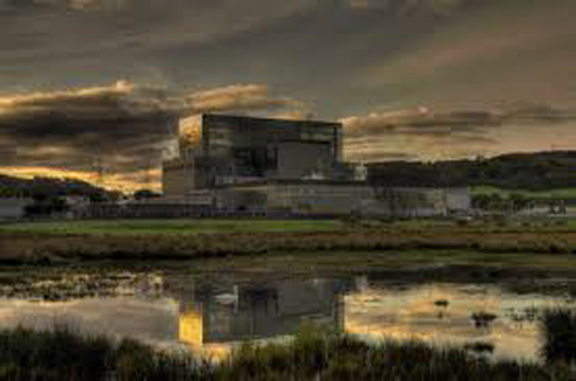
 The two reactors at Hunterston B nuclear power plant near Ardrossan are 43 years old – the oldest in Europe. They’re already well beyond their operating lifetimes, which have twice been extended by EDF Energy, and they’re scheduled to close down for good in 2023.
However, there’s a serious safety fault in the reactors. The fault is known as keyway root-cracking: where the graphite moderator cores in the reactors develop cracks leading to instabilities that could lead to a major nuclear accident: which would lead to a large swathe of Scotland’s central belt having to be evacuated.
The reactors have been closed since October 2018 as a result, but owners EDF Energy are currently making a case for turning them back on, with help from trade union GMB. Although the probability of a meltdown is still low, the consequences could be incredibly severe. In such an event, both Glasgow and Edinburgh would need to be entirely evacuated due to radioactive contamination. According to Dr Ian Fairlie, an independent consultant on radioactivity in the environment, and Dr David Toke, Reader in Energy Policy at the University of Aberdeen, the two reactors definitely should not be restarted.
Speaking about the cracks in the barrels, they say: “This is a serious matter because if an untoward incident were to occur – for example an earth tremor, gas excursion, steam surge, sudden outage, or sudden depressurisation, the barrels could
become dislodged and/or misaligned. “These events could in turn lead to large emissions of radioactive gases. Further, if hot spots were to occur and if nuclear fuel were to react with the graphite moderator they could lead to explosions inside the reactor core. “In the very worst case the hot graphite core could become exposed to air and ignite leading to radioactive contamination of large areas of central Scotland, including the metropolitan areas of Glasgow and Edinburgh.”
https://www.edinburghlive.co.uk/news/edinburgh-news/cracks-found-nuclear-reactor-could-15944122
March 10, 2019
Posted by Christina Macpherson |
safety, UK |
Leave a comment






 nuclear-news