In Cumbria, concern over nuclear waste canisters, and inadequacy of Radioactive Waste Management (RWM)

Current model for storing nuclear waste is  incomplete, https://cumbriatrust.wordpress.com/2020/01/30/current-model-for-storing-nuclear-waste-is-incomplete/ 30 Jan
  , New research carried out by Ohio State University has revealed significant problems with one of the key containment methods for high level nuclear waste to be used in the UK. It had previously been assumed that forming high level waste into glass or ceramics within a stainless steel canister would ensure that the waste would be isolated from its surroundings while it underwent radioactive decay. It now appears that the iron within stainless steel canister is reacting with the silicon, a fundamental constituent of glass. This leads to severe localised corrosion at a far higher rate than previously assumed. The full article can be found here.
Followers of Cumbria Trust will be aware that this is not the only example of a canister intended for the UK’s geological disposal programme which has failed to perform as expected. Another is the KBS-3 concept which used copper canisters, where some experiments have shown accelerated corrosion via a pitting process.
 During the previous search for a site to bury the UK’s nuclear waste, the Nuclear Decommissioning Authority (NDA) attempted to deny the existence of these problems. Recently, Radioactive Waste Management (RWM), a subsidiary of the NDA, has become more open in its admission of the difficulties they face. Cumbria Trust welcomes this approach, and has had a constructive dialogue with some senior RWM figures over recent years.
Our recent experience with RWM hasn’t been entirely positive though – they have failed to exclude designated areas (such as national parks and AONBs) in the latest search process, despite overwhelming public opposition to their inclusion, and have refused to discuss this with Cumbria Trust when asked. Cumbrians might ask themselves why RWM are taking this stance.
UK govt is treating Julian Assange inhumanely – amounting to torture
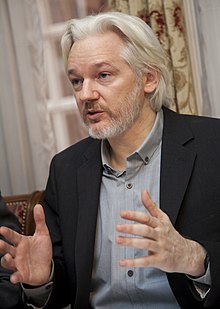 Julian Assange and the Inhumanity of the British State: ‘Unofficial’ Solitary Confinement as Torture 21st Century Wire, JANUARY 26, 2020 BY NINA CROSS
 Up until this week, Assange has been held in solitary confinement in Belmarsh prison. Incredibly, it was the other prisoners along with Assange’s legal team, who have pressured the government officials to respect the law and allow Assange to be removed from solitary confinement, resulting in his transfer to a general wing. This piece looks at how Assange was unofficially segregated in the prison’s healthcare unit, with no recourse to systems designed for prisoners in official solitary confinement regimes as applied under Prison Rule 45, leaving him out of reach of rules and law.
The sustained violation of the human rights of Wikileaks founder, Julian Assange, has been carried out in full view of the world throughout his arbitrary detention in HMP Belmarsh. Until now, condemnation of his treatment and pleas to end his suffering have been met with denial and silence by the British authorities.
But the announcement this week that Assange has been moved out of Belmarsh healthcare unit where he has been detained in solitary confinement since May, is a sign that the campaign to stop his persecution is gaining traction. Continue reading
Russian Space Agency confirms plans to launch nuclear-powered space tug by 2030
|
Russian Space Agency confirms plans to launch nuclear-powered space tug by 2030 Space Daily, by Staff Writers
Moscow (Sputnik) Jan 29, 2020 The secrecy-laden project, in development since 2010, is intended to facilitate the transportation of large cargoes in deep space, including for the purpose of creating permanent bases on other planets in our solar system.Roscosmos plans to deliver a nuclear-powered space tug into orbit by the year 2030, agency first deputy director Yuri Urlichich has confirmed. In a presentation at the ongoing Korolev Academic Space Conference in Moscow, Urlichich explained that the tug will be launched in 2030 for flight testing, with series production and commercial use to begin after that…….. http://www.spacedaily.com/reports/Russian_Space_Agency_confirms_plans_to_launch_nuclear_powered_space_tug_by_2030_999.html |
|
In UK “deep disposal” is planned for the mounting, costly and forever problem of nuclear wastes
 How To Solve Nuclear Energy’s Biggest Problem https://oilprice.com/Alternative-Energy/Nuclear-Power/How-To-Solve-Nuclear-Energys-Biggest-Problem.html By Haley Zaremba – Jan 22, 2020, Nuclear waste is a huge issue and it’s not going away any time soon–in fact, it’s not going away for millions of years. While most types of nuclear waste remain radioactive for mere tens of thousands of years, the half-life of Chlorine-36 is 300,000 years and neptunium-237 boasts a half-life of a whopping 2 million years.
All this radioactivity amounts to a huge amount of maintenance to ensure that our radioactive waste is being properly managed throughout its extraordinarily long shelf life and isn’t endangering anyone. And, it almost goes without saying, all this maintenance comes at a cost. In the United States, nuclear waste carries a particularly hefty cost.
Last year, in a hard-hitting expose on the nuclear industry’s toll on U.S. taxpayers, the Los Angeles Times reported that “almost 40 years after Congress decided the United States, and not private companies, would be responsible for storing radioactive waste, the cost of that effort has grown to $7.5 billion, and it’s about to get even pricier.”
How much pricier? A lot. “With no place of its own to keep the waste, the government now says it expects to pay $35.5 billion to private companies as more and more nuclear plants shut down, unable to compete with cheaper natural gas and renewable energy sources. Storing spent fuel at an operating plant with staff and technology on hand can cost $300,000 a year. The price for a closed facility: more than $8 million, according to the Nuclear Energy Institute.”
With the United States as a poster child of what not to do with your nuclear waste, the United Kingdom is taking a much different tack. The UK is currently undertaking what the country’s Radioactive Waste Management (RWM) department says “will be one of the UK’s largest ever environmental projects.” This nuclear waste storage solution comes in the form of a geological disposal facility (GDF), a waste disposal method that involves burying nuclear waste deep, deep underground in a cocoon of backfill, most commonly comprised of bentonite-based cement. This type of cement is able to absorb shocks and is ideal for containing radioactive particles in case of any failure. The GDF system would also be at such a depth that it would be under the water table, minimizing any risk of contaminating the groundwater.
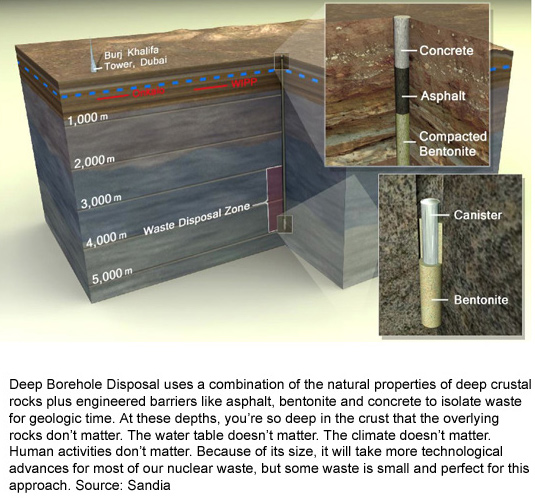
According to reporting from Engineering & Technology, nuclear waste is a mounting issue in Europe and in the UK in particular. “Under European law, all countries that create radioactive waste are obliged to find their own disposal solutions – shipping nuclear waste is not generally permitted except in some legacy agreements. However, when the first countries charged into nuclear energy generation (or nuclear weapons research), disposal of the radioactive waste was not a major consideration. For several of those countries, like the UK, that is now around 70 years ago, and the waste has been ‘stored’ rather than disposed of. It remains a problem.”
In fact, not only does it remain a problem, it is a mounting problem. As nuclear waste has been improperly or shortsightedly managed in the past, the current administration can no longer avoid dealing with the issue. In the past the UK used its Drigg Low-Level Waste Repository on the Cumbrian Coast to treat low and intermediate level waste, but now, thanks to coastal erosion, the facility will soon begin leeching radioactive materials into the sea, although that might not be quite as scary as it sounds.
Back in 2014, the Environment Agency raised concerns that coastal erosion could result in leakage from the site within 100 to 1,000 years, although it was counter-claimed that the levels of radioactivity after such a time would be low enough to be harmless,” Engineering & Technology writes. “This would definitely not be the case for high-level wastes, where radioactivity could remain a hazard into and beyond the next ice age, hence the need for longer-term disposal.”
Where exactly will that longer-term disposal be based? That’s up for debate. And it won’t be an easy thing to decide, as the RWM says that they will need a community to volunteer to be involved in such a costly, lengthy, and potentially unpopular project. And it’s not just an issue for the current inhabitants of potential locations in the UK, but for many generations to come over the next tens of thousands of years of radioactivity
Rolls Royce’s fantasy plan for so-called ‘mini’ nuclear reactors

|
Rolls-Royce plans mini nuclear reactors by 2029 https://www.bbc.com/news/business-51233444 By Roger Harrabin & Katie Prescott, BBC environment analyst and business reporter, 24 January 2020
Mini nuclear reactors could be generating power in the UK by the end of the decade. Manufacturer Rolls-Royce has told the BBC’s Today programme that it plans to install and operate factory-built power stations by 2029. Mini nuclear stations can be mass manufactured and delivered in chunks on the back of a lorry, which makes costs more predictable. But opponents say the UK should quit nuclear power altogether. They say the country should concentrate on cheaper renewable energy instead. Environmentalists are divided over nuclear power, with some maintaining it is dangerous and expensive, while others say that to achieve net zero emissions by 2050 all technologies are needed. However, the industry is confident that mini reactors can compete on price with low-cost renewables such as offshore wind. Rolls-Royce is leading a consortium to build small modular reactors (SMRs) and install them in former nuclear sites in Cumbria or in Wales. Ultimately, the company thinks it will build between 10 and 15 of the stations in the UK. They are about 1.5 acres in size – sitting in a 10-acre space. That is a 16th of the size of a major power station such as Hinkley Point. SMRs are so small that theoretically every town could have its own reactor – but using existing sites avoids the huge problem of how to secure them against terrorist attacks. It is a rare positive note from the nuclear industry, which has struggled as the cost of renewables has plummeted. In the past few years, major nuclear projects have been abandoned as Japanese companies Toshiba and Hitachi pulled out because they could not get the required funding. And the construction of Hinkley Point in Somerset could cost £3bn more than was expected, in an echo of the row over the rail mega-project HS2. “The trick is to have prefabricated parts where we use advanced digital welding methods and robotic assembly and then parts are shipped to site and bolted together,” said Paul Stein, the chief technology officer at Rolls-Royce.
He said the approach would dramatically reduce the cost of building nuclear power sites, which would lead to cheaper electricity. But Paul Dorfman from University College London said: “The potential cost benefits of assembly line module construction relative to custom-build on-site construction may prove overstated. “Production line mistakes may lead to generic defects that propagate throughout an entire fleet of reactors and are costly to fix,” he warned. “It’s far more economic to build one 1.2 GW unit than a dozen 100 MW units.” Rolls-Royce is hoping to overcome the cost barrier by selling SMRs abroad to achieve economies of scale. Its critics have warned that SMRs will not be ready in substantial numbers until the mid 2030s, by which time electricity needs to be carbon-free in the UK already to meet climate change targets. |
|

Sloppy safety and waste management at Electricite de France’s nuclear sites

 Improve Nuclear Plant Maintenance Works, Watchdog Says, Francois de Beaupuy, Bloomberg News (Bloomberg) 24 Jan 2020 — Electricite de France SA and its suppliers must improve maintenance operations at nuclear reactors and waste management because they have lost skills and become sloppy in recent years, the French nuclear safety authority said.
The warning reflects a string of incidents related to substandard manufacturing or installation of equipment at EDF and its suppliers. It underscores the difficulties the French nuclear giant faces in extending the lifetime of aging reactors and building new ones, prompting it to announce an action plan to revamp the industry’s skills.
“There’s a need to reinforce skills and some carelessness among some players in the industry,” Bernard Doroszczuk, chairman of Autorite de Surete Nucleaire, said at a press conference near Paris on Thursday. “There’s a lack of rigor in the oversight of safety by operators,” from manufacturing to welding to equipment tests “which must be corrected.”
Discussions are still going on with EDF regarding safety improvements, including ways to prevent or mitigate the impact outside its plants in case of a severe accident such as the meltdown of the radioactive fuel and its vessel, said Sylvie Cadet-Mercier, a commissioner of the regulator. A spokesman for the utility declined to comment…… https://www.bnnbloomberg.ca/edf-must-improve-nuclear-plant-maintenance-works-watchdog-says-1.1378571
In UK “big” nuclear power versus “small” (both unaffordable) at Wylfa
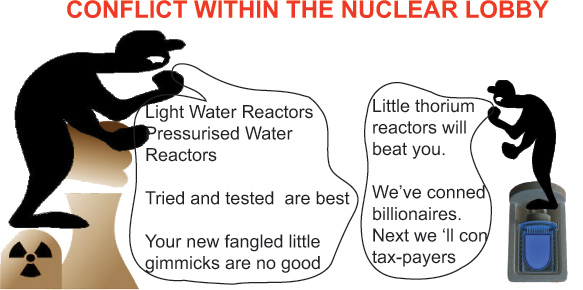
 The global nuclear lobby might look like a unified force – it’s anything but!. The nuclear nations fight each other in desperately trying to flog off their unaffordable white elephant nuclear reactors to ‘developing’ countries, or to any sucker, really. .
The nuclear industry itself is divided – the ‘conventional’ big nuclear reactors versus the (not yet existing) Small and Medium Nuclear Reactors (SMRs)
‘No plans’ for Wylfa mini nuclear power station according to developer, https://www.dailypost.co.uk/news/north-wales-news/no-plans-wylfa-mini-nuclear-17599188, Owen Hughes, Business correspondent, 20 JAN 2020
Horizon Nuclear Power said its full focus is on delivering a full scale nuke plant.
Wylfa Newydd developer Horizon Nuclear Power says there are “no plans” to build mini reactors at its Anglesey site.
Rolls Royce is currently leading a consortium developing the technology for Small Modular Reactors (SMRs) – supported by the UK Government. Trawsfynydd in Gwynedd has been tipped at a prime spot for one of the reactors and over the weekend Wylfa was also reported as a target location.
But Horizon has released a statement making clear the Wylfa site is not being put forward for this technology as they press on with the current plan for a full scale nuclear site.
A spokesman said: “There are no plans to deploy a Rolls Royce Small Modular Reactor at the Wylfa Newydd site.”
He added: “Activity on the Horizon project is currently suspended, but we’re working hard to establish the conditions for a restart using our tried and tested reactor design, which has already cleared the UK regulators’ assessment process.
Energy Secretary Andrea Leadsom wants additional information before deciding whether to give planning permission for Wylfa Newydd.
She deferred the decision on the site in October.
If permission is granted then the next step will be securing funding to make the project happen.
When it comes to SMRs, Alan Woods, strategy and business development director for Rolls-Royce, said they were focusing on sites in Wales and the north of England. Modular reactors are smaller and, once the first is approved and built, manufacturers hope mass-production will lead to shorter construction times and lower costs for each unit.
The consortium will need to establish factories to produce the small modular reactors with the pre-fabricated modules transported to sites for construction.
Wildfires – drastic climate effects in Australia, but Europe is copping it, too

Wildfires show us how the climate emergency is already affecting Europe, Guardian, Imogen West-Knights We look at the devastation of Australia’s bushfires and don’t believe it could happen here. But it already is, 22 Jan 2020 “……… what we’re seeing in Australia. Since the fire season began there, in the middle of last year, 29 people have died, along with more than a billion animals, and an area comparable in size to the whole of England has been ablaze. It’s a vicious reminder that, for all the sophistication of the modern world, something as primitive as fire can still bring us to our knees. As shocking as the scale of the destruction has been, though, it’s easy to see it on our computer screens here on the other side of the world, in the middle of a British winter, and feel disconnected from it. We accept that the climate emergency is now truly upon us yet still feel that it’s mostly happening to other people, elsewhere.wildfires are increasingly a problem for everyone, including in the UK. Last August, there were almost five times as many of them around the world as there had been the previous August. In the EU, the number of wildfires in the first half of 2019 was three times the annual average for the previous decade. And while they used to be a serious problem only in hotter, southern European countries such as Portugal and Spain, now northern Europe is in trouble too.
The Swedish fires of 2018 were by far the most severe in the country’s history, burning an area almost twice as large as the worst previous wildfire, in 2014. In the UK, 2018 and 2019 were the worst two years on record for wildfires, particularly on moors in the north-west of England and parts of Scotland. One fire last year, at Marsden Moor in Yorkshire, destroyed almost three square miles of land. The damage is on a very different scale to the almost 30,000 square miles that have burned in Australia, of course, but this is still a development we can’t afford to ignore.
Aside from all the more immediate effects – the threat to humans, livestock and wildlife – the recent increase in wildfires has been linked to severe air quality problems. People living up to 62 miles (100km) downwind of fires in the Pennines in 2018 were exposed to toxic fumes. And as there is no sign of cooler weather in the years ahead, it is reasonable to expect more fires in 2020. The EU has now established a fleet of firefighting planes, and the European Forest Institute has warned that unless we take steps to protect the countryside – for instance, by planting less-flammable species and creating barriers to the spread of flames – emergency services won’t be able to prevent the rapid spread and firestorms that have characterised the Australian crisis.
This isn’t all because of the climate crisis – changes to land use and increased urbanisation over several decades are also factors. Weather patterns are noisy data, and it’s difficult to attribute any single wildfire to the climate crisis. The scientific consensus, however, is that it is increasing the intensity and frequency of fire-conducive weather across the world.
Even those fires that are eventually linked to human error, like a still-lit disposable barbecue, are increasingly likely due to warming temperatures. Hotter summers mean more barbecues lit in the first place. The climate crisis is going to change the way we behave in every aspect of our lives. And with the probability of another summer of extreme weather coming, we will need to adapt to new dangers that won’t just be on the other side of the planet but, quite literally, in our own backyards.
It’s not at all clear that we’re ready for what might be coming. There is still a cognitive jump yet to be made when those of us in Europe read about the fires in Australia, from mourning the destruction there to recognising that we face some version of the same threat. When we look at Australia, we’re not looking at the future that might await Europe. That future is already here.
• Imogen West-Knights is a writer and freelance journalist
Swedish Parliament Rejects Proposal to Halt Nuclear Shutdown
Swedish Parliament Rejects Proposal to Halt Nuclear Shutdown, Bloomberg, By Niclas Rolander, January 23, 2020,
A majority in the Swedish parliament rejected a proposal from the nationalist Sweden Democrats to stop Vattenfall AB’s plans to close two nuclear reactors, in a victory for the Social Democrat-led government.
The Sweden Democrats had support from three parties but failed to secure a majority. Its proposal to give the state-owned utility instructions to reverse its plans to wind down the Ringhals 1 reactor and to restart another reactor that was shuttered Dec. 30 lost by a single vote on Wednesday afternoon.
Vattenfall has repeatedly said it isn’t economically viable to keep running the two reactors, which were commissioned in 1975 and 1976, respectively. The company also operates two newer reactors at the plant, which produces a sixth of Sweden’s electricity, and is owned jointly with Germany’s Uniper SE, which holds a 29.6% stake through a subsidiary. ……. https://www.bloomberg.com/news/articles/2020-01-22/swedish-parliament-rejects-proposal-to-halt-nuclear-shutdown
Romania quits deal with China for new nuclear reactors
|
Romania to exit deal with Chinese company for new nuclear reactors https://www.romania-insider.com/ro-exit-deal-cgn-nuclear-jan-2020 Romania’s Government will exit the deal with the Chinese partner for the construction of reactors 3 and 4 at the Cernavoda nuclear power plant, prime minister Ludovic Orban announced in an interview with Hotnews.ro.“It is clear to me that the partnership with the Chinese company is not going to work,” Orban said, adding that the Government has already started to look for a new partner and financing for this project.
In 2015, Romanian state-owned electricity producer Nuclearelectrica, the company that operates the Cernavoda nuclear power plant, signed a memorandum of understanding with China General Nuclear Power Corporation (CGN) for the construction of two new reactors (3 and 4). On May 8 last year, the two sides officially signed the preliminary agreement on the construction and operation of two new reactors. However, the cooperation between Nuclearelectrica and CGN became uncertain after Romania’s president Klaus Iohannis and U.S. president Donald Trump signed a joint declaration in Washington, on August 21, that mentioned, among others, a closer cooperation between U.S. and Romania in the field of nuclear energy. In September, former PM Viorica Dancila also signed a memorandum in this regard with U.S. Energy Secretary Rick Perry. Moreover, China General Nuclear Power Corporation was accused of nuclear espionage by the U.S. Government back in 2016. |
|
Unsafety of Russia’s November-class submarines
Sailing These Russian Nuclear Submarines Was Basically A Suicide Mission, Safety was sacrificed for the sake of performance. National Interest, by Sebastien Roblin, 22 Jan 2020
Key Point: The November-class submarined expanded Soviet influence, but at a cost.
The United States launched the first nuclear-powered submarine, the USS Nautilus, in 1954, revolutionizing undersea warfare. The Nautilus’s reactor allowed it operate underwater for months at a time, compared to the hours or days afforded conventional submarines. The following year, the Soviet Union began building its own nuclear submarine, the Project 627—known as the November class by NATO. The result was a boat with a few advantages compared to its American competition, but that also exhibited a disturbing tendency to catastrophic accidents that would prove characteristic of the burgeoning Soviet submarine fleet during the Cold War………
the power of the November class’s reactors was bought at the price of safety and reliability. A lack of radiation shielding resulted in frequent crew illness, and many of the boat suffered multiple reactor malfunctions over their lifetimes. This lack of reliability may explain why the Soviet Union dispatched conventional Foxtrot submarines instead of the November-class vessels during the Cuban Missile Crisis, despite the fact that the diesel boats needed to surface every few days, and for this reason were cornered and chased away by patrolling American ships.
In fact, the frequent, catastrophic disasters onboard the Project 627 boats seem almost like gruesome public service announcements for everything that could conceivably go wrong with nuclear submarines. Many of the accidents reflected not only technological flaws, but the weak safety culture of the Soviet Navy………..
This is just an accounting of major accidents on the November-class boats—more occurred on Echo- and Hotel-class submarines equipped with the same nuclear reactors. Submarine operations are, of course, inherently risky; the U.S. Navy also lost two submarines during the 1960s, though it hasn’t lost any since.
The November-class submarines may not have been particularly silent hunters, but they nonetheless marked a breakthrough in providing the Soviet submarine fleet global reach while operating submerged. They also provided painful lessons, paid in human lives lost or irreparably injured, in the risks inherent to exploiting nuclear power, and in the high price to be paid for technical errors and lax safety procedures. https://nationalinterest.org/blog/buzz/sailing-these-russian-nuclear-submarines-was-basically-suicide-mission-115661
UK’s nuclear region, Cumbria, has unusually high rates of certain cancers
 NW Evening Mail 16th Jan 2020, A WORRYING new report has found that Cumbria has the highest incidence rates of certain kinds of cancer in the North West. According to data collated by charity North West Cancer Research, the county ranks 11 per cent higher on key cancers than the national average. As part of the study, analysts assessed the impact of 25 key cancers across the North West and 37 cancers across Wales.
Nuclear’s swansong?
 Is This The Death Knell For Nuclear? https://finance.yahoo.com/news/death-knell-nuclear-200000585.html By Haley Zaremba – Jan 18, 2020 It’s nearly impossible to discuss climate change and the future of the energy industry without discussing nuclear energy. Nuclear energy produces zero carbon emissions, [ ed. not so!] it’s ultra-efficient, it’s already in widespread use, and could be scaled up to meet much more of our global energy needs with relative ease, but it is, and will likely always be, an extremely divisive solution.nuclear energy certainly has its fair share of drawbacks. It may not emit greenhouse gases, but what it does produce is deadly nuclear waste that remains radioactive for up to millions of years and we still don’t really know what to do with it other than hold onto it in ever-growing storage spaces. And then there are the horror stories that keep civilians and politicians alike wary if not outright antagonistic toward the technology. Chernobyl, Fukushima, and Three Mile Island loom large in our collective doomsday consciousness, and not without good reason.
We’re still dealing with the aftermath of these nuclear disasters. Japan is in many ways still reeling from 2011’s Fukushima nuclear disaster and recently even threatened to throw radioactive water into the Pacific Ocean or letting it evaporate into the air because they are running out of storage space for the wastewater they have been using to keep the damaged Fukushima reactors from overheating again. So yeah, nuclear isn’t perfect.
As paraphrased by environmental news site EcoWatch, the energy experts at Chatham House “agreed that despite continued enthusiasm from the industry, and from some politicians, the number of nuclear power stations under construction worldwide would not be enough to replace those closing down.” The consensus was that this is nuclear’s swan song, and we are now unequivocally entering the era of wind and solar power.
These conclusions were arrived at during a summit convened to discuss the findings of the World Nuclear Industry Status Report 2019, which concluded that “money spent on building and running nuclear power stations was diverting cash away from much better ways of tackling climate change.”
This echoes the sentiment of many other climate and energy experts, who have long been sounding the alarm bells that renewable energy is not being built up or invested in with nearly enough urgency. Last year the International Energy Agency announced that renewables growth has slumped, and that our current renewable growth rate of 18o GW of added renewable capacity per year is “only around 60 percent of the net additions needed each year to meet long-term climate goals”.
The International Renewable Energy Agency (Irena) did the math, calculating exactly how much renewable energy will need to be installed by 2030 if the world has any hope of meeting the goals set by the Paris climate agreement, and they found that “7.7TW of operational renewable capacity will be needed by 2030 if the world is to limit global warming to ‘well below’ 2C above pre-industrial levels, in line with the Paris Climate Agreement,” according to reporting by Wind Power Monthly. “However, at present, countries’ nationally determined contributions (NDCs) amount to 3.2TW of renewable installations by 2030, up from 2.3TW currently deployed.”
The World Nuclear Industry Status Report succinctly sums up the situation while sounding the death knell for nuclear: “Stabilising the climate is urgent, nuclear power is slow. It meets no technical or operational need that these low-carbon competitors cannot meet better, cheaper, and faster.”
Belgium lawmakers narrowly agree to keep U.S. nuclear weapons, Belgian public overwhelmingly opposes this
Belgium debates phase-out of US nuclear weapons on its soil, By Alexandra Brzozowski | EURACTIV.com Jan 17, 2020 It’s one of Belgium’s worst kept secrets. Lawmakers on Thursday (16 January) narrowly rejected a resolution asking for the removal of US nuclear weapons stationed in the country and joining the UN Treaty on the Prohibition of Nuclear Weapons (TPNW).
66 MPs voted in favour of the resolution while 74 rejected it.
Those in favour included the Socialists, Greens, centrists (cdH), the workers party (PVDA) and the francophone party DéFI. The 74 that voted against included the nationalist Flemish party N-VA, the Flemish Christian Democrats (CD&V), the far-right Vlaams Belang and both Flemish and francophone Liberals.
Just before the Christmas recess, the parliament’s Foreign Affairs Committee approved a motion calling for the withdrawal of nuclear weapons from Belgian territory and the accession of Belgium to the International Treaty on the Prohibition of Nuclear Weapons. The resolution was led by Flemish socialist John Crombez (sp.a).
With this resolution, the chamber requested the Belgian government “to draw up, as soon as possible, a roadmap aiming at the withdrawal of nuclear weapons on Belgian territory”.
The December resolution was voted in the absence of two liberal MPs, even though the text was already watered down.
According to Flemish daily De Morgen, the American ambassador to Belgium was “particularly worried” about the resolution before Thursday’s vote and a number of MPs were approached by the US embassy for a discussion.
The controversy was sparked by a debate to replace the US-made F-16 fighter aircraft in the Belgian army with American F-35s, a more advanced plane capable of carrying nuclear weapons…….
Although the Belgian government had so far adopted a policy of “to neither confirm, nor deny” their presence on Belgian soil, military officials have called it one of Belgium’s “most poorly kept secrets”.
According to De Morgen, which obtained a leaked copy of the document before its final paragraph was replaced, the report stated:
“In the context of NATO, the United States is deploying around 150 nuclear weapons in Europe, in particular B61 free-bombs, which can be deployed by both US and Allied planes. These bombs are stored in six American and European bases: Kleine Brogel in Belgium, Büchel in Germany, Aviano and Ghedi-Torre in Italy, Volkel in the Netherlands and Inçirlik in Turkey……..
Belgium, as a NATO country, so far has not supported the 2017 UN Treaty on the Prohibition of Nuclear Weapons (TPNW), the first legally binding international agreement to comprehensively prohibit nuclear weapons, with the goal of leading towards their total elimination.
However, the resolution voted on Thursday was meant to change that. A public opinion poll conducted by YouGov in April 2019 found that 64% of Belgians believe that their government should sign the treaty, with only 17% opposed to signing. https://www.euractiv.com/section/defence-and-security/news/belgium-debates-phase-out-of-us-nuclear-weapons-on-its-soil/
Anxiety in Belarus and Lithuania, over new Chernobyl-style nuclear power station
|
They may not tell you the whole truth’: Fears of another Chernobyl as Russian-built atomic power station set to open in Belarus, Independent, 20 Jan 2020 Three decades after world’s worst nuclear disaster, the country most affected by the fall out is set to open its first nuclear plant. But as Oliver Carroll finds out, not everyone is pleased It was when the tree fellers arrived in early 2009 with their bulldozers that Nikolai Ulasevich, a local activist, knew the game was up. There might not have been a published order to build an atomic power station in the fields overlooking his homestead in the village of Vornyany – but a decision had clearly been made. In authoritarian Belarus those decisions rarely have a reverse gear. In the years that followed, Ulasevich watched as the gigantic cooling towers and system blocks of Belarus’s first nuclear power station took shape. Construction, which was led by the Russian state nuclear agency Rosatom, would be far from straightforward. A string of incidents delayed its opening, but the first reactor is finally due to go online early 2020. To say the construction of the Belarusian nuclear plant has been controversial would be to trivialise the history of these lands. Chernobyl lies only seven miles from Belarus’s southern border, and the nuclear accident, still the world’s worst, has left the deepest of scars locally. The direction of the wind in spring 1986 – and the Soviet authorities’ decision to avoid major harm in Moscow – meant Belarus suffered more than any other region in the union. At the moment that the radioactive clouds moved towards the capital, air force pilots were ordered to chase down the toxic clouds and seed them with jets of silver iodide. Much of the southernmost region of Homel remains seriously contaminated, with elevated oncology levels as a result. Any local over 50 can recall what they were doing on those dry, spring-summer days. They talk about the tiredness; the strange, dryness of the mouth; the rumours that it might be a good idea to take iodine, but the lack of reliable information. They will also tell you about a cloud of secrecy almost as harmful as the black cumulus masses that had their radioactive bowels emptied over southern Belarus. …….. “The thought of what happened back in 1986 can’t fail to make you anxious about what may happen. You know they may not tell you the whole truth.” Lithuania, the European nation that borders Belarus just 10 miles west of Astravets, is bitterly opposed to the nuclear plant. It says it has not been properly consulted and claims the plant breaches post-Fukushima distance guidelines – in particular, a recommendation that nuclear power stations should not be built closer than 100km of major conurbations. The new nuclear plant lies just 30 miles east of the Lithuanian capital, Vilnius. The Lithuanians say they are preparing for any eventuality: from stockpiling iodine tablets to opening up nuclear bunkers and issuing survival notes to their citizens. In October, authorities ran a major preparedness operation, imitating a disaster response to a nuclear meltdown. The drills were knowingly hyperbolic. But several reported incidents do give pause for thought. From what we know, the reactor vessel in Belarus has already been involved in at least two accidents. The first was in July 2016, when it was apparently dropped from a crane during installation. Belarusian authorities took weeks to admit a “minor” incident. Five months later, a replacement reactor vessel collided with a railway pylon while being transported. At least five workers have died in construction accidents. There was at least one fire incident in the control room. The outside world would likely have stayed little the wiser were it not for the opposition activist Ulasevich monitoring from his modest home, which he shares with his wife, a few chickens and sheep, three miles away from the new power station. He said he found out about the dropped reactor vessel in conversation with a local construction worker. “He swore that he saw it break free of ropes at a height of two or three metres,” he says. ……. Yury Voronezhtsev, the man who led the official Soviet official response to Chernobyl, says he could not believe any statement that the plant was “safe”. “I don’t believe that our Belarusian construction workers are any better than the Soviet ones,” he tells The Independent. “We have the same people, and the same systems………. https://www.independent.co.uk/news/world/europe/chernobyl-belarus-nuclear-power-station-atomic-vornyany-rosatom-ostrovets-astravets-a9271811.html
|
|
1 This Month
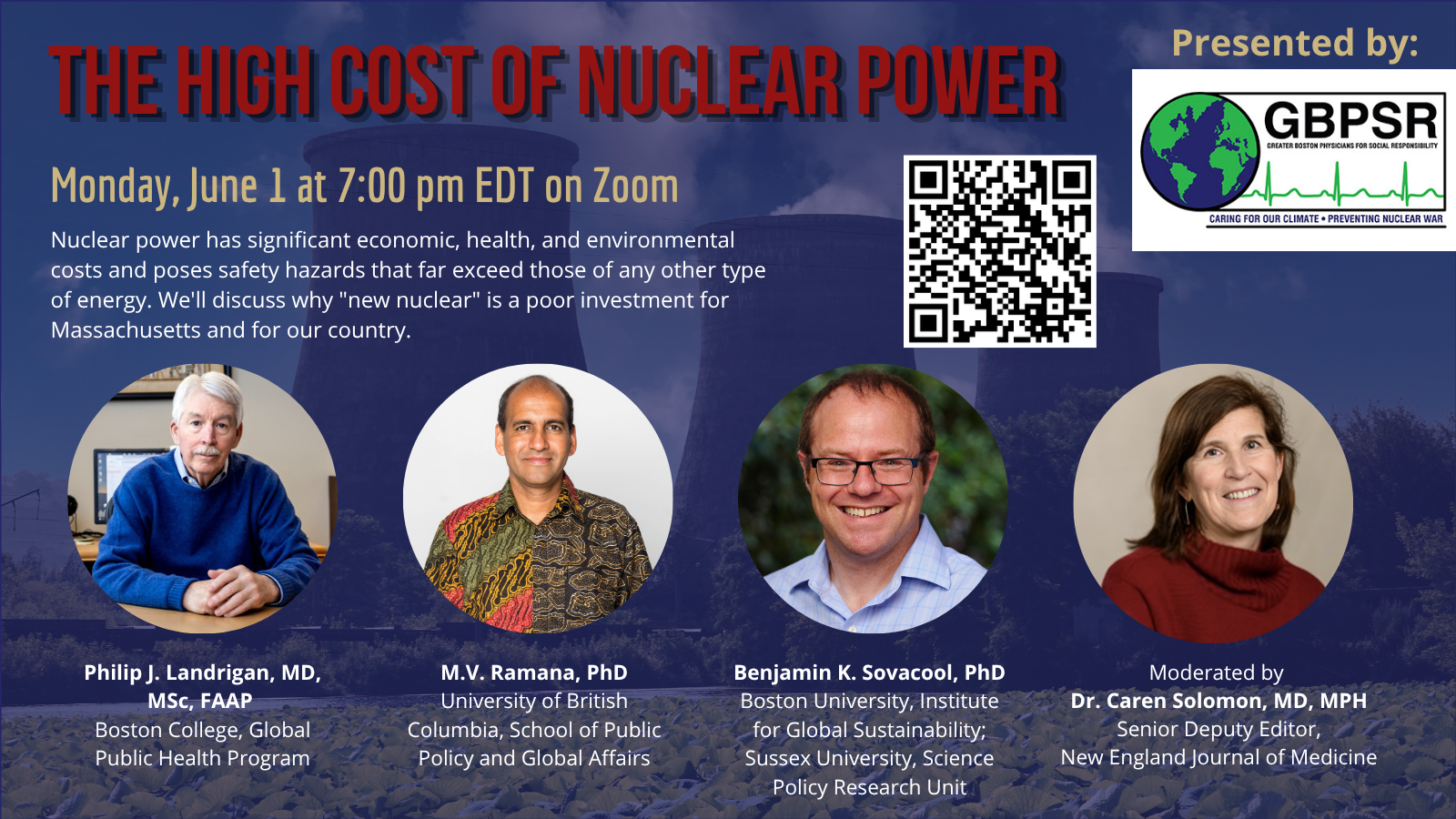
1 June Webinar – The High Cost of Nuclear Power – Register


of the week– Nuclear Reactor Information Task Force
To see nuclear-related stories in greater depth and intensity – go to https://nuclearinformation.wordpress.com
-
Archives
- May 2026 (235)
- April 2026 (356)
- March 2026 (251)
- February 2026 (268)
- January 2026 (308)
- December 2025 (358)
- November 2025 (359)
- October 2025 (376)
- September 2025 (257)
- August 2025 (319)
- July 2025 (230)
- June 2025 (348)
-
Categories
- 1
- 1 NUCLEAR ISSUES
- business and costs
- climate change
- culture and arts
- ENERGY
- environment
- health
- history
- indigenous issues
- Legal
- marketing of nuclear
- media
- opposition to nuclear
- PERSONAL STORIES
- politics
- politics international
- Religion and ethics
- safety
- secrets,lies and civil liberties
- spinbuster
- technology
- Uranium
- wastes
- weapons and war
- Women
- 2 WORLD
- ACTION
- AFRICA
- Atrocities
- AUSTRALIA
- Christina's notes
- Christina's themes
- culture and arts
- Events
- Fuk 2022
- Fuk 2023
- Fukushima 2017
- Fukushima 2018
- fukushima 2019
- Fukushima 2020
- Fukushima 2021
- general
- global warming
- Humour (God we need it)
- Nuclear
- RARE EARTHS
- Reference
- resources – print
- Resources -audiovicual
- Weekly Newsletter
- World
- World Nuclear
- YouTube
-
RSS
Entries RSS
Comments RSS
 nuclear-news