The search for the 4th hydrogen bomb dropped over Palomares, Spain
|
Who Do You Call When Nuclear Weapons Go Missing? Mathematicians. Here’s What You Need To Remember: With no witnesses, no debris and a search area in the least understood part of the world’s ocean, there’s little even mathematical wizards can do. But even then, few thought 50 years ago that the lost bomb of Palomares would ever turn up. National Interest, 10 May 20
When a routine Cold War operation went terribly wrong, two planes and seven men died, a village got contaminated and a hydrogen bomb disappeared.
The search and cleanup required 1,400 American and Spanish personnel, a dozen aircraft, 27 U.S. Navy ships and five submarines. It cost more than $120 million and a lot of diplomatic capital. And it made an obscure 18th-century mathematical theorem a practical solution to finding veritable needles in haystacks. Around 10 a.m. on Jan. 17, 1966, two B-52Gs of the 31st Bomb Squadron based out of North Carolina approached two KC-135 tankers over the Spanish coast southwest of Cartagena.
The bombers each carried four 1.5-megaton B-28 hydrogen bombs as part of Operation Chrome Dome, a U.S. deterrence mission that placed nuclear-armed bombers on the Soviet Union’s doorsteps. The resulting breakup destroyed the tanker in a fireball of blazing jet fuel. All four crew on board the tanker died. One hundred tons of flaming wreckage fell upon the arid hamlet of Palomares, near the Mediterranean Sea.
Three of the four H-bombs aboard the bomber fell there, too. Within 24 hours, a U.S. Air Force disaster team arrived from Torrejon Air Base near Madrid. Specialists from the Los Alamos and Sandia weapons labs — and Air Force logistics units — descended on the tiny rural town.
The search teams found the three H-bombs within a day. One landed on a soft slope, its casing relatively intact. The high explosives within the other two bombs detonated on impact, blowing 100-foot-wide craters in the dry soil and scattering plutonium, uranium and tritium across the landscape. The region’s long history of human habitation complicated the land search. Almeria, the province where Palomares sits, hosted a mining industry for more than 5,000 years. Countless mine shafts, diggings and depressions pepper its dry landscape made famous by the spaghetti westerns filmed there. ,,,,,,, https://nationalinterest.org/blog/buzz/who-do-you-call-when-nuclear-weapons-go-missing-152441
|
|
France’s Strategic Nuclear Forces
|
Is France’s Nuclear Shield Big Enough to Cover All of Europe? Modern Diplomacy
Alexander Yermakov 10 May 20, At the end of the third year of his presidency, Emmanuel Macron delivered his long-awaited policy speech on the country’s defence and deterrence strategy. The long-awaited indeed: many have been expecting France to step up its nuclear role in recent years, including heading up the establishment of the EU Nuclear Forcete. Did the President deliver on these expectations? Yes and no. From the get-go, Macron has been keen to play up the historical significance of his February 7 speech. The eighth president of the Fifth Republic noted that the last head of state to visit the École de Guerre in Paris was Charles de Gaulle himself, who delivered his famous speech on the creation of the Force de frappe, or the French Strategic Nuclear Forces (SNF), here on November 3, 1959.
The previous resident of the Élysée Palace, François Hollande, delivered his address on the nuclear deterrence at the Istres-Le Tubé Air Base on February 19, 2015, where one of the French Air Force’s two nuclear squadrons was stationed at the time. Macron’s predecessor gave a speech that was rather typical of the French nuclear policy, reminding his fellow countrymen that the world is still full of threats and that, despite the commitment to nuclear disarmament (someday, like other powers), it was vital to “keep the powder dry.” The President reiterated the promise to not use nuclear weapons against those countries that had signed and honoured the Nuclear Non-Proliferation Treaty (NPT). According to Hollande, the French Strategic Nuclear Forces contribute to the pan-European security, yet remain ‘sovereign:’ Paris will neither, as a matter of principle, be part of the NATO Nuclear Planning Group nor will it participate in the NATO’s Nuclear Sharing [1]. Notwithstanding European solidarity and the special nuclear cooperation that France enjoys with the United Kingdom, Hollande stressed that, “our [France’s] deterrence is our own; it is we who decide, we who evaluate our vital interests.”……. Thermonuclear Assets What does France have to offer to Europe? According to conservative estimates, the third largest nuclear arsenal in the world after that of Russia and the U.S., no less, with almost 300 warheads (the actual number is not known:….. The French Strategic Nuclear Forces currently consist of two components: an airborne and a seaborne. …… much of France’s nuclear potential is concentrated on a hidden yet permanently combat-ready component of its Strategic Nuclear Forces, namely its fleet of Triomphant-class nuclear-powered missile submarines…… Of course, Macron did not utter these exact words, but he did make an extremely important message that most commentators have missed: “France’s vital interests now have a European dimension.” This is not a throw-away sentence, because according to France’s military doctrine, a perceived threat to the country’s “vital interests” is an enough reason to resort to the nuclear force [10]. Macron could not have made a more explicit offer to extend his country’s nuclear umbrella to cover the rest of the European Union as he suggested opening a strategic dialogue on this issue.,,,,,,,, https://moderndiplomacy.eu/2020/05/10/is-frances-nuclear-shield-big-enough-to-cover-all-of-europe/ |
|
Delay in preparations for Wylfa nuclear plant
North Wales Chronicle 7th May 2020, The firm behind a planned multi-billion-pound nuclear plant has asked for more time to carry out significant improvements to a 16 kilometre stretch
of road linking the development with the A55. In July 2018 Anglesey
Council’s planning committee approved the plans which include widening
and putting down a new surface on the A5025 between Valley and
Llanynghenedl, Llanfachraeth and Llanrhuddlad, and Cefn Coch to the
proposed Wylfa Newydd power plant site. But with the project officially on
hold and a UK Government decision on a Development Consent Order (DCO) not
expected until at least September, developers have now asked to extend the
condition ruling that work would have to start within two years.
A potential US extradition of Assange poses existential threats to democracy.
In his fight against extradition to the US, where he faces 175 years in prison and being subjected to harsh conditions under “Special Administrative Measures”, Assange is rendered defenseless. He is in effective solitary confinement, being psychologically tortured inside London’s maximum-security prison. With the British government’s refusal to release him temporarily into home detention, despite his deteriorating health and weak lung condition developed as consequences of long detention, Assange is now put at risk of contracting coronavirus. This threatens his life.
Now, as the world stands still and becomes silent in our collective self-quarantine, Assange’s words spoken years ago in defense of a free internet call for our attention from behind the walls of Belmarsh prison:
“Nuclear war, climate change or global pandemics are existential threats that we can work through with discussion and thought. Discourse is humanity’s immune system for existential threats. Diseases that infect the immune system are usually fatal. In this case, at a planetary scale.”
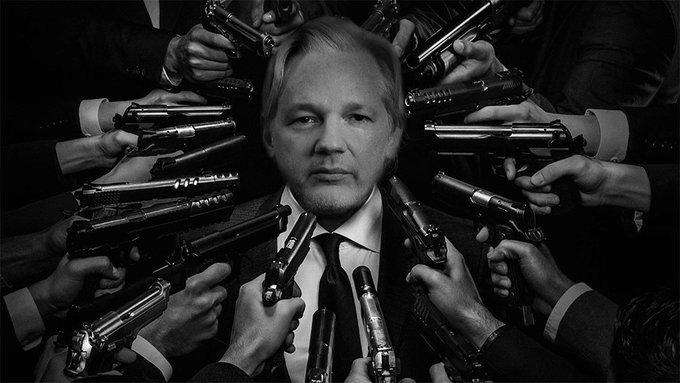
Assange’s US extradition, Threat to Future of Internet and Democracy, CounterPunch by NOZOMI HAYASE 8 May 20 On Monday May 4, the British Court decided that the extradition hearing for WikiLeaks publisher Julian Assange, scheduled for May 18, would be moved to September. This four month delay was made after Assange’s defense lawyer argued the difficulty of his receiving a fair hearing due to restrictions posed by the Covid-19 lockdown. Monday’s hearing at Westminster Magistrates’ Court proceeded without enabling the phone link for press and observers waiting on the line, and without Assange who was not well enough to appear via videolink.
Sunday May 3rd marked World Press Freedom Day. As people around the globe celebrated with online debates and workshops, Assange was being held on remand in London’s Belmarsh prison for publishing classified documents which exposed US war crimes in Iraq and Afghanistan. On this day, annually observed by the United Nations to remind the governments of the importance of free press, Amnesty International renewed its call for the US to drop the charges against this imprisoned journalist.
The US case to extradite Assange is one of the most important press freedom cases of this century. The indictment against him under the Espionage Act is an unprecedented attack on journalism. This is a war on free speech that has escalated in recent years turning the Internet into a battleground.
Privatized censorship Continue reading
Bosnia aims to stop Croatia’splan for radioactive waste dump close to the border
|
Croatia and Bosnia at loggerheads over nuclear waste plan, Emerging Europe, May 7, 2020, Nikola Đorđević
Tensions are flaring between Bosnia and Herzegovina and Croatia over the latter’s controversial plan to store nuclear waste at Čerkezovac, a former military installation on the border between the two countries.
The location has been selected by the Croatian government as its designated site for the storage of its share of waste produced by the Krško nuclear power plant in Slovenia. Environmentalists have warned that the site could have serious consequences for the health of both the people in the area and the ecosystem. Last summer a number of protests against the plans to dump waste at Čerkezovac were held just over the border, in the town of Novi Grad, in Bosnia and Herzegovina’s Republika Srpska. Since then, the Croatian parliament has reconfirmed that the military installation in the Trgovska Gora mountains remains its preferred choice as the site of the nuclear waste disposal programme. Čerkezovac will be given over to Fond NEK, the entity responsible for decommissioning the Krško plant and the disposal of radioactive waste and spent nuclear fuel. Krško, opened in 1983, was set to be decommissioned in 2023, although Slovenia and Croatia have agreed to extend operation at the plant to 2043. Before the waste site can be built, an environmental study must be carried out: this has yet to happen. “We are talking about storing nuclear waste in a complex that is located 800 metres from the river Una,” says Mario Crnković, a member of the Green Team NGO which was involved in last year’s protests. “In Novi Grad alone, 15,000 people consume water from the river. It is also a national park, home to 325 species of animal, of which 92 are protected.” Green Team is not the only organisation that has raised concerns. Others have claimed that if the waste disposal plan proceeds, some 250,000 people could be in danger. Bosnian officials have also raised concerns publicly. Some have pointed out that Croatia intends to build the site in an area with a predominately ethnic Serb population. “The eventual building of the nuclear waste disposal site on Trgovska Gora is completely unacceptable because it would endanger the health of 250,000 people in 13 municipalities near the river Una, and have a negative effect on the environment,” says Staša Košarac, Bosnia and Herzegovina’s minister of foreign trade and economic relations……. Despite all the opposition, Croatia remains steadfast in its determination to go ahead with the plan. NGOs like Green Team have called on the Bosnian government to raise the issue at international level. “We expect Bosnia and Herzegovina as a state to act responsibly to stop this. We also expect experts from the non-governmental sector to be included in the process,” Mr Crnković concludes. https://emerging-europe.com/news/croatia-and-bosnia-at-loggerheads-over-nuclear-waste-plan/ |
|
Lithuania presses Belarus to delay use of nuclear fuel, for safety reasons
|
Lithuania urges Belarus not to use nuclear fuel delivered to new power plant https://bnn-news.com/lithuania-urges-belarus-not-to-use-nuclear-fuel-delivered-to-new-power-plant-213078 After Belarus announced that nuclear fuel has been delivered to its new Astravyets nuclear power plant, Lithuania has called on Minsk not to load it into power productions facilities before international safety recommendations have been met, according to the Lithuanian Foreign Ministry.
On Wednesday, May 6, the issue was discussed in a telephone conversation between Minister of Foreign Affairs of Lithuania Linas Linkevičius and Minister of Foreign Affairs of Belarus Vladimir Makei.
Therefore, we urge Belarus not to load nuclear fuel into its nuclear power station until full implementation of the recommendations by international experts. We agreed to consult regularly on all these issues,» told L. Linkevičius as quoted by the Lithuanian Foreign Ministry. Lithuania’s Ministry of Foreign Affairs also sent a diplomatic note to Belarus, requesting the neighbouring state to give priority to safety rather than to the construction schedule, and to avoid jeopardizing its own residents, as well as citizens in other countries. A positive step in this direction, as is expected by Lithuania and the European Union, would be to halt the launch of the Belarusian NPP and to immediately organize an official EU expert review of the implementation of the stress test recommendations under the National Action Plan, as well as to promptly welcome a group of international experts that would monitor the process, the Lithuanian Foreign Ministry wrote in the press release. |
|
The pandemic is a direct threat to Russia’s secret nuclear cities – says Rosatom chief
 Rosatom fears for its nuclear cities amid coronavirus pandemic, The head of
 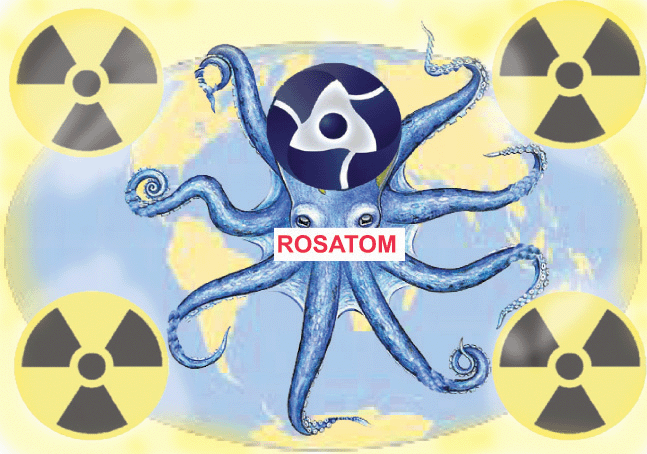 Russia’s state nuclear corporation has expressed concerns about the spread of the novel coronavirus to three of its so-called “nuclear cities,” including one that houses a top-secret research institute that helped develop the Soviet nuclear bomb. May 5, 2020 by Charles Digges charles@bellona.noThe head of Russia’s state nuclear corporation has expressed concerns about the spread of the novel coronavirus to three of its so-called “nuclear cities,” including one that houses a top-secret research institute that helped develop the Soviet nuclear bomb.
The cities hold a fabled place in Russia’s nuclear industry, which is managed by the state-controled Rosatom corporation. Most of them are closed to foreigners and even most Russians require special permission to enter them because of the top-secret facilities that many of them house.
In his most recent video appearance, Rosatom chief Alexei Likhachev said a special delivery of ventilators and personal protective equipment for medical workers has been sent to the city of Sarov and other closed towns where dozens of cases have been reported.
“This (pandemic) creates a direct threat to our nuclear towns,” Likhachev said in the video address on the Rosatom website – a communication method he has embraced since the beginning of the pandemic. “The situation in Sarov, Elektrostal, Desnogorsk is today particularly alarming.”
His remarks come as Russia reports a total of 155,370 cases of coronavirus infection and 1,451 deaths, making Russian the seventh most infected country, having surpassed China, Turkey and Iran last week.
The spread of the coronavirus has posed special challenges to the worldwide nuclear industry, where small groups of highly trained specialists are required to safely run reactors and manage nuclear fuel and radioactive waste services in close quarters.
In Russia, Rosatom has moved to sequester its nuclear technicians onsite at the plants and facilities where they work to minimize their exposure to carriers of the coronavirus.
Rosenergoatom, which is the utility subsidiary of Rosatom, hasn’t made clear precisely how many Russian nuclear workers have been put in isolation or ordered to shelter at their plants. But Rosatom controls a sprawling network of reactors, laboratories, commercial structures and fuel fabrication facilities that employ some 250,000 people.
Russia’s 11 commercial nuclear power plants operate a total of 38 nuclear reactors. Rosatom also has 36 power units at different stages of implementation in 12 countries around the world. It is currently constructing seven reactors overseas: two each in Bangladesh, Belarus and India, plus one unit in Turkey.
In a sense, Russian nuclear power and scientific facilities are uniquely designed to handle outbreaks of the virus. The 10 so-called “closed administrative territorial formations,” which were formed as part of the Soviet nuclear weapons program, are nearly entirely off limits for foreigners as well as most Russians.
The cities hosting Russia’s commercial nuclear plants, while less strictly separated from the rest of the country, are nonetheless surrounded by checkpoints and often require foreign visitors to get special permission to enter them.
As of last week, said Likhachev in his address, there were 47 infected personnel among the corporation’s ranks.
In the city of Sarov alone, there have been 23 cases of Covid-19, Likhachev said – 7 of them Rosatom employees.
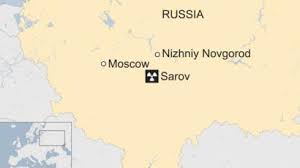
Known formerly as Arzamas-16, Sarov didn’t even appear on maps until the breakup of the Soviet Union in 1991. It remains home to the All-Russian Scientific Research Institute of Experimental Physics, which made headlines last year when five of its scientists died in a mysterious radiological explosion at a weapons testing site in the Russian Arctic.
The institute, which is now run by Rosatom, is an important part of Russia’s nuclear military complex. Likhachev indicated in his address that the workers who tested positive are affiliated with the institute.
In the city of Sarov alone, there have been 23 cases of Covid-19, Likhachev said – 7 of them Rosatom employees.
Known formerly as Arzamas-16, Sarov didn’t even appear on maps until the breakup of the Soviet Union in 1991. It remains home to the All-Russian Scientific Research Institute of Experimental Physics, which made headlines last year when five of its scientists died in a mysterious radiological explosion at a weapons testing site in the Russian Arctic.
The institute, which is now run by Rosatom, is an important part of Russia’s nuclear military complex. Likhachev indicated in his address that the workers who tested positive are affiliated with the institute.
As UK’s Torness nuclear power station deteriorates, – cheaper to build renewables than to repair aging reactors
 The Ferret 6th May 2020, Cracks that could increase the risk of a radioactive accident at Torness
nuclear power station in East Lothian will start appearing six years sooner than previously thought, according to the UK government’s safety watchdog. The Office for Nuclear Regulation (ONR) said that cracking which could cause debris to inhibit vital cooling of highly radioactive reactor fuel is now predicted to begin in 2022 rather than 2028.
After a major review ONR has given Torness permission to keep operating until 2030 –
but only if inspections to check for cracks are intensified. ONR promises
to “robustly challenge” the plant’s operators, EDF Energy, to ensure
that it “remains safe”.
Campaigners fear that Torness will become
increasingly unsafe, and warn it may have to close down sooner than
expected. EDF, however, insists that the station will keep generating
electricity safely until 2030. The coalition of 50 nuclear-free local
authorities in the UK has called on ONR to keep Torness under close
scrutiny. “These safety reservations surrounding the Torness periodic
safety review need to be cleared up as soon as possible,” said the
group’s Scotland convenor, SNP Glasgow councillor, Feargal Dalton.
“Whilst EDF is having to spend large resources trying to persuade the
regulator that it is safe to restart the Hunterston B reactors, this report
emphasises that similar issues with ageing are likely to arise at Torness
over coming years.” Councils would press ONR “to forensically
scrutinise what look like significant weaknesses in the EDF safety case,”
Dalton added.
“In the meantime, the Scottish Government should start
discussions about a ‘just transition’ for the workers at both
Hunterston and Torness so that Scotland can move to a safe, sustainable and
non-nuclear economy as quickly as possible.” The Edinburgh-based nuclear
consultant, Pete Roche, argued that it could be cheaper to build new
renewable capacity instead of continuing to operate ageing reactors.
“This could soon be the case with Torness, especially if it has to keep
being turned on and off to inspect the graphite core,” he said.
“Scotland clearly needs to be prepared for the possibility that Torness
might be forced to close not long after 2022.”
https://theferret.scot/torness-nuclear-reactors-cracking-2022/
Big drop in France’s nuclear power generation.
The fall in output is “due to a drop in demand and prolonged (nuclear reactor) outages linked in particular to the health crisis,” EDF said.
Electricity consumption has plunged across Europe due to shutdown measures ordered by governments to halt the spread of the virus.
The utility added that its nuclear generation in Britain fell 18.7% year-on-year in April to 3.7 TWh, while total output since January was at 15.6 TWh, down 5.3% compared with the same period in 2019.
EDF’s subsidiary in Britain, EDF Energy has been asked to temporarily reduce output at its Sizewell B nuclear plant in the east of England to help balance the grid and prevent blackouts, due to the fall in energy demand, EDF and grid operator National Grid said separately on Wednesday. (Reporting by Bate Felix; Editing by GV De Clercq and Elaine Hardcastle) AT TOP https://af.reuters.com/article/commoditiesNews/idAFL8N2CO843
SPD, junior partner in Germany’s coalition government, calls to withdraw US nuclear arms
|
Germany: SPD call to withdraw US nuclear arms stokes debate, DW, 4 May 20, The parliamentary leader of the SPD, the junior partner in Germany’s coalition government, has called for US atomic weapons to be withdrawn from the country. But other parties remain opposed to such a move.The presence of US nuclear weapons on German soil is a danger to Germany’s security and should be terminated, according to the parliamentary leader of the Social Democratic Party (SPD), Rolf Mützenich.
Read more: US military in Germany: What you need to know Mützenich, whose party is junior partner to Chancellor Angela Merkel’s conservative CDU/CSU bloc in Germany’s coalition government, told the paper Tagesspiegel am Sonntag that “atomic weapons on German territory do not heighten our security, on the contrary.” “It is time that Germany ruled out their deployment in future,” he added, stressing that such a move would not call Germany’s membership in NATO into question. Read more: US set to upgrade controversial nukes stationed in Germany Changed US nuclear strategy He justified his call largely by referring to the change in US nuclear strategy under President Donald Trump, saying that Trump’s administration saw atomic weapons not solely as deterrents but as weapons of aggression, making the risk of escalation “incalculable.”……. https://www.dw.com/en/germany-spd-call-to-withdraw-us-nuclear-arms-stokes-debate/a-53314883 |
|
|
UK’s Ministry of Defence (MoD) gags staff on subject of Trident nuclear weapons in Scotland.
Ferret 3rd May 2020, The Ministry of Defence (MoD) has banned its military and civilian staff
from speaking publicly about Trident nuclear weapons in Scotland. All
members of the armed forces and MoD civil servants have been instructed not
make any public comment, or have any contact with the media, on
“contentious topics” such as “Trident/Successor” and “Scotland
and Defence”. The instructions have been condemned as a “gagging order
worthy of a dictatorship” by campaigners. They have also been criticised
by the Scottish National Party as “an infringement too far”.
https://theferret.scot/ministry-of-defence-trident-scotland-gag/
New START is the only U.S.-Russian nuclear treaty still in effect. Time to renew it
|
Minister Lavrov was specific that Washington must agree to extend New START before Russia would agree to include new Russian systems in future negotiations. Secretary Pompeo reiterated the U.S. position that future arms control talks must embrace the White House desire to include China in a trilateral arms control agreement. Frankly, holding New START hostage to Chinese agreement to join a trilateral negotiation makes no sense. Under New START, Russia and the U.S. are permitted to deploy up to 1,550 nuclear warheads. China maintains a minimum deterrence force that the director of the Defense Intelligence Agency recently stated to be a couple of hundred nuclear warheads. Given this large disparity, China has little to gain from negotiating and has shown little interest in doing so. If Russia and the U.S. can bring their numbers down significantly through a new round of negotiations, there could be a basis then to persuade China to join a trilateral negotiation. The Trump administration should immediately accept the Russian offer to extend the New START Treaty and to engage in a new round of strategic arms negotiations. New START is the only U.S.-Russian nuclear treaty still in effect. If the pact is permitted to expire in February 2021, there will be no limits on Russian strategic systems and no inspection regime to verify what types and numbers of systems the Russians are deploying. The Joint Chiefs of Staff and the Intelligence Community are solidly in favor of extending New START because they know what the adverse impact will be on our ability to assess the threat to U.S. interests and our planning to address that threat. A bold approach the U.S. should consider is to enter into a negotiation now with Russia to extend New START at a lower level of 1,000 deployed warheads from the currently authorized 1,550. During the 2010 negotiations on New START, the Joint Chiefs certified that 1,000 would be adequate to support our deterrence strategy. …….. https://thehill.com/opinion/international/494960-time-to-restart-nuclear-arms-negotiations-with-russia |
|

UK ignored warnings about pandemic danger, cut health funding, spent up big on nuclear weapons
 Pride: why the UK spent billions on nuclear bombs but ignored Pride: why the UK spent billions on nuclear bombs but ignored 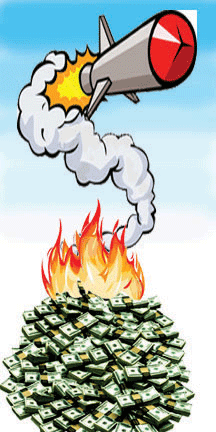 pandemic threat https://www.opendemocracy.net/en/opendemocracyuk/pride-why-uk-spent-billions-nuclear-bombs-ignored-pandemic-threat/ pandemic threat https://www.opendemocracy.net/en/opendemocracyuk/pride-why-uk-spent-billions-nuclear-bombs-ignored-pandemic-threat/
A viral outbreak was judged more likely than a nuclear attack – so why was Trident ring-fenced while NHS funding was cut? Richard Norton-Taylor 30 April 2020 We now know that the government was warned last year that a viral pandemic posed the greatest potential threat to the country. In a confidential briefing from the Cabinet Office, which was leaked last week, ministers were told that tens of thousands lives could be at risk if an outbreak occurred. Among the recommendations were stockpiling PPE (personal protective equipment) and establishing plans for a contact tracing system.
It was not the first time that warnings fell on deaf ears. In 2014, the Ministry of Defence advised that “alertness to changing trends” was vital to mitigating the likelihood of a pandemic. Senior civilian and military officials promptly shoved the report into a draw where it was left to gather dust.
To make matters worse, the austerity programme carried out over the last decade, has led to significant cuts to government projects and public services, including the NHS, that would ready us for a pandemic. There has, however, been one notable exception to the cuts – the country’s nuclear weapons arsenal. Tens of billions continue to be spent on weapons that are of no use against the types of attacks judged a possible threat to the UK in the government’s National Risk Register. The latest register, drawn up in 2017, refers only to the need to protect nuclear power stations and the possibility of chemical, biological and nuclear material attacks by terrorists. But it adds that terrorists’ use of conventional weapons is “far more likely”. Successive governments have described Britain’s nuclear arsenal as an “ultimate insurance” against an attack, or blackmail, by a foreign power. If that is the case, then why did the government not increase its healthcare spending as insurance against what it knew was a far greater threat – an infectious pandemic. Defenders of Britain’s nuclear weapons argue that they are needed for political reasons, to preserve Britain’s status as world power. But arguments about whether nuclear weapons would ever be considered a realistic or effective threat against a potential aggressor are dodged. Continue reading |
Report warns on the threat of sea level rise to Sizewell nuclear plan
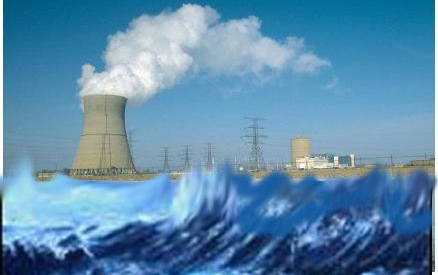 Sea level rise ‘could threaten nuclear power
  station’ planned for UK, report claims, Independent UK, EDF about to submit planning application for major development at Sizewell on Suffolk coast, Harry Cockburn, 1 May 20
Rising sea levels and coastal erosion could pose a threat to two nuclear reactors planned to be built on the low-lying Suffolk coast, according to local councils and analysis by an independent environmental group.
East Suffolk Council and Suffolk County Council have already lodged various concerns about French company EDF Energy’s plans for the new facilities at Sizewell C, and a new analysis by experts at the Nuclear Consulting Group suggests planned sea defences may be inadequate in future climate change scenarios.
EDF is reportedly about to submit its official planning application for the project, and has been working with Chinese state-owned nuclear company.
The Nuclear Consulting Group’s paper, written by structural engineer, Nick Scarr, suggests the Suffolk coast where the Sizewell development is planned, is inherently “unstable”, and that due to erosion by the sea the site could become an island before the station reaches the end of its active life, thereby risking a serious accident. Mr Scarr told the Climate News Network:
“Any sailor, or lifeboat crew, knows that east coast banks need respect — they have dynamic patterns, and even the latest charts cannot be accurate for long. “I was deeply concerned by EDF’s premise that there is micro-stability at the Sizewell site, which makes it suitable for new-build nuclear. It is true if you restrict analysis to recent historical
data, but it is false if you look at longer-term data and evidence-based climate science predictions…….. (subscribers only) https://www.independent.co.uk/independentpremium/nuclear-power-sea-rise-sizewell-c-edf-suffolk-a9492901.html
Coronavirus a big threat to Russia’s secret nuclear cities, as virus incidence rises

Concern as coronavirus threatens Russia’s closed ‘nuclear cities’ https://www.theguardian.com/world/2020/apr/28/concern-as-coronavirus-threatens-russias-closed-nuclear-cities
Rosatom nuclear chief warns of ‘particularly alarming situation’ in three areas as country reports biggest daily rise in cases, Reuters in Moscow 29 Apr 2020
Alexei Likhachev, Rosatom chief, said the pandemic ‘creates a direct threat’ to Russia’s nuclear cities.
The head of Russia’s state-run nuclear corporation has expressed concern about the spread of the new coronavirus to three “nuclear cities”, including one that houses a top-secret research institute that helped develop the Soviet atomic bomb.
The cities are closely linked to Russia’s nuclear industry, which is managed by the Rosatom corporation. Several are closed to foreigners and Russians require special clearance to enter them as facilities located there are closely guarded secrets.
Rosatom chief Alexei Likhachev said special deliveries of ventilators and personal protection equipment (PPE) were being sent to the closed town of Sarov, east of Moscow, and other towns where dozens of cases of the virus have been registered.
“This [pandemic] creates a direct threat to our nuclear towns. The situation in Sarov, Elektrostal [and] Desnogorsk is today particularly alarming,” he said in an online speech to Russia’s nuclear industry workers.
“The situation in Sarov is exacerbated by an outbreak of the illness in the nearby Diveyevo monastery,” he said, without elaborating further.
Likhachev made his remarks on a day when Russia reported its biggest daily rise in new coronavirus cases. Russia now ranks eighth worldwide with 93,558 confirmed cases, though its death toll of 867 is still far below that of many other countries.
Moscow, which accounts for more than half of Russia’s cases, and many other regions have imposed stay-at-home orders to curb the spread of the virus.
Sarov, which was so secret that it did not appear on maps until the breakup of the Soviet Union in 1991, remains an important part of Russia’s nuclear military complex, defence experts say.
It is home to a research institute that gained prominence last year when five of its scientists died in a mysterious accident at a military testing site in the far north.
Rosatom said the incident had occurred during a rocket engine test on a sea platform. Some US experts said they suspected it had been a botched test of a new missile vaunted by the president, Vladimir Putin.
Last week, Rosatom said seven people at Sarov’s All-Russian Scientific Research Institute of Experimental Physics had been diagnosed with coronavirus, bringing the total number of cases in the city – which has a population of about 95,000 – to 23.
It said the outbreak in Sarov had begun when a retired couple returned to the city from a Russian holiday resort and that more than 100 people had since been isolated to stop it spreading further.
1 This Month
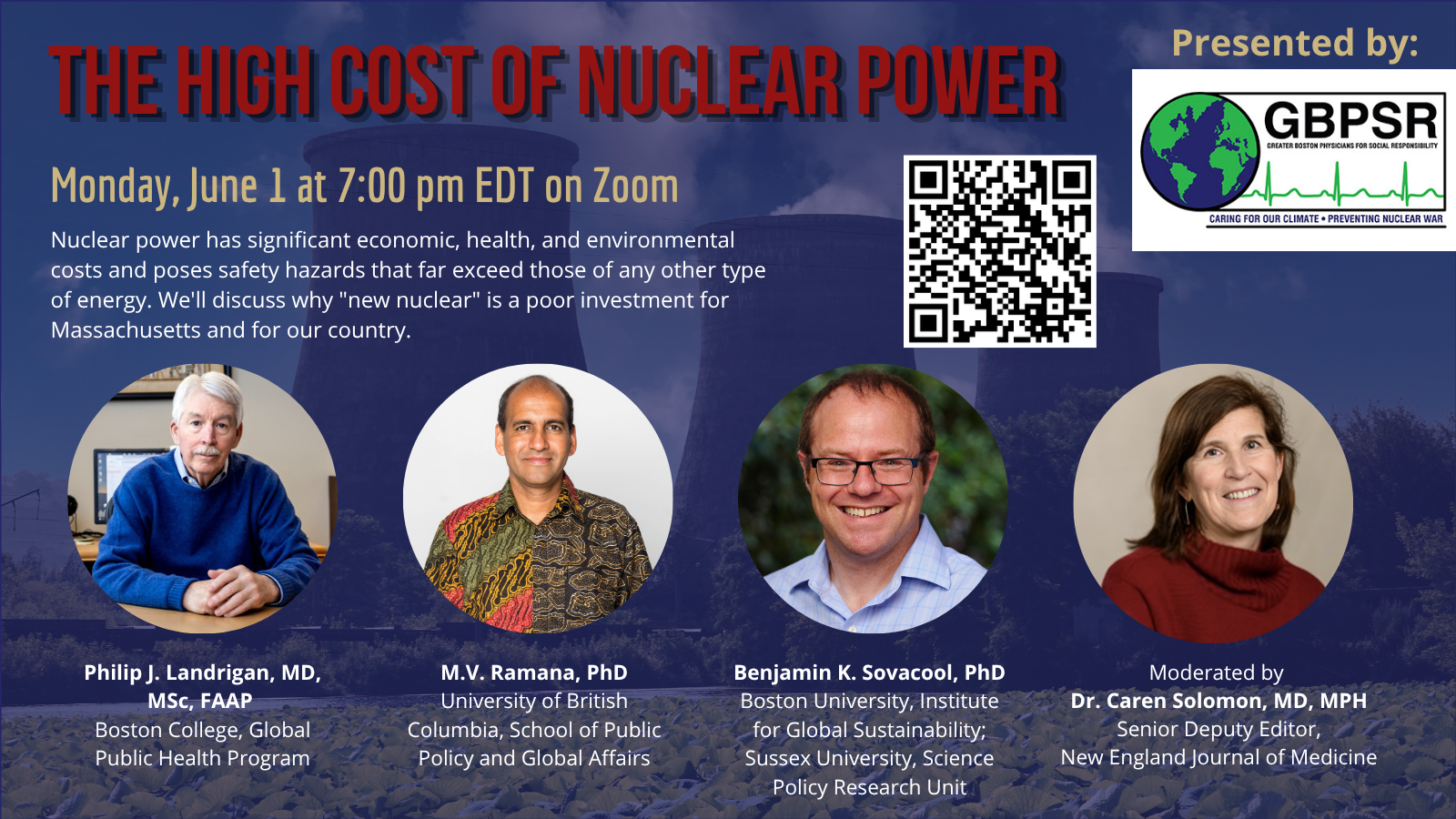
1 June Webinar – The High Cost of Nuclear Power – Register


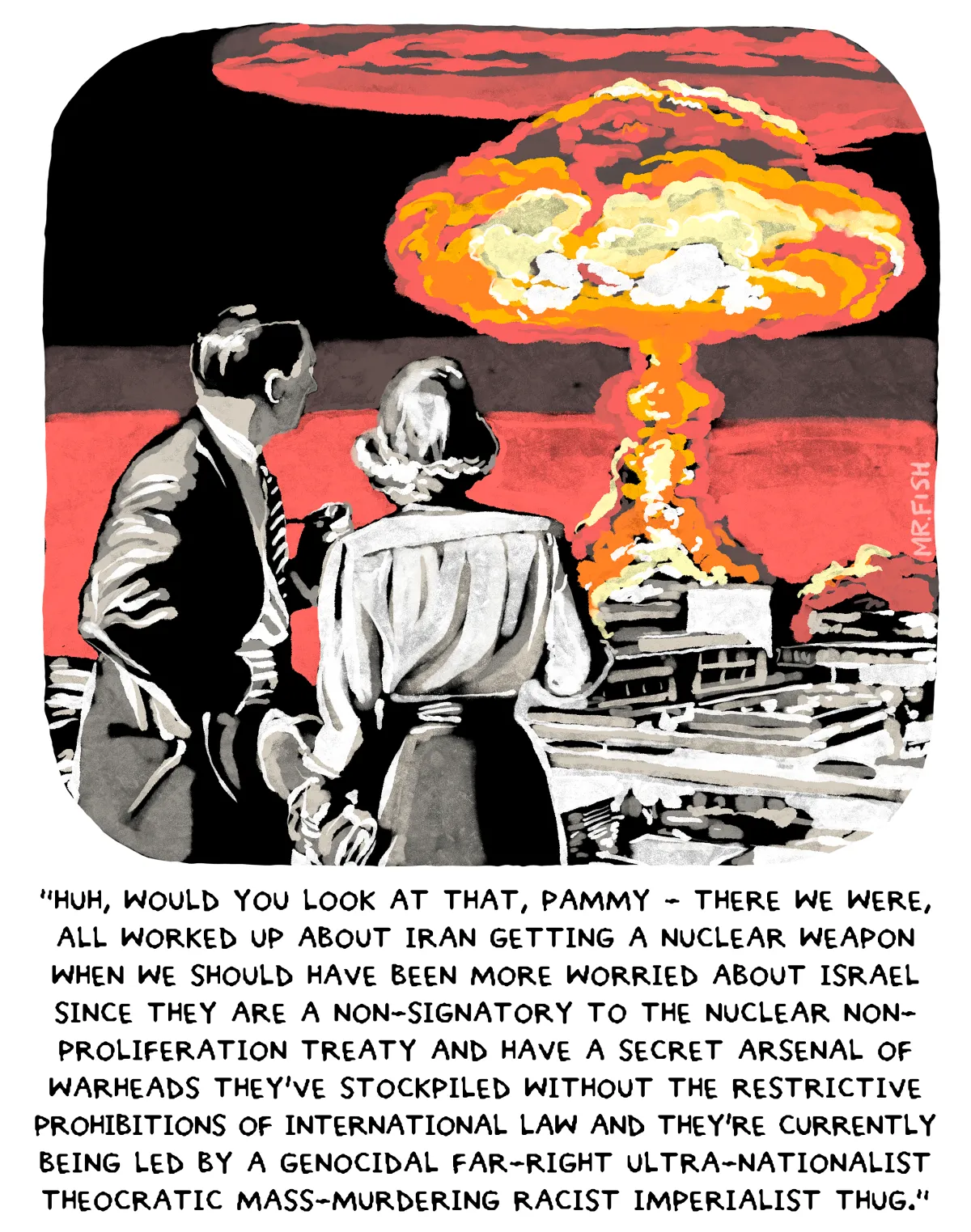
of the week– Nuclear Reactor Information Task Force
To see nuclear-related stories in greater depth and intensity – go to https://nuclearinformation.wordpress.com
-
Archives
- May 2026 (235)
- April 2026 (356)
- March 2026 (251)
- February 2026 (268)
- January 2026 (308)
- December 2025 (358)
- November 2025 (359)
- October 2025 (376)
- September 2025 (257)
- August 2025 (319)
- July 2025 (230)
- June 2025 (348)
-
Categories
- 1
- 1 NUCLEAR ISSUES
- business and costs
- climate change
- culture and arts
- ENERGY
- environment
- health
- history
- indigenous issues
- Legal
- marketing of nuclear
- media
- opposition to nuclear
- PERSONAL STORIES
- politics
- politics international
- Religion and ethics
- safety
- secrets,lies and civil liberties
- spinbuster
- technology
- Uranium
- wastes
- weapons and war
- Women
- 2 WORLD
- ACTION
- AFRICA
- Atrocities
- AUSTRALIA
- Christina's notes
- Christina's themes
- culture and arts
- Events
- Fuk 2022
- Fuk 2023
- Fukushima 2017
- Fukushima 2018
- fukushima 2019
- Fukushima 2020
- Fukushima 2021
- general
- global warming
- Humour (God we need it)
- Nuclear
- RARE EARTHS
- Reference
- resources – print
- Resources -audiovicual
- Weekly Newsletter
- World
- World Nuclear
- YouTube
-
RSS
Entries RSS
Comments RSS
 nuclear-news