Nation Cymru 18th July 2020, Campaigners press for full testing of nuclear plant sediment in effort to
halt dumping off Cardiff coast. Campaigners are calling for plans to dump
mud from the construction of the new Hinkley Point C nuclear power station
into the sea off Cardiff Bay to be halted.
Campaign group Geiger Bay are
pressing for extensive testing of the sediment following what they say is
evidence of plutonium contamination, a claim that Westminster’s
Environment Agency (EA) denies.
In February environment watchdog Natural
Resources Wales confirmed they had received an application from EDF Energy,
who want to dump 800,0000 tonnes of sediment dredged as part of building
work for the new plant at Hinkley Point, the site of the disused Hinkley
Point A facility.
Geiger Bay are a coalition of scientists, experts,
individuals and organisations formed to oppose the plans. Two years ago,
EDF were given the green light to dump 300,000 tonnes of mud off the
Cardiff coast. Despite protests and a petition signed by over 7,000 people,
and the support of Senedd Member Neil McEvoy, a full Senedd debate failed
to convince the Welsh Government to halt the dumping.
Idle Threat? Azerbaijan’s Hint Of Missile Strike On Armenian Nuclear Plant Increases Tensions, Radio Free Europe July 17, 2020 By Andy Heil
Azerbaijan dramatically escalated tensions amid its border battle with Armenia this week with an implicit threat to bomb the region’s only nuclear power plant and unleash “great catastrophe” on Armenians.
The July 16 warning drew outrage from Yerevan and deepened concerns that the worst violence in four years between Azerbaijan and Armenia, who are technically still in a war begun in the late 1980s, could quickly spiral out of control.
At least 16 Azerbaijanis and Armenians have died in the fighting near a northern section of their internationally recognized border that has included heavy artillery, tank, and drone attacks since it began on July 12.
Yerevan and Baku routinely threaten and accuse the other of provocations that have killed dozens of people in recent years, many of them civilians, with neither side willing to back down publicly for fear of being viewed as weak in the more than 30-year-long standoff.
The strategic or tactical aim of either side in contributing to this week’s violence is unclear.
But the reframing of the current flareup to include a missile attack on a Soviet-built nuclear plant — a move that could massively increase the death toll and set off a Chernobyl-like fallout in the region and beyond — took many people by surprise.
“The Armenian side must not forget that our army’s state-of-the-art missile systems allow us to strike the Metsamor nuclear plant with precision, which could lead to a great catastrophe for Armenia,” Vagif Dargahli, the Azerbaijani Defense Ministry spokesman, said on July 16, hours after hostilities had resumed following a one-day lull. …….
There are some 3 million people living in Armenia.
The Metsamor Nuclear Power Plant lies just a few kilometers from cities with tens of thousands of people and 35 kilometers from the Armenian capital, Yerevan, and its 1 million inhabitants…………
Emil Sanamyan, a blogger and fellow at the University of Southern California’s Dornsife Institute of Armenian Studies, said Baku’s threat involved its possession of a missile system it purchased from Israel.
“Just to be clear: With this statement issued yesterday, [the] Azerbaijani Defense Ministry is threatening to use the LORA surface-to-surface missile it bought from Israel…to attack Armenia’s nuclear power plant to cause a leak of radiation.”…………..
End the nuclear risk to Scotland Herald Scotland, Margaret Forbes, 17 Jul 20, Kilmacolm. I NOTE your article regarding the near miss between between the ferry crossing between Scotland and Northern Ireland and the nuclear submarine (“Ferry was forced to change course to avoid nuclear submarine, inquiry told”, The Herald, July 16). CND has been warning about the dangers of nuclear submarines in busy sea lanes for years – this latest incident was the third such incident in four years. If there is any accident with these nuclear vessels the whole of the Central Belt of Scotland would have to be evacuated. Where would the population be evacuated to? The nuclear convoys travelling the length of Britain from the south of England pose a similar threat.
…….The modern nuclear weapons are even more dangerous – we risk wiping out the whole of humanity. There is a peace walkat Barshaw Park in Paisley on August 6 at 5pm. We need as many people as possible to come to tell the Westminster Government that we do not wish any nuclear weapons on Scottish soil. If Westminster wants them, Westminster can take them. The Americans can take the warheads to a naval yard in the US. https://www.heraldscotland.com/news/18588148.letters-end-nuclear-risk-scotland/
British nuclear sub narrowly missed passenger ferry near Belfast, By BRIAN NIEMIETZ, NEW YORK DAILY NEWS |JUL 16, 2020 An Irish passenger ship avoided colliding with a British nuclear sub when the ferry’s crew spotted the sub’s periscope sticking out of the water and quickly changed course.
The vessels came as close as 164 feet from each other, according to a report released Thursday that all aboard both vessels were “in immediate danger.”
Great Britain’s Marine Accident Investigation Branch found that the November 2018 incident was a result of the submarine crew miscalculating the speed of the Stena Superfast VII ferry, which was carrying 215 passengers and 67 crew members, according to the Belfast Telegraph.
100% Renewables 16th July 2020, The Government has just announced a £40 million research programme into so-called advanced modular reactor technology that is highly unlikely ever to see any practical use. That is because the so-called small modular reactors (SMRs) are much too expensive for civilian use.
In an important sense it is nonsense to talk about research to develop SMRs as a ‘new’ technology simply because they already exist. They power military submarines and also US aircraft carriers. Their design is simply a smaller
version of the Pressurised Water Reactor (PWR) design that dominates the world nuclear power industry. Indeed PWRs began as small projects housed in submarines which were then developed up in scale so that they could produce electricity more cheaply.
At 450 MW for their proposed plant, the plant is not far off the same order of magnitude as conventional plant – for
example the AGR series that currently generates the bulk of British nuclear plant has units of around 600-660 MW. In fact, as Tom Burke points out, they are close to the size of Britain’s first generation of reactors, the ‘Magnox’ reactors.
Neither is the plant proposed by Rolls Royce modular in the sense that such plant can be rolled off a production line. What Rolls Royce claims is that some parts can be produced in a ‘modular’ fashion. This is not the same as producing whole units off a production line, and in fact the developers of the nuclear plant Vogtle in the USA also claim to produce parts in a ‘modular ‘fashion (although this plant is now hopelessly behind schedule with very large cost overruns).
BY ALEXANDRA GENOVA, PHOTOGRAPHS BY PHIL HATCHER-MOORE OCTOBER 13, 2017
Decay and desolation scar the landscape of a remote corner of the Kazakh Steppe. Unnatural lakes formed by nuclear bomb explosions pockmark the once flat terrain, broken up only by empty shells of buildings. It appears uninhabitable. And yet, ghosts – living and dead – haunt the land, still burdened by the effects a nuclear testing program that stopped nearly 30 years ago.
The site, known as the Polygon, was home to nearly a quarter of the world’s nuclear tests during the Cold War. The zone was chosen for being unoccupied, but several small agricultural villages dot its perimeter. Though some residents were bussed out during the test period, most remained. The damage that continues today is visceral.
Photographer Phil Hatcher-Moore spent two months documenting the region, and was struck by the “wanton waste of man’s folly.”
His project ‘Nuclear Ghosts’ marries the wasted landscape and intimate portraits of villagers still suffering the consequences.
The figures are astonishing – some 100,000 people in the area are still affected by radiation, which can be transmitted down through five generations. But with his intimately harrowing pictures, Moore sought to make the abstract numbers tangible.
“Nuclear contamination is not something we can necessarily see,” he says. “And we can talk about the numbers, but I find it more interesting to focus on individuals who encapsulate the story.”
Moore interviewed all his subjects before picking up his camera and learned that secrecy and misinformation plagued much of their experience.
“[During the 50s] one guy was packed up with his tent and told to live out in the hills for five days with his flock. He was effectively used as a test subject to see what happened,” says Moore. “They were never told what was going on, certainly not the dangers that they may be in.”
Though human stories were central, Moore also documented the scientific test labs that are still uncovering the damage. The juxtaposition of these labs alongside portraits of people disfigured by radiation makes for uncomfortable viewing. But this proximity is deliberate.
“There was a history of humans being used as live subjects,” says Moore. “I wanted to marry these ideas together; the way people were used by researchers at the time and how that trickles down into every day life – what that looks like, what that means.”
While some of Moore’s subjects are severely deformed, many suffer from less visible health issues like cancer, blood diseases or PTSD. And the hidden, insidious nature of the thing is what is perhaps most troubling. “For a long time there hadn’t been much nuclear development but it is a very real issue right now,” says Moore. “But we don’t talk about what it takes to renew these weapons. These people are legacy and testament to what was done to meet those ends.”
See more of Phil Hatcher-Moore’s work on his website and follow him on Instagram.
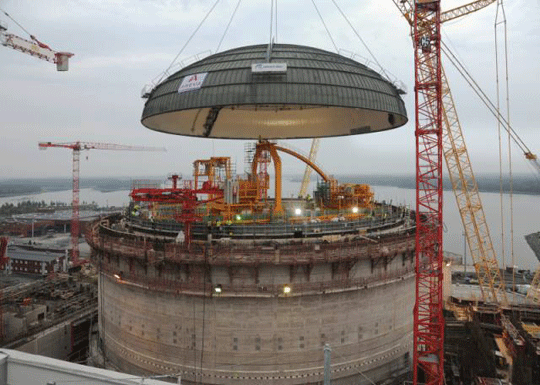
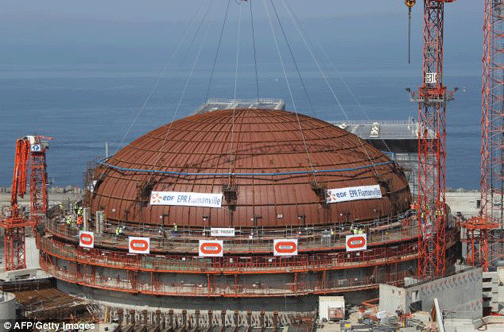
French auditor calls for financing guarantee for future EPR projects, WNN, 15 July 2020, EDF must ensure the financing and profitability of its proposed EPR2 reactor before starting construction of any plants based on the design in France, the country’s state audit office has said. The EPR2 is a simplified version of the EPR design, construction of which has been hit by delays and cost increases in France and Finland……..
Construction of the Olkiluoto 3 EPR began in 2005, with completion of the reactor originally scheduled for 2009. However, with various delays and setbacks, fuel loading is now planned for later this year. The loading of fuel into the Flamanville EPR in France, construction of which began in December 2007, is now scheduled for the end of 2022. Two EPR units are also under construction at the Hinkley Point C project in Somerset, UK.
In a report published 9 July, the Cour des Comptes says the rivalries between Areva and EDF “resulted in the hasty launch of the construction sites of the first two EPRs, in Finland and in Flamanville. This insufficient preparation led to underestimating the difficulties and the construction costs, and to overestimating the capacity of the French nuclear sector to face it, at the cost of financial risks for the companies of the sector.”
The report says the 3.3 times increase in the construction cost, estimated by EDF at EUR12.4 billion (2015 value), and by at least 3.5 times the commissioning time for the Flamanville EPR compared to initial forecasts, “constitutes a considerable drift”. It says this is the result of “unrealistic initial estimates, poor organisation of the project by EDF, a lack of vigilance on the part of the supervisory authorities and a lack of awareness of the loss of technical competence of industrialists in the sector”.
The audit office added, “The construction of new EPRs in France cannot in any event be envisaged without clear prior answers on the methods of financing and the role of nuclear power production in the electricity mix of tomorrow.”
The report says EDF is no longer in a position to finance the construction of new reactors on its own. The utility, it says, is studying means of financing that either makes the consumer – as in the case of the UK’s contract-for-difference for construction of Hinkley Point C – or the taxpayer bear the costs of construction.
“The financial challenges are major, with the cost of construction of three pairs of EPR2 reactors being estimated at EUR46 billion (2018 value),” the Cour des Comptes notes. “Taking into account their duration of construction, production and dismantling, the decision to build or not to build future EPRs will have consequences until the 22nd Century. …. https://world-nuclear-news.org/Articles/French-auditor-calls-for-financing-guarantee-for-f
Siberia heatwave was ‘almost impossible’ without climate change, scientists say, SBS News 16 Jul 20, An extreme heatwave in the Arctic is a problem for the entire planet, say scientists, because the region regulates weather around the globe and contains much of the world’s carbon-rich permafrost.A recent heatwave in Siberia that saw temperature records tumble as the region sweltered in 38-Celsius highs was “almost impossible” without the influence of man-made climate change, leading climate scientists say.
An international team of researchers found that the record-breaking warm period was more than 2 degrees hotter than it would have been if humans had not warmed the planet through decades of greenhouse gas emissions.
The five hottest years in history have occurred in the last five years and there’s a better-than-even chance that 2020 will be the hottest ever recorded.
Earth’s poles are warming faster than the rest of the planet, and temperatures in Siberia – home to much of the world’s carbon-rich permafrost – were more than 5 degrees hotter than average between January and June. ………
‘Important for everyone’
The team behind the calculations stressed that the Siberian heatwave was a problem for the entire globe. Some 1.15 million hectares of forest going up in flames released millions of tonnes of CO2 into the atmosphere.
At the same time, the wildfires and sustained heatwaves accelerated the region’s permafrost melt. This caused an oil tank built on frozen soil to collapse in May, leading to one of the region’s worst-ever oil spills…….
The 2015 Paris climate deal commits nations to capping temperature rises to “well-below” 2 degrees above pre-industrial levels and to strive for a 1.5 degrees limit if at all possible. With just 1 degree of warming so far, Earth is already buffeted by record-breaking droughts, wild fires and super storms made more potent by rising sea levels.
To keep in line with the 1.5-degree target, the United Nations says global emissions must fall by 7.6 per cent every year this decade.
New EC ‘Green Deal’ strategies ignore nuclear power, Nuclear Engineering 13 July 2020 The European Commission (EC) on 8 July presented two strategies as part of its Green Deal – “An EU Strategy for Energy System Integration”, and “A hydrogen strategy for a climate-neutral Europe”.The 21-page strategy for Energy System Integration aims to provide the framework for the green energy transition. The EC said: “The current model where energy consumption in transport, industry, gas and buildings is happening in ‘silos’ – each with separate value chains, rules, infrastructure, planning and operations – cannot deliver climate neutrality by 2050 in a cost efficient way; the changing costs of innovative solutions have to be integrated in the way we operate our energy system. New links between sectors must be created and technological progress exploited.”
There are three main pillars to this strategy:
First, a more ‘circular’ energy system, with energy efficiency at its core.
Second, a greater direct electrification of end-use sectors – a network of one million electric vehicle charging points will be among the visible results, along with the expansion of solar and wind power.
For those sectors where electrification is difficult, the strategy promotes clean fuels, including renewable hydrogen and sustainable biofuels and biogas. The Commission will propose a new classification and certification system for renewable and low-carbon fuels………..
To help deliver on this Strategy, the Commission announced the launch of the European Clean Hydrogen Alliance with industry leaders, civil society, national and regional ministers and the European Investment Bank. The Alliance will build up an investment pipeline for scaled-up production and will support demand for clean hydrogen in the EU.
“To target support at the cleanest available technologies, the Commission will work to introduce common standards, terminology and certification, based on life-cycle carbon emissions, anchored in existing climate and energy legislation, and in line with the EU taxonomy for sustainable investments.”
Neither of the reports made any mention of nuclear power either as part of energy system integration or as an energy source for the production of hydrogen. …
SPRU 9th July 2020, A public consultation on plans for the UK’s newest nuclear power station
is deeply flawed and should be suspended, according to two leading energy
policy experts. Professor Andrew Stirling and Dr Philip Johnstone say the
consultation into Bradwell B is invalid because the UK government has
repeatedly failed to make the case for nuclear in the face of its
ever-rising costs, slow lead times and poor value-for-money comparison to
renewables.
The academics at the world-renowned Science Policy Research
Unit (SPRU) at the University of Sussex Business School have criticised the
restrictive nature of the consultation’s scope which they argue excludes
crucial underlying questions over the rationale for building more nuclear
power stations in the UK. Prof Stirling and Dr Johnstone say the
consultation should resume only when the government publish a long-promised
rigorous justification for nuclear power compared to other low carbon
energy sources – something they argue it has failed to do for the past 17
years.
BANNG 9th July 2020, Maldon District Council Planning Committee’s comprehensive rejection
today of the Chinese state-backed nuclear developer’s (CGN) application
for permission to undertake ground investigations came like a bolt from the
blue.
For so long a firm supporter of a new nuclear power station at
Bradwell, Maldon has done a complete volte-face.
Prof. Andy Blowers, Chair of the Blackwater Against New Nuclear Group (BANNG) commented: ‘From the
moment CGN revealed its plans just before lockdown it became clear the
Bradwell B project would be dead in the water. The massive scale of the
project which would totally overwhelm the Blackwater area and the Dengie
peninula has proved too much to stomach, even for those who were seduced by
the promise of thousands of jobs. The price, in terms of loss of
environment and wellbeing, was simply too high.’
But the project is also
being threatened by the political fallout in relations with China. Chinese
ambitions to build a new nuclear power station at Bradwell do not come
without serious risks to national security and the threat of Chinese
economic dominance over the UK’s sensitive infrastructure.
Nuclear Plant And Sound Projector Developers Fight Over Acoustic Fish Deterrent In The Severn Estuary
Emanuela Barbiroglio Senior 11 Jul
As Hinkley Point C power plant is being built in South West England, hundreds of thousands of fish living in the Severn estuary, including protected Atlantic salmon, may be under threat from the plant’s cooling turbines.
An acoustic deterrent could help deflect fish away from the water intakes. Developed by Fish Guidance Systems Ltd, the Sound Projector Array would use underwater sound projectors to prevent fish being drawn.
Hinkley Point C’s owner, the energy company EDF, would prefer to proceed with a change to the Secretary of State’s Development Consent Order that requires the device. Although they originally proposed the installation as part of the environmental protection package, the company is now proposing to avoid it.
According to some scientists, however, removing this piece of environmental protection would threaten the biodiverse ecosystem of the UK’s largest estuary and designated Special Area of Conservation. It could also set a precedent for future projects like Sizewell nuclear power stations in Suffolk.
“I have lost sleep over the danger to the fish and the risk of devastating the ecosystem of the Severn estuary,” a researcher in coastal governance, Natasha Bradshaw, said. “There is little proof that fish will survive the journey through 3 km of tunnels or what impact returning them (dead or alive) into the estuary will have on the ecosystem.”
The Severn estuary supports up to 110 fish species, with fish nurseries serving the whole of the Bristol Channel and Celtic Sea, and an average of 74,000 wintering birds each year.
“In such a large and complex ecosystem, effects of individual projects are always difficult to pinpoint. The situation is complicated further by ongoing changes wrought by climate change,” says David Lambert, managing director of Fish Guidance Systems. “The provision of an acoustic fish deterrent as required under the existing Development Consent Order is to mitigate the uncertainty over these impacts which will perpetuate through the 60 year lifespan of the plant.”
Nuclear weapons and nuclear power share several common features. In fact, the UK’s first nuclear power stations were built primarily to provide fissile material for nuclear weapons during the Cold War.
The development of both the nuclear weapons and nuclear power industries is mutually beneficial. And now it appears that the government is using the Hinkley Point C nuclear power station to subsidise Trident, Britain’s nuclear weapons system.
As part of a Parliamentary investigation into the Hinkley project, it emerged that without the billions of pounds earmarked for building this new power station in Somerset, Trident would be ‘unsupportable’. Professor Andy Stirling and Dr Phil Johnstone argued that the nuclear power station will ‘maintain a large-scale national base of nuclear-specific skills’ essential for maintaining Britain’s military nuclear capability.
Join CND for an online discussion with Professor Stirling and Dr Johnstone about these connections.




 While some of Moore’s subjects are severely deformed, many suffer from less visible health issues like cancer, blood diseases or PTSD. And the hidden, insidious nature of the thing is what is perhaps most troubling. “For a long time there hadn’t been much nuclear development but it is a very real issue right now,” says Moore. “But we don’t talk about what it takes to renew these weapons. These people are legacy and testament to what was done to meet those ends.”




 nuclear-news