Six Portuguese youth file ‘unprecedented’ climate lawsuit against 33 countries
Six Portuguese youth file ‘unprecedented’ climate lawsuit against 33 countries Climate Home News, first climate case to be filed with the European Court of Human Rights, six Portuguese youth argue inadequate emissions cuts violate their human rights t
This is the first climate change case to be filed with the European Court of Human Rights (ECHR) in Strasbourg, France. If admissible, it could set an important precedent, showing the way for other climate lawsuits based on human rights arguments.
Cláudia Agostinho (21), Catarina Mota (20), Martim Agostinho (17), Sofia Oliveira (15), André Oliveira (12) and Mariana Agostinho (8) are suing the 27 European member states, as well as the UK, Switzerland, Norway, Russia, Turkey and Ukraine for failing to make deep and urgent emissions cuts to safeguard their future.
Their complaint comes after lethal wildfires in Portugal in 2017 killed more than 120 people. Researchers have linked the intensity of the 2017 blaze to global warming. The case is being filed after Portugal recorded its hottest July in the last 90 years……….. https://www.climatechangenews.com/2020/09/03/six-portuguese-youth-file-unprecedented-climate-lawsuit-33-countries/
THe Arctic’s slow-moving underwater nuclear disaster – Russia’s radioactive trash

 Russia’s ‘slow-motion Chernobyl’ at sea, BBC By Alec Luhn2nd September 2020, ”…………………………. Beneath some of the world’s busiest fisheries, radioactive submarines from the Soviet era lie disintegrating on the seafloor. Decades later, Russia is preparing to retrieve them………. Russia’s ‘slow-motion Chernobyl’ at sea, BBC By Alec Luhn2nd September 2020, ”…………………………. Beneath some of the world’s busiest fisheries, radioactive submarines from the Soviet era lie disintegrating on the seafloor. Decades later, Russia is preparing to retrieve them……….With a draft decree published in March, President Vladimir Putin set in motion an initiative to lift two Soviet nuclear submarines and four reactor compartments from the silty bottom, reducing the amount of radioactive material in the Arctic Ocean by 90%. First on the list is Lappa’s K-159.
|
|
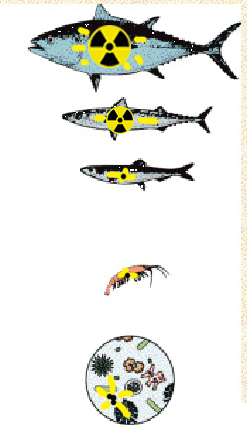
Russia facing huge problem to recover radioactive sunken nuclear reactors, but Putin still plans new ones in the Arctic
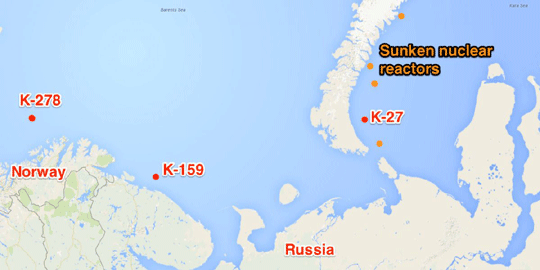
Russia’s ‘slow-motion Chernobyl’ at sea, FUTURE PLANET | OCEANS By Alec Luhn, 2nd September 2020 ……….
 Minimising risk
Russia, Norway and other countries whose fishing boats ply the bountiful waters of the Barents Sea have now found themselves with a sword of Damocles hanging over their heads. Although a 2014 Russian-Norwegian expedition to the K-159 wreck that tested the water, seafloor and animals like a sea centipede did not find radiation above background levels, an expert from Moscow’s Kurchatov Institute said at the time that a reactor containment failure “could happen within 30 years of sinking in the best case and within 10 years at the worst”. That would release radioactive caesium-137 and strontium-90, among other isotopes.
While the vast size of the oceans quickly dilutes radiation, even very small levels can become concentrated in animals at the top of the food chain through “bioaccumulation” – and then be ingested by humans. But economic consequences for the Barents Sea fishing industry, which provides the vast majority of cod and haddock at British fish and chip shops, “may perhaps be worse than the environmental consequences”, says Hilde Elise Heldal, a scientist at Norway’s Institute of Marine Research.
According to her studies, if all the radioactive material from the K-159’s reactors were to be released in a single “pulse discharge”, it would increase Cesium-137 levels in the muscles of cod in the eastern Barents Sea at least 100 times. (As would a leak from the Komsomolets, another sunken Soviet submarine near Norway that is not slated for lifting.) That would still be below limits set by the Norwegian government after the Chernobyl accident, but it could be enough to scare off consumers. More than 20 countries continue to ban Japanese seafood, for instance, even though studies have failed to find dangerous concentrations of radioactive isotopes in Pacific predatory fishes following the Fukushima nuclear power plant release in 2011. Any ban on fishing in the Barents and Kara seas could cost the Russian and Norwegian economies €120m ($140m; £110m) a month, according to a European Commission feasibility study about the lifting project.
There is no ship in the world capable of lifting the K-159, so a special salvage vessel would have to be built
But an accident while raising the submarine, on the other hand, could suddenly jar the reactor, potentially mixing fuel elements and starting an uncontrolled chain reaction and explosion. That could boost radiation levels in fish 1,000 times normal or, if it occurred on the surface, irradiate terrestrial animals and humans, another Norwegian study found. Norway would be forced to stop sales of products from the Arctic such as fish and reindeer meat for a year or more. The study estimated that more radiation could be released than in the 1985 Chazhma Bay incident, when an uncontrolled chain reaction during refuelling of a Soviet submarine near Vladivostok killed 10 sailors.
Amundsen argued that the risk of such a criticality excursion with the K-159 or K-27 was low and could be minimised with proper planning, as it was during the removal of high-risk spent fuel from Andreyev Bay.
“In that case we do not leave the problem for future generations to solve, generations where the knowledge of handling such legacy waste may be very limited,” he says.
The safety and transparency of Russia’s nuclear industry has often been questioned, though, most recently when Dutch authorities concluded that radioactive iodine-131 detected over northern Europe in June originated in western Russia. The Mayak reprocessing facility that received the spent fuel from Andreyev Bay by train has a troubled history going back to the world’s then-worst nuclear disaster in 1957. Rosatom continues to deny the findings of international experts that the facility was the source of a radioactive cloud of ruthenium-106 registered over Europe in 2017.
While the K-159 and K-27 need to be raised, Rashid Alimov of Greenpeace Russia has reservations. “We are worried about the monitoring of this work, public participation and the transport [of spent fuel] to Mayak,” he says.
Custom mission
Raising a submarine is a rare feat of engineering. The United States spent $800m (£610m) in an attempt to lift another Soviet submarine, the diesel-powered K-129 that carried several nuclear missiles, from 16,400ft (5,000m) in the Pacific Ocean, under the guise of a seabed mining operation. In the end, they only managed to bring a third of the submarine to the surface, leaving the CIA with little usable intelligence.
That was the deepest raise in history. The heaviest was the Kursk. To bring the latter 17,000-tonne missile submarine up from 350ft (108m) below the Barents Sea, the Dutch companies Mammoet and Smit International installed 26 hydraulically cushioned lifting jacks on a giant barge and cut 26 holes in the submarine’s rubber-coated steel hull with a water jet operated by scuba divers. On 8 October 2001, rushing to beat the winter storm season after four months of nerve-wracking work and delays, steel grippers fitted in the 26 holes lifted the Kursk from the seabed in 14 hours, after which the barge was towed to a dry dock in Murmansk.
At less than 5,000 tonnes, the K-159 is smaller than the Kursk, but even before it sank its outer hull was “as weak as foil”, according to Bellona. It has since been embedded in 17 years’ worth of silt. A hole in the bow would seem to rule out pumping it full of air and raising it with balloons, as has been previously suggested. At a conference of European Bank of Reconstruction and Development donors in December, a Rosatom representative said there was no ship in the world capable of lifting it, so a special salvage vessel would have to be built.
That will increase the estimated cost of €278m ($330m; £250m) to raise the six most radioactive objects. Donors are discussing Russia’s request to help finance the project, said Balthasar Lindauer, director of nuclear safety at EBRD.
“There’s consensus something needs to be done there,” he says. Any such custom-built vessel would likely need a bevy of specialised technologies such as bow and aft thrusters to keep it positioned precisely over the wreck.
But in August, Grigoriev told a Rosatom-funded website that one plan the company was considering would involve a pair of barges fitted with hydraulic cable jacks and secured to deep-sea moorings. Instead of steel grippers like the ones inserted into the holes in the Kursk, giant curved pincers would grab the entire hull and lift it up between the barges. A partially submersible scow would be positioned underneath, then brought to the surface along with the submarine and finally towed to port. The K-27 and K-159 could both be recovered this way, he said.
One of three engineering firms working on proposals for Rosatom is the military design bureau Malachite, which drafted a project to raise the K-159 in 2007 that “was never realised due to a lack of money”, according to its lead designer. This year the bureau has begun updating this plan, an employee tells Future Planet in the lobby of Malachite’s headquarters in St Petersburg. Many questions remain, however.
“What condition is the hull in? How much of force can it handle? How much silt has built up? We need to survey the conditions there,” the employee says, before the head of security arrives to break up our conversation.
Nuclear paradox
Removing the six radioactive objects fits in with an image Putin as crafted as a defender of the fragile Arctic environment. In 2017, he inspected the results of an operation to remove 42,000 tonnes of scrap metal from the Franz Josef Land archipelago as part of a “general clean-up of the Arctic”. He has spoken about environmental preservation at an annual conference for Arctic nations. And on the same day in March 2020 that he issued his draft decree about the sunken objects, he signed an Arctic policy that lists “protecting the Arctic environment and the native lands and traditional livelihood of indigenous peoples” as one of six national interests in the region.
“For Putin, the Arctic is part of his historic legacy. It should be well-protected, bring real benefits and be clean,” said Dmitry Trenin, head of the think tank Carnegie Centre Moscow.
Yet while pursuing a “clean” Arctic, the Kremlin has also been backing Arctic oil and gas development, which accounts for the majority of shipping on the Northern Sea Route. State-owned Gazprom built one of two growing oil and gas clusters on the Yamal peninsula, and this year the government cut taxes on new Arctic liquified natural gas projects to 0% to tap into some of the trillions of dollars of fossil fuel and mineral wealth in the region.
And even as Putin cleans up the Soviet nuclear legacy in the far north, he is building a nuclear legacy of his own. A steady march of new nuclear icebreakers and, in 2019, the world’s only floating nuclear power plant has again made the Arctic the most nuclear waters on the planet.
Meanwhile, the Northern Fleet is building at least eight submarines and has plans to construct several more, as well as eight missile destroyers and an aircraft carrier, all of them nuclear-powered. It has also been testing a nuclear-powered underwater drone and cruise missile. In total, there could be as many as 114 nuclear reactors in operation in the Arctic by 2035, almost twice as many as today, a 2019 Barents Observer study found.
This growth has not gone without incident. In July 2019, a fire on a nuclear deep-sea submersible near Murmansk almost caused a “catastrophe of a global scale,” an officer reportedly said at the funeral of the 14 sailors killed. The next month, a “liquid-fuel reactive propulsion system” exploded during a test on a floating platform in the White Sea, killing two of those involved and briefly spiking radiation levels in the nearby city of Severodvinsk.
“The joint efforts of the international community including Norway and Russia after breakup of the Soviet Union, using taxpayer money to clean up nuclear waste, was a good investment in our fisheries,” says The Barents Observer’s Nilsen. “But today there are more and more politicians in Norway and Europe who think it’s a really big paradox that the international community is giving aid to secure the Cold War legacy while it seems Russia is giving priority to building a new Cold War.”
As long as the civilian agency Rosatom is tasked with clean-up, the Russian military has little incentive to slow down this nuclear spree, Nilsen notes.
“Who is going to pay for the clean-up of those reactors when they are not in use anymore?” he asks. “That is the challenge with today’s Russia, that the military don’t have to think what to do with the very, very expensive decommissioning of all this.”
So while the coming nuclear clean-up is set to be the largest of its kind in history, it may turn out to be just a prelude to what’s needed to deal with the next wave of nuclear power in the Arctic…………….https://www.bbc.com/future/article/20200901-the-radioactive-risk-of-sunken-nuclear-soviet-submarines
Petition against dumping ‘nuclear mud’ off Cardiff reaches 5k threshold for Senedd debate
|
Petition against dumping ‘nuclear mud’ off Cardiff reaches 5k threshold for Senedd debate https://nation.cymru/news/petition-against-dumping-nuclear-mud-off-cardiff-reaches-5k-threshold-for-senedd-debate/, 2nd September 2020 A petition to stop the dumping of what campaigners are calling ‘nuclear mud’ off the coast of Cardiff has reached its 5,000 signature target.The campaigners are calling for plans to dump mud from the construction of the new Hinkley Point C nuclear power station into the sea off Cardiff Bay to be halted.
Reaching the 5,000 target means the controversial topic will be up for a debate in the Welsh Parliament. Campaign group Geiger Bay are pressing for extensive testing of the sediment following what they say is evidence of plutonium contamination, a claim that Westminster’s Environment Agency (EA) denies. The petition, created by Cian Ciaran of the Super Furry Animals, demands “that a full Environmental Impact Assessment (EIA) is carried out before any further sediment from Hinkley Point nuclear power station can be dumped”. 780,000 tonnes of the sediment from set to be dumped just one mile from Wales’ capital city. Concerned’ Speaking this morning, Welsh National Party leader and Cardiff West Senedd candidate Neil McEvoy MS said, who has been a prominent voice in the campaign, said that “Wales is standing up for itself”. “How can we allow 780,000 tonnes of material dredged from outside a nuclear power station to be dumped in our waters without testing it properly?” he said. “The Labour Government and Natural Resources Wales have a lot to answer for. “The public are concerned about this issue. Environmentalists are outraged. Eminent scientists are on record saying they are seriously concerned. The only people who don’t seem to be bothered about this are the Labour politicians sitting in Cardiff Bay. “This is first and foremost about the safety of our people and of our marine environment. It is also about how Wales is treated as a nation.” |
|
France’s President Macron joins the global nuclear lobby’s push to export nuclear reactors
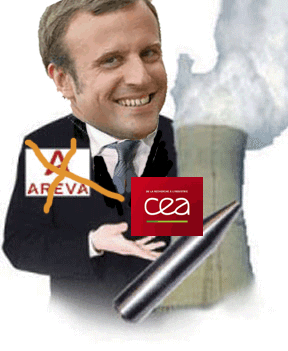 Macron talks nuclear energy and ways to control militias during Iraq visit, The National , Khaled Yacoub Oweis, Sep 2, 2020French PM is the most significant leader to visit Iraq since Prime Minister Mustafa Al Kadhimi came to power in May
During a visit to Baghdad on Wednesday, French President Emmanuel Macron discussed solving Iraq’s massive power shortages with nuclear energy ……. Mr Kadhimi told reporters in Baghdad that he discussed with Mr Macron “a future project” to use nuclear energy to produce electricity and solve decades-long power shortages……..
If realised, the project would place Iraq along with the UAE and Iran as the only Middle East countries with electricity produced by a nuclear reactor. ………. https://www.thenational.ae/world/mena/macron-talks-nuclear-energy-and-ways-to-control-militias-during-iraq-visit-1.1071729
Wylfa nuclear project – a contentious issue in Wales
Wales’ controversial nuclear history and what comes next as D-Day approaches for Wylfa One of Wales’ most contentious projects is facing a possible D-Day next month but opinion remains divided about nuclear power on the isle of Anglesey, Wales Online, 31 AUG 2020
….since its announcement it has been met with a mixture of hope, optimism, and concern from campaigners and local politicians.
It has also been dogged by delays and uncertainty in the decade since it was confirmed Wylfa would get a new nuclear plant……. as we approach possible clarity on a long-proposed and controversial project, what do those closest to the project think?
People Against Wylfa B (or Pawb, meaning ‘everyone’ in Welsh) was set up in the late 1980s and opposes the establishment of a new nuclear plant in north Wales.
One of its leading members, Robat Idris, explained that the history of nuclear power’s prominence in the Anglesey region goes back more than 60 years.
“The development of the UK nuclear programme was part of the Cold War strategy of the government at the time,” he said.
“The Thatcher government wanted to start a programme of building nuclear reactors, which were then shelved. At the time there was strong opposition across the political parties, except the Tories, to nuclear in Wales.”………
the concerns shared by Pawb go deeper than local politics and economics. The dangers associated with nuclear power are well-documented.
Despite being more than 2,000 miles away, farms over 53,000 hectares in north Wales felt the effects of the 1986 Chernobyl disaster, with many restrictions placed on farms due to radioactive particles in the soil and vegetation.
This threatened livelihoods across Wales for decades. Some restrictions in areas like Snowdonia were only lifted as recently as 2012.
Often smaller incidents at nuclear stations are not reported on a national scale or are discovered belatedly. At the Sellafield nuclear site, off the coast of Cumbria, between 1950 and 2000 there were 21 incidents or accidents involving off-site radiological releases that warranted a rating on the International Nuclear Event Scale.
“Historical effects like Chernobyl and Fukushima show that if things go wrong they go wrong dramatically,” Mr Idris said.
“With capitalist extractive models you take what you want and leave the rest. Even though nothing has been built yet there has already been changes to the topography of the area – flattening of hills and demolishing of houses and purchasing of land from farmers.”…….
“We have concerns about the idea that nuclear energy is low-carbon. But it is only low-carbon in the actual production – not in the building and construction, mining of uranium, or other elements,” Mr Idris said.
“There is also an unknown element to the decommissioning process – you are talking about centuries after production stops before a site is safe.”……………………………….
Not all are convinced that Wylfa is the magic pill that will transform Anglesey’s fortunes ……….
we’ve had this salvation of nuclear in the 60s and 70s, and Anglesey is still one of the poorest areas.
“Renewables are coming in more – falling costs, improvements in storage technology. The technology is there and just needs to be purchased.
“It comes back to a lack of a plan B – why haven’t other credible scenarios been presented?”……..
With the impending decision from the UK Government it appears increasingly likely that clarity is coming either way.
If permission is granted then the final hurdle will be arranging funding between the UK Government and the company – something which has proven elusive thus far……… https://www.walesonline.co.uk/news/wales-news/nuclear-power-wales-anglesey-wylfa-18836063
The Assange extradition hearing – a continued travesty of justice

 Assange Travesty Continues https://www.craigmurray.org.uk/archives/2020/08/assange-travesty-continues/?fbclid=IwAR2MvHqWNmC2Z7gpPI3I24-XwXRvFGIUFmxoa5LgBm5vJqgDJ3BxSDexU4U
By 7 September it will be six months since I applied to resume my membership of the National Union of Journalists. I STILL have not the slightest idea who objected, or what the grounds were for objection. I have not heard from the NUJ for months. A senior official of an international journalists’ organisation has told us that he inquired, and learnt that the NUJ national executive has considered my application and set up a sub-committee to report. But if so, why is this secret, why have I not been informed, and why am I not allowed to know what the objection is? I find this all very sinister. At this stage it is not paranoid to wonder whose hand is behind this.
The practical effect of this is that without NUJ membership I cannot access a Press card, and avail myself of whatever media arrangements are in place for the Assange hearing (just as I was kept out of most of the Salmond trial). I have now reached the stage where I would like to take legal action against the NUJ, but the finances are beyond me. I am not going to ask you to donate because we are going to need all our resources for the contempt case against me, which the Crown drags out.
I shall be writing next week about my own case and that hearing earlier this week. I would just note now that the “virtual hearing” is entirely unsatisfactory and unfair on defendants. There was at least one occasion when my QC agreed with a suggestion of the judge when I would have instructed them not to had I been, as I should normally have been, seated near them in court and able to instruct.
Unlike our adversaries including the Integrity Initiative, the 77th Brigade, Bellingcat, the Atlantic Council and hundreds of other warmongering propaganda operations, this blog has no source of state, corporate or institutional finance whatsoever. It runs entirely on voluntary subscriptions from its readers – many of whom do not necessarily agree with the every article, but welcome the alternative voice, insider information and debate.
Cracks in UK’s Hunterston and other very old nuclear reactors
 Radio Scotland (From 1:41:33) 29th Aug 2020, Rob Edwards speaking about Hunterston. The lifetime of Hunterston has been extended 3 times. The problem is these very old reactors have developed all
these cracks.
Reactor 3 has an estimated 377 cracks. Reactor 4 has 209.
Those are only estimates based on looking at a part of the core. They have
underestimated the number of cracks that would appear in the past. If you
have too many cracks you get bits of debris breaking off so the graphite
core of these reactors start to crumble and that in some scenarios could
cause the core to overheat.
They are balancing how much money they can make
out of the plants against a leak. Climate change has been used by the
industry to try to make themselves look better. Hunterston has been closed
for most of the last two years.
The closure of Hunterston B will not cause power network outages
|
Insider Media 28th Aug 2020, The closure of Hunterston B will not cause power network outages,
Scotland’s energy minister Paul Wheelhouse has insisted. The nuclear power station is to close by January 2022, according to operator EDF Energy, almost two years earlier than expected. Last year, Scottish Gas owner
Centrica blamed interruption of electricity supply from Hunterston for loss of income. Wheelhouse reiterated the Scottish Government’s position that no new nuclear power stations should be built in Scotland, with energy generated by renewable sources instead. He said that for a two-month period
in 2018, Hunterston B was entirely offline and the Torness nuclear power station in East Lothian was operating at reduced capacity, but it caused no issues for the energy supply. Wheelhouse told the BBC: “Scotland, in the last year for which we got full statistics, exported a net 15.9 terawatt hours of energy – which dwarfs the output of Hunterston.” https://www.insider.co.uk/news/energy-minister-hunterston-closure-not-22593000 |
|
Nuclear colonialism. ICAN says that France must clean up its nucleat test wastelands in Algeria

France must clean up Algerian nuclear test sites: group, https://www.france24.com/en/20200826-france-must- clean-up-algerian-nuclear-test-sites-group 28 Aug 20, France must clean up nuclear test sites in Algeria where radioactive waste remains from testing in the former colony during the 1960s, a Nobel Peace Prize-winning group said Wednesday.
France carried out 17 nuclear explosions in the Algerian part of the Sahara Desert between 1960 and 1966.
Eleven of the tests came after the 1962 Evian Accords ended the six-year war of independence and 132 years of colonial rule.
“France must give the Algerian authorities the full list of where the contaminated toxic waste was buried,” the International Campaign to Abolish Nuclear Weapons (ICAN) said in a new 60-page report.
“The ‘nuclear past’ must no longer remain deeply buried under the sand,” ICAN said, citing the concerned areas as the western Reggane region and a zone close to the In Ekker village.
The campaign group identified contaminated, radioactive elements that have either been buried, or are easily accessible.
“The majority of the waste is in the open air, without any security, and accessible by the population, creating a high level of sanitary and environmental insecurity,” ICAN said.The 2017 Nobel Peace Prize laureate group added that almost nothing has been done to clean the sites, inform the populations and evaluate the risks.
Exposure to radioactive material can cause cancer.
“This case study shows once more an asymmetry of power and an injustice that we find all through nuclear history,” Giorgio Franceschini, director of the Heinrich Boll Foundation which published the report, said in his forward.
“It is not a coincidence that France tested its first nuclear weapon in Algeria, that was still a French colony in 1960,” he added.
France refused to sign up the UN’s 2017 Treaty on the Prohibition of Nuclear Weapons, whereas Algeria signed and is in the process of ratifying the legally binding agreement.
Since Algeria’s independence, Franco-Algerian relations have been tumultuous.
Algerian President Abdelmadjid Tebboune in July called on France to fully apologise for its colonial past.
An apology could “make it possible to cool tensions and create a calmer atmosphere for economic and cultural relations”, especially for the more than six million Algerians who live in France, he said.
Water shortage, drought, necessitate shutdown of France’s Chooz Nuclear Plant

 Nuclear reactor in France shut down over drought, Chooz Nuclear Plant on Belgian border turned off after dry summer evaporates water needed to cool reactors, AA, Cindi Cook |25.08.2020 A nuclear power plant in northern France has been temporarily shuttered due to a drought in the area, said the company that runs the plant Tuesday.
The second reactor of the Chooz Nuclear Power Plant, in Ardennes, on the Belgian border, was shut down late Monday night, after the first reactor ceased operations Friday evening.
The actions were taken due to low water levels in the Meuse River, the main artery that runs through the area used to cool the two reactors.
The plant is named after Chooz, the commune where it is located in the Ardennes. The region is on level three of four drought alert levels…….
Water is a crucial ingredient for nuclear plant safety to cool the reactor core. ……
Water restrictions have been imposed this summer in 79 out of the 96 mainland departments in France due to drought conditions. https://www.aa.com.tr/en/europe/nuclear-reactor-in-france-shut-down-over-drought/1952943
A series of safety problems bring EDF’s decision on early shut down of Scotland’s Hunterston nuclear station
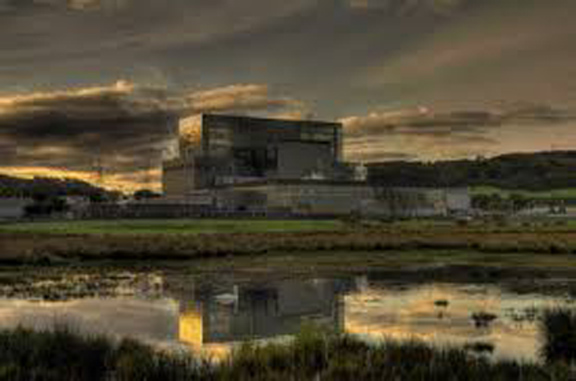
Scottish nuclear power station to shut down early after reactor problems
EDF Energy to close Hunterston next year after spending £200m on repairs, Guardian, Severin Carrell and Jillian Ambrose, Fri 28 Aug 2020 Hunterston nuclear power station, one of the UK’s oldest remaining nuclear plants, is to close down next year, earlier than expected, after encountering a series of safety-critical problems in its reactors.
Industry sources told the Guardian that EDF Energy, the state-owned French operator of Hunterston, decided at a board meeting on Thursday afternoon that the plant would stop generating electricity in late 2021, at least two years earlier than planned.
The energy company had hoped to keep generating electricity from the 44-year-old nuclear plant on the Firth of Clyde until 2023, after ploughing more than £200m into repairing the reactor.
Hunterston, which first began generating electricity in 1976, has been offline since 2018 after inspectors discovered 350 microscopic cracks in the reactor’s graphite core.
In October last year the Ferret, an investigative website, reported that at least 58 fragments and pieces of debris had fallen off the graphite blocks as the cracks worsened. It quoted the Office for Nuclear Regulation (ONR) as saying this had created “significant uncertainty” about the risks of debris blocking channels for cooling the reactor and causing fuel cladding to melt.
After a two-year investigation, the ONR said on Thursday that reactor 3 at Hunterston would be allowed to restart as planned, but it would only be allowed to generate electricity for approximately six months.
EDF then plans to apply next spring to extend its life for one final six-month run. EDF said it would begin the process of decommissioning Hunterston no later than the first week of 2022…….
Richard Dixon, the director of Friends of the Earth Scotland, said: “In terms of energy security, clearly there’s no problem. Its reactors haven’t been running and the lights haven’t gone out. What’s more urgent now is to build up renewables and energy efficiency, to make sure the gap left by Hunterston is filled by zero-carbon electricity or energy saving.” ……… https://www.theguardian.com/uk-news/2020/aug/27/hunterston-scottish-nuclear-power-station-to-shut-down-early-after-reactor-problems
Kazakhstan’s moves toward a world free of nuclear weapons
 Leading the way to a world free of nuclear weapons, Today more than ever, the world needs leadership in the field of nuclear non-proliferation and disarmament. Kazakhstan keeps providing this leadership, writes Jonathan Granoff. https://www.euractiv.com/section/central-asia/opinion/leading-the-way-to-a-world-free-of-nuclear-weapons/ 28 Aug 20, Jonathan Granoff is the president of the Global Security Institute.In 1949, the first of over 450 nuclear explosive tests, surprised the residents in towns and villages in the northeast corner of Kazakhstan. The sky lit up with a blinding flash of light followed by an enormous mushroom cloud. In houses books falling from shelves and the crashing of dishes could be heard. They had not been forewarned.
For the next forty years, silently, in the bodies of at least one and half million citizens the consequence of the radioactive fall-out of those hundreds of explosions inflicted numerous diseases such as cancer and horrible birth defects. Not only did the explosions cause cracks in houses and roads.
It caused the crack of tragedy in the hearts of millions. The people of Kazakhstan, because of those nuclear tests in the windswept steppe test site at Semipalatinsk, know all too well the reality of nuclear weapons
Millions of activists worldwide in the late 1980s protested nuclear testing, prominent amongst those protests was the Nevada-Semipalatinsk Movement, bringing together the voices of citizens of the USA and the then Soviet Union.
The protesters in Kazakhstan demonstrated enormous courage for they were still living in a system where political repression posed serious dangers.
But times changed and that became very clear when Kazakhstan’s First President, Nursultan Nazarbayev, came into office. He did not ignore or avoid addressing these dreadful devices and their national and global impact.
He set out to bring his sense of responsibility as a witness to the reality of nuclear weapons into meaningful action, not only for his nation but also for the world.
First and foremost, he supported the brave activists who protested the testing in Kazakhstan and he signed the historic Decree shutting down the Semipalatinsk test site on 29 August 1991.
It should be noted Kazakhstan was then still part of the Soviet Union. In his speeches, Nazarbayev has always emphasized that the closure expressed the will of the people.
This bold gesture helped stimulate a moratorium on testing which has to this day restrained the five permanent members of the Security Council and holders of more than 97% of the world’s nuclear arsenals (the P5) – United States, Russia, China, United Kingdom, and France from further testing.
It also gave momentum to the global movement to create a treaty to end all nuclear testing, the Comprehensive Test Ban Treaty (CTBT). 29 August is now the International Day against Nuclear Tests. It was established on December 2, 2009 at the 64th session of the United Nations General
Soon after the Soviet Union collapsed, Kazakhstan, under the leadership of Nazarbayev, set a precedent in world history by abandoning the world’s 4th largest nuclear arsenal and the status of a de facto nuclear power.
This decision was crucial not only for the formation and further development of Kazakhstan but also had far-reaching global consequences. Kazakhstan had inherited more than 100 stationary-based missiles with about 1,400 nuclear warheads.
In addition, 40 strategic Tu-95 MS bombers with 240 cruise nuclear missiles were deployed in Kazakhstan. Giving up this powerful arsenal gained the nation enormous international good will and recognition, and the moral credibility to demand progress on legal duties of all nuclear weapons states to negotiate the universal elimination of nuclear weapons.
Nazarbayev’s strategic decision was instrumental in stimulating confidence in the maturity of independent Kazakhstan. It remains an action of national pride and international respect.
Kazakhstan also set out to address the nuclear non-proliferation problem. In 2017, under the leadership of Nazarbayev, it created the world’s first bank for low enriched uranium under the auspices of the International Atomic Energy Agency.
This unique mechanism provides countries around the world with the opportunity to develop peaceful nuclear energy without the need to create their own uranium enrichment programs, which represents a proliferation danger.
Kazakhstan has also become an active participant in absolutely all basic international treaties and institutions in the field of non-proliferation of nuclear weapons and a strong contributor to stability in the world.
For example, under Nazarbayev’s leadership, it was a leading contributor in the creation of the Central Asian Nuclear-Weapon-Free Zone (CANWFZ) signed into force by Kyrgyzstan, Tajikistan, Turkmenistan and Uzbekistan on 8 September 2006.
Current President Kassym-Jomart Tokayev is continuing the country’s nuclear non-proliferation and disarmament commitments. The world needs leadership today in this field more than ever.
The Nursultan Nazarbayev Foundation has established the “Nazarbayev Prize for Nuclear Weapon Free World and Global Security”, which is awarded every 2 years on 29 August for outstanding contributions to non-proliferation and disarmament.
It was first presented in 2017 to King of Jordan Abdullah II. In 2019, the laureates were the Executive Secretary of the CTBTO Preparatory Commission, Lassina Zerbo and former IAEA Director-General Yukio Amano (posthumously).
In 2012, Nazarbayev announced the launch of the ATOM Project (Abolish Testing – Our Mission). ATOM is an online petition to world governments to forever abandon nuclear testing and to bring the Comprehensive Nuclear-Test-Ban Treaty into force as soon as possible.
Speaking at the 70th session of the UN General Assembly in September 2015, Kazakhstan’s First President called for making the construction of a world without nuclear weapons the main goal of mankind in the 21st century and the adoption of the UN Universal Declaration on a Nuclear-Weapon-Free World.
In 2016, in his Manifesto: The World, The 21st Century”, Nazarbayev sets forth a comprehensive vision to move toward a world without reliance on militarism and war, but based on a cooperative human-centred approach to security. Now, a recognized official UN document, it contains realistic policy proposals worthy of serious debate today.
The solution of many problems in the field of global security, conflict prevention and resolution, and especially nuclear disarmament depend on the availability of environments and platforms for honest debate and dialogue.
President Nazarbayev thus established the Astana Club – a forum where annually more than 50 world renown politicians and experts discuss current security issues in Eurasia and beyond.
In November 2019, as part of the fifth meeting of the Club, Nazarbayev initiated the creation of an authoritative political platform, the Global Alliance of Leaders for a Nuclear-Free World.
GAL is an alliance of leaders that will allow for an open dialogue with members of the “nuclear club” and make a feasible contribution to strengthening global security.
Kazakhstan, within the framework of the GAL, will act as a neutral dialogue platform for both nuclear and non-nuclear states.
Those who have already supported the project and expressed their readiness to contribute to the implementation of this initiative include former heads of state, heads of international organizations and famous experts: Heinz Fischer (Austrian Federal President 2004-2016), Mohammed El-Baradei, IAEA Director General 1997-2009, Nobel Peace Prize Laureate), Lassina Zerbo (CTBTO Executive Secretary), and others of similar stature.
Nazarbayev, stimulated by perestroika and President Mikhail Gorbachev’s new thinking, developed a vision of a peace loving, open minded, dynamic nation respectful of the rule of law that could be a responsible actor in world affairs.
A bold perspective given the turbulence of these times, it requires diligent and courageous perseverance and a people of enormous dynamism to help advance it, including finding a path to ensuring that the ethnic and religious diversity of their nation can remain harmonious and not lead to conflict as it has been the case so many times in other places. Again, Kazakhstan is providing a good example.
EDF’s Hunterston ageing nuclear power station kept going in effort to prolong all EDF’s old reactors
The Ferret 27th Aug 2020, The energy company, EDF, is planning to operate a cracked and ageingnuclear power station at Hunterston in North Ayrshire for another year before closing it down for good. The company is hoping to restart the two 44-year-old reactors at the site for two last six-month periods and then
begin decommissioning them “no later than 7 January 2022”.
being put at risk. They are calling for the plant to be permanently closed down now. The 50-strong group of Nuclear-Free Local Authorities in the UK demanded that both reactors never re-open. “The safest thing to do is to
close Hunterston B and start accelerated decommissioning of its reactors,” said the group’s Scottish convener, Glasgow SNP councillor Feargal Dalton. “We totally disagree with EDF that decommissioning should start in 2022. It should happen now for the sake of public safety.” He added: “The fact it has taken two years and much resource from EDF to provide sufficient information to the ONR to allow a restart to take place is indicative of the level of risk over the structural integrity of these reactors.”
been in such a financial pickle long before the virus hit,” he added.https://theferret.scot/hunterston-cracked-nuclear-reactors-another-year/
UK’s Dounreay nuclear power site, opened in 1955, closed 1994, cleaned up in 2333, if they’re lucky

Dounreay on Scottish north coast has been site of considerable radioactive leaks https://www.independent.co.uk/environment/nuclear-power-dounreay-scotland-thurso-decommissioning-radiation-a9680611.html Harry Cockburn, Thursday 20 August 2020 In 313 years’ time, 378 years after it first opened in 1955, and 339 years after it ceased operations in 1994, the 178-acre nuclear power facility site at Dounreay will be safe for other uses, a new report has stated.
Though the site on the north coast of Scotland was only home to functioning nuclear reactors for 39 years, the clean-up will take roughly ten times as long, with efforts already underway to clean up hazardous radioactive material.
The facility, near Thurso, was used by the government for research and testing of various types of nuclear reactors, including a “fast reactor” and those intended for use on nuclear submarines.
The first reactor at the site to provide power to the National Grid was the Dounreay Fast Reactor, which provided power between 1962 and 1977. A second reactor also pumped power into the grid between 1975 and 1994.
A draft report from the government’s nuclear decommissioning authority states the site will only be ready for other uses after the year 2333.
Over the next two years, Dounreay Site Restoration Limited has said it will undertake assessments of “installations, current and future disposals, areas of land contamination, sub-surface structures and other discrete site conditions” to determine “credible options for the site end state”.
A process of demolition of buildings and waste removal is already underway at the site, which has previously been used to store dangerous radioactive material.
Part of the demolition process has involved the use of a remote controlled robot nicknamed the “Reactosaurus”, a 75-tonne device with radiation-proof cameras, and robotic arms which are able to reach 12 metres into the reactors where they can operate an array of size-reduction and handling tools, including diamond wire and disks and hydraulic shears.
One of the areas targeted for waste removal is a highly contaminated area called the Shaft.
The water reacted violently with the sodium and potassium, throwing off the massive steel and concrete lids of the shaft, and littered the area with radioactive particles.
The dangerous pollution affected local beaches, the coastline and the seabed. Fishing has been banned within a two-kilometre radius of the plant since 1997.
Milled shards from the processing of irradiated plutonium and uranium, are roughly the size of grains of grains of sand. The most radioactive of the particles are believed to be potentially lethal if ingested. These small fragments are known to contain caesium-137, which has a half-life of 30 years, but they can also incorporate traces of plutonium-239, which has a half-life of over 24,000 years.
1 This Month
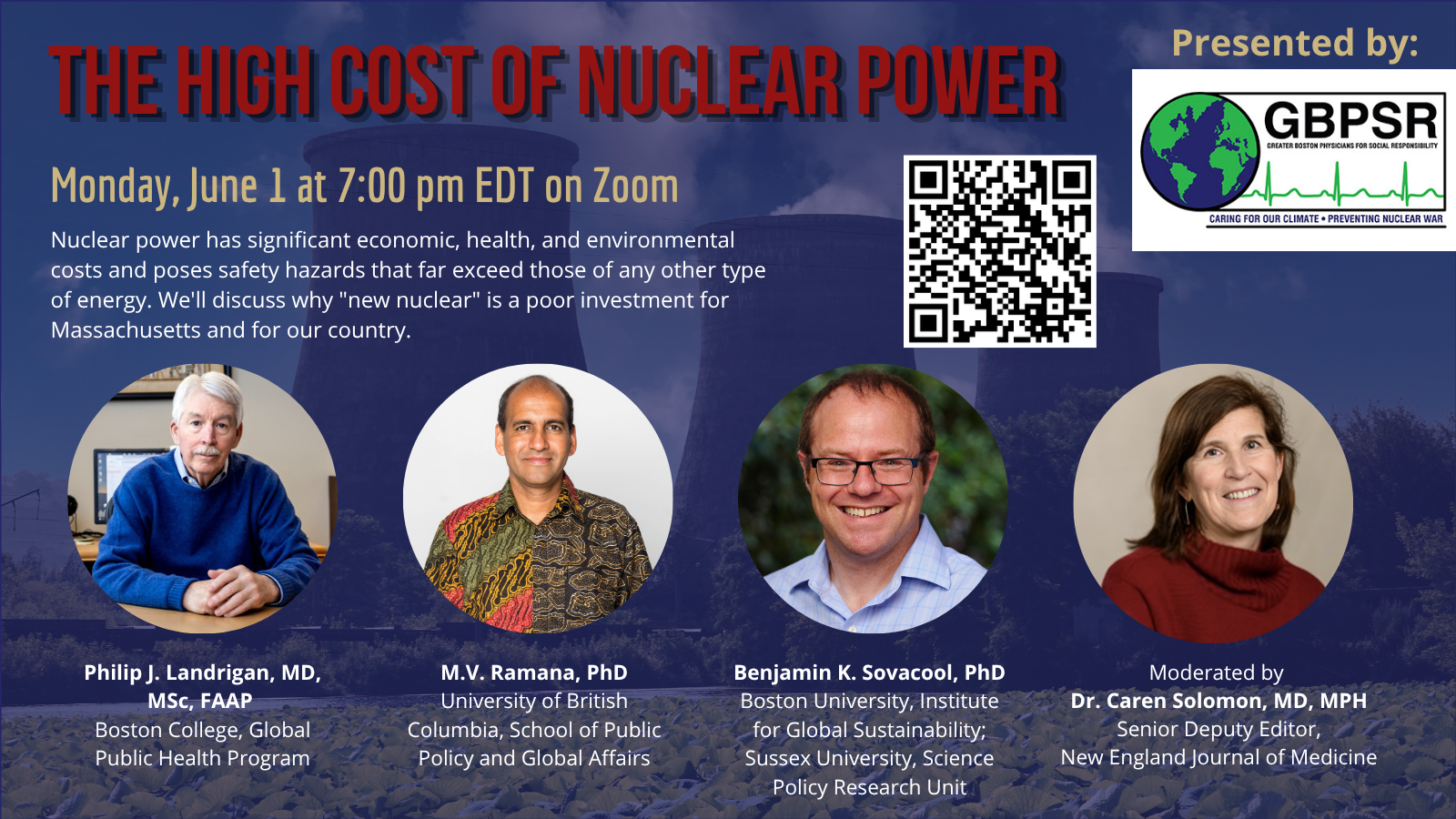
1 June Webinar – The High Cost of Nuclear Power – Register


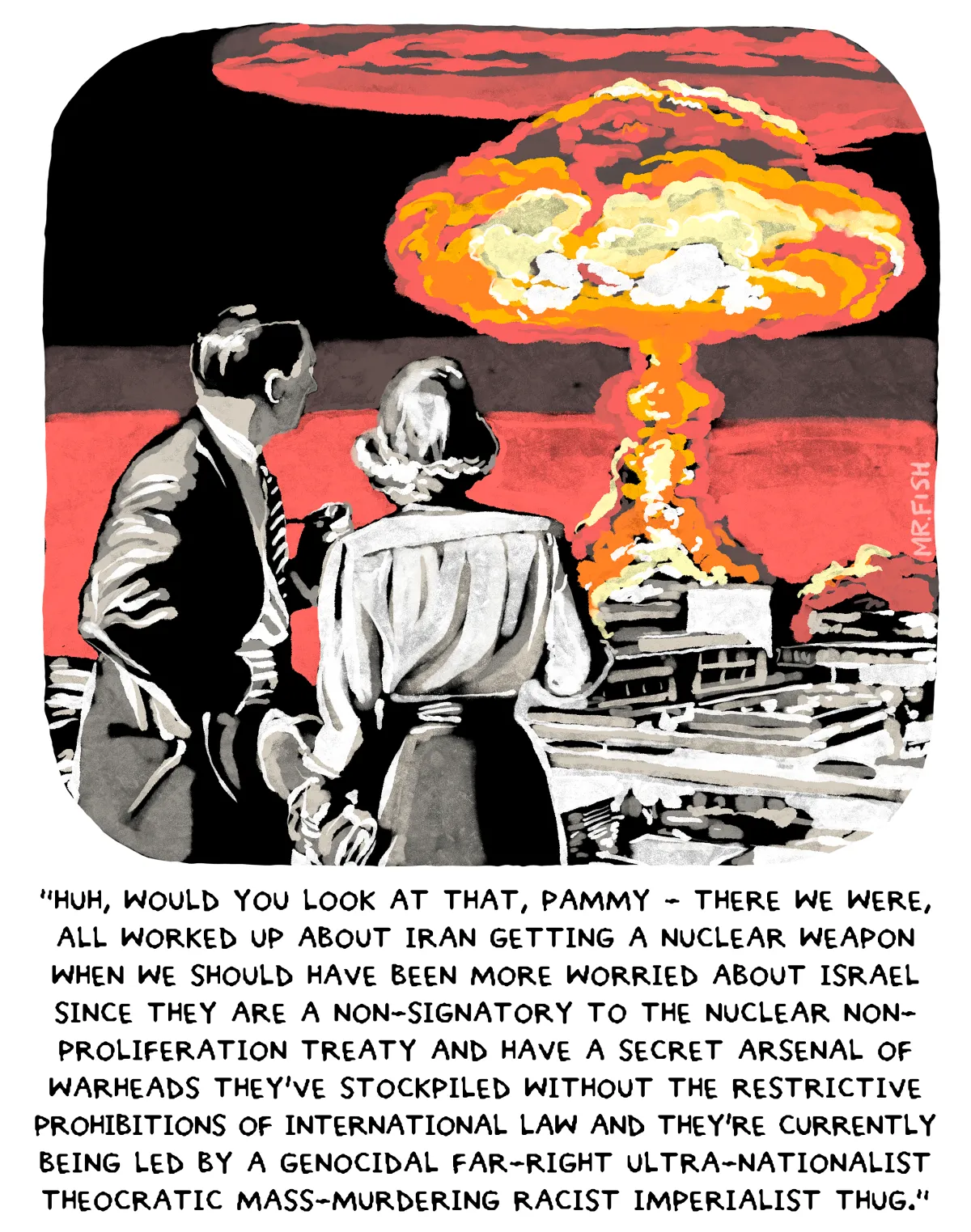
of the week– Nuclear Reactor Information Task Force
To see nuclear-related stories in greater depth and intensity – go to https://nuclearinformation.wordpress.com
-
Archives
- May 2026 (225)
- April 2026 (356)
- March 2026 (251)
- February 2026 (268)
- January 2026 (308)
- December 2025 (358)
- November 2025 (359)
- October 2025 (376)
- September 2025 (257)
- August 2025 (319)
- July 2025 (230)
- June 2025 (348)
-
Categories
- 1
- 1 NUCLEAR ISSUES
- business and costs
- climate change
- culture and arts
- ENERGY
- environment
- health
- history
- indigenous issues
- Legal
- marketing of nuclear
- media
- opposition to nuclear
- PERSONAL STORIES
- politics
- politics international
- Religion and ethics
- safety
- secrets,lies and civil liberties
- spinbuster
- technology
- Uranium
- wastes
- weapons and war
- Women
- 2 WORLD
- ACTION
- AFRICA
- Atrocities
- AUSTRALIA
- Christina's notes
- Christina's themes
- culture and arts
- Events
- Fuk 2022
- Fuk 2023
- Fukushima 2017
- Fukushima 2018
- fukushima 2019
- Fukushima 2020
- Fukushima 2021
- general
- global warming
- Humour (God we need it)
- Nuclear
- RARE EARTHS
- Reference
- resources – print
- Resources -audiovicual
- Weekly Newsletter
- World
- World Nuclear
- YouTube
-
RSS
Entries RSS
Comments RSS
 nuclear-news