The real reason for “civil” Small Nuclear Reactors- to supply expertise and technology for the nuclear weapons industry
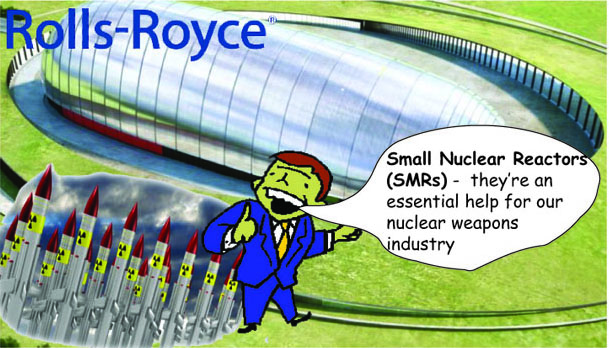
 How investment in SMRs supports “defense nuclear programs” https://concernedcitizens.net/2020/12/19/how-investment-in-smrs-supports-defense-nuclear-programs/comment-page-1/?unapproved=2198&moderation-hash=3219adce054494626a5ee71e323fef71#comment-2198 How investment in SMRs supports “defense nuclear programs” https://concernedcitizens.net/2020/12/19/how-investment-in-smrs-supports-defense-nuclear-programs/comment-page-1/?unapproved=2198&moderation-hash=3219adce054494626a5ee71e323fef71#comment-2198
1. Rolls-Royce, 2017, ‘UK SMR: A National Endeavour’, https://www.uknuclearsmr.org/wp-content/uploads/2017/09/V2088-Rolls-Royc… “The indigenous UK supply chain that supports defence nuclear programmes requires significant ongoing support to retain talent and develop and maintain capability between major programmes. Opportunities for the supply chain to invest in new capability are restricted by the limited size and scope of the defence nuclear programme. A UK SMR programme would increase the security, size and scope of opportunities for the UK supply chain significantly, enabling long-term sustainable investment in people, technology and capability. “Expanding the talent pool from which defence nuclear programmes can draw from would bring a double benefit. First, additional talent means more competition for senior technical and managerial positions, driving excellence and performance. Second, the expansion of a nuclear-capable skilled workforce through a civil nuclear UK SMR programme would relieve the Ministry of Defence of the burden of developing and retaining skills and capability. This would free up valuable resources for other investments.” |
|
Russian environmental defenders under attack
For future updates follow RSEU on facebook.
For more information contact:
Vitaly Servetnik,
Russian Social-Ecological Union / Friends of the Earth Russia
Email: vitservetnik@gmail.com
Program Area: Environmental Human Rights Defenders
Member Group: Russian Social Ecological Union (RSEU)
EDF did a small survey of Suffolk community opinion -weighted to favour nuclear industry?
Suffolk towards the building of a new nuclear power station on the coast.
The survey was carried out by a company called ICM Unlimited on behalf of
EDF, which is looking to build the Sizewell C station. ICM interviewed a
representative sample of 500 adults in east Suffolk over the phone between
November 5 and November 19.
dismissed the research as “meaningless”, saying a sample of 500 people – in
an area with a population of 247,000 – was “hardly representative”. All
those that took part in the survey live in the area with data having been
weighted to the population profile of the East Suffolk Council adult
population.
https://www.eadt.co.uk/news/sizewell-c-survey-shows-favourable-results-6854678
Sizewell C nuclear plan – a disastrous and expensive mistake
heritage coast, but quite possibly the entire county, could be changed for
ever by the arrival of two new European pressurised reactors (EPRs).
‘Sizewell C, a proposed new nuclear power station in Suffolk, has the
potential to generate the reliable low carbon electricity the country needs
for decades to come’ is the claim made by EDF Energy, the French-owned
company behind the project. It also has the potential to be a disastrous
and expensive mistake. Many believe it already is.
https://www.spectator.co.uk/article/building-sizewell-c-would-be-a-nuclear-sized-disaster#
Ipswich Council raises fresh worries about Sizewell nuclear power plan
nuclear power station project on the Suffolk coast, citing train concerns
and impacts on housing as key worries.
consultation last month after tweaking plans for the £20billion scheme,
with Ipswich Borough Council’s planning committee on Wednesday agreeing its
response.
movements by rail on the East Suffolk Line should have regard to noise and
air quality disturbance; questions over the impact freight transport would
have on the Ipswich Garden Suburb development being built at the north of
the town; and fears that the extra freight by rail could reduce the number
of passenger trains on the East Suffolk Line – a key commuter route and
sustainable mode of transport. EDF agreed to transport more construction
materials by rail and sea in a bid to take hundreds of lorries off the road
during the construction, a move that would cut road haulage by 20%,
according to the developers.
https://www.eadt.co.uk/news/local-council/ipswich-borough-council-sizewell-c-consultation-response-6855812
34 years later, food crops near Chernobyl still contain ionising radiation
 Unsafe levels of radiation found in Chernobyl crops, By Harry Baker – Staff Writer https://www.livescience.com/chernobyl-radioactive-isotopes-crops.html– 19 December 20, The effects of the explosive 1986 disaster can still be seen in nearby crops.
Crops grown near the Chernobyl nuclear site in Ukraine are still contaminated with radiation from the explosive 1986 disaster.
In a new study, researchers found that wheat, rye, oats and barley grown in this area contained two radioactive isotopes — strontium 90 and cesium 137 — that were above safe consumption limits. Radioactive isotopes are elements that have increased masses and release excess energy as a result.
“Our findings point to ongoing contamination and human exposure, compounded by lack of official routine monitoring,” study author David Santillo, an environmental forensic scientist at Greenpeace Research Laboratories at the University of Exeter, said in a statement, referring to the fact that the government suspended its radioactive goods monitoring program in 2013.
Santillo and his colleagues, in collaboration with researchers from the Ukrainian Institute of Agricultural Radiology, analyzed 116 grain samples, collected between 2011 and 2019, from the Ivankiv district of Ukraine — about 31 miles (50 kilometers) south of the nuclear plant.
This area is outside of Chernobyl’s “exclusion zone,” which is a 30 mile (48 km) radius around the plant that was evacuated in 1986 and has remained unoccupied. They found radioactive isotopes, predominantly strontium 90, were above safe consumption level in 48% of samples. They also found that wood samples collected from the same region between 2015 and 2019, had strontium 90 levels above the safe limit for firewood.
The researchers believe that the lingering radiation in the wood, in particular, may be the reason for the continued contamination of crops, almost 35 years after the disaster. When analyzing the wood ash from domestic wood-burning ovens, they found strontium 90 levels that were 25 times higher than the safe limit. Locals use this ash, as well as ash from the local thermal power plant (TPP), to fertilize their crops, which continues to cycle the radiation through their soil.
However, computer simulations suggest that it could be possible to grow crops in the region at “safe” levels if this process of repeated contamination ceased. The researchers are now calling for the Ukrainian government to reinstate its monitoring program and create a system for properly disposing of radioactive ash.
“Contamination of grain and wood grown in the Ivankiv district remains of major concern and deserves further urgent investigation,” study author Valery Kashparov, director of the Ukrainian Institute of Agricultural Radiology, said in the statement. “Similarly, further research is urgently needed to assess the effects of the Ivankiv TPP on the environment and local residents, which still remain mostly unknown.”
The findings were published on Dec. 17 in the journal Environment International.
Originally published on Live Science.
Big boasts for small nuclear reactors on ships – but a recipe for disaster?
 Floating ‘mini-nukes’ could power countries by 2025, says startup, Danish company plans to fit ships with small nuclear reactors to send energy to developing countries, Guardian, Jillian Ambrose, 18 Dec 2020
 Floating barges fitted with advanced nuclear reactors could begin powering developing nations by the mid-2020s, according to a Danish startup company.Seaborg Technologies believes it can make cheap nuclear electricity a viable alternative to fossil fuels across the developing world as soon as 2025……..
Seaborg has raised about €20m (£18.3m) from private investors, including the Danish retail billionaire Anders Holch Povlsen, and received the first of the necessary regulatory approvals within a four-phase process from the American Bureau of Shipping this week. ….
Seaborg hopes to begin taking orders by the end of 2022 for the nuclear barges, which would be built in South Korean shipyards and towed to coastlines where they could be anchored for up to 24 years, he said. ……….
Seaborg’s design would be one of the first examples of a commercially available nuclear barge used to provide electricity to the mainland.
Chris Gadomski, a nuclear analyst at Bloomberg New Energy Finance, said: “The concept of a floating nuclear power plant has been around for a long time, and makes a lot of sense. But there are concerns.” There was inherent risk involved with nuclear reactor technologies and floating power plants, so combining to two could raise serious questions for investors and governments, he said.
“In places like the Philippines and Indonesia it makes a lot of sense. But it wasn’t so long ago that the Philippines was the site of a major tsunami, and I don’t know how you would hedge against a risk like that,” he added.
Jan Haverkamp, from Greenpeace, said floating reactors were “a recipe for disaster” including “all of the flaws and risks of larger land-based nuclear power stations”. “On top of that, they face extra risks from the unpredictability of operation in coastal areas and transport – particularly in a loaded state – over the high seas. Think storms, think tsunamis,” he said. ……..https://www.theguardian.com/environment/2020/dec/17/floating-mini-nukes-could-power-countries-by-2025-says-startup
Doubts about planned Berkshire ”garden town”, because it’s too close to AWE nuclear weapons factory
BBC 15th Dec 2020, Plans to build a new “garden town” could be scrapped over concerns about a
potential nuclear emergency. The proposed 15,000-home development in
Grazeley is within a couple of miles of nuclear weapons factory AWE
Burghfield. The Office for Nuclear Regulation has extended a “detailed
emergency planning zone” (DEPZ) for the plant, taking in most of the site
earmarked for homes.
That means anyone living in the zone could be affected
by a “reasonably foreseeable” radiation emergency. Three Berkshire councils
that have worked jointly on the plans are now considering shelving the
project, according to the Local Democracy Reporting Service (LDRS).
Russian hackers evaded layers of U.S. security to attack America’s military and intelligence agencies
 New York Times 14th Dec 2020, The scope of a hack engineered by one of Russia’s premier intelligence agencies became clearer on Monday, when some Trump administration officials acknowledged that other federal agencies — the State Department, the Department of Homeland Security and parts of the Pentagon — had been compromised. Investigators were struggling to determine the extent to which the military, intelligence community and nuclear laboratories were affected by the highly sophisticated attack.
https://www.nytimes.com/2020/12/14/us/politics/russia-hack-nsa-homeland-security-pentagon.html
Why is UK govt taking the financial and flooding risk of Sizewell nuclear, when renewables are clearly safer and cheaper?
 Tax Research UK 16th Dec 2020, There is an article in the FT this morning that suggests something that
should be obvious, but needs saying. And that is that renewable energy is
now bringing deflation into the energy market.
Management. As he puts it: With the US poised to rejoin the Paris Agreement
under the incoming Biden administration and the proliferation of net-zero
commitments from various governments, the romance between equity markets
and renewable-energy goes from strength to strength.
overlooked: the underlying reason for the astonishing transformation of
renewables over the past decade from niche to mainstream competing
head-to-head with fossil fuels is economic rather than environmental.
fuels are intrinsically inflationary. This has huge implications for the
distribution of value across the global energy system over the next three
decades.
on the Suffolk coast where the chance that it will be flooded within the
foreseeable future is high? I wish I knew. We now have the option of viable
energy to sustain the transition we need. More investment in it only
increases its appeal. And yet still we stick with the harmful solutions. I
have never got this. I never will.
Law and Disorder: The case of Julian Assange
 In the case of Julian Assange, what is on trial is nothing less than our right to know what is done by governments in our name, and our capacity to hold power to account.

Law and Disorder: The case of Julian Assange, DiEM25, By Pam Stavropoulos | 10/12/2020,
What kind of law allows pursuit of charges under the 1917 United States Espionage Act — for which there is no public interest defence — against a journalist who is a foreign national?
The closing argument of the defence in the extradition hearing of WikiLeaks founder and publisher Julian Assange has been filed. For this and other reasons it is apposite to consider the authority invested in the law before which, in democratic societies, we are ostensibly all equal.
In fact, notwithstanding the familiar claims of objectivity (and as `everybody knows’ in Leonard Cohen’s famous lyric) the reality is somewhat different. Jokes about the law attest to this:
‘One law for the rich…’
‘Everyone has the right to their day in court — if they can pay for it’
‘What’s the difference between a good lawyer and a great one? A good lawyer knows the law. A great lawyer knows the judge’
The term ‘legal fiction’ calls into question the relationship between law, objectivity, and truth. On the one hand, law is the essential pillar of a functioning society. On the other, it is replete with anomalies both in conception and execution. To what extent can these perspectives be reconciled? High stakes are attached to this question.
Questioning claims of objectivity in the context of law.
Britain: Controversial funding arrangements for unnecessary Sizewell C nuclear project ?
 Sizewell C: government reignites £20bn nuclear power station row, Talks with EDF could lead to energy customers being charged for construction costs, Guardian, Jillian Ambrose Energy Energy correspondent, Tue 15 Dec 2020 The government has reignited a row over Britain’s nuclear energy ambitions by agreeing to restart talks with EDF over plans to build a reactor at Sizewell C in Suffolk.The talks could lead to the government taking a direct financial stake in the project before the end of the current parliamentary term in 2024, and using a new financial model that would make the public liable for cost overruns. Sizewell C: government reignites £20bn nuclear power station row, Talks with EDF could lead to energy customers being charged for construction costs, Guardian, Jillian Ambrose Energy Energy correspondent, Tue 15 Dec 2020 The government has reignited a row over Britain’s nuclear energy ambitions by agreeing to restart talks with EDF over plans to build a reactor at Sizewell C in Suffolk.The talks could lead to the government taking a direct financial stake in the project before the end of the current parliamentary term in 2024, and using a new financial model that would make the public liable for cost overruns.
The formal negotiations over the £20bn nuclear plant will hinge on whether the French state-owned EDF can prove it has learned lessons from its Hinkley Point nuclear project in Somerset, and that a successor plant would offer the public value for money. If it succeeds it may be offered a multi-billion-pound deal that allows it to charge energy customers for the cost of construction while it builds the reactor, effectively putting bill payers on the hook for delays or cost overruns. Ed Miliband, Labour’s shadow business secretary, accused the government of “kicking big decisions into touch” and failing to offer a “definitive statement today one way or the other on financing, costs or an overall plan. The decision to restart talks is also expected to reopen a debate over whether nuclear energy can offer good value for money, and whether the UK needs new nuclear reactors to help meet a steep rise in demand for low-carbon electricity to power a boom in electric vehicles, induction hobs and heat pumps. …….. The decision to restart formal negotiations follows a hiatus in talks that have been dogged by concerns over cost, and the involvement of China General Nuclear Power (CGN), which owns 20% of the project. But environmental campaigners, including Greenpeace, have warned that nuclear reactors are “unnecessary” and expensive compared with renewable energy combined with battery storage technology. The community group Stop Sizewell added that the reactor posed a risk to the natural habitats along the Suffolk coast and the nearby Minsmere nature reserve. ……. The government said it would only consider playing a greater role in the Sizewell project if there was “clear value for money for consumers and taxpayers”. It is also planning to back a new generation of small modular nuclear reactors, or “mini nukes”, which can be built at a lower cost…… https://www.theguardian.com/business/2020/dec/14/sizewell-c-government-talks-nuclear-power-station-edf-suffolk |
|
European Leadership Network appeals to nuclear weapons States to reduce nuclear risks
Group statement | 14 December 2020
European Leadership Network ELN Group Statement: Appeal for P5 states to reduce nuclear weapons risks.
Over the past decade, geopolitical relations among the major powers have deteriorated and the threshold of nuclear use has lowered due to the near-total erosion of arms control, the modernisation of nuclear arsenals in all P5 states as well as a move, by some P5 states, to include “limited nuclear use” in their national security strategies. These developments, and the fiftieth anniversary of the Nuclear Non-Proliferation Treaty’s entry-into-force, are stark reminders of the risks stemming from nuclear weapons.
Against this strained security environment, the ELN has issued a group statement, signed by 140 security experts from 30 countries, calling upon the five recognised nuclear-weapon states by the Nuclear Non-Proliferation Treaty (NPT) – China, France, Russia, the United Kingdom, the United States (the P5) – to launch a sustained, open-ended and regular panel on strategic risk reduction.
Full statement reproduced below……….. (Many signatories from many States ) https://www.europeanleadershipnetwork.org/group-statement/eln-group-statement-appeal-for-p5-states-to-reduce-nuclear-weapons-risks/
UK’s Sizewell nuclear project could be a costly fiasco like Hinkley Point C
|
Britain must tread with caution on new nuclear
The country’s first power plant in over 20 years is costly and late,THE EDITORIAL BOARD, Ft.com, 14 Dec 20, The government cannot afford a repeat of what happened with Hinkley Point. Thanks to spiralling construction costs and a controversial support system that guaranteed EDF and its junior partner, China’s CGN, a steep price for the electricity, it has become one of the most expensive nuclear reactor projects in the world. Under the 2013 deal, the coalition government agreed a price of £92.50 per megawatt hour for the electricity — at the time, close to double the wholesale price. The price is also indexed to inflation. Since then, the cost of renewables has plummeted, making Hinkley Point look even more expensive. ….. https://www.ft.com/content/b528ba1c-3e29-4472-89ef-6627b60b6b0c
|
|
UK Sizewell nuclear project could be a costly fiasco like Hikley Point C
|
Britain must tread with caution on new nuclear
The country’s first power plant in over 20 years is costly and late,THE EDITORIAL BOARD, Ft.com, 14 Dec 20 The government cannot afford a repeat of what happened with Hinkley Point. Thanks to spiralling construction costs and a controversial support system that guaranteed EDF and its junior partner, China’s CGN, a steep price for the electricity, it has become one of the most expensive nuclear reactor projects in the world. Under the 2013 deal, the coalition government agreed a price of £92.50 per megawatt hour for the electricity — at the time, close to double the wholesale price. The price is also indexed to inflation. Since then, the cost of renewables has plummeted, making Hinkley Point look even more expensive. ….. https://www.ft.com/content/b528ba1c-3e29-4472-89ef-6627b60b6b0c
|
|
1 This Month
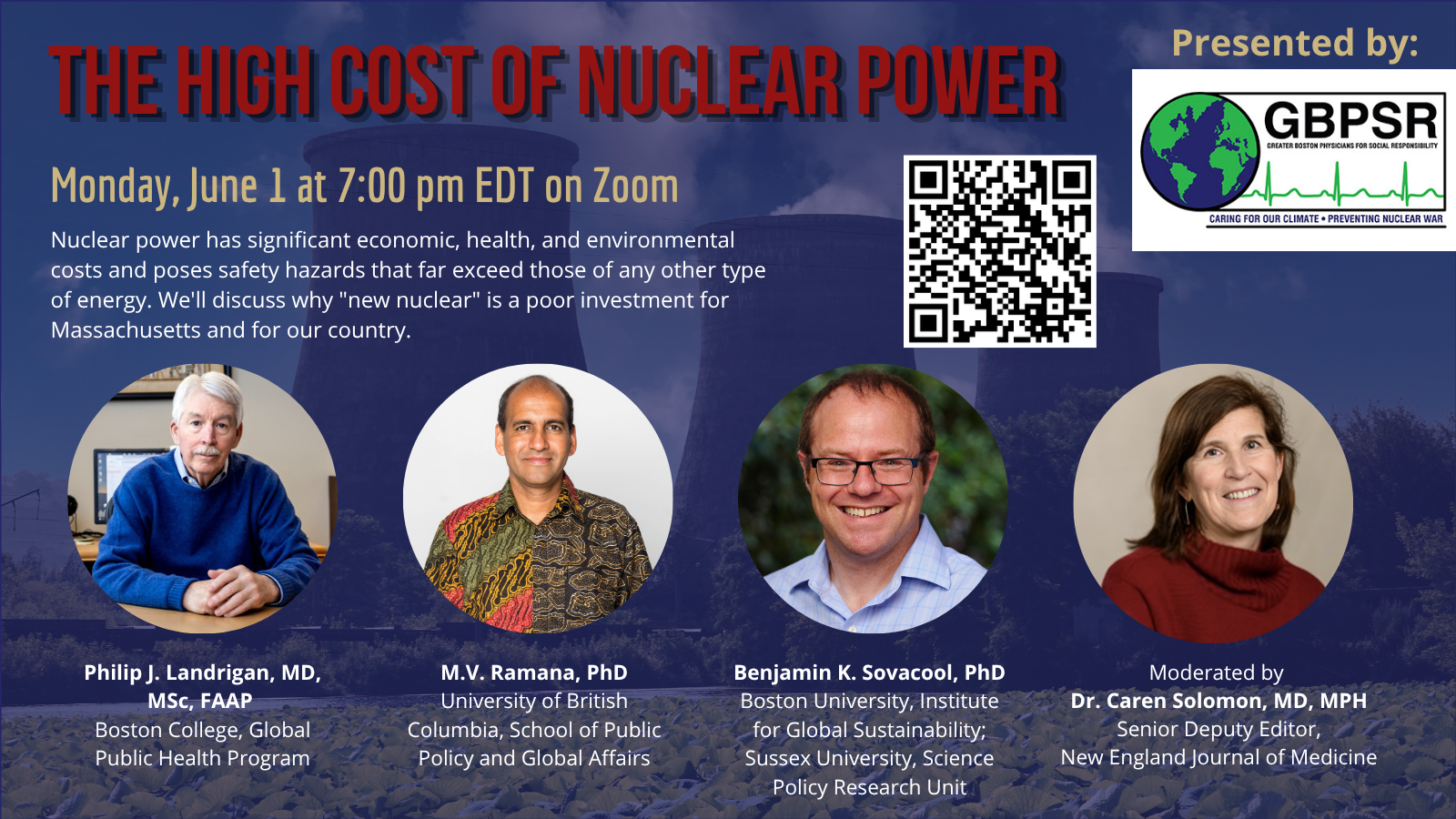
1 June Webinar – The High Cost of Nuclear Power – Register


of the week– Nuclear Reactor Information Task Force
To see nuclear-related stories in greater depth and intensity – go to https://nuclearinformation.wordpress.com
-
Archives
- May 2026 (225)
- April 2026 (356)
- March 2026 (251)
- February 2026 (268)
- January 2026 (308)
- December 2025 (358)
- November 2025 (359)
- October 2025 (376)
- September 2025 (257)
- August 2025 (319)
- July 2025 (230)
- June 2025 (348)
-
Categories
- 1
- 1 NUCLEAR ISSUES
- business and costs
- climate change
- culture and arts
- ENERGY
- environment
- health
- history
- indigenous issues
- Legal
- marketing of nuclear
- media
- opposition to nuclear
- PERSONAL STORIES
- politics
- politics international
- Religion and ethics
- safety
- secrets,lies and civil liberties
- spinbuster
- technology
- Uranium
- wastes
- weapons and war
- Women
- 2 WORLD
- ACTION
- AFRICA
- Atrocities
- AUSTRALIA
- Christina's notes
- Christina's themes
- culture and arts
- Events
- Fuk 2022
- Fuk 2023
- Fukushima 2017
- Fukushima 2018
- fukushima 2019
- Fukushima 2020
- Fukushima 2021
- general
- global warming
- Humour (God we need it)
- Nuclear
- RARE EARTHS
- Reference
- resources – print
- Resources -audiovicual
- Weekly Newsletter
- World
- World Nuclear
- YouTube
-
RSS
Entries RSS
Comments RSS
 nuclear-news